Hose Reels
When it comes to workplace organization, equipment protection, and smoother day-to-day operation, the hose reel is one of the most useful tools in a workshop, garage, plant, or service environment. While it is easy to overlook, the right reel can improve hose management, reduce clutter, and help extend equipment life. This article takes an in-depth look at hose and cord reels, with attention to their design, materials, industrial applications, and the factors buyers often review before selecting a reel for air, water, hydraulic, welding, or power delivery tasks.
At its core, a hose reel is a cylindrical device designed to store hoses and other lengthy materials in an orderly, protected way. Its structure simplifies winding and unwinding, helping create tangle-free, kink-resistant storage while improving access and reducing trip hazards. Hose reels are available in a wide range of materials, with plastic, fiberglass, and metal being the most common. They are manufactured in sizes that fit everything from a light residential garden hose to a heavy duty industrial fire hose. Some reels are also engineered to manage large amounts of rope and cable, and certain models provide a safe path for electric current or data transmission where moving equipment must remain connected.
Hose and cord reels are commonly found in commercial and professional settings, especially in industries such as manufacturing, construction, maintenance, and field service. They also appear in many less obvious environments. Hospitals and emergency vehicles use hose reels to extend equipment and tools while maintaining mobility and order. Automotive shops use them to store exhaust hoses and compressed air lines, while farmers and agriculturists rely on industrial reels for irrigation, fluid transfer, and washdown operations. Food packaging companies also use hose reels to clean large processing areas, sanitize equipment, and manage washdown hoses near production lines, loading zones, and waste collection points.
Hose reels are built to meet the performance demands of many applications. For residential use, smaller hose reels are available to store lighter hoses, such as a standard garden hose or utility line. For larger hoses, such as those used by fire departments, construction crews, service trucks, or industrial cleaning teams, reels are manufactured from stronger materials and in larger sizes to support added hose weight, longer footage, and higher flow demands. In industrial manufacturing settings, hose reels are used for winding hoses as well as cables for arc and gas welding, air and hydraulic tools, lubrication systems, industrial lighting, and other utility functions. Some hose reels are dedicated to transport only, while others combine storage, deployment, and active operation. There are also reels that allow the hose to be used while it remains wound, and retractable hose reels that support self-contained retrieval of the unwound hose to improve workflow, housekeeping, and operator convenience.
Across these different types of hose reels, the shared advantage is easier access, cleaner storage, improved hose protection, and faster retrieval, which is why they remain popular with homeowners, contractors, mechanics, plant engineers, and operations teams.
Hose Reel FAQs
What is the main purpose of a hose reel?
A hose reel is designed to neatly store hoses, cords, or cables by winding them around a cylindrical spool. This helps prevent tangling, limits wear, supports safer housekeeping, and provides organized access for residential, commercial, and industrial use where fast deployment and clean storage both matter.
Where are hose reels commonly used?
Hose reels are used in workshops, factories, farms, hospitals, garages, warehouses, service vehicles, and emergency vehicles. They support applications such as irrigation, fire safety, welding, pneumatic tools, washdown cleaning, lubrication, and equipment maintenance in industrial and commercial facilities.
What materials are hose reels made from?
Hose reels can be made from plastic, fiberglass, or metals such as steel, aluminum, or stainless steel. Industrial and outdoor reels often use corrosion-resistant materials so they can withstand repeated use, moisture, temperature swings, chemicals, and demanding plant or field conditions.
What types of hose reels are available for industrial applications?
Industrial options include air hose reels, welding reels, retractable reels, high-pressure reels, water hose reels, electric-powered reels, and truck-mounted reels. These models are built to manage longer hose lengths, higher flow or pressure requirements, and repetitive use in manufacturing, construction, and maintenance operations.
How do automatic or retractable hose reels work?
Automatic and retractable hose reels use spring-driven, powered, or pressure-assisted mechanisms to rewind hoses after use. This self-retraction saves time, helps improve safety, and keeps hoses organized in busy settings such as garages, production floors, assembly areas, and mobile service bays.
How should a hose reel be installed and maintained?
Follow manufacturer instructions to mount hose reels securely using proper hardware and load-rated supports. Keep reels dry when required, wind hoses neatly after use, and inspect moving parts, guide arms, latches, springs, and swivels regularly to maintain safe, efficient performance.
What factors should be considered when selecting a hose reel?
When choosing a hose reel, consider the hose type, pressure rating, inner diameter, hose length, mounting method, duty cycle, and the surrounding environment. Matching those factors helps support reliable performance whether the reel is used for air, water, oil, grease, welding cable, or electrical applications.
The History of Hose Reels
The concept of the hose reel dates back to 17th-century Holland, where inventors were focused on improving the fire hose and making it more practical to transport and deploy. After much experimentation, they created a design that worked well, although early hoses were heavy and cumbersome. To manage that weight, specialized drums were used to transport the hoses. Over time, the design of these drums changed, and hose reels emerged as a more practical, built-in solution for fire trucks and other response equipment. As ideas and technologies spread, the hose reel became a widely adopted tool in both public safety and industrial settings.
With the onset of the Industrial Revolution in the 18th century, new materials and manufacturing methods became available, which helped reduce the weight of the fire hose and improve reel construction. As a result, the design of the fire hose reel also evolved. The familiar spool shape became the standard because it offered better storage, smoother payout, and more dependable support for hose weight and repeated handling. As hose and cable reels became more common, their flexibility across industries became even more evident. With rapid technological development, hose reels were mass-produced, and although size, materials, mounting style, and rewind method changed based on application, the core idea and function of the hose reel remained the same.
Benefits and Advantages of Hose Reels
Hose reels offer major advantages in maintaining an organized, efficient, and safer workplace. By keeping hoses and cables neatly wound and off the floor, they reduce the risk of accidents, snags, and tripping hazards in busy work areas. Their design helps distribute hose weight more evenly, which limits tangling and kinking and can reduce the wear that often occurs when hoses and cables are stored loosely on the floor or piled together without support.
These reels are also highly versatile. They can be mounted on a wall in smaller work areas, suspended overhead for better reach, installed on a pivot base for wider coverage, or placed on a reel cart for easier mobility. Their compact footprint allows them to fit into many workspaces without consuming excess floor area. Because hose reels can be configured for different hose sizes, media types, and retraction methods, they can be tailored to the performance needs of specific jobs while also improving daily convenience.
Additionally, hose reels can help reduce loss and misuse by keeping hoses and cables secured in one location. They also improve workflow by eliminating the time wasted searching for scattered lines or untangling damaged hose. For buyers comparing storage options, this combination of hose protection, cleaner work areas, quicker access, and improved operational consistency often makes a hose reel a smart long-term investment.
Design of Reels
Designing Hose Reels
As previously mentioned, the earliest hose reel designs were large metal drums or rods of uniform width. As hoses and cables became lighter, more specialized, and more common in homes and industry, the design of the reel changed as well. The original bulky setup was streamlined into the large spool shape that is still widely used today because it supports efficient winding, cleaner storage, and better control during payout and retrieval.
At its core, a hose or cord reel is designed to wrap its contents around a sturdy center, much like thread is wrapped around a spool. The design features a narrower center with two larger barriers on either end, which helps keep the contents secure, organized, and easier to handle. The specific details of a reel can vary based on the user’s application. For example, some hose reels feature a spring-driven mechanism for self-retraction, while others use a manual hand crank or motor to retract the contents. Buyers often compare manual, spring-driven, and powered reels based on hose length, frequency of use, operator effort, and the need for repeatable retrieval in high-traffic work areas.
Hose Reel Materials
The materials used in the construction of hose reels directly affect durability, corrosion resistance, weight capacity, and service life. For basic applications, such as a garden hose or an extension cord, a simple plastic body may be affordable and functional. However, for longer hose lengths or more industrial applications, manufacturers must ensure the reel can support the weight of the industrial hose and hold up under the surrounding operating conditions. For reels used in harsh outdoor or washdown environments, weather-resistant materials and anti-corrosion metals are often preferred. Fiberglass and stainless steel are popular choices because they offer durability, resistance to scratching, and the ability to handle temperature changes, moisture exposure, and frequent use.
Specific applications may require particular materials; for example, medical cord reels are often made from sanitary-grade materials, such as 304L stainless steel, while industrial reels typically use heavy-duty metals like stainless steel, steel, or aluminum for a balance of corrosion resistance, strength, and long-term durability. Material selection becomes even more important when reels are exposed to chemicals, outdoor weather, washdown cycles, or repetitive mechanical stress.
Customizing Hose Reels
Customization of hose and cable reels can be useful for buyers seeking a solution that fits a particular workspace, vehicle layout, or equipment process. If building or modifying a reel by hand, material choices are broad, provided the selected materials can handle weight, motion, and usage demands. Customization options may include swapping handles or cranks, changing brackets or mounting methods, engraving the surface, or painting the reel to match a company vehicle, service bay, or personal workspace.
Hose Reel Images, Diagrams and Visual Concepts
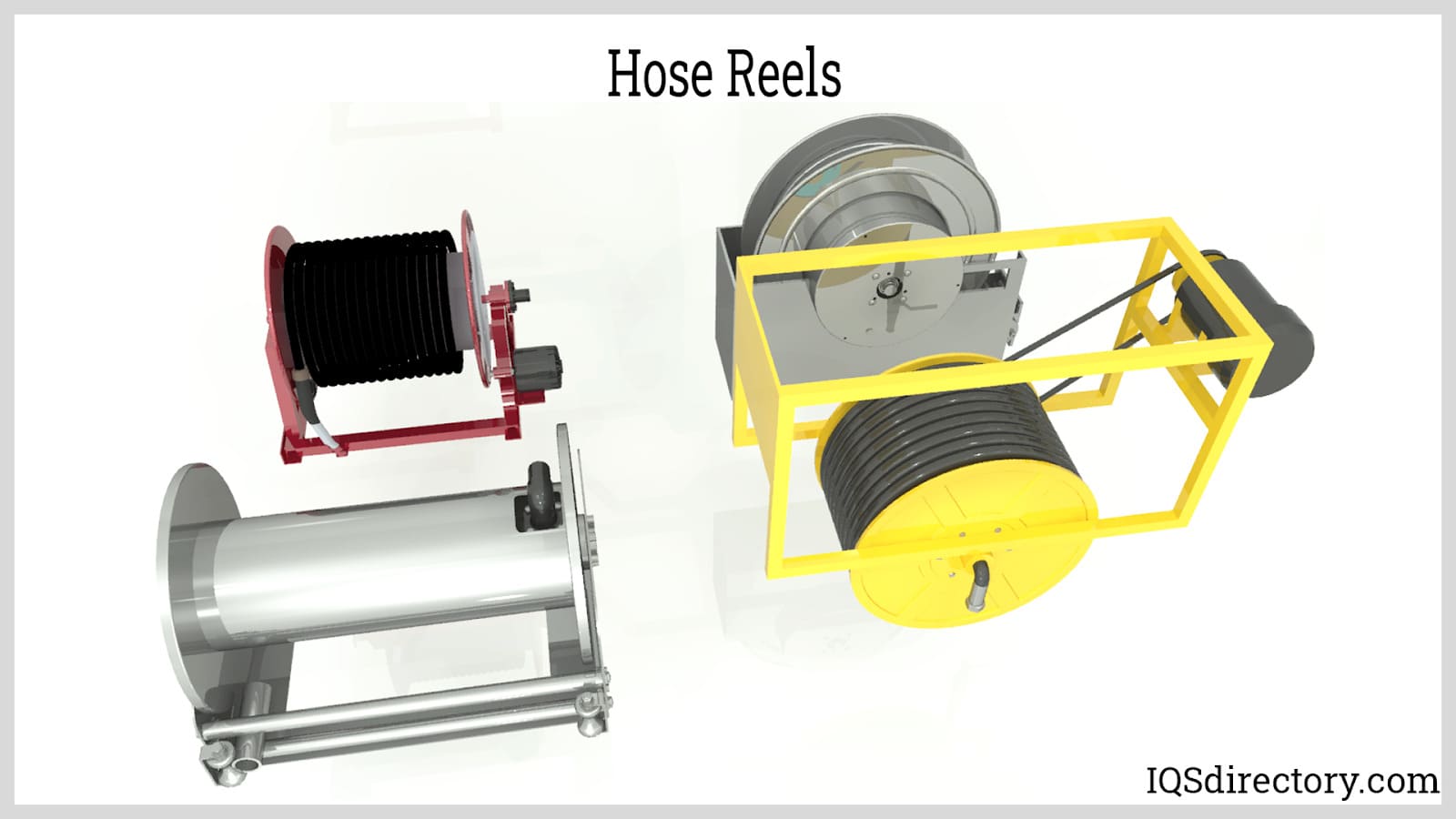
Hose reel mechanisms are used for the storage, deployment, and management of hose on a barrel-style spool designed to make hoses, cords, flexible tubing, or wire easier to access, organize, and protect during everyday use.
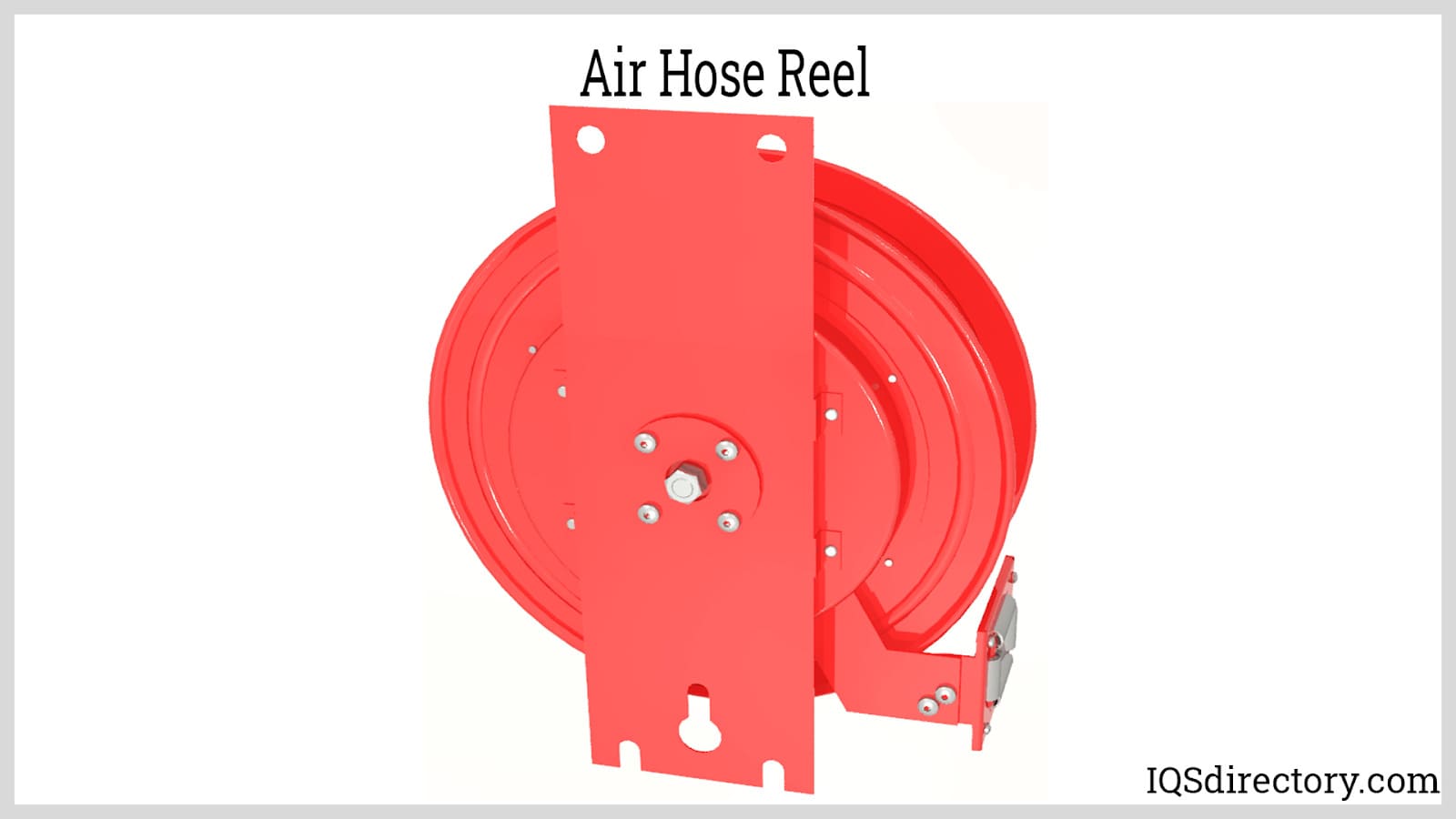
Air hose reels are connected to an air compressor, with the hose wound around the reel; to reduce extra wear on the hose and improve access, many are suspended from the ceiling or mounted overhead in service areas.
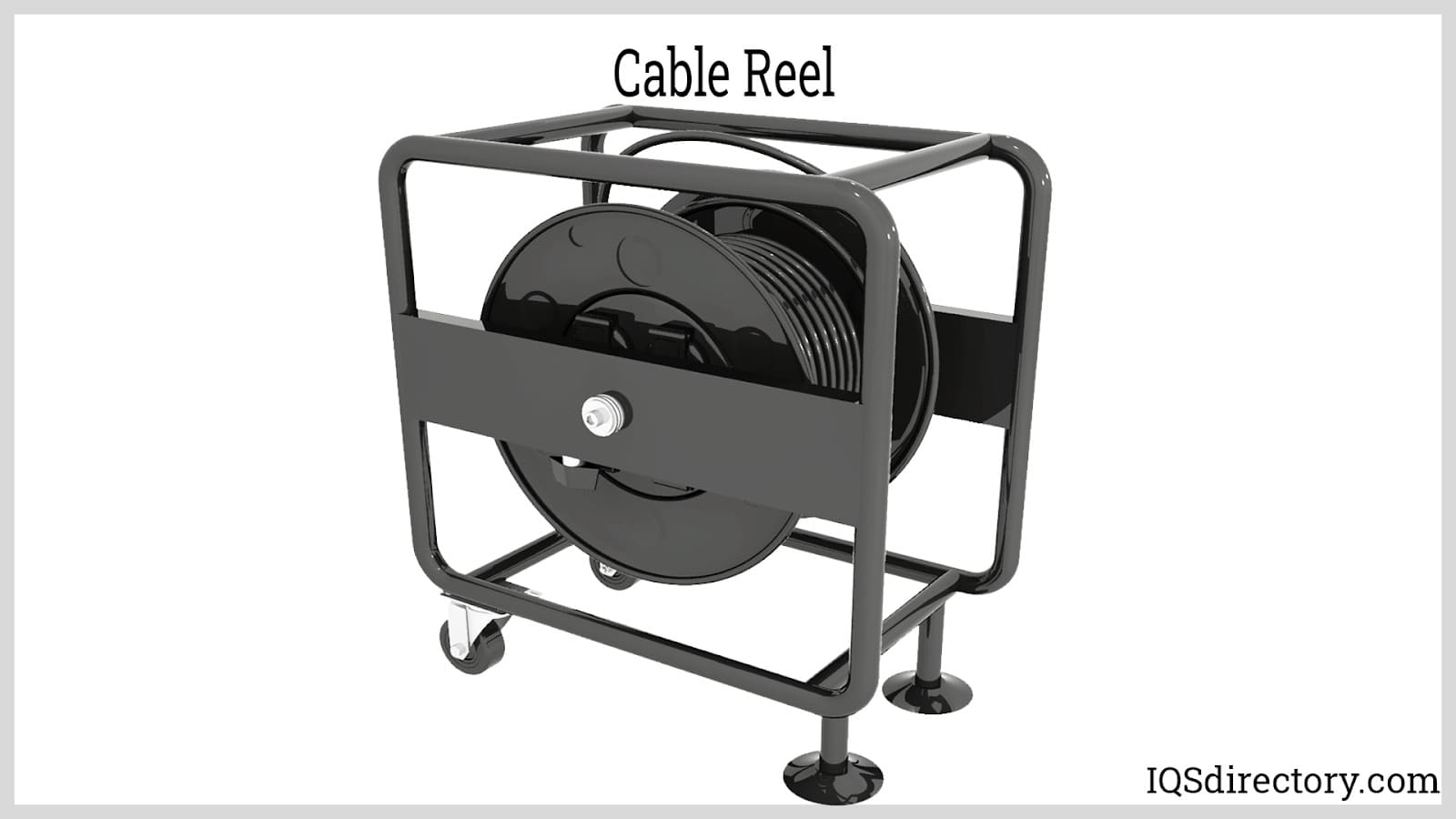
Cable reels hold conductive cable or lifting cable for storage, controlled unwinding, and rewinding, making them useful where power delivery, motion, and cable protection all need to work together.
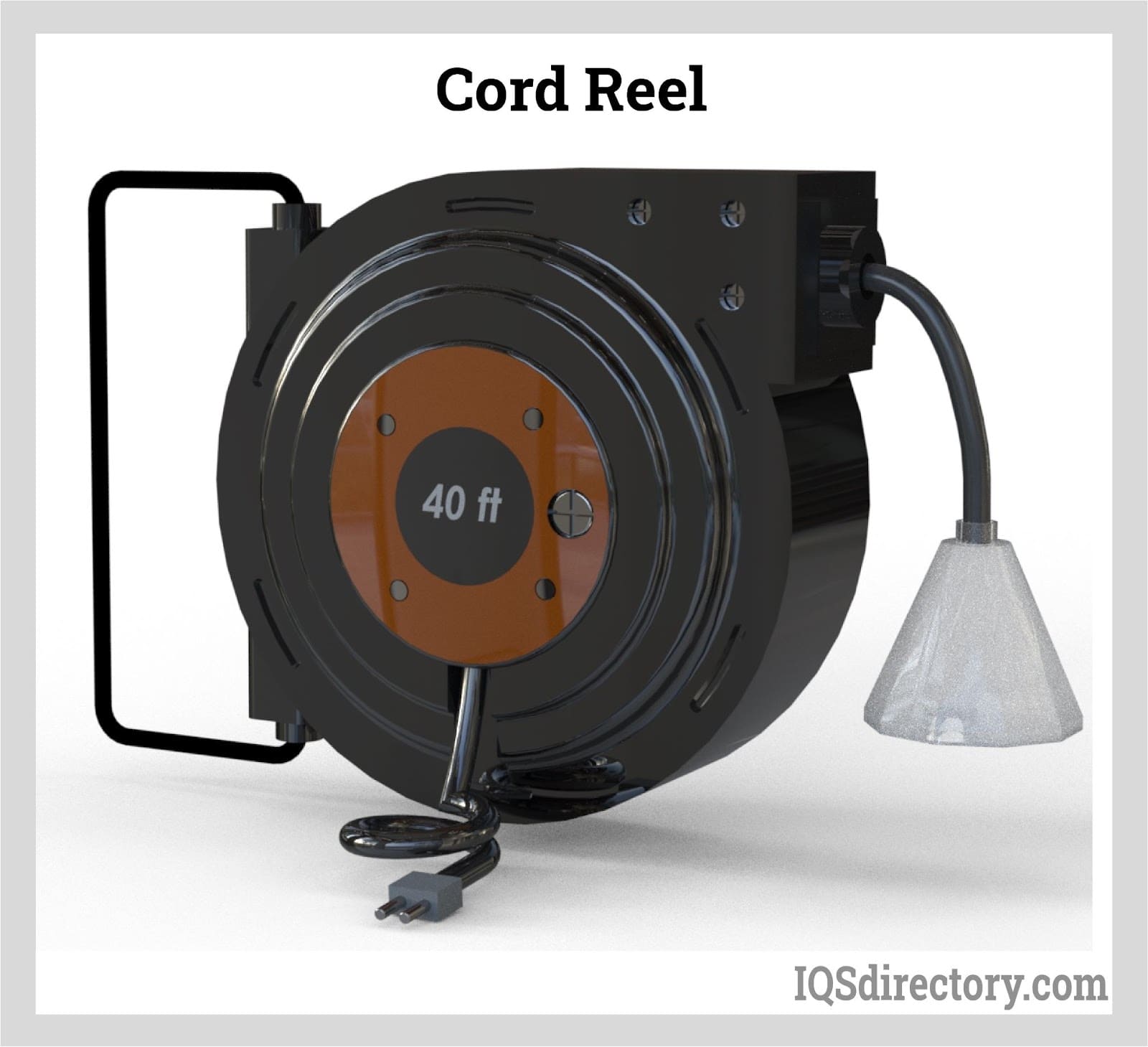
Cord reels hold extension cords used to supply power to electrical equipment or devices, helping prevent cable clutter while keeping portable tools or moving equipment connected.
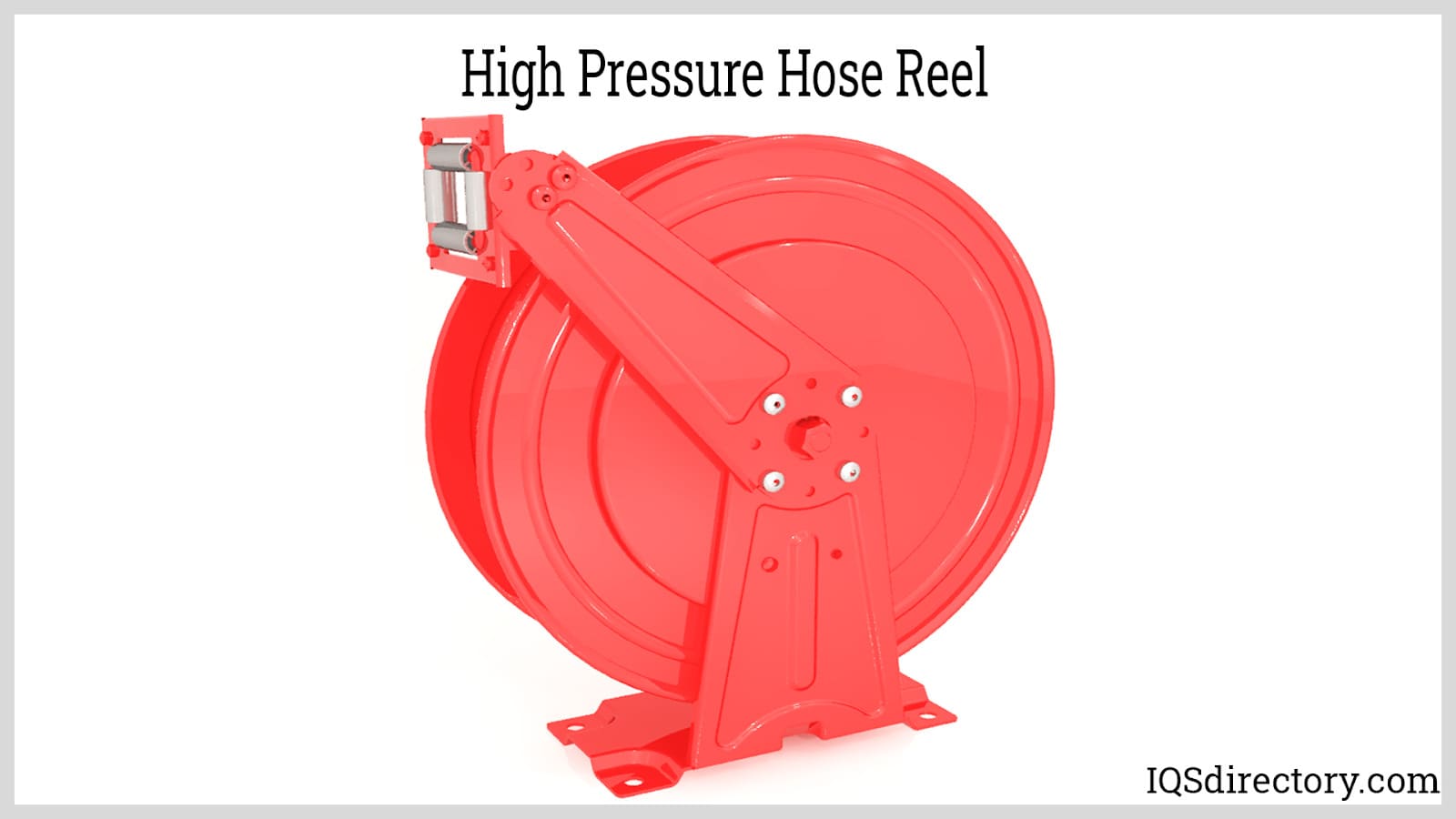
High pressure hose reels help prevent hoses from kinking, tangling, or becoming damaged, issues that can interfere with pressure delivery and shorten hose service life in demanding operations.
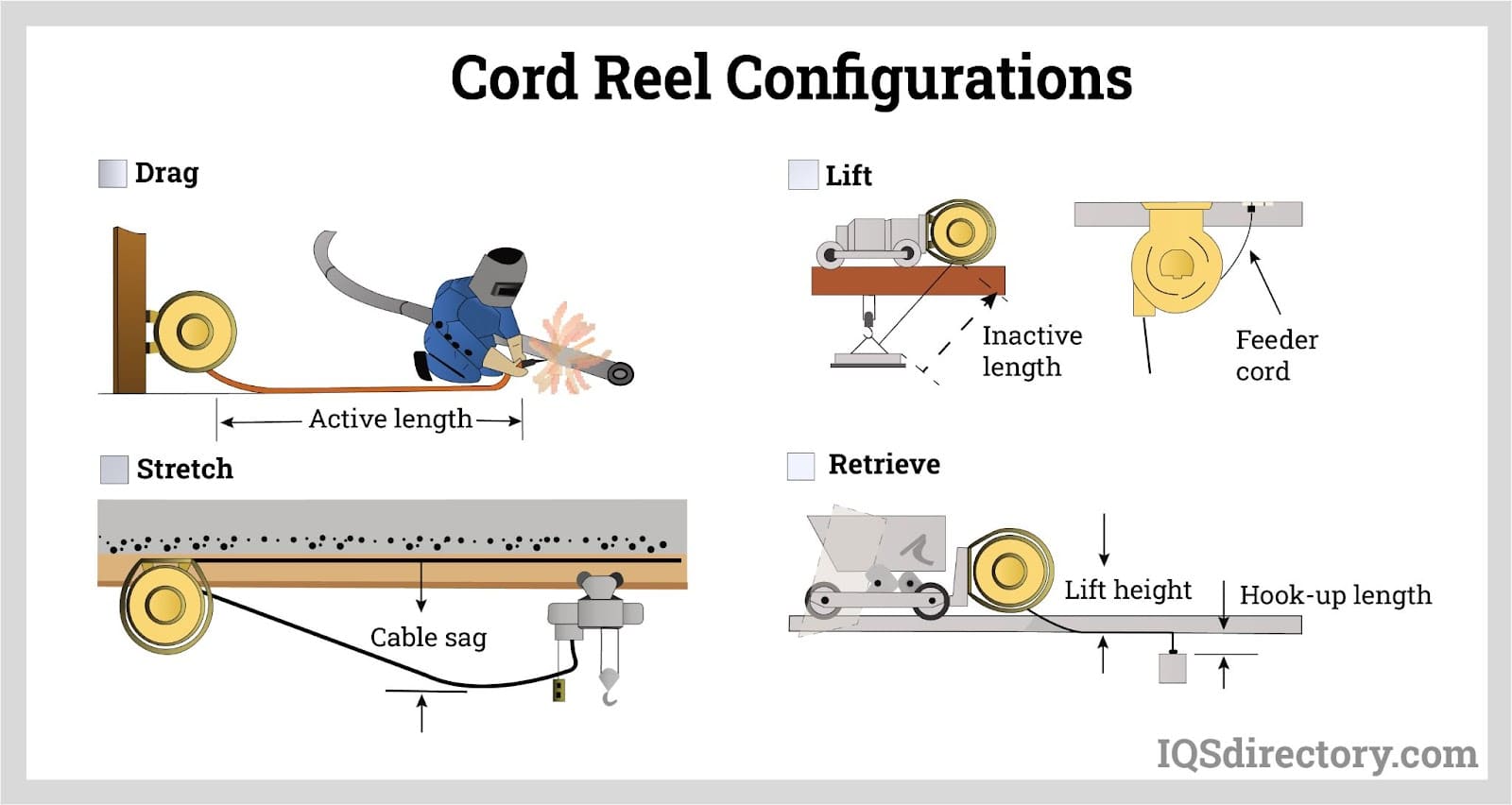
Installation arrangements of cord reels vary based on use, including lift, drag, stretch, retrieve, and vertical pickup applications, with each setup affecting cable travel, reel placement, and operator access.
Hose Reel Types
Air Hose Reels
Designed specifically to store air hoses, typically of small diameter, these compact reels are ideal for keeping air hoses organized, protected, and easy to access in garages, maintenance bays, assembly areas, and compressed-air workstations.
Automatic Hose Reels
These reels automatically retrieve the hose using batteries, electricity, or water/air pressure, offering convenience, reduced operator effort, and faster hose management in settings where lines are deployed repeatedly throughout the day.
Cable Carriers
Made up of a series of flexible links, cable carriers are used to organize and house conduits such as cables, hoses, and chains, providing a streamlined method for managing movement while reducing wear from abrasion and uncontrolled bending.
Cable Reels
These reels are built to store cables for electrical or industrial use. They consist of linked parts designed to hold and organize materials such as cables, ropes, chains, and hoses, making them useful where orderly payout and protection matter.
Cord Reels
Cord reels are used to store, extend, and automatically rewind electrical cables, often supplying power to mobile machinery or portable equipment from a stationary power source without leaving excess cable on the floor.
Electric Reels
Utilizing electric power to wind and unwind hoses, electric reels are well suited for applications where heavier hoses must be moved often, such as refueling, washdown, utility service, or other operations that benefit from powered retrieval.
Extension Reels
A cylindrical device designed to keep electrical cords organized, extension reels are often used to supply power to tools in environments where equipment is frequently moved and where neat, repeatable cable handling improves efficiency.
Fire Hose Reels
These reels provide easy access to a water supply for fire protection, offering a larger-response option than handheld extinguishers in many settings. They are commonly found in high-risk areas such as large schools, warehouses, factories, and industrial facilities.
High Pressure Hose Reels
Built to handle pressurized hoses, high-pressure hose reels are used in industrial processing, cleaning, washdown, and manufacturing operations to store and manage pressurized air and water hoses without sacrificing control or durability.
Industrial Reels
These reels are used in applications requiring high product flow, longer hose lengths, or heavier duty cycles, making them a common choice for plant operations, commercial maintenance, and other demanding industrial settings.
Medical Cord Reels
Used in medical environments, these reels store and rewind conductive cords or lifting cords that power mobile medical equipment such as crash carts while maintaining a clean, controlled connection to a stationary power source.
Phone Cord Reels
Self-retracting reels designed for telephone cords allow for simple storage in small, portable containers and illustrate how reel technology can be scaled for lighter-duty communication applications.
Retractable Hose Reels
Equipped with cranks or internal retrieval systems, these reels allow for easier retraction and storage of hoses, keeping them neat, reducing manual handling, and supporting better space management in active work zones.
Spring Reels
Driven by a spring mechanism, these reels are suited for a variety of applications in agriculture, commercial facilities, workshops, greenhouses, and other operations that require repeated hose or cord payout with simple retraction.
Static Discharge Reels
Used to ground equipment in hazardous environments, these reels help prevent static electrical buildup, reducing the risk of sparking and improving safety in fueling, chemical handling, and other sensitive operations.
Truck Mounted Reels
These reels are designed for attachment to trucks or vans, with types that include air hose reels, static grounding reels, and water hose reels. They are commonly used on service trucks, mechanics’ trucks, utility vehicles, and mobile maintenance fleets.
Water Hose Reels
Cylindrical cranks designed to wind water hoses manually or mechanically, these reels keep hoses organized, protected, and ready for irrigation, cleanup, washdown, and other water-transfer tasks.
Welding Reels
Welding reels support smoother operation by providing controlled access to welding cables and hoses. They are often engineered from durable materials and hard-coated surfaces to improve longevity in fabrication, repair, and industrial welding environments.
Reel Features
One of the most valuable features of a hose reel is its mobility and placement flexibility. While many hose reels can be mounted securely on a wall, there are situations where it is more useful to let the reel move freely or cover a larger range. Reels can be suspended from the ceiling to provide access from multiple angles, and in industrial settings, they can be mounted on carts, trucks, or service vehicles for transportation and greater versatility. Buyers often compare mounting style, swing range, and reel placement when deciding how the reel will support workflow.
Installation and Product Care for Hose Reels
When using a mounted hose reel, it is wise to follow the manufacturer’s instructions so the reel is securely attached to the wall or support structure. The instruction manual typically specifies the correct fasteners, anchors, or screws required for mounting. Avoid using tape or glue, even for lighter reels, because improper mounting can cause the reel to fall and damage nearby equipment. For portable hose reels, make sure they are safely positioned on their cart or wagon, with the weight distributed evenly to help prevent tipping. If the reel is made from materials that may rust or corrode, store it in a dry, cool location indoors when possible.
Proper storage and care help maintain the performance and longevity of a hose reel. When using a hand crank, always wind the hose fully back into place. Leaving the hose on the ground defeats the purpose of the reel and can create a tripping hazard or expose the hose to unnecessary wear. For spring reels, pull the cord with a firm, controlled motion and lock it securely when the desired amount has been extended. Avoid swinging the cord while attached to the reel, and do not pull too forcefully, as that can damage the hose, latch, or cord connection.
Automatic reels should not be left unattended during winding. Make sure the hose or cord is laid out untangled before retraction begins so the reel can wind smoothly and evenly. If the reel has adjustable settings, check them before use. When not in use, store the reel in its designated area or move it clear of workplace traffic so aisles, production zones, and service paths remain open and orderly.
What to Consider When Choosing a Hose Reel
Before purchasing a hose reel, buyers should consider the full application rather than the reel alone. One of the first factors is the type of medium the hose will carry. For air, especially in pneumatic tools, it is important to determine the required pounds per square inch (psi) the hose must handle. Hoses used for oil, grease, water, chemicals, or lubricants also require matching the reel to the proper psi range and compatibility requirements. For applications that demand more torque or higher flow, the inner diameter (ID) of the hose becomes important, since higher-demand applications often require larger ID hoses. For cord reels, it is helpful to evaluate the cable type, length, conductor count, wire size, voltage requirements, and whether the reel will be mounted on a wall, ceiling, cart, truck, or machine frame.
Besides choosing the wrong reel for the job, there are other common reasons hose reels may fail. For example, if a spring hose reel is not properly sealed and remains exposed to the atmosphere, the internal spring can rust and eventually break. In addition, selecting the wrong materials for parts—such as thin sheet metal or cast aluminum for a latching mechanism in a high-cycle application—can shorten product life. Buyers comparing industrial hose reels often review sealing, spring protection, finish quality, latch durability, swivel design, and load handling before making a decision.
It is also helpful not to confuse a respected manufacturer with the right manufacturer for a particular job. Strong reviews and broad market presence are useful, but they do not guarantee a reel will match your exact hose size, pressure requirements, mount location, or usage cycle. If possible, inspect the equipment in person or review dimensional and performance details carefully so the reel fits the intended application before purchase.
Hose Reel Terms
Ball Stop
Also known as a "hose" or "bumper" stop, this component is used to control the retraction length. Ball stops are often needed when accessories such as drills, blow guns, or air tools are installed on hose reels and a controlled stopping point is preferred.
Bracket
A simple L-shaped component, with one arm fixed to a vertical surface such as a wall, while the other arm extends horizontally to support the hose reel and maintain proper positioning.
Bridge
A device placed over a section of hose to allow traffic to pass over it without damaging the hose, often used in warehouses, service areas, and maintenance zones.
Carcass
The fabric, cord, and/or metal reinforcing section of a hose, distinct from the tube or cover, that contributes to hose strength and pressure performance.
Core Diameter
The diameter of the inside of the reel, a measurement that affects bend radius, hose storage, and the reel’s ability to handle specific hose types.
Coupling
A fitting attached to the end of a hose to connect two hose lines together or to link the hose to appliances, nozzles, discharge valves, hydrants, or other equipment.
Cover
The outermost part of the hose that protects the reinforcement from physical wear, abrasion, weather, and environmental exposure.
Fairlead
A square hose guide that helps direct the hose during payout and retraction so winding remains more orderly and controlled.
Guide Arm
A piece that typically extends from the side of the hose reel. Its purpose is to guide the hose in a straighter line, helping prevent tangling and improving retrieval.
Lift Height
The vertical distance measured from where the hose is positioned to the centerline of the spool, an important dimension when planning reel placement.
Pivot Base
A base that allows the hose reel to turn in multiple directions, expanding the working range and helping the hose follow the operator more naturally.
Pressure Rating
The maximum pressure capacity of a hose or cord. For air and water hoses, it is measured in pounds per square inch (psi), and for electrical cables and power cords, it is measured in voltage (V).
Ratchet
A mechanism that holds the hose reel spool in place at selected points during payout so the hose stays at the desired working length.
Reel Capacity
The maximum length of hose that a reel can efficiently store, usually expressed in feet, and one of the main factors to check during product selection.
Reinforcement
The central component of a hose that provides its strength. The hose’s working pressure depends on the type and amount of reinforcement used in its construction.
Safety Wrap
The portion of the hose that remains on the reel when the rest has been completely unwound, helping maintain a safer connection point and reducing strain on the reel.
Slip Rings
A device that maintains an electrical connection between a stationary structure and a rotating structure, used in systems that require power or data transmission while allowing rotation.
Spool Axial
The device around which the hose or wiring is wound. It rotates with the swivel to load and unload the hose or cable during operation.
Swivel
A supported pivot that allows the hose reel to rotate in a horizontal plane, supporting winding and unwinding motion while transferring gas or fluid from a fixed source to a rotating source.
Tie Rod
A component that helps ensure the spool flanges remain securely attached to the drum, preserving structural rigidity during use.
More Hose Reels