Water Jet Cutting
Water jet cutting allows manufacturers, artists, lumber-based workers and a variety of others the ability to shape or modify materials such as plastics, ceramics, and stainless steel.
Quick links to Water Jet Cutting Information
History of Water Jet Cutting
Water jet cutting was initially used as a technique to quickly rinse away rocks and loose coal from mining projects in New Zealand and South Africa in the 19th century. This was partially instigated out of safety concerns. By using this technique, a miner could eradicate debris and unwanted obstacles while standing far enough away to avoid ricochets or other safety hazards. In the 20th century, water jet cutting became a preferred method for Russians in the 1930s who wanted to cut large rocks without using traditional tools. These initial forays into the technology used water cannons with 7,000 bars of pressure. In the 1970s, the United States developed cutters with 40,000 bars of pressure by combining the water jet with a drill. Later, industrial designers discovered that by adding sand to the water, they could create custom finishes on the materials.
Advantages of Water Jet Cutting
Unlike plasma, laser, or blade-based cutting, water jet cutting offers all the precision of a high intensity, heat-based cutting process without any of the corresponding defects. A variety of materials can be modified and shaped with water jet cutting with no need for secondary processing. This is because there is no heat involved in the process, only high pressure. Heat-based cutting tends to warp the materials slightly, while blade-based cutting can leave behind small burrs or other irregularities that must be carefully removed. The removal of these heat-affected zones adds expense to the cutting process. Water jet cutters are capable of cutting many different kinds of materials and involve minimal setup time. They can efficiently accommodate product runs of all sizes (including prototype runs) and can be configured with multiple heads working simultaneously to increase output.
Design of Water Jet Cutting
Today, cutters have a pressure ranging between 30,000 and 120,000 pounds per square inch, or PSI. Materials such as glass and ceramics may shatter at the higher end of this range, which is why the lower pressure water jet cutters are generally used for the modification of brittle materials. A CNC, or computer numerical control system, is used to control both the pressure and specific movement of the water jet cutter.
Materials Used in Water Jet Cutting
Some materials are not appropriate for water jet cutting processes. Some glass compositions and thicknesses are too vulnerable to becoming shattered when exposed to water jets, and some ceramics are similarly vulnerable to damage when subject to water jets. On the opposite end of the hardness spectrum, diamond and certain metals can be too hard to be cut with water jets. Moisture-sensitive materials and hydrophobic elements are obviously also not suited to water jet cutting, but aside from these limitations, water jet cutting is an extremely effective, efficient and versatile cutting and machining process. Water jet metal cutting is considered to be one of the strongest forms of jet cuts, as it can shape virtually any material, including steel and sheet metal.
Water Jet Cutting Process
One of the reasons for water jet cutting processes’ high effectiveness and efficiency is that nearly all water jet processing methods are managed by computer numerical control systems. Another reason for the high efficiency of water jet cutting systems is their capacity for materials reclamation. Most of the water and abrasive media expelled from water jet nozzles can be reclaimed and re-circulated, minimizing water and media consumption. The recycling of water and abrasive media reduces the amount of investment in materials costs and increases the sustainability of the process. Professionals interested in reducing the environmental impact of their operations can appreciate the low energy-intensiveness and high efficiency of water jet cutting. Also, because materials costs are low, companies can invest the materials expenses they have saved in equipment maintenance, new equipment and raw materials.
Compared to other cutting and machining methods, water jet cutting presents few threats to workplace safety. It produces no noxious gases or liquids, as can be the case with hot cutting methods like laser and plasma cutting. It also produces no sparks or flying debris, which further reduces the number of hazards compared to other cutting processes. The only substantial threat to workplace safety present in water jet cutting is noise; high-pressure water jet cutting in particular can be quite loud. However, this issue is easily addressed by sound-proofing the cutting workspace and issuing personal ear protection to employees. Minimal safety hazards, the absence of dangerous byproducts and low heat levels allow water jet cutting operations to continue without interruption for as long as 20 hours, further contributing to high output and efficiency.
Industrial equipment manufacturers, the aerospace industry, the automotive industry, food processors, and the communication industry regularly employ water jet cutters to create precise objects out of strong or heat-sensitive materials. Water jet cutting is often used on thermoplastics, which are notorious for their sensitivity to heat. During the jet cut, the thermoplastic object will not discolor or deform beyond the specific site where modifications are desired. For wood, the cut service allows timber to be custom etched and shaped to client specifications, making it possible to create custom furnishings, construction materials, and products such as drawer handles, utensils, and keepsake boxes. In the food industry, water jet cutting offers a clean and safe way to rapidly process large orders of food. This is ideal for makers of packaged delicacies such as bento boxes, or specialized vendors of sausage or noodles. For artists, the specificity of jet cuts makes it possible to create nuanced and often very complex replicas of characters or designs for merchandising purposes. The exact duplication of these designs creates a uniformity and degree of precision that can rarely be matched elsewhere, even by a studio of trained artists.
Machinery Used for Water Jet Cutting
As machining processes go, water cutting is relatively simple. The basic equipment consists of a nozzle, sometimes referred to as a focusing or mixing tube, that pushes water through small apertures. To prevent splashing, the nozzle is equipped with a muff, which is a sponge or brush. The mixing tube will have high pressure fittings with weep holes in the side, which allow for the safe dispersal of water in case of a leak. An attenuator is responsible for keeping the water output pressure sustainable, as some pumps can vary their pressure.
The water used in the process can be pure, or small particles can be introduced into the water in order to increase the strength of the cut. The speed of the added particles is referred to as an abrasive flow rate, while the particles themselves are referred to as abrasive substances. The thickness and number of these particles in a given stream is referred to as a mesh. The most complicated part of the machinery is the CNC, which controls the movements of the cutter. This is usually an electronic device, and the software used to program it varies depending on the specific installation. Many cutters use a mixture of programs that are similar to CAD/CAM, as well as elements of nesting and scanning. Once programmed, the water jet executes a path that cuts at a resolution of 2,000 points per inch. The type of apertures, the spacing of those apertures, as well as the specific material that the apertures are made of, also vary. The apertures are often referred to as jewels, and are often made of diamond, sapphire or ruby.
Stainless steel is also common as a material for the nozzle or supply device. A secured holding or catch tank or other protected area to help retain water and debris is also traditionally a part of the operation. The process can be customized depending on the size of the apertures, the pressure of the water, the specific materials or objects being cut, and the sophistication of the CNC.
Water Jet Cutting Images, Diagrams and Visual Concepts
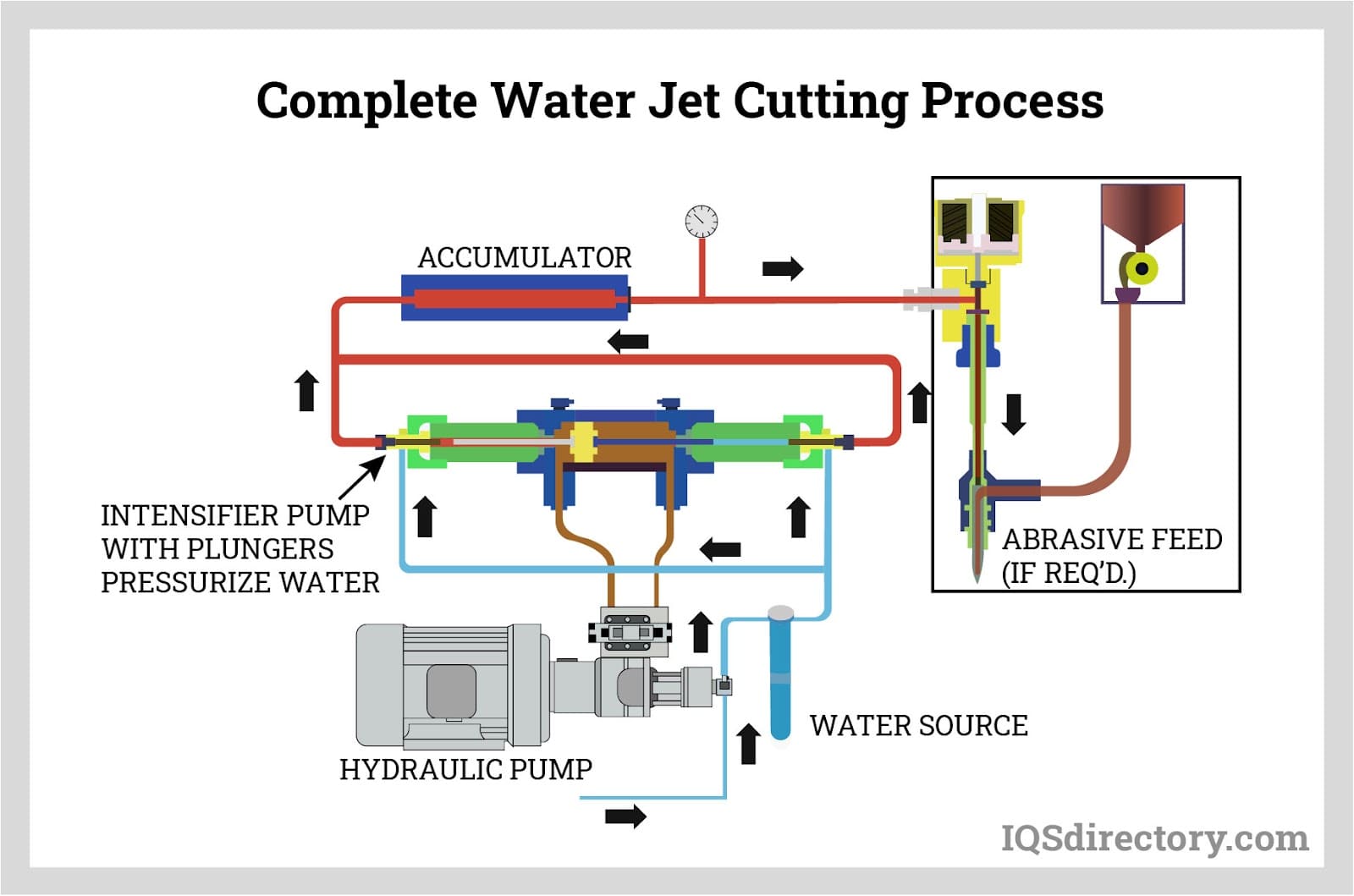 Water jet cutting, a manufacturing process using high pressure jets of water provided by pressurizing pumps to deliver a supersonic stream of water to shape various materials.
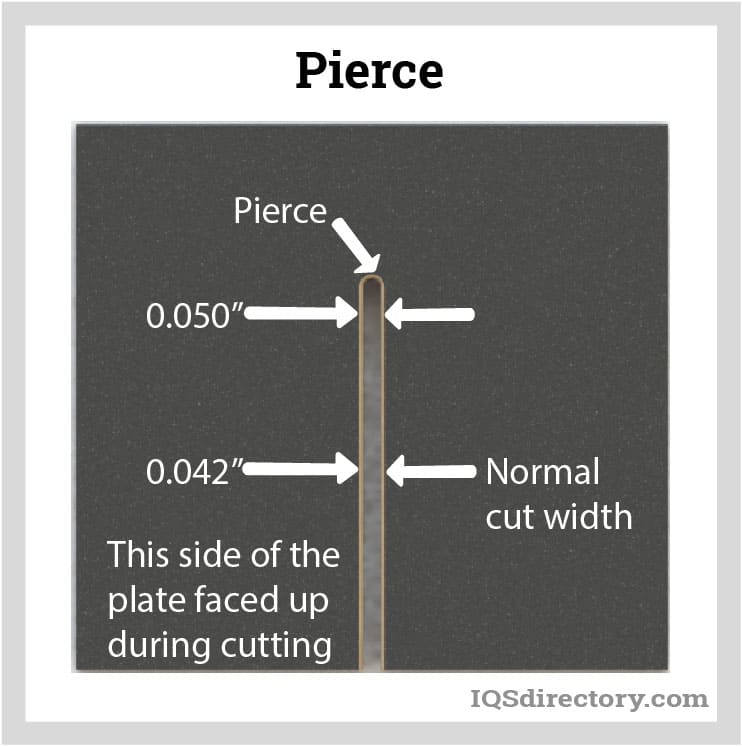 The initial cut is the pierce.
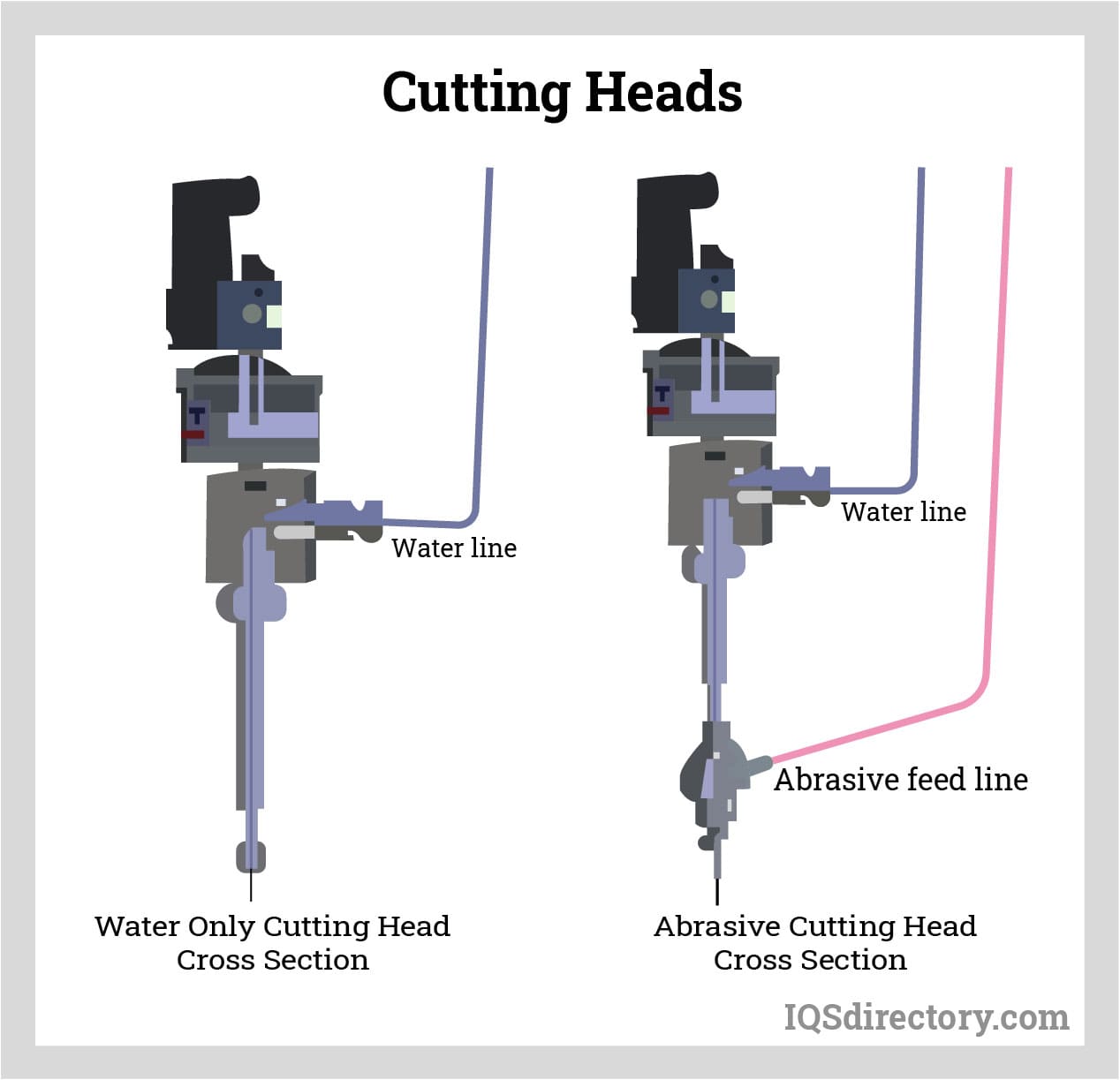 The pressurized water passes through the orifice of the cutting head with a hole smaller than the point of a pin and as water passes through, its velocity radically increases to over 90,000 psi.
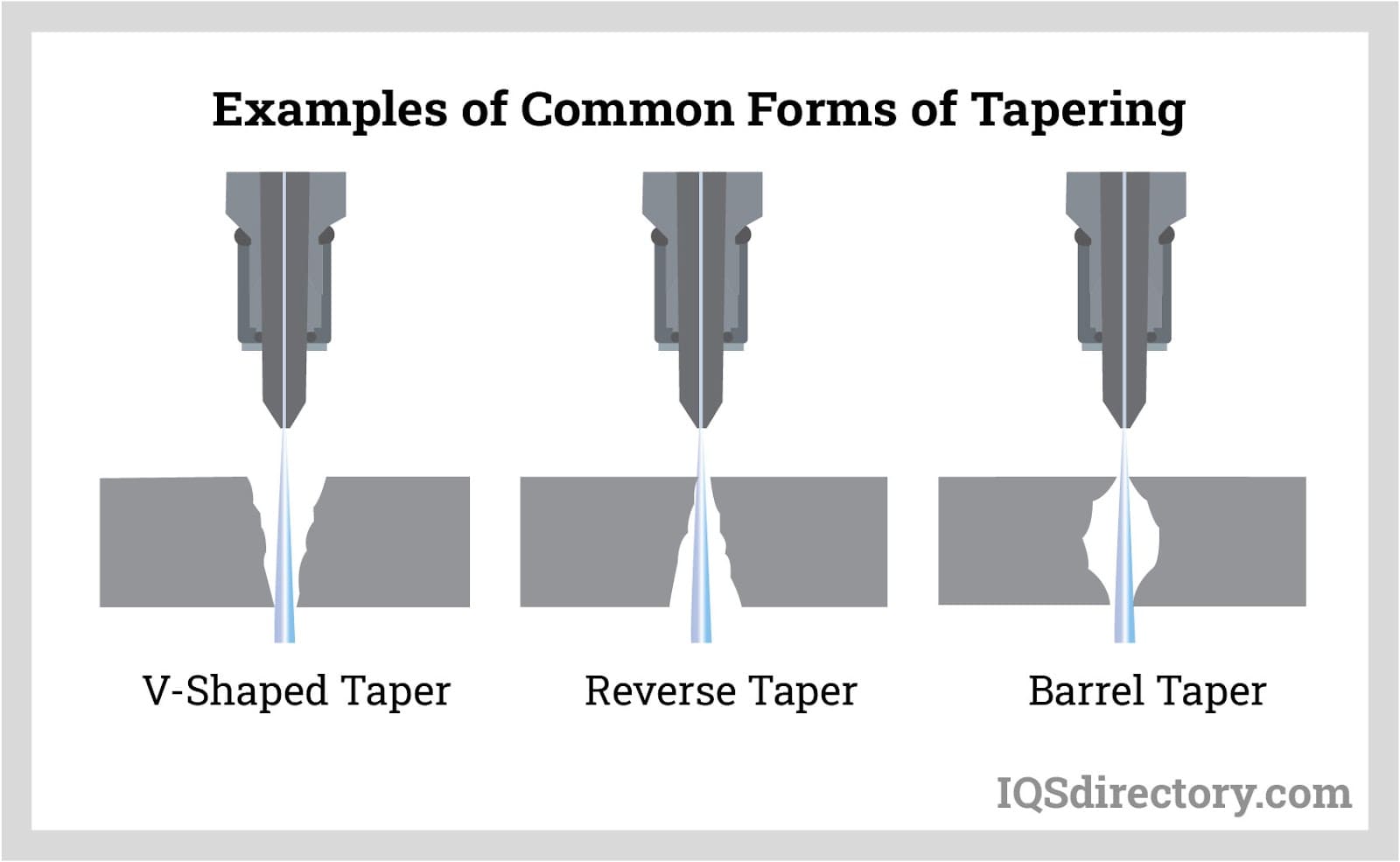 Examples of the different forms of tapering used in water jet cutting.
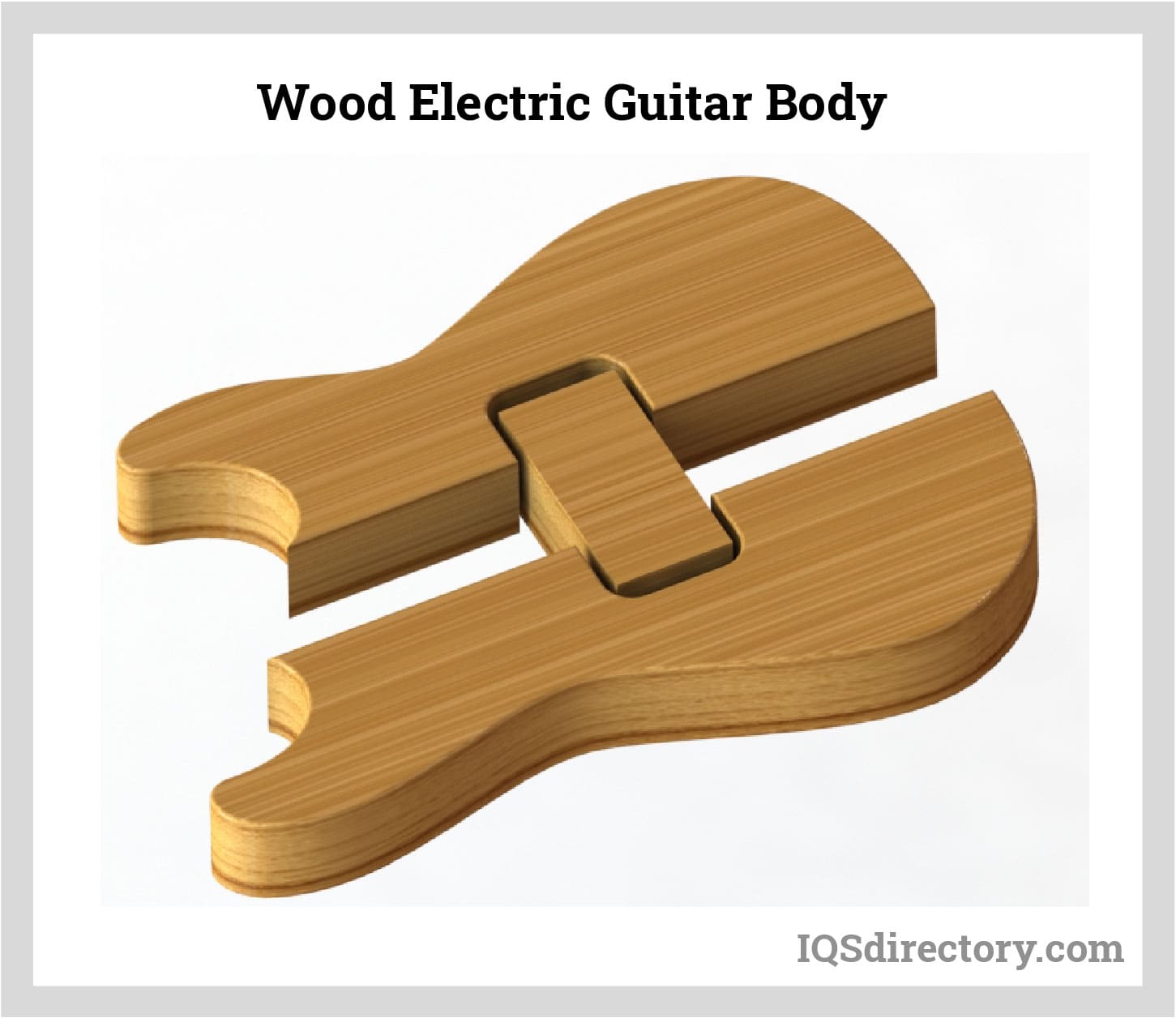 Since water jet cutting does not place a load on the piece, it is capable of cutting without damaging the grain of the wood.
 Water jet cutting of rubber is easier other cutting methods, since water jet cutting does not require special tools or dies.
Water Jet Cutting Types
Within the larger umbrella of water jet cutting, there are numerous specific types of jet cuts.
- Abrasive Flow Machining (AFM)
- A secondary processing operation used to smooth, polish, radius, and remove cracks and burrs from hard to reach or internal surfaces of machinery, parts and products.
- Abrasive Jet Machining
- Water jet cutting with the addition of an abrasive material to increase the cutting ability, used for cutting hard materials. The abrasive particles are what accomplish the erosion cutting process in addition to the water and high speed.
- Abrasive Waterjet Cutting
- An alternative to using pure water to cut through a wide variety of materials. To add strength and the ability to shape and form metals, brick, marble, stone, ceramics and composite materials, abrasive particles like garnet and diamond are mixed in with the water.
- CNC Water Jet Cutting
- Uses computer software instead of manual operation to cut, drill and engrave many materials.
- High Pressure Water Cutting
- Able to form, shape and design products out of almost any material, including ceramics, foam, marble, plastic and glass.
- Hydro Cutting
- A cold working manufacturing process that uses high pressure water jets to cut a wide variety of materials and shape them.
- Pure Waterjet Cutting
- The use of a pressurized jet of water through a tiny aperture at an extreme velocity. This is the original water jet cutting method, and it generally cuts soft materials like rubber, cloth and paper.
- Water Jet Glass Cutting
- Severs glass into pieces, adds detail, and makes holes in many kinds of glass.
- Water Jet Machining
- A process by which materials are cut into shapes using pressurized water.
- Water Jet Metal Cutting
- Strong enough to cut through nearly any material, including metal.
Products Made From Water Jet Cutting
There is virtually no limit to the types of products that can be created through water jet cutting. The precise nature of the process, along with its lack of warping and jagged edges, allows for the most spatially advantageous cuts from sheets of metal. For car manufacturers, electronics makers, and other large assembly line industries, this process can create the raw patterns for almost any part found in a car or device in a highly efficient manner that saves time and material. Additionally, the process makes it easy to recover scrap material and re-use it, as the water does not damage the excess bits of the material and can be recovered easily from the catch tanks.
Products that require machining, such as bolts or gears or other objects that must interlock with other objects, are also produced cleanly and en masse by this process. The specificity of the water jets makes it easy to program the CNC to create holes and patterns of almost any imaginable dimension. Whether a simple circle is needed, or a more geometrically complex void, the jets can quickly carve the material into the desired shape. This specificity is perfect for one-off products, such as an artist would make, or complex prototypes that have yet to be produced in large quantities. Since cork, wood, granite, plexiglass, aluminum, composites, copper, steel, rubber, acrylic, granite, and foam can all be jet cut, there is almost no product that can’t be produced by way of water jet cutting.
As noted above, glass can be a problematic material for this process only if the pressure used to cut it is too high. Luckily, there are manufacturers who specialize in glass cutting, and can analyze the specific object prior to the cut to determine the best pressure and method for the process. In addition to its lack of heat-related defects, the environmentally friendly nature of the process makes it ideal for all applications. The water can often be used again for other cutting processes and can be filtered so that particles are removed after each use. Because most of the particles used in this process are themselves not organically harmful, the environment is not contaminated. The highly adaptable nature of the process also makes it ideal for rapidly changing industries that need to constantly update or refine their products. New details or additions to existing product lines can be quickly implemented with a minimum of cost, even if the material of that product changes.
Things to Consider when Choosing Water Jet Cutting
How does one choose the right manufacturer for their needs? Those who are seeking a manufacturer should first determine what materials they will need modified and the quantity of those materials they would like to produce. Some manufacturers specialize in creating prototypes or one-offs, while others regularly produce mill runs of thousands or sometimes millions of parts. Manufacturers also will have detailed knowledge about certain materials and how best to jet cut them. A material such as metal, for example, comes in a wide range of styles. From stainless to galvanized to rolled metal to types in between, the thickness, processing type, and quantity of metal will determine the best water jet cutting process. This is often referred to as the cutting index or cutting machinability, specifically as it relates to cutting processes that use abrasive water just cutting. Depending on the thickness of the metal, a stationary pierce, which keeps the cutter in one position until the metal is cut, may be needed. The stationary pierce is traditionally used for thin metals on the cut machine.
The right manufacturer will not only be intimately familiar with the material a potential client wishes to cut, but also the kinds and quantities of products that client wishes to produce. Water jet cutting uses a variety of terminology to describe how the process occurs. The right manufacturer will understand the difference between etching, which creates light marks on the material, as opposed to a complete cut. They will also understand the process of bridging, which connects parts that are being modified so that they do not fall into the water of the holding tank.
The best measure of a manufacturer is their previous work. Asking to see samples of machined parts, or conferring with previous or current clients of that manufacturer, can provide invaluable insight into the types of products and materials at which they excel. The right manufacturer should be able to provide an example of their cut service as a matter of courtesy. A knowledgeable manufacturer will also be able to give an estimate of the time the company will require to thoroughly execute an order. Some manufacturers will have lead times, due to a large amount of ongoing work. This is often a sign that the manufacturer is highly skilled in their particular area of expertise.
Disadvantages
Some materials are not appropriate for water jet cutting processes. Some glass compositions and thicknesses are too vulnerable to becoming shattered when exposed to water jets, and some ceramics are similarly vulnerable to damage when subject to water jets. On the opposite end of the hardness spectrum, diamond and certain metals can be too hard to be cut with water jets. Moisture-sensitive materials and hydrophobic elements are obviously also not suited to water jet cutting, but aside from these limitations, water jet cutting is an extremely effective, efficient and versatile cutting and machining process. Water jet metal cutting is considered to be one of the strongest forms of jet cuts, as it can shape virtually any material, including steel and sheet metal.
Water Jet Cutting Terms
- Abrasive Flow Rate
- Rate that an abrasive material streams into the cutting head of the water jet cutting device.
- Abrasive Substances
- What an abrasive water jet cutting machine uses to cut. These are typically garnet or substances similar to sand.
- Attenuator
- This pressurized vessel sustains output pressure for a continuous flow of water out of the water jet cutting device, accommodating irregular pressure produced by some pumps.
- Bridge/Bridging
- When parts are connected together with a narrow piece of metal while cutting to avoid falling into the catch tank. Once the water jet cutting process is done, the connecting pieces are removed.
- Catch Tank
- A tank of water below the water jet cutting head that disperses the water from the cutting beams and prevents holes in the floor. The tank also collects used abrasives that are ejected from the water jet cutting device with the water stream.
- Common Line Cutting
- A method of water jet cutting used when multiple parts are being cut at once. This technique saves time, but it is hard to program, and the cuts are not as precise as they would be if the parts were cut separately.
- Crankshaft Pump
- A pump in which plungers driven by a crankshaft create the pressure needed to run water jet cutters.
- Cutting Index/Machinability
- A quantitative value representing how easy it is for abrasive water jet cutting or water jet cutting of a particular material.
- Cutting Model
- A model of the way a water jet cutting will cut, used to predict when to slow down and how to compensate for using a "floppy tool."
- Draft Angle
- The angle resulting from taper.
- Dynamic Pierce
- A way of piercing the material by permitting the water jet to initiate travel along the part path.
- Etch
- Creating marks on the material without completely water jet cutting through it, done with the reduction of pressure and abrasive flow rate.
- Feed Rate
- The speed of the water jet cutting head movement.
- Focusing/Mixing Tube
- A tube of hardened material that directs the water and abrasive substance into a coherent cutting beam out of the water jet cutting device.
- Frosting/Hazing
- Stray abrasive particles that cause a "frosting" effect on the material being cut. This usually occurs at the edge of a water jet cut, or in a rounded pattern around a pierce point.
- Garnet
- The most common abrasive material in abrasive water jet cutting; it is able to cut many different materials, and soft enough to maintain a long life for the mixing tube.
- Hard Limit
- A limit on the water jet cutting machine that prevents it from moving in a particular direction or beyond its physical limits.
- Hard Water
- Water that has a large number of dissolved minerals, typically calcium and magnesium. Hard water tends to leave behind deposits of the dissolved minerals, which necessitates regular clean-up or replacement of jewels, pipes and filters.
- Intensifier
- A high-pressure pump that uses hydraulics to create extremely high pressure. Used in the water jet cutting process.
- Jet Lag
- A term for the lag in the spot where the water jet cutting exits the material to the spot where it entered the material.
- Jewel
- The aptly named aperture that the water exits to create the water jet cutting stream, usually made of ruby, diamond or sapphire.
- Kerf
- The cutting beam width of the water jet cutting stream.
- Kick Back
- A term for what the water jet cutting head does as the water jet cutting machine accelerates away from a corner that has just been cut.
- Mesh
- A measure of the degree of coarseness of the abrasive.
- Muff
- A brush or sponge around the tip of the nozzle on the water jet cutter, that is used to prevent splashing.
- Nozzle
- Includes the focusing/mixing tube, jewel, nozzle body and sometimes the plumbing of water jet cutters.
- Pierce
- The process of drilling a hole through the material using water jet cutting.
- Reverse Osmosis
- A method for filtering water, used in water jet cutting.
- Slat
- A prop for the material as it is being water jet cut, typically disposable.
- Soft Limit
- A way of using software to program the boundaries in which a water jet can move. The soft limit is used to define the area the head can move in so it does not collide into anything nearby.
- Splash Back
- A common occurrence during piercing. This is the mess that results from the water jet cutting splashing water off the slat, or when the piercing does not go all the way through the material.
- Stationary Pierce
- A slow method of piercing used for thin materials and very small holes. The water jet cutting stays stationary in one position until the material is cut.
- Striation Marks
- Marks caused by the wiggling movements of the water jet cutting machine. The quicker the cut, the more striation occurs.
- Super-Water®
- A chemical additive that enables water jet cutting machines to increase cutting speed, focus the cutting stream and reduce wear of high-pressure components.
- Tab/Tabbing
- A procedure for keeping parts in place by leaving a small piece of material attached to the original piece from which the material was cut. This prevents the material from falling into the tank or from tipping and colliding with the nozzle.
- Taper
- The amount of difference between the top and bottom profiles of the cut made by the water jet machining.
- Tool Offset
- The necessity of slightly offsetting the tool from the cutting line, because of the width of the water jet cutting stream.
- Traverse
- Any movement of the machine's head without water jet cutting anything, such as moving it into a cutting position.
- Velocity
- A measure of motion relative to time, generally expressed in feet per second. Velocity expresses the amount of space passed over by a moving body in a certain period of time.
- Water Jet Cutters
- Use a stream of pressurized water to cut through materials.
- Water Knives
- Cutting tools that use pressured water to slice food.
- Waterjet
- A pressurized stream of water used to erode and cut materials.
- Waterjet Cutting Machinery
- Uses water under high pressure and velocity to precisely cut through and grind away small amounts of material.
- Weep Hole
- A small hole drilled into the side of the high pressure fittings that allows water to escape safely if there is a leak.
- Wiggle Pierce
- A method of cutting where the water jet wiggles back and forth as it cuts. This method is faster than a typical clean water jet cut.