Vibratory Feeders
A vibratory feeder, also known as a bowl feeder, is one of the three primary types of parts feeders used in bulk material handling. The other two are centrifugal feeders and pneumatic feeders. Vibratory feeder systems use controlled vibration and gravity to transport, meter, align, and discharge parts or bulk materials through manufacturing, finishing, packaging, inspection, and recycling stages. They are widely selected when a process requires steady feed rates, repeatable movement, gentle handling, and dependable part orientation for downstream automation.
- In contrast to methods like pneumatic, screw, or standard belt conveying, vibratory conveying can be an excellent solution for handling delicate, irregular, or sticky food materials. Its gentle motion helps reduce liquefying, shearing, breakage, clumping, and product loss while supporting cleaner transfer, better flow control, and more uniform movement through processing lines.
Frequently Asked Questions
What is a vibratory feeder and how does it work?
A vibratory feeder uses controlled vibrations and gravity to move materials or parts along a track, bowl, trough, or pan. The vibrating motion, generated by electromagnetic or electromechanical drives, propels materials in a steady, uniform flow for sorting, orienting, screening, batching, packaging, or processing applications where accuracy and consistency matter.
What industries commonly use vibratory feeders?
Vibratory feeders are used across industries such as mining, recycling, agriculture, pharmaceuticals, food processing, plastics, packaging, and general manufacturing. They efficiently feed, sift, singulate, and sort materials like powders, metals, gravel, plastics, grains, and small mechanical parts in automated production lines.
What are the main advantages of using vibratory feeders?
Vibratory feeders offer precise material handling, low maintenance, energy efficiency, and dependable feed control. Their adjustable vibration settings help prevent damage to delicate materials, reduce downtime, support automation, and maintain accurate feed rates across a wide range of parts handling and bulk material applications.
What are the different types of vibratory feeders?
Common types include vibratory bowl feeders, vibratory conveyors, grizzly screens, electromagnetic and electromechanical feeders, and trommels. Each design is suited for specific materials and production goals, from small-part orientation and inline assembly feeding to large-scale bulk material transport, screening, and separation.
How do electromagnetic vibratory feeders differ from electromechanical ones?
Electromagnetic feeders use magnetic fields to create linear vibrations, allowing precise control for metering and batching. Electromechanical feeders use rotary vibrators for adjustable volumetric flow and are often chosen for rugged, higher-capacity industrial operations that require durable performance and flexible throughput.
What factors should be considered when selecting a vibratory feeder?
Important selection factors include material type, feed rate, particle size, part geometry, weight, sanitation requirements, wear resistance, and noise control. The feeder’s vibration intensity, amplitude, tray or bowl design, controls, and construction materials should match the application for smooth performance and long service life.
Are vibratory feeders suitable for delicate or sticky materials?
Yes. Vibratory feeders are often well suited for delicate or sticky materials such as snack foods, produce, gummies, powders, and coated parts. Their gentle vibration helps minimize shearing, smearing, sticking, and product damage while promoting smooth, controlled transport through production stages.
History of Vibratory Feeders
The first vibratory feeders were patented in the United States by Mario Thomas Sgriccia in 1950. Initially used mainly in the mining industry, these early machines were durable and straightforward but had notable drawbacks, including high energy consumption, substantial weight, and uneven material distribution. In the 1960s, engineers introduced the electromagnetic vibrating feeder, which was lighter, more energy-efficient, and delivered more consistent material flow for metering and conveying duties. These earlier models, however, were still loud and did not always provide the long wear life many operators wanted.
Since then, manufacturers worldwide have refined vibratory feeders through better controls, quieter drive systems, wear-resistant liners, sound enclosures, and more application-specific bowl and trough designs. These improvements have expanded their use far beyond mining into food processing, pharmaceuticals, recycling, plastics, packaging, and precision assembly, where smooth flow, accurate orientation, and dependable throughput all affect productivity.
Benefits of Vibratory Feeders
Vibratory feeders offer several advantages, especially for companies comparing feeder systems for automation, bulk handling, or precision parts feeding:
- Low Maintenance & Easy Material Handling: Minimal moving parts help reduce upkeep, simplify servicing, and support dependable handling of powders, pellets, parts, and bulk solids.
- Cost-Effectiveness & Automation: Lower operating costs, repeatable feed control, and easy integration with automated equipment make them a strong option for continuous production.
- Versatility: Adaptable for many materials, part sizes, weights, shapes, and production environments, from clean-room part orientation to rugged aggregate handling.
- Effectiveness & Accuracy: Precise feeding supports efficient material handling, better part presentation, reduced waste, and more consistent cycle times.
- Ergonomic Design: User-friendly controls, clean layouts, and simple adjustments can improve operator interaction and make changeovers more manageable.
Additionally, feed rates can be adjusted to match specific application needs, which improves process control, supports better throughput planning, and makes these systems useful for both high-speed automated lines and slower, product-sensitive operations.
Design of Vibratory Feeders
When designing a vibratory feeder system, manufacturers consider factors such as load volume, desired feed rate, part size, bulk density, material texture, abrasiveness, and the vibration intensity or amplitude required for reliable movement. Designers may also account for noise reduction, sanitary construction, wear resistance, bowl or trough geometry, and how the feeder will interface with conveyors, packaging equipment, vision systems, or downstream assembly stations.
The standard vibratory feeder design is a bowl feeder, typically made of stainless steel, silicone, or plastic. These bowls are mounted on a base with a vibrating drive system beneath them. Customization options often help buyers match a feeder to the product, production rate, cleanliness standard, and working environment. Common options include:
- Sound Enclosures: Help minimize operational noise and improve workplace comfort in busy manufacturing areas.
- Feed Rate Adjustments: Can be tailored to support batching, metering, counting, or continuous material flow requirements.
- Vibration Parameters: Custom intensity, frequency, and amplitude settings can be tuned for part orientation, flow uniformity, and gentle handling.
How Vibratory Feeders Work
Though individual models vary, vibratory feeders generally move materials using a combination of gravity and controlled vibration. This pairing makes it possible to meter product steadily, separate parts, and guide materials into the next stage of production with greater consistency:
- Gravity dictates the flow direction of materials, guiding them downward, outward, or along a defined path inside the bowl or pan.
- Vibrations, generated by a drive unit beneath the feeder bowl, move materials or parts along a predetermined track with repeatable motion and controlled spacing.
The bowl and drive unit create circular vibrations, propelling materials up a spiral ridge along the bowl’s edge. At the outfeed area, parts are aligned into a single-file line, which is especially useful for counting, inspection, assembly, filling, or packaging tasks that depend on proper orientation and spacing.
For loose materials, vibratory feeders often work alongside additional equipment like vibratory screens, conveyors, or trommels to sift, classify, de-dust, separate, and transfer materials efficiently through a broader bulk handling or screening system.
Vibratory Feeders Images, Diagrams and Visual Concepts
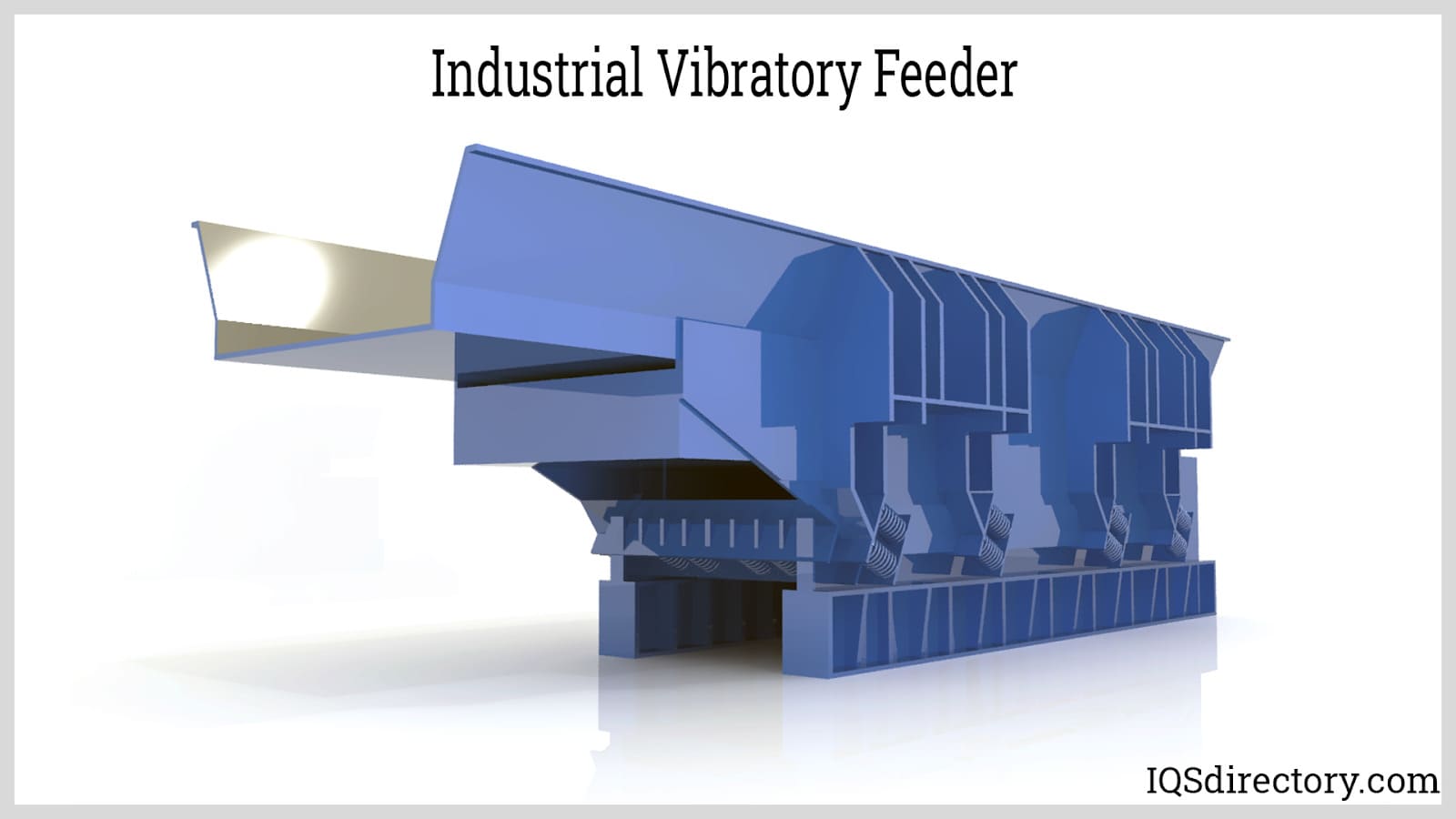
A vibratory feeder is a conveying system designed to feed components or materials to an assembly or processing operation using controlled vibratory forces, gravity, and guiding mechanisms to position materials with repeatable accuracy.
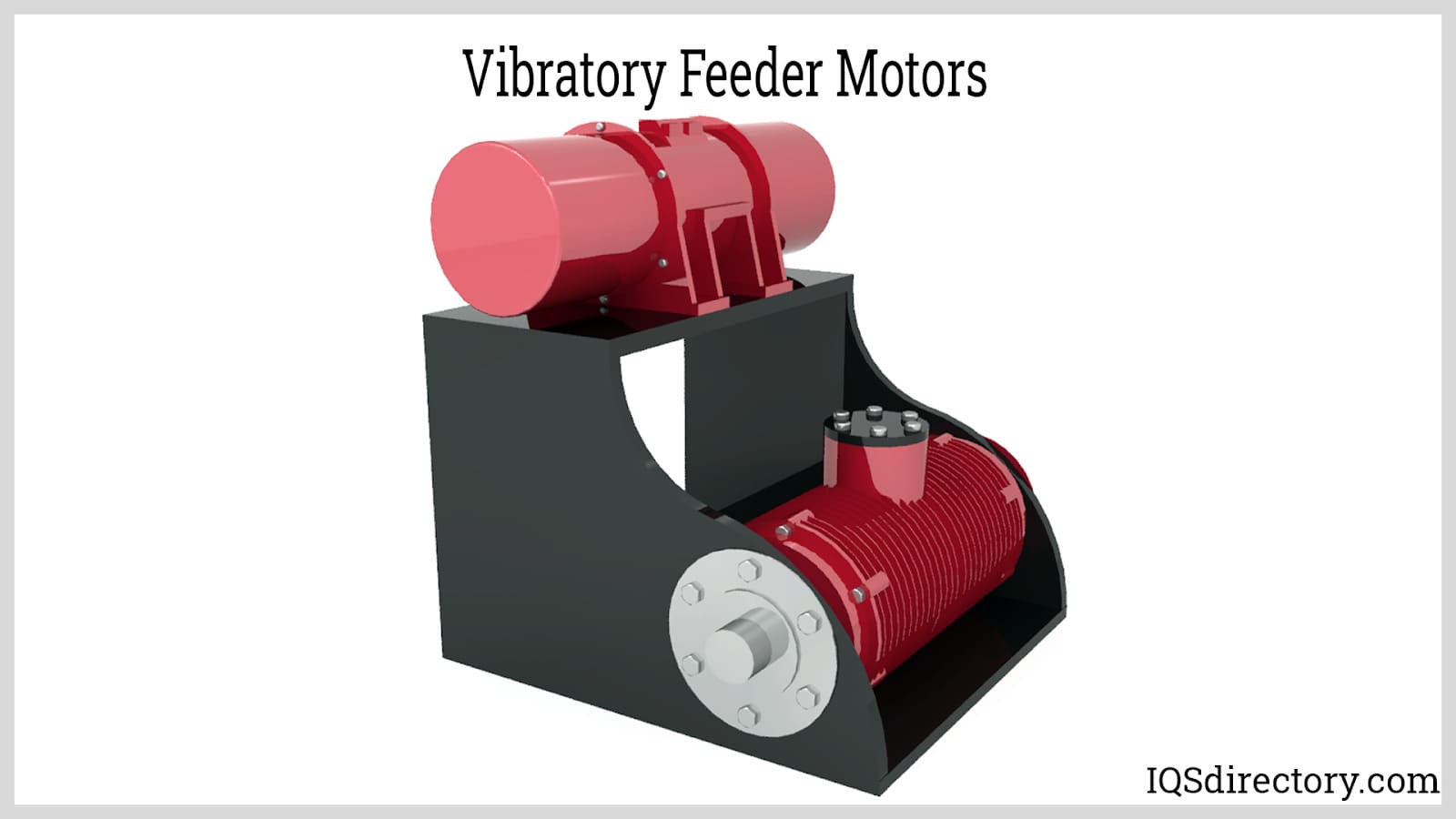
The motors create both horizontal and vertical vibrations, generating the motion needed to move product across the feeder surface and toward the discharge point.
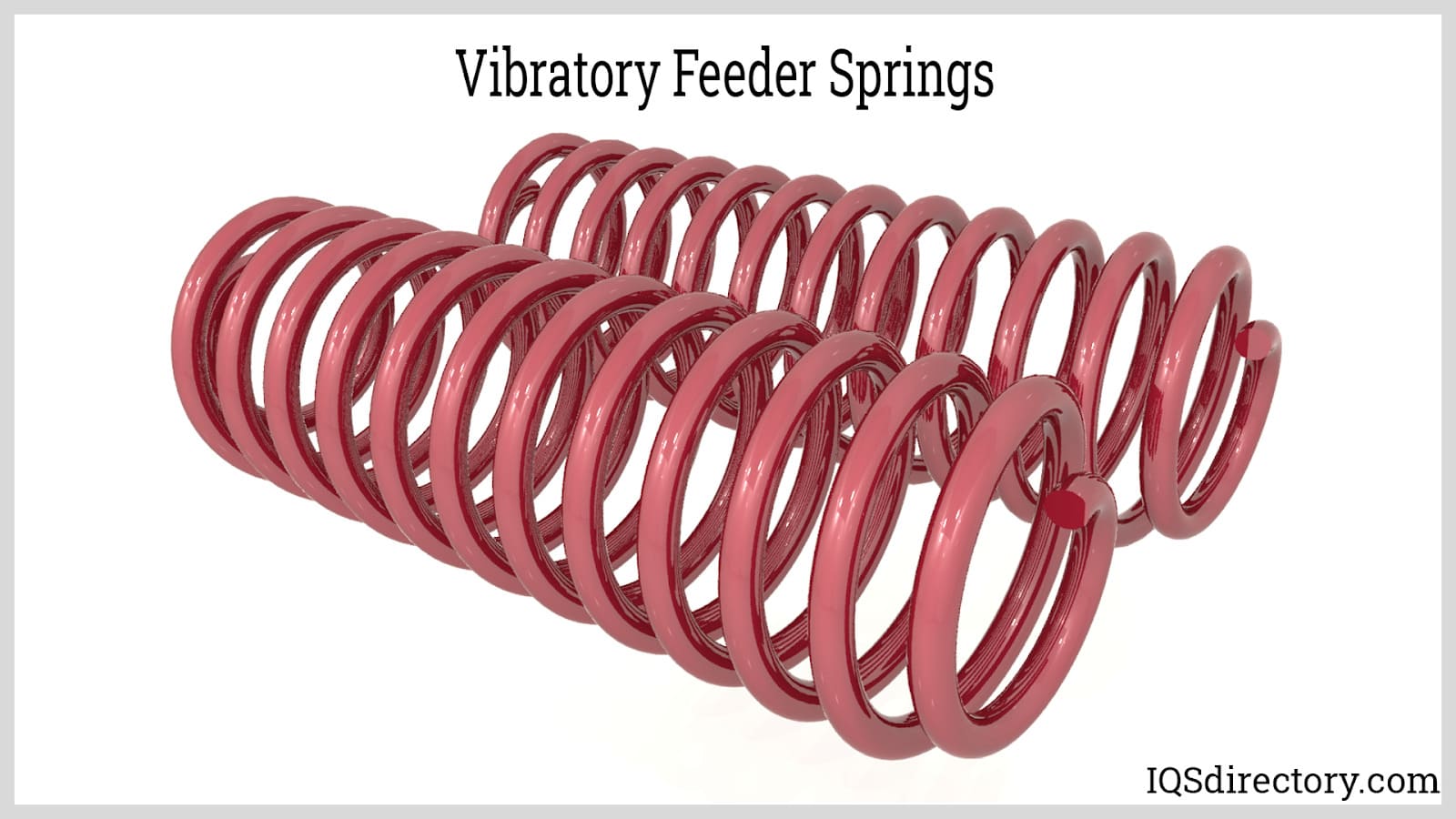
The primary springs continuously store and release energy during operation, helping transfer vibration efficiently while supporting controlled material flow.
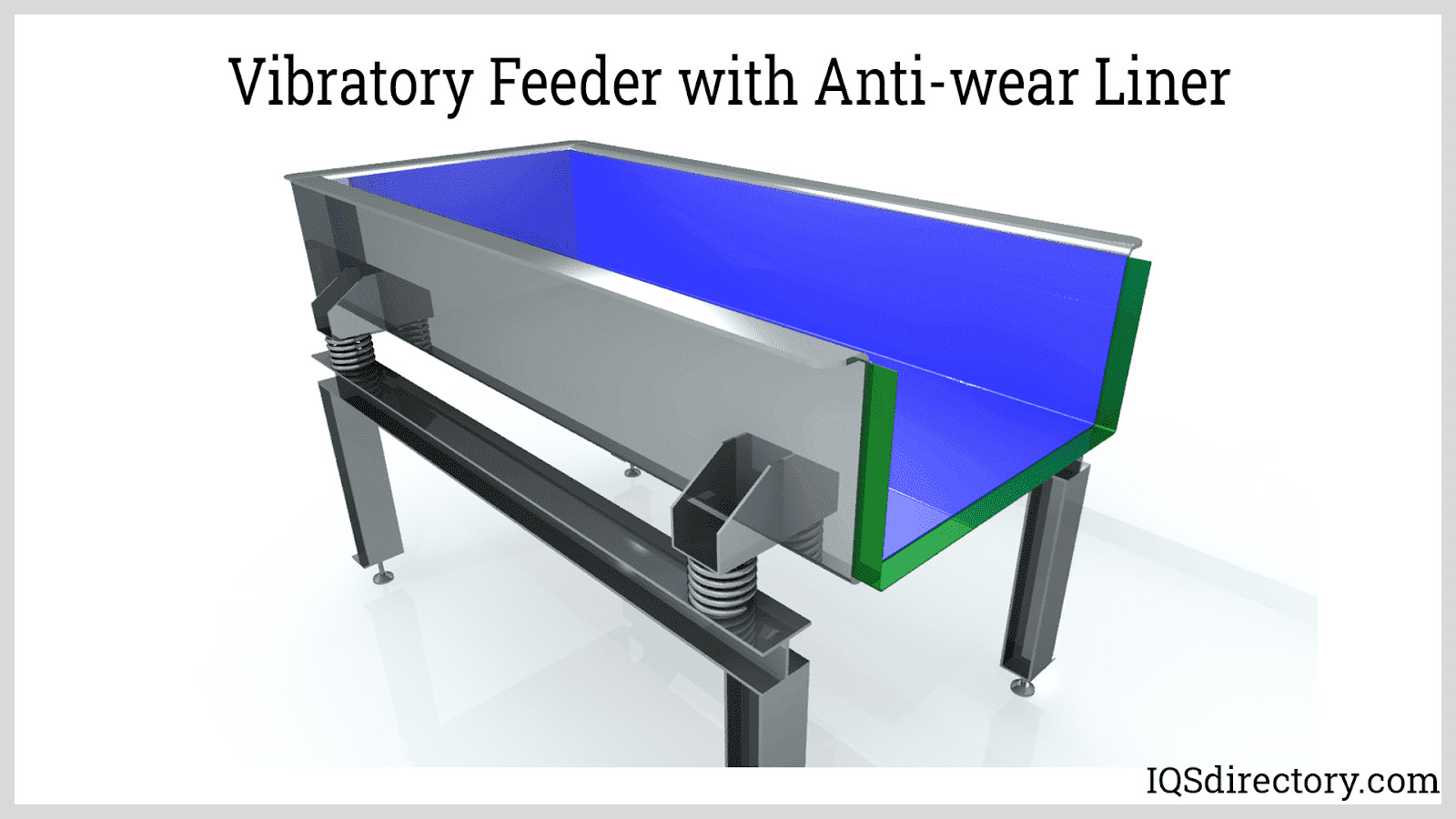
Anti-wear liner material covers the surface of the trough to resist wear, manage temperature, reduce noise, lower friction, and help prevent material buildup inside the trough.
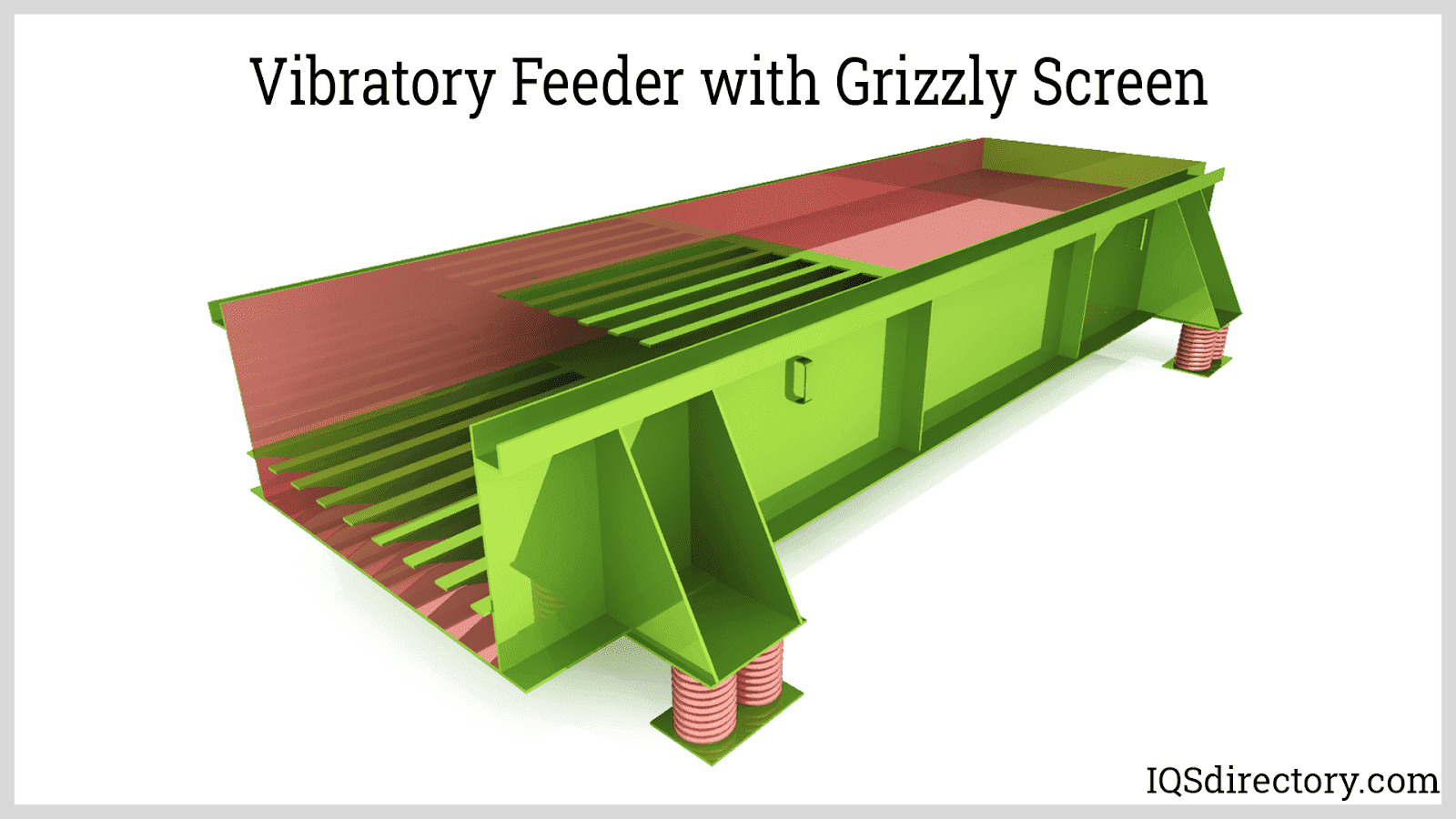
A grizzly screen is a heavy-duty screening surface consisting of rails or bars running in the direction of material flow and separating finer particles from larger material.
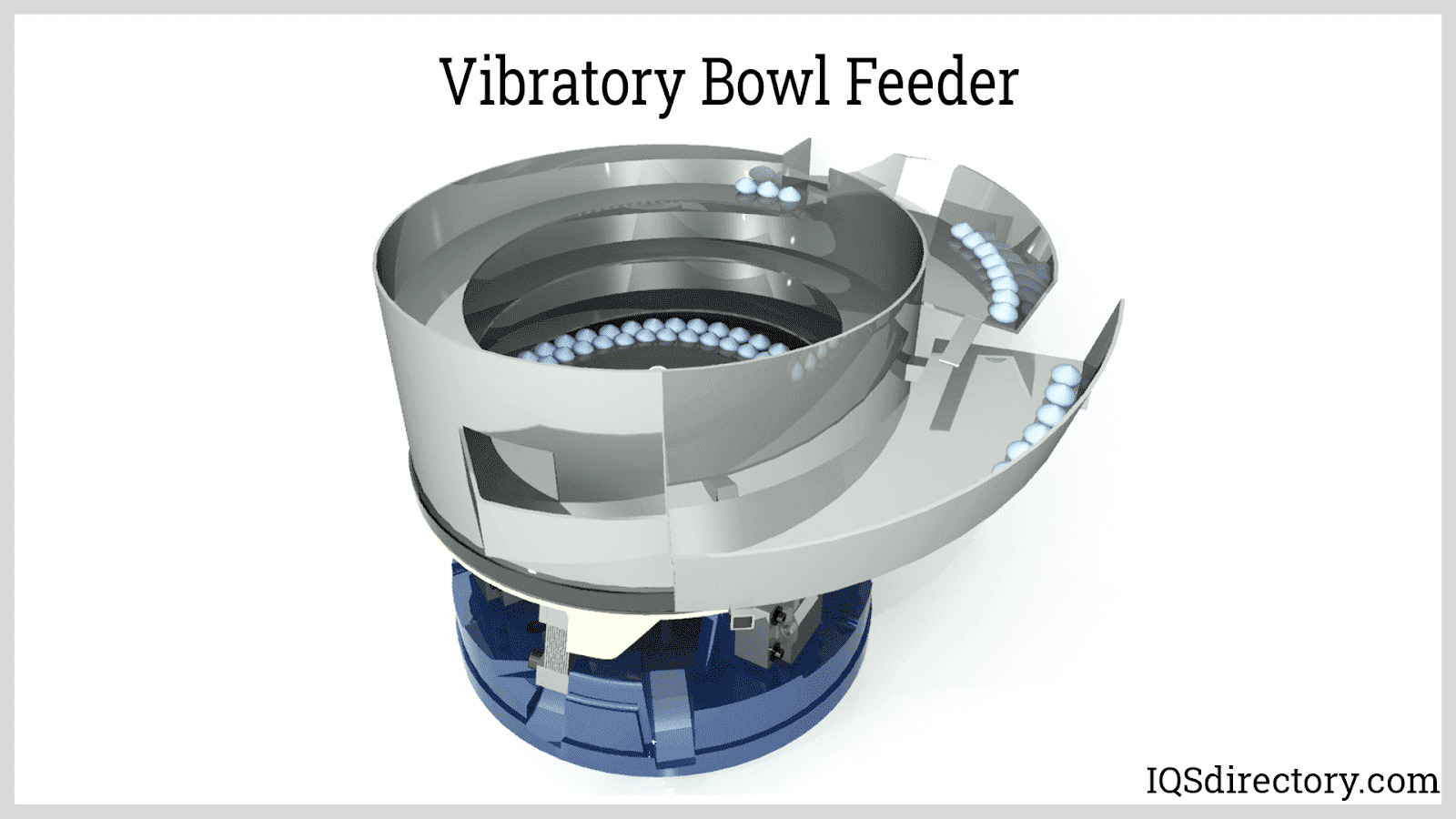
Vibratory bowl feeders have a helical trough that uses vibration to toss, shuffle, and guide materials or parts along a slightly slanted spiral path for orientation and discharge.
Types of Vibratory Feeders
Vibratory Bowl Feeder
Also referred to as vibratory bowls, these feeders consist of a bowl-shaped top and an inclined spiral track that guides components into position. Parts travel from the track to a line leading to the bottom or outfeed of the bowl feeder. These feeders are widely used by small parts manufacturers to orient products for further processing, packaging, or distribution. Initially designed by pharmaceutical companies for counting, sorting, and organizing pills, bowl feeders are now used for small parts such as fasteners, ammunition, O-rings, molded rubber components, caps, closures, and many other precision parts that benefit from dependable singulation.
Vibratory Conveyor
Also known as step feeders, these are metal troughs that vibrate in one direction to transport bulk powders or heterogeneous mixtures from one process to another. Some vibratory conveyors are designed with ultra-low vibrations for delicate or sticky materials, such as gummy bears, snack foods, produce, or lettuce. A major benefit of step feeders is that they help prevent part jamming, a common issue with standard bowl feeders. This smoother operation can reduce downtime, improve throughput, and lower operating costs over time.
Grizzly Screen
A high-powered type of vibrating screen, the grizzly screen is most commonly used in mining, aggregate, and bulk material processing for separating oversized material from smaller particles before additional crushing, conveying, or screening steps.
Electromagnetic Vibratory Feeders
These feeders utilize a sub-resonance tuned two-mass system to generate vibrations. The basic mechanism involves an electromagnet attracting an armature bracket, which is connected to a secondary mass via a leaf spring set, creating linear vibrations that move materials along the feeder pan. A controller adjusts the AC supply to regulate feed rate and output. Electromagnetic feeders are known for excellent control, responsive adjustment, and clean metering, which makes them well suited for batching, dosing, and precise flow applications.
Electromechanical Vibratory Feeders
These feeders use rotary electric vibrators to provide fully adjustable and consistent volumetric flow. They are corrosion-resistant, rugged, and require minimal maintenance. Electromechanical feeders are equipped with controls for vibration intensity, force, and frequency, making them versatile across many industries. They can be outfitted with single, dual, or multiple drives to function as vibrating conveyors, offering unique flexibility compared to other vibratory equipment used for bulk solids or parts handling.
Trommel
Trommels, or trommel screens, are vibrating or rotating screening systems used to sort smaller particles from larger ones. They reduce the labor needed to separate recyclable materials, aggregates, compost, and similar bulk materials, helping streamline sorting and make the process more cost-effective.
Rotary Trommel
This large tumbler design aids in gravel processing and recycling. Trommel magnets are often incorporated into metal recycling rotary trommels to separate ferrous materials from non-ferrous ones and improve downstream sorting efficiency.
Continuous Flatbed Trommel
Equipped with screens or filtering devices, these trommels sort particles by size, allowing larger particles to be conveyed for further processing, storage, or containment while undersized material passes through for separate handling.
Pneumatic Feeder
Specialized for laboratory use, pneumatic feeders are both water- and explosion-proof, meeting many laboratory operating standards. They use a pneumatic drive unit with a piston engine to create vibration and maintain a constant speed regardless of load. These qualities make them useful in lab environments that value cleanliness, consistent flow, reliability, and low maintenance.
Types of Non-Vibratory Feeders
Screw Feeder
Screw feeders are specifically designed for use with screw conveyors. They are ideal for volumetrically metering materials at a controlled rate and are often selected when a process needs a compact, enclosed feeding method for powders, granules, or bulk solids.
Belt Feeder
A belt feeder consists of a conveyor belt and rollers that allow the belt to move. This type of feeder is commonly used to transport materials that do not require pre-sifting before being introduced into bulk handling machines, and it is often chosen for steady, continuous transfer over longer distances.
Storage Hopper
Storage hoppers are containers used to collect granular materials and dispense them onto a conveyor or other material handling systems using gravity. They are frequently paired with feeders to support more uniform flow and improve loading consistency.
Linear Feeder
Also known as inline feeders, linear feeders are a non-vibratory alternative to vibratory feeders. They feature horizontal conveying components and are designed for handling oily or irregular parts that vary in size and shape. Linear feeders require minimal maintenance, are easy to set up, and can provide reliable long-term performance where gentle horizontal transfer is preferred.
Centrifugal Feeder
Centrifugal (or rotary) feeders work alongside screw conveyors or vibratory conveyors to provide air-tight bulk material feeding. These feeders use a rotating disk powered by an electric motor to generate centrifugal force that moves components to the outer edge of the bowl. Specialized tools then orient the parts before they enter the processing line. They are often chosen for high-speed, gentle handling of components that do not tangle easily, such as caps, closures, and medical devices, and they are also used in powder conveying or dust collection systems.
Vertical Mast-Step Feeder
Vertical mast-step feeders save floor space by collecting components from a hopper and using elevated plates or conveyors to achieve the necessary height. They operate quietly and without vibration, which can lower maintenance demands while helping facilities optimize layout and available production space.
Applications of Vibratory Feeders
Vibratory feeders are widely used for feeding, sifting, screening, orienting, and sorting delicate materials like powders as well as tougher bulk solids and small parts. They handle materials such as plastic, wood, crushed cement, metals, gravel, and sand, and can also align small parts like washers, O-rings, Legos, and coins. These feeders are common in recycling, fertilizer production, sand and gravel processing, pharmaceuticals, agriculture, food processing, mining, and pulp production because they support more controlled flow, cleaner separation, and dependable transfer between process steps.
Things to Consider When Purchasing Vibratory Feeders
When purchasing a vibratory feeder, it helps to evaluate both your application needs and the reliability of the manufacturer. Important factors include the type of material you need to handle, the part or material weight, the required speed of movement, whether sanitary conditions are necessary, whether abrasion or corrosion is a concern, and how often you will need to change products or run different parts through the same system.
Once you have answers to these questions, take them to a trusted manufacturer. The best approach is to use a directory, like the one provided by IQS. We’ve already done the research for you by identifying the top manufacturers across the USA and Canada. To explore our recommendations, check out the list at the top of the page. Review their websites, select three or four companies that appear to match your needs, and contact them to discuss your specifications, throughput goals, controls, budget, and delivery timeline. Comparing responses can help you identify the manufacturer that offers the right balance of performance, service, customization, and long-term value.
Vibratory Feeder Equipment Components
Vibratory feeders consist of several main components: an electromagnetic or electromechanical drive system, springs, a bowl or trough, a spiral track, and often a control box or controller for feed adjustment.
In an electromagnetic system, springs connected to the drive convert electromagnetic motion into wavelike movement within the bowl. In an electromechanical system, rotary electric vibrator drives generate the movement. The spiral track guides parts through the feeder, while the control box or cycle controller adjusts vibration intensity and amplitude so the system can match product needs and line speed.
Vibratory Feeders Terms
Approach
The location in the parts feeder bowl where parts begin to ascend the feeder track and start moving toward orientation.
Backpressure
The force exerted when parts emerge from the vibratory feeder and accumulate or resist movement at the discharge point.
Cascade Bowl
A type of bowl feeder featuring basic tooling on its inner track. Cascade bowls are often used to orient larger, standard parts with simpler geometry.
Depth of Bed
Also known as "material depth (mat. depth)," this is the thickness of the material layer carried on the conveyor or vibratory feeder surface.
Discharge End
The exit point of the vibratory feeder where parts or material leave the system for the next operation.
Drive Unit
Also called the "drive base unit," this device powers the vibratory feeder system and generates the motion that moves materials or parts.
Explosion Proof
Equipment designed to meet operating standards in hazardous environments, as defined by organizations such as Underwriters Laboratories (UL).
Feed End
The entrance through which parts or material enter the vibratory feeder system.
Grizzly
A durable screen used for sizing and separating bulk materials in demanding aggregate or mining environments.
Hanger
Also referred to as "suspension assembly" or "bail assembly," this device supports the vibratory feeder and helps isolate motion.
Head Load
The weight of the material supported by the vibratory feeder, located in the trough and hopper or bin.
Hopper
A large, bulk container that stores material and regulates its flow into the vibratory feeder system.
Isolation
Also known as a "vibration absorber," this device separates vibration between the machine and the supporting structure. Examples include coil springs and rubber isolators.
Load Sensitivity
The variation in vibratory feeder performance as its material load decreases or changes during operation.
Orientation
The process of arranging parts in a specific position from random orientations. Vibratory feeders commonly support simple, moderately complex, and highly complex orientation tasks.
Outside Track Bowl
A bowl feeder with intricate tooling designed for parts with more complex configurations that need added control during orientation.
Rotation
The directional movement, clockwise or counterclockwise, of the drive base unit that shifts the bowl feeder and the parts it carries.
Singulation
The separation of a group of parts into individual components so they can be inspected, counted, or fed one at a time.
Sound Enclosure
A foam-lined structure designed to absorb and reduce noise generated by the vibratory feeder during operation.
Spring
A device that generates or isolates vibration between the machine and its supporting structure, helping regulate motion and performance.
Trough
Also known as a "pan," this is the tray where materials are loaded into the vibratory feeder system for transport.
Vibratory Separators
Devices used across various industries to separate materials or particles for grading, classification, and processing applications.
More Vibratory Feeders Information