Linear Bearings
Linear bearings, also known as linear-motion bearings, linear slides or linear actuators, are precision-engineered linear motion components that support smooth, controlled travel along a straight path. In automation systems, CNC equipment, packaging lines, medical devices, and precision machinery, they help guide moving loads with low friction, repeatable positioning, and dependable service life.
In most applications, the mounted component moves in a single axis, which makes linear bearing design both efficient and highly effective. By reducing drag, supporting accurate travel, and promoting repeatable motion cycles, these bearings improve machine efficiency, positioning quality, throughput, and overall motion-control performance in both manual and automated systems.
Linear Bearings FAQs
What are linear bearings used for?
Linear bearings are used to create smooth, accurate, low-friction travel along a straight line. They are common in industrial automation, robotics, packaging machinery, medical equipment, CNC systems, and precision manufacturing where guided linear motion, repeatability, and stable load support matter.
How do rolling and plain linear bearings differ?
Rolling linear bearings use balls or rollers to reduce friction and support faster, smoother travel, while plain linear bearings rely on sliding contact and are often chosen for simple, low-maintenance, or contamination-prone environments. The right choice depends on speed, load, accuracy, duty cycle, and operating conditions.
What materials are linear bearings made from?
Linear bearings are often made from hardened steel, aluminum, stainless steel, and cast iron for strength, stiffness, and wear resistance. Depending on the application, manufacturers may also use bronze, PTFE, engineered plastics, or acetal to improve corrosion resistance, reduce weight, or support quieter operation.
What industries use linear bearings?
Linear bearings are used in automation, packaging, medical technology, aerospace, material handling, machine building, food processing, and electronics manufacturing. They also support accurate travel in robotics, optical alignment, inspection equipment, and other systems that rely on dependable linear guidance.
What factors should be considered when selecting a linear bearing?
When selecting a linear bearing, buyers should review load direction, speed, travel accuracy, mounting style, lubrication needs, contamination exposure, and available installation space. Matching the bearing style to the application helps improve service life, motion quality, and overall machine efficiency.
How are motion errors in linear bearings minimized?
Motion errors can be reduced by analyzing rail-form deviation, straightness variation, and load distribution with methods such as Hertz contact theory and transfer function analysis. These approaches help engineers refine alignment and rail geometry so the system delivers tighter positioning and smoother linear travel.
What maintenance helps extend linear bearing lifespan?
Routine lubrication, alignment checks, contamination control, and the use of accessories such as clamps, locks, and stopper bolts help extend bearing life. Working with manufacturers that offer testing, sizing support, and application guidance can also reduce wear, downtime, and maintenance issues over time.
The History of Linear Bearings
- Beginning History of Linear Bearings
- Bearings have existed in various forms since ancient times, possibly predating the invention of the wheel. Early civilizations utilized rolling bearings, with the earliest known examples crafted from wood. The most tangible evidence of early roller bearings comes from the remains of a Roman shipwreck dated to approximately 40 BC. However, additional archaeological findings, including Egyptian hieroglyphs and tomb illustrations, suggest that the concept of linear motion was understood and applied even earlier. These depictions show the use of tree trunks as rolling supports beneath sleds, sledges fitted with liquid-lubricated runners akin to plain bearings, and primitive bearings used in hand drills.
- Around 1500 AD, Leonardo da Vinci included drawings of ball bearings in his conceptual helicopter design, marking the first recorded reference to linear bearings in an aerospace-related application. Later, Italian engineer Agostino Ramelli produced sketches detailing roller and thrust bearings, which were further refined in the 17th century when Galileo proposed enclosing rolling elements within a cage to minimize friction.
- By the mid-18th century, these theoretical advancements began materializing in practical applications. In the 1740s, John Harrison incorporated caged-roller bearings into his H3 marine timekeeper, improving timekeeping precision. The transition to modern linear bearings took a significant leap in 1794 when British inventor Philip Vaughan patented the first ball bearing system, featuring a ball rolling within a grooved axle assembly. This period also coincided with the height of the Industrial Revolution, during which linear bearings played a important role in ensuring the efficient operation of wheel and axle systems, improving precision in watchmaking, and enhancing the performance of water mills.
- Later History of Linear Bearings
- The late 19th century ushered in new styles and applications for linear bearings. In 1869, a Parisian bicycle mechanic patented the radial-style ball bearing, marking a significant innovation in bearing design. Henry Timken followed in 1898 with the tapered roller bearing, further expanding the functional capabilities of bearings. Meanwhile, in 1883, Friedrich Fischer introduced a method for milling and grinding bearing balls with consistent size and shape, laying the groundwork for a fully developed bearing manufacturing industry.
- At the dawn of the 20th century, the industry saw further refinement, including the development of the self-aligning linear ball bearing in 1907. Progress continued through the 1930s, particularly with the invention of the wire race bearing in 1934. World War II spurred additional innovation, and from the 1960s through the 1980s, the industry introduced new technologies such as v-groove bearing guide wheels, bi-material plain bearings, and bearings constructed from Teflon-based materials.
- Today, linear bearings serve in cutting-edge applications across numerous industries. They support high-speed operations in dental drills, ensure precision in aerospace applications such as the Mars Rover, and contribute to the accuracy of optical alignment systems through flexure bearings. Their increasing popularity is largely driven by advances in robotic automation, which demand reliable, efficient, and highly durable linear motion solutions.
Advantages of Linear Bearings
Linear bearings offer smooth travel, low friction, and repeatable motion in applications that demand dependable linear guidance. They are valued for efficient load handling, straightforward installation, reduced energy loss, and the ability to support customized assemblies. Whether used in compact devices or large industrial systems, they help improve accuracy, cycle consistency, and service life while keeping motion systems responsive and efficient.
Linear Bearings Design
Manufacturers can configure linear bearings in several ways to match application goals for speed, accuracy, load capacity, and maintenance. Most systems fall into rolling or plain designs. Rolling systems use balls, rollers, rails, or slides to deliver low-friction guided travel, while plain systems provide a simpler sliding surface that can be attractive in dirty, washdown, or lower-speed environments.
- Rolling Elements
- Linear bearings that use rolling elements typically feature a sleeve-style ring and rows of balls or rollers held in precision cages. These cages guide the rolling elements while hardened raceways support smooth travel, low friction, and dependable load handling. Surface finish, lubrication, and raceway geometry all influence noise levels, wear, and motion quality.
- One advantage of rolling-element linear bearings is the combination of strength, smooth travel, and dependable repeatability. While many assemblies move through manual input, modern systems can also be integrated with electric drives, control panels, sensors, or remote-control interfaces to support automated linear motion in smart equipment.
- Plain Elements
- Alongside rolling systems, plain linear bearings provide a ball-free and roller-free alternative for guided motion. They are often selected for simpler assemblies, lighter loads, lower speeds, or environments where low maintenance and contamination resistance are more important than maximum travel speed.
- Linear bearings are commonly manufactured from robust materials such as cast iron, hard-coat aluminum, and stainless steel. plastic, PTFE, and acetal are also used when lower weight, corrosion resistance, chemical resistance, or reduced friction are priorities. bronze, plastic, PTFE, and acetal are also utilized, particularly when specific weight, corrosion resistance, or friction reduction properties are required.
Linear Bearings Images, Diagrams and Visual Concepts
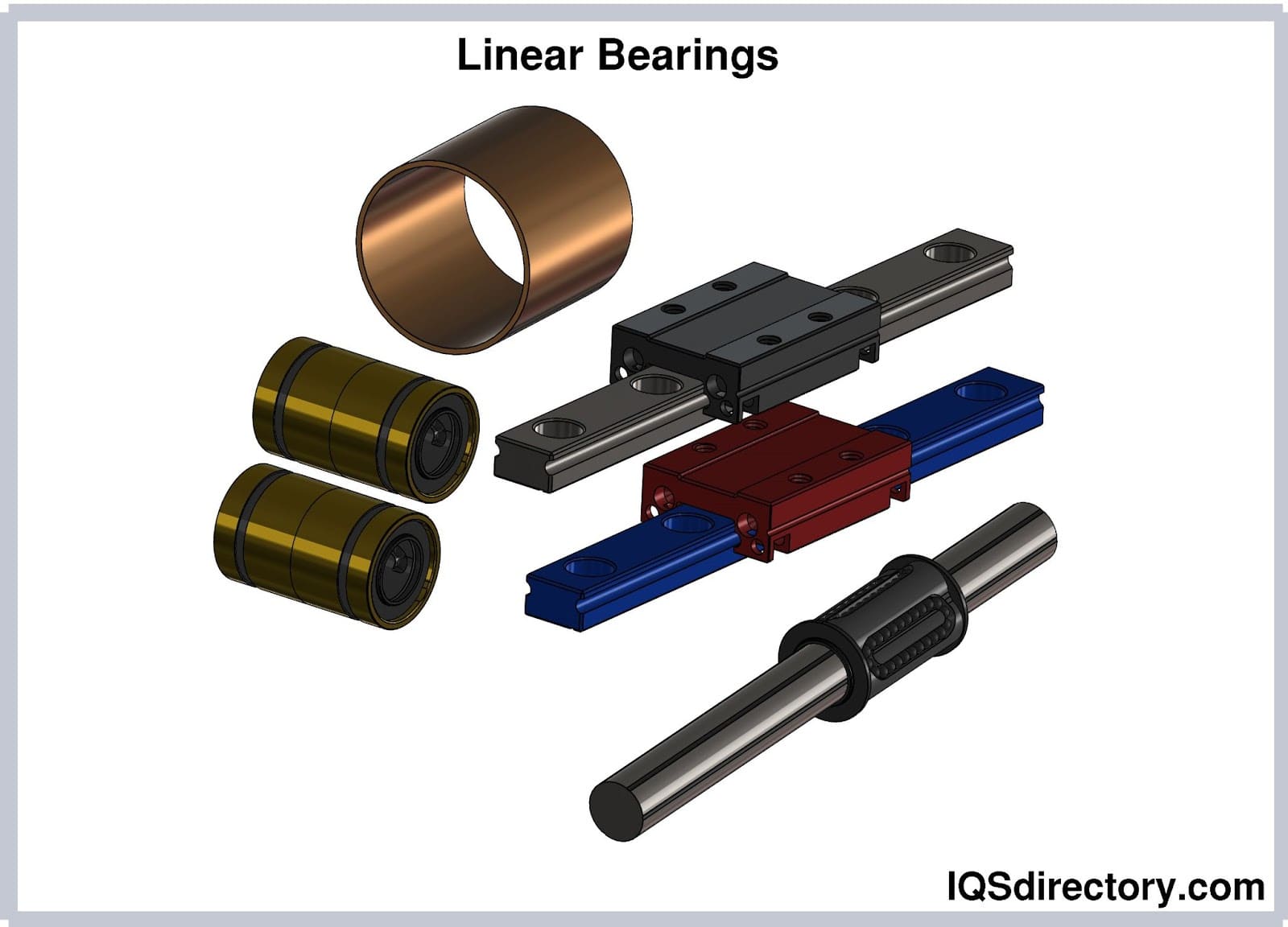 Linear bearings support the carriage load during single-axis travel and provide a low-friction guiding surface along the rail.
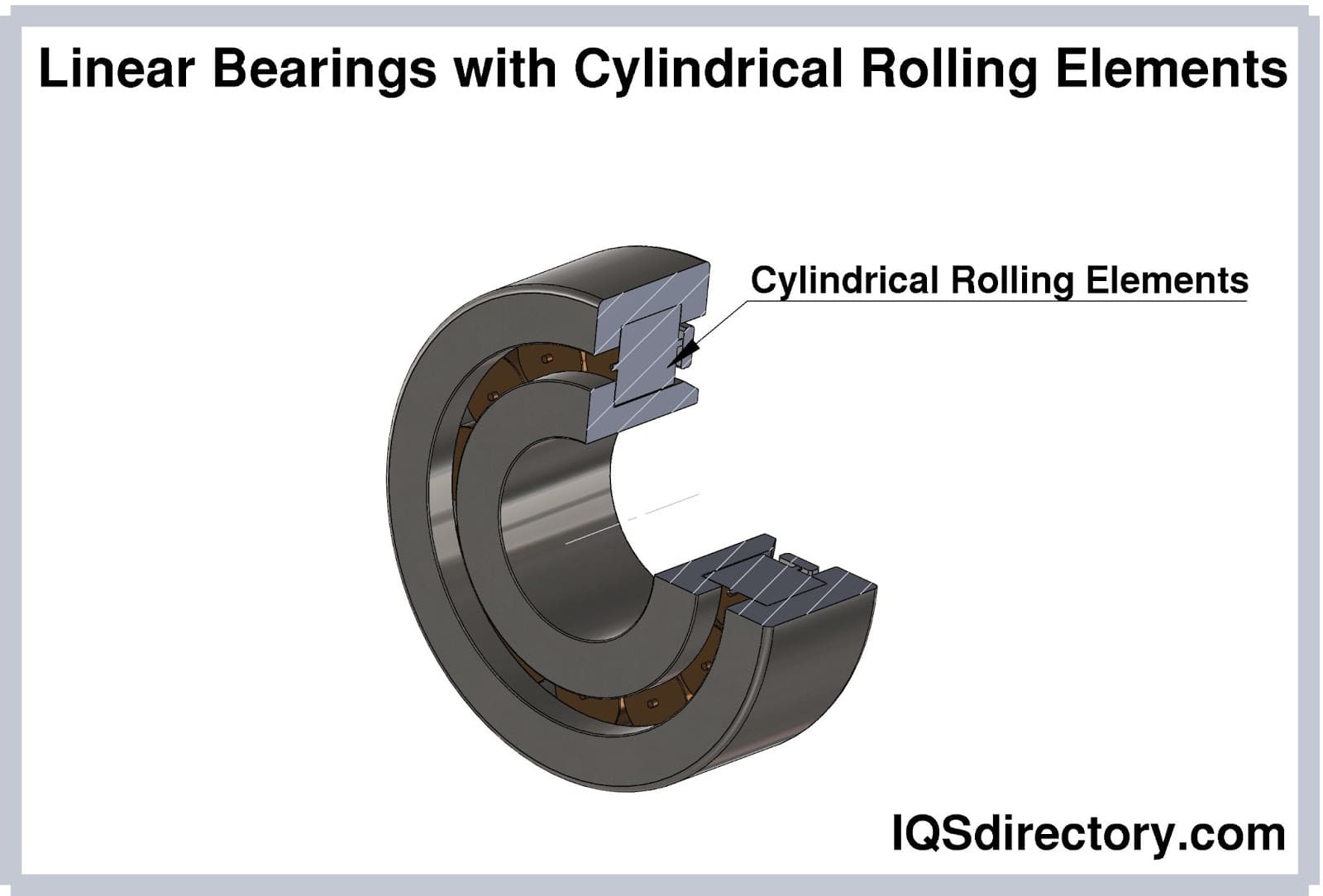 Linear bearings with cylindrical rolling elements offer higher load capacity, rigidity, and shock resistance than comparable ball-bearing designs.
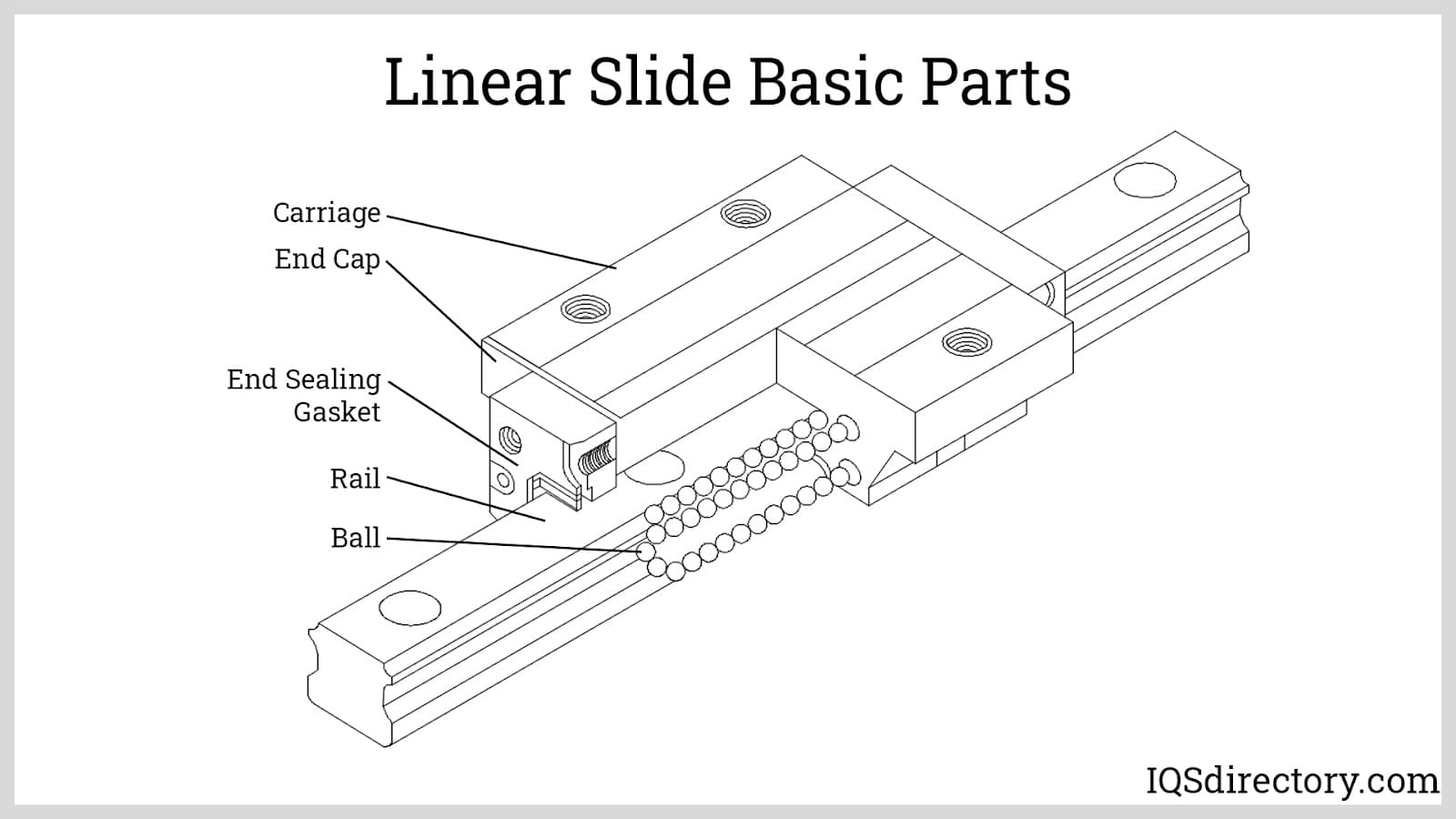 The basic components of a linear slide system, including the guide, carriage, and support structure.
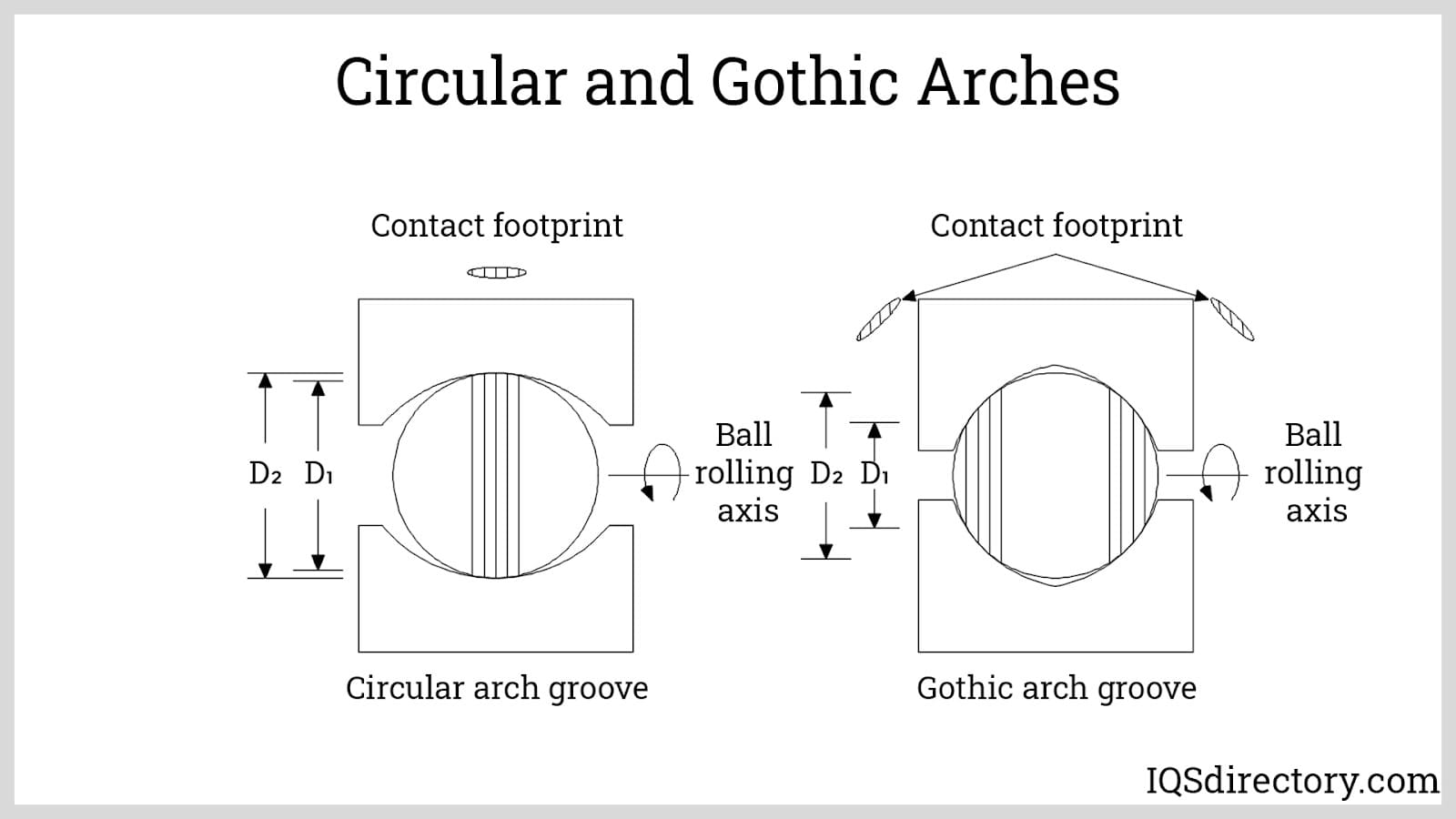 The circular arch profile promotes lower friction, while gothic arch geometry supports higher load capacity and stiffness.
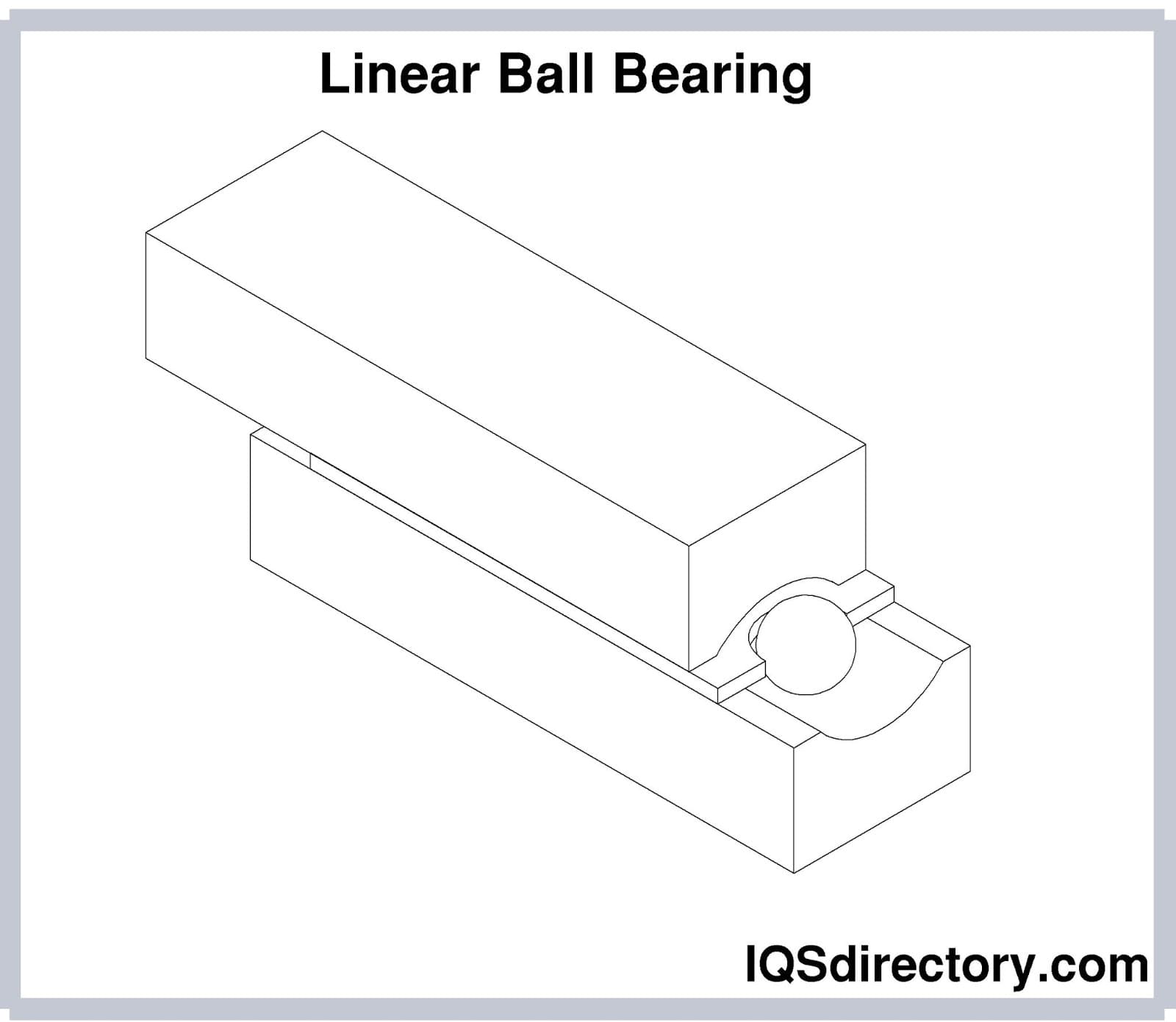 Non-recirculating linear ball bearings use fixed metal balls between the cage, guide rail, and mating groove to support smooth linear travel.
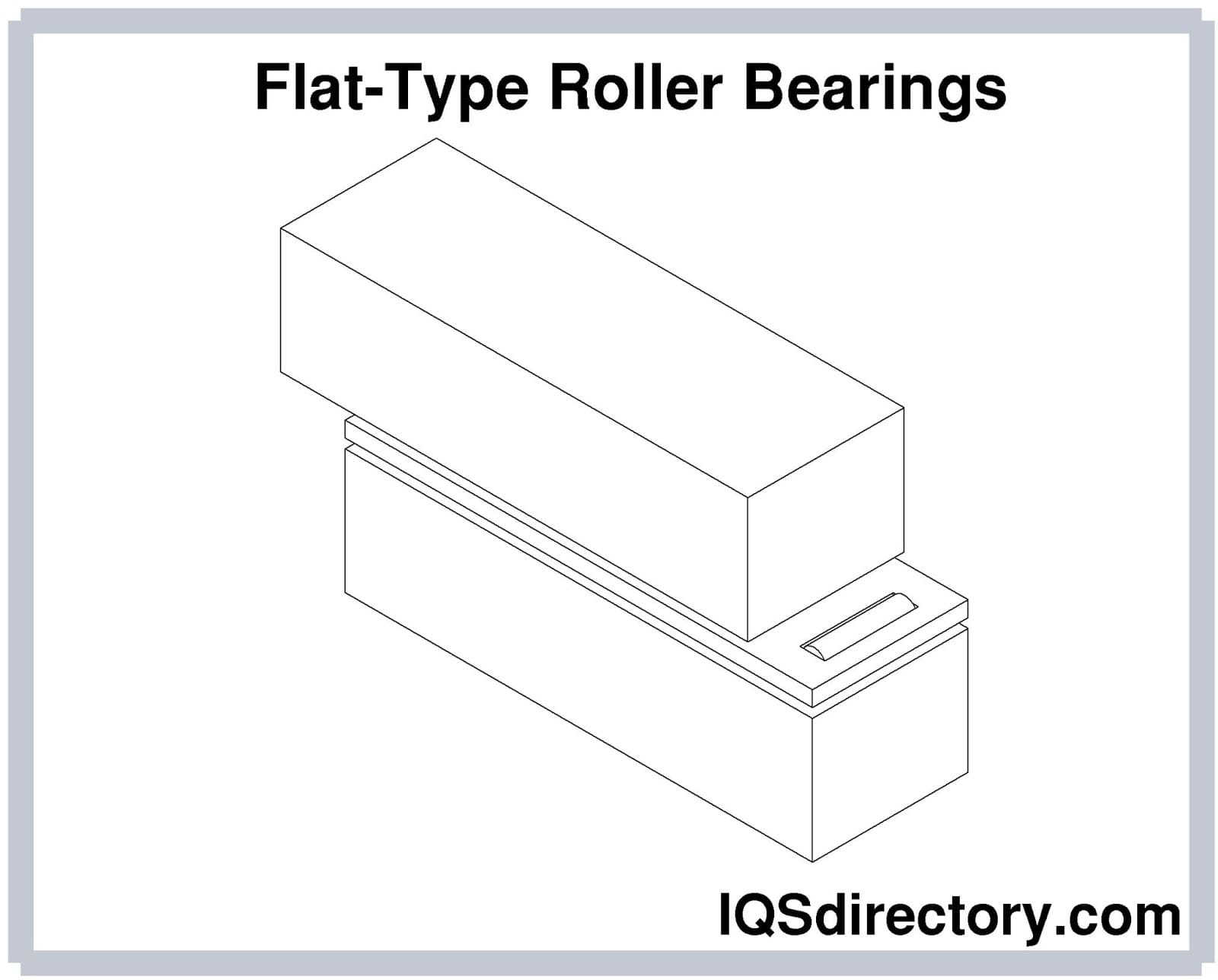 Flat-type roller bearings use cylindrical rollers positioned on their horizontal axis within the cage for guided linear motion.
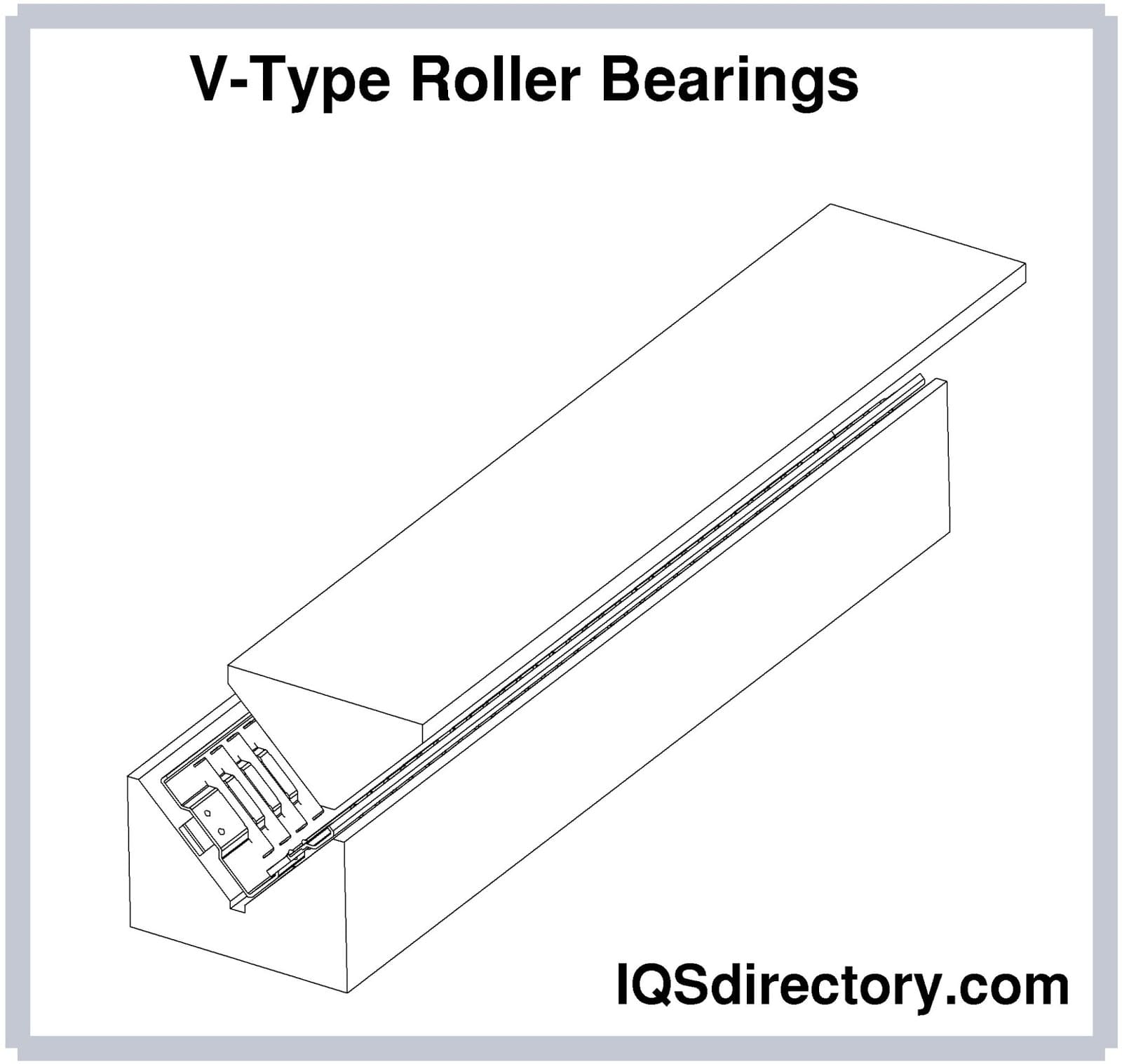 V-type roller bearings run on a V-shaped pathway that forms a 90° contact angle for controlled travel and load support.
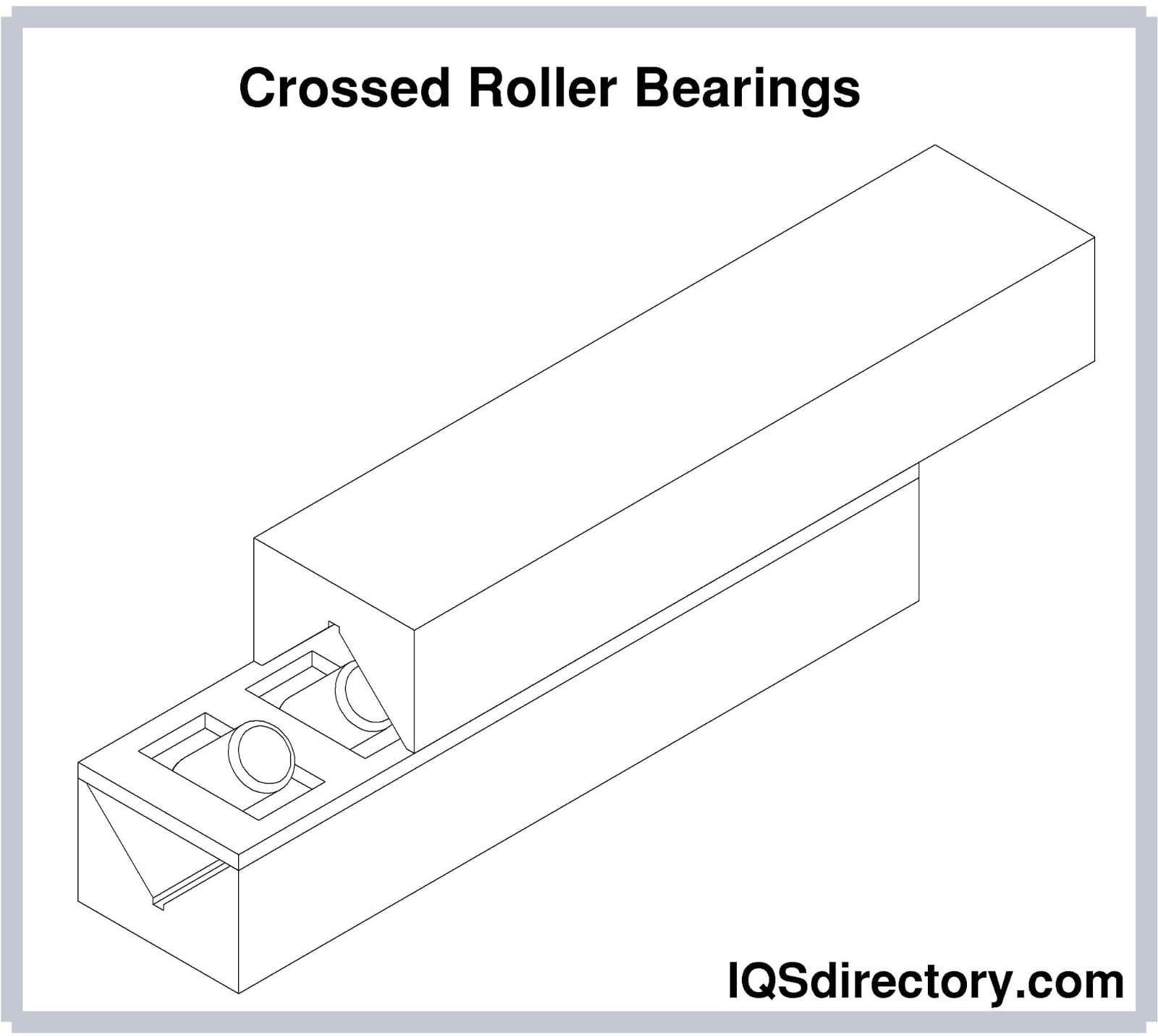 Crossed roller bearings use cylindrical rollers arranged at 90° to one another in a crisscross pattern for greater rigidity and load handling.
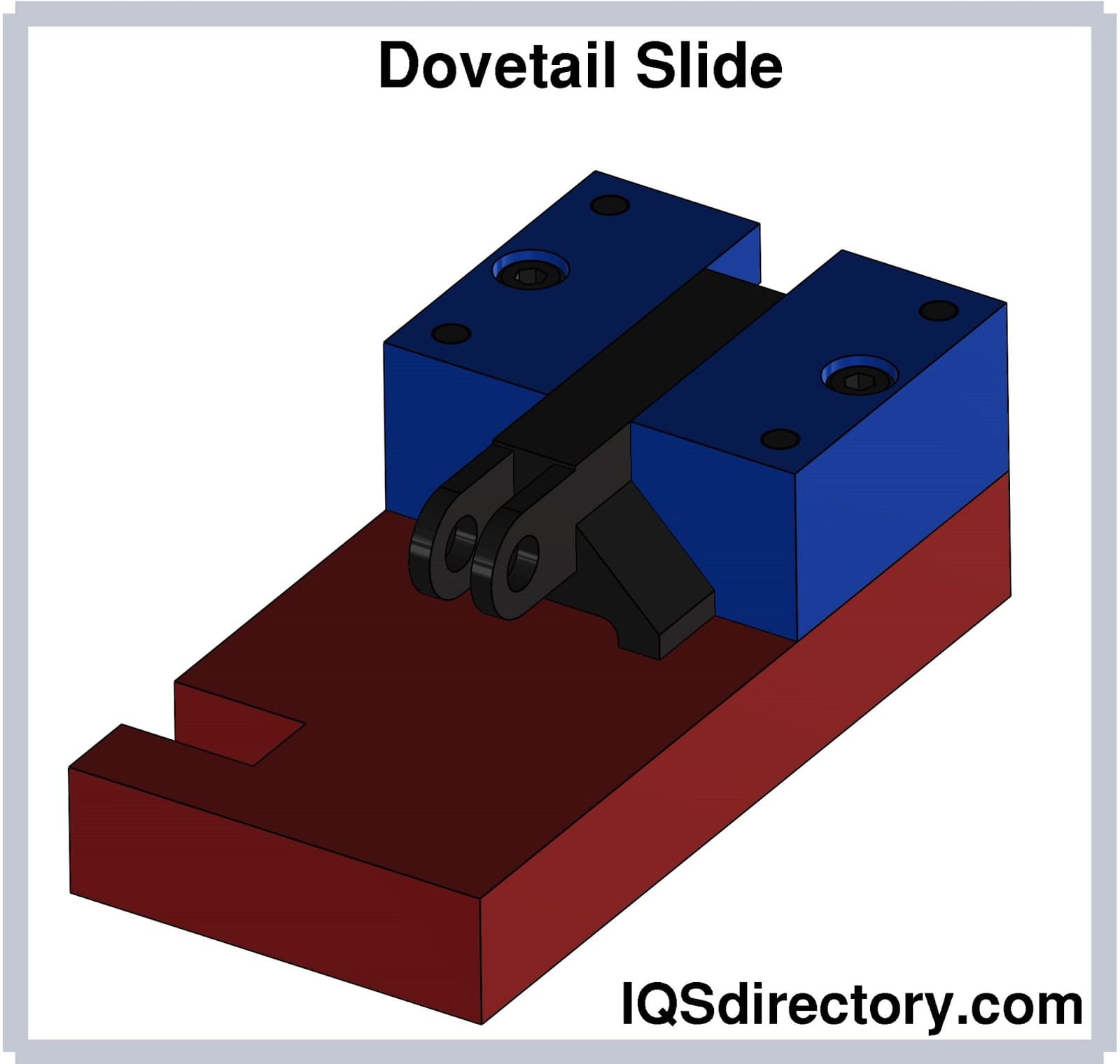 A dovetail slide uses a V-shaped tongue and matching saddle to create guided, full-contact linear motion.
Types of Linear Bearings
Linear bearings are available in multiple configurations designed for different motion profiles, load demands, and accuracy requirements. The three primary categories include linear ball bearings, linear roller bearings—including needle-style options—and slide bearings. Beyond these standard categories, buyers can also evaluate crossed roller bearings, precision linear bearings, miniature linear bearings, linear rotary bearings, linear air bearings, pillow block bearings, dovetail slides, ball screws, rail bushing bearings, and profile rail systems for specialized linear motion applications.
- Linear Ball Bearing
- Linear ball bearings are efficient rolling-element components that separate moving parts with recirculating or non-recirculating balls. They are widely used for smooth, low-friction linear travel in instrumentation, robotics, cleanroom equipment, and precision machinery where repeatable movement and compact design are important.
- Linear Roller Bearing
- Linear roller bearings use cylindrical rollers to spread loads across a larger contact area than ball systems. That broader contact can improve rigidity, load capacity, and durability, making roller-based linear guides a strong fit for machine tools, heavy assemblies, and applications that demand stable guided travel.
- Needle Bearing
- Needle bearings use slim cylindrical rollers with a small diameter relative to their length, allowing compact designs to carry meaningful loads. They are often chosen where space is limited but guided motion, rigidity, and efficient load support still matter.
- Slide Bearing
- Using low-friction materials such as Teflon or graphite embedded in metal backing plates, slide bearings facilitate linear motion while supporting weight. These are frequently used in high-temperature environments, including heated pipelines on oil production modules, steel fabrication processes, and oil or water transportation systems.
- Crossed Roller Bearing
- Crossed roller bearings arrange rollers in alternating directions so the assembly can manage higher loads with better rigidity and more stable motion than many ball-slide systems.
- Precision Linear Bearing
- Precision linear bearings are built for machine tools, positioning systems, and other demanding applications that require tight tolerances, smooth travel, and repeatable accuracy over long production cycles.
- Miniature Linear Bearing
- Miniature linear bearings deliver controlled motion with low torque, low noise, and minimal runout, making them a smart choice for compact devices, laboratory equipment, instrumentation, and small automation assemblies.
- Linear Rotary Bearing
- Used in scenarios where precise linear movement of large objects is required, linear rotary bearings feature cylindrical rollers capable of dividing and supporting heavy loads. Their self-lubricating nature makes them ideal for use in car axles, machine shafts, clock components, and grinders.
- Linear Air Bearing
- Utilizing crossed roller slide assemblies controlled by air cylinders, linear air bearings enable frictionless motion by suspending the moving component on a cushion of air. Available in round or rectangular designs with optional vacuum and magnetic preloads, they are frequently employed in aerospace and precision machine tool applications. Made from lightweight materials like aluminum, linear air cylinders are widely used for tensile testing and precision positioning.
- Pillow Block Bearing
- Designed to provide load support for rotating linear shafts, pillow block bearings are typically constructed from iron and come in two primary types: plain, which guide and minimize friction in rotary or linear applications, and ball, which ensure smooth, low-friction rotary movement.
- Dovetail Slide
- A type of plain bearing consisting of a stationary base and a movable carriage, dovetail slides feature a v-shaped groove that locks into a corresponding channel in the base, enabling precise linear movement. A platform can be attached to the carriage to create a dovetail carriage system.
- Ball Screw
- A linear actuator that converts rotational motion into linear motion with minimal friction, ball screws are particularly suited for applications requiring high thrust loads and precision due to their tight design tolerances.
- Rail Bushing Bearing
- One of the most widely used linear motion bearings, rail bushing bearings efficiently accommodate torsional misalignment caused by movement variations, ensuring smooth operation across a variety of applications.
- Profile Rail Bearing
- Recognized for their high accuracy, superior strength, and compact design, profile rail bearings are used in applications requiring enhanced dynamic load capacity. By incorporating internal and external ball channels, they offer greater load-bearing efficiency than standard round rail systems.
- Flat Ball Cages
- A linear bearing design in which balls are enclosed within a structured frame, maintaining equal spacing and consistent motion control.
- Flat Roller Cages
- Similar to crossed roller bearings, flat roller cages utilize parallel rollers instead of crossed ones, allowing for smooth, guided linear motion.
- Gonio Way Bearings
- Curved linear bearings designed to follow an arc, mimicking the movement of a pendulum.
- Linear Motion Bearings
- Fundamental to load-bearing and motion-directing applications, these bearings enable precise linear movement in industrial systems.
- Metric Linear Bearings
- Engineered for applications demanding high-accuracy linear motion in a single direction, metric linear bearings are defined by their metric-based measurements, ensuring consistency in international applications.
- Plastic Linear Bearings
- Constructed entirely from plastic materials, these bearings facilitate low-friction linear motion while offering advantages such as chemical and acid resistance, making them suitable for environments where conventional steel or ceramic bearings may be compromised.
- Positioning Stages or Tables
- Comprising two needed components—a precision linear slide (such as a ball or crossed roller slide) that acts as a guide and a drive mechanism that controls movement—positioning stages provide highly accurate linear positioning for industrial automation and research applications.
Linear Bearing Applications
Linear motion bearings guide smooth, accurate movement by allowing components to slide or roll along a defined path within equipment, appliances, and production systems. Their wide use comes from their ability to reduce friction, support controlled travel, and maintain dependable motion quality over repeated operating cycles.
These bearings appear anywhere controlled linear travel is needed. They support moving assemblies in machinery, furniture, vehicles, home appliances, drawers, adjustable workstations, and industrial motion systems. In automated equipment, they are often paired with actuators, rails, and drive systems to improve positioning, speed control, and repeatability.
Beyond these general uses, linear bearings contribute to advanced applications such as optic alignment, disk certification, precision dispensing, vision inspection, wafer testing and handling, precision gauging, and automated production equipment. Their versatility makes them indispensable across industries including automation, packaging, Beyond general product design, linear bearings are used in optical alignment, disk certification, precision dispensing, vision inspection, wafer handling, gauging, and automated production equipment. Their flexibility makes them well suited for automation, packaging, medical technology, machine building, metal fabrication, printing, automotive manufacturing, and food processing operations where guided motion and accuracy directly affect output quality.
Things to Consider When Purchasing Linear Bearings
Choosing the right linear bearing system helps improve uptime, motion quality, and service life. A poorly matched bearing can raise maintenance costs, slow production, and reduce positioning accuracy. Reviewing the following considerations can help buyers select the best linear motion bearing for a given machine, assembly, or automation project.
- Understand the Mechanism
- The first step in selecting a system is defining the application in detail. Manufacturers can then recommend solutions based on load capacity, accuracy, smoothness, installation method, self-alignment, speed, preload options, end support, and drag characteristics so the bearing matches the way the equipment will actually operate.
- Consider the Type of Load
- Linear bearings must handle different load directions, including vertical, horizontal, pitch, roll, and yaw moment loads. Many applications combine several load conditions at once, so each bearing must be sized and arranged to support the real load vectors seen during operation and throughout the duty cycle.
- Consider Your Required Accuracy
- Required accuracy should be evaluated early because not every linear bearing system is built for the same motion tolerance. Height variation, rail quality, preload, and mounting accuracy all affect travel precision. For tighter positioning demands, profile rail bearings and other precision guide systems can offer more stable results.
- Find the Right Manufacturer
- Selecting the right manufacturer can shape the success of the entire project. A strong supplier understands the application, provides consistent product quality, meets delivery requirements, and offers sizing or engineering guidance instead of simply supplying standard parts.
- Finding the right manufacturer usually involves comparing several suppliers, reviewing their product ranges, and sharing detailed operating requirements. By evaluating responsiveness, technical knowledge, and fit for the application, buyers can choose a partner that supports long-term performance, dependable delivery, and the right solution for the job.
Proper Care for Linear Bearings
Long bearing life depends on thoughtful design, correct installation, and consistent maintenance. To avoid expensive repairs such as regrinding or scraping, many companies work with manufacturers that provide engineering support during linear guide development. Application testing, alignment review, and motion analysis help reduce error sources and improve overall linear bearing performance.
- Evaluate Load Distribution via Hertz Contact Theory
- Load distribution in linear bearings can be reviewed with measuring tools based on Hertz contact theory. These tools help engineers see how force is shared across rolling contacts so they can predict wear, identify motion-error sources, and keep the bearing system within the target tolerance range.
- Transfer Function Method
- The transfer function method is another way to evaluate motion errors. Using measured motion behavior and a hydrostatic feed table, engineers can estimate rail-form error and make targeted adjustments that reduce travel deviation. When applied carefully, this method can improve positioning accuracy to levels below one micrometer.
- This approach is particularly useful in minimizing motion errors within linear motion bearing tables, ensuring smooth and precise movement even in high-precision applications.
- Check for Straightness Error
- Rail-form and straightness errors directly affect linear bearing performance, but they can be difficult to isolate inside a complete motion system. For that reason, many engineers study measured motion behavior and compare it with guide geometry so straightness issues can be corrected before they affect accuracy, wear, or repeatability.
- Using laser interferometers and straight edges during the assembly process, engineers can accurately measure and correct straightness errors. In some cases, a dial gauge may be used instead of a laser interferometer to check for discrepancies. Addressing horizontal straightness errors helps minimize inaccuracies caused by roll or ball placement issues.
- Parallelism errors often accumulate where two rails join, which can affect motion accuracy. Identifying and correcting these parallelism deviations enhances precision, ensuring that motion errors remain within acceptable limits. Both straightness error calculations and rail-form error detection rely on Hertz contact theory, which helps pinpoint and rectify potential sources of misalignment.
Linear Bearing Accessories
Many linear bearing systems use accessories to improve installation, protection, and long-term performance. Common options include lubricants, roller tables, mounting systems, stopper bolts, linear locks, clamps, height-adjusting blocks, guideway block stopper plates, and mounting hole caps. Reviewing accessory compatibility with a manufacturer can improve fit, reduce wear, and support more dependable linear motion over time.
Linear Bearings Terms
- Axial Clearance
- The amount of play or movement observed when a bearing’s inner ring is shifted axially in relation to the outer ring.
- Basic Dynamic Load
- The maximum load a bearing can sustain while operating under continuous rotation without premature failure.
- Bearing Analyzer
- A diagnostic device used to evaluate bearing performance and detect faults or irregularities after use.
- Bearing Cage
- Also known as a retainer, this component separates and secures the rolling elements within a bearing to ensure proper spacing and alignment.
- Brinelled
- A condition in which rolling elements press forcefully onto inner or outer raceways, creating indentations that accelerate bearing wear and lead to premature failure.
- Carrier
- A structural component responsible for supporting and transporting the load. Carriers are typically mounted onto linear slides with an integrated bearing system.
- Gib
- A wedge-shaped metal or wooden piece used to secure structural components in place and/or provide a smooth bearing surface for movement.
- Graphitic Corrosion
- The degradation of bearing housings in grey cast iron products due to the selective leaching of iron, leaving behind a weak, graphite-rich structure.
- Grease Pocket
- A design feature within a cage or retainer that allows grease to collect and gradually distribute lubrication to the rolling elements over time.
- Load Rating
- The highest weight or force a bearing can support while maintaining reliable performance.
- Lubricant
- A substance applied to bearings to reduce friction, prevent corrosion, transfer heat, and block contaminants from entering the system.
- Pear Skin
- A textured, "fuzzy" appearance on the load-bearing surface of a bearing, typically caused by contamination or surface degradation.
- Raceway
- The track or channel within a bearing where rolling elements move, ensuring controlled and confined motion.
- Radial Clearance
- The intentional space between the rolling elements and the races in an unmounted bearing, allowing for proper clearance during operation.
- Seal
- A protective device that prevents contaminants from entering and retains lubrication within the bearing system.
- Stay Rod
- A long fastener used to hold retainers together when riveted retainers are utilized for maximum bearing capacity.
- Tensile Strength
- A measurement of a material's ability to withstand tension, calculated as the ratio of applied force to its cross-sectional area.
- Tribology
- The scientific study of friction, lubrication, and wear between two surfaces in relative motion.
- Weibull Distribution
- A statistical analysis tool used to assess bearing life expectancy and determine the probability of failure over time.