Pneumatic Conveyors
A pneumatic conveying system involves the transfer of any bulk material of any kind from one place to another. This process may involve the use of gas flow as the conveying medium but air is one of the most frequently used. A properly designed conveying system should be efficient, practical, and economical for transporting bulk materials from one point to another or to multiple destinations.
Pneumatic conveying equipment is a critical system and is mainly applied for the transfer of dry bulk materials and powder materials along a pipeline which is fully enclosed. The force used in that movement is as an effect of the combination of pressure differential and the flow of various gases in the tubes such as nitrogen. The system’s essential elements include a feeder, an air mover, a dust collection system, a termination vessel and a belt conveyor, among other components.
It is also critical to notice that the system transfers material like cement, flour, sand, minerals, and food products among other substances. It is a requirement that granular materials are to be dry. Materials in paste or slurry are unsuitable and may cause complications in the system.
Quick links to Pneumatic Conveyors Information
Applications of Pneumatic Conveying Systems
Pneumatic conveying systems are designed to meet various applications which are the backbone of most organizations. Many industries depend on the pneumatic conveying system to run their operations.
The food packaging industry is one of the sectors that depends on pneumatic conveying equipment to help meet its constant demands for high hygiene standards. Pneumatic conveying systems can be applied to transport various food varieties that may include rice, cereals, sugar, salt, animal and pet foods.
The pharmaceutical industry depends on pneumatic conveying system to transfer their products without contamination. Pharmaceutical manufacturers significantly utilize the vacuum conveying systems because of their suction ability. The chemical industry is known to use products which are hazardous when exposed. Pneumatic conveying systems provide the chemical industry with a medium that helps ensure that their products meet environmental protection standards, and are free of cross-contamination.
Other industries that use the pneumatic conveying systems include mineral, cement, plastic or polymer.
History of Pneumatic Conveying Systems
Pneumatic conveying was first used in Germany, circa 1950. The first conveying system was developed by a man named Gasterstadt. Gasterstadt developed the first pressure drop flow meter and carried out experiments using 100 pipes.
Further advancements were made in the 1960’s when Japanese students at Nagoya University were tasked by their lecturer to develop a solution for reliable material conveying that would be applied in a multi-level facility. The student made significant advances in pneumatic technology, and some even become lecturers.
Most industries in the United States spend a lot of resources into improving the pneumatic conveyor technology. The Americans then discovered the three types of pneumatic conveying that are used today.
How Pneumatic Conveying Systems Work
In pneumatic conveying equipment, the air pressure in the conveying line is altered by the equipment's air mover, which in turn produces pressure or vacuum. The location of the air mover is the determinant of whether the system generates one or the other. When the air mover is located at the system’s start, the air mover forces air through the system hence making the system to operate under pressure. When the location of the air mover is at the system's end, the air mover pulls air via the equipment making the system to run under a vacuum. The transfer of material in the Pneumatic conveying system depends upon the satisfactory control vacuum or positive pressure and air flow inside the equipment.
Categories of Pneumatic Conveying Systems
Pneumatic conveying systems are usually categorized in relation to their operating principles into three distinct categories, that is, the dense conveying phase, dilute phase and the lean phase conveying phase. The classifications of the systems can operate under pressure or vacuum.
- Dilute Phase
- Also known as streamflow pneumatic conveying, this is the most common method of transporting materials. Dilute phase conveying uses a large portion of air to convey materials at lower pressures than dense phase systems. These materials are usually transported at higher velocities via the system while being suspended on air. For this process, a suitable air conveying velocity should be maintained.
- Dense Phase
- In dense phase conveying, materials are extruded with sufficient pressure to transfer it along the pipe in one piece throughout the entire tube. Dry bulk solid is rendered unsuitable for this kind of a system since such materials are likely to attract high friction from the system. Instead, material and air flow in the pipe in multiple patterns. The dense phase operates under the low velocity very high-pressure differential. There is also a method known as lean phase pneumatic conveying where conveying is under one bar. This technique transports a wide range of materials and works well in both pressure and vacuum conveying.
Alternative Conveying Systems
Screw conveyors are often applied to numerous industrial applications every day for efficiently conveying a wide range of bulk materials. They are cheaper and need minimal maintenance to operate; their main function is to transfer bulk materials from one operation to another.
Systems with a conveyor belt are an excellent choice with regard to an affordable and accessible method of moving products from one place to another. They can be applied to help you run a number of shapes, weights and product sizes efficiently for very long lengths by use of the single drive.
Components of Pneumatic Conveying Systems
A pneumatic conveyor system is composed of the following elements:
- A feed system that can insert the solid in the gaseous stream while blocking the passage of the gas into the storage systems.
- A conveyor line, or the key principal conduct line which carries the material, and the accessories of which it is composed.
- Equipment for producing a gaseous flow.
- Solid gas separation equipment in the form of sophisticated reverse jet, bag, or centrifugal separators.
Advantages of Pneumatic Conveyors Systems
Pneumatic conveyor equipment has several benefits as compared to old units such as vibrating belts and trays.
Most mechanical conveyors are open hence releasing impurities into the atmosphere. Pneumatic systems, on the contrary, are fully enclosed and are highly flexible. The other advantages of Pneumatic conveying systems include:
- High Transfer Rates
- Pneumatic conveyor systems can move materials at very high speeds depending on particle size of the elements that are being transferred.
- Transfer Over Long Distances
- Pneumatic conveyors can be used to transfer bulk materials over long distances at the shortest time possible.
- Less Maintenance
- Regardless of the high setup costs incurred in setting up a pneumatic conveying system, the system requires less maintenance since it has less movable components.
- Less Spillage and Dust
- The pneumatic conveying system is fully enclosed, reducing spillage, and dust is very rare.
- Better Sanitation
- The bulk material is enclosed in the system, thus reducing the chances of contamination of the materials being transferred.
- Enhanced Safety
- The transfer of materials via the pneumatic conveying systems means less operational dangers.
How to Use a Pneumatic Conveying System
Since the pneumatic conveyor systems operate under differential air pressure to move bulk material from one point to the other effectively, it follows that material placed at one point of the system will be moved to the other point of the system.
Most importantly, pneumatic systems are categorized as negative pressure systems which apply vacuum system to pill bulk solid or positive pressure equipment which presses forces the bulk material to move in the pipe. The application of pressure makes the bulk materials to be air hence enabling the elements to move freely in the tube.
Design Aspects of the Pneumatic Conveying System
To ensure the efficiency and reliability of the pneumatic conveying equipment, a lot of considerations are put in place. Some of the factors leading to the design of the pneumatic conveying system include:
- Determination of the Material Bulk Density
- The identification of the material bulk density is critical in sizing the other system components such as the air sources and vacuum conveyor receivers. The material bulk density is also used to determine the amount of compressed air that is required in the system. Materials with low bulk densities are easy to convey, whereas those with high bulk densities tend to need higher power and larger vacuum conveyor receivers.
- Conveying Distance
- The conveying distance is another critical factor in designing the Pneumatic conveyors system since the longer the conveying distance, the bigger the vacuum pump required.
- Material Characteristics
- The material components are critical in determining whether the material is suitable for a pneumatic conveyor or not. It is significant to ensure that the materials to be transferred are dry, since the pneumatic systems are not appropriate for moving paste or slurry.
- The customization of pneumatic conveyor systems involves the determination of the material's characteristics. The engineers will then design a system that meets the features of the system while providing accuracy, reliability, and efficiency. Custom options to transfer bulk materials can also be made available. The designs are made to ensure minimum maintenance and provide the best process solutions that are appealing to the industries.
Safety and Compliance Issues for Pneumatic Conveyors
The pneumatic conveyor systems are enclosed to efficiently dry bulk materials and improve health standards. Some of the safety issues in the system include:
- The system is fully enclosed to ensure that pressure is transmitted throughout the system and ensure that the bulk materials reach their destination. Surrounding the system also saves the atmosphere from contamination. It is clear that attaching the method provides that no dust is released into the atmosphere hence making the air clean.
- Secondly, the system is designed to ensure that the bulk materials that are transferred do not mix, ensuring that the bulk materials that are transported are pure.
- Pneumatic conveyor systems are more secure than the regular transport. It therefore follows that the bulk materials reach their destination without any security threat.
Factors to Consider When Selecting a Pneumatic Conveying System
The choice of the right pneumatic conveying systems involves some considerations. The first factor to address when choosing a dense or dilute phase pneumatic conveyor system is the material's characteristics and the manufacturer. The material features may range from particle shape and size, bulk density, moisture content, friability, hygroscopic, toxicity among other examples.
Secondly, one should consider the suitability of the system in the location area. It is essential to believe that the system will fit into the plant. One should think if there exist any physical constraints in the area and establish how the system can be configured to ensure high performance.
Another primary consideration is to notice the transfer rate that the system in question must achieve to meet the expectations of the clients. High transfer rates are suitable for perishable materials.
In a nutshell, pneumatic conveying systems are used in the transfer of dry solid materials. Various considerations are put in place when at the design stage and when selecting the favorable manufacturer for pneumatic conveying systems. The pneumatic conveying system has led to the expansion and development of most firms such as the food and chemical industries. The pneumatic conveying systems ensures that the materials in the tube remains uncontaminated and does not contaminate the environment as well. The pneumatic conveying systems are relatively fast and efficient.
Pneumatic Conveyors Images, Diagrams and Visual Concepts
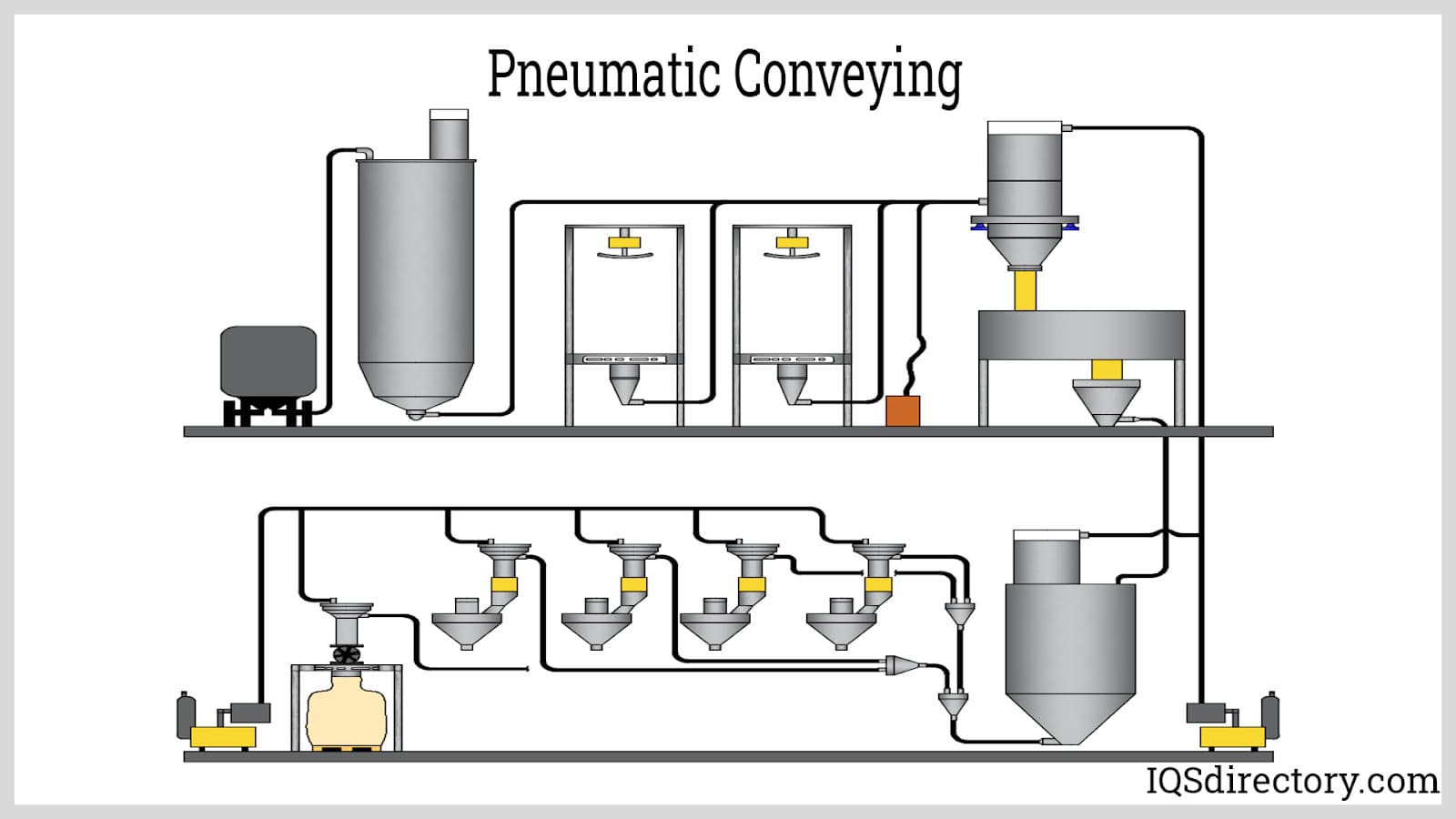 A method for transferring bulk materials, like powders and granules using air or gas to different processing centers.
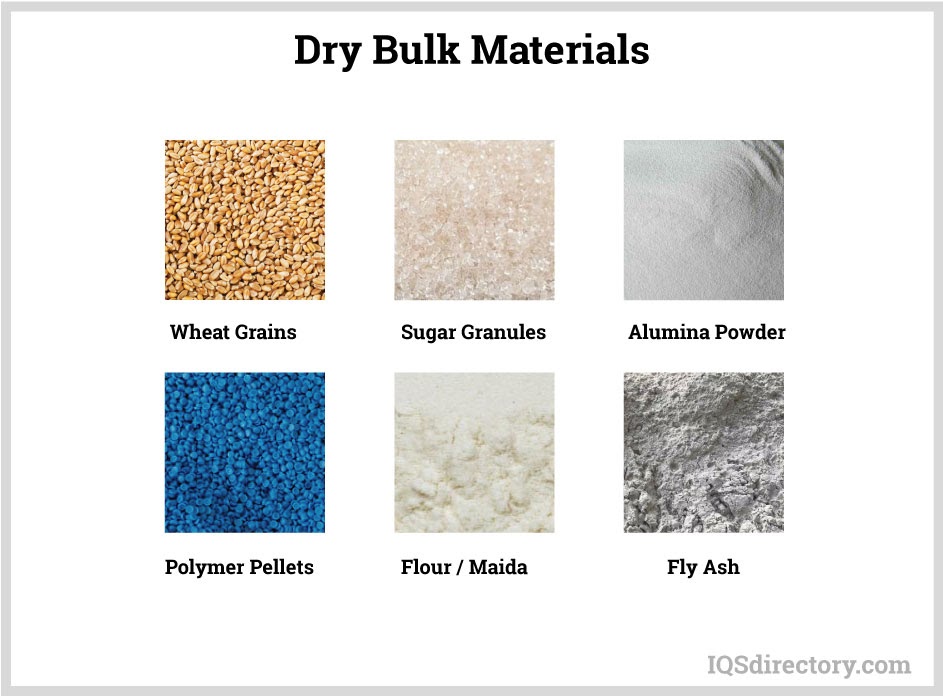 Examples of different materials that uses pneumatic conveying.
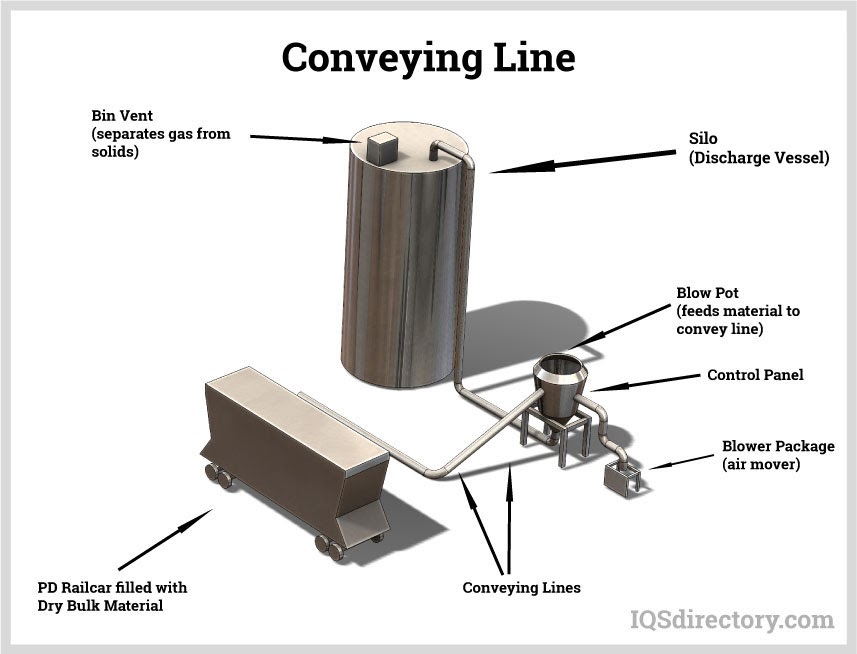 A Conveying lines is the method of transport.
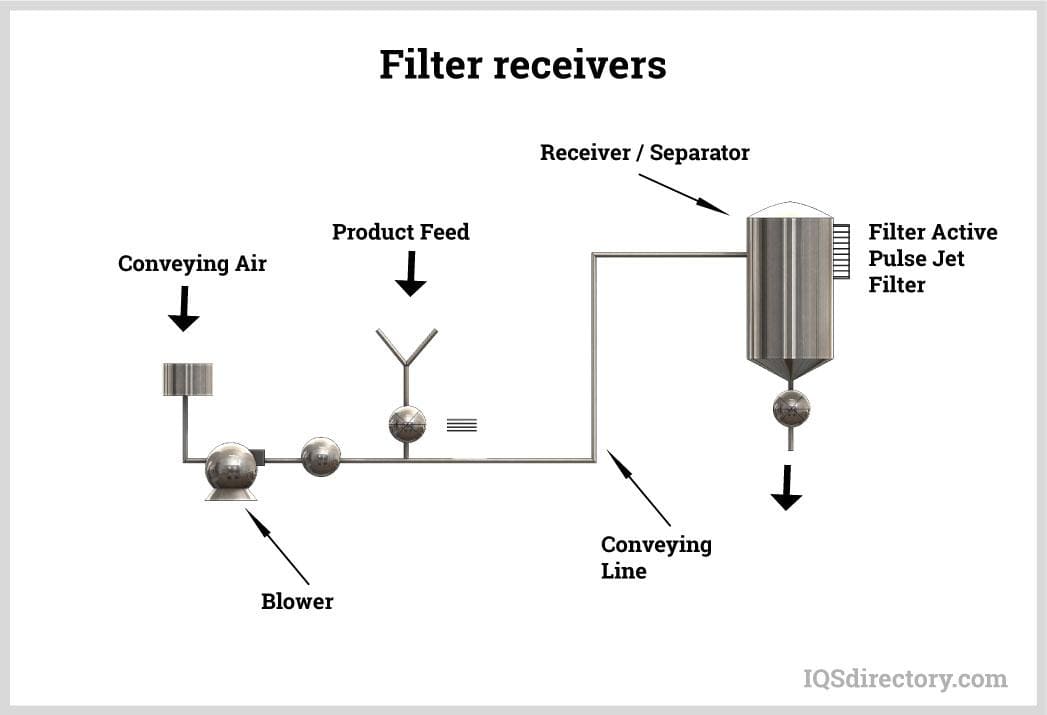 The Filter receivers separates airborne material from the material in the pneumatic conveying system.
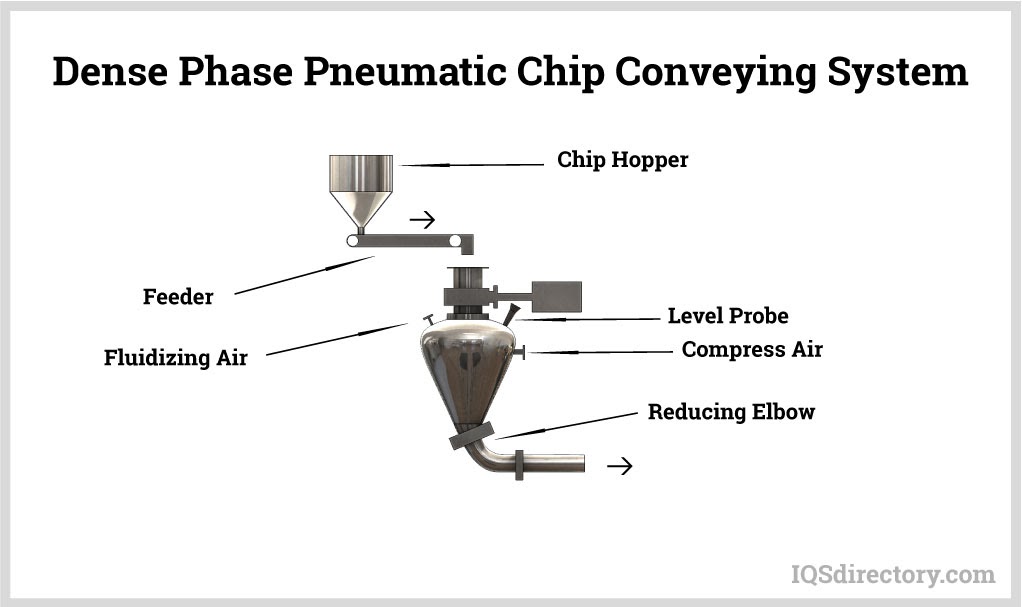 The Dense phase is the transfering of the material at a low velocity to prevent less damage to the machine parts.
Pneumatic Conveyors Types
- Abrasive Materials Conveyors
- Move coarse, rough materials at a slow pace. Abrasive materials conveyors often use compressed air to move the material through the system efficiently.
- Air Conveyors
- Use pneumatic power to transport materials.
- Bulk Bag Unloaders
- Provide efficient discharging of powders or other dry bulk materials from bags, which were used to provide storage or easy transport for otherwise difficult-to-handle materials.
- Bulk Conveyors
- Handle a variety of materials for a wide and ever-increasing range of industries. These conveyors fill bags with bulk materials and transport them.
- Dense Phase Conveying
- The process of transporting abrasive, friable or heavy materials such as sands, soils, minerals and rocks. Dense phase conveyors use an air compressor to generate high pressure levels to move materials slowly through the system.
- Dilute Phase Conveying
- The process of moving non-abrasive, light materials like powders and grains. Dilute phase conveyors use low pressure air levels during the quick transportation of materials through the system.
- Enclosed Conveyors
- Conveyor systems that are completely covered. Enclosed conveyors protect against product contamination and are particularly useful in applications involving the conveyance of sensitive products for many industries including the pharmaceutical, chemical and medical industries.
- Food Handling Conveyors
- Used in the food processing industry to convey a variety of food products including beans, nuts, powders and formulas. Because food handling conveyors transfer products that will eventually be ingested, cleaning is very important to avoid product contamination.
- Mobile Conveyors
- Rolled to and positioned at a desired discharge point. Material can be drawn from a container, a feedbin or a pickup adapter under a bin or process vessel.
- Pneumatic Conveying
- Uses forced gas to transport solid goods.
- Pneumatic Conveying Systems
- Consist of all of the components used in air-powered conveyors.
- Powder Conveyors
- Carefully and efficiently transport powders that could be potentially hazardous, like sodium sulfate.
- Powder Bulk Handling
- The process of industrial mixing, conveying, measuring or packaging of delicate, friable, sticky or free-flowing powdered solids.
- Railcar Unloading
- The method of transferring materials or products from railcars to storage such as silos or bins.
- Vacuum Conveyors
- Generated by compressed air-driven vacuum pumps that can be controlled automatically. When the material container is full, the vacuum pump is stopped and the bottom valve opens so the material can be discharged.
Pneumatic Conveyors Terms
- Air Compressor
- The piece of equipment that creates pressurized air above atmospheric level in a dense phase pneumatic conveyor system.
- Air Receiver
- A tank that holds compressed air obtained from the system's air compressor in a dense phase pneumatic conveyor system.
- Arching
- A no-flow condition in which material forms a stable arch (bridge) across the bin.
- Atmospheric Pressure
- The amount of force the atmosphere exerts upon the earth's surface. Air in a pneumatic conveyor with pressure greater than 14.7 psi is considered compressed, and pressure below 14.7 psi is considered a vacuum.
- Attrition
- The generation of fines or dust during solids handling. Highly sensitive solids prone to attrition include fragile granules (kitty litter), finished food products (chips), plastic pellets, and sugar or salt.
- Bin
- Container for bulk solids with one or more outlets for withdrawal, either by gravity alone or by flow-promoting devices which assist gravity.
- Bin Vent Filter
- In a pneumatic conveyor, the mechanism that removes or filters dust from system components, such as silos.
- Bridging
- Same as arching (a no-flow condition).
- Bulk Bag Equipment
- A type of process equipment used to hold and transport bulk bags. Bulk bags are industrial fabric containers used to store and transport dry, flowable materials.
- Bunker
- Same as bin, often used in reference to storing coal.
- Casters
- Wheels that make the pneumatic conveyors portable.
- Chute
- Means of collecting or directing material stream, which, unlike a hopper, does not operate full.
- Cylinder
- Vertical part of a bin which has a constant cross-section; can be any shape.
- Dense Phase Conveying
- This occurs when particles are conveyed in the gas stream at a velocity that is less than the saltation velocity. Two general modes of flow can result in dense phase, and are referred to as plug or piston flow and moving bed (dune) flow.
- Dilute Phase Conveying
- This occurs when particles are conveyed in the gas stream at a velocity that is greater than the saltation and choking velocities.
- Discharger
- Device used to enhance material flow from a bin but which is not capable of controlling the rate of withdrawal.
- Diverter Valve
- A mechanism that changes/diverts material flow in pneumatic conveyors to a different direction.
- Effective Head
- Convenient way to express consolidating pressure by dividing it by bulk density.
- Elevator
- Same as bin, often used in reference to storing grains.
- End Receiver
- The mechanism that transfers the conveyed material from the tubing to the receiving bin.
- Expanded Flow
- Flow pattern that is a combination of mass flow and funnel flow.
- Feeder
- Device for controlling the rate of withdrawal of bulk solid from a bin.
- Flooding, Flushing
- Condition where an aerated bulk solid behaves like a fluid and flows uncontrollably through an outlet or feeder.
- Flow Channel
- Space in a bin through which a bulk solid is actually flowing during withdrawal.
- Flow Properties Test Report (FPTR)
- Jenike and Johanson’s bulk material characterization report typically containing results for a material’s cohesive strength, bulk density range, coefficient of sliding friction against hopper wall surfaces, moisture content, particle size distribution, and permeability. These are the core characteristics needed to properly design a mass flow bin and feeder.
- Fluidization
- Using air or inert gas to fully aerate a fine bulk solid to allow it to behave as a liquid.
- Footprint
- The total space that pneumatic conveyors occupy on the production floor.
- Funnel Flow
- Flow pattern in which solid flows in a channel formed within stagnant material.
- Hopper
- Converging part of a bin.
- Horsepower (HP)
- A measure of the time rate of doing work.
- Mass Flow
- Flow pattern in which all solid in a bin is in motion whenever any of it is withdrawn.
- P-Factor
- The ratio of the applied solids compacting pressure to the solids pressure during steady gravity flow.
- Pickup Velocity
- This is the gas velocity at the pickup point of the conveying system where solids are introduced into the conveying gas stream.
- Piping
- The tubes through which the conveyed material travels to reach the intended destination. Pneumatic conveyor piping is arranged in a network that travels through the facility, avoiding obstacles.
- Pneumatic Piping System
- The entire system of pneumatic conduits used to transfer air or other gases between various operating components of the pneumatic system such as pumps, valves and actuators of the pneumatic conveyors.
- Pressure
- Force per unit of area.
- Psi (Pounds per Square Inch)
- A unit that measures the amount of pressure applied to an object.
- Powder Handling
- The process of industrial mixing, conveying, measuring or packaging of delicate, friable, sticky or free-flowing powdered solids.
- Ratholing
- A no-flow condition in which material forms a stable vertical hole within the bin.
- Receiving Bin
- Pneumatic conveyor component that obtains or receives conveyed material.
- Relief Valve
- A mechanism attached to different pneumatic conveyors components that alleviates built up pressure created by the system.
- Rotary Valve
- A mechanism responsible for releasing pneumatic conveyors materials under gravitational pressure.
- Saltation Velocity
- The gas velocity at which particles fully suspended within a horizontal conveying line begin to drop out of suspension and settle in a layer on the bottom of the pipeline.
- Sifting Segregation
- Separation of bulk solids by their size, shape, or particle density. There are several ways bulk solids can separate.
- Silo
- A large container in which material is stored prior to conveyance.
- State Diagram
- The plot of pressure drop as function of conveying gas velocity over range of solids loading. This diagram defines conveying modes of dilute and dense phase transport.
- Tubing Bend
- Sections of tubes containing various degrees of curvature to facilitate the efficient maneuvering of pneumatic conveyors pipes, through which conveyed materials are transported.
- Transporter
- A container in pneumatic conveyors that stores material to be conveyed at a certain rate. Dense phase pneumatic conveyor transporters often accept compressed air into the container to move or transport the material under pressure.