Hydraulic Presses
A hydraulic press is an industrial press machine that uses hydraulic pressure, transmitted through fluid-filled cylinders, to generate compressive force for shaping, forming, stamping, molding, and assembling materials. These press machines apply controlled downward force to a substrate and die, allowing manufacturers to produce repeatable parts, tight tolerances, and dependable production results across metalworking and other fabrication processes.
Hydraulic presses operate according to Pascal’s principle, which means pressure in a closed hydraulic system is distributed evenly and can be converted into substantial pressing force. That operating principle helps hydraulic press manufacturers deliver machines that outperform many pneumatic and mechanical presses in force consistency, control, stroke flexibility, overload protection, and suitability for demanding industrial applications.
Hydraulic Presses FAQs
What is a hydraulic press and how does it work?
A hydraulic press uses hydraulic fluid, cylinders, and pistons to generate high compressive force for metal forming, molding, stamping, and assembly work. By applying pressure evenly throughout a closed system, it shapes materials with repeatable accuracy, controlled tonnage, and efficient production performance.
What are common applications of hydraulic presses in manufacturing?
Hydraulic presses are used for stamping, forging, blanking, punching, clinching, deep drawing, compression molding, laminating, and straightening. Automotive, aerospace, appliance, packaging, defense, and general manufacturing operations rely on them when precise force, repeatable part quality, and production efficiency matter.
Why are hydraulic presses preferred over mechanical or pneumatic presses?
Hydraulic presses deliver consistent force throughout the stroke, offer adjustable speed and dwell control, and include overload protection that helps protect tooling and equipment. They also tend to run more quietly than many mechanical presses and give operators better process control for demanding forming applications.
What types of hydraulic presses are available for industrial use?
Industrial options include C-frame presses, H-frame presses, forging presses, platen presses, shop presses, extrusion presses, vacuum presses, and stamping presses. Each configuration supports different tonnage ranges, work envelopes, material-handling needs, and production goals, making application-specific press selection much easier.
How do manufacturers customize hydraulic presses for different applications?
Manufacturers can customize hydraulic presses by adjusting tonnage, stroke length, daylight, bed size, frame style, controls, die dimensions, hydraulic fluid selection, and station configuration. That flexibility supports everything from laboratory testing and short runs to automated heavy-duty production systems above 3,000 tons.
What maintenance practices keep hydraulic presses operating efficiently?
Routine maintenance includes checking for leaks, monitoring oil level and cleanliness, inspecting seals, hoses, fittings, and wiring, and keeping operating temperature near 120°F. Preventive service helps reduce downtime, protect press performance, and extend the working life of hydraulic components.
What safety features make hydraulic presses reliable for operators?
Many hydraulic presses include relief valves, pressure controls, and overload protection that help prevent excessive force, tooling damage, and machine failure. These safeguards improve operator safety and support dependable performance in industrial production environments.
Applications of Hydraulic Presses
Hydraulic presses are used across manufacturing because they can stamp, form, bend, punch, clinch, shear, mold, draw, and blank materials with a high degree of force control. Whether a company is producing heavy-gauge metal parts, formed sheet components, molded composites, or assembled subcomponents, a hydraulic press supports precision production, repeatability, and efficient workflow planning.
Common hydraulic press applications appear in automotive manufacturing, aerospace fabrication, appliance production, packaging, ceramics, defense work, food and beverage processing, pulp and paper operations, and marine manufacturing. Buyers often ask which hydraulic press machine best fits beverage can production, automotive parts, structural components, or custom formed parts, and the answer usually depends on tonnage, tooling, cycle time, material type, and production volume.
The History of the Hydraulic Press
The hydraulic press was first invented in England in 1795 by Joseph Bramah, who was inspired to explore the properties of fluids following his development of the flush toilet. As a result, hydraulic presses are sometimes referred to as Bramah presses. His invention was based on the Pascal principle, or Pascal’s law, which asserts that pressure within a closed system remains constant and is transmitted equally in all directions.
At the time of its invention, the hydraulic press had few comparable technologies, making Bramah a pioneer in hydraulic engineering. His foundational work set the stage for the development of numerous variations on the original hydraulic press, leading to the vast range of models and applications in use today.
Benefits of a Hydraulic Press
The value of a hydraulic press goes far beyond raw tonnage. For many manufacturers, the bigger advantage is the ability to combine high force output with predictable control, safer operation, process flexibility, and long-term production consistency.
- Low Upfront Investment and Operating Cost
- Hydraulic presses are cost-effective due to their simple construction and minimal number of moving parts. This makes them inexpensive to purchase, easy to maintain, and straightforward to troubleshoot when compared to alternative press technologies. If a component fails, replacement is quick and does not require complete disassembly of the machine. Additionally, hydraulic equipment and supplies are readily available worldwide, ensuring minimal downtime and low maintenance costs.
- Operation of Power Stroke
- Unlike other types of presses that only deliver full power at the bottom of the stroke, hydraulic presses exert full power at any point in the stroke. This eliminates the need to invest in a heavier press—such as a 200-ton press—simply to achieve a lower force, like 100 tons, consistently throughout the stroke. This capability is particularly beneficial for drawing operations where precision and controlled force application are important.
- Easy Operation and Built-in Protection
- A hydraulic press designed to exert a specific pressure, such as 100 tons, will apply that exact force regardless of setup errors, making it highly reliable and foolproof. Operators do not need to worry about overloading, breaking a die, or damaging the press. When a hydraulic press reaches its set pressure, the relief valve automatically opens to prevent excessive force, eliminating the risk of overload.
- Control and Flexibility
- Hydraulic presses offer a high degree of control, allowing operators to adjust various parameters according to specific application requirements. These include pressure dwell duration, direction of movement, ram force, speed, and force release. This level of flexibility ensures optimal performance for diverse manufacturing needs.
- Lower Operation Noise
- Because hydraulic presses lack flywheels and have fewer moving parts, they operate with significantly less noise than mechanical presses. Modern hydraulic presses, when equipped with a properly mounted pumping unit, comply with and often exceed current federal noise regulations, contributing to a quieter and safer work environment.
- Long Machine Tool Life
- The built-in overload protection of hydraulic presses extends the lifespan of tools. Since the pressure applied remains consistent, the risk of tool damage due to overloading is eliminated. Additionally, the absence of shock, vibration, and impact reduces wear and tear on auxiliary equipment, such as press brakes and machine guards, leading to longer service life and reduced operational costs.
How Hydraulic Presses Work
A hydraulic press works by moving pressurized hydraulic fluid through interconnected cylinders to multiply force and transfer it to the workpiece. The process begins when fluid is directed into a small double-acting cylinder, sometimes by a pump and sometimes by manual input. Inside this cylinder, a sliding piston pushes fluid through hydraulic lines and into a larger master cylinder. Because pressure is transmitted evenly, the larger piston can apply substantial forming force to a ram, platen, die, or work surface during the pressing cycle.
As pressure builds within the system, the press applies controlled force against the anvil, bed, baseplate, or tooling set. That force can be used to shape sheet metal, compress molded materials, seat components, straighten parts, or complete deep-drawing and forging operations with a high level of repeatability.
To help prevent overload, the hydraulic circuit uses pressure regulation and relief valves that respond when preset limits are reached. This allows the machine to maintain controlled operation, support more consistent forming results, and reduce the chance of tooling damage, press damage, or avoidable production interruptions.
Hydraulic Press Images, Diagrams and Visual Concepts
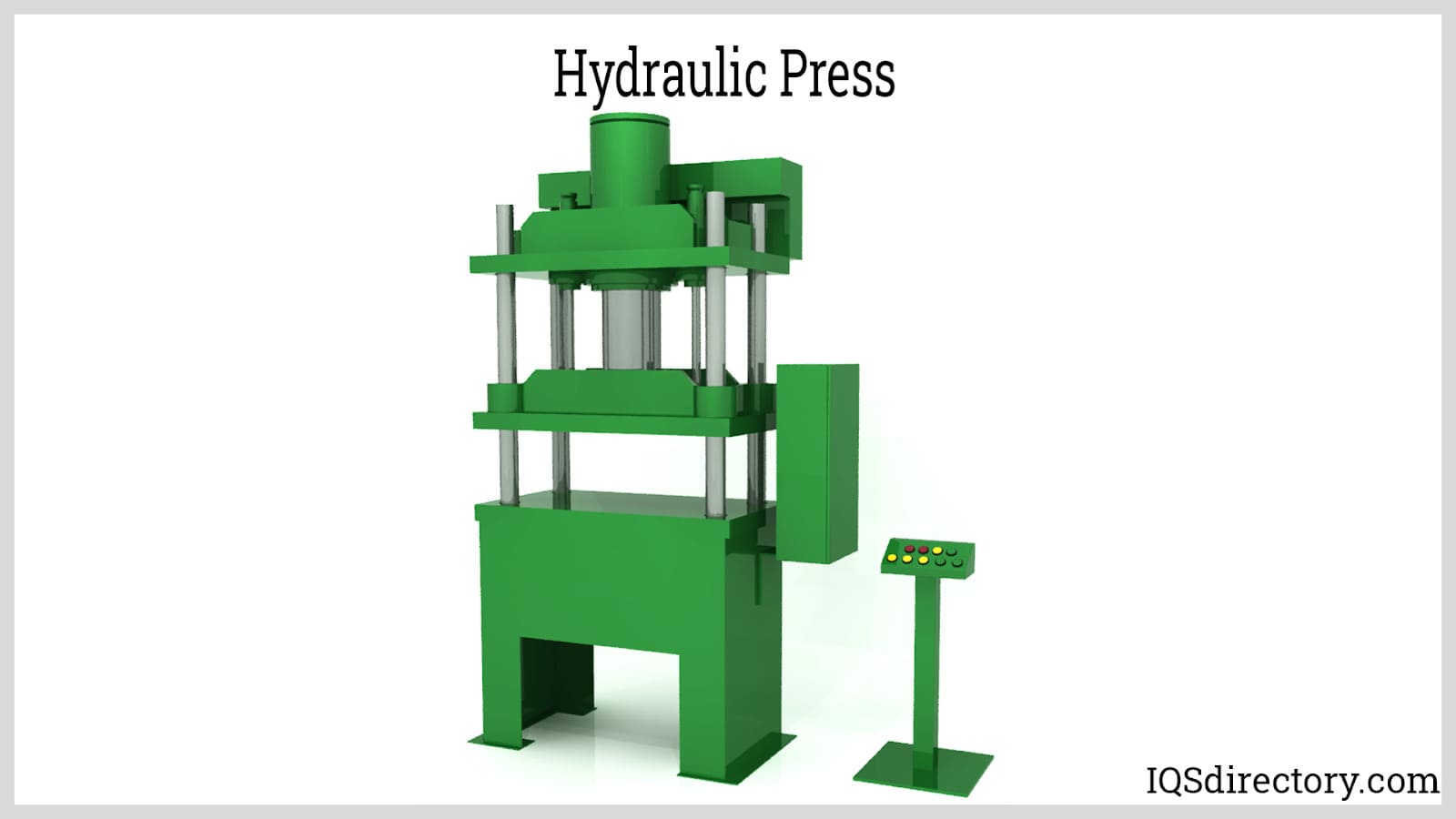 hydraulic press uses liquid static pressure to configure different materials into different shapes.
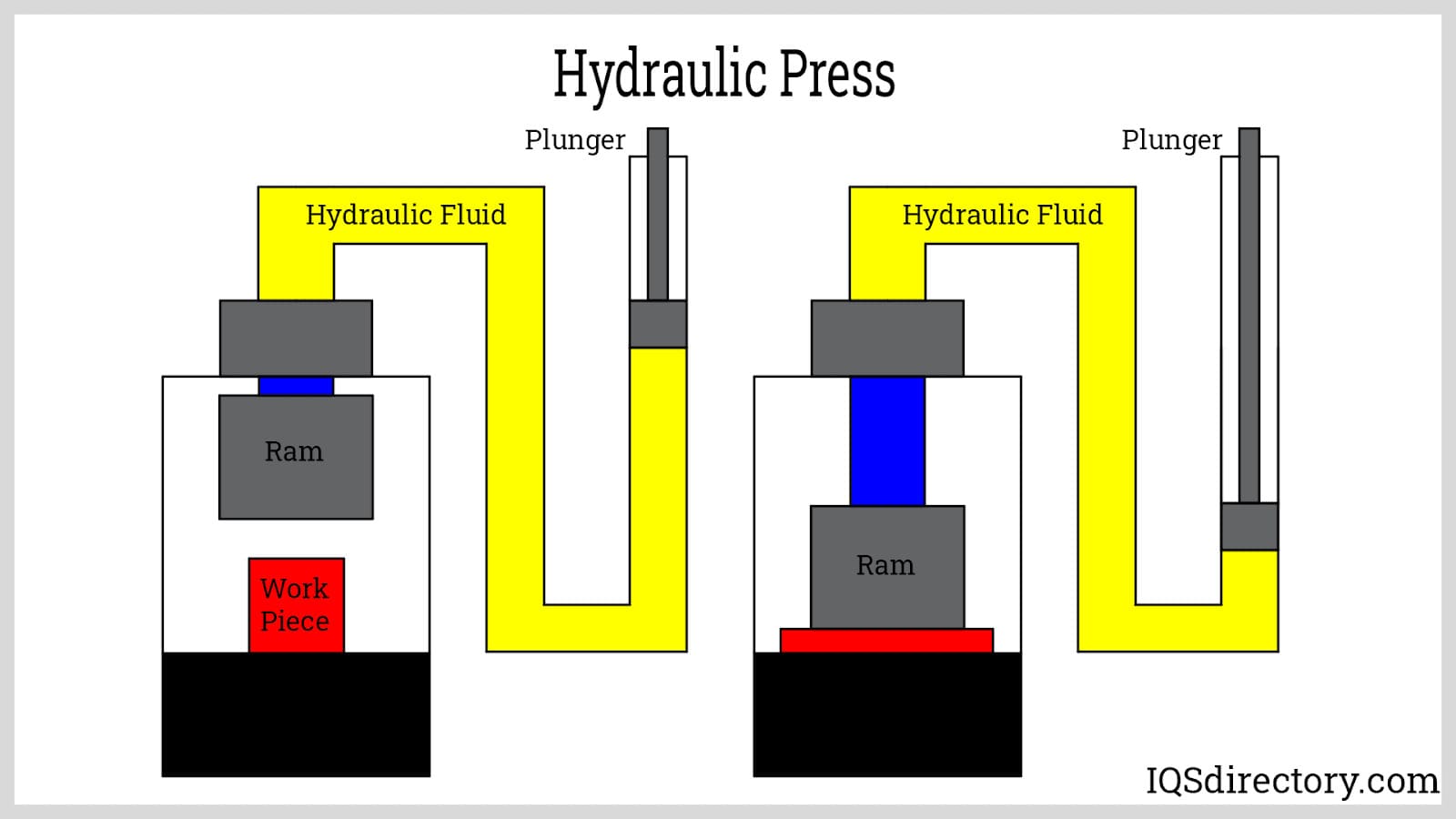 The hydraulic press uses the plunger displaces the fluid and extends the ram to shape the material.
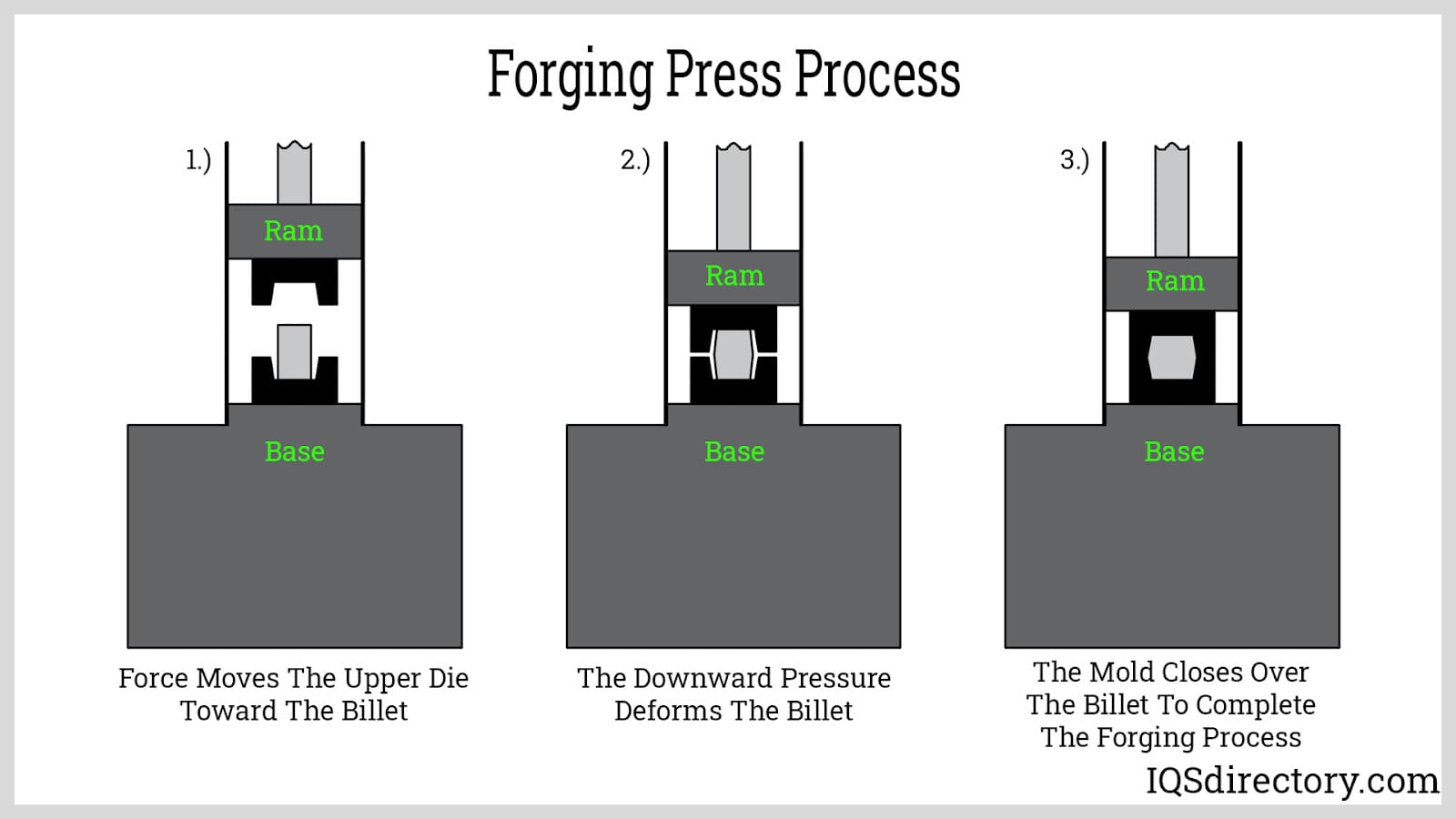 Forging presses use a vertical ram to apply gradual, controlled pressure to the workpiece inside a die.
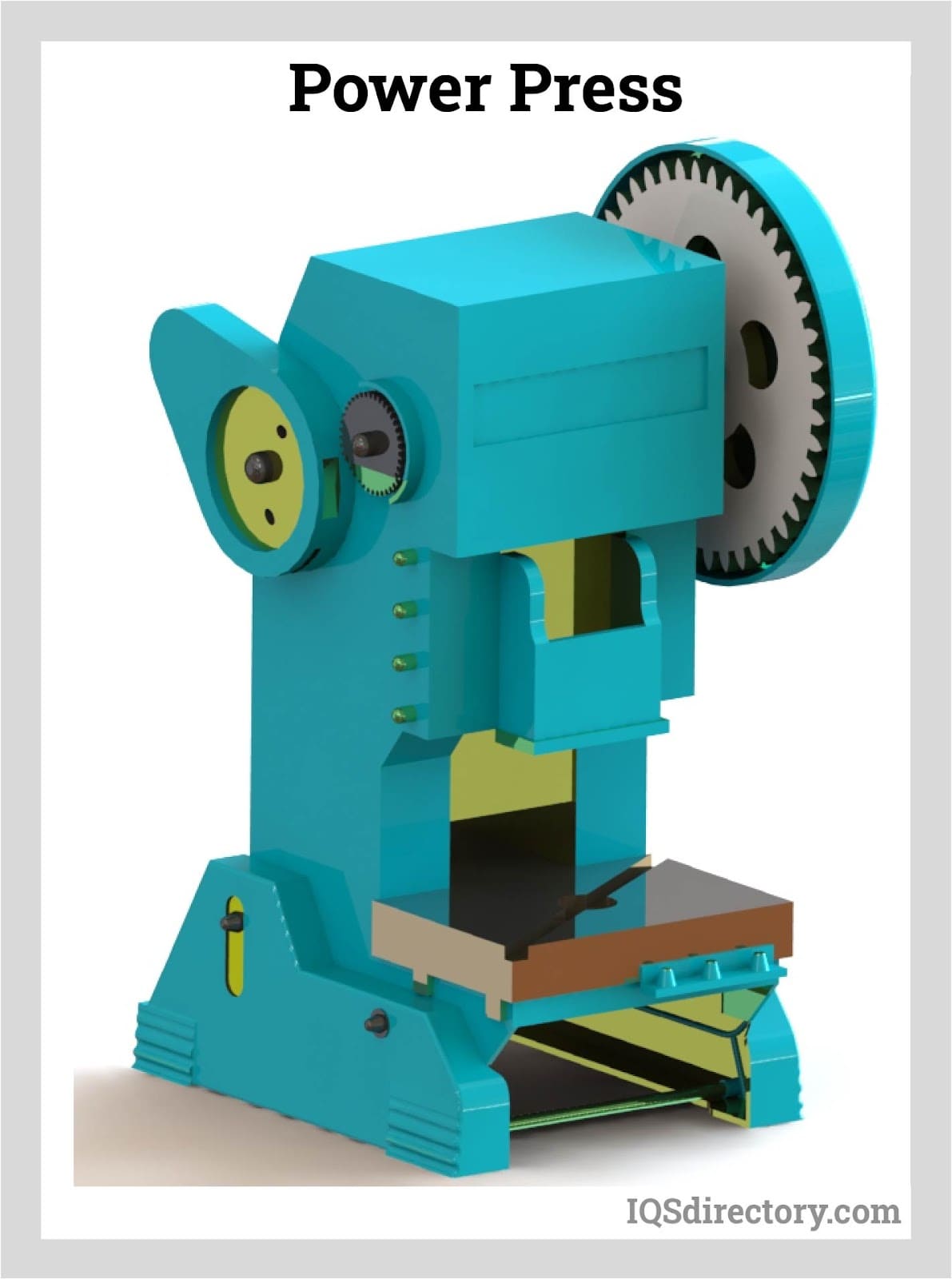 Power presses cut or shape any type of sheet metal to the required shape.
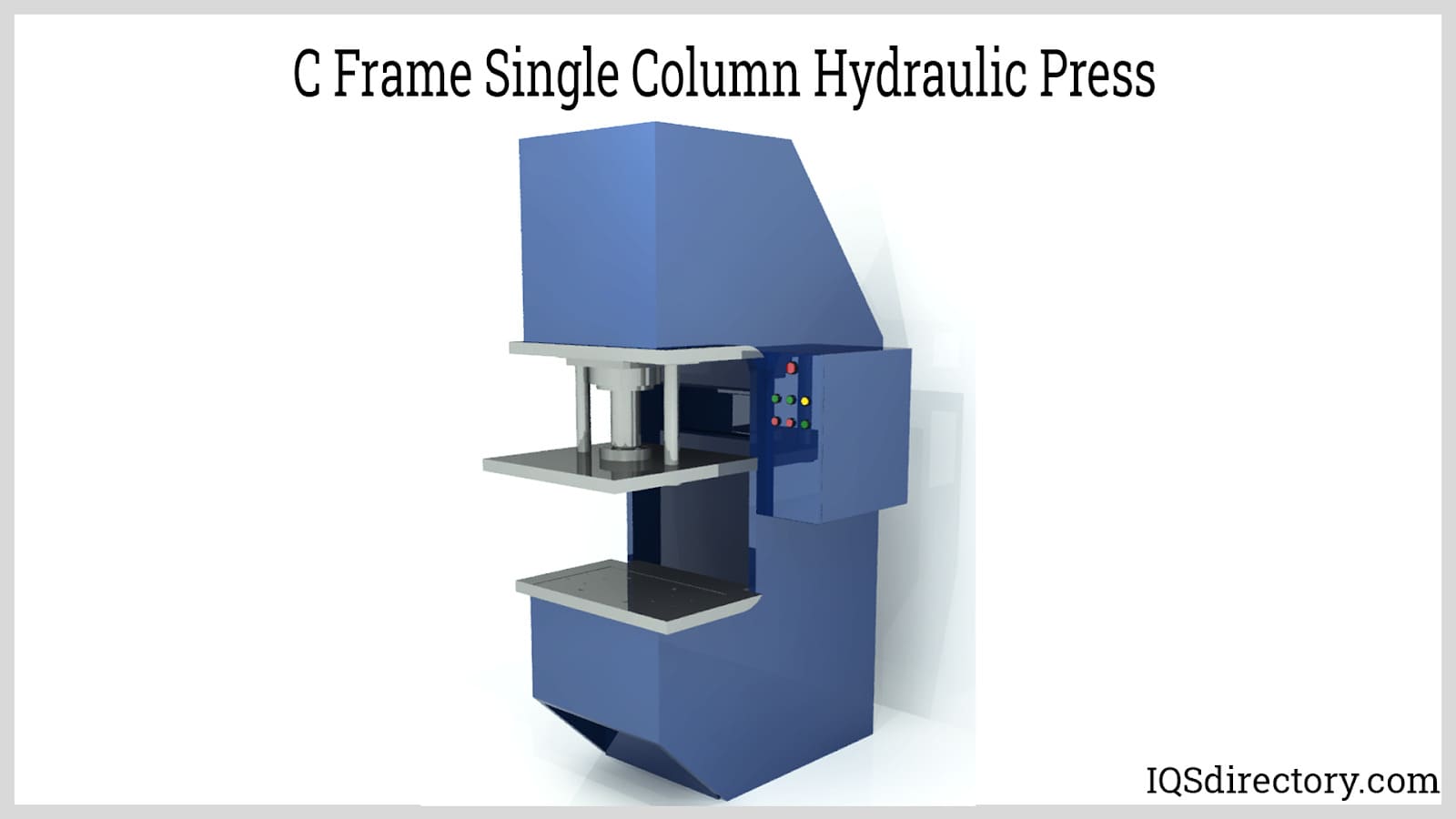 Single column C frame hydraulic presses have excellent rigidity, guide performance, speed, and exceptional precision.
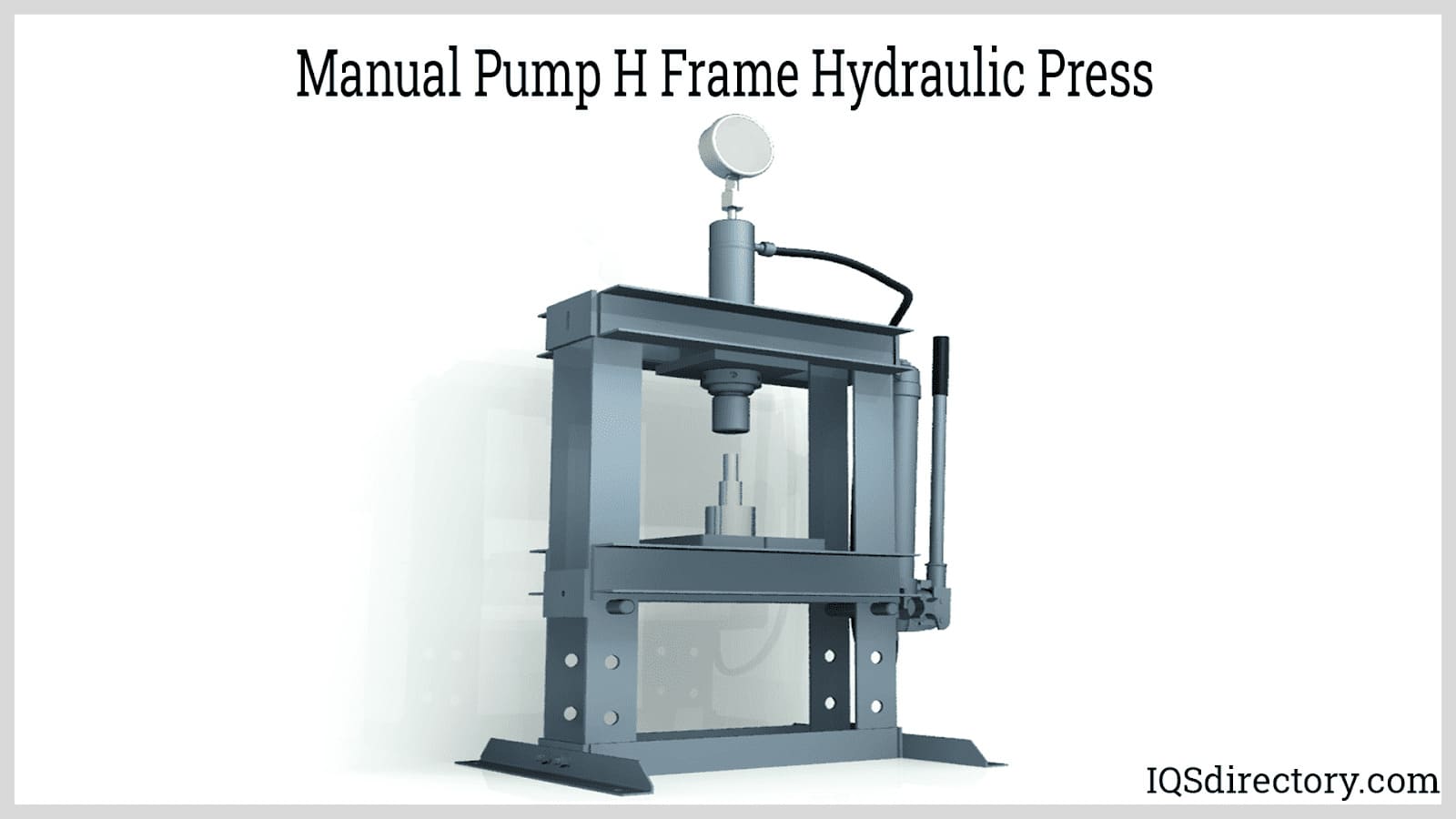 H frame presses can either be manual or automatic depending on the function.
Types of Hydraulic Presses
- Arbor Presses
- Designed for high-pressure assembly, repair, and production tasks, arbor presses are widely used for seating, stamping, and removing bearings.
- Assembly Presses
- These presses apply immense pressure to securely fasten or assemble multiple parts together with precision and stability.
- C-Frame Presses
- Named for their compact, C-shaped frame, these presses are streamlined in size and typically used for single press applications.
- Compression Molding Presses
- These presses function by pressing two plates together to compress material within a mold, forming the desired shape.
- Forging Presses
- Hydraulically powered metal-forming machines that force metal blocks into specific shapes using molds, extreme force, and pressure—sometimes combined with heat—to achieve the final product.
- Platen Press
- A broad category of hydraulic presses that utilize a ram and a solid, stable surface to carry out a range of forming and shaping operations.
- Hydraulic C-Frame Press
- With a space-saving yet sturdy C-shaped frame, these presses handle a variety of industrial applications, including forming, straightening, blanking, punching, drawing, and riveting. They are available in both manual and automatic configurations.
- H-Frame Hydraulic Press
- Distinguished by their welded H-shaped frame, also known as 4-column presses, these machines can support multiple press applications simultaneously. They are commonly used for coining, crimping, bending, punching, and trimming, offering greater versatility than C-frame presses.
- Extrusion Press
- Designed for metalworkers and manufacturers, extrusion presses push material through a die to create a fixed cross-sectional profile, enabling precision extrusion of metal and other materials.
- Laboratory Presses
- Compact, single-run hydraulic presses primarily used in research laboratories for short production and test-run scenarios.
- Laminate Press (Laminating Press)
- Manually operated compression presses equipped with two plates—one for heating and one for cooling—allowing simultaneous heating and cooling to speed up the lamination process. These presses are commonly used to laminate polymers onto surfaces such as wood, metal, and paper.
- LIM Presses
- Specialized hydraulic presses designed for liquid injection molding, handling plastics that are formed through an injection process.
- Vacuum Press
- Engineered for specialized applications such as film application and material encapsulation in industries like electronics, credit card production, and ID card manufacturing.
- Stamp Press (Stamping Press)
- Used for shaping or cutting materials with a die, these presses are widely employed in metalworking and automotive industries for precision stamping operations.
- Transfer Press
- These presses automate the stamping and molding process by feeding flat plastic, rubber, or metal blanks into the press. Feed bar fingers then transport the part from one die to the next, making them ideal for high-efficiency manufacturing in medical and aerospace industries.
- Press Brake
- Used for bending and folding sheet metal, these machines typically feature two C-frames, a movable beam, and a bottom tool mounted on a table. Hydraulic press brakes operate with synchronized hydraulic cylinders that control movement, and when automated, they are classified as CNC press brakes.
- Hydraulic Forge Press (Forging Press)
- Exclusively used for metal forging, these presses force metal blocks into molds under extreme force, pressure, and sometimes heat. The process stretches the metal beyond its yield point without breaking it, making forge presses widely used for vehicle manufacturing and other heavy-duty applications.
- Shop Press
- Primarily used in automotive repair, shop presses are versatile machines capable of removing, repairing, and setting bearings, bushings, U-joints, and more. They are also used for straightening bent parts, making them a practical choice for small garage businesses.
- Non-Hydraulic Presses
- A hydraulic press is a type of power press, but there are alternatives, including mechanical, electric, and pneumatic presses.
- Mechanical Press
- Utilizing a flywheel to store and release energy, these presses shear, punch, form, or assemble materials through tools or dies attached to slides or rams. Mechanical presses are categorized by the number of slides or rams they use—single, double, or triple action—and their stroke adjustability allows precise control over pressing operations.
- All-Electric Press
- A more recent innovation, these presses employ advanced drive systems where the ram is directly linked to the drive motor, providing efficient control over speed and eliminating hydraulic fluid variations, which can fluctuate due to temperature and time.
- Pneumatic Press
- Capable of performing operations similar to hydraulic presses, such as piercing, stamping, bending, and punching, pneumatic presses operate at speeds of up to 400 strokes per minute. They rely on compressed air for movement rather than rotary motion, reducing the number of moving parts compared to hydraulic and mechanical presses. However, pneumatic presses cannot achieve the extreme pressures that hydraulic presses can generate.
- Platen Presses
- Large-scale industrial hydraulic presses that use two heated steel plates to crush, mold, condense, or form materials into specific shapes.
- Power Presses
- Hydraulic-powered machines equipped with tools and dies for shearing, punching, and forming metal parts.
- Press Brakes
- Manual, mechanical, or hydraulic pressing machines that shape sheet metal through bending and folding. Hydraulic press brakes are controlled by synchronized hydraulic cylinders for precision metal forming.
- Stamping Presses
- Presses designed to stamp materials using specialized dies, enabling precision shaping and cutting operations in metalworking.
- Straightening Presses
- Designed to apply pressure to metal surfaces to straighten and align them with high accuracy.
- Tableting Presses
- Used for compressing powdered materials into uniform tablets or compacted shapes for pharmaceutical and industrial applications.
- Transfer Presses
- Hydraulic presses that automatically move parts from one stamping station to another using feed bar fingers, improving efficiency and consistency in high-volume production.
- Vacuum Presses
- Industrial hydraulic presses that utilize air pressure to create the necessary force for laminating and bonding applications, ensuring uniform adhesion of materials.
System Equipment Components of Hydraulic Presses
A hydraulic press is built around core system components that create and direct hydraulic force. In its basic form, the machine includes double-acting cylinders, pistons—also referred to as punches—hydraulic lines, valves, a frame, and a stationary anvil or die that supports the material-forming process.
The system typically uses cylinders of different sizes, including a smaller slave cylinder and a larger master cylinder, to multiply force and deliver it where it is needed. Pistons create the thrusting motion, valves regulate fluid flow and pressure, and the anvil or die defines the final geometry of the workpiece as it moves through the forming cycle.
Design and Customization of Hydraulic Presses
Hydraulic presses are designed for a wide range of tonnage requirements, from compact laboratory and shop press applications to large industrial systems rated for thousands of tons. This broad capacity range helps buyers match press size, frame design, and operating force to the parts, materials, and production goals they are targeting.
Constructed from materials such as stainless steel, high-strength steel alloys, aluminum, and brass, hydraulic press systems are built for durability, long service life, and dependable operation. They are available in single-station and multi-station configurations depending on whether the application calls for dedicated tooling or progressive production capability.
Single-station presses use one primary tooling setup, such as a die and punch mounted within a work area, while multi-station presses support multiple operations within one system. In progressive or transfer-style production, this can improve throughput, reduce handling time, and support more efficient part flow from one stage to the next.
Manufacturers can further tailor a hydraulic press by adjusting tonnage limits, stroke length, bed size, daylight opening, die design, controls, guarding, automation features, and hydraulic fluid selection. When buyers ask how to choose the right hydraulic press, these design variables often determine whether the machine is best suited for short runs, repeat production, custom fabrication, or high-volume manufacturing.
Things to Consider When Purchasing Hydraulic Equipment
Proper maintenance helps hydraulic equipment run efficiently, safely, and predictably over time. When comparing hydraulic press machines or planning preventive service, the following maintenance practices can help reduce downtime, improve operating life, and support more stable production output.
- Don’t Allow Leaks
- A leaky hydraulic system significantly reduces performance and efficiency. Operators should routinely inspect O-ring seals, the ram of the press, hydraulic lines, hose end fittings, and valve seats for any signs of leakage. Addressing leaks early prevents costly downtime and extends the machine’s lifespan.
- Don’t Exceed Load Limits
- Always ensure that the press operates within its designated load capacity. Applying a load heavier than the specified tonnage can place undue stress on the machine, leading to breakage, system failure, and potential safety hazards for operators.
- Keep a Well-oiled Machine
- To minimize wear and support smooth operation, hydraulic machines should remain properly lubricated, particularly around seals and moving contact points. It is also important to use the hydraulic fluid specified in the operator’s manual so the system maintains stable pressure, dependable sealing, and consistent overall performance.
- Check Pressure Build-up Speed
- A properly functioning hydraulic press should reach its working pressure within half a second to one second. If it takes more than two to three seconds to achieve the preset pressure, there may be an issue with the pump or relief valve. In many cases, the problem stems from an insufficient pump revolution rate. Valve-related issues, such as dirt in the hydraulic lines or an excessively wide valve opening, can also contribute to pressure buildup delays.
- Listen for Unfamiliar Machine Sounds
- Operators should promptly investigate any unfamiliar noises during operation. Banging sounds are often caused by valve shifts, while other abnormal noises may result from insufficient lubrication. Identifying the source early and addressing it can prevent serious mechanical failures.
- Check Electronic Machine Elements
- Hydraulic presses rely on various electronic components, including coils and relays, which have finite life cycles. Coils typically last for 3 million strokes, while relays are designed for around 1 million strokes. Regular replacement of these components reduces troubleshooting efforts and machine downtime. To streamline maintenance, use an hour meter and a non-resettable cycle counter to track machine performance and anticipate necessary replacements.
- Check Other Machine Elements
- Regular checks on machine fittings, wiring, and hoses matter for both performance and safety. Frayed hoses, loose connections, and poorly crimped fittings can lead to plumbing failures, fluid loss, and unstable press behavior, so these items should be inspected and corrected before they disrupt production.
- Maintain Oil and Temperature During Operation
- One of the simplest ways to extend the life of a hydraulic press is by maintaining proper oil levels and ensuring oil cleanliness. Running the machine with low or contaminated oil can lead to damage and reduced performance. Regular oil sampling helps detect dirt and contaminants—if present, changing the filter is necessary to maintain system health.
- Temperature control is equally important. The optimal operating temperature for hydraulic presses is around 120°F. If temperatures rise beyond this threshold, system efficiency declines, leading to increased wear and potential failure. Using air and water coolers can help regulate temperature, but these units, especially radiators, require regular cleaning and maintenance to function effectively.
Choosing the Right Hydraulic Press Manufacturer
For the best results from specification through installation, it helps to work with a reputable hydraulic press manufacturer that understands your application, production goals, tonnage needs, and service expectations. Because supplier quality can vary, buyers should look beyond marketing claims and compare build quality, engineering support, customization options, and after-sale responsiveness.
To simplify your search, we have compiled a list of reputable manufacturers. Visit their websites, compare their offerings, and evaluate their customer service. When you're ready, reach out with your specifications and assess their responsiveness, expertise, and overall service quality. By taking the time to compare and contrast, you can confidently choose a manufacturer that aligns with your needs.
Hydraulic Press Terms
- Actuator
- A mechanical device that transforms fluid power into linear or rotary motion, driving movement within a hydraulic system.
- Age
- The required waiting period between molding and evaluating the physical properties of a molded part.
- Backrind
- A molding defect occurring at the parting line, where material shrinkage results in an internal indentation.
- Bed
- The flat, stable surface that supports the material being processed during press operations.
- Bolster
- Plates attached to the rods that support the platens or any structure mounted to the bed of a press. Some bolsters are designed to be removable.
- Check Valve
- A valve that permits hydraulic fluid flow in only one direction, preventing backflow and maintaining system pressure.
- Compression Set
- The residual deformation left after a compressive force is removed. For example, when a molded material is pressed with a fingernail, the impression that remains over time is an example of compression set.
- Contact Gauge
- A hydraulic system component that automatically turns the system on or off when the pressure reaches preset thresholds.
- Cylinder Assembly
- The complete assembly within a hydraulic press that includes the cylinder, piston, ram, seals, and packing, all working together to generate force.
- Daylight
- The maximum vertical clearance a press can accommodate, measured from the underside of the ram to the top of the bolster when the ram is in its fully raised position.
- Die
- A precision tooling component in a hydraulic press used for shearing, punching, forming, drawing, or assembling materials.
- Gate
- The final opening through which injected material flows before entering a part cavity during the molding process.
- Heat Exchanger
- A system that circulates air or water to regulate oil temperature, ensuring consistent hydraulic system performance.
- Hydraulic Pressure
- The force exerted by pressurized fluid within a hydraulic system, enabling mechanical movement.
- Hydraulic Cylinders
- Devices that generate linear motion and force through the controlled application of pressurized hydraulic fluid.
- Hydraulic Pump
- A mechanical component that converts energy into pressurized fluid flow, delivering hydraulic power to the system’s components.
- Hydraulic Seals
- Specialized devices that prevent hydraulic fluid leakage while blocking contaminants from entering the system.
- Hydraulic Valves
- Key components that control the flow and pressure of hydraulic fluid, directing movement and force within the hydraulic power system.
- Knockout
- A mechanism used to eject a finished part from the punch or die after processing.
- Low Pressure System
- A function allowing the press to operate continuously at no more than 10% of its maximum rated force, often used for preheating applications at reduced pressure.
- Platen
- A flat, rigid surface where the mold is attached. Hydraulic presses typically feature one stationary platen and one movable platen to facilitate pressing operations.
- Rod or Tie Rod
- A long, sturdy shaft that connects different press components, ensuring synchronized movement and structural integrity.
- Shut Height
- The vertical clearance above the bed when the ram is fully lowered, defining the maximum height of workpieces that can be processed.
- Sprue
- The main feed channel that directs molten material from the outer face of an injection or transfer mold into a single cavity or multiple cavity mold system.
- Stroke Control
- An adjustable feature that regulates the length of the press stroke, allowing operators to customize movement according to specific application needs.
- Throat Clearance
- The distance from the press frame behind the bed to the vertical centerline of the ram. This measurement determines the maximum width of workpieces that the press can accommodate.