Broaching
Broaching is a precision material removal and metal machining process used to shape, size, and form a wide range of materials and part geometries. While it is often associated with external surface work, both external and internal broaching can be performed by manufacturers.
As a precision machining and metal removal service, broaching can be applied to various materials, including ferrous and nonferrous metals, stainless steel, aluminum alloys, plastics, and wood, making it useful for both prototype evaluation and repeatable production machining.
Broaching FAQs
What is broaching used for in manufacturing?
Broaching is a precision machining process used to create shapes such as keyways, holes, splines, serrations, slots, and other internal or external profiles in metals, plastics, and wood. It is widely used for producing high-tolerance parts with repeatable accuracy, smooth finishes, and efficient cycle times in industries such as automotive, aerospace, power generation, and industrial equipment manufacturing.
How does internal broaching differ from surface broaching?
Internal broaching cuts shapes inside a pre-existing hole using a toothed tool that passes through the workpiece to generate precise internal forms such as splines, keyways, and polygonal openings. Surface broaching, on the other hand, cuts along the external surface to produce flat, contoured, or stepped finishes for machined components that need consistent geometry and repeatable dimensional control.
What advantages does broaching offer manufacturers?
Broaching offers excellent dimensional accuracy, close tolerances, strong repeatability, and smooth surface finishes. It is fast, highly efficient, and well suited for automated or semi-automated production, often reducing or eliminating secondary machining and finishing operations on high-volume parts.
What types of machines are used for broaching?
Manufacturers use vertical and horizontal broaching machines, along with specialized equipment such as keyway broaching machines, rotary broaching systems, chain-broaching machines, and custom production cells. The best machine depends on part geometry, workpiece material, tolerance requirements, production volume, stroke length, and whether the operation is internal or external.
Why is broaching considered a cost-intensive process?
Each broach tool is designed for a specific shape and cutting profile, so broaching is a specialized process that can involve higher tooling costs for custom parts and short-run work. To improve value, many buyers turn to dedicated broaching job shops that already have the machines, tooling knowledge, fixturing, and process control needed for efficient production.
Which industries commonly use broaching?
Broaching is used across automotive, aerospace, transportation, power generation, fluid handling, industrial machinery, and consumer product manufacturing. It is often selected for producing precision components such as gears, pulleys, spline shafts, fasteners, couplings, and drive parts that require consistent geometry, dependable fit, and repeatable performance.
What should be considered before choosing a broaching service?
Before selecting a broaching manufacturer, review part geometry, starting hole requirements, material type, production volume, surface finish expectations, and tolerance targets. The right provider should be able to match the broaching method to your application, control cost across the run, and deliver precise, repeatable results within your timeline.
Broaching History
Broaching is a comparatively modern cutting and machining process, but its development has had a major effect on precision part production and high-volume manufacturing.
It became a practical machining process in the early 1850s, when manufacturers and metalworkers began using it to cut keyways in pulleys and gears. Those early uses established broaching as a dependable way to make repeatable forms. After World War I, additional industrial demand accelerated adoption, and by the 1920s and 1930s engineers had improved broaching machine design, tooling accuracy, and form grinding methods. Those developments helped manufacturers achieve tighter tolerances, better surface finishes, and more economical production cycles.
Today, broaching supports a wide range of machining applications, from internal spline cutting and keyway production to surface finishing and specialty profiles. As automation, tooling materials, and production controls continue to improve, broaching remains a strong option for manufacturers that need speed, consistency, and reliable dimensional results.
Benefits and Advantages of Broaching
Broaching offers a broad mix of production advantages, including high throughput, short cycle times, dimensional accuracy, close tolerances, process consistency, application versatility, and smooth finished surfaces on many machined parts.
Productivity and Efficiency
The broaching process is fast and can be fully automated, with many operations completed in only a few seconds. That efficiency supports high-volume production runs, dependable takt times, and lower per-part machining costs when the process is matched to the right component and tooling setup.
Accuracy and Tolerances
Broaching enables precise cuts across large production runs, helping manufacturers maintain close tolerances, repeatable dimensions, and dependable part-to-part consistency for assemblies where fit and alignment matter.
Versatility of Broaching
The main limitation of broaching is the size of the part being machined, especially length, width, access, and starting-hole conditions. Beyond those considerations, broaching can handle a wide range of part configurations, profiles, and production requirements across many industries.
Finishing Process
Unlike many machining methods that require added finishing steps, broaching can produce a high-quality surface finish directly in the cut. That can reduce secondary processing, simplify workflow, and help manufacturers shorten total production time.
Broaching Process Details
The broaching process varies depending on the method selected by the manufacturer. Methods differ according to application, direction of motion, machine construction, tooling style, and the feature being produced. In most cases, broaching is discussed in two broad categories: surface broaching and internal broaching.
The Setup
To begin the broaching process, manufacturers use a workpiece and a broach machine fitted with a dedicated broach tool. Broach tools contain multiple cutting teeth with pre-formed profiles that progressively increase in height, allowing the tool to remove material in controlled increments. Broaches can be designed for hole shapes, squares, splines, irregular profiles, and other precision forms. Rather than cutting with a single point, the broach uses a sequence of cutting edges arranged linearly so material removal happens in a controlled, repeatable progression.
Surface Broaching
Surface broaching is one of the most straightforward broaching methods and can be performed in one of two basic ways:
- The workpiece moves while the broach remains stationary.
- The broach moves against the surface of the stationary workpiece.
Internal Broaching
In the internal broaching process, manufacturers begin by clamping the workpiece into a holder or fixture. Inside the broach machine, the broach tool is positioned above the work holder and then guided through a pre-existing hole in the workpiece. As the tool passes through, successive teeth form the required internal geometry. In some operations, such as spiral splining, the broach may also rotate to generate the final profile accurately.
Design of Broaching Machine Configuration
When preparing to broach a part, manufacturers consider two main factors in machine configuration: whether the broach cutting tool will be internal or external, and what the production requirements demand. Those requirements include output targets such as pieces per hour, total run size, repeatability needs, and the level of automation that makes sense for the job.
These factors directly influence which machine will be the most efficient and economical for the job. If an internal broach machine is needed, manufacturers also evaluate the ratio of the broach’s length to its diameter to decide whether a pull or push machine is the better fit. Other considerations include drive type, power source such as hydraulic or electromechanical systems, fixturing, automation capability, maintenance needs, and how easily the machine can be converted for different parts or production schedules.
Every broaching setup should be matched to the application so the finished part meets dimensional, finish, throughput, and cost expectations.
Applications of Broaching
Broaching services are widely used to form industrial parts and production components in many shapes and sizes. The process can create slots, keyways, hole shapes, serrations, internal splines, external profiles, and other precision features on both the interior and the surface of a workpiece.
Customers and manufacturers often prefer broaching because it combines precision, repeatability, and production efficiency. Since the process does not rely on heat to shape the part, it helps preserve dimensional control and supports accurate feature generation on machined components.
Industries that commonly rely on broaching for part production include automotive manufacturing, aviation and aerospace, transportation, power generation, injection molding, assembly operations, heavy equipment, and consumer product manufacturing where repeatable machined features are needed.
Products Produced by Broaching
One of the most commonly broached product groups is gears, with gear manufacturers available here on IQS Directory. Other broached items include sprockets, pulleys, fastener heads and threading, nuts and bolts, couplings, hubs, drive components, spline shafts, keyways, smaller wheels, gun components, industrial machinery parts, and tools such as bushings and wrenches.
Broaching Images, Diagrams and Visual Concepts
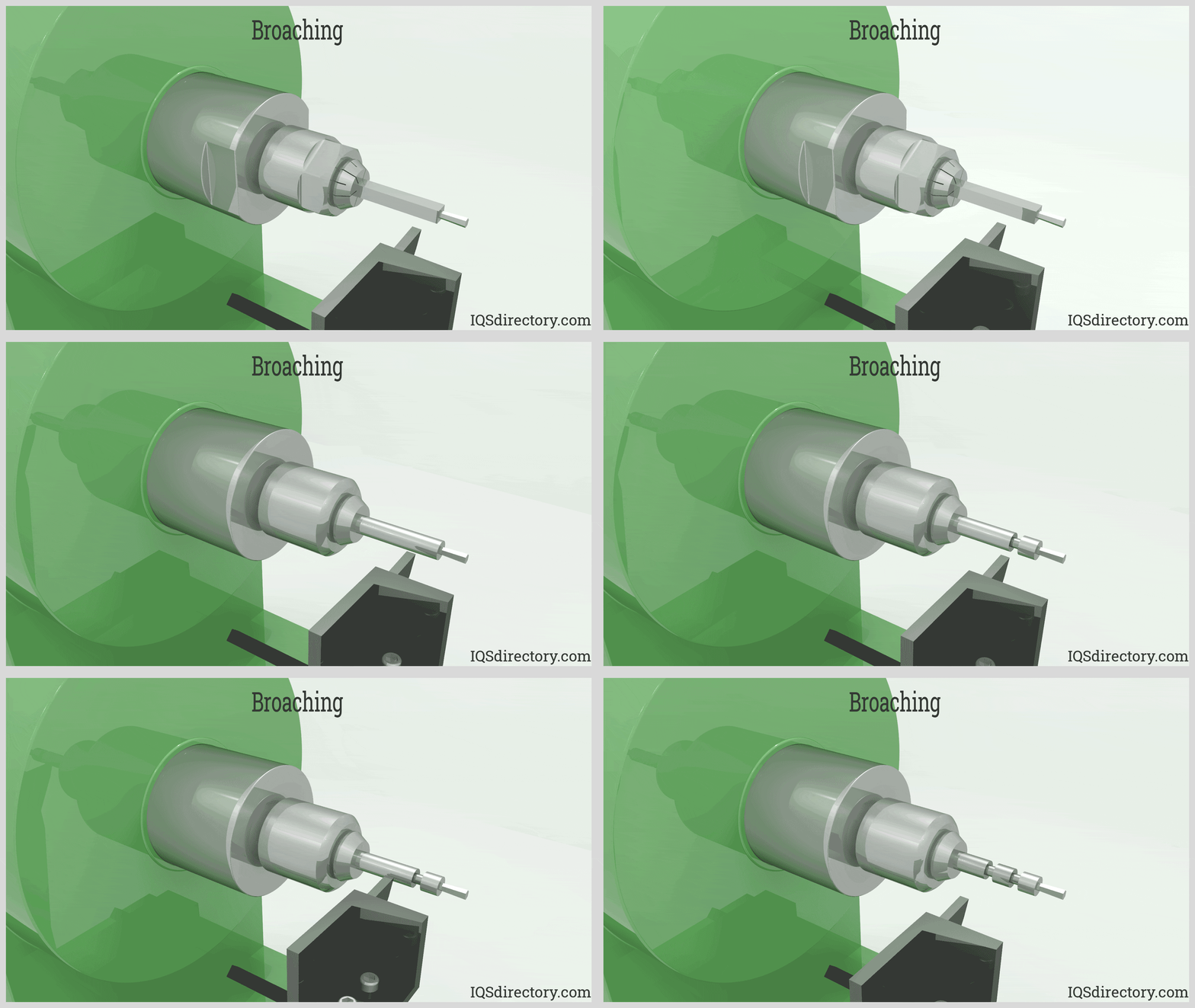 Broaching, a machining process where a sharp, hardened, toothed tool removes material from a workpiece in a consistent, continuous, and accurate way.
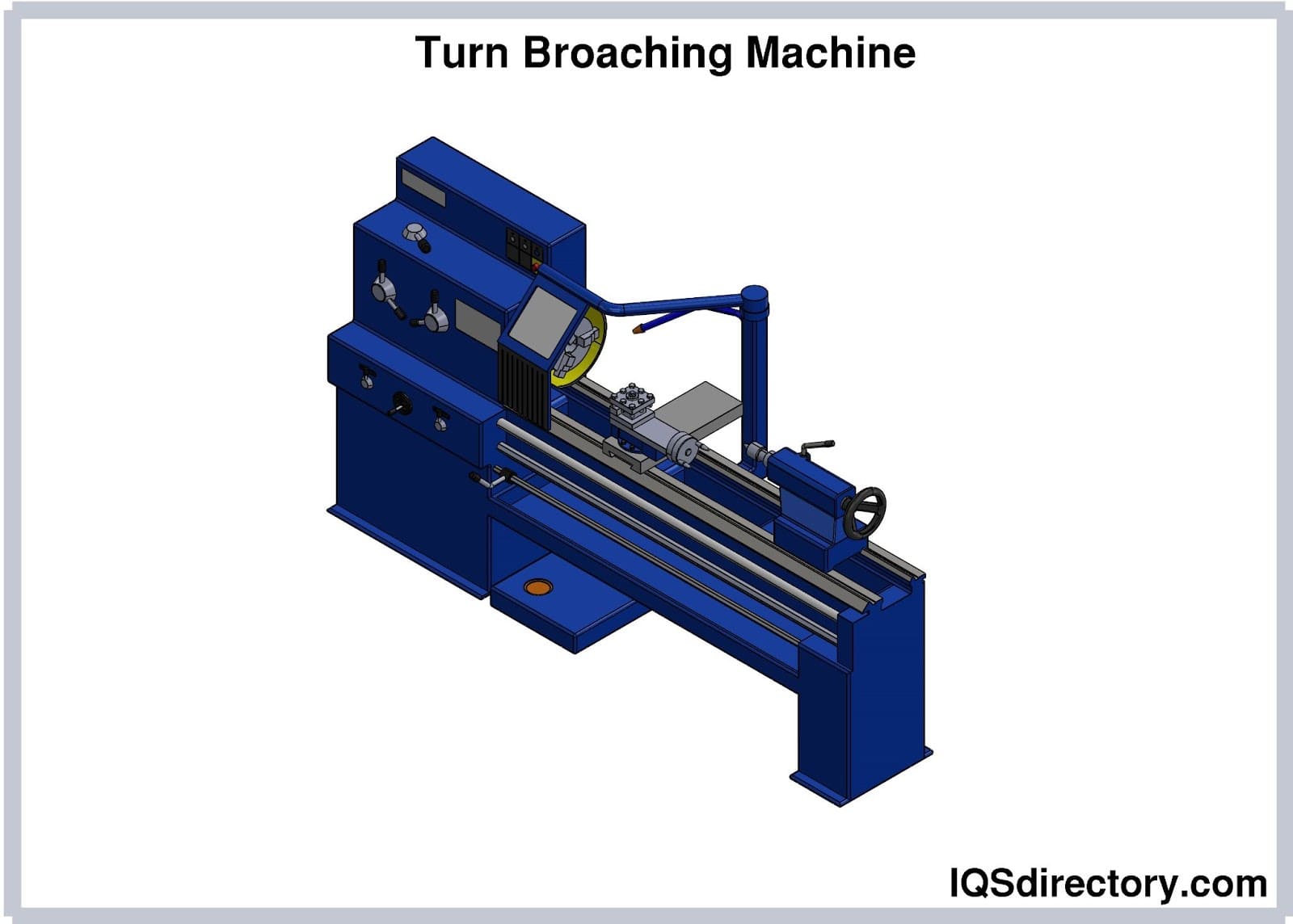 Turn broaching machines are used for circular, linear, and spiral cutting surfaces.
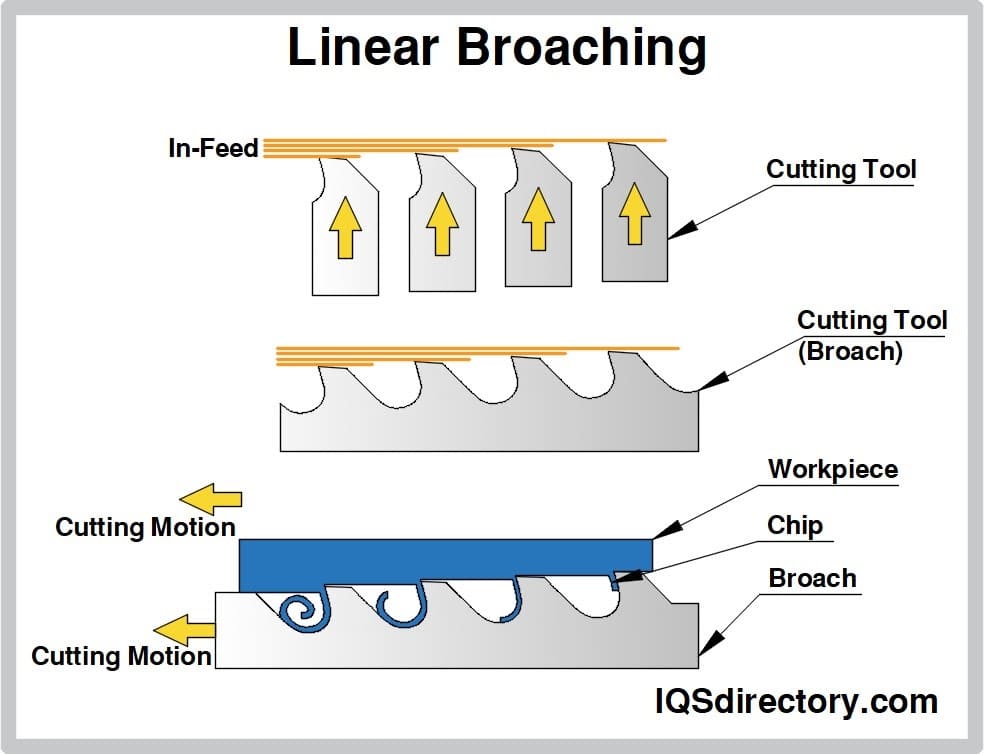 Linear broaching is where a tool moves linearly against the workpiece surface, cutting as it moves.
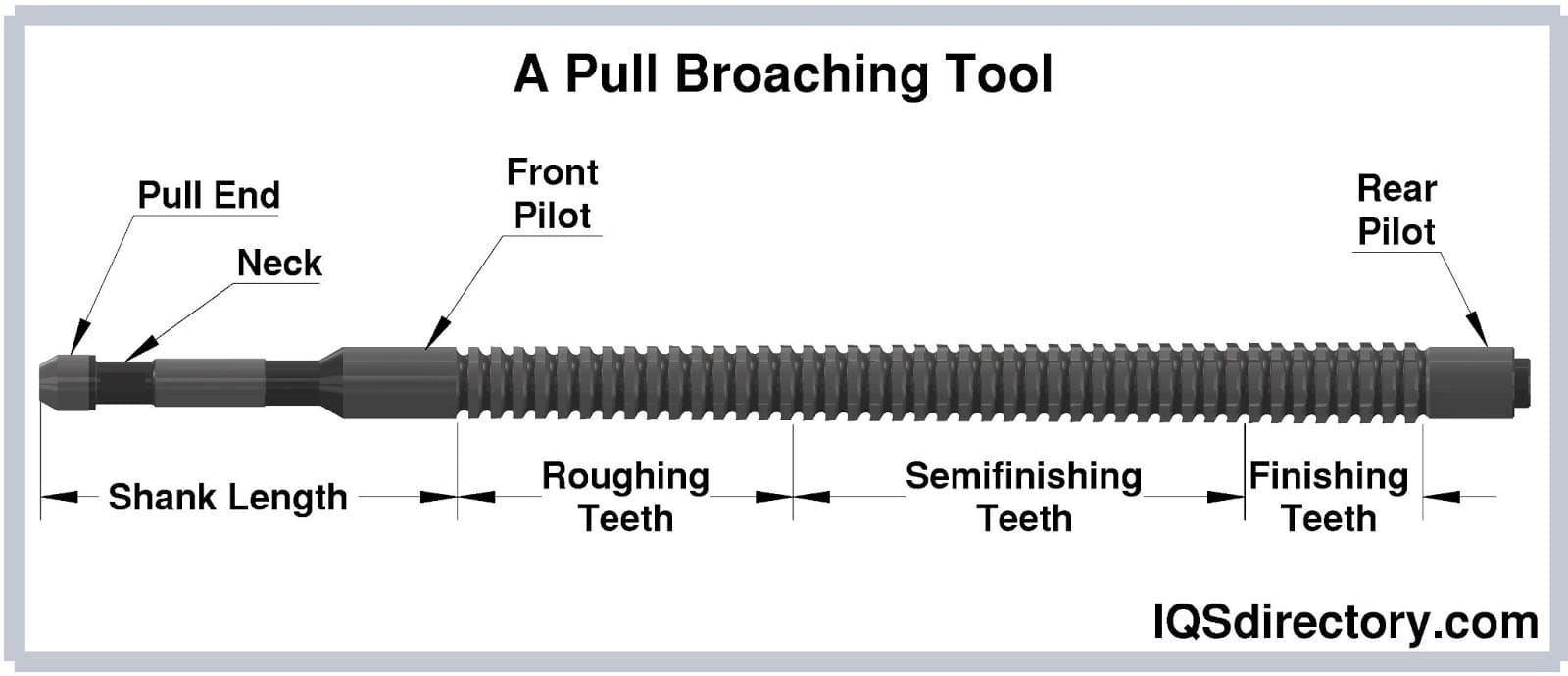 Pull broaching, a workpiece is held in place as the broach is pulled through.
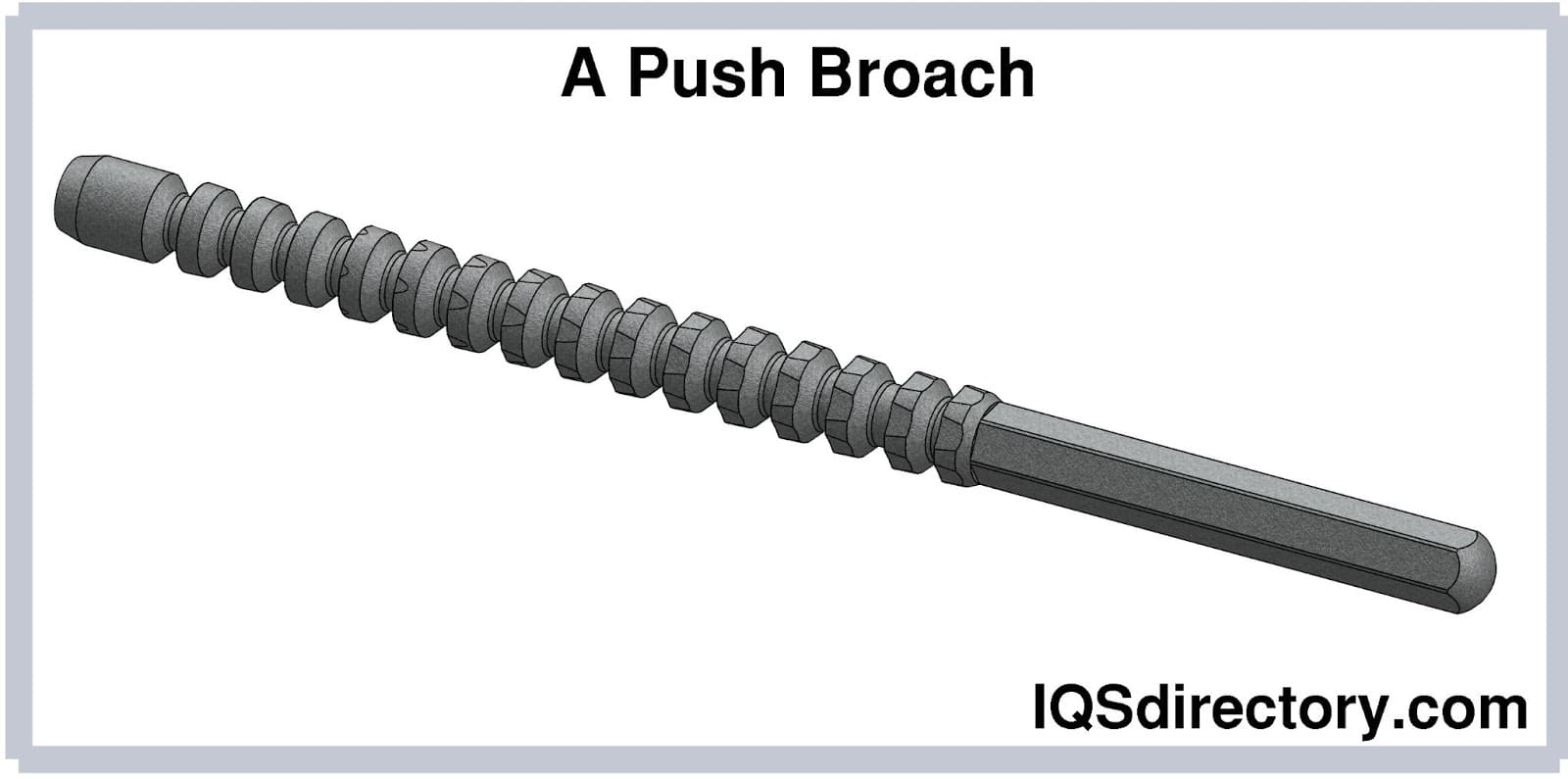 A push broaching tool is shorter which can endure the compressive forces applied as it goes through the workpiece.
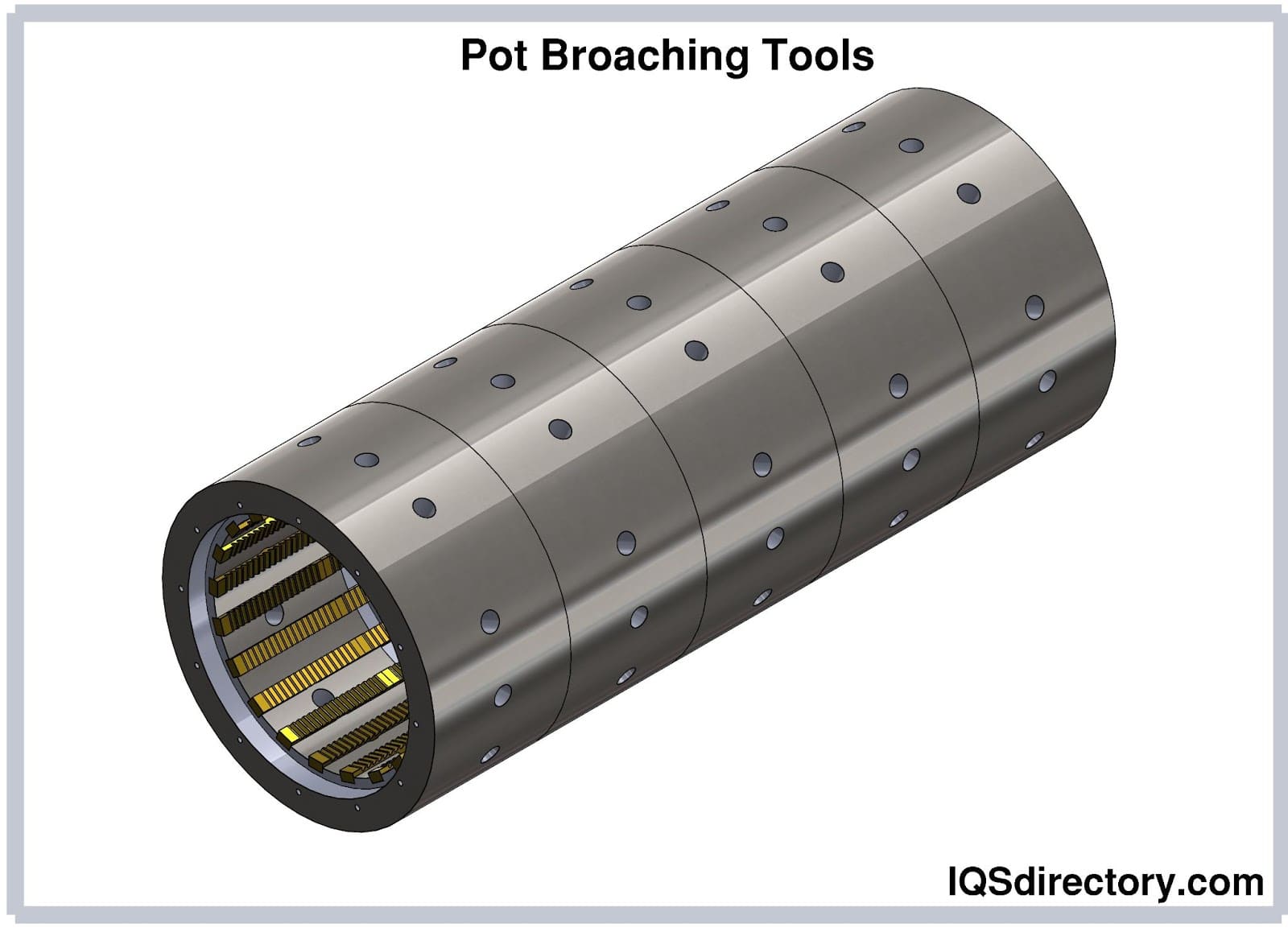 In pot broaching, the tool remains stationary as the workpiece is pushed or pulled through it.
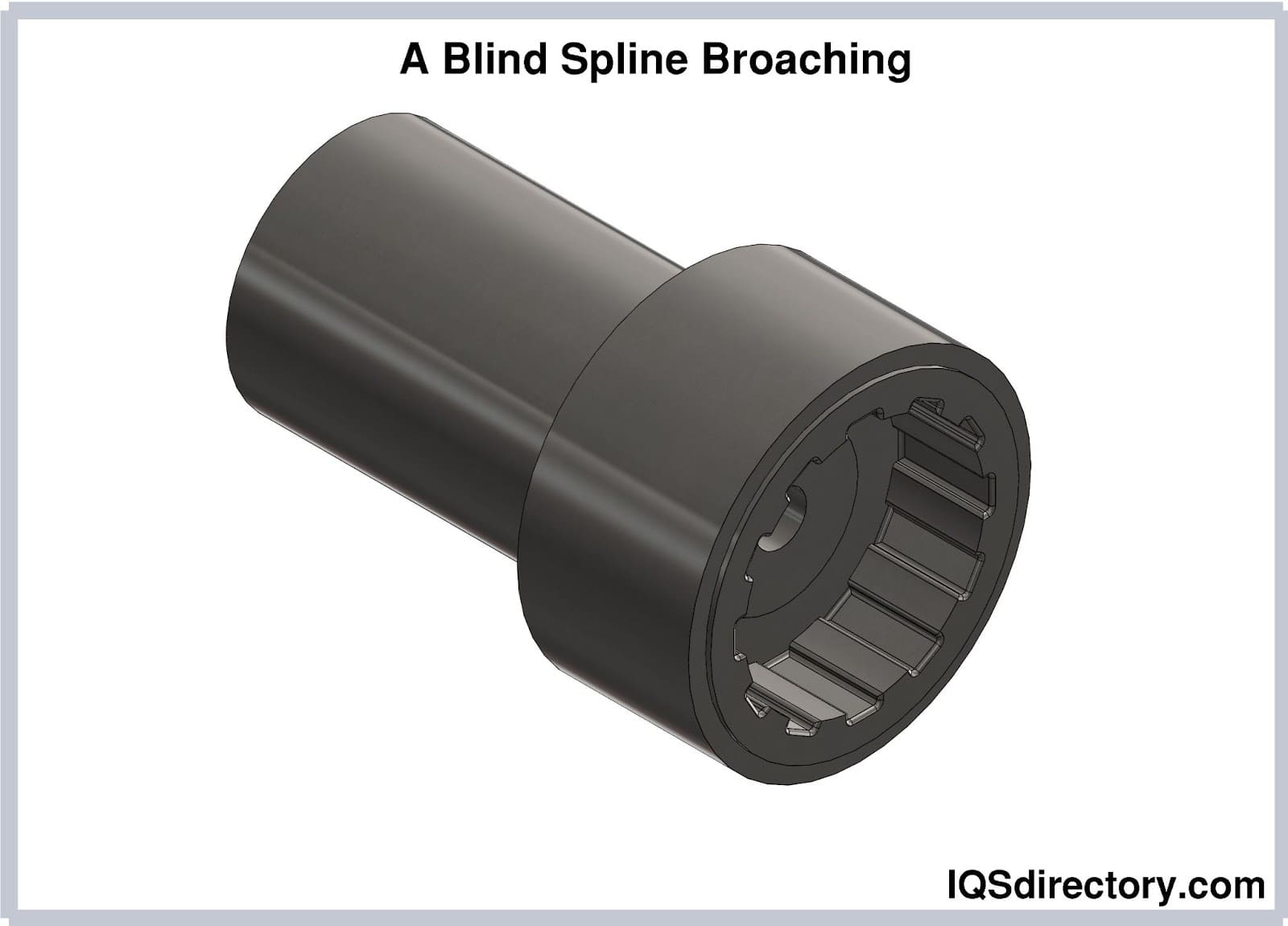 The process of blind broaching is used on parts designed to not have a pass through.
Types of Broaching Machines
During the broaching process, manufacturers use a range of broaching machines capable of machining to precise dimensions and repeatable tolerances. These machines typically combine push or pull broaching tools with cutting teeth and may be integrated with automatic lathes, CNC Swiss lathes, and rotary transfer machines.
Vertical Broaching Machine
In many broaching job shops, vertical broaching machines are a common choice for both external and internal broaching operations. These machines work vertically on the part and are often powered by hydraulic systems, making them practical for a range of production environments. Vertical broaching machines are typically categorized by operation, including table-up, pull-up, and pull-down or push-down designs.
Vertical Table-Up Machine
Vertical table-up machines feature a stationary broach while the workpiece is mounted on a movable table. This arrangement offers flexibility for cell-based manufacturing and can be a practical choice for short-run or mixed-part production. These machines can often be retooled for different applications, helping manufacturers adapt capacity to changing workloads.
Horizontal Broaching Machine
Horizontal broaching machines use a horizontal layout and are often gear-driven or screw-driven, powered by hydraulic or mechanical systems. They are commonly used for both roughing and finishing operations on larger components, including engine blocks and long parts that benefit from extended stroke capacity. Horizontal broaching machines may be configured for internal, surface, and chain-broaching operations.
Chain Broaching Machine
For modern production demands, chain-broaching machines are often preferred for continuous surface broaching. These machines use a moving chain to carry workpieces through the cutting path, which removes the need for a return stroke and supports efficient throughput.
Specialized Machinery
Specialized broaching machines are designed for specific or semi-specific applications. Keyway broach machines, for example, are built specifically to form keyways with repeatable alignment and depth. Other semi-specific machines, such as turn-broaching or rotary broaching systems, can cut linear, circular, and spiral forms. These robust machines are often used on steel, cast iron, and other demanding production materials.
Custom Machinery
Manufacturers can adapt existing equipment or build custom machinery for highly specialized tasks. In some cases, peripheral cutters are assembled in segments to perform multiple functions, while standardized tooling components may be combined to rough and finish workpieces efficiently within the same production approach.
Ways to Broach
-
Blind Broaching
This term is often used for external or surface-focused broaching applications in which the cut is made on the outside of the workpiece rather than through an internal opening.
Broaching Job Shops
Facilities dedicated to broaching services, with specialized machines, tooling, operators, and process knowledge focused on production broaching and precision part manufacturing.
Gear Hobbing
A machining process used to cut or form gear teeth and related drive features for power transmission components.
Internal Broaching
This method uses a broach tool to make precise cuts inside a workpiece, usually through a pre-existing hole that will be shaped to the required internal profile.
Keyseaters
Machines designed to create keyway holes and similar internal drive features in hubs, bushings, and locking components.
Keyway Broaching
A broaching-related process in which keyseater machines are used to create keyways in metals and other machinable materials.
Pot Broaching
An external broaching method used to form gears and other outside profiles by moving the workpiece through a stationary cutting form.
Production Broaching
A broaching approach used for high-volume production in which the machine, tooling, and fixturing are optimized to manufacture a specific part efficiently.
Rotary Broaching
Also called wobble broaching, this is a well-established method used on automatic lathes and increasingly on rotary transfer machines and CNC Swiss lathes to create polygons and other forms without a dedicated full-length broach machine.
Spline Cutting
A broaching process used to cut grooves or spline forms along the length of a shaft for torque transfer and mechanical engagement.
Spline Shafts
Shafts with grooves or spline features created through broaching or related machining methods for mechanical power transmission.
Surface Broaching
This process uses a broach tool to cut the surface of a workpiece precisely, producing flat, contoured, or stepped forms with repeatable accuracy.
Vertical Broaching
A type of broaching that uses cutting tools with successively larger teeth.
Variations and Similar Processes
-
Gear Hobbing
This process forms gears by externally broaching grooves onto the external surface of the gear.
Vertical Broaching
Often used for higher-volume work, vertical broaching creates hole features, grooves, and internal forms with a broach containing successively larger teeth capable of cutting through metals and other machinable materials. Depending on the application, it can create through-holes or shallower features through blind broaching operations.
Pull Broaching
In pull broaching, the broach cutting tool is pulled through the part in a single pass, allowing multiple teeth to remove material progressively and generate the finished form with strong dimensional consistency.
Push Broaching
One of the more common broaching variations, push broaching is often used for short-run jobs, repair work, and simpler internal forms. Broaching job shops commonly perform it with a hydraulic press or an arbor press depending on the part and tooling.
Pot Broaching
Pot broaching inverts the typical machine movement. The broaching tool stays stationary while the workpiece is pushed or pulled through it, and the tool is surrounded by a pot-like fixture that supports the cutting profile and guides the operation.
Lathe Broaching
Broaching on a lathe is another service offered by many broaching job shops. It allows manufacturers to create formed features on rotating parts while using existing turning equipment for efficient secondary machining.
Rotary Broaching
In rotary broaching, the broach tool is held at a 1° angle to the workpiece, with the cutting face positioned close to the part centerline. The tool and part remain aligned while the broach holder spins on a spindle, producing the familiar "wobble" motion that forms the feature. Rotary broaching is popular because it does not require a dedicated full-length broach machine and can be performed on a lathe, Swiss lathe, milling machine, or screw machine.
Production Broaching
The term "production broaching" refers to the high-volume fabrication of broached parts in specialized broaching job shops. It applies to various types of broaching, such as keyway broaching, rotary broaching, vertical broaching, and more.
Things to Consider When Choosing Broaching
Expense of Broaching
Broaching is a job-specific machining process because each broach is designed for a specific shape and geometry. That specialization narrows tooling flexibility and can increase cost when a custom form is required. Custom broaching often involves new tooling, fixture planning, and setup work, so buyers should weigh production volume, tolerance demands, and long-term per-part value when reviewing cost.
To help reduce costs, manufacturers often place work with specialized broaching job shops. These facilities use dedicated machines, established tooling practices, and experienced operators to make the process more efficient and more economical over the length of a production run.
Machine Parts and Broaching
When determining which machine parts are suitable for broaching, consider part geometry, access to the cut, starting-hole conditions, material hardness, tolerance requirements, and run size. While broaching has application limits, it can be controlled very effectively to deliver dependable cutting performance and repeatable results.
Finding the Right Broaching Manufacturer
Once you determine that broaching is the right service for your needs, the next step is choosing the right manufacturer. A capable supplier should be able to produce the part and also show experience with your material, tolerances, geometry, feature type, inspection needs, and production volume.
To find a suitable provider, review the list of broaching companies provided at the top of this page and compare their capabilities with your specifications. Ask about tooling, fixture design, tolerance control, production capacity, lead times, and how they handle your specific part requirements before placing the work.
Broaching Terms
-
Broach
A metal cutting tool equipped with a series of cutting teeth that remove material progressively to generate a finished shape.
Chip Breakers
Notches on the broach tool that help break and manage chips during the cutting process. The semi-finishing and roughing sections often contain chip breakers so chips form in sizes that are easier to evacuate from the cut.
Chip Load
The fixed thickness of material removed by each tooth as it enters the workpiece. Broach design, material, and cutting conditions all influence the chip load used in the operation.
Chip Space
The gap between broach teeth that collects chips during the cutting operation and supports chip evacuation.
Cutting Teeth
The teeth of the broach, typically divided into roughing, semi-finishing, and finishing sections. Tooth size increases progressively along the tool until the finishing teeth generate the final dimension and surface quality.
External Broach
A broach used to cut along the external surface of a workpiece to form outside profiles or finished surfaces.
Face Angle
The angle of the cutting edge of a broach tooth, which influences cutting action and tool performance.
Finishing Teeth
Teeth designed for finishing the cut, typically arranged at a constant size near the end of the broach to refine dimension and surface finish.
Front Pilot
The front pilot helps maintain axial alignment between the broaching tool and the starting hole while checking entry conditions. A rear pilot serves a similar guiding role after the teeth pass through the workpiece.
Gullet
Another term for chip space, referring to the area that receives and carries chips during cutting.
Hook Angle
The face angle of a broach tooth, describing the cutting edge angle relative to the direction of tool movement.
Internal Broach
A broach that is pushed or pulled through a hole in the workpiece to generate the required internal size, form, and profile.
Overall Length
The total length of a broach tool from end to end.
Pitch
The distance between the cutting edge of one tooth and the corresponding point on the next tooth.
Pull Broach
A type of broach that is pulled through or over the workpiece during an operation.
Push Broach
A type of broach that is pushed through or over the workpiece during an operation.
Roughing Teeth
The first teeth to engage in a broaching operation, typically taking heavier cuts than the semi-finishing and finishing sections.
Round Broach
A broach with a circular section, typically used for making round cuts or sizing round internal forms.
Shear Angle
On surface broaches, the angle between the cutting edge of a shear tooth and the line perpendicular to the broach axis. Teeth designed with a shear angle can improve cutting action and chip flow.
Shear Cutting Tooth
A type of tooth used on surface and external broaches, designed so the cutting edge is not at a right angle to broach motion.
Side Relief
A clearance on both sides of each tooth that reduces friction and tool wear as the broach teeth move against the sides of the slot or form being cut.
Surface Broach
An external broach used to cut flat, stepped, or contoured surfaces on a workpiece.
Tooth Depth
The height of the tooth or broach gullet, measured from the root to the cutting edge of the tooth.
Tooth Land
The portion of the tooth that supports the cutting edge as it carries cutting load during the broaching process.
Tooth Pitch
The distance between teeth on a broach. The tooth pitch is influenced by factors such as the length of the cut and the type of material being worked on.