Linear Slides
Linear slides are devices which are used to provide free precision motion along linear planes for many different types of automated machinery for the purposes of pushing, pulling or positioning. The name "linear slide," or "linear motion slide," comes from the action these mechanisms carry out, i.e. linear motion.
Quick links to Linear Slides Information
The History of Linear Slides
Linear slides have been in existence, in the form of wooden rolling bearings, since at least 40 BC. This is the approximate dating of the wreckage of a Roman ship, in which the artifacts were found. It is quite possible, however, that they have been around even longer, as evidenced by Egyptian hieroglyphs and tomb drawings; they appear to depict suggest linear slide use in the form of tree trunks under sleds, sledges with liquid-lubricated, plain bearing-esque runners, and bearings used with hand drills.
During the Renaissance, Leonardo da Vinci included ball bearing drawings in his helicopter design. Later in the Renaissance, the Italian engineer Agostino Ramelli published the first sketches of roller and thrust bearings. In the 1600s, Galileo improved upon Ramelli’s model by proposing caging rollers or balls inside an enclosure, so as to reduce friction. It was not until the next century, though, that Galileo’s model was put to practical use, when John Harrison used caged-roller slides in his H3 marine timekeeper.
So-called "modern" linear slides were invented during the Industrial Revolution; one of the first was a ball bear design with a ball running along a groove in axle assembly. It was patented in 1794 by Philip Vaughan. Also during the Industrial Revolution were the inventions of radial style ball slides (1869), the tapered roller bearing (1898), and the development of a method for grinding and milling uniformly sized and shaped bearing balls (1883). During the 19th century, linear slides were important components of applications like: the smooth running of wheel and axle assemblies, watchmaking (producing more precise timekeeping) and the running of water mills.
The 20th century saw still more linear slide development. In 1907, for example, Sven Wingquist invented the self-aligning linear ball bearing. In 1934, Erich Franke invented the wire race bearing in 1934. In 1968, Bud Wisecarver invented v-groove bearing guide wheels, which he patented in 1972, and in the early 1980’s, Robert Schroeder of Pacific Bearings invented bi-material plain bearings. This type of slide consists of a metal shell, a layer of Teflon-based material, connected by a thin layer of adhesive.
Today, the linear slide industry is more popular and relevant than ever, thanks to industry advancements in robotic automation. Contemporary linear slides are essential to a wide range of high tech product and system applications. High speed linear slides, for example, are used in dental drills; aerospace slides are used in the Mars Rover, and flexure slides are used in optical alignment systems.
Advantages of Linear Slides
There are so many advantages to linear slides. First, they create minimal friction as they work. At the same time, they are able to move thousands of pounds of weight. A byproduct of this advantage is another one: the fact that they require only a relatively small amount of torque to move even massive loads. In addition, linear slides work using very little energy. Because they have few moving parts, they require little maintenance.
Linear Slide Designs
To fabricate linear slides, manufacturers usually use a combination of shape rolling, extrusion, forging and shape drawing.
Typically, linear slides are composed of three main parts: a stationary base, a carriage (a moving platform or component) and a linear rail of bearings. The carriage is attached to the base along the linear rail. The carriage slides along the bearings from one end of the base to the other with minimal friction, offering a precisely restricted range of movement.
Rails, or support rails, are a simple design element; usually they have a flat surface. However, rails can also be a perfectly round, polished rod. Sometimes, they can be a complex design, which is typically decided based on the application.
The most common linear slide material is cast iron, as it is durable, strong, and able to withstand a fair amount of wear and tear. This is especially important for linear systems designed to carry heavy loads. Two other common linear slide materials are stainless steel and aluminum. Stainless steel is ideal for linear systems designed for work environments in which humidity and corrosion may be factors, as its corrosion resistance and durability will protect the slide. Aluminum is popular because it is able to maintain its shape and structure even under stress.
When designing a linear slide system, manufacturers think about situational factors such as load weight, speed of operation, frequency of use and application environment. The configuration and material choices they make based on these factors will largely determine the lifespan of the mechanism. Environment, for example, impacts whether or not they will choose to encase a slide in a bearing housing. Bearing housings, such as covers or shields, are used to provide a protective barrier between the sensitive bearing systems and the possible contaminants of debris and dust. Manufacturers can usually attach them to the slide system without interfering in the operations of the sliding mechanism.
Another choice they have to make is whether the linear slide will rely on inertia or linear motor power. While some applications rely on inertia or gravity to move the carriage, others are motor driven, which further adds to the control of the motion process as the load or equipment can be moved at an exactly desired speed. These motorized slides are run by a drive mechanism, which is powered by electricity (AC or DC power) and sometimes fuel.
Linear slides vary in design quite a bit, so a custom slide request should be no problem for your supplier. There are a number of ways in which they customize a linear bearing. These include: base length (to the mm), rail width (to the mm), saddle length (to the mm), flange type, load capacity, friction level, resistive element, shaft style, and standard requirement adherence.
Linear Slides Images, Diagrams and Visual Concepts
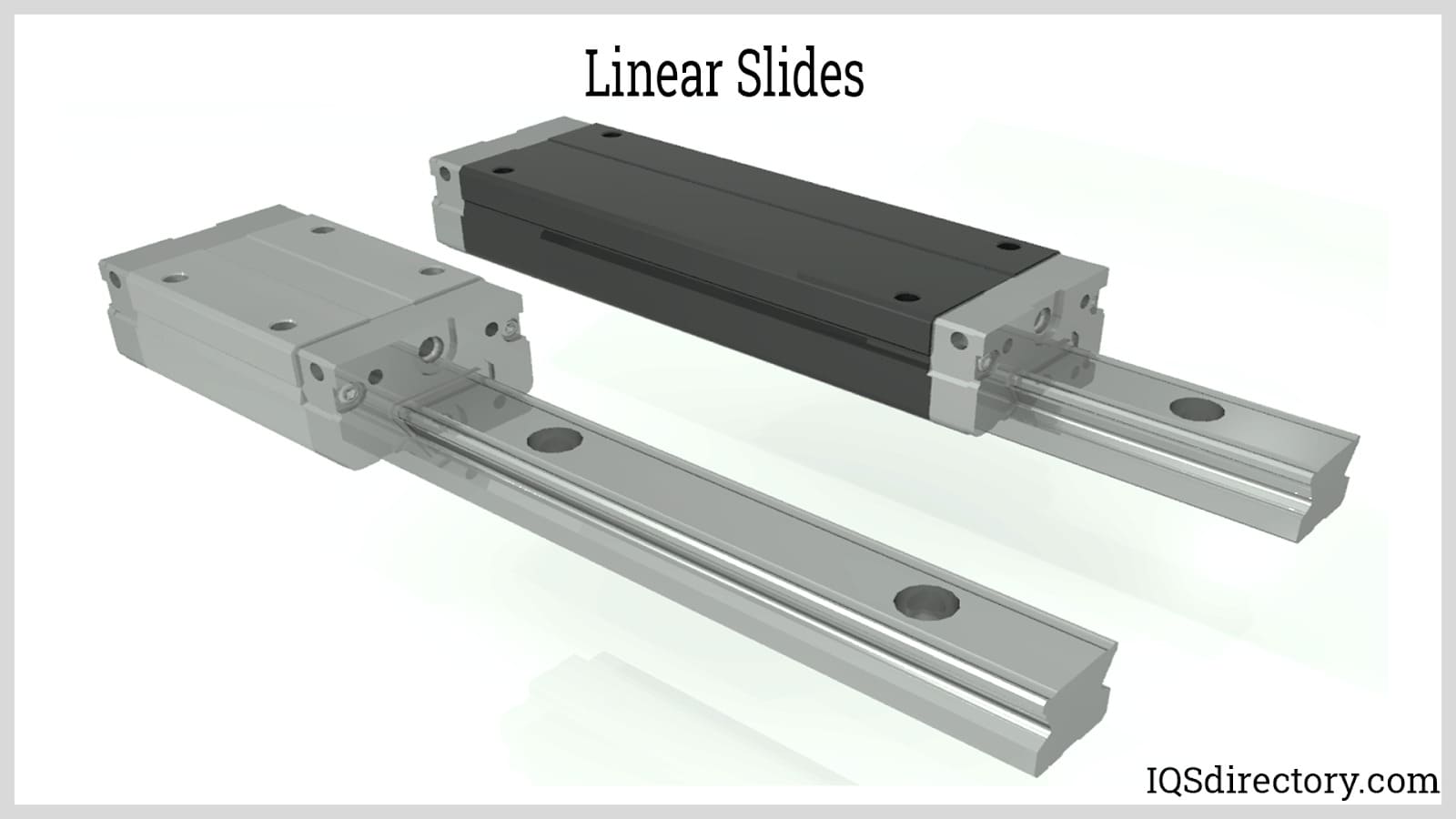 Linear slides are types of bearings that allow smooth and frictionless motion on a single axis.
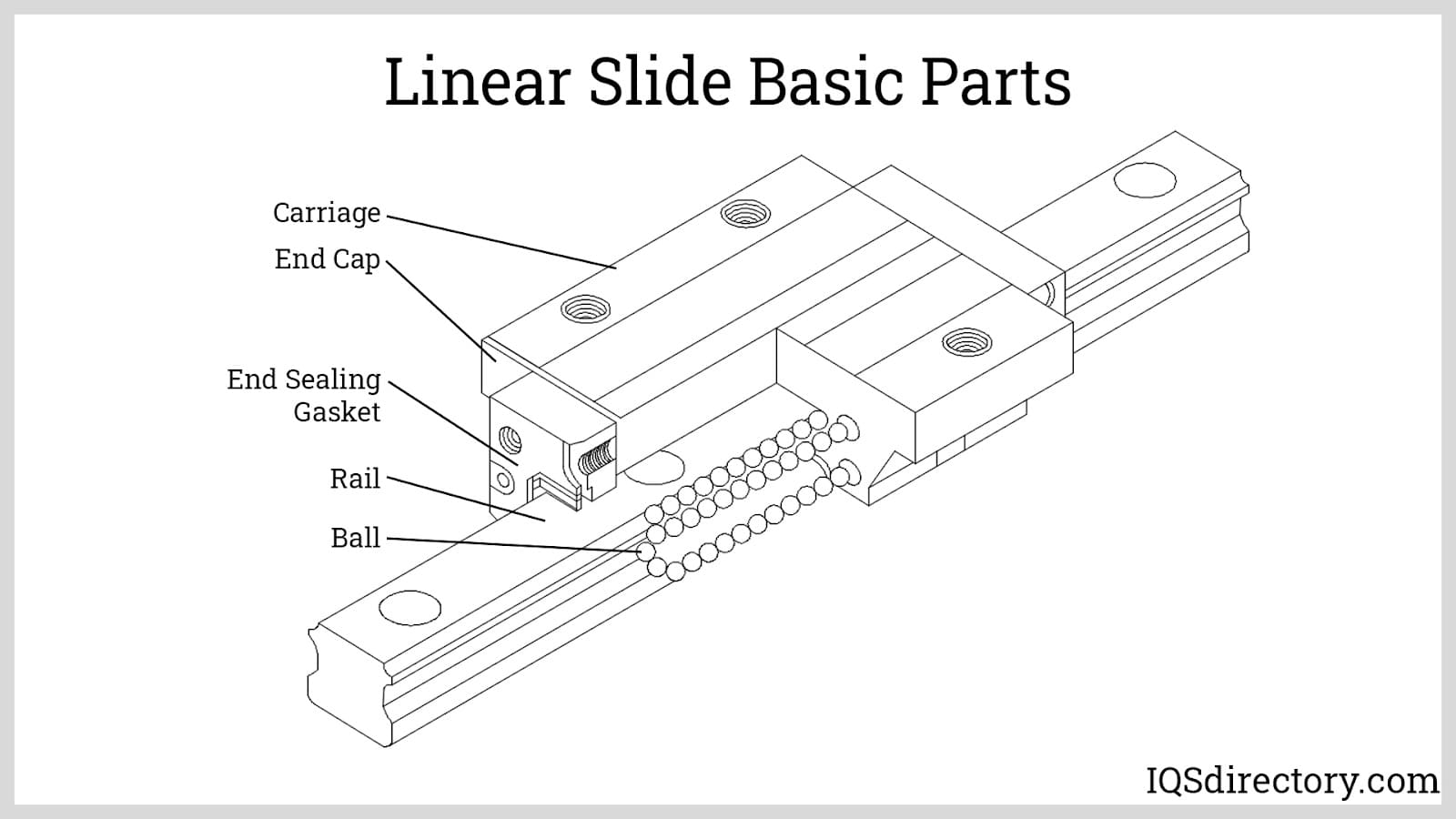 The basic parts of a linear slides.
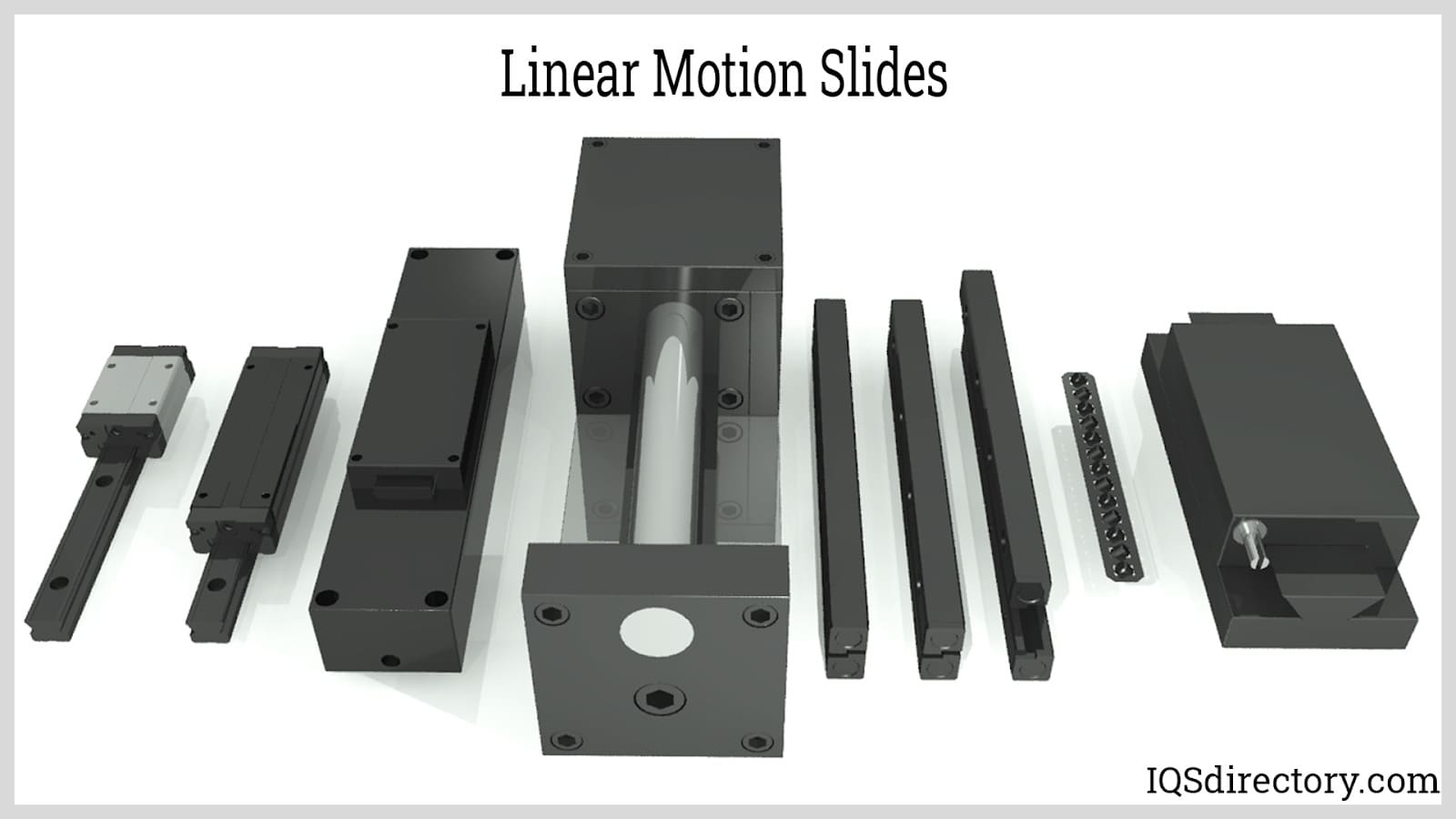 The different types of linear slides.
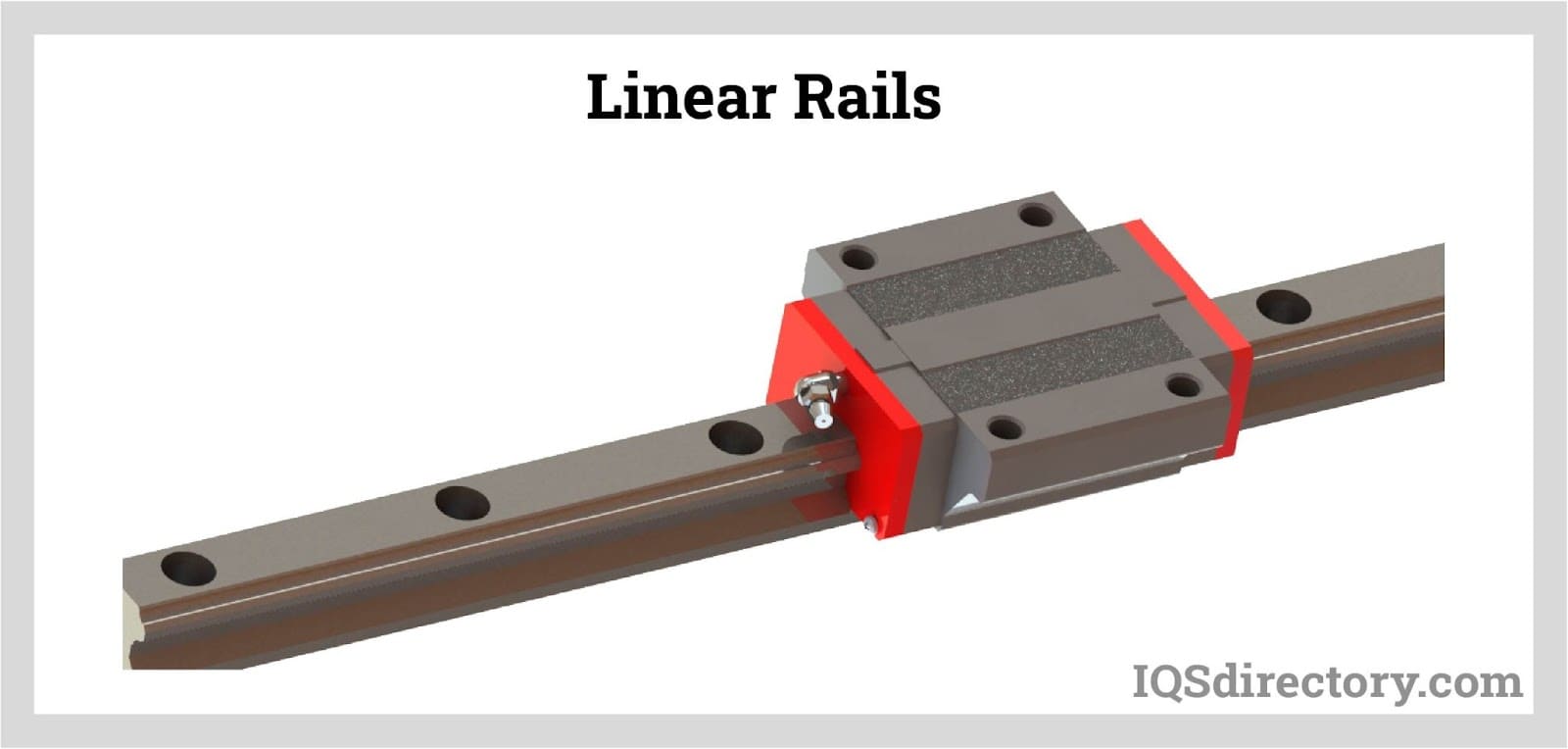 Linear Rails move items through a production process withprecision with little friction.
 Linear slides which employ plain surface bearings that rely on a low coefficient of friction and lubrication.
Types of Linear Slides
There are many different types of linear slides; below are examples of some of the most prominent varieties.
- Rolling Element Slide
- Made from a sleeve-like outer ring, in addition to many rows of balls that are assembled in a set of cages. Earlier, these cages were made from solid metal, but now, these can be a composition of stampings. The key job of these bearings is to render smooth motions, while providing low friction and durability to the mechanism. These slides also offer high rigidity and affordable operation, due to their easy maintenance feature.
- Ball Slide Bearing
- Or more commonly, ball bearing slides, are a type of rolling element slide known for their smooth and accurate motions in a single-axis linear environment. The single-axis is positioned in the linear base that has its own lubrication technique, which automatically increases the speed of the motion whenever needed.
- Roller Slide
- Also a type of roller element slide. They belong in the category of non-motorized bearings. Due to their crisscrossed movement, they are also called crossed roller slides. These slides are used to provide heavy load bearing capability to the mechanism. From the medical to the telecommunication industry, and from construction and automation to vacuum systems and clean rooms, roller slides play an important role in a large number of industrial applications. The best part of roller slides is their versatility.
- Plain Slide
- In design, plain bearings are very close to roller slides. Since they have no provision of ball bearings, though, they have limited industrial application usage. Additionally, they are not as rigid as rolling element slides. Plain slides are made from metal and plastic materials. These bearings can efficiently run on steel and stainless-steel shafts, in addition to the ones that are made from aluminum.
- Bushing
- Used to create the simplest linear slides. They are innovatively designed cylinders with thin walls. These cylinders are created via the injection molding process, are made from polymers, and used with a set of lubricants to foster the smooth motion. At times, there are bronze metal cylinders that have oil infused in the body. These bronze cylinders rotate and slide around the polished rod.
- Linear Guide
- Known for carrying and bearing heavy loads. These slides have a recirculating ball, which is technically referred to as a roller bearing affixed into a rectangular pad. These rectangular pads are often replaced by slide units. In linear motion guides, there can be more than one rail, to support faster and more reliable sliding and bearing of the load.
- Linear Guide Rails
- On a linear slide, the linear guide rail is the rail that the bearing unit is fixed to. The length and position of this rail determines how far the linear slide will be able to move. In some applications, the linear guide rails will be very short, while in others they will need to be several feet long to allow for a wide range of motion.
- Linear Slide Rails
- A type of bearing mechanism that is designed to move freely in a single direction. A linear slide can be motorized or powered by hand, depending on the application that it is being used for.
- Ball Spline
- Nothing but an advanced design of linear slides that have a cylinder that acts as the sliding unit of the mechanism. The cylinder typically has three to five circuits that help recirculate the balls, ensuring easy and controlled movement. Some linear slide manufacturers also create low maintenance slides, cylinders, and balls - that will help you save on your designing and manufacturing cost.
- V Rail
- Sometimes, long-length rails are strategically designed to have a "V" shape to help with space and material management. There is another benefit of these designs, V-shaped rails are less likely to get affected or damaged by dust and other possible pollutants. In addition, these designs do not need a bellow or cover to protect it.
- Advanced Linear Slide
- Such as positioning stages, XY tables, linear stages and machine slides, may be designed and configured to provide precision movement along multiple axes. These systems are more complicated to manufacture, but they can be used to drastically cut back on operating procedure times.
- Machine Slide
- Use precision machine components, placed in front of the attached carriage, to brush or wipe clean the railing before the carriage passes over it. This removes dirt particles that would otherwise accelerate wear and tear on the complete system. It also helps the carriage to transport products more smoothly and with less friction.
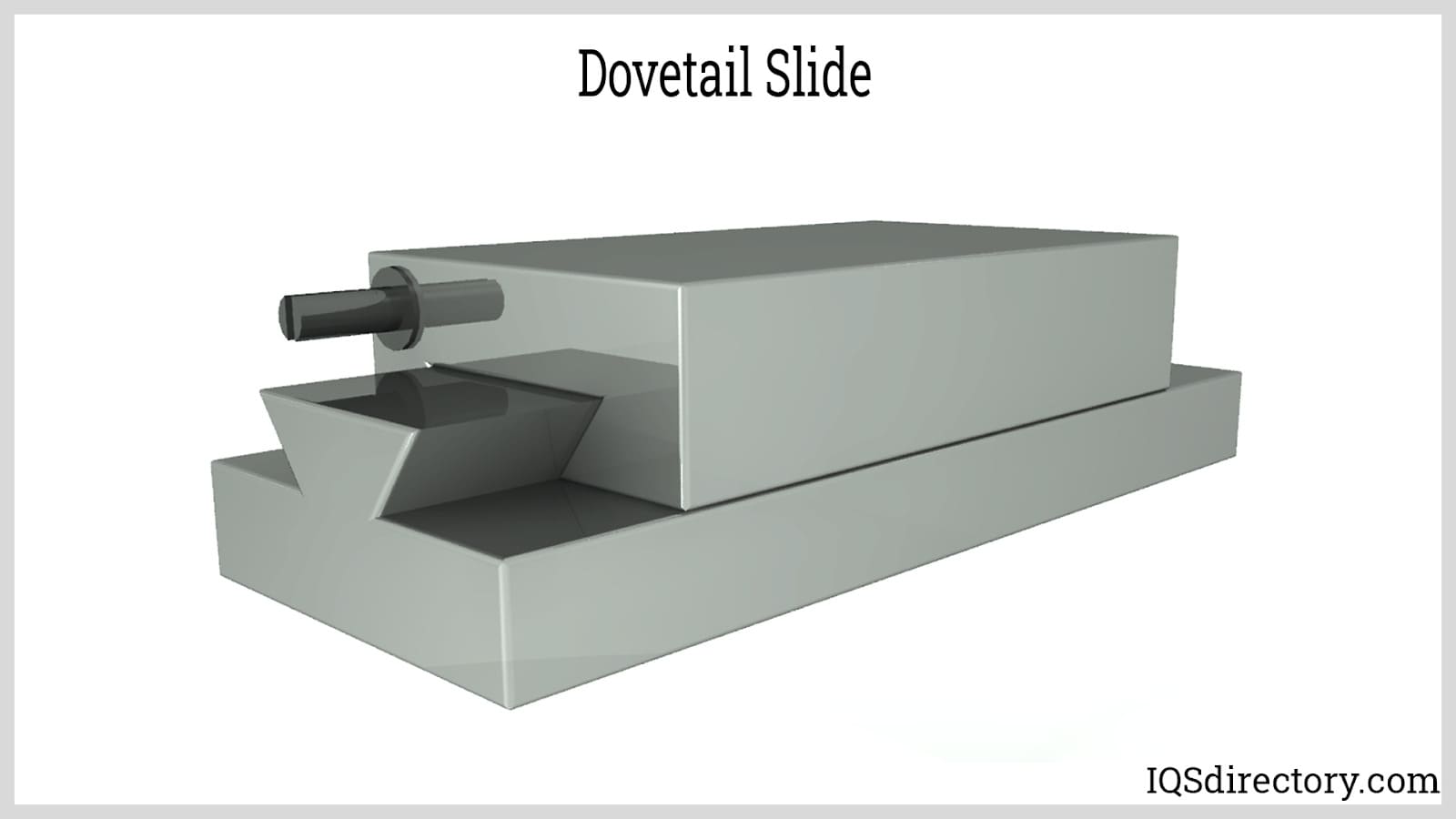
- Dovetail Slide
- May require additional lubrication, but most linear slides should be able to maintain a low-friction, smooth movement without adding further lubrication. Precisely controlled automated equipment is costly and the procedures which use linear slides are often dependent upon accuracy, therefore, it is important to maintain optimum working conditions of linear slide systems including regular maintenance and repair when needed.
- Round Rail Bearing System
- One of the two types of railing and bushing systems that enable torsional misalignment in the application. These bearings provide a point contact on the inner and outer race. This enables low friction and low load capacity.
- Profile Rail Bearing System
- This is another type of profile rail bearing system that provides higher accuracy, superior rigor, and better load capacity. Profile rail slides are a superior option over round rail bearings. Additionally, they are compact in design, meaning, these can be used for a number of applications that need higher accuracy, rigor, and load capacity in less space.
- Ball Screw
- A linear actuator type used to convert rotational motion into linear motion. Linear actuators like these generate little friction, which makes them better for use with high thrust loads. Also, because ball screws have close tolerances, they work well in settings in high precision applications.
- Lead Screw
- A linear bearing quite similar to the ball screw. The main difference between the two linear bearings is the fact that ball screws use ball bears to eliminate friction between the nut and screw, whereas lead screws do not. Instead, lead screws use deep helical threads and a mating nut to do their work. Lead screws are self-locking, do not require a braking system, and work well with vertical applications.
- Drawer Slide
- Linear bearings used, as their name suggests, to help drawers slide open and closed. They are non-motorized, instead relying on hand power.
- Pillow Slide Block
- Housings that are mounted on a rotating linear shaft in order to provide load support. Typically, they’re made from iron, and provide smooth, low friction movement. They constrain, guide or minimize friction in rotary or linear applications.
- Linear Rails
- Consists of a smooth, flat base that is used to support and guide the motion of linear bearings.
- Linear Positioners
- Consist of a drive that is attached to a fixed slide base and two extended springs that pull the slide top toward the screw end, against which it is firmly held. As the screw is turned clockwise, it moves the slide top forward along the linear axis, and because of the spring pressure, the screw retracts when turned counter-clockwise, resulting in a smooth linear rotation.
- Precision Slides
- Consist of a carrier, a base and ways fitted together with a gib and gib screws, which allow for adjustment to ensure accurate movement. Precision slides are basically motion guides that are used to feed and retract parts, tools or fixtures on all kinds of equipment.
- Roller Tables
- The quietest type of bearing table.
- Rotary Stages
- Rotate on an axis, typically positioned in the center, and provide rotary motion used in positioning and moving objects. Rotary stages are utilized to adjust the roll, pitch and yaw of objects, as opposed to linear stages, which position objects in space.
- Standard Slides
- Integrate roller or ball guides to permit the engineering of complete systems easily and with a minimum of assembly time.
- Telescopic Slides
- Linear motion devices that are capable of compaction and extension as a result of concentric parts that slide inside of each other.
Applications of Linear Slides
Linear slides are technically known as linear motion bearings. They are designed for and used in machineries and mechanisms to provide free motion and control the machine's operation.
These motion bearing elements offer accurate support and guidance to the mechanism. In addition to this, these instruments provide low and controlled friction, as well as smooth, accurate motion to applications.
There are many applications in which linear slides are used including: clean room operating systems, robotic welding and assembly, precision eyeglass assembly, automatic packaging equipment and use with CNC machining equipment like drilling and grinding machines.
In addition to the industries from which these applications come, linear rails are used in many other diverse industries, such as: healthcare, medicine, aerospace, semiconductor, chemical processing, textile and printing, commercial and food production.
Different Types of Loads
The load that these linear bearings tolerate varies with the type of application. The various types of loads are: vertical loads, moment loads, dynamic equivalent load, horizontal loads, pitch roll, and yaw. Sometimes, the load can be a combination of all these. At times, the direction and angle of the load can also vary. The intensity of the load also differs in some industrial operations.
- Linear Slides Accuracy
- Linear bearing accuracy is the variation in height and length. For a fluent operation, it is necessary for the slide to achieve the best possible accuracy. For applications that do not have perfect accuracy, having a profile rail bearing system can be a suitable option.
- Bearing Preload
- To minimize deflection, bearing preload can be used with both round and profile rail bearings. Preloading can provide internal clearance in the bearing. Preloading can be generated by creating an interference between the outer and inner race and fine-tuning the rolling elements. Linear slides are available in low precision options. These low precisions include sleds, slides, carts, and drawers. Sometimes, these slides are also present in medium precision, such as saw guides and door guides.
Proper Care for Linear Slides
Linear slides tend to be low maintenance equipment. However, they are not impervious to damage. They are especially vulnerable to wear and tear at the point of contact between the weight of the load and the linear rails. Depending on the type of slide, this stress may work to a greater or lesser degree. For example, linear ball bearings wear down more quickly than roller slides. Either way, in order to stave off damage, it is sometimes helpful to coat your bearings with lubricant. Also, you will likely need to replace your bearings, particularly ball bearings, every once and awhile, in order to ensure optimum running of the linear rail system.
How to Find a Reliable Linear Slide Supplier
Linear slides are linear motion bearings that are utilized in the design of a wide variety of applications we see or use in our day to life. The primary job of these utilities is to support effortless, quick, and noiseless movement of a part. Linear slides are present in hundreds of options, depending on the type and size of the application. You can also get linear motion guides designed for your special purpose. For that, you will have to speak to your supplier, explaining to them your exact requirements.
To get a perfectly fine-tuned linear slide, you will need to find a reliable and experienced linear slide manufacturer or supplier. The article in the following sections describes a step by step process to help you find one.
- Determine Your Requirements
- Before you even start the process of finding a linear slides supplier, you have to figure out what exactly you need. First, you have to create a detailed list of various factors associated with your application. In this list, you should include the capacity of your appliance, as well as, the frequency at which you use your application. Some other factors - such as the size of the machine, type of environment this mechanism will be used in - should also be included. Along with this, the rigidity and speed your application requires from your linear slide should also be included in this list.
- You will need this list while speaking to your supplier.
- The idea is to have all the bits and pieces related to your application and requirements available with you, so that you do not miss anything important during the rounds of negotiation with the supplier. This list will also prove helpful in finding the perfect utility for your application.
- Perform a Search on Google
- The most popular way to find a reliable linear slide manufacturer or supplier is to go Google. On Google, you just have to enter your keywords and results will be there in front of you. From the top results, you can locate a few most popular suppliers of linear slides in your area. Then, browse their website and profile, compare their services and prices, speak to them, share your detailed requirements, and ask for a quote. It would be advisable to request the quote from at least three to four suppliers, doing so will give you a fair idea about the market prices and latest industrial developments. Next, compare their quotations and finalize the deal with them.
- The biggest drawback of researching via Google is, sometimes you will find unwanted websites and mediators that are not able to fulfill your demands.
- Use an Online Directory
- IQSdirectory.com is a reliable online directory that lists all the suppliers for your regular and bulky requirements. Visit the site, enter the keyword, i.e. "linear slides", or "linear slide suppliers", and you shall see a list of reliable and verified suppliers of linear slides.
- Compare the companies' services, products and prices, and decide which company to work with. On a reliable online directory, this task can be completed within a few minutes.
- Linear Slides for Smoothly Working Application
- Linear slide is a type of bearing that is designed for enabling free motions in an application. Also known as the linear motion bearing, these slides provide motion to a part in the desired direction. These motion-bearing elements offer accurate support and guidance to the mechanism. In addition to this, these instruments provide low and controlled friction, as well as smooth, accurate motion to applications. Linear slides are used across many industries, including medical, factory automation, machining, packaging, semiconductor, aerospace, printing, automotive, and food production, etc.
- Choosing the right linear slide is crucial for smooth and efficient operation. In the following descriptions, are some tips on how to ensure that the linear motion bearing slides are working fine for your application.
Things to Consider When Purchasing Linear Slides
To get a perfectly fine-tuned linear slide, you will need to find a reliable and experienced linear slide contract manufacturer or supplier. Do so using the following tips:
- Determine Your Requirements
- Before you even start the process of finding a linear slides supplier, you have to figure out what exactly you need. Create a detailed list of various factors associated with your application. Include the required capacity of your appliance, the frequency with which you will use it, the size of the machine, the type of environment in which it will be used, and the rigidity and speed of your application.
- You will need this list while speaking to your supplier, so that you have a general product description, or at least a product parameter description, of which they can work.
- Use an Online Directory
- Once you have your specifications mapped out, you can look for your supplier. While Google searching is always an option, it can create a sense of information overload; worse, a lot of that information is no good, since many manufacturers out there are not reputable. Avoid the headache by using an online directory. The directory providers have already done most of the work for you by clearing out the riff raff and figuring out which companies are worth your while.
- Near the top of this page, you can find a list of the manufacturers we recommend. To find the right supplier for you, browse their websites, compare their services, products and prices, and then choose a few to contact. Once you reach them, discuss your specifications and get a feel for which company offers not only the best deals, but the best customer service. Remember, customer service is key.
Linear Slide Accessories
Accessories are an important component of your linear guideway system. One such accessory, a wiper, is used for sweeping the rail right before the slide unit. This movement ensures that there is no debris on the rail to impact the performance of the linear sliding system. Sometimes, seals are also used to keep away the dust and dirt from the rail. However, for seals, debris is not consisting of dust and particulates, but an excess of lubricants. Other accessories you may consider include: lubricant, clamps, roller tables, mounts, stopper bolts, linear locks, height adjusting blocks, block stopper plates, and slide guide mounting hole caps.
Linear Slides Terms
- Actuator
- A mechanism used for controlling or moving an object indirectly, as opposed to manually.
- Auxiliary Carrier
- An optional carrier for linear slides that increases the load capacity.
- Axial Loading
- A load with a force moving along a shaft or another type of axis.
- Base Mount
- To attach linear slides by either fastening directly to "T" slot nuts located in the slide base or by using the base mounting.
- Bearing
- A device whose support allows smooth, low friction motion between two loaded surfaces moving against each other.
- Breakaway
- The minimum amount of force or pressure needed to actuate movement of a device, such as a cable, cylinder or rotary actuator, through a complete stroke.
- Carrier
- A device attached to the linear slide, commonly with a bearing system, and responsible for supporting and moving the load.
- Center of Gravity (COG)
- A single point at which the weight of an object is most concentrated. The object would remain in equilibrium if supported at the COG.
- Coefficient of Friction
- A measurement of resistance of a single object sliding across another.
- Dead Length
- The part of a linear slide or band cylinder that is necessary for mechanisms and mounting. Dead length plus stroke length equals the total length of the linear slide or band cylinder.
- Deflection
- The amount of bend under a specific weight load.
- Gib
- A wedge-shaped piece of metal or wood designed to hold structural parts in place and/or provide a bearing surface.
- Inertia
- The amount of resistance of an object to change velocity. If a linear slide has a large inertia, more torque will be required to move it.
- Leadscrew
- A device that changes rotary motion into linear motion.
- Proximity Sensor
- A device that senses the end of a stroke on a linear slide. Proximity sensors supply signal to any of various controllers.
- Rotary Actuator
- An actuator that provides rotational movement.
- Rotor
- The shaft on a rotary actuator that rotates on its own axis.
- Shock Absorber
- A device implemented with linear slides to decelerate heavy loads at high speeds.
- Stroke Length
- The distance the carrier and its load move on the linear slide.
- Tenon
- A finger-shaped projection that fits into a corresponding hole.
- Torque
- The twisting or turning force that produces rotation.