Electric Hoists
Hoists are used to facilitate the raising, lowering, and transport of goods and materials in industrial settings where conveyor systems or cranes are not feasible or functional. The hoist incorporates the use of a cable, rope, or chain with a pulley or system of pulleys to provide the lifting capabilities. They may be manually operated or powered by pneumatic air, hydraulics, or electricity.
The most widely recognized hoist systems are found in elevators, although there are thousands of other applications throughout many industries, including automotive, paper, mining, forestry, gas, petroleum, shipyards, energy, and nuclear.
Hoists used in pharmaceutical applications may be required to lift very heavy loads in a clean room environment. Food service hoists must meet sanitary standards for safe food handling. Those used in production facilities may have to withstand extreme temperatures, harsh or toxic environments, or continuous heavy operation. Hoists may even be explosion proof for use in areas where flammable materials are handled.
Quick Links to Electric Hoists Information
The History of Electrical Hoists
- Early Hoist Creation
- Leonardo DaVinci designed a simple hoist as far back as 1480. His design was a large wheel attached to a windlass wound with rope. As the wheel turned, it fed the rope out or took up the slack, thereby raising and lowering the load, presumably a bucket or container for lifting water up from a well.
- Agricola's De Re Metallica, published in 1556, documents mine hoists that were powered by water, men, or beasts of burden, and used to raise ore from the depths of mine shafts.
- Hoists in the 1800s
- The "Flying Chair", a bench seat on ropes used to lift passengers, was introduced in 1845 by its manufacturer, Gaetano Genovese.
- One year later the hydraulic crane was invented by Sir William Armstrong. Using water pressure to level the load and counter weights and balances to raise and lower the crane, Armstrong's crane was able to move cargo with greater force than the current steam driven cranes.
- The Otis Elevator brake came into being in 1852. The safety brake was designed to stop the cab of an elevator from falling if the cable should break.
- In 1854, Thomas A. Weston invented the differential pulley block, commonly known as a block and tackle. The simple rig allowed heavy loads to be lifted with a minimum of effort by pulling on a rope looped around a set of pulleys attached to an axle.
- Yale Lock Company acquired the patent for the differential pulley block in 1876, and began commercial production.
- During the 1880s, Alton J. Shaw, working as a draftsman for Edwin P. Allis, was developing ways to improve the steam driven cranes. His idea was to incorporate three reversible electric motors, via gearing and controls, to drive the hoist, trolley cross travel, and the crane's long travel, from a single control point.
- By 1889, Shaw was the designer, manufacturer, and seller of over thirty different crane configurations.
- 1880 saw the first electrically operated elevator in Germany. It was built by Werner von Seimens. Frank Sprague expanded on von Seimens' ideas and by 1895 had designed and sold almost six hundred elevators before he sold his company to Otis.
- Hoists in the 1900s
- The revolution of industry that occurred at the turn of the century opened the floodgates for the development of lifting equipment that was faster, safer, and cheaper. Cranes, hoists, and elevators became commonplace.
- 1935 saw the development of the first portable electric chain hoist, followed closely by the lever operated chain hoist that nearly anyone could afford.
- World War II only escalated the need for hoisting equipment as small factories became more involved in the war effort. Inexpensive hoists were being sold almost as fast as they could be manufactured.
- The end of the war did not bring a slow down to industry or the economy. The development of electric wire rope monorail hoists, electric chain hoists, and ratchet lever hoists moved manufacturing and production industries forward at a breakneck pace.
- Over the next two decades, the development of the package hoist, a single, economical unit capable of providing complete lifting capabilities for smaller projects or lighter duties, revolutionized construction and manufacturing.
- In the 1960s, built up systems were designed that integrated hoisting systems to complete heavy lifting tasks, on a large scale, over a long term. The integrated systems were more expensive, but easier to repair, and proved to be quite durable.
Design of Electric Hoists
A simple manual chain hoist utilizes two loops of chain for operation. The hand chain is situated on a chain wheel that is designed with special indentations that "grab and pull" a link in the chain as it passes around the wheel. The lifting mechanism consists of a cog wheel, axle, drive shaft, gears, and sprockets.
When the hand chain is pulled, it turns the axle of the lifting mechanism, which is fitted with gears of differing ratios. Large gears turn slower than small gears, providing more force to the lifting chain. The lifting chain is rigged in a double or triple wrap around the gears, increasing the lifting capacity. As the hand chain is pulled quickly, it turns the drive shaft, which turns the larger gears slowly, but with force, which raises or lowers the load on the hoist hook.
A hook to attach the hoist to the ceiling or overhead monorail as well as a hook from which to hang a load are also part of the chain hoist. Many chain hoists are equipped with a chain stopper or braking mechanism to prevent dropping the load.
Manual chain hoists operate very slowly, but they are inexpensive and easy to operate, and do not require a power source.
Hoists may be operated by a chain or wire rope. The chain may be made up of links or rollers. The wire rope is a cable of wire strands that have been twisted into a cable. For any given load rate, chain is heavier than wire rope, but the rope is limited in length by the diameter of the cable drum it is wound around. The lift wheel of the chain can be larger, causing the lift to travel farther.
Wire ropes and chains on lifting mechanisms need lubrication, especially in adverse conditions or under continuous use. If no maintenance is performed or if the tensile breaking strength is pushed excessively, the wire rope will rust from the inside out and the chains will start to wear thin, stretch, and show signs of stress fracture. When the wire rope is not under load, it may snarl. Chain, although considerably heavier, foot for foot, does not get tangled so easily. Wire ropes should be used for lifting over sixty feet per minute due to the fatigue inducing resonance created by the chain at that speed. Material handling with wire rope hoists is scalable up to eighty tons.
Electric hoists may be portable hoist units or overhead hoist lift systems. The portables are stand alone devices, typically mounted on wheels or rails, that are comparably lightweight and easy to transport and maneuver. They are used for light to medium duty applications, usually lifting no more than a few tons. Overhead lift systems are mounted to a ceiling, beam, or heavy duty tracks. Overhead chain hoists may be rated for up to five tons, wire rope hoists may lift up to eighty tons.
Hoist Images, Diagrams and Visual Concepts
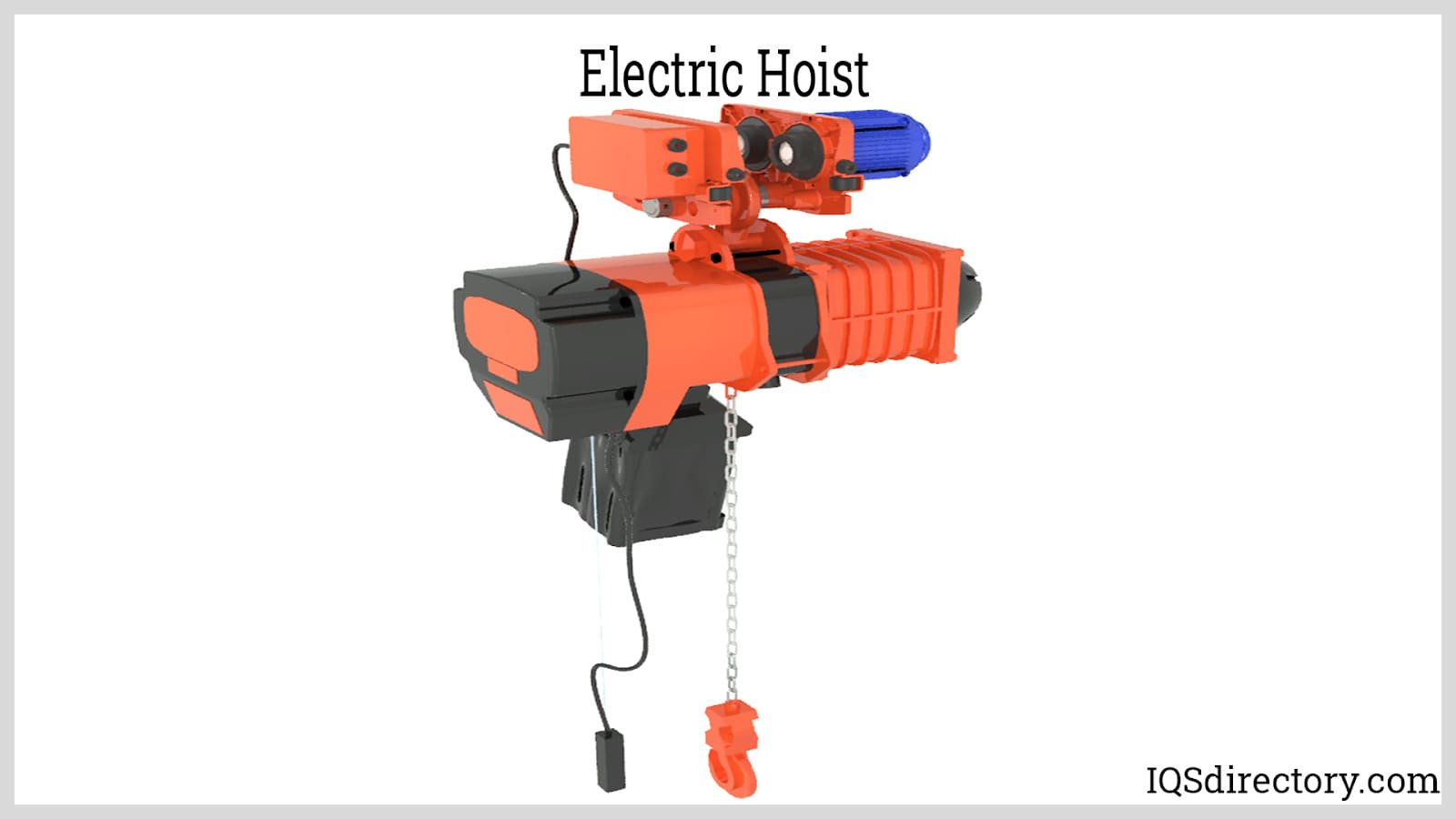 Electric hoists are handling equipment used for lifting, lowering, and transporting materials or products.
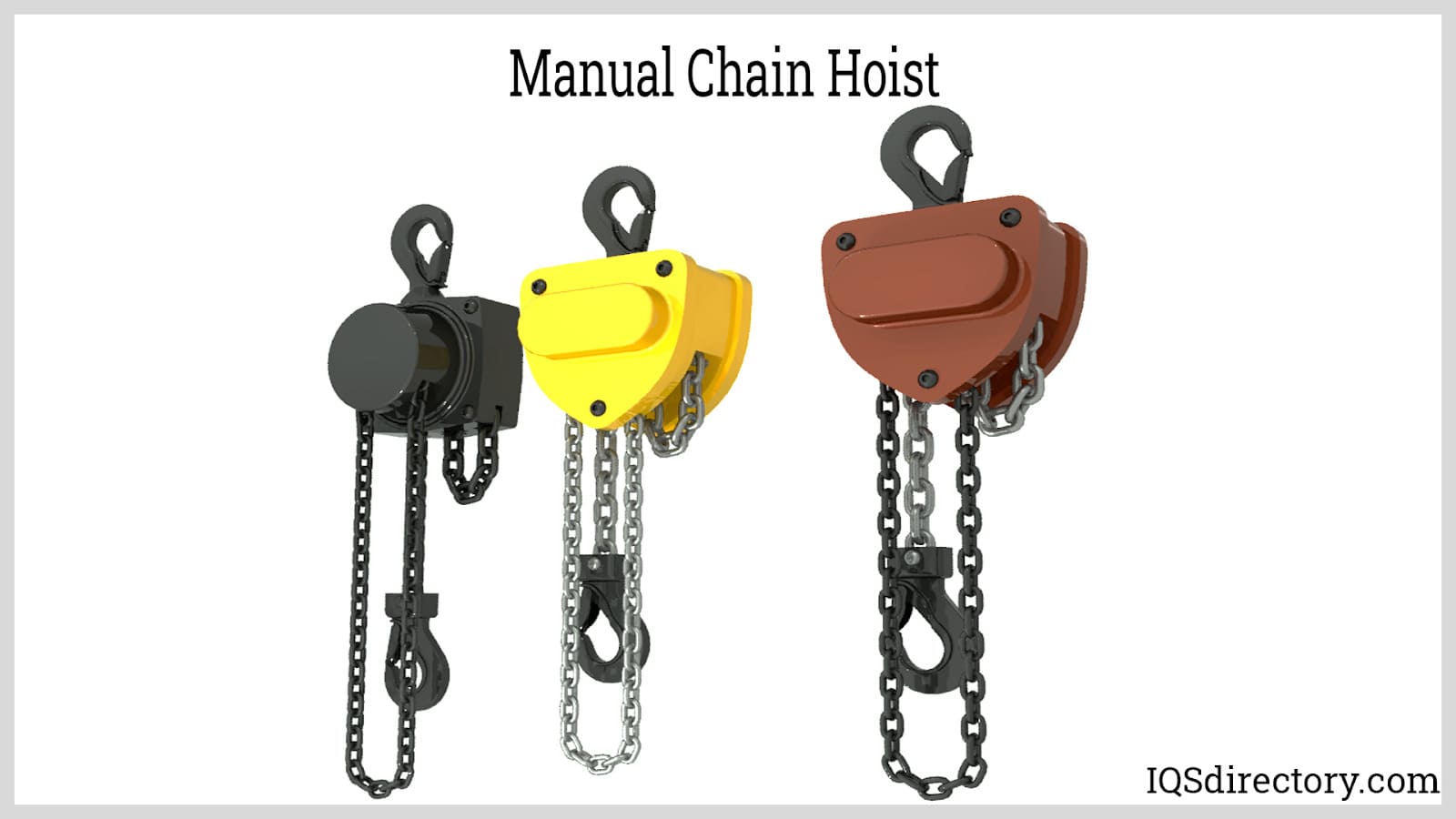 Manual chain hoists concentrate a low force with high travel input into a high force but its low travel output causes there slow operation.
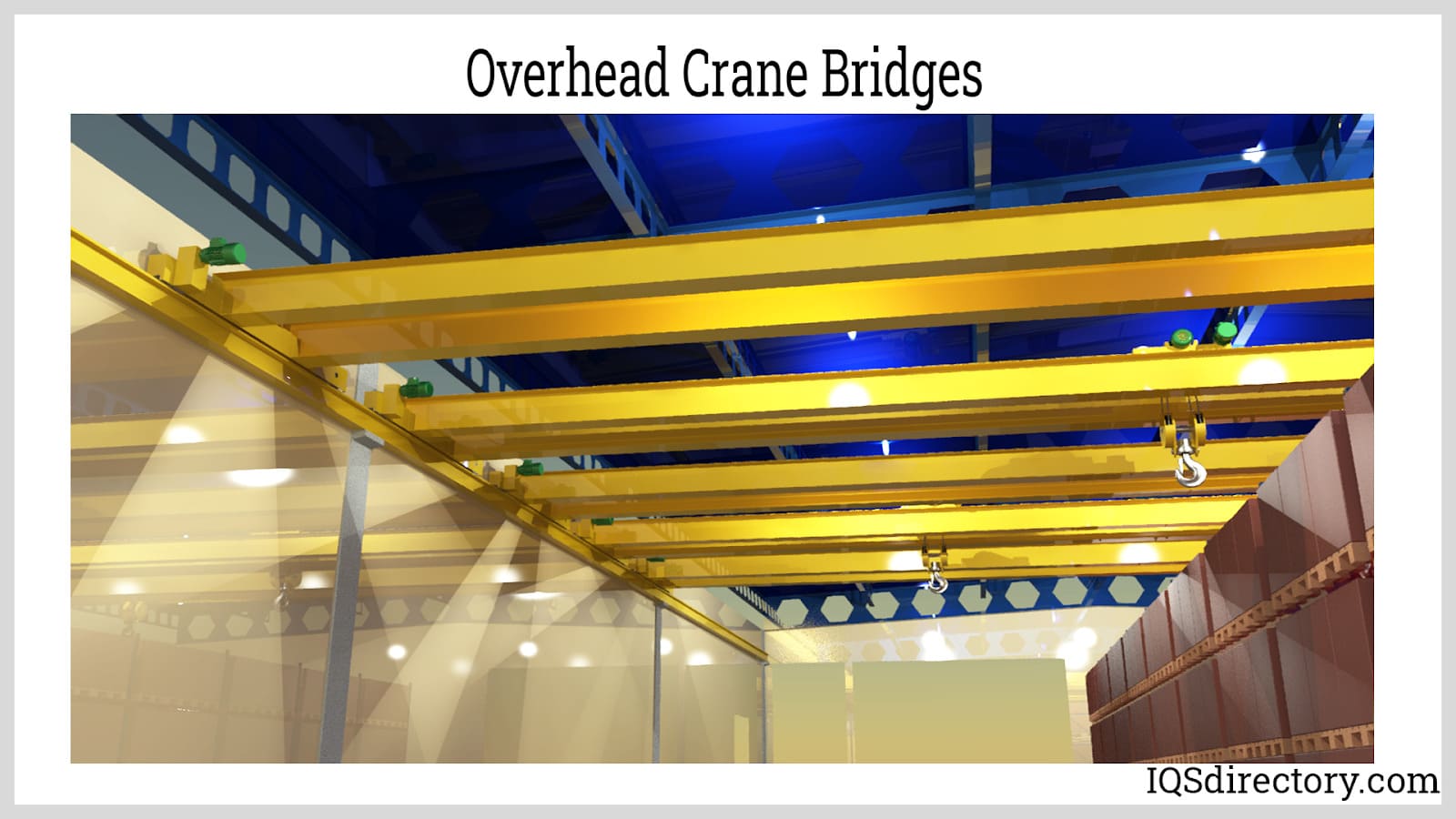 The bridge, are made up of beams and its structural frame is durable enough to support the combined load of the electric hoist and the lifted object.
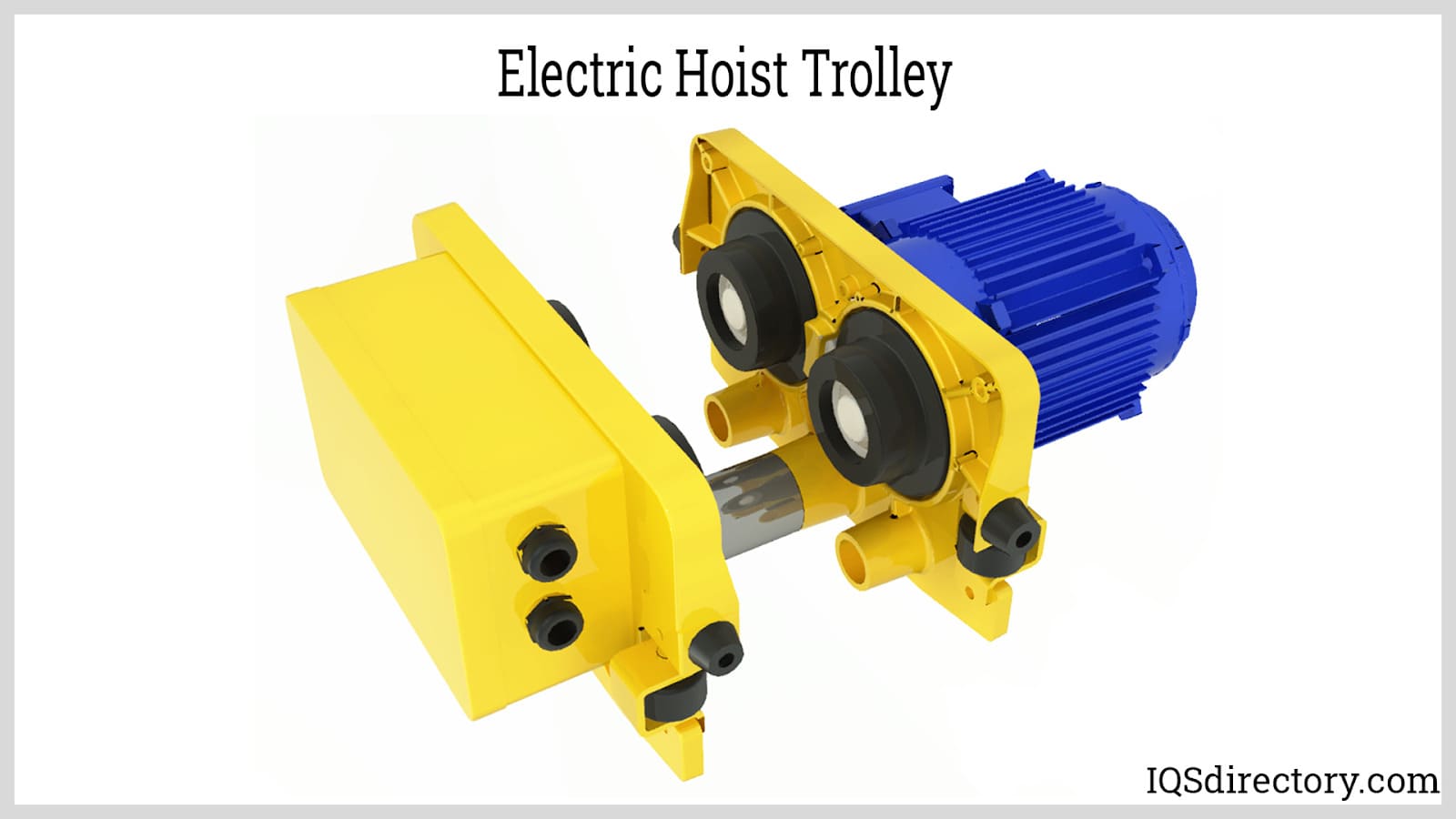 Electric travel trolleys have an electric motor to move the hoist a specific distance.
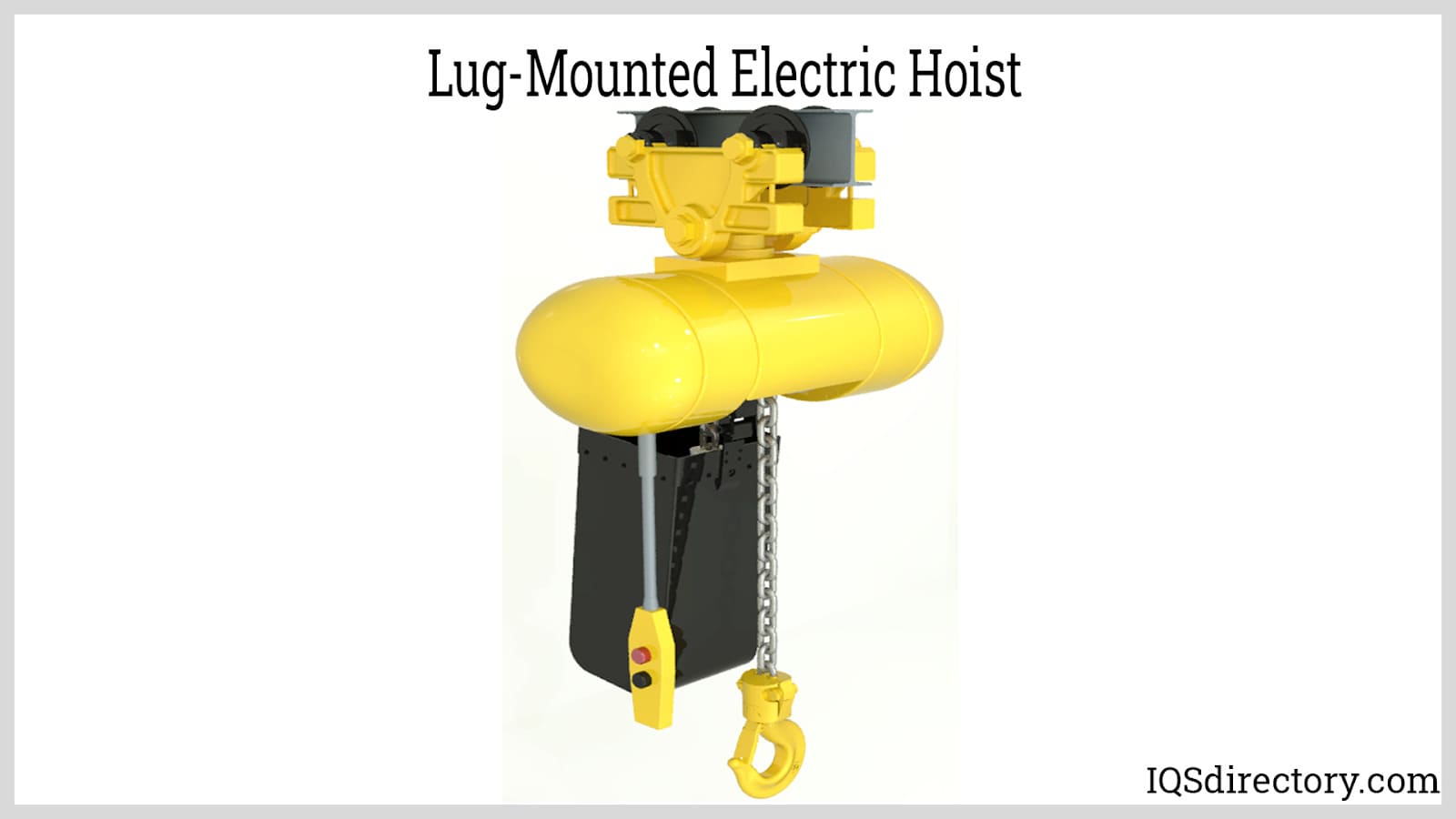 Electric hoists can be differentiated according to the type of suspension used and the position of the hoist.
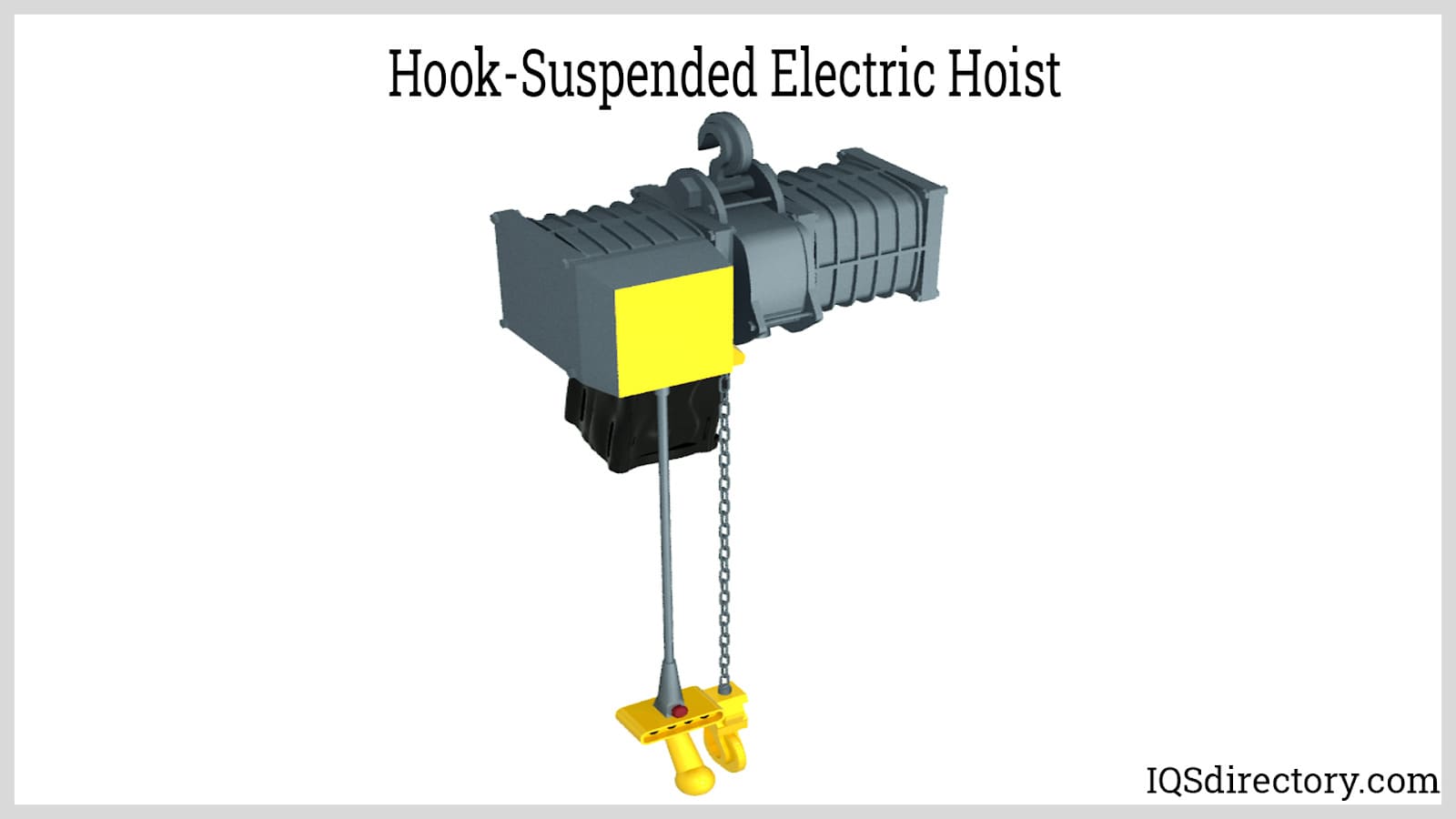 Hook-mounted hoists have a top hook that allows the attachment temporarily to a trolley or beam clamp.
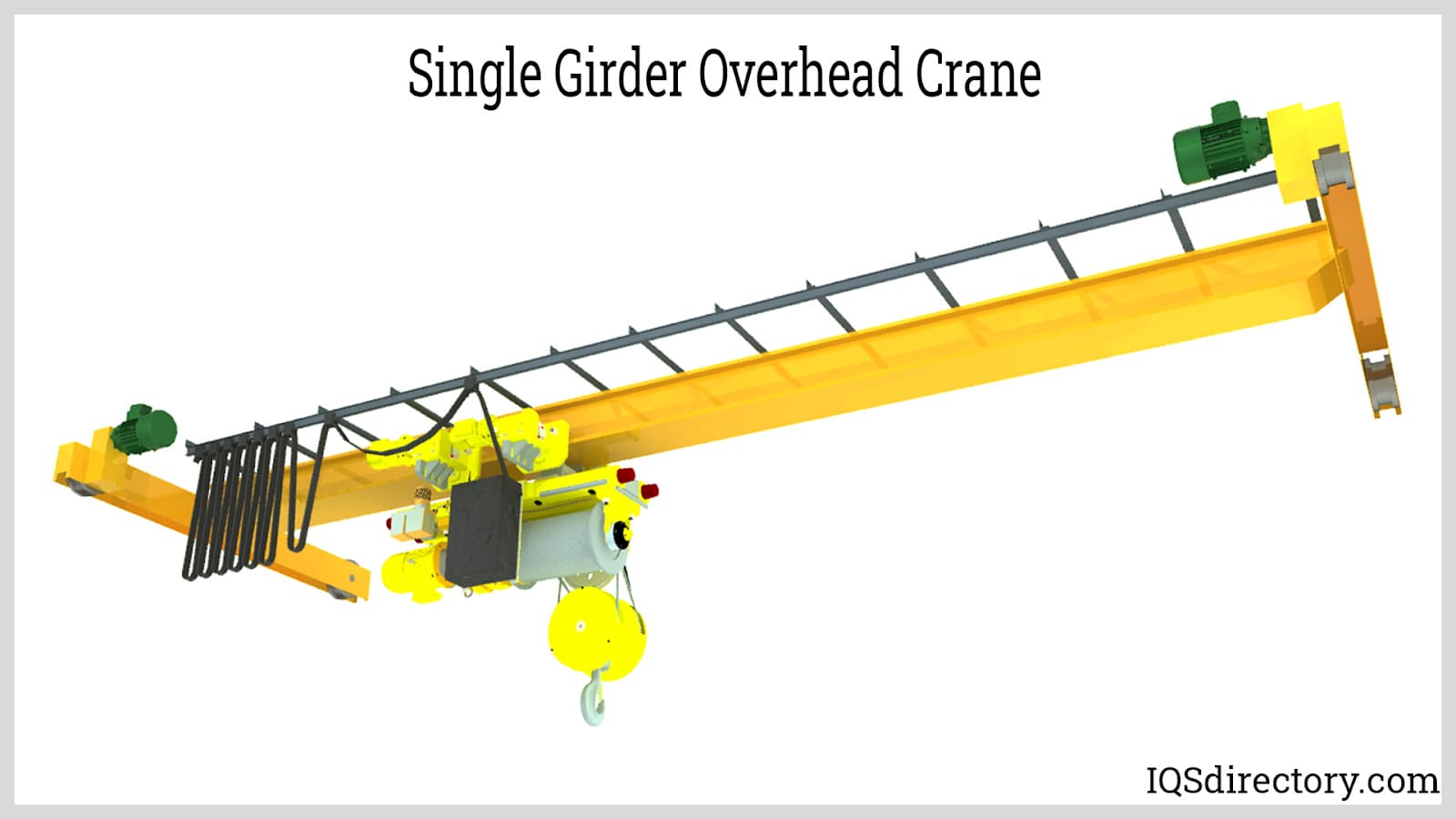 Overhead crane lift the heaviest loads at the highest lifting heights in an enclosed facility.
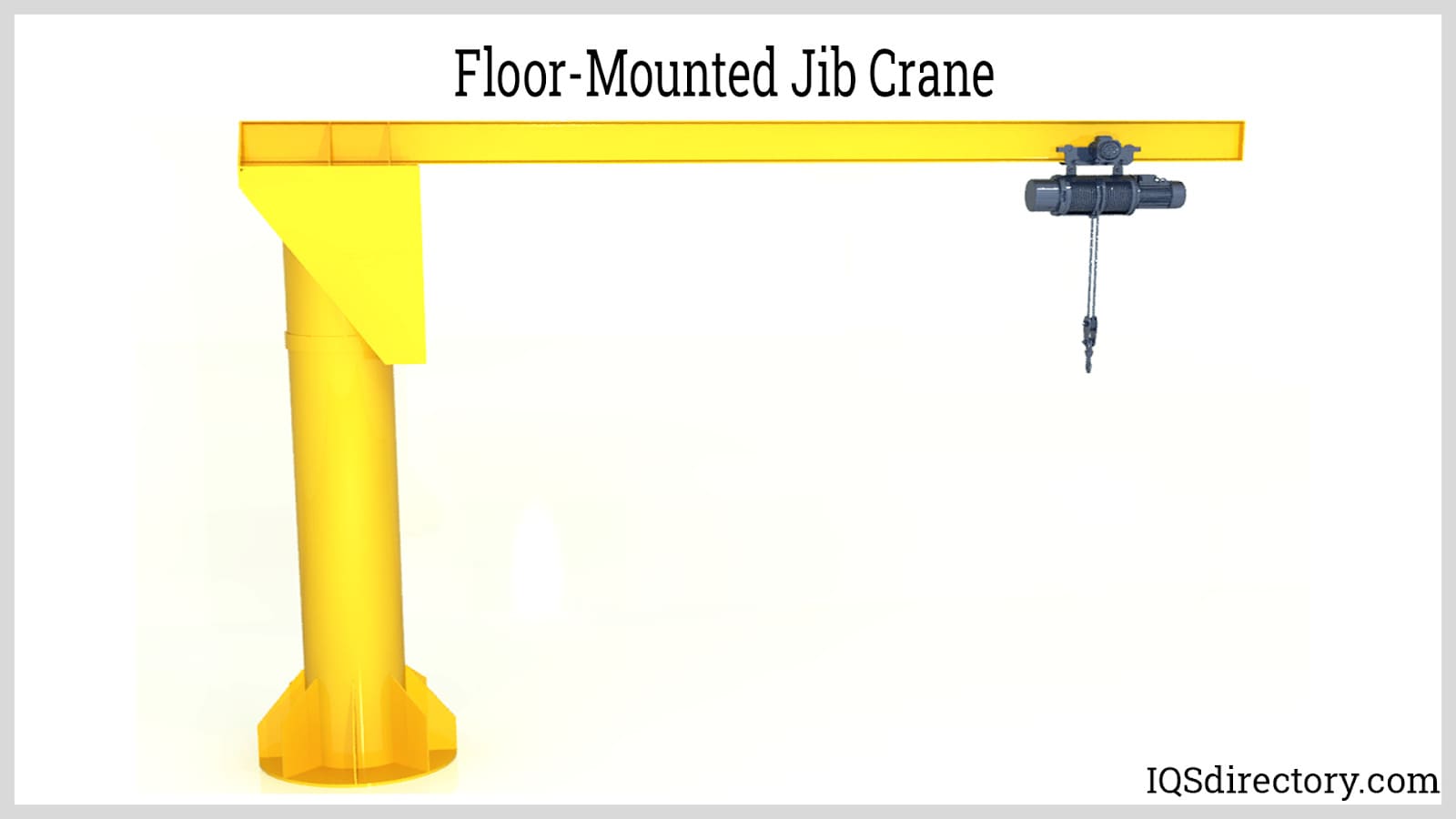 Jib cranes consist of a reach a horizontal beam where the electric hoist positions the load and a mast a vertical beam that supports the reach.
Types of Hoists
Hoisting systems may integrate several hoisting devices to accomplish production processes. The main hoist may be an overhead trolley type that moves material from station to station.
- Supplemental Hoists
- Or auxiliary hoists may be used to move smaller loads at higher speeds.
- Trolley Hoists
- Suspended by a hook attached to a track mounted overhead. The hoist raises the load and the trolley conveys it to the next production station.
- Boat Hoists
- Use a davit system to lift boats in or out of the water. They may be operated electrically or hydraulically and can lift boats weighing up to ten tons.
- Engine Hoists
- Often small portable units on wheels that are easily maneuvered in small shop applications.
- Gate Hoists
- Used in dams to control the flow of water.
- Mini Hoists
- Used to convey, maneuver, and transport workers, equipment, and raw materials for processing. They are found in placer mining and underground mining operations. In underground operations, the hoists allow narrow shafts to be created for deep mining. This reduces the amount of excavation required to arrive at the lode source and causes less destruction to the infrastructure of the surrounding terrain.
- Elevators
- Designated as rope dependent or rope free. Geared traction elevators are driven by a worm gear used to control the cars through the use of steel ropes placed over a drive sheave, attached to the gearbox, which is driven by a high speed electric motor. Geared traction elevators are used in applications where an elevator only travels up to five hundred feet per minute.
- Elevators are equipped with redundant safety systems ensuring that the car will not drop in the event of a catastrophic failure. The cables are made from multiple, intertwined strands of steel. There are multiple rope loops holding each car, reducing the chance of a total loss of cable integrity.
- Gearless Traction
- Operate with a low speed, high torque electric motor that is attached to the drive sheave. Cables are attached to the hitch plate on top or underslung below the cab. The cable, with counterweights on each end, is looped over the drive sheave. The counterweights ride in a separate shaft way and counterbalance the weight of the cab, reducing the amount of power required to operate. These units may travel up to four thousand feet per minute.
- Elevator Brake
- Activated by a governor if the car begins to move too fast. The governor rope is looped around a governor sheave at the top of the shaft. The governor rope is counter weighted so as the car drops, the counter weight balances the speed at which it can fall.
- Electromagnetic Elevator Brakes
- Rely on a supply of electricity to hold a caliper type brake system in its open position. If the elevator experiences a loss of power, the brakes shut automatically, clamping the car in place.
- Auxiliary Hoists
- Supplemental hoists that are used to handle light loads at a higher speed than the main hoist.
- Boat Hoists
- Lifting units specially designed to raise and lower boats. Boat hoists are typically hydraulically or electrically powered and can lift up to 20,000 pounds.
- Car Hoists
- Used in the automotive maintenance and repair industries to help vertically lift a vehicle so work can be done to the tires or underbody.
- Engine Lifts
- Hoists specifically designed to lift and transport large engines safely within a facility.
- Modular Hoists
- Have an integral drum, motor and gearbox, with no visible shaft couplings between them.
Electric Hoist Manufacturers
Good electrical hoist manufacturers can design a system that suits your lifting needs as well as meets compliance standards for any state or federal health and safety guidelines that apply. The designs should include careful considerations for maximum weight capacity, maximum lift speed, the type of line, and how the mechanism is mounted. Inadequate equipment presents a danger to men as well as materials and machines.
The hoist provider will create a maintenance program that works with the production schedule, including operator training, industrial load testing and capacity certifications, inspection, and servicing of equipment. The Overhead Alliance provides guidelines for the manufacture and usage of cranes, elevators, and hoists.
Many companies offer round the clock service, with fleets ready and able to refurbish, repair, or replace faulty equipment on site, reducing downtime on the job.
Electric Hoist Terms
- Attachments
- Components that are used along with lifting devices, forged, stamped or cast.
- Boom (Crane)
- The projecting part of a hoist, sometimes connected to a rotating structure. This is responsible for supporting the hoisting tackle and load.
- Breaking Strength
- The measured load that is required to break a chain or wire rope.
- Carbon Chain
- A type of chain commonly used for various pulling and towing purposes.
- Clevis
- A U-shaped fitting that has a pin or a number of pins. A shackle clevis is a device used to safely lift a load.
- Controller
- A device used by the hoist operator to adjust the amount of power delivered to the unit’s electrical motor.
- Critical Load
- The load point at which any uncontrolled movement will result in hazardous safety conditions.
- Critical Service
- Using hoisting equipment for the handling of critical items.
- Cushioned Start
- A way of reducing the rate of acceleration when moving loads.
- Drum
- A cylindrically-shaped barrel with a uniform diameter that can be found in grooved or smooth configurations. Wire rope or chain is wound around the drum for operation and storage.
- Festooning
- A way of supplying power to a hoist that is moving along a beam.
- Hook
- A lifting attachment that is connected to a hoist.
- Hook Load
- The total weight that is supported by the hook of a hoist. This includes the load, wire or rope tackle and any other masses suspended from the hook.
- Idler
- A roller that is used to support and guide a rope or chain.
- Lifters
- Grabs that are designed to attach, hold, control and direct a load, commonly used with hoists.
- Line Speed
- A measure of the quickness of a hoist to wind up or let out its lifting/lowering medium. Line speed is typically measured by the manufacturer without a load attached to the hoist.
- Load Capacity
- The maximum weight that a hoist is designed to safely carry. Under full loads a hoist’s maximum line speed is typically reduced.
- Pawl
- The device that acts directly upon the ratchet. The pawl ensures the one way travel of the ratchet, which adds safety in case the raising/lowering force is suddenly withdrawn.
- Plate Clamps
- Devices that are used with hoists to lift large, heavy steel plates.
- Qualified Inspector
- A professional or manufacturing representative who is certified to inspect a hoist or other type of rigging system.
- Ratchet
- A circular-shaped mechanism with uniform ridges. The ratchet allows for line retrieval of intake.
- Reeving
- The path of the wire rope on a hoist when it pays off the hoist drum and wraps around the upper and lower sheaves.
- Rigging
- Any necessary equipment or hardware used to attach a load to a hoist.
- Running Sheave
- A sheave that will rotate when the hook is raised and lowered.
- Side Pull
- The portion of the hoist’s pull that is acting horizontally when hoist lines are not acting vertically.
- Sheave
- The grooved wheel/pulley that uses a chain or a rope to change the direction and point of application of the pulling force.
- Tag Line
- A type of rope used to avoid load rotation.
- Trolley
- A wheeled mechanism supported by a frame from which the hoist is suspended. The trolley allows for movement of the hoist for transporting supported loads.
- Winch
- A lifting device, which consists of a horizontal cylinder on a wire rope or chain, wound by a crank.