Broaching
Broaching is a material removal service, used on almost any material to impart shape or form. By and large, broaching is an external process, but manufacturers can perform external and internal broaching.
It is considered a metal removal service. Almost any material, from ferrous and nonferrous metals, to plastic materials and wood can be cut through broaching.
Quick links to Broaching Information
Broaching History
As far as cutting processes go, modern broaching is a fairly recent development, and its history is short and sweet.
Broaching emerged as a viable machining process in the early 1850s, when manufacturers and metalworkers used it for cutting keyways in pulleys and gears. Those were its primary applications until after World War I. After WWI, weapons manufacturers began using the broaching process to rifle gun barrels. Then, between the 1920s and 1930s, engineers made many gains in broaching machine design and form grinding. Thanks to this progress, manufacturers were able to produce broached products with tighter tolerances than ever before, and with lower production costs.
Today, broaching has a long list of applications that continues to grow. As the years advance, we’re sure to see more innovation with this relatively young process.
Benefits and Advantages of Broaching
Broaching has many advantages, including: high productivity, speed and efficiency, accuracy, close tolerances, versatility, cost-effectiveness and smooth surface finishes.
- Productivity and Efficiency
- The entire broaching process takes a matter of seconds, and is fully automated. High production runs are possible, making broaching cost efficient, economical and fast.
- Accuracy and Tolerances
- Broaching allows accurate cuts over large runs and close tolerances.
- Versatility of Broaching
- The only limit to the process is the length and width of the part that is being machined.
- Finishing Process
- The broaching process can be used for high volumes of machine parts with no extra finishing step, unlike other alternatives, which require additional finishing steps. Instead, broaching produces an excellent surface finish on completed parts the first time around.
Broaching Process Details
The broaching process varies based on which method a manufacturer chooses to use. These methods vary based on the use, purpose and motion, construction and function being addressed. However, broaching can generally be classified as surface or internal based on the manufacturing use.
Let’s take a quick look at the setup for the overall process, then go over surface broaching and internal broaching.
- The Setup
- To broach parts, manufacturers start with a workpiece and broach machine. Broach machines are toothed, designed with preformed tooth shapes that vary in length successively; these can be hole-shaped, square, irregular or gear hobbings.
- Instead of cutting a single point, the broach includes a collection of single point cutting tools arranged linearly to cut or remove material.
- Surface Broaching
- The simplest of all broaching methods, and it can be done in one of two basic ways. Either 1) the workpiece to be machined moves while the broach remains stationary, or 2) the broach moves against the surface of the workpiece as it is held stationary.
- Internal Broaching
- During internal broach processes, manufacturers start by clamping the workpiece into a holder called a work holder.
- Within the broach machine, a part called the elevator moves the broach tool above the work holder. There, the broach is moved side-side-side through the workpiece. It gains entry through at least one hole. If need be, like during spiral splining, the broach also rotates.
Design of Broaching Machine Configuration
When getting ready to broach a part, manufacturers look at two major factors, in terms of broach machine configuration. These include: whether the broach cutting tool will be internal or external, and production requirements. Production requirements look at specifics, such as the number of pieces required per hour or per the total run of production.
Together, these factors directly determine which machine will work efficiently for a given job. If an internal broach machine is the answer, then manufacturers will also consider the ratio of length of the broach to its diameter; this helps them decide if a pull or push action machine is more appropriate. Additional factors they make decisions on include: type of drive, power type (hydraulic vs. electromechanical), automation and convertibility.
Manufacturers will base all of their decisions based on your application requirements, so that the results fit your needs.
Applications of Broaching
Broaching services are used to effectively form parts and products, primarily industrial, of all shapes and sizes. They create slots, hole shapes, serrations, internal splines and much more on the interior and surface of a workpiece.
Customers and manufacturers turn to broaching processes for their efficiency and accuracy, which is enhanced by the fact that they don’t use heat.
Industries that rely on the broaching process for parts production include: automotive manufacturing, aviation and aerospace, transportation, power generation, injection molding and assembly, and consumer products.
Products Produced by Broaching
The most common broached products are gears. You can find gear manufacturers here on IQS Directory. Other broached products include: sprockets, pulleys, fastener heads and threading, nuts and bolts, spline shafts, keyways, smaller wheels, gun components, industrial machinery parts, and tools like bushings and wrenches.
Broaching Images, Diagrams and Visual Concepts
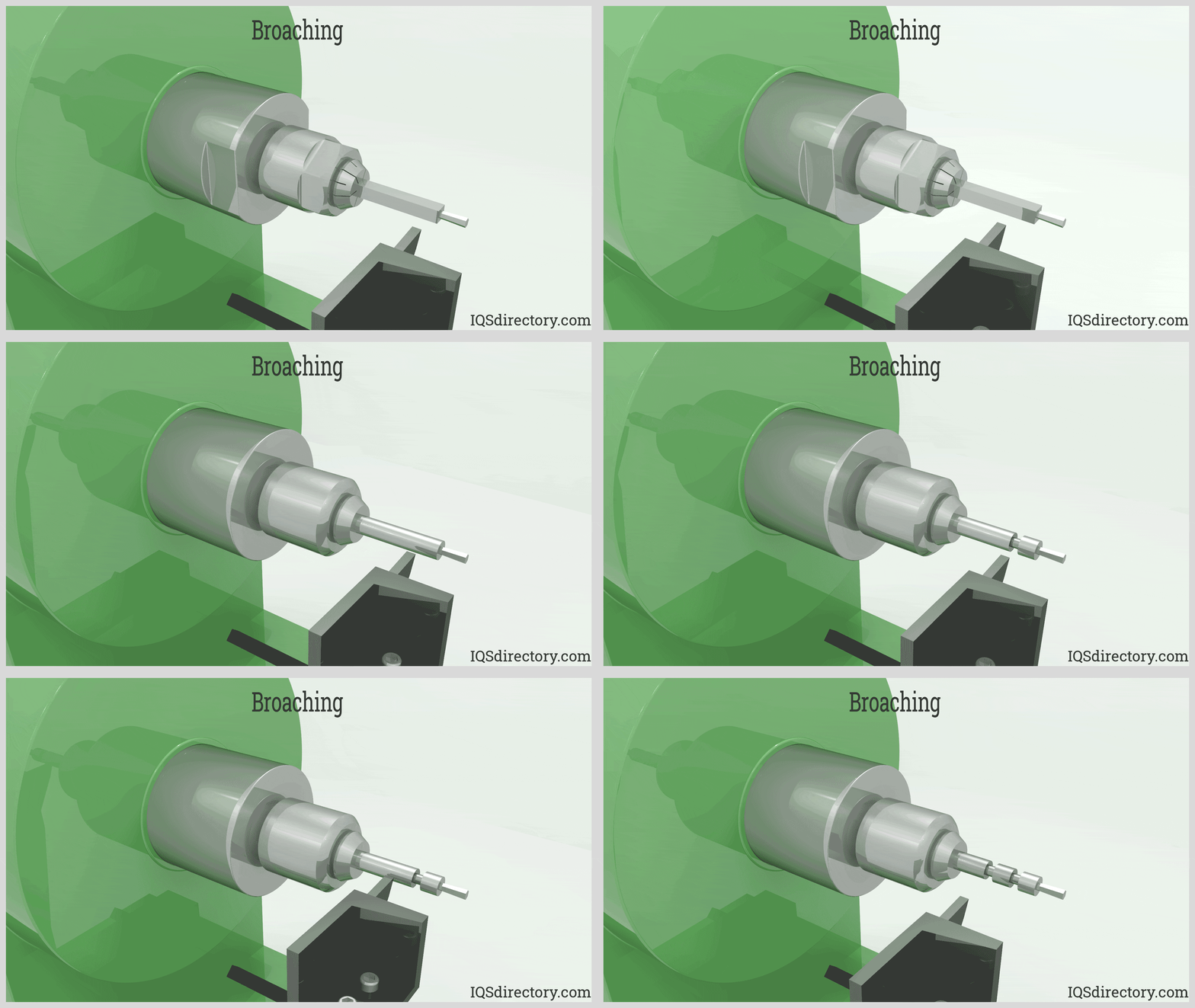 Broaching, a machining process where a sharp, hardened, toothed tool removes material from a workpiece in a consistent, continuous, and accurate way.
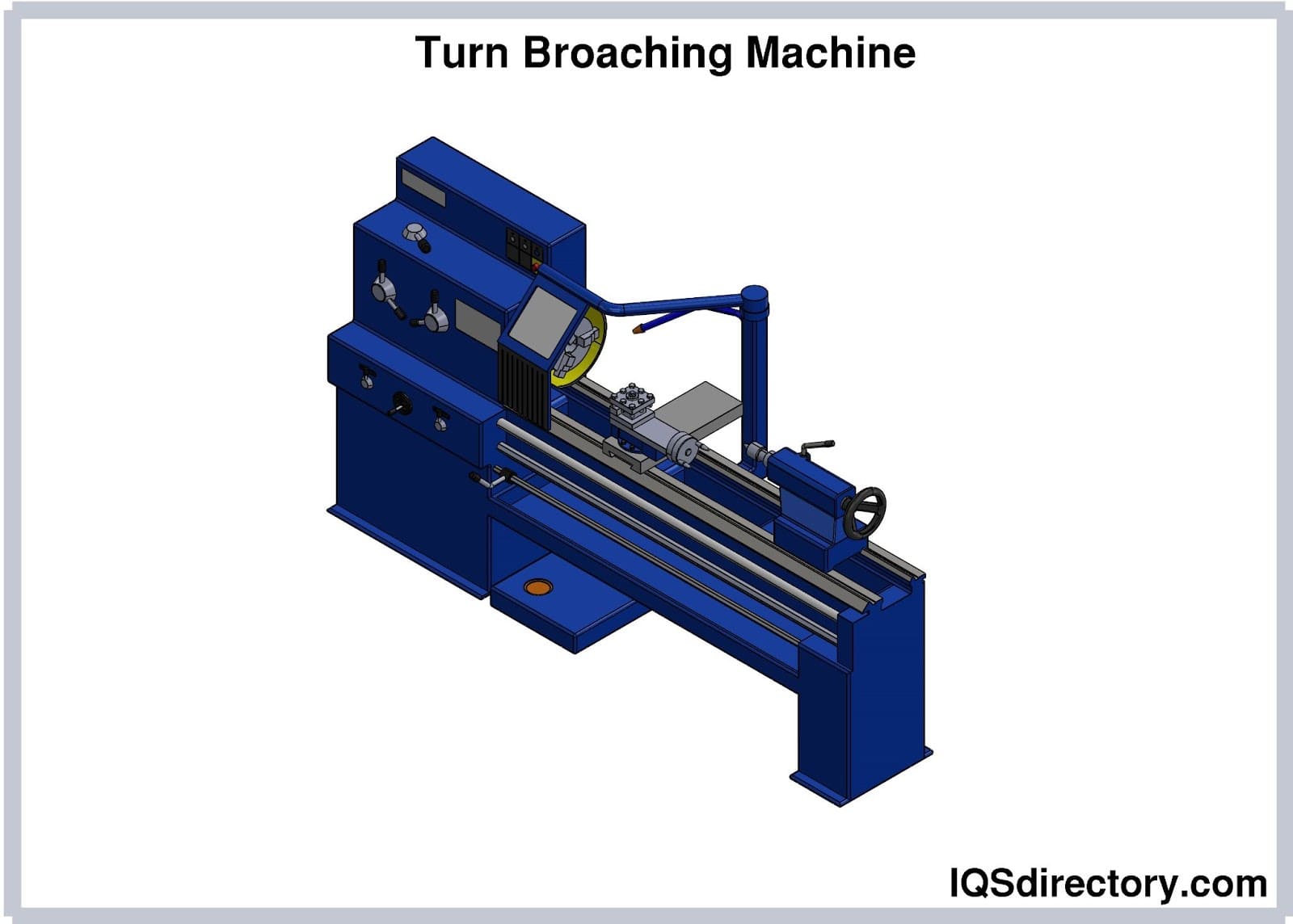 Turn broaching machines are used for circular, linear, and spiral cutting surfaces.
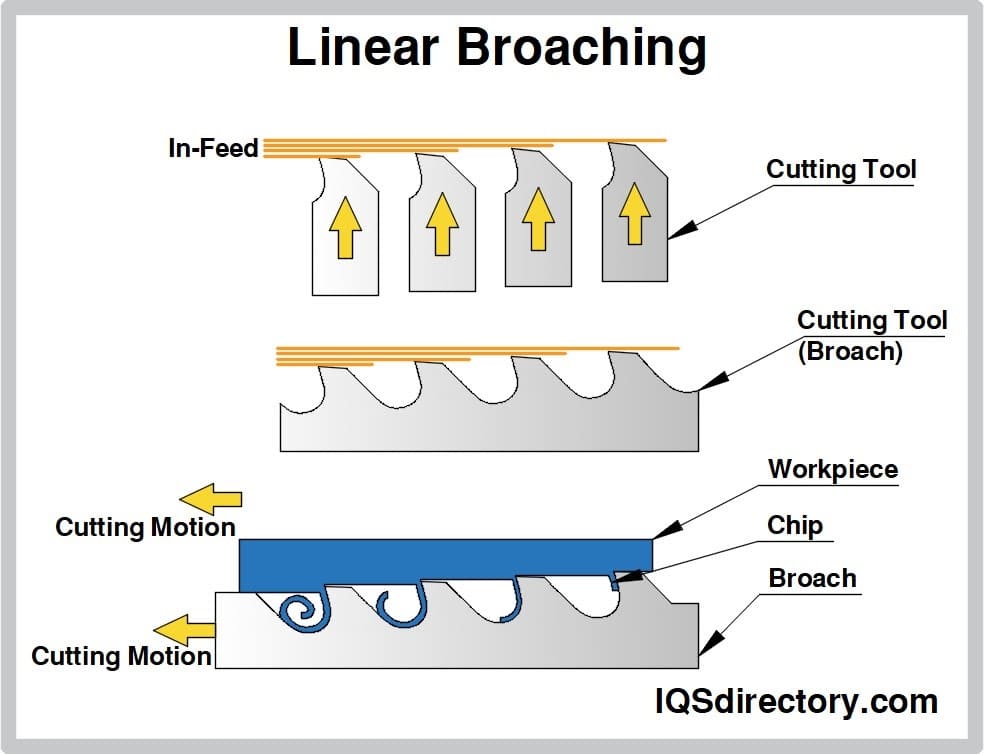 Linear broaching is where a tool moves linearly against the workpiece surface, cutting as it moves.
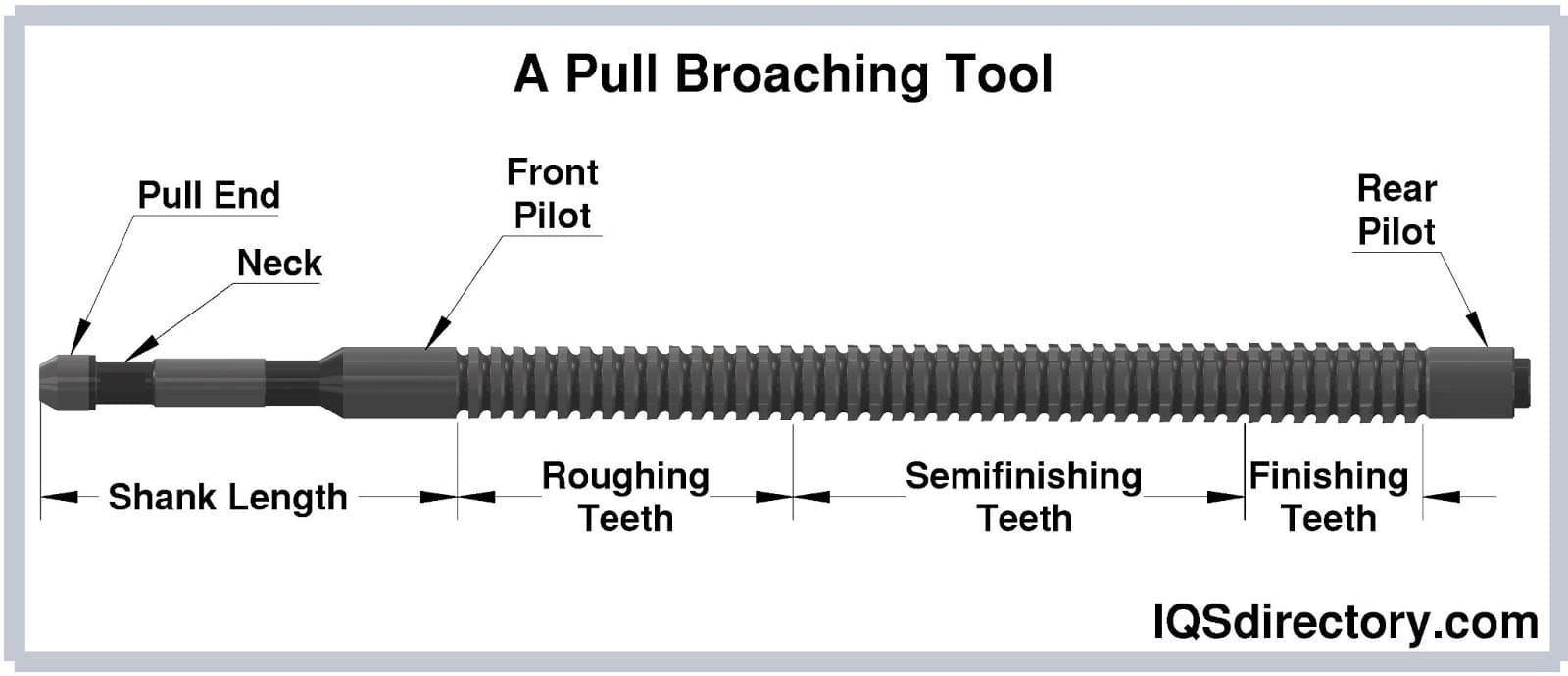 Pull broaching, a workpiece is held in place as the broach is pulled through.
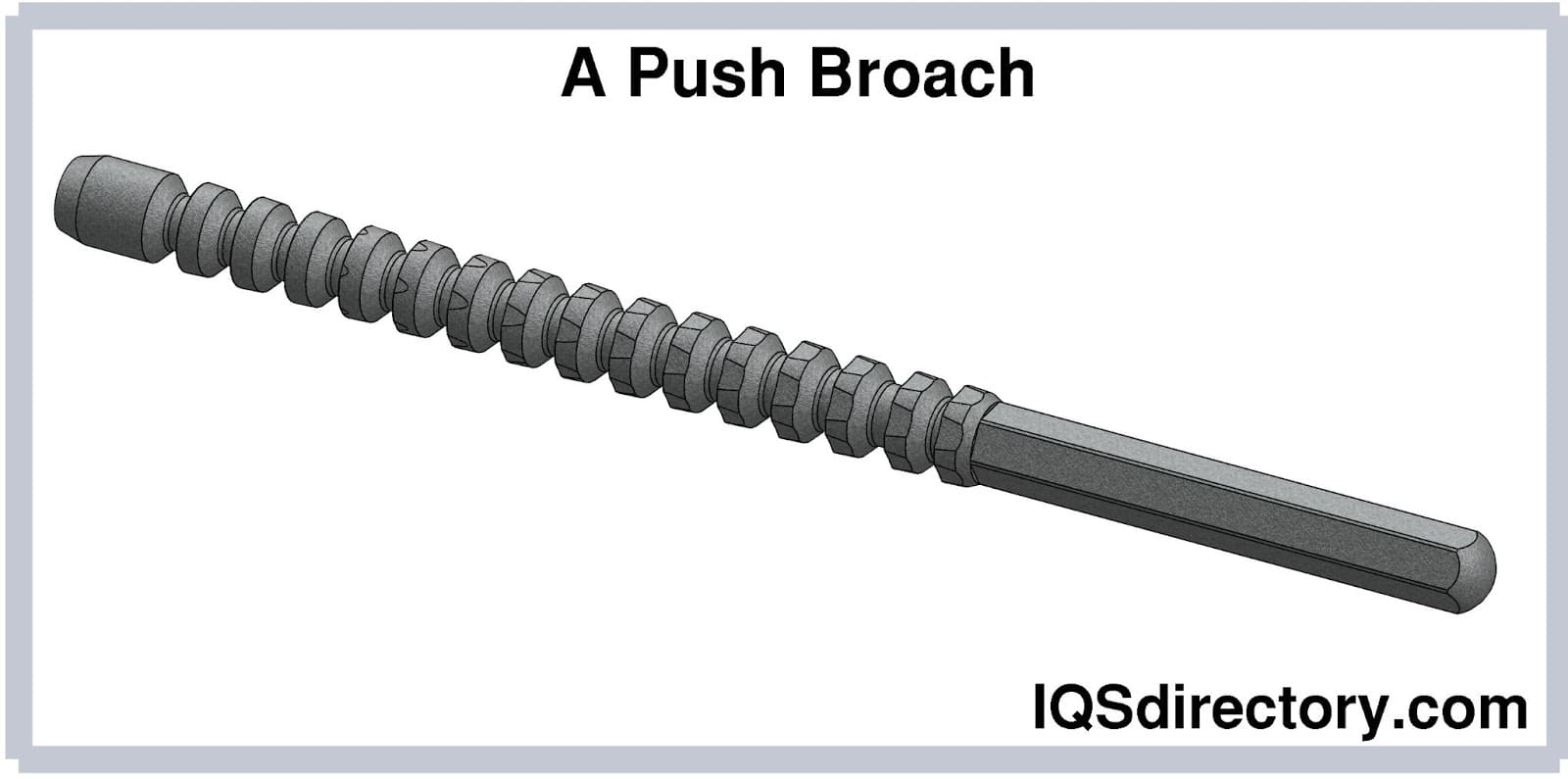 A push broaching tool is shorter which can endure the compressive forces applied as it goes through the workpiece.
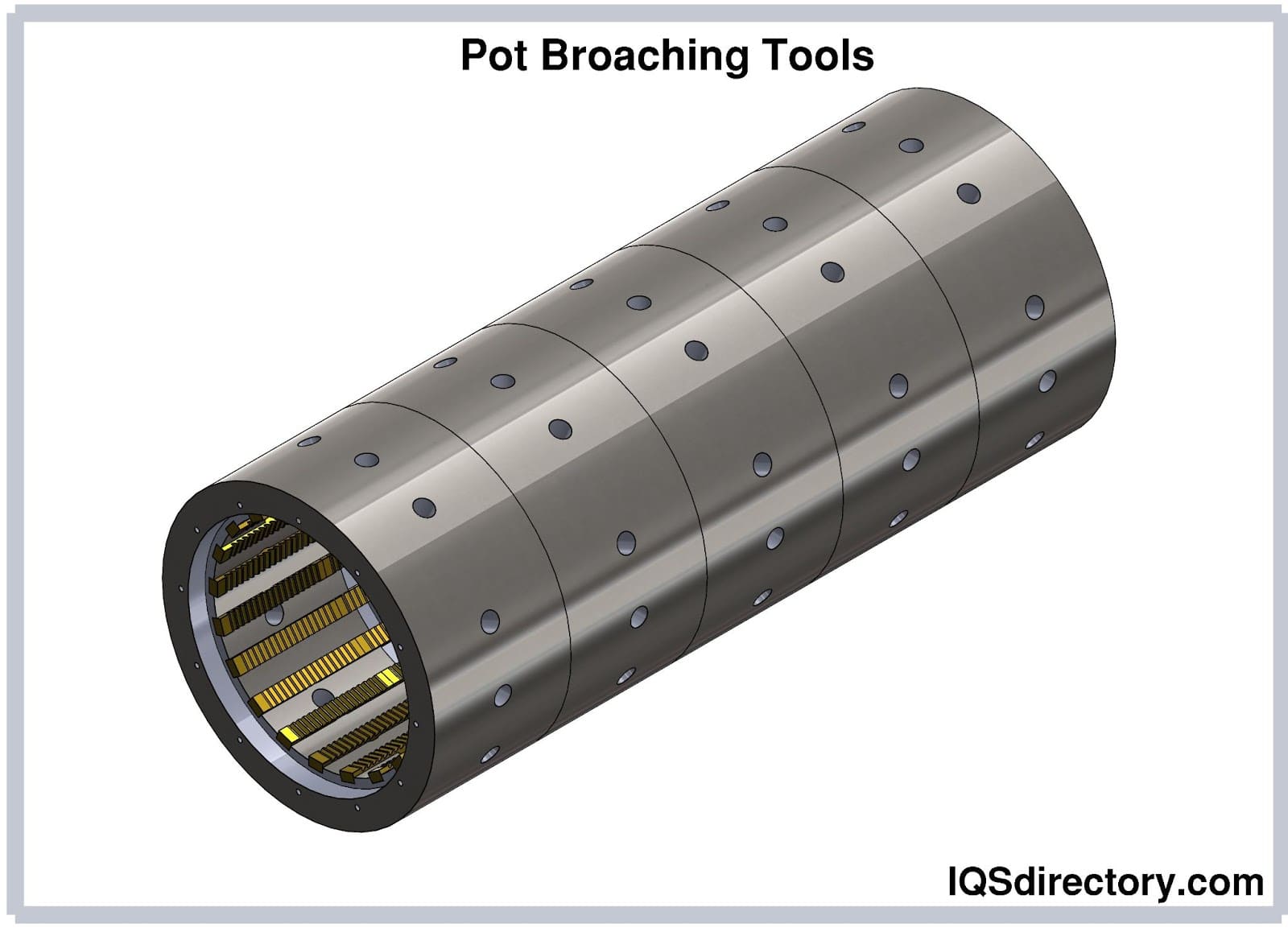 In pot broaching, the tool remains stationary as the workpiece is pushed or pulled through it.
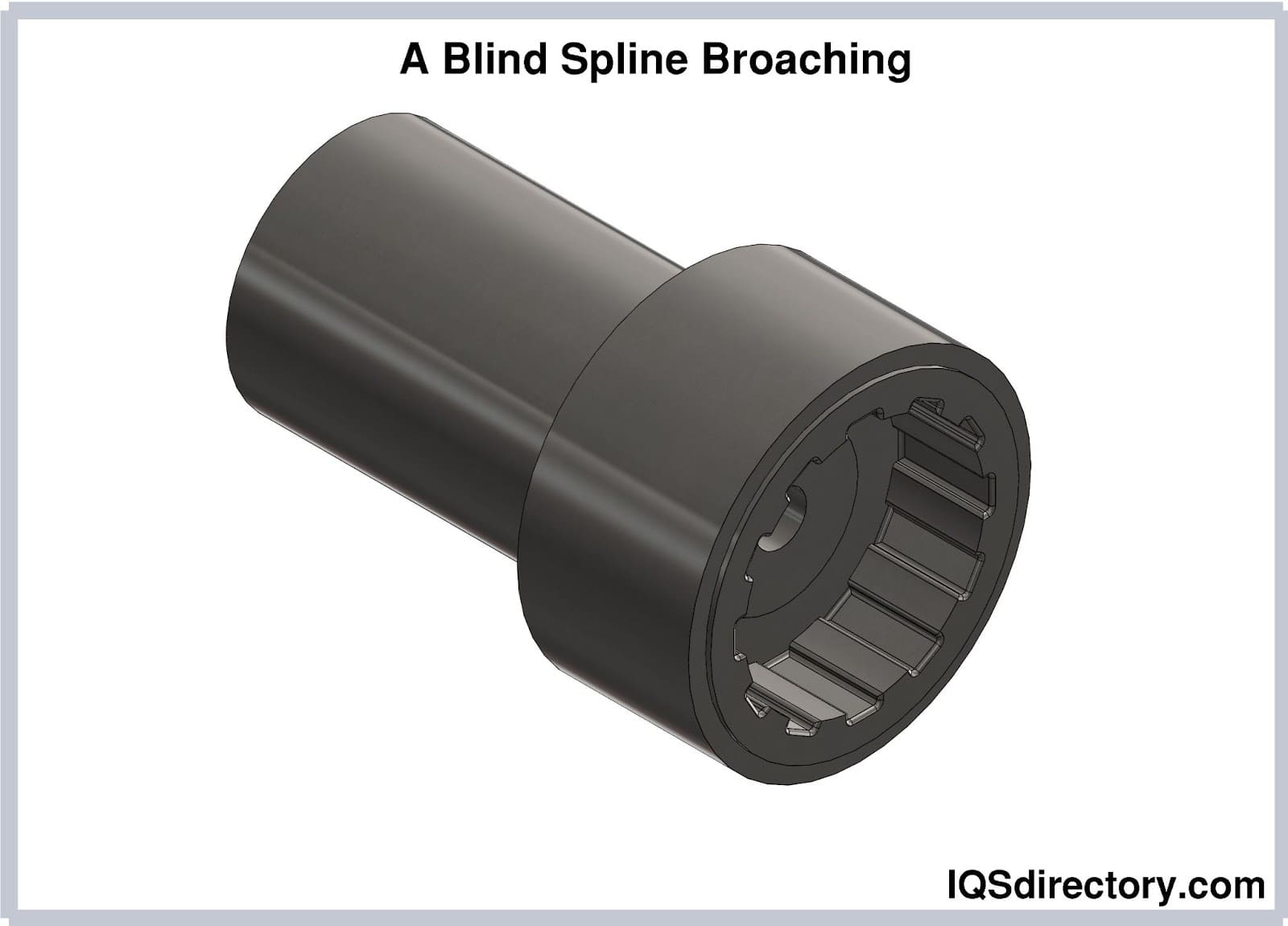 The process of blind broaching is used on parts designed to not have a pass through.
Types of Broaching Machines
During the broaching process, manufacturers use a variety of broaching machines. These machines can generally machine down to the square millimeter (sq mm or mm sq). Most broaching machines are some combination of a push or pull broaching tool with cutting teeth, and equipment such as automatic lathes, CNC Swiss lathes and rotary transfer machines.
- Vertical Broaching Machine
- Most of the broaching machines used in broaching job shops are vertical and support either external or internal broaching. These machines, as their name suggests, work vertically on a work piece and are driven by hydraulic presses. They also add flexibility, as they can be moved from one area to another.
- Based on their mode of operation, vertical machines are categorized as table-up, pull-up, and pull-down or push-down machines.
- Vertical Table-Up Machine
- Have a broach that remains stationary, and a workpiece mounted on a movable table. These machines meet cell concept manufacturing needs, adding flexibility for manufacturing processes. They are designed for short-runs; and after one or two years, the machines can be retooled for different applications. Vertical table-up machines have stroke lengths between 30 to 90 feet, with a capacity of 5 to 30 tons.
- Horizontal Broaching Machine
- Have a horizontal configuration. They are gear or screw driven, and may be powered hydraulically or mechanically. Sometimes, they’re used exclusively for finishing and roughing various engine blocks. Horizontal broaching machines are returning to favor because they perform very long strokes and do not have the limitations of their vertical counterparts.
- These broaches are further divided as horizontal internal broaching machines, horizontal surface broaching machines, and chain-broaching machines.
- Chain Broaching Machine
- For modern production needs, manufacturers often prefer chain-broaching machines. This is because these surface broaching machines have a continuous chain where workpieces are mounted, eliminating the need of a return stroke.
- Specialized Machinery
- Those broaches designed for specific or semi-specific applications. Keyway broach machines, for example, are designed specially to broach keyways.
- Examples of semi-specific specialized broaching machinery include turn-broaching or rotary broaching machines, which cut different shapes that vary from linear, to circular, to spiral. These sturdy broach tools cut machine steel and cast-iron crankshafts.
- Custom Machinery
- For custom machining, manufacturers can adapt or create specialty machinery. For example, to perform different functions, they can assemble peripheral cutters in segments. Manufacturers also have standardized components ready to rough or finish workpieces.
Ways to Broach
- Blind Broaching
- Another term for external broaching, the broaching process that is surface level.
- Broaching Job Shops
- Facilities devoted to providing broaching services.
- Gear Hobbing
- The process of using a broaching machine to cut gear teeth.
- Internal Broaching
- Involves using a broach tool to make precise cuts to a preexisting hole on the inside of a workpiece.
- Keyseaters
- Machines that make the keyway holes inside locking mechanisms.
- Keyway Broaching
- Uses keyseater machines to make keyholes in a variety of materials.
- Pot Broaching
- One external broaching method specifically used to form gears.
- Production Broaching
- When a machine is used to make mass amounts of a single product.
- Rotary Broaching
- Also known as wobble broaching, is a popular broaching method that has been used for years on automatic lathes, and is now gaining popularity on rotary transfer machines and CNC Swiss lathes.
- Spline Cutting
- A broaching process that cuts grooves into the length of a spline shaft.
- Spline Shafts
- Have grooves created by broaching machines.
- Surface Broaching
- Involves using a broach tool to precisely cut the surface of a workpiece.
- Vertical Broaching
- Cutting tools with successively larger teeth.
Variations and Similar Processes
- Gear Hobbing
- Forms gears by externally broaching the grooves on the gear's external surface.
- Vertical Broaching
- Used for higher volumes of products. The hole indentations and grooves that are made with a spline shaft, which contains a series of successively larger teeth that are strong enough to cut through metals, may reach all the way through the work-piece, forming a hole, or make shallow indents that blind broaching produces.
- Pull Broaching
- When the broach cutting tool is pulled through the part in a single pass, this process is called pull broaching.
- Push Broaching
- The second most common type of broaching services used is push broaching. Broaching job shops most often utilize this service on short run jobs using a hydraulic press, or more commonly, a hand operated arbor press.
- Pot Broaching
- Inverts machinery movements; while the broaching tool remains stationary, the workpiece pushes through it. Note: The pot broach is named as such because it features a hollow casing shaped like a pot.
- Broaching job shops can also perform broaching on a lathe, which spins at a high rotation.
- Rotary Broaching
- During the rotary broach process, the rotary broach tool must be held at a 1° angle to the workpiece, while the cutting face of the broach must be positioned as close to the centerline of the workpiece as possible. The tool and part are stationary while the broach holder spins on a spindle. As the rotary broach tool and the part come into contact, the tool moves in a "wobble" motion.
- One of the reasons that rotary broach machining, or wobble broaching, is popular is the fact that it does not require a full broach machine, but rather may be performed with only a lathe, Swiss lathe, milling machine or screw machine.
- Production Broaching
- Manufacturers use the term “production broaching” when referring to the high-volume fabrication of broached parts in a specialized broaching job shop. This label can be applied to many other types of broaching, including keyway broaching, rotary broach processes, vertical broach processes, etc.
Things to Consider When Choosing Broaching
Expense of Broaching
Broaching, unlike other machining alternatives, is job specific. Each type of broach can machine only one shape, as it is designed for a specific geometry. These limitations make it a highly specialized option for very limited use. In custom broaching, a completely new tool is developed only adding to manufacturing costs. For these reasons, broaching can be quite expensive.
To reduce costs, manufacturers perform broaching in specialized broaching job shops. At these facilities, manufacturers use specialized machines, like the p machine, to make broaching more cost effective.
Machine Parts and Broaching
Consider the following points when determining which machine parts are appropriate for broaching. Broaching does have its limitations but can be controlled to ensure precision and process efficiency.
- If you are machining a workpiece, the piece should not contain any obstructions over the length of the surface.
- You cannot machine work pieces that have curves in multiple planes; the broach primarily works within a single plane.
- The part you are machining must be able to withstand the forces involved in broaching.
- For internal broaching, the workpiece must have a hole where the broach can enter.
Finding the Right Broaching Manufacturer
If and when you’ve come to the conclusion that this service is right for you, you want to find the right manufacturer. Who is the right manufacturer? The right manufacturer is that broaching company who is willing and able to work within your timeline, with your specifications and satisfaction as their main focus. While broaching can be expensive, the right company will also do their best to give you the best service at the most affordable price.
To find a provider like this, check out the list of quality broaching companies that we’ve listed near the top of this page. See what they have to offer, then reach out to one or more of them with your specifications and questions.
Broaching Terms
- Broach
- A metal cutting tool with a series of cutting teeth.
- Chip Breakers
- Chip breakers are broach tool notches that get rid of the chip by facilitating its removal. The semi-finishing and roughing teeth section of the broach has chip breakers which are parallel to the axis of the tool.
- Chip Load
- As a tooth enters a workpiece, a fixed thickness of material is chipped, and this is called chip load. The type of the broach tool used in a machine determines the chip load.
- Chip Space
- The space between the teeth on a broach that accumulates chips during the cutting operation.
- Cutting Teeth
- The cutting teeth on the broach are not of the same size; instead, they are divided into three separate sections. The first section consists of roughing teeth, which are followed by semi-finishing teeth, and the final section has finishing teeth. The roughing teeth are smaller and the size of teeth height increases progressively.
- External Broach
- A broach that cuts along the external surface of a workpiece.
- Face Angle
- The angle of the cutting edge of a broach tooth.
- Finishing Teeth
- Teeth for finishing a surface that are arranged at a constant size at the end of a broach.
- Front Pilot
- Front pilot ensures the axial alignment of the broaching tool and the starting hole. Basically, the front pilot works as a check on the starting hole size. Similarly, there is a rear pilot, which also checks the alignment of the tool but is placed at the rear end.
- Gullet
- Another name for “chip space.”
- Hook Angle
- Another name for a tooth’s “face angle.”
- Internal Broach
- A broach that is pulled or pushed through a hole in the workpiece in order to bring the hole to a desired size and shape.
- Overall Length
- The length of a broach tool.
- Pitch
- The measurement from the cutting edge of one tooth to the same point on the next.
- Pull Broach
- A type of broach that is pulled through or over the surface of the workpiece during an operation.
- Push Broach
- A type of broach that is pushed through or over the surface of the workpiece during an operation.
- Roughing Teeth
- The teeth that are cut first in a broaching operation, with heavier cuts than semi-finishing teeth.
- Round Broach
- A broach with a circular section.
- Shear Angle
- On surface broaches, the angle between the cutting edge of a shear tool and the line perpendicular to the broach axis or line of travel. Broach teeth designed at a shear angle, which improves the ultimate surface finish and brings tool chatter down significantly. Shear angles become important when an adjacent workpiece surface is being cut concurrently, as the shear angle moves chips, made from broaching, away from the intersecting corner. If not done properly, this can lead to the crowding of chips at the intersection and overall machine damage.
- Shear Cutting Tooth
- A type of tooth used on surface and external broaches, positioned so that it does not make a right angle with the direction of broach motion.
- Side Relief
- As slots are broached, the motion leads to substantial friction because the sides of the broach teeth rub the sides of the slot. This friction can cause rapid tool wear and tear. To extend tool life, machines feature a clearance, which is called side relief. A relief angle is grinded, therefore, on both sides of each tooth.
- Surface Broach
- An external broach that is used to cut a flat or contoured surface.
- Tooth Depth
- From the root to the cutting edge, the height of the tooth or broach gullet.
- Tooth Land
- The tooth land gives support to the cutting edge as it goes through various processes stresses.
- Tooth Pitch
- The distance between teeth is called tooth pitch. The length of the cut determines tooth pitch or length between. However, sometimes pitch is influenced by the type of material, like steel or aluminum.