Perforated Metals
Perforated metals are sheet metal products that have been punched, stamped, or otherwise processed to create a controlled pattern of holes, slots, or decorative openings. These openings may be round, square, slotted, hexagonal, or custom shaped, and they are selected to support airflow, drainage, light diffusion, filtration, acoustics, weight reduction, visual design, or a mix of these goals. In practical terms, perforated metal combines form and function in one material, which is why it remains a popular choice in industrial manufacturing, commercial construction, architectural design, and OEM fabrication.
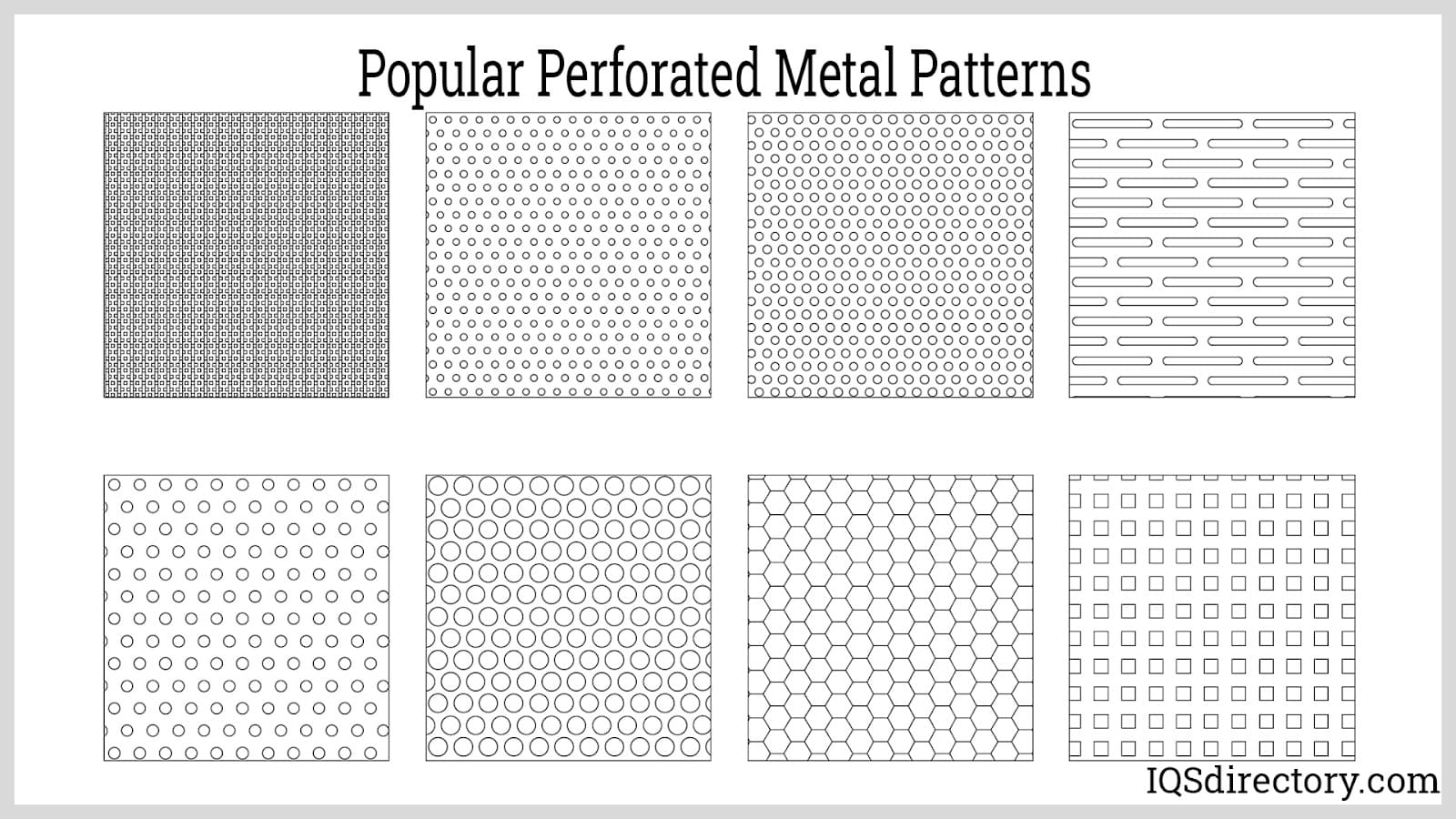
The types of hole patterns available include staggered round, staggered center, straight square slot, round and line square, round slot end, side staggered, square staggered diamond, chain link, cross, hexagon, center, square hole patterns, and decorative cutouts like stars and flowers. Buyers often compare open area, hole size, sheet gauge, center spacing, flatness, strength, and appearance when choosing perforated metal sheets, perforated panels, perforated plates, or custom perforated components for a project.
Perforated Metals FAQ
What are perforated metals used for?
Perforated metals are used in filtration, screening, acoustics, insulation, construction, waste management, furniture design, and security barriers. They also serve industries such as architecture, automotive, food processing, and chemical production.
Which metals are commonly perforated?
Commonly perforated metals include stainless steel, aluminum, copper, and brass. Specialty steel grades, galvanized metals, and alloys are also used depending on strength, corrosion resistance, and decorative needs.
What advantages do perforated metals provide?
Perforated metals provide strength, durability, and aesthetic flexibility. They reduce energy costs, support acoustic control, and withstand mishandling. Their versatility makes them ideal for architectural facades, sound absorbers, and filtration systems.
How are perforated metals manufactured?
Perforated metals are made using techniques such as standard punching, XY-axis CNC punching, rotary pinned rollers, die-and-punch presses, and laser perforation. Finishing processes like polishing and grinding prepare sheets for final applications.
What are popular perforation patterns?
Popular patterns include staggered round, diamond, hexagon, square, chain link, cross, slots, and decorative shapes like stars or flowers. The choice depends on functional needs such as sound transparency or decorative appeal in construction and design.
What industries rely on perforated metals?
Industries such as construction, architecture, automotive, aerospace, food and beverage, chemical, energy, and acoustics rely on perforated metals for products like screens, filters, vents, panels, acoustic barriers, and structural components.
What is the difference between perforated and expanded metal?
Perforated metal is created by punching holes or patterns into sheets, while expanded metal is slit and stretched to form diamond-shaped openings. Expanded metal is cost-effective, but perforated metal allows finer holes and greater design flexibility.
The History of Perforated Metals
Perforated metals have been used for decorative purposes for centuries, but they did not see broad industrial use until the 19th century. Early manufacturers manually perforated screens to sift and separate mined coal, grain, and other raw materials. For a long stretch of time, the perforated metal screen was the primary industrial product, valued because it could sort, separate, and protect while standing up to hard use in demanding environments.
As fabrication methods and machine capabilities improved, perforated metal manufacturers adapted by developing custom dies, presses, and production methods built specifically for repetitive metal punching. That shift helped move perforated metals from simple screens into a broader category that included ventilation panels, protective guards, speaker grilles, architectural facades, and machine enclosures.
The manufacturing landscape shifted again with rotary pinned perforation rollers, CNC punching systems, and laser perforation. These methods improved speed, repeatability, and design freedom, allowing buyers to request custom open area percentages, tighter tolerances, finer hole diameters, and more decorative layouts. As a result, perforated metal became a go-to material for building skins, sunshades, acoustic treatments, filtration systems, agricultural screening, and lightweight engineered parts.
Today, perforated metal continues to grow in importance across industries ranging from aerospace and automotive to environmental control and commercial architecture. It solves a simple challenge in a surprisingly elegant way: how to keep strength and surface coverage while still allowing air, light, sound, or fluids to pass through.
There are many advantages to choosing perforated metals over alternative materials. They offer structural integrity, predictable performance, and design flexibility in one sheet. Because the hole pattern can be engineered around a specific application, perforated metal can improve airflow, manage heat, reduce weight, increase visibility, support filtration, or create privacy without fully blocking light and movement. It is one of those materials that can look refined on a building exterior and still work hard on a factory line.
In architecture, perforated metal sheets and panels add visual texture while also supporting shading, privacy screening, and facade ventilation. In some applications, they can help reduce solar heat gain and contribute to lower energy use. In acoustic systems, perforated sheet metal is widely used because it can protect absorptive materials while still permitting sound waves to interact with the assembly. It is also easy to clean, resistant to wear, and better suited for repeated use than many nonmetal alternatives.
Another benefit is manufacturing consistency. Modern perforation equipment produces repeatable results across large production runs, which matters when buyers need uniform open area, matching panel appearance, exact fit, or dependable performance in screens, filters, guards, and OEM components. Whether the goal is durability, corrosion resistance, attractive appearance, or a favorable strength-to-weight ratio, perforated metals give engineers and buyers a lot of room to work with.
Materials Process
The most commonly perforated metals include copper, stainless steel sheet, and aluminum. Alloy manufacturers also produce a wide variety of alloys, including brass and specialty steel grades. Galvanized and regular perforated metals are used depending on the application. Each type of perforated material has its own unique properties and uses, which are detailed below.
Perforated Copper
Perforated copper is recognized for its reddish tint, making it ideal for decorative purposes. It performs well in a range of temperatures and is resistant to rust when exposed to water. As an excellent conductor of heat and electricity, copper is widely used in applications such as interior and exterior design, tubing, shielding, electronics, and specialty architectural accents where appearance matters just as much as performance.
Stainless Steel
Perforated stainless steel is strong, lightweight, corrosion-resistant, rust-resistant, and antibacterial. It comes in multiple grades, with carbon steel also being commonly used where a different balance of cost and performance is needed. These properties make perforated steel and stainless steel versatile options for healthcare, pharmaceuticals, food processing, enclosures, industrial screening, and outdoor architectural applications that demand long service life.
Aluminum Perforated Sheet
Aluminum perforated sheets are valued for their corrosion and rust resistance, heat resistance, strength, and durability. Because aluminum is comparatively light, it is widely used in architectural cladding, office refurbishments, railing infill, stairway panels, speaker covers, transportation components, and applications where reducing weight can simplify installation and support long-term performance.
Perforated Brass
Brass, like copper, has a gold-like shine, making it a popular choice for decorative applications. It is relatively resistant to tarnishing, an excellent thermal conductor, and a good electrical conductor. Perforated brass is commonly used in HVAC applications, electronics, heating systems, displays, and decorative grilles where designers want a warmer metallic appearance.
Process Details
Select the Appropriate Material
The first step is choosing the right material for the project. The choice of metal depends on the intended application and properties required, such as strength, corrosion resistance, conductivity, weight, appearance, sanitation needs, and expected exposure to moisture, chemicals, or temperature swings.
Determine the Appropriate Sheet Gauge
Sheets come in varying thicknesses and are measured by gauges—note that the larger the gauge number, the thinner the sheet. Selecting the correct sheet gauge is just as important as choosing the material itself. It affects rigidity, weight, open area, manufacturability, and how the finished perforated sheet will perform once installed.
Choose Your Perforation Pattern
There are numerous pattern options, ranging from staggered squares to intricate floral designs. The right perforation pattern depends on airflow, drainage, visibility, sound transparency, product protection, and visual effect. Buyers often ask: do you need more open area, smaller holes, smoother appearance, or better strength between perforations? The answer guides the pattern selection.
Bend, Weld, Punch, and Cut
Perforating sheet metal can be done in different ways, depending on the complexity and design of the hole patterns. The two main methods are standard punching and XY-axis punching, though rotary perforation and laser perforation are also used for certain volumes, materials, or specialty patterns. Secondary operations such as shearing, leveling, forming, welding, edging, and finishing are often part of the finished product.
Standard Punching
For simple perforations, a standard punching press is used. In this method, the sheet metal is fed slowly into the press, which contains the designed hole pattern, and the metal is perforated as it passes through. This approach works well for repeated patterns, production efficiency, and common industrial perforated sheet applications.
XY Axis Punching
For more complex and decorative designs, an XY-axis punching press is used. This CNC-controlled press offers high precision and is perfect for creating intricate, non-repetitive patterns.The sheet metal is secured to the machine, and the punching rams move along the X and Y axes, creating a detailed design as the sheet moves through the press. This method is a strong fit for custom perforated panels, branded designs, and architectural sheet metal work.
Finishing
Once perforated, the metal undergoes finishing processes, such as surface polishing and rounding. Depending on the application, manufacturers may polish the sheet either mechanically or with electric methods. The metal is then degreased, blasted with beads or sand, and may undergo additional grinding or brushing techniques to smooth the surface and prepare it for use. Finishing can improve appearance, remove burrs, support coating adhesion, and help the material meet sanitary or decorative requirements.
When designing perforated metals, manufacturers consider a variety of factors to ensure that the final product meets both functional and production goals.
Manufacturing Speed
One important factor is manufacturing speed. If turnaround time matters, manufacturers may recommend coil processing, high-speed wide press methods, or another approach that balances pattern complexity with efficient production.
Perforation Patterns and Application
Another key consideration is the perforation pattern, which is tailored to the specific application. In acoustic products, open area and sound transparency shape the pattern choice. In filtration, hole diameter and material compatibility matter more. In architecture, the look of the panel may carry as much weight as the performance data. Good design aligns these goals instead of forcing one to fight the other.
Industry Requirements and Space Constraints
Manufacturers also factor in code requirements, sanitation needs, load expectations, available installation space, and end-use conditions. Whether the product will become a security screen, machine guard, speaker grille, facade panel, filter basket, or ventilation cover, the design must fit the application instead of just looking good on paper.
By considering these elements, manufacturers create perforated metal products that meet performance goals while supporting practical production and installation.
Machinery Used in the Process
Wide Press
The wide press perforation method is one of the most widely used and cost-effective options for high-volume production. This process involves punching the entire width of a metal plate in each strike of the die. While it is fast and efficient, it can introduce stress or distortion in some layouts, which is why leveling and corrective handling may be used after perforation.
Sectional Press
Sectional press perforation works on a specific area of a plate instead of the full width. It is more flexible for tailored perforation zones, specialty layouts, and thicker materials. Tooling costs may be lower than a wide press setup, and modern CNC controls help simplify pre-programmed perforation locations and pattern variation.
Automatic Nibbling Machines
Automatic nibbling machines work similarly to sectional presses but with the added advantage of automated tool changes and contouring. They are useful for custom shapes, varied perforations, and low-to-medium volume production where flexibility matters as much as output speed.
Manufacturers utilize various machinery options to create perforated metal products that meet specific requirements, such as hole size, open area, plate thickness, flatness, and strength-to-weight ratio. The choice of machine depends on design complexity, production volume, tooling budget, and the performance needs of the final product.
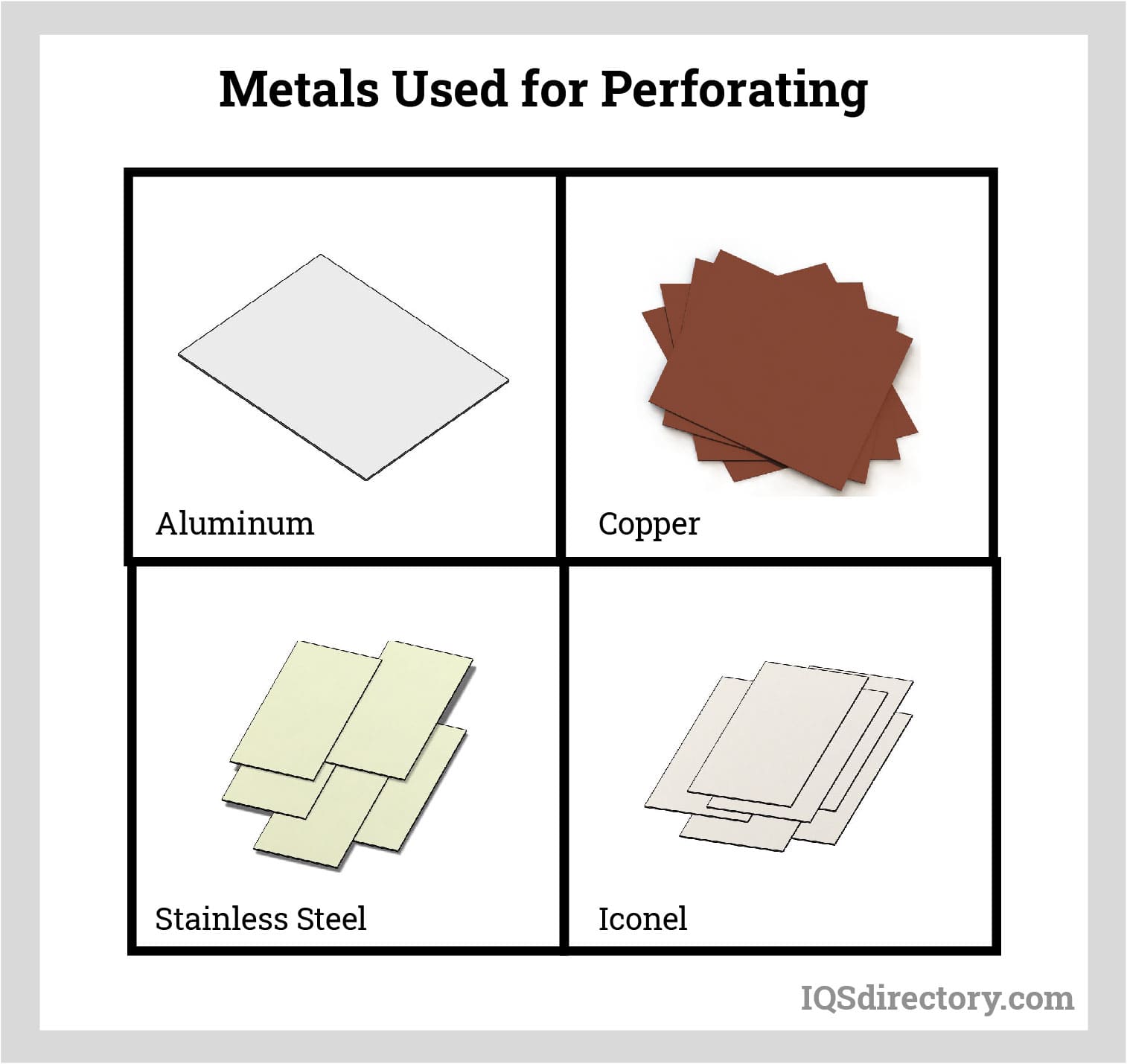 The different metals that can be used for a perforating pattern, however the thickness of the mteal affects the amount of time to finsih the final product.
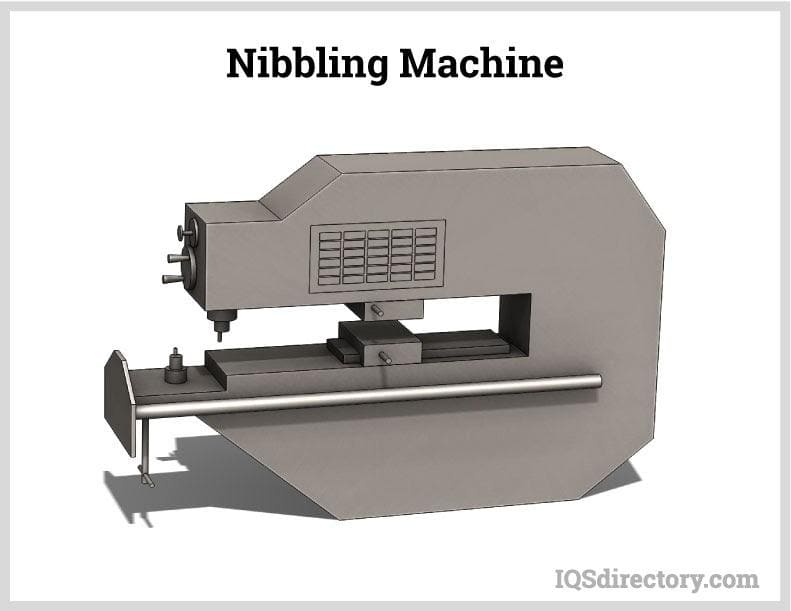 Nibbling, a production process where the metal sheet is cut in stages using a punch using an electrohydraulic motor.
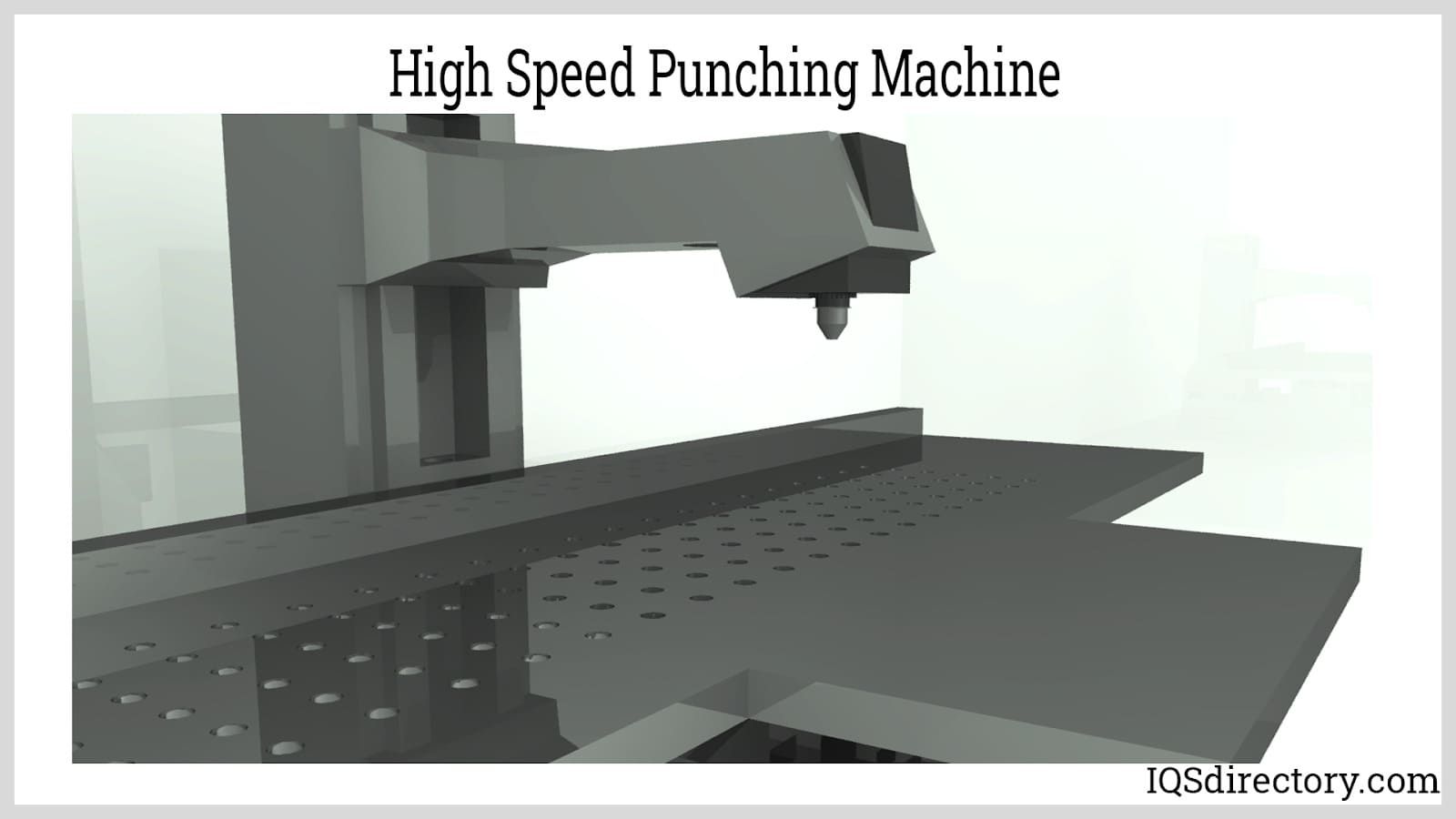 A punching machine functions much like a wide punch press that moves across the sheet metal placing symmetrical holes section by section.
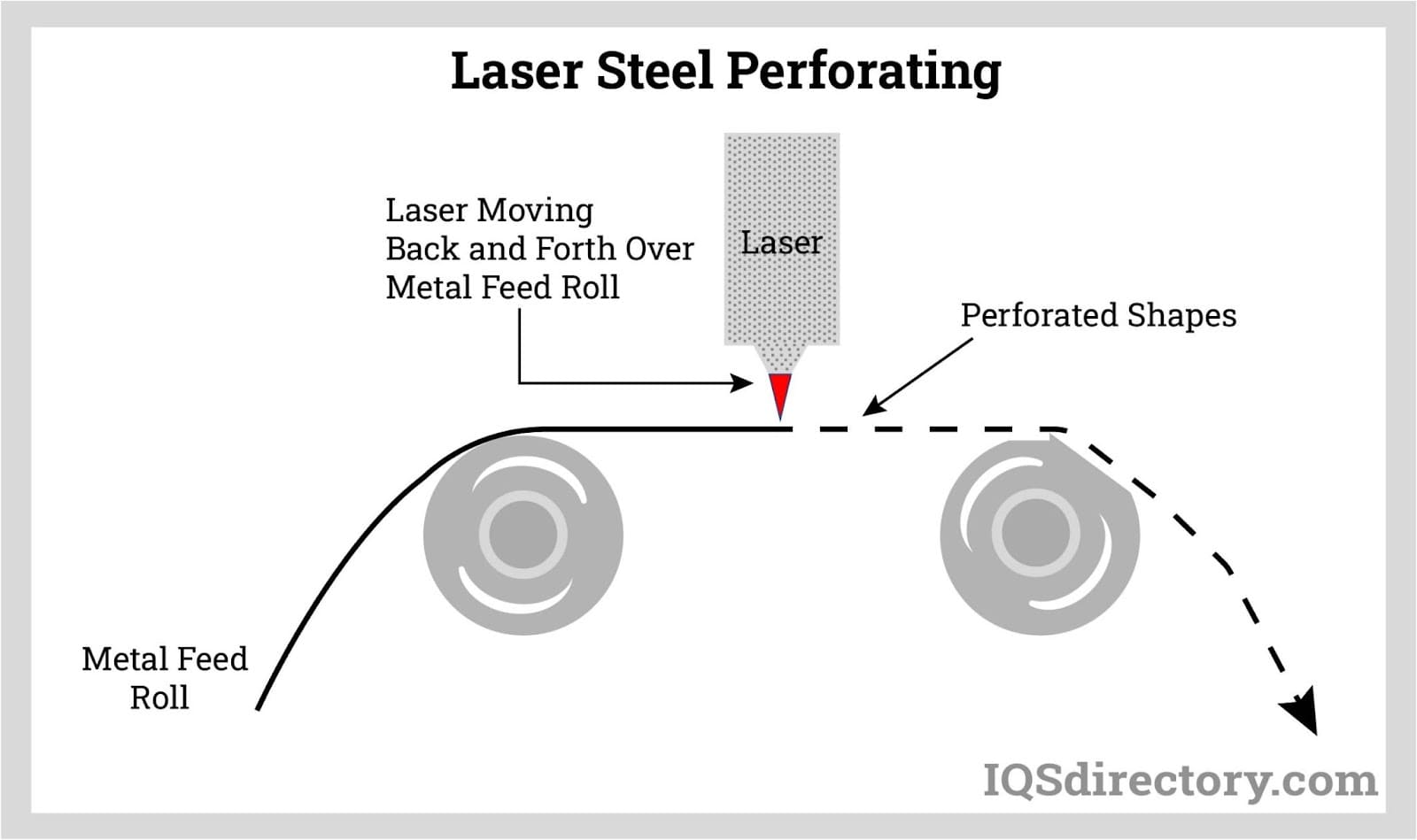 A laser perforating machine acts like an electronic pen for cutting complex and intricate patterns into steel metal sheets.
 A perforated metal is a piece of sheet metal that has been stamped, fabricated, or punched to create a pattern of holes, slots, and various aesthetic shapes.
- Architectural Perforated Metal
- These are punched metal sheets used in building construction for decoration, screening, shading, facade systems, and functional structural support.
- Bar Grating
- A heavy-duty expanded metal featuring thicker bearing bars, used primarily for industrial flooring, stairs, and transportation systems like street or railroad grating.
- Filter Screens
- Screens designed to regulate the flow of fluids, light, or noise, commonly used in light fixtures, window openings, filtration equipment, and acoustic applications.
- Floor Grating
- Durable, expanded metal arranged in a grid pattern, typically used in flooring, stairs, and catwalks for light to moderate traffic areas.
- Metal Panels
- These are metal sheets used in construction for insulation support, decoration, privacy screening, ventilation, and architectural applications.
- Perforated Aluminum
- Aluminum sheet metal that has been perforated by a punch to create holes or other patterns for lightweight, corrosion-resistant applications.
- Perforated Brass Sheets
- Brass sheets that have been punched with holes or other shapes for decorative, HVAC, and specialty design uses.
- Perforated Copper Products
- Copper sheets or panels with holes or patterns created by punching, used in architectural and industrial applications.
- Perforated Metal Panels
- Perforated panels used in screening, decoration, enclosures, and a variety of functional applications.
- Metal Screens
- Used to block substances or objects from entering enclosed areas, providing security, protection, separation, or filtration.
- Perforated Plates
- Metal plates punched with decorative or functional shapes, often used in construction, OEM products, or industrial design.
- Perforated Sheet Metal
- Metal sheets that are perforated for use in screens, tubing, panels, grating, vents, and guards across multiple sectors.
- Perforated Sheets
- Sheets of metal that have been punched with specific shapes for various functional and decorative applications.
- Perforated Stainless Steel
- Stainless steel sheets, plates, or panels that have been perforated with holes or other shapes, often used for strength and durability in demanding environments.
- Perforated Steel
- Steel sheet metal that has been perforated to create various patterns, used in construction, design, filtration, and industrial processes.
- Perforated Tubes
- Metal tubes perforated with holes, used for filtration, diffusion, shielding, guarding, or sound dampening applications.
- Radically Cut Grating
- Panels with annular shapes cut out of rectangular grating, designed for use in circular or annular areas.
- Reversible
- Grating that can be installed with either side facing up, with no change in appearance or performance capacity.
- Riveted Grating
- Made of straight bars and bent connecting bars joined by rivets at the points of contact, commonly used for secure and durable grating.
- Standard Expanded
- Metal that begins as a solid sheet, which is then uniformly slit and stretched to create diamond-shaped openings, commonly used for grating.
- Swage-Locked Grating
- A type of grating made by applying pressure through dies to alter the shape of a metal cross bar, enhancing durability and strength.
- Wire Cloth
- A versatile material available in various weave patterns, used in applications such as air filters, ventilation covers, animal cages, window guards, and clothes dryers.
Applications
Perforated metals are used wherever a project needs a balance of strength and open area. Their most common applications include filtration, screening, structural components, acoustics, insulation, building construction, waste management, furniture design, security barriers, machine guarding, airflow control, ventilation covers, and decorative cladding. They are often selected by buyers looking for a material that can separate, protect, ventilate, diffuse, or visually enhance without becoming bulky or difficult to fabricate.
Key industries that utilize perforated metals include architecture, food and beverage processing, chemical handling, energy, material development, automotive engineering, acoustics, agriculture, pharmaceuticals, and general manufacturing. If someone is searching for perforated sheet metal for filters, perforated stainless steel for sanitary use, perforated aluminum panels for architectural screening, or custom perforated metal for OEM products, they are usually trying to solve a very specific performance problem with a very practical material.
Products Produced
Perforated sheet metal is often used to create a variety of products, including screens, filters, strainers, piping inserts, trash cans, tubing, light fixtures, vents, audio speaker covers, patio furniture, protective guards, facings, baskets, partitions, and custom enclosures. It is also used in products that require a controlled balance of visibility and coverage, such as equipment shields, storefront features, privacy panels, and transportation components.
Architectural Products
In architecture, perforated metal is used for products such as perforated metal panels, sunshades, cladding, eco-friendly aesthetic elements, decorations, signage, fencing, access control systems, railing infill, parking garage screens, wall panels, and column covers. Architects and contractors often look for perforated metal because it supports airflow and daylight while still delivering a polished exterior finish. It can also help a building feel lighter, sharper, and a little less like a concrete brick with opinions.
Food and Beverage Products
In the food and beverage industry, perforated metals are found in products like grain dryers, fish screens, silo ventilation screens, perforated metal strainers, juice press screens, wine vat screens, cheese mold screens, sorting trays, wash-down equipment panels, and processing guards. Stainless steel perforated sheet is especially common in sanitary environments because it resists corrosion and supports cleaning protocols.
Metal Expansion
Expanded metals are similar to perforated metals but are created through a different process. Instead of punching holes into a sheet, expanded metal is cut and stretched into a framework. This process is cost-effective and environmentally friendly because it produces minimal waste and can increase the surface area of a metal sheet significantly.
Expanded metal is often used for similar applications as perforated metal, including enclosures, grating, shelving, and protective guards. While it is a cost-effective alternative in some cases, perforated metal offers finer holes, more exact pattern control, and greater versatility in terms of hole configurations. This makes perforated metal ideal for filters, screens, decorative panels, acoustic products, and architectural designs where appearance and precision both matter.
There are many excellent perforated metal manufacturers available, but how do you choose the right one for your needs? Start by defining the application clearly. Do you need corrosion resistance, acoustic transparency, fine filtration, structural rigidity, decorative appeal, food-grade performance, or a custom hole pattern? From there, compare material options, hole size, sheet thickness, open area, tolerances, finish, fabrication support, and production capacity. Buyers should also confirm whether a supplier can handle secondary operations such as leveling, shearing, forming, welding, coating, and custom panel fabrication.
It is also smart to ask practical questions before placing an order. What sheet size do you need? What finish will the product require? Will it be exposed to chemicals, water, heat, or impact? Does the job call for a standard pattern or a custom design? Are you buying perforated metal sheets for architecture, industrial filtering, speaker grilles, machine guarding, or OEM assembly? The clearer these answers are, the easier it is to match your project with the right manufacturer and the right perforated material.
A dependable supplier should be able to explain pattern options, recommend materials, discuss lead times, and help you compare standard products with custom perforated metal fabrication. That guidance can make the difference between a sheet that merely fits and one that actually performs.
More Perforated Metals Information