Machine Vision
Machine vision systems are advanced industrial imaging solutions designed to simulate selected functions of human sight with far greater speed and consistency in repetitive environments. In manufacturing, packaging, robotics, and automated inspection settings, machine vision (MV) refers to computer-based visual inspection, identification, measurement, and process control used to monitor production quality and guide equipment. Within systems engineering, machine vision is usually treated as a practical automation technology, while computer vision is more often discussed as a broader computer science field focused on image interpretation.
Machine Vision FAQ
What is a machine vision system?
A machine vision system uses cameras, optics, lighting, sensors, and software to capture and analyze images for inspection, measurement, verification, and process control. In industrial automation, these systems handle fast, repeatable visual tasks with a high level of accuracy, making them well suited for manufacturing lines where consistency and throughput matter.
How does machine vision work in manufacturing?
Machine vision in manufacturing uses cameras, controlled lighting, and image processing software to inspect parts, verify assembly, measure dimensions, and read barcodes or characters. It applies tools such as edge detection, segmentation, OCR, and pattern recognition to support quality assurance, reduce scrap, and improve production efficiency.
What are the main components of a machine vision system?
The main components are lighting, an imaging device such as a camera or sensor, and image processing software. Many systems also rely on optics, communication interfaces, and control hardware that translate captured visual data into measurement, pass-fail, guidance, or sorting decisions on automated equipment.
What are common applications of machine vision?
Common machine vision applications include automated inspection, defect detection, barcode and 2D code reading, OCR, robot guidance, presence-absence verification, gauging, and product sorting. These uses improve traceability, throughput, and repeatability across industrial production lines in sectors ranging from electronics to packaging and automotive manufacturing.
What are the benefits of using machine vision systems?
Machine vision systems reduce manual inspection errors, detect fine surface flaws, verify tolerances, and improve repeatability in high-volume operations. They also help manufacturers gather production data, strengthen quality control programs, and make faster, better-informed decisions that support uptime, yield, and customer satisfaction.
What types of cameras are used in machine vision?
Common machine vision camera types include line-scan cameras, area-scan cameras, CCD cameras, and smart cameras. Line-scan models build an image one row of pixels at a time, area-scan cameras capture a complete frame instantly, and smart cameras combine imaging with onboard processing for space-saving inspection tasks.
How do machine vision standards improve system performance?
Standards such as GigE Vision and EMVA support compatibility, integration, and consistent measurement practices across machine vision hardware and software. They help buyers compare equipment with more confidence and make it easier to connect cameras, software, controls, and industrial networks in demanding production environments.
The History of Machine Vision Systems
The evolution of machine vision systems reaches back to the 1950s, when psychologist James J. Gibson introduced the concept of optical flow and helped shape the way motion and visual information could be analyzed. Building on that foundation, early researchers developed two-dimensional imaging methods that relied on statistical pattern recognition. In 1960, Larry Roberts at MIT completed a PhD thesis focused on extracting 3D geometric information from 2D images, helping inspire broader research into automated image analysis and 3D machine imaging.
During the 1970s, MIT continued to influence the field by offering a machine vision course within its Artificial Intelligence Lab, where attention was given to practical image interpretation tasks such as edge detection and object analysis. In 1978, David Marr introduced an influential framework for computer vision that moved from a 2D sketch toward a 3D understanding of a scene. That work helped define how vision systems could interpret shapes, surfaces, and spatial relationships in more useful ways.
By the 1980s, machine vision moved beyond laboratories and into industrial manufacturing, where vision systems were used to read numbers, letters, symbols, and barcodes on products and packaging. The decade also brought the first smart cameras, making it easier to combine image capture and processing in one compact unit. In the 1990s, digital signal processing expanded those capabilities further, opening the door to faster image analysis, lower system costs, and wider adoption across quality control, assembly verification, and automated inspection applications.
Today, machine vision systems are used worldwide in factories, warehouses, laboratories, and logistics operations, and the market continues to expand as automation investments increase. Earlier industry forecasts placed the global machine vision market at roughly $15.46 billion by 2022, with Asia Pacific holding a large share, followed by Europe and North America. That growth reflects ongoing demand for automated inspection, robotic guidance, product traceability, and tighter manufacturing consistency.
Benefits of Machine Vision Systems
Machine vision systems offer a wide range of advantages for manufacturers, processors, and automated equipment users. They reduce the variation associated with manual inspection, identify flaws or subtle details that operators may overlook, and sort products far faster than labor-intensive methods. Their flexibility also allows one platform to support inspection, identification, measurement, and verification tasks. In addition, machine vision systems generate usable digital data that can be stored, reviewed, trended, and transferred for deeper analysis, process improvement, and documentation.
How Machine Vision Works
Machine vision works by combining controlled lighting, optics, digital cameras, triggering, and pattern recognition software to capture images and turn them into decisions. Although machine vision technology has advanced dramatically, most systems are still designed around repeatable inspection or guidance tasks where the viewing conditions, part orientation, and decision rules can be defined in advance. That is why machine vision performs so well in industrial automation, in-line inspection, and quality assurance environments.
These systems process images through methods such as thresholding, stitching, pixel counting, filtering, color analysis, segmentation, blob detection and extraction, edge detection, pattern recognition, barcode reading, neural network or deep learning, optical character recognition, and metrology or gauging. In many applications, several of these tools are used in sequence so the system can isolate a feature, inspect it, compare it to a reference, and return a reliable result that supports sorting, measurement, or pass-fail inspection.
- Thresholding
- A technique that applies a selected gray value to separate one region of an image from another. Thresholding is often used to convert portions of an image to black or white so edges, marks, holes, labels, or part features can be isolated for inspection.
- Stitching
- Also called registration, this method combines adjacent 2D or 3D images into one composite image. It is useful when a field of view is too large for a single capture or when detailed inspection requires several overlapping images.
- Pixel Counting
- A process in which the system counts dark or light pixels within a defined area. Because pixels are the smallest units in a digital image, counting them can help determine fill level, surface coverage, presence or absence, or the size of a selected feature.
- Morphological Filtering
- Morphological filtering uses lattice-based image operations to clean up and analyze digital images. It can remove noise, close gaps, emphasize shapes, and improve feature extraction before the system moves on to measurement, comparison, or defect detection.
- Color Analysis
- This process uses color information to isolate features, assess quality, and identify specific items, products, coatings, or parts within an image. Color analysis is often used when grayscale inspection alone cannot separate a target from its background.
- Segmentation Process
- Segmentation divides a digital image into multiple regions or segments, making it easier to analyze objects, boundaries, textures, or surfaces. It is a common step in machine vision workflows that require object identification, counting, or dimensional analysis.
- Blob Detection
- Blob detection and extraction identify connected regions in an image that differ from their surroundings, such as a dark flaw on a lighter surface. These regions, called blobs, are useful for presence-absence checks, particle inspection, contamination screening, and shape analysis.
- Edge Detection
- A method that locates and defines object boundaries within an image. Edge detection helps a machine vision system outline shapes, measure distances, verify alignment, and determine whether a component matches the required profile.
- Pattern Recognition
- Pattern recognition software identifies, matches, or counts known shapes or image features, even when they are rotated, partially hidden, or presented at varying sizes. This method is widely used in assembly verification, part location, and automated inspection.
- Barcode Reading
- The machine vision system scans barcodes or 2D codes and compares the captured information to stored reference values or expected formats. This supports traceability, inventory movement, product authentication, and code verification on high-speed production lines.
- Neural Net
- Neural networks and deep learning systems learn to identify visual patterns and make more complex classification decisions as they process new data. These tools are especially helpful when a rule-based approach is too rigid for natural variation in parts, surfaces, or image conditions.
- Optical Character Recognition
- An automated method for reading printed or marked text within images, such as serial numbers, lot codes, expiration dates, and product identifiers. OCR improves traceability and supports verification without requiring manual data entry.
- Metrology or Gauging
- The accurate measurement of object dimensions, such as length, width, diameter, gap, or height, in units like millimeters, inches, or pixels. Gauging is widely used when manufacturers need non-contact measurement for tolerance checks and dimensional verification.
Machine Vision Images, Diagrams and Visual Concepts
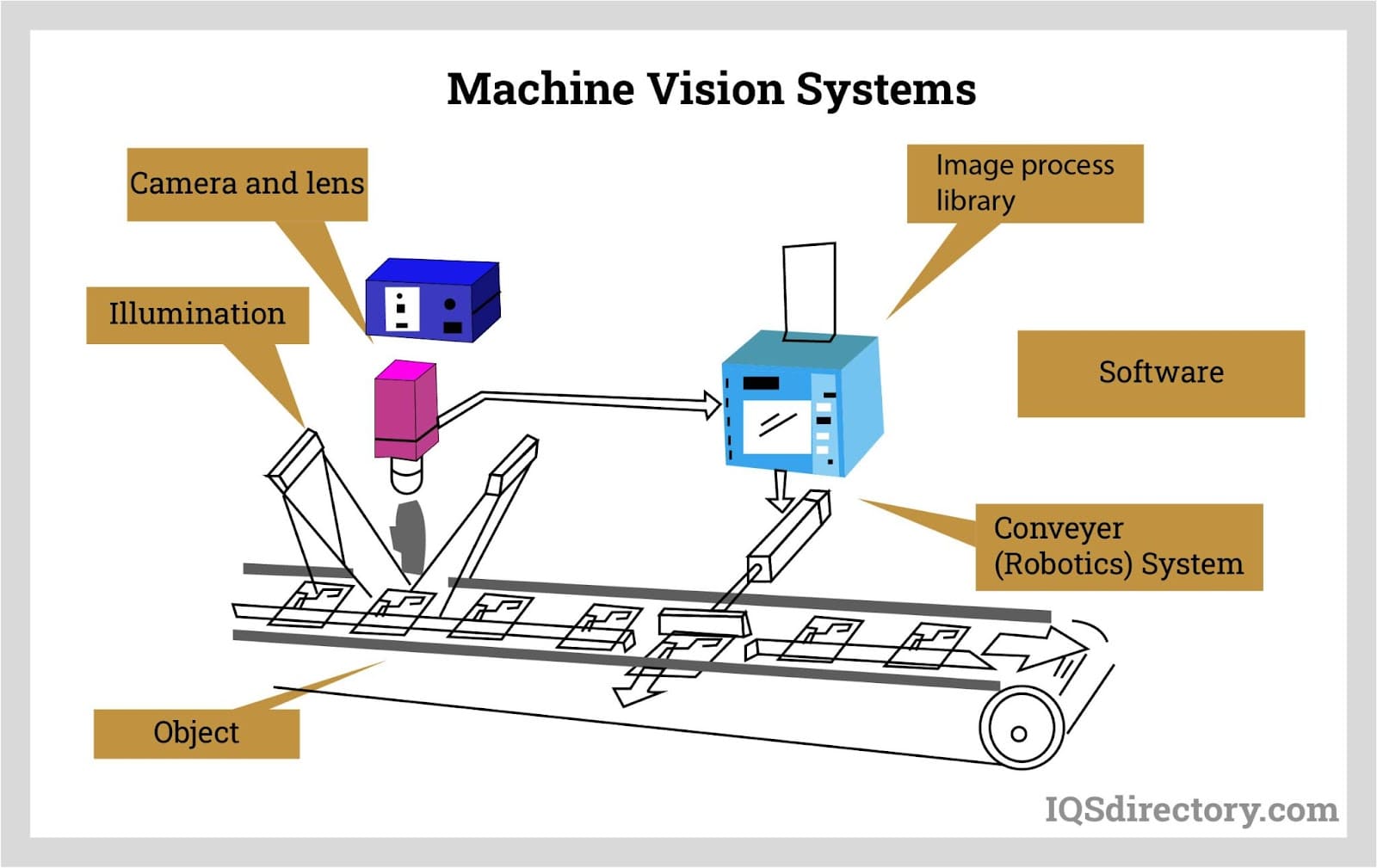 Machine vision systems combine electronic components, cameras, optics, processors, and software algorithms to capture, interpret, and act on image data from an industrial environment.
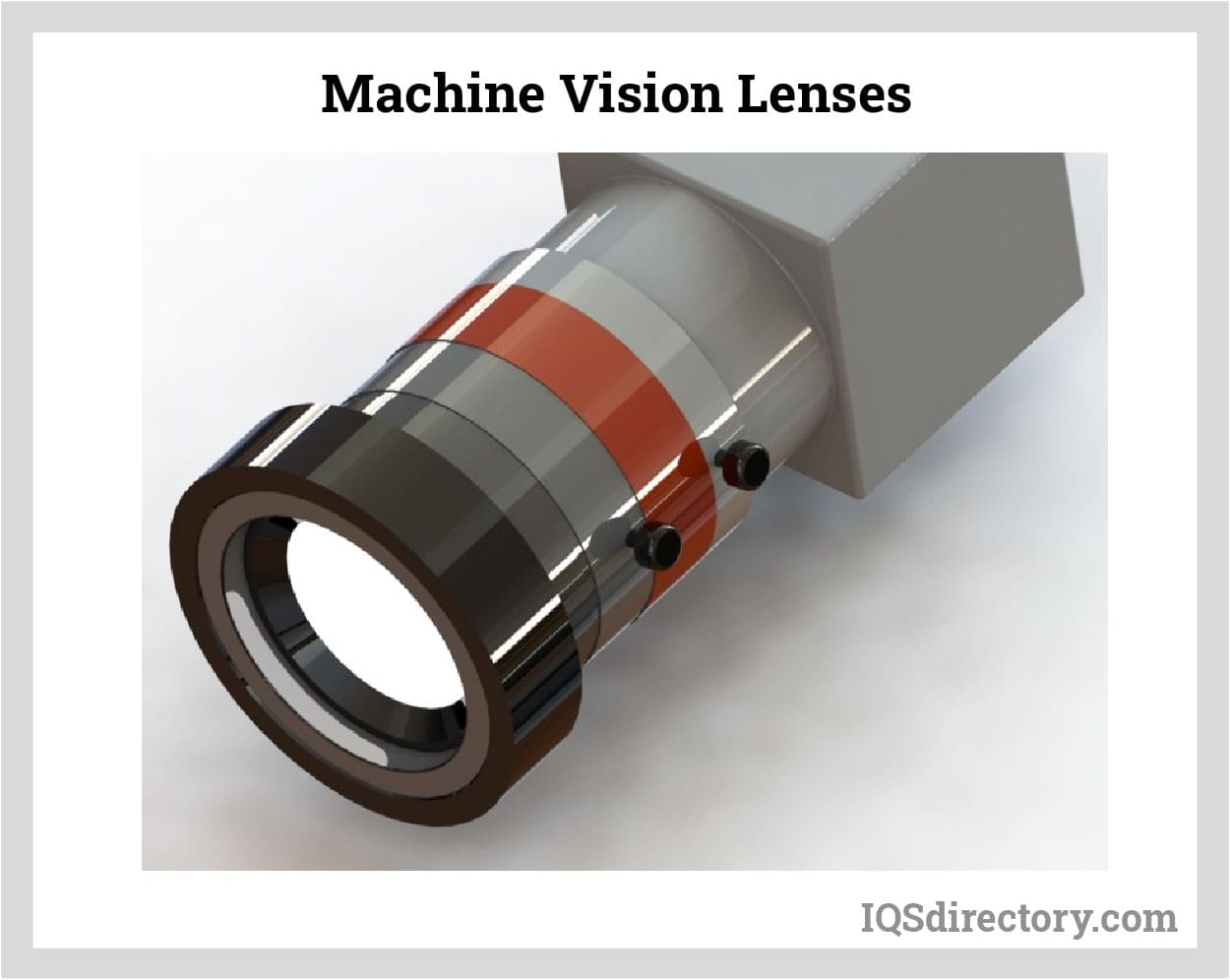 The lens collects and focuses light so a sharp image can be projected onto the image sensor inside the camera for accurate inspection and measurement.
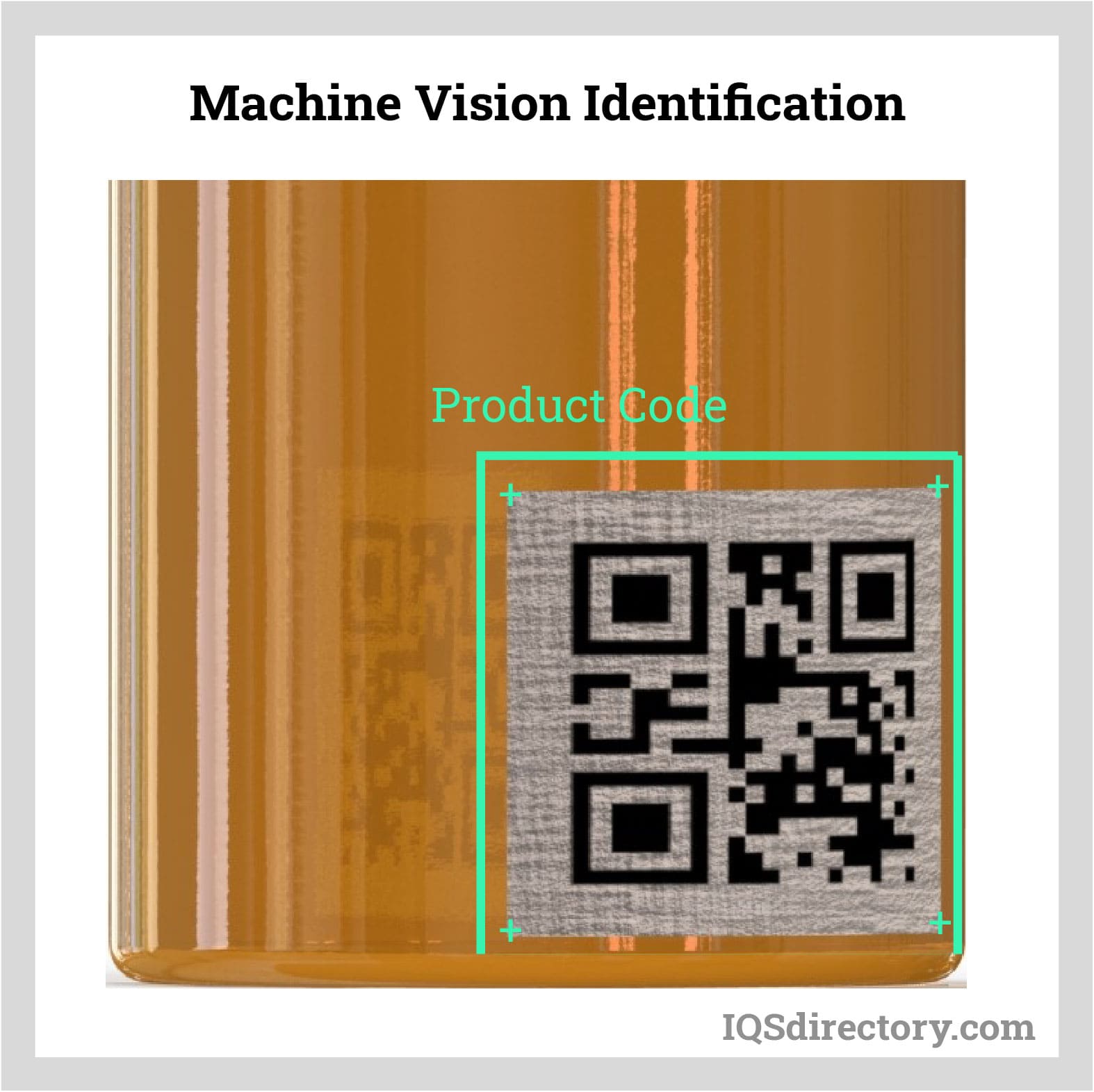 Machine vision identification systems scan barcodes, 2D codes, direct part marks, and printed characters to improve product traceability and data accuracy.
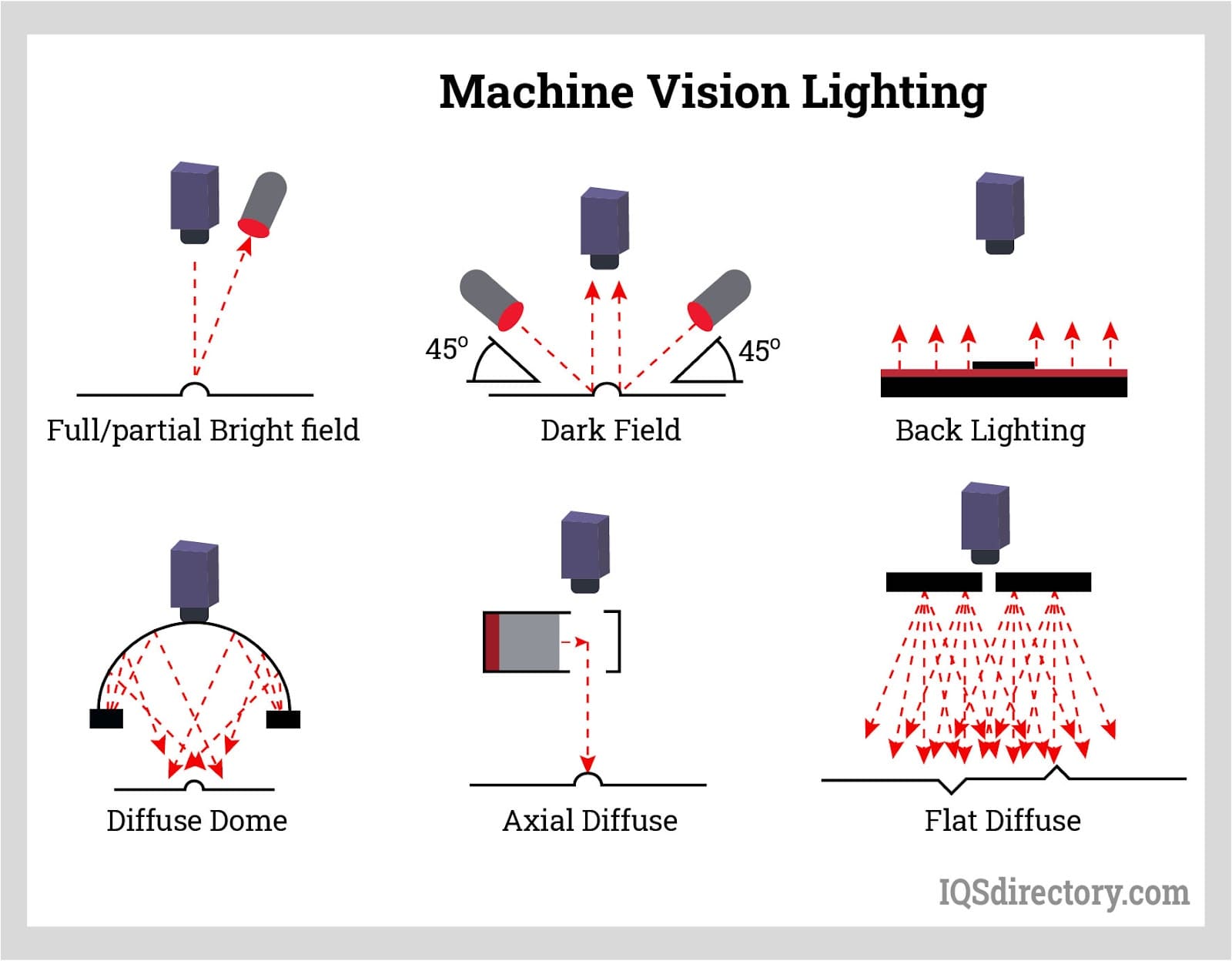 The lighting component illuminates the target so edges, textures, marks, and surface features can be captured clearly by the camera.
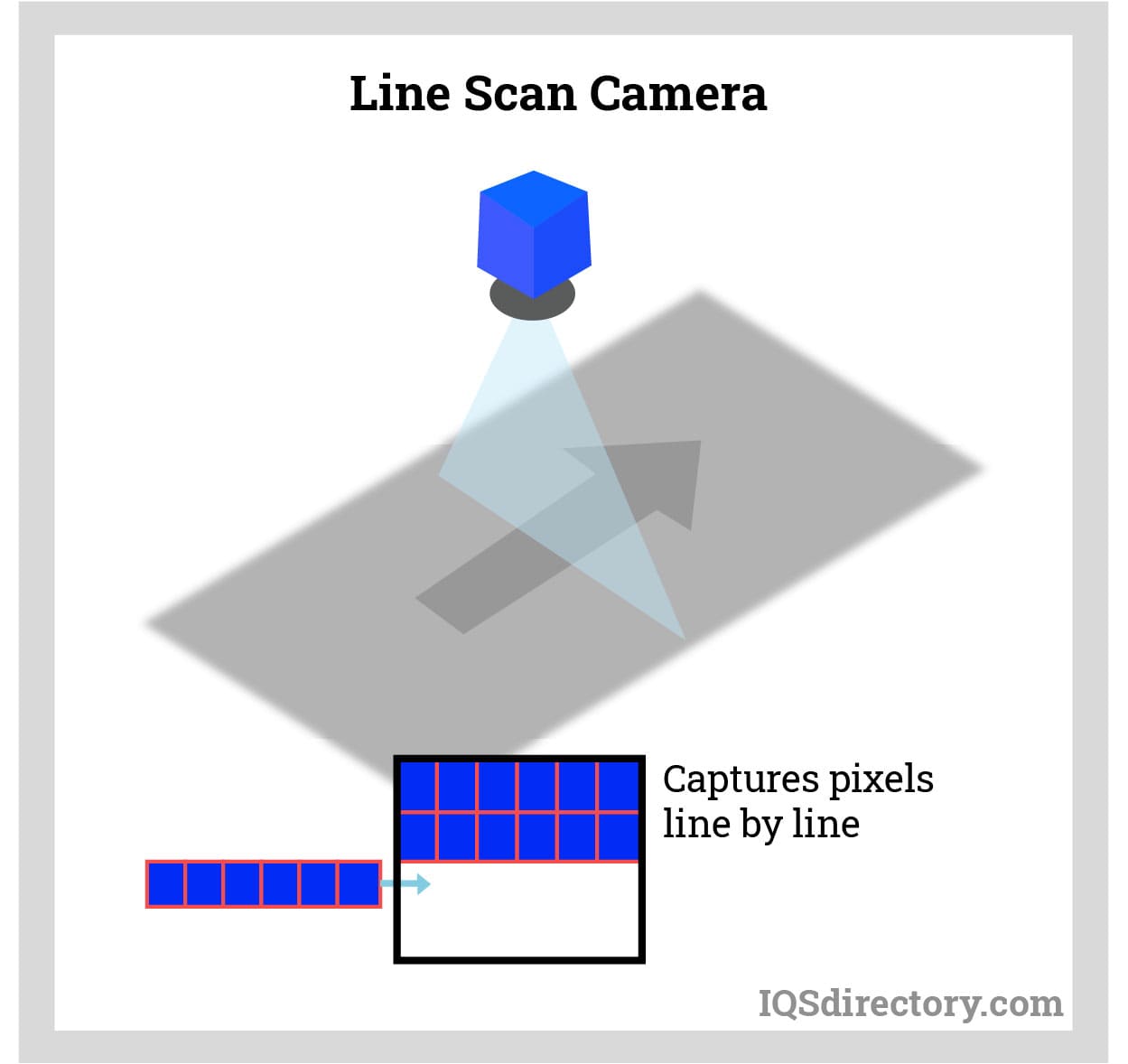 Line-scan cameras capture images one row at a time, making them useful for inspecting continuous webs, moving materials, and long surfaces.
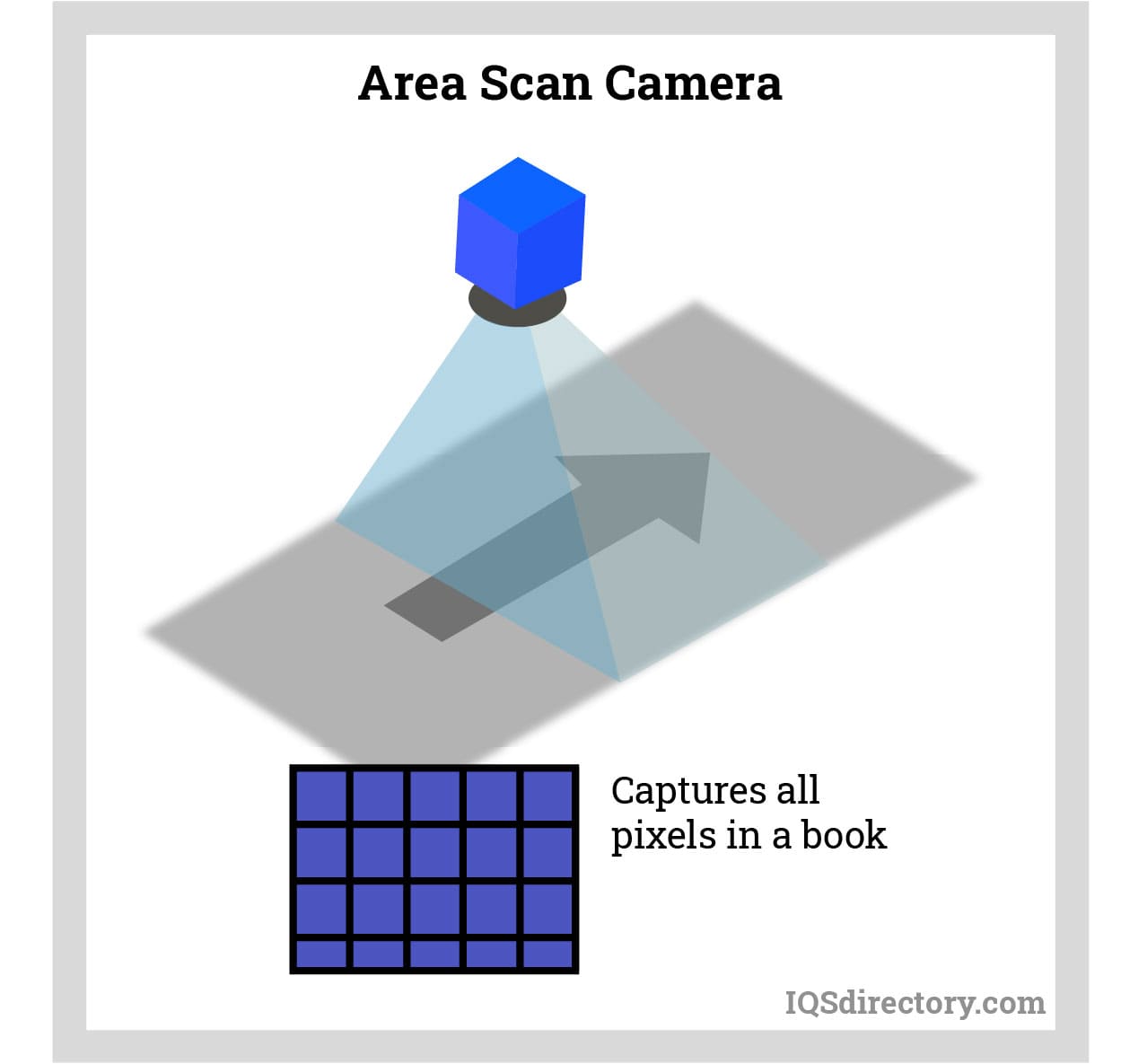 Area scan cameras use rectangular image sensors to capture a full image in one exposure, producing digital frames with defined pixel dimensions.
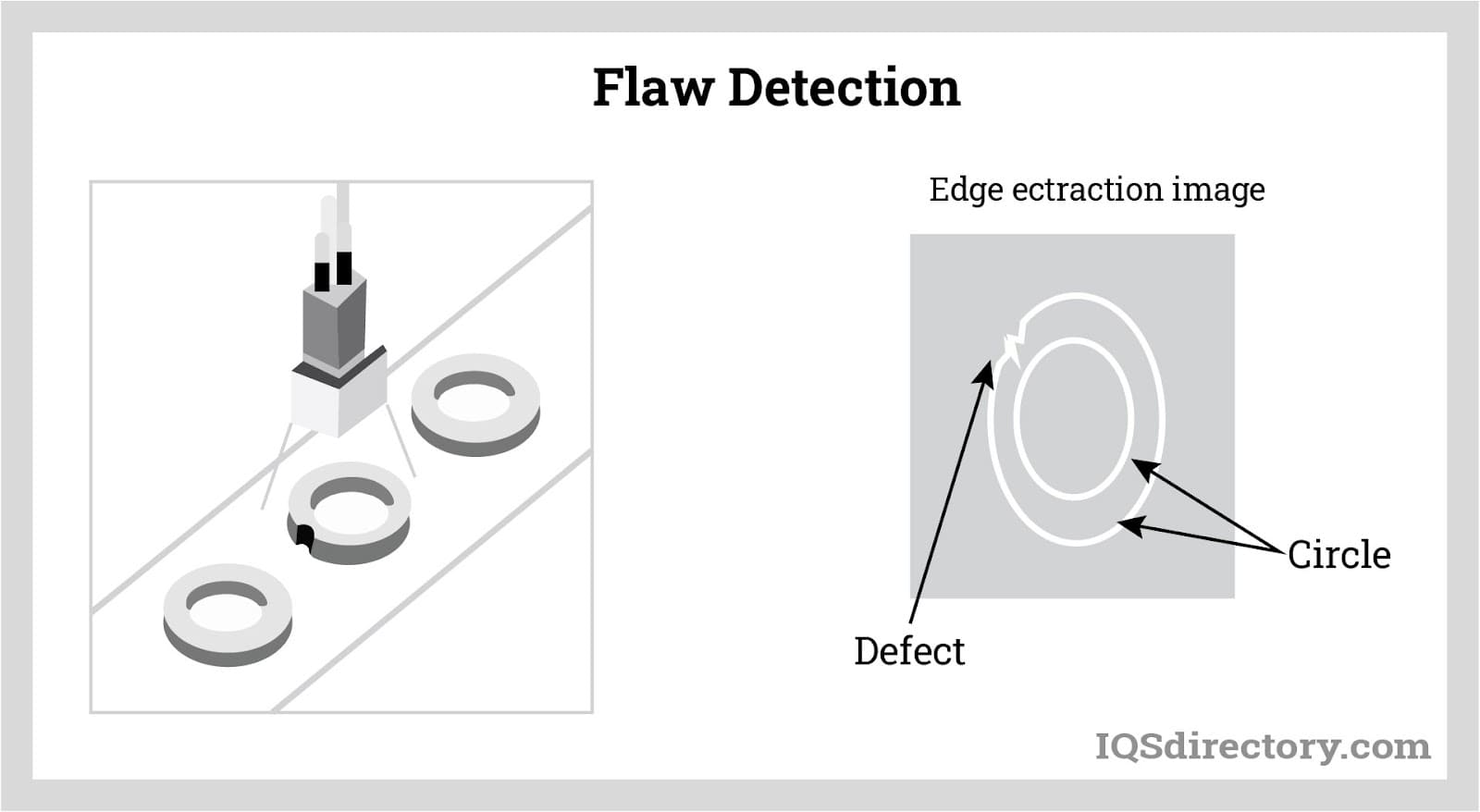 Machine vision systems can detect scratches, dents, contamination, and other surface irregularities that may affect product quality and performance.
Machine Vision Types
- CCD Cameras
- CCD cameras use charge coupled device chips to capture image data and convert incoming photons into electrical signals. In machine vision applications, they are valued for dependable image capture and can store digital image data directly without film-based processing.
- Laser Inspection Systems
- These systems use photoelectric sensors together with laser beams for applications such as barcode and serial number reading, microscopic flaw detection, part counting, and profile measurement. In some applications, laser inspection also supports detailed 3D surface modeling.
- Optical Inspection Systems
- Optical inspection systems perform product inspection through machine vision and image analysis. Vision inspection systems are often installed directly on assembly lines for serial number reading, item counting, defect detection, label verification, and assembly confirmation.
- Optical Sorting Systems
- These systems use machine vision technology to automate product sorting based on color, size, shape, mark location, orientation, or visible defects.
- Magnetic Imaging Systems
- Magnetic imaging systems work with magnetically responsive materials and specialized sensors to create visual representations that can reveal subsurface conditions in a way similar to x-ray style imaging.
- Smart Cameras
- Smart cameras are machine vision cameras with onboard imaging software and processing hardware for capturing and evaluating high-resolution images in one device. Because onboard storage can be limited, they are often connected to a larger vision system or automation network.
- Robotic Vision Systems
- Robotic vision systems give semi-autonomous machines such as AGVs and robotic arms the visual input needed for navigation, pick-and-place guidance, alignment, and task execution in industrial environments.
Machine Vision Applications
The main purpose of machine vision is to deliver image-based information that can be used to analyze products, surfaces, assemblies, or production conditions. Machine vision applications include automation process control, quality screening, automated inspection, robotic guidance, integrated systems, and the manufacture of both hardware and software used along assembly lines. Buyers often search for machine vision when they need faster inspection, tighter tolerances, better traceability, or a more repeatable way to verify product quality.
Machine vision is used throughout assembly lines for measurement, counting, inspection, and reading serial numbers on items such as die casted products. It has taken over many repetitive and error-prone visual tasks once handled manually and plays a major role in automation environments where a robot arm or AGV needs dependable visual guidance. It is also widely used in packaging, food processing, electronics, medical device manufacturing, and automotive production.
Machine Vision Equipment Components
Although machine vision systems can vary widely by design, most share three core components: purpose-built lighting, an imaging device such as a digital camera or vision sensor, and dedicated image processing software. Together, these elements allow the system to capture a usable image, isolate the required features, and turn visual data into measurements, inspections, or control signals.
- Imager Component
- For digital cameras, manufacturers may integrate the imager within the main machine vision unit or keep it separate. When separate, the camera can connect through specialized hardware, a frame grabber in a computer, or direct interfaces such as USB, FireWire, or Gigabit Ethernet. Integrated cameras are often called smart sensors or smart cameras and are used when compact, high-precision image capture is needed close to the production process.
- Image Processing Software
- Also called vision software, this programming extracts and interprets raw image data from cameras or sensors and converts it into actionable output. It supports tasks such as counting, measuring, inspecting, sorting, OCR, code reading, and pass-fail verification for operators and automated equipment.
Standards and Specifications of Machine Vision
Machine vision systems must align with a range of industry standards based on geography, application, and system design. One of the best-known organizations in this area is EMVA (European Machine Vision Association), which promotes consistent measurement methods, transparent image data reporting, and broader compatibility across products. EMVA also supports programming and evaluation practices that make it easier to compare equipment and share data across flexible automation platforms. The group works with organizations such as AIA in North America, JIIA in Japan, VDMA in Germany, and CMVU in China.
The GigE Vision standard, developed by AIA, is another widely used interface standard for cost-effective Gigabit Ethernet communication between cameras and host systems. For buyers comparing machine vision cameras, inspection software, and system integration options, standards like these can simplify selection, reduce integration issues, and support stronger long-term interoperability.
Choosing the Right Machine Vision System Manufacturer
When searching for a machine vision product or turnkey system, it helps to work with an experienced supplier that can recommend the most suitable technology for your application. The list of machine vision system manufacturers on this page provides a starting point for comparing providers with different specialties, service models, and solution capabilities. Before reviewing profiles, prepare a detailed list of your requirements so discussions stay focused and productive. Include information such as the primary application, inspection goals, barcode or OCR needs, quality targets, budget, timeline, required standards, delivery expectations, and support needs. After outlining your criteria, compare the listed suppliers, narrow the field to three or four candidates, and discuss your project in more detail. If you are asking, “Which machine vision system fits my line?” or “How do I compare machine vision manufacturers?”, that preparation will make the selection process much easier.
Machine Vision Terms
- 3-D Imaging
- A technology that creates three-dimensional images from a series of two-dimensional cross-sectional images, with computers assembling the final 3D view from multiple scans or picture sets.
- Acquisition
- The process of capturing external visual information so it can be analyzed by a vision system.
- Aperture
- The diameter of a lens opening, which affects how much light reaches the photoconductive image sensor.
- Attenuation
- The reduction or weakening of signal strength during transmission or processing.
- Chroma
- The aspect of color that combines hue with saturation and helps describe visual intensity.
- Decompression
- The act of restoring original data from a compressed format so it can be viewed, stored, or analyzed.
- Depth of Focus
- The range in which the sensor-to-object distance still produces a sharp image through the lens.
- Digital Imaging
- The conversion of a video image into a pixel-based digital format through an analog-to-digital converter, with each pixel value stored in a computer or processor.
- Dichroic Filter
- A filter that transmits or reflects light according to wavelength rather than polarization, allowing one color to pass while redirecting another.
- Fiber Optics
- The delivery of light or optical images through bundles of transparent fibers using internal reflection. Coherent fiber optics maintain spatial order so images can be relayed accurately.
- Focal Plane
- The plane perpendicular to the lens axis where the image comes into focus, usually at the location of the sensor.
- Frame Rate
- The number of image frames captured or displayed during a given unit of time.
- Gauging
- Non-contact measurement and dimensional analysis of an object, often used in quality control and tolerance verification.
- Gray Scale
- The range of shades between white and black in a digitized image, used to describe tonal information without color.
- Halogen Lamp
- An incandescent lamp containing a halogen gas such as iodine that helps cycle evaporated filament material back onto the filament.
- Image Analysis
- The process of identifying objects, edges, patterns, and shapes within images for tasks ranging from colorization to automated inspection and guidance.
- Image Plane
- The flat surface of the imaging sensor set perpendicular to the viewing direction where the lens forms a focused image.
- Infrared
- The region of the electromagnetic spectrum just beyond visible red light, characterized by longer wavelengths.
- Laser Technology
- Often used in 3D surface imaging and precision inspection, lasers produce concentrated light with properties well suited for measurement and scanning.
- Machine Vision Products
- All systems, components, accessories, cameras, lighting products, and software used to apply computer vision technology in industrial and manufacturing environments.
- Pattern Recognition
- The classification of images into defined categories using statistical, algorithmic, or learned methods.
- Pixel
- Short for picture element; the smallest addressable component in a digital image array.
- Process Imaging
- The imaging of manufacturing processes during both design and production stages, often for monitoring, verification, and quality control.
- Sharpening
- An image processing technique that enhances boundaries and edge detail by combining the original image with a filtered version.
- Shutter
- A mechanical or electronic device that controls how long the imaging surface is exposed to light, helping reduce blur and manage brightness.
- Spatial Filtering
- A method of enhancing images by modifying spatial frequency content to emphasize features or reduce unwanted noise.
- Zoom Lens
- A multi-element lens that maintains focus while continuously changing image size, either manually or through motorized control.