Infrared Heaters
Infrared heaters can be likened to miniature versions of the Sun. These electric or gas-powered devices rely on electromagnetic radiation to warm objects, materials, or spaces. The heat they produce originates from infrared light, which emits long electromagnetic waves found just outside the range of visible light on the electromagnetic spectrum. Unlike traditional heaters, they do not require a medium like air or other molecules to transfer heat. Instead, they deliver radiant energy directly to surfaces, people, equipment, and work areas, which is why infrared heating is widely used for industrial process heating, warehouse comfort heating, paint drying, curing, and targeted space heating. Buyers often compare infrared heaters to convection systems because infrared units can offer faster response, more focused warmth, and better performance in open or drafty environments where heated air can quickly escape.
Infrared Heaters FAQs
How do infrared heaters generate heat?
Infrared heaters create heat through electromagnetic radiation, emitting long infrared waves that directly warm objects and surfaces without needing air as a medium. This direct transfer makes them faster and more efficient than traditional convection heaters.
What are the main types of infrared heaters?
Infrared heaters come in several types, including electric, gas-fired, low-intensity tube heaters, high-intensity ceramic models, and short-, medium-, and far-infrared emitters. Each design suits specific needs, from industrial paint curing to residential space heating.
Why are infrared heaters considered energy efficient?
Infrared heaters are energy efficient because they directly heat objects and people instead of the surrounding air. This targeted approach reduces energy waste and provides quick warmth, making them an environmentally friendly heating solution for homes and facilities.
Where are infrared heaters commonly used?
Infrared heaters are used in industrial, commercial, and residential settings. Common applications include paint drying, process heating, warehouse and garage heating, plastic welding, glass processing, and even animal care in zoos and veterinary clinics.
What materials are used in infrared heater construction?
Infrared heaters often use ceramic, glass, or metal heating elements housed in protective casings made of aluminum, brass, copper, or stainless steel. Quartz tube heaters are especially popular for their fast heating and durability in industrial applications.
How should infrared heaters be maintained for safety?
To maintain safety, keep reflectors clean, inspect regularly for cracks or wear, avoid placing flammable materials nearby, and ensure gas-powered units are checked for leaks. Routine care ensures consistent performance and reduces fire hazards.
What standards apply to infrared heater manufacturing?
Infrared heaters sold in the U.S. must meet Consumer Product Safety Commission (CPSC) regulations. Many also comply with ISO guidelines and CAN/ANSI/AHRI 1330-2015 standards for gas infrared systems to ensure safety and energy efficiency.
The History of Infrared Heaters
Infrared radiation was first identified in 1800 by German-British astronomer Sir William Herschel during an experiment using a spectrometer of his own invention. He employed the device to measure radiant energy at various wavelengths, leading to the discovery of infrared light. That discovery did more than expand scientific understanding of the electromagnetic spectrum. It eventually opened the door to a heating method that could transfer energy without relying on moving air, a feature that would later become highly valuable in industrial manufacturing and building heat applications.
Despite the early discovery, infrared technology did not find widespread use until World War II, when it was applied to curing and drying paints and lacquers on military equipment. At that time, manufacturers directed infrared heat through arrays of lamp bulbs. Although the power output was low by modern standards, these infrared lamps significantly outperformed fuel-based convection heaters in drying efficiency. They helped demonstrate that radiant heat could shorten process times and deliver more consistent results when coatings and finishes had to be dried quickly.
Following the war, manufacturers continued experimenting with infrared heat, but its adoption did not accelerate again until the mid-1950s. The turning point came when the automotive industry introduced infrared tunnels on production lines for paint curing. Once infrared heat proved its value in factory environments, its role expanded into drying, laminating, shrinking, preheating, curing, comfort heating, and more specialized thermal processing tasks.
Today, infrared heaters are more popular than ever, thanks to their energy efficiency, fast response, and growing versatility. Engineers continue to refine their designs to improve safety, effectiveness, durability, and appeal across a broader range of industrial, commercial, agricultural, and residential uses. What began as a scientific discovery now supports everything from warehouse heating to precision process heat on manufacturing lines.
Infrared Heater Applications
Because infrared heaters use energy efficiently, they are well-suited to heating spaces of nearly any size, from compact rooms to expansive warehouses, garages, and sheds. They are commonly used in applications such as industrial oven heating, central heating systems, small space heating, process heating, plastic welding, coating and paint drying, glass processing, zoo and veterinary animal care, and even therapeutic relief for arthritic joints. In manufacturing settings, infrared heat is often selected where rapid surface heating, repeatable process control, or targeted thermal treatment is needed without wasting energy on heating large volumes of surrounding air.
Infrared heating can be integrated into a wide range of heater designs, making it versatile for both industrial and residential purposes. It is commonly found in space heaters, radiant heaters, radiant gas heaters , indoor and outdoor heating units, tube heaters, infrared patio heaters, and many other specialized systems. Because the technology can be aimed, zoned, and scaled in different ways, it fits applications ranging from worker comfort heat on loading docks to high-speed industrial curing lines that need controlled thermal exposure.
Advantages of Infrared Heaters
-
Less Time to Heat Up
Infrared heater systems emit energy beams that warm people or objects directly, rather than heating the surrounding air first. As a result, the targeted area or individual experiences warmth almost instantly. In contrast, conventional heaters distribute warmth gradually by circulating heated air throughout the space, leading to slower overall heating. This fast warm-up is one reason infrared heaters are often favored for spot heating, intermittent heating schedules, and production environments where quick temperature response matters.
Quiet Operation
Infrared heaters typically operate without the use of fans, making them exceptionally quiet. Their near-silent performance has earned them the nickname “silent heaters,” making them ideal for noise-sensitive environments such as offices, studios, treatment rooms, workstations, and enclosed comfort-heating areas where fan noise would be distracting.
Even Heating Distribution
By using a metallic coil wrapped around the heat source, infrared heaters deliver consistent, uniform heat across the application area. Traditional heating systems often rely on convection currents, which can create uneven hot and cold zones—a drawback for industrial processes that require steadier temperature conditions. Radiant heat can be directed more precisely, which is especially useful for drying, curing, or line-side process work where thermal consistency affects product quality.
Health and Environmental Friendliness
Since electric infrared heaters do not rely on combustion, they produce no direct fumes or exhaust at the point of heat generation. This can make them attractive for indoor environments where air movement, dust circulation, or combustion byproducts are concerns. In the right application, infrared heat can also help lower overall energy use by focusing warmth where it is actually needed rather than heating unused air volume.
Energy Efficiency
Infrared heaters are known for strong energy efficiency. Their ability to directly heat surfaces and objects without wasteful air circulation makes them a popular heating solution for facilities trying to improve zoning, reduce heat loss, and support more focused energy use. This is particularly helpful in high-ceiling buildings, partially open spaces, and industrial work areas where convection heat can be harder to contain.
Infrared Heater Design
Infrared Heater Components
Infrared heaters consist of a heating element and a reflective surface. The heating element converts energy—whether from electricity or gas—into radiant heat, measured in microns. The reflective surface directs these heat rays toward objects, enabling direct and efficient warming. Regardless of the energy source, the heating element is housed inside a radiating tube, giving rise to the common term “tube heaters.” Many designs also include guards, control systems, housings, and mounting hardware that help manage safety, durability, and beam direction.
Parts of an Infrared Heater
Infrared heating elements may be made of ceramic, glass, or metal, but quartz tube heaters are among the most popular due to quartz’s rapid heating capabilities. The heating element is enclosed in a protective casing made of heat-resistant materials like aluminum, brass, copper, iron, stainless steel, or steel—each chosen for its ability to withstand elevated temperatures. Material choice can affect warm-up speed, corrosion resistance, mechanical strength, and suitability for industrial versus residential service.
Design Considerations and Customization
Infrared heater manufacturers take several factors into account when designing a unit. These include the material of the shield, the type of heating element or heat exchanger, the internal temperature range, required input voltage, and the maximum wattage the unit can safely produce. Designers must also determine whether the heater will be electric or gas-powered. In addition, they often consider mounting position, beam pattern, reflector angle, environment exposure, required heat intensity, and whether the user needs comfort heating, drying, curing, or other process heat performance.
Some radiant heaters incorporate fans or air-moving components to help circulate warm air more quickly throughout a space. However, fans are not necessary for effective infrared heat distribution. Most heaters also include a protective casing around the heating element to minimize contact injuries and enhance operational safety. Depending on the installation, manufacturers may also add thermostatic controls, tip-over protection, disconnects, timers, or guards to match the needs of the end user.
Infrared Heater Images, Diagrams and Visual Concepts
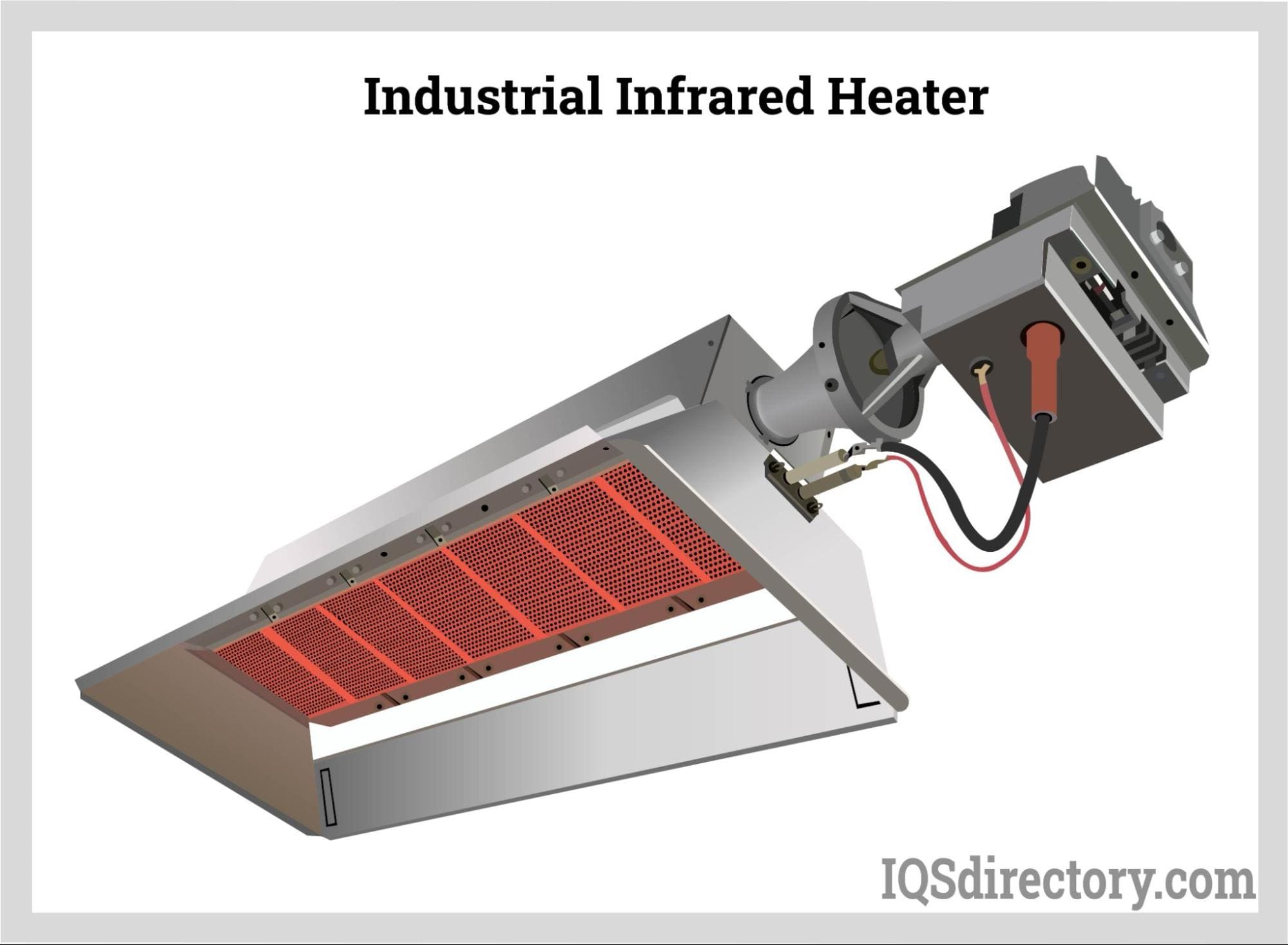 Infrared heating, a method for heating materials that uses electromagnetic waves to transfer energy from the infrared source without heating the air between.
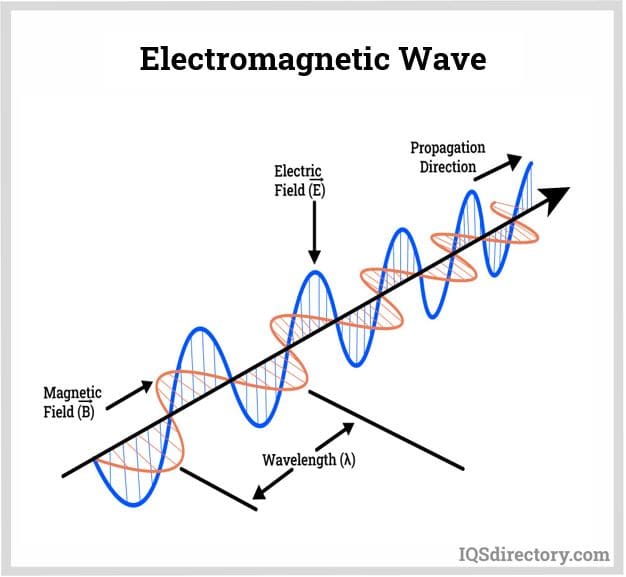 Electromagnetic waves, are composed of waves one electric field and one magnetic field which sways perpendicular to each other
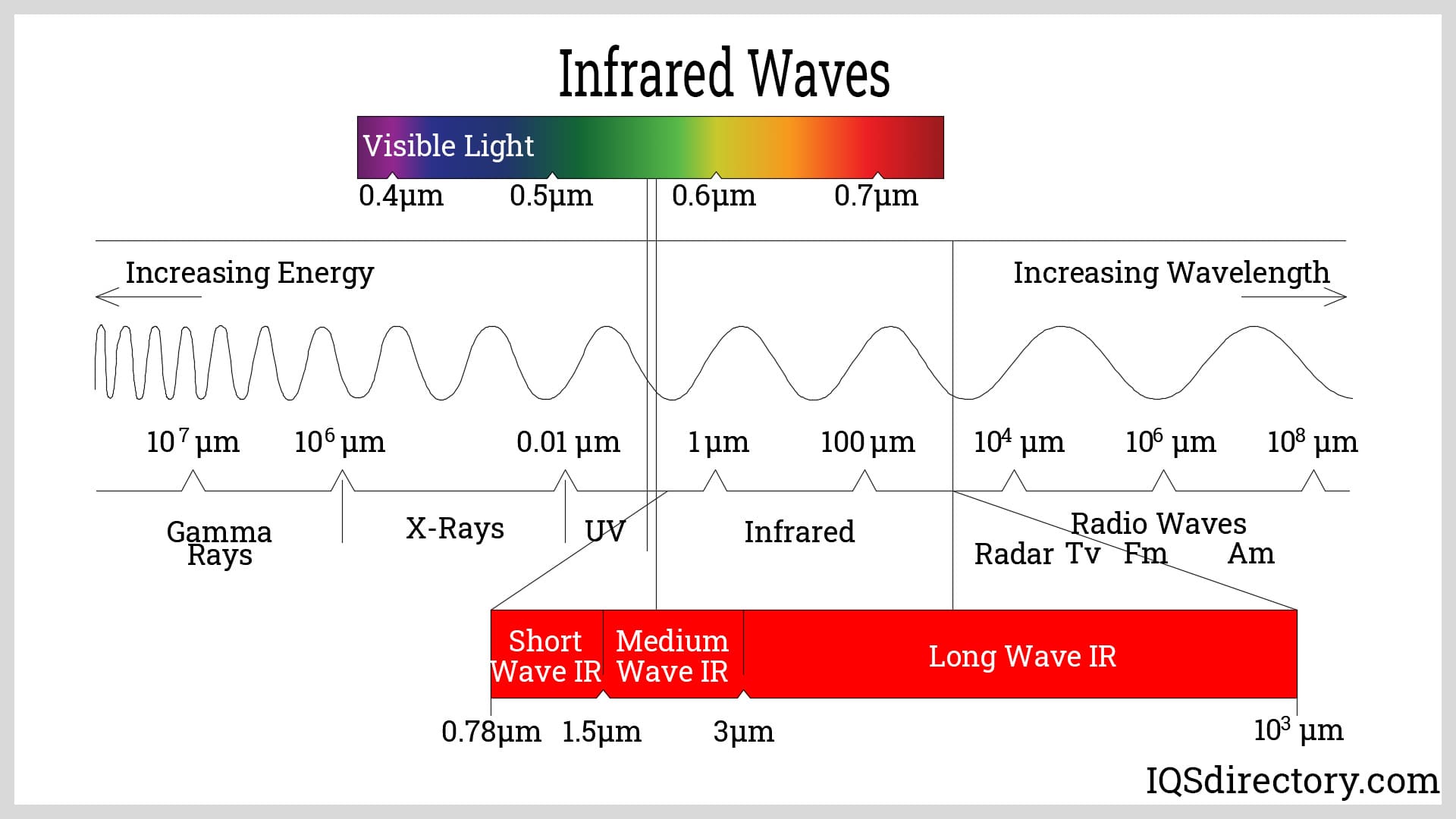 The infrared region is between the visible and the microwave regions of the electromagnetic spectrum with the wavelength range from 700nm to 1mm.
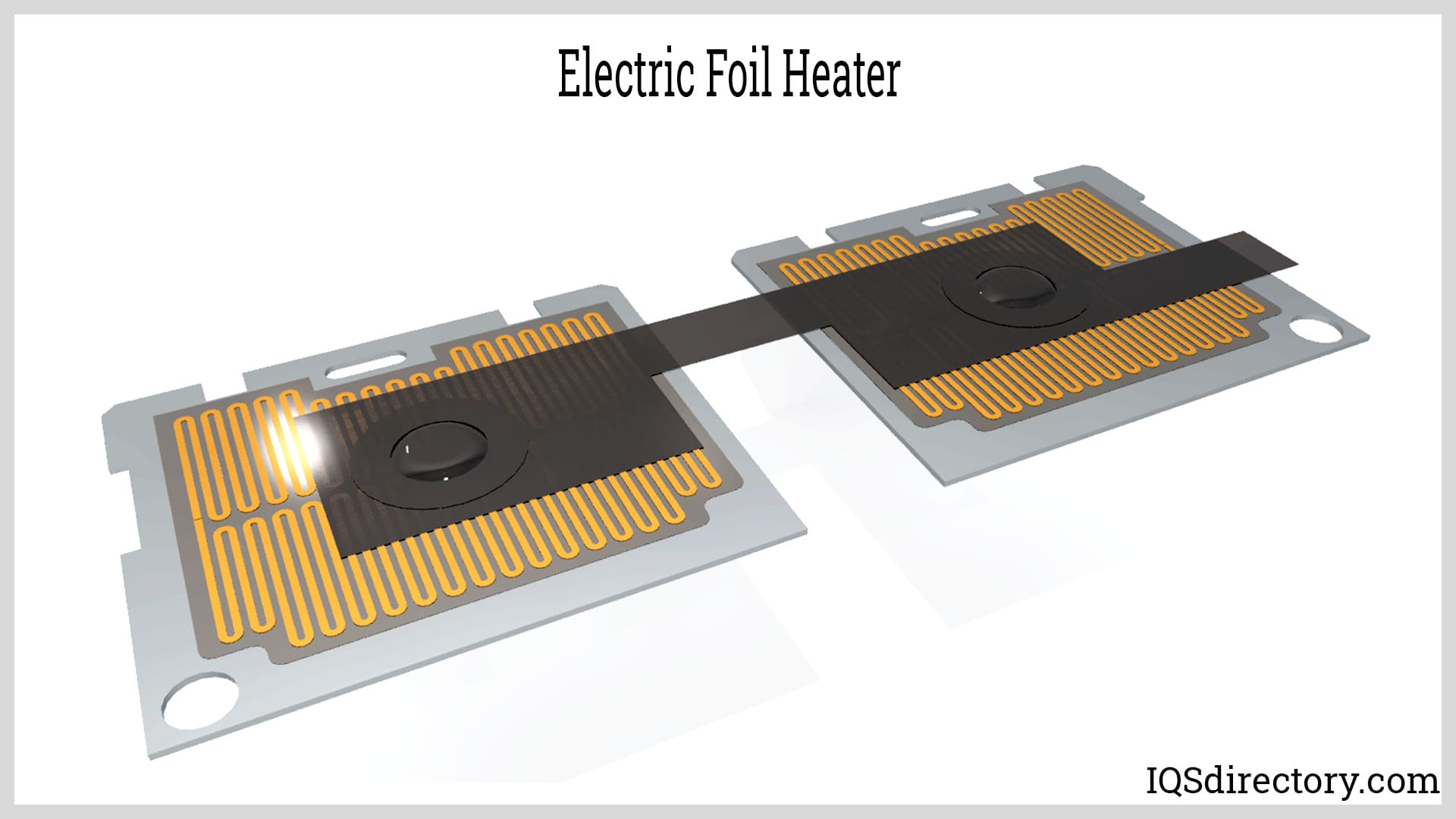 Electric infrared heaters utilizes electricity to transfer heat using the principle of resistive heating.
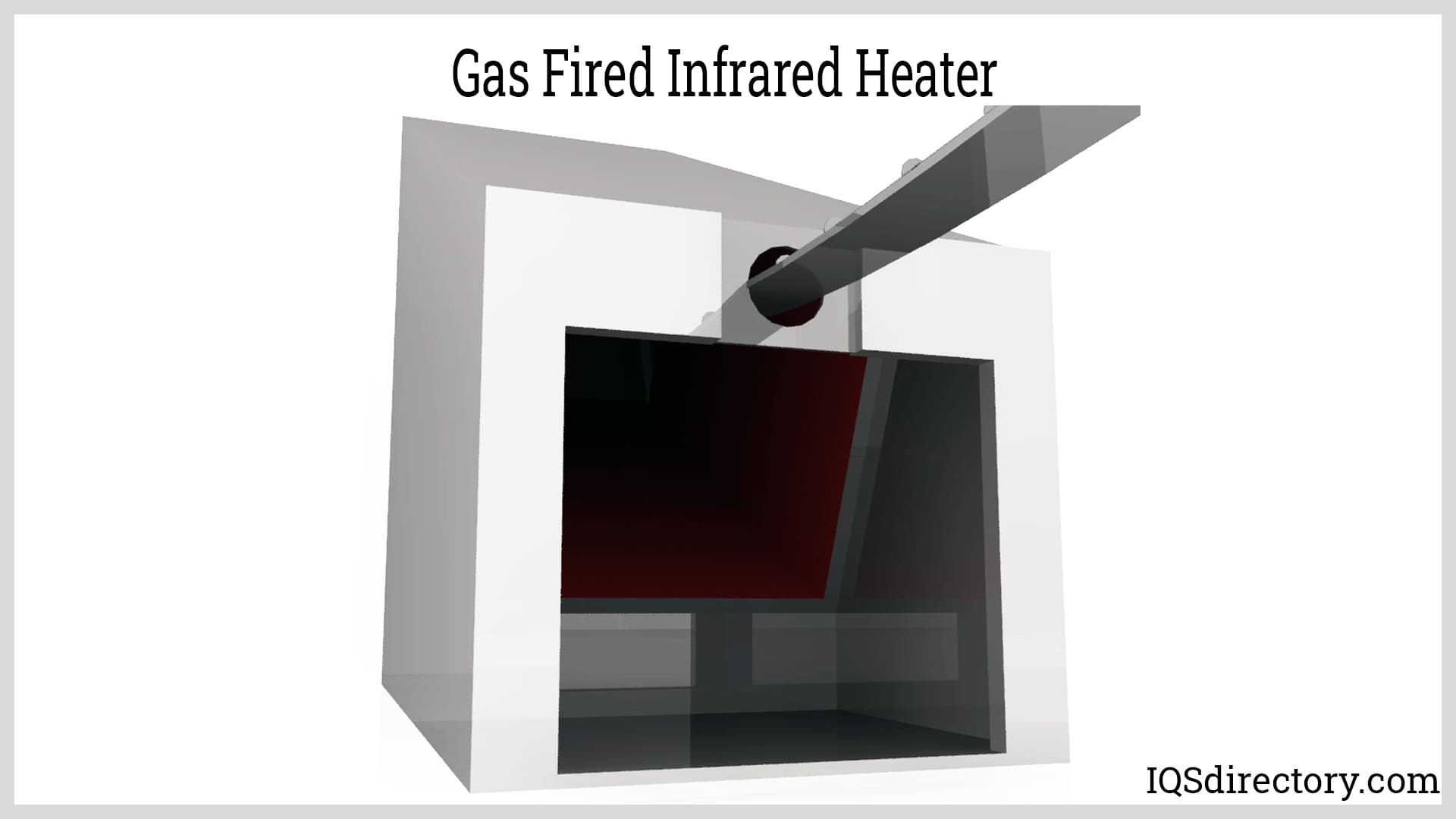 Gas fired infrared heaters, uses a heating element to convert chemical energy stored in various natural gases into heating energy.
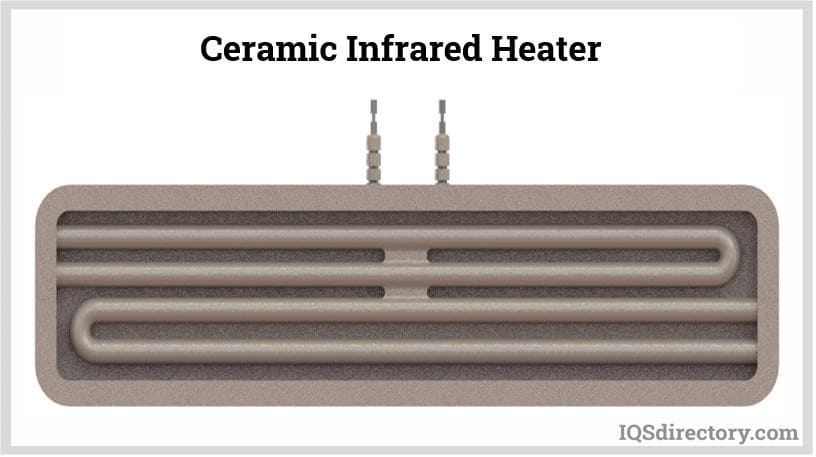 Ceramic heaters, uses a heating element directly cast into the ceramic material which emits medium to long infrared waves.
Infrared Heater Types
Electric Infrared Heater
Electric infrared heaters generate heat using electricity and transfer that heat directly to spaces or objects. They are widely favored in industrial and residential settings for their energy efficiency and quick response. These heaters often feature coiled tungsten wire elements and are especially common in domestic applications where immediate warmth is desired. They are also popular in indoor settings where simple installation, clean operation, and localized heat are priorities.
Gas-Based Infrared Heater
Gas infrared heaters produce heat from a gas flame, which is then converted into infrared radiation using filaments, tubes, or ceramic heat exchangers. Reflectors direct the radiant energy to the target area. Most models use propane or natural gas, although petroleum-fueled options also exist. These systems are common in larger facilities and open areas where fuel availability and coverage needs make gas-fired radiant heat attractive.
Low-Intensity Infrared Heater
These tube heaters use a radiant tube that emits heat at lower temperatures as exhaust gas flows through it. Sometimes referred to as positive or negative pressure heaters, they utilize fresh air for combustion and are commonly installed in building heating systems for consistent, low-intensity warmth. They are often selected for warehouses, work bays, and large overhead installations where steady comfort heat is needed.
High-Intensity Infrared Heater
Also known as ceramic, luminous, plaque, or radiant heaters, high-intensity infrared units create heat through combustion on a ceramic surface. Ideal for settings that require strong heat and significant air exchange, they use ceramic reflectors to efficiently distribute radiant energy. These are often used where concentrated output and rapid surface heating are more important than gentle ambient warmth.
Short Wave Infrared Heater
Also called near-infrared (NIR) heaters, these operate at filament temperatures exceeding 1800°C and deliver very high power densities. They are not ideal for drying processes involving water, but they are effective in applications like deep silica heating and other specialty process tasks where intense radiant output is needed.
Medium Wave Infrared Heater
Medium wave and carbon infrared (CIR) heaters operate at approximately 1000°C. They are capable of reaching up to 60 kW/m² (medium wave) and 150 kW/m² (CIR), offering powerful and efficient heat suited for various industrial tasks such as drying, curing, softening, or controlled process heating.
Far Infrared Emitter (FIR)
These heaters use low-watt ceramic plates that remain cooler while emitting far infrared radiation. Unlike traditional high-temperature emitters, FIR units are quieter and used in niche applications like small saunas and gentle comfort-heat environments due to their unique heating characteristics.
Construction Heater
Also known as tank top heaters, these portable infrared units mount directly onto propane tanks and are commonly used for outdoor or spot heating in construction environments. The ceramic or steel surface glows red-hot to emit radiant heat, making them useful where temporary, focused heating is needed on job sites.
Door Heater
Installed above or near building entrances, door heaters project a stream of warm air to form an invisible thermal barrier. This prevents heat loss and helps maintain interior temperatures despite frequent door openings. They are often used in commercial buildings, loading areas, and service entrances.
Garage Heater
Electric or infrared garage heaters provide effective warmth in spaces like workshops, storage areas, or home garages. Their long infrared waves offer immediate, absorbable heat without warming the surrounding air first, which makes them useful for comfort heat in areas with frequent door openings or intermittent occupancy.
Warehouse Heaters
Designed for large open spaces, warehouse infrared heaters deliver energy-efficient heat in environments where insulation is limited and convection heating methods prove less effective. They help maintain workable conditions in expansive facilities while allowing heat to be directed toward occupied zones instead of wasting energy at the ceiling level.
Infrared Heater Standards and Specifications
The U.S. Consumer Product Safety Commission (CPSC) enforces numerous regulations for products including electric heater systems. If your heater is intended for use by the general public in the United States, it should comply with all applicable CPSC standards. For industrial buyers, product suitability may also depend on the installation environment, the type of controls used, and any additional safety expectations tied to the site.
International organizations like the International Organization for Standardization (ISO) also issue important regulatory guidelines. For heating systems that may be distributed or used abroad, obtaining ISO-related compliance support may be advisable. Additionally, consider compliance with CAN/ANSI/AHRI 1330-2015, the joint Canada–USA standard for gas infrared heaters. Reviewing the relevant standard early can help avoid specification mismatches later in the purchase process.
Many countries maintain energy efficiency rating systems for electric appliances. If your heater will be sold internationally, be sure to research and comply with the relevant efficiency standards in each target market. For both manufacturers and buyers, understanding these requirements is part of choosing a heater that matches performance, market, and safety expectations.
Things to Consider When Purchasing a Heater
Be it home heating or industrial heating, infrared heaters should be purchased with care. To do so, keep the following considerations in mind. The right choice depends not just on fuel type, but also on beam coverage, mounting style, control options, maintenance needs, and how the heater will actually be used day to day.
Look for Power Saving Models
To minimize installation costs and energy usage, consult your vendor about creating a smart heating plan tailored to the layout and zoning of your home or facility. In many cases, a well-planned radiant layout can reduce wasted heat and improve comfort at the same time.
Buy the Appliance That Fits Your Needs
Make sure the heater you select is suited to your space or application. Speak with your supplier about the size of the area you need to heat, the mounting height, and the type of material or occupancy involved, and they can guide you toward an appropriately sized unit.
Select the Latest Model
Even if an older model has strong reviews, it is often best to opt for the most recent version. Newer models typically feature updated controls, improved efficiency, better materials, and stronger safety features, which can translate into better long-term value.
Consider Portability
Ask your supplier about portable infrared heaters. These lightweight options are useful when centralized heating is not needed. You can easily move them to another room, a cold corner, a workstation, or any space that could benefit from direct radiant heat.
Look for a Low Maintenance Heater
Choose a model that is simple to operate and does not require frequent upkeep. A low-maintenance heater can help reduce service costs and limit downtime, especially in production or facility settings where consistent heater availability matters.
Find the Right Heater Supplier
Ultimately, securing a quality infrared heater depends on working with a reputable, experienced supplier. Review the manufacturers listed near the top of this page—each is known for quality and reliability. We recommend visiting their websites, narrowing your options to three or four, and then reaching out with your requirements. Be sure to cover the factors discussed above so you can confidently select the supplier best suited to meet your needs.
Proper Care for Infrared Heaters
To keep yourself, others, and your surrounding environment safe, be sure to follow these important guidelines. Routine care not only supports safety, but also helps the heater maintain output consistency, reflector performance, and service life over time.
Avoid Flammable Materials
Never store or use flammable liquids, vapors, or objects near the heater. Doing so creates a serious fire hazard.
Do Not Obstruct or Hang Items
Avoid hanging anything from the heater or placing objects underneath the reflector, between the tubes, or within decorative elements. These areas must remain clear to prevent overheating and reduce fire risk.
Maintain a Clean Reflector Surface
Wipe down the reflector with a soft cloth whenever you notice dust or debris. Regular cleaning keeps the heater functioning properly and efficiently. Establish a routine maintenance schedule so buildup does not reduce output or interfere with heat direction.
Inspect for Wear or Damage
Check for any signs of cracking, sagging, or warping on the reflector. Also be alert for obstructions, corrosion, dirt buildup, loose seals, or visible cracks. If any of these are present, do not use the heater until it has been professionally inspected or repaired.
Check for Gas Leaks
If you're using a gas-powered heater, conduct regular leak checks. The presence of gas leaks can be extremely dangerous and must be addressed immediately. Gas-fired systems should also be reviewed by qualified personnel as part of a broader preventive maintenance routine.
Accessories for Heaters
Accessories worth considering for your heating system include replacement reflector sets, replacement heating elements, protective guards, ground fault interrupters, built-in disconnect features, and tip-over shutdown safety functions. Depending on the installation, buyers may also consider thermostats, mounting kits, timers, remote controls, zone controls, and protective housings designed for tougher environments.
Infrared Heaters Terms
-
BTU (British Thermal Unit)
Measurement of heat based on the amount required to raise the temperature of water by one degree.
Closed Loop Control
Control method that adjusts system performance by comparing actual response to the desired output and correcting deviations accordingly.
Convection
Heat transfer and distribution through fluid or gas movement, serving as an alternative to infrared.
Conduction
Heat transfer through direct contact with solids, offering another alternative to infrared.
Curing
The enhancement of coating durability by heating polymeric materials to trigger structural improvements. (Explore curing oven manufacturers on IQS Directory.)
Drying
The use of heat to remove moisture or solvents without altering the material's composition.
Feedback
The return of part of a system’s output to its input for regulation and stability.
Forced Warm Air System
A central heating method that distributes air through ducts to various rooms.
Heat Treating
Heating materials to achieve specific outcomes such as drying, curing, hardening, or tempering.
Infrared
A section of the electromagnetic spectrum located just beyond visible light, used for efficient heat transfer.
Kelvin
An international unit for measuring absolute temperature.
Maximum Operating Temperature
The peak temperature the infrared heater’s sheath can safely reach.
Micron
A unit of length equal to one-millionth of a meter, also known as a micrometer.
Powder Coating
The application of a dry polymer powder that is melted and cured into a smooth finish using heat. (Suitable ovens are listed on IQS Directory.)
Radiant Heat
Heat transferred by infrared waves from a central source, warming solid objects that then heat the air.
Reflector
A component used to redirect or concentrate heat waves to a desired area.
Substrate
The surface or object that receives a coating or thermal treatment.
Therm
A unit of heat equal to approximately 100,000 BTUs per hour.
Wavelength
The distance a wave travels to complete one cycle, especially in electromagnetic applications.