Diaphragm Valves
Linear motion valves use a flexible closure member to regulate, isolate, or shut off process media. In this family of industrial valves, diaphragm designs stand out for clean operation, dependable sealing, and accurate flow control across sanitary, corrosive, abrasive, and slurry-handling service.
Diaphragm valves are bidirectional linear motion valves used to start, stop, and throttle fluid flow while keeping the working mechanism separated from the process stream. That separation helps contain slurries, corrosive chemicals, radioactive media, and other hard-to-handle fluids. The diaphragm serves as a flexible pressure-responsive barrier that lifts away from the seat to permit flow and seals against the seat to create shutoff.
Diaphragm Valves FAQs
What is a diaphragm valve and how does it control flow?
A diaphragm valve controls flow with a flexible elastomeric or PTFE-backed membrane that moves up and down over the valve seat. Because the diaphragm separates the media from the bonnet, stem, and actuator area, it delivers clean shutoff, low leakage, and dependable control for liquids, gases, slurries, and high-purity service.
What are the main advantages of diaphragm valves?
The main advantages of diaphragm valves include tight shutoff, contamination control, simple maintenance, and reliable performance in corrosive or sanitary service. They work well for on/off duty and many throttling applications, which is why buyers often compare them when they need a clean process valve with low-emission sealing.
Where are diaphragm valves commonly used?
Diaphragm valves are commonly used in food processing, pharmaceutical production, biotechnology, water treatment, ultrapure water systems, chemical processing, and general industrial plants. They are especially useful anywhere operators need to control clean fluids, corrosive media, viscous products, or suspended solids without exposing the operating parts to the stream.
What is the difference between weir and straight-through diaphragm valves?
Weir diaphragm valves seal against a raised saddle, which reduces diaphragm travel and makes them a strong choice for throttling, chemical service, and frequent cycling. Straight-through diaphragm valves have a smoother, flatter flow path, making them better for slurries, sludge, viscous fluids, and process lines where unrestricted flow and easy draining matter more.
What materials are diaphragm valves made from?
Valve bodies are commonly manufactured from stainless steel, PVC, CPVC, polypropylene, lined metals, or glass-lined materials, while diaphragms are often made from EPDM, PTFE, butyl, natural rubber, or other elastomers. Material selection depends on chemical compatibility, operating temperature, pressure, cleanability, abrasion, and the type of media moving through the line.
How do actuators operate diaphragm valves?
Actuators open and close diaphragm valves by moving the compressor and diaphragm assembly. Manual, pneumatic, electric, hydraulic, and thermal actuator options let manufacturers match the valve to simple isolation duty, automated process control, high-cycle applications, or systems that need quick response and repeatable positioning.
What industries benefit most from sanitary diaphragm valves?
Sanitary diaphragm valves are widely used in pharmaceutical, biotech, food, beverage, dairy, and personal care production because they support clean-in-place procedures, contamination control, and smooth product flow. They are also common in water purification and high-purity utilities where dead-leg reduction, washdown durability, and hygienic design are major buying factors.
The History of Diaphragm Valves
Simple diaphragm-style flow control concepts date back to ancient Rome and Greece, where early mechanisms were used to manage water flow and bath temperature. Those early devices relied on flexible materials laid over a weir, which established the basic idea behind a valve that seals by pressing a membrane against a seat.
The modern diaphragm valve is generally traced to the 1931 patent issued to P.K. Sanders. Working in South African mining, Sanders revisited the membrane-seal concept to address leakage, seat failure, and energy loss in underground air and water lines, helping move diaphragm valves from an old concept into modern industrial valve design.
After the Saunders design entered commercial production, manufacturers in the United States expanded the market and improved material performance. Better elastomers, plastics, and lined components improved chemical resistance and service life, while demand for automation led to stronger integration with actuator technology for repeatable shutoff and process control.
In the late 1940s, the iris diaphragm valve introduced another useful variation for powders, granules, and sticky bulk solids. By twisting and compressing a flexible sleeve rather than sliding a gate through the product stream, the design reduced leakage, trapped dust, and handled lumpy material more effectively in production environments that had challenged conventional valves.
Early iris-style versions used simple fabric materials, but the design evolved into nylon, rubber, polyurethane-coated fabrics, stainless steel assemblies, and other application-specific combinations for food, pharmaceutical, and industrial processing. Today, buyers can choose from standard process diaphragm valves, automated solenoid valves, corrosion-resistant stainless steel flow-control products, and sanitary diaphragm valves built for hygienic systems.
Diaphragm Valve Advantages and Disadvantages
-
Diaphragm Valve Advantages Diaphragm valves are often selected because they combine dependable shutoff, media isolation, and straightforward serviceability in one compact valve design.
- They support very clean operation because the diaphragm separates the process fluid from moving metal parts.
- They perform well in demanding service that may involve corrosive chemicals, abrasive slurries, aggressive cleaners, or radioactive media.
- They help prevent product contamination, making them attractive for sanitary processing and high-purity applications.
- They can be used for on/off isolation as well as many throttling and flow-regulation duties.
- They offer low-emission sealing and reduce the risk of stem leakage compared with many other valve types.
- They provide tight shutoff when the valve is properly sized, installed, and maintained for the service conditions.
- They are generally easy to inspect and maintain because diaphragm replacement can often be performed without removing the valve body from the line.
- They help reduce fugitive leakage to the surrounding environment, supporting safer and cleaner plant operation.
-
Diaphragm Valve Disadvantages Even with those benefits, diaphragm valves have operating limits that buyers should review during valve selection:
- They are usually best suited to moderate temperature ranges based on diaphragm material, liner design, and service chemistry.
- They are often specified for moderate pressure service rather than the highest-pressure valve applications.
- They are not the best fit for every multi-turn, severe-service, or high-temperature process, so application matching matters.
Design of Diaphragm Valves
Diaphragm Valve Cost-Effectiveness Diaphragm valves can be economical because the wetted components are limited mainly to the valve body and diaphragm. That simplifies material selection for corrosive media, reduces the number of exposed internal parts, and can lower long-term maintenance costs in chemical, sanitary, and slurry systems.
Diaphragm Valve End Connections End connections are available in many styles, including threaded, flanged, clamp, grooved, solvent-cement, socket-weld, and butt-weld configurations. Choosing the right connection depends on piping standards, cleanability, maintenance access, pressure rating, and whether the process line is sanitary, plastic, or heavy industrial.
Rangeability Rangeability describes how well a valve can control both low and high flow rates within the same service envelope. When engineers ask how much turn-down a diaphragm valve can provide, they are really evaluating how stable the valve remains from near-closed control to higher-flow operation.
- Seat geometry and closure design influence how accurately the valve can meter low flow without instability or seat leakage.
- Actuator precision near the shut position affects repeatability, sensitivity, and the ability to hold a target flow rate.
- A valve with broader rangeability can manage a wider operating window, though control sensitivity changes as the valve moves from nearly closed to more open positions.
Flow and Flow Coefficient The flow coefficient helps determine the valve size and opening needed to deliver the target flow while maintaining useful control authority over the process stream. In valve sizing work, this value is often compared with pressure drop, media properties, and operating temperature to avoid oversizing or poor throttling performance.
Flow rate can be estimated by considering common control relationships such as:
- A linear characteristic, where flow changes in direct proportion to valve travel.
- An equal-percentage characteristic, where each incremental change in travel produces a similar percentage change in flow.
Pressure Drop Pressure drop across the valve affects controllability, energy use, and the size of opening required to regulate the system. If the pressure drop through a fully open valve is too small relative to total system drop, flow may not change much until the valve nears closure, which can make fine control harder to achieve.
Valve Sizing for Throttle Devices In throttling service, the valve opening is selected according to media type, target capacity, inlet and outlet pressure, viscosity, specific gravity, and operating temperature. Buyers comparing diaphragm valve sizes often ask what flow coefficient they need, how much pressure drop is available, and whether the process demands isolation only or stable modulating control.
- The type of media, including viscosity, solids content, specific gravity, temperature, and pressure conditions at maximum load.
- The maximum system capacity the valve must pass while still allowing controllable throttling or dependable shutoff.
Types of Diaphragm Valves
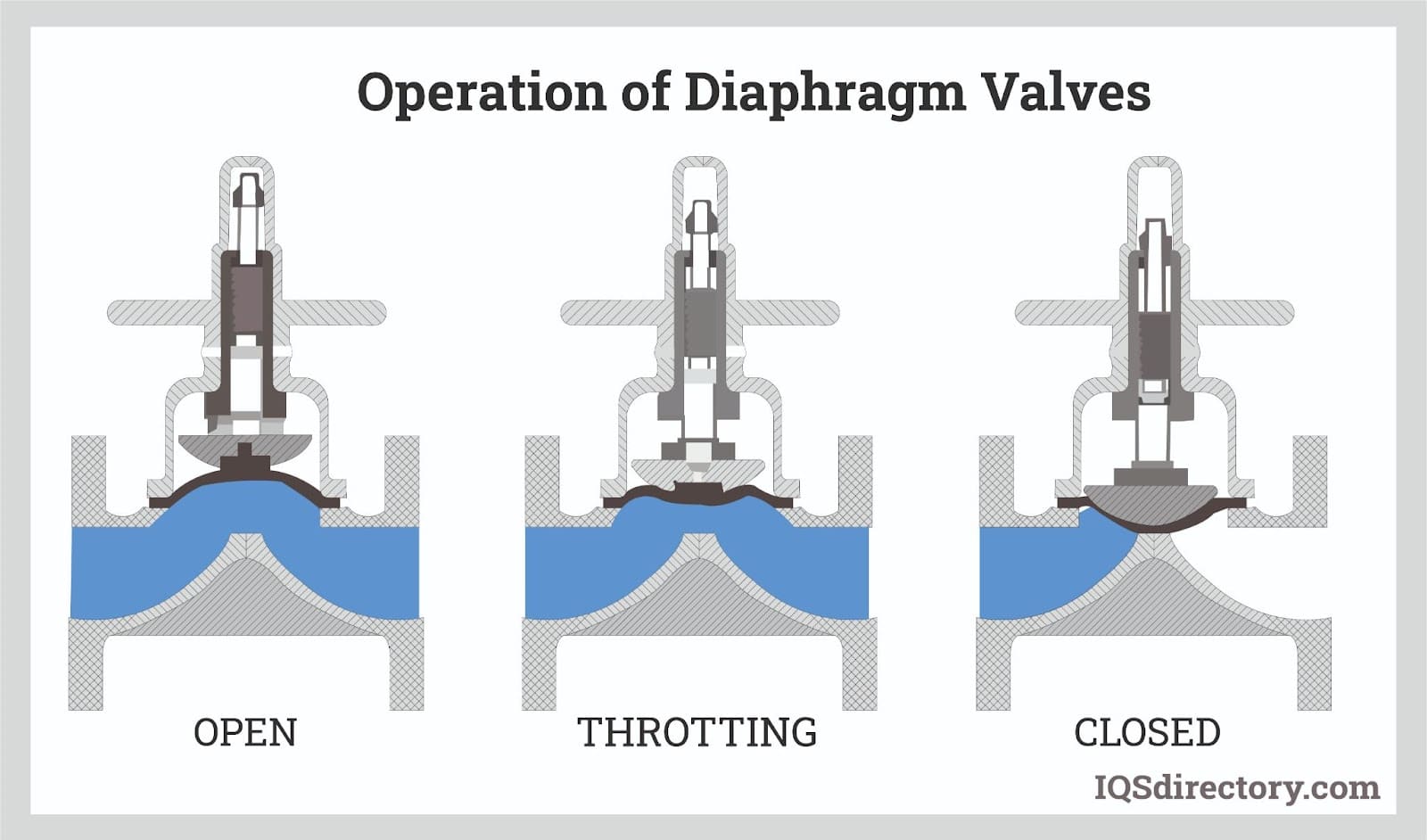 This illustration shows how a diaphragm seals against the valve seat to obstruct, isolate, or regulate the flow of process media.
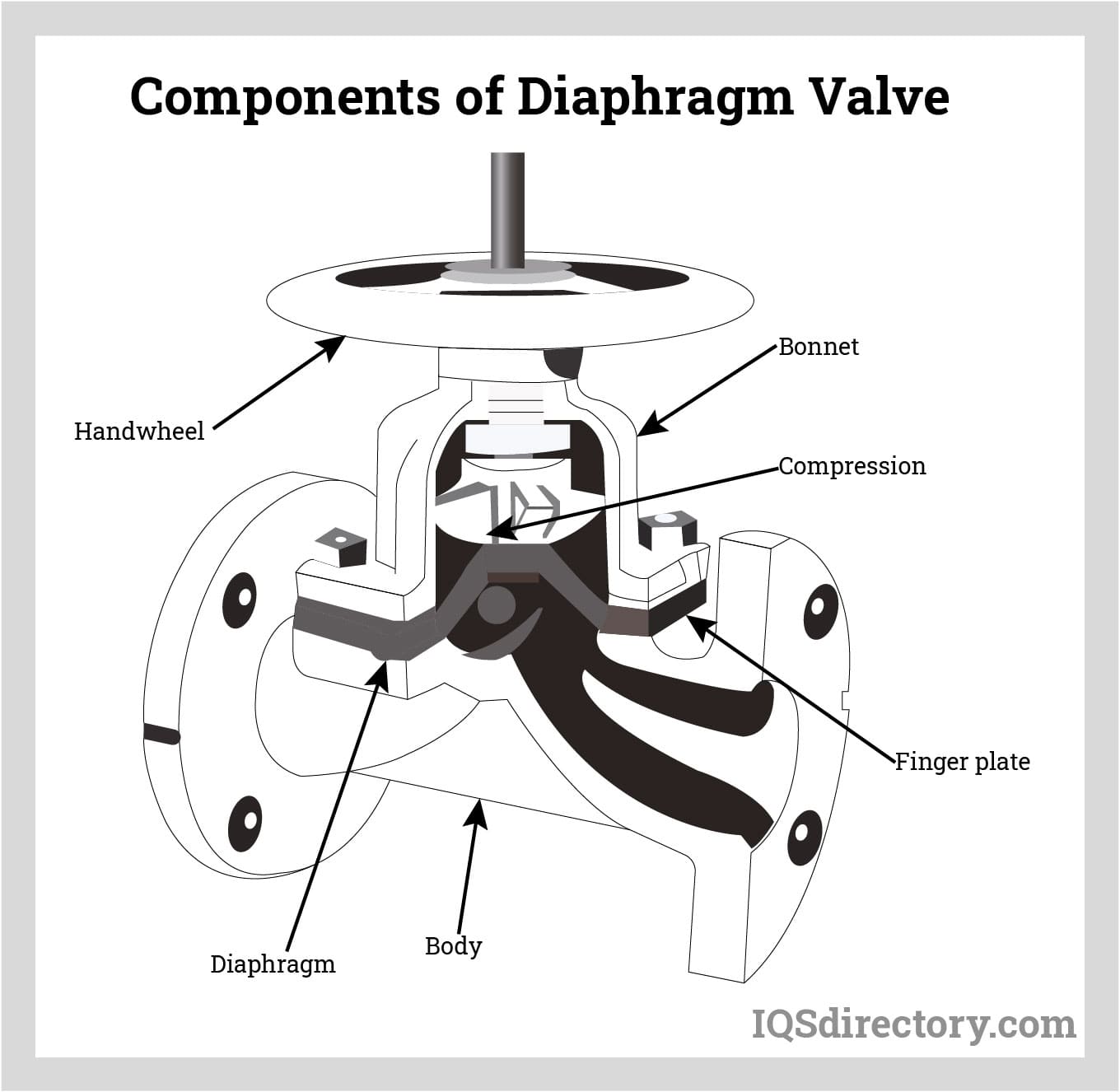 This view highlights common diaphragm valve components, including the body, bonnet, stem, compressor, diaphragm, and actuator assembly.
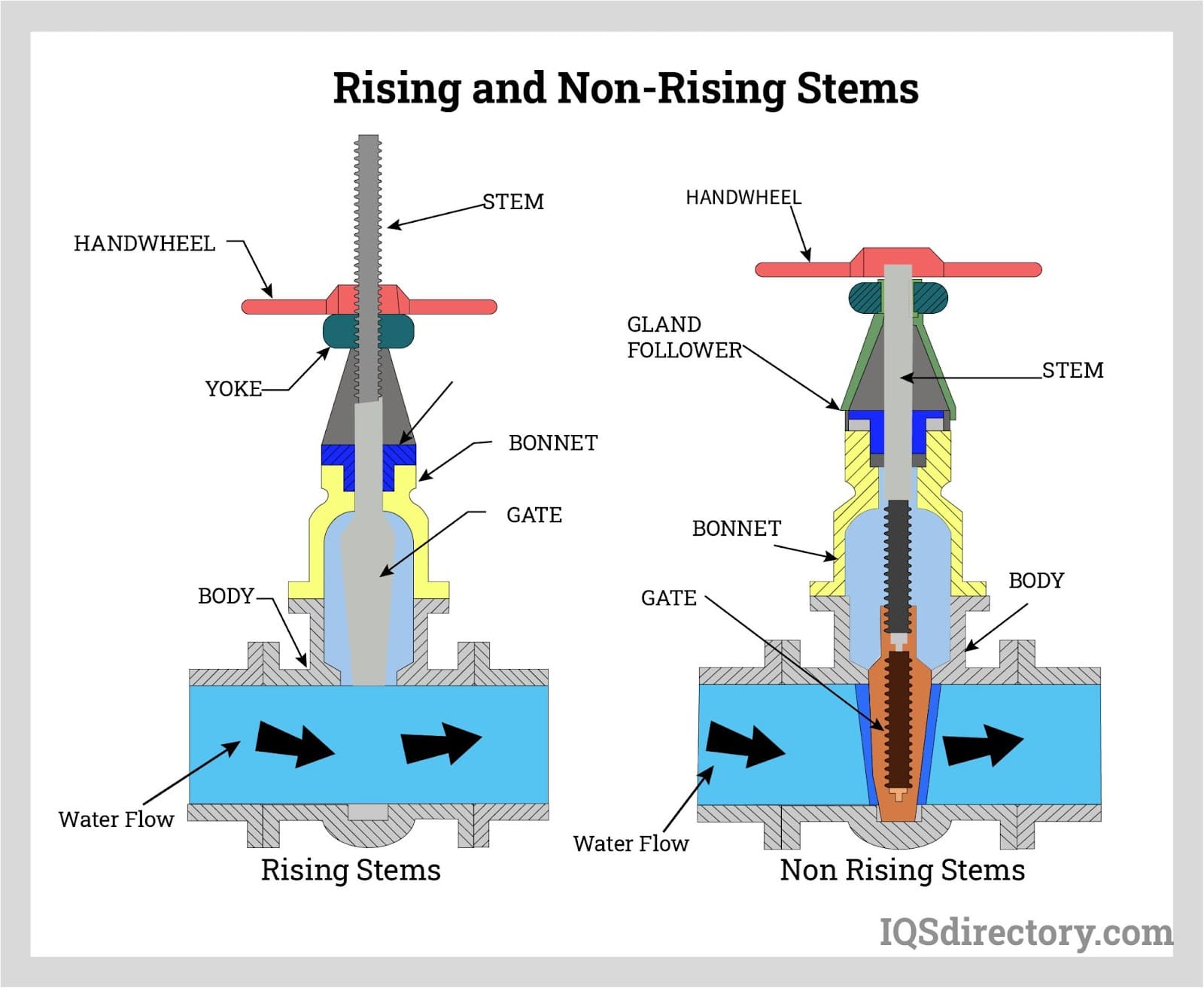 Rising stems move upward as the valve is opened or closed, while non-rising stems rotate internally without visible stem travel above the handwheel.
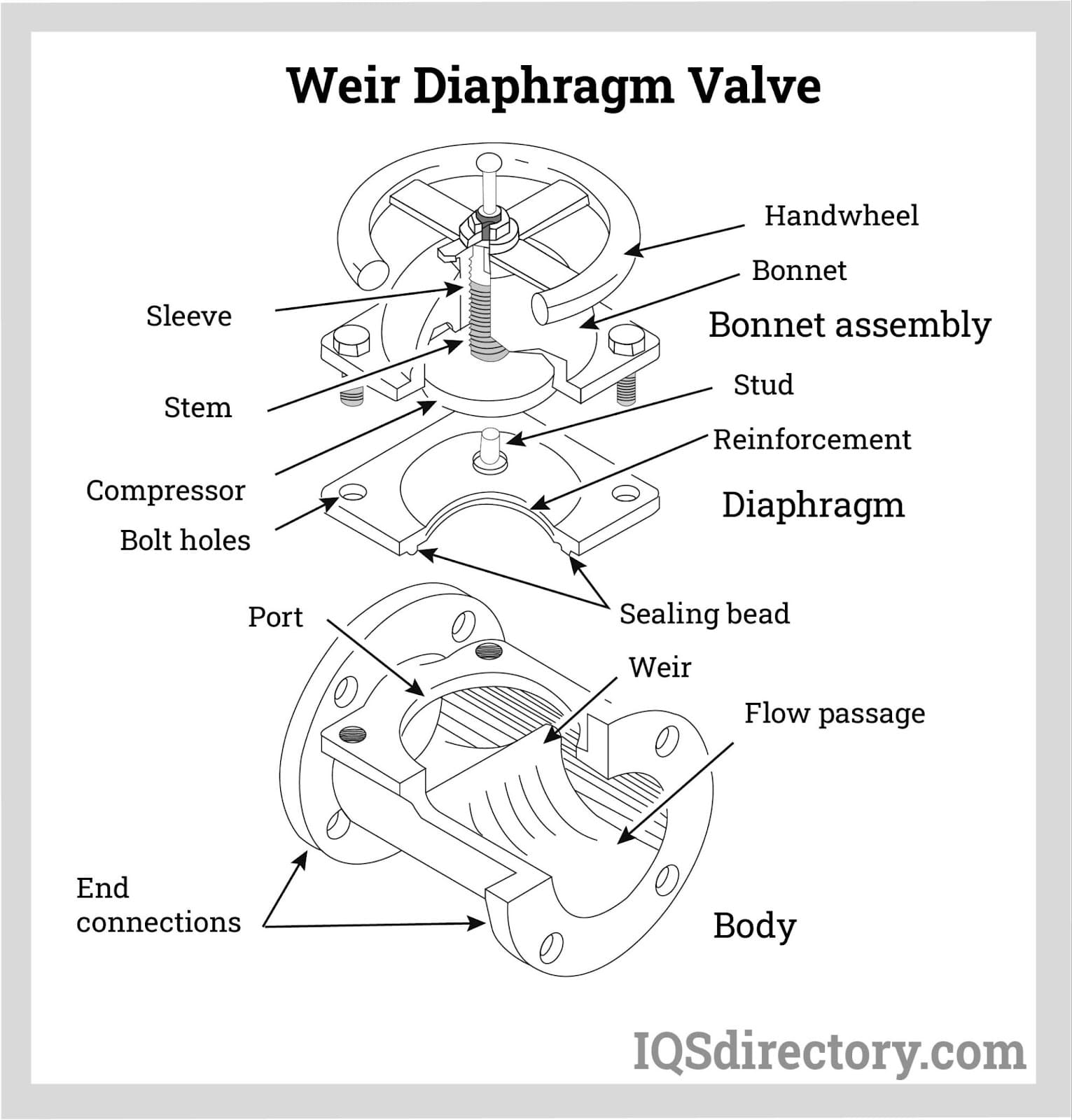 A weir diaphragm valve uses a raised saddle so the diaphragm can seal with shorter travel and smoother throttling response.
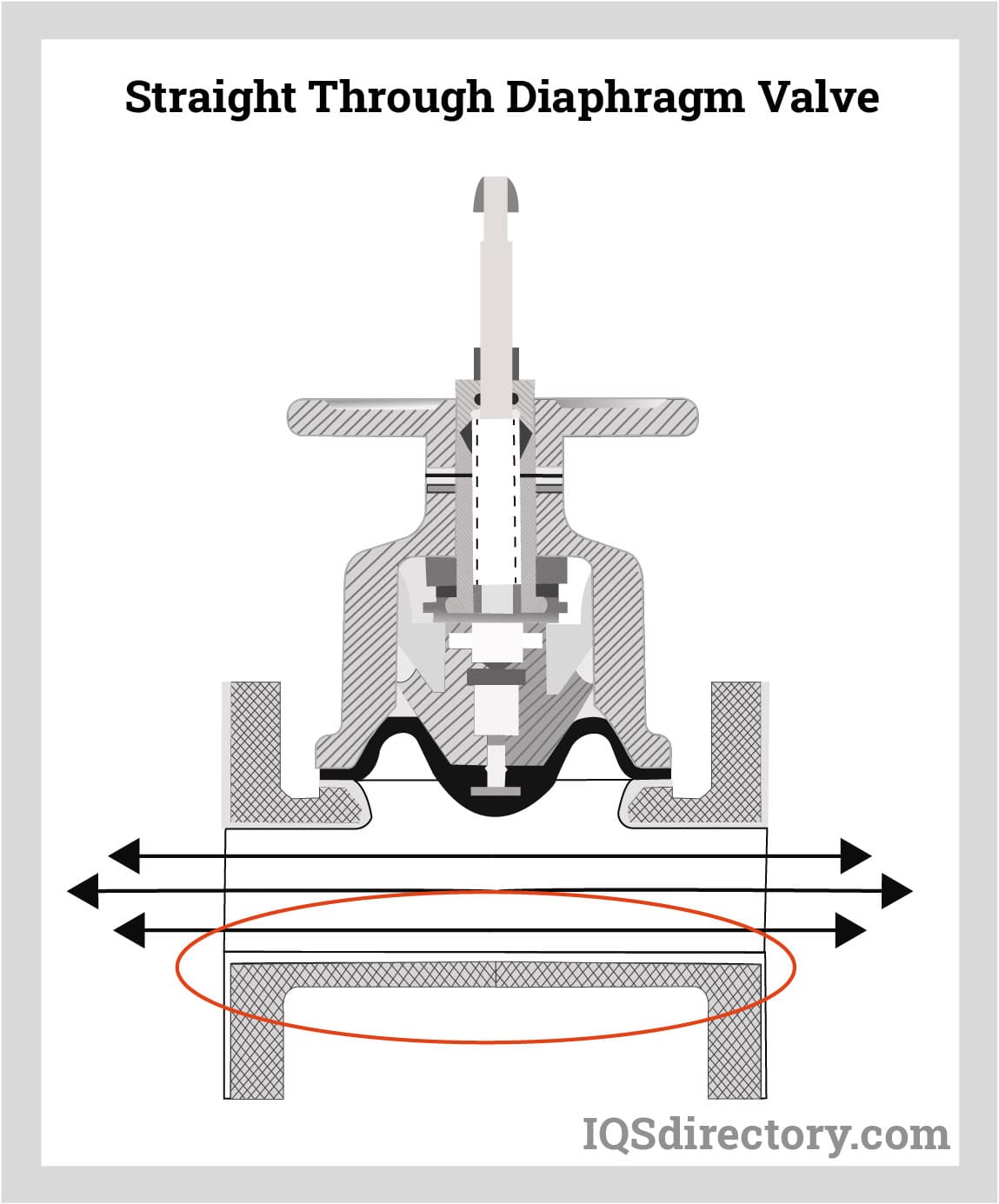 A straight-through diaphragm valve uses a less restricted flow path to handle slurries, viscous fluids, and media that benefit from easier passage.
Types of Diaphragm Valves
Diaphragm Valves Components: A diaphragm valve is typically built from a rigid body, a flow path with either a weir or straight-through seat area, a flexible diaphragm, a compressor assembly, and a bonnet with handwheel or actuator. Each component affects chemical compatibility, shutoff performance, cycle life, maintenance needs, and overall valve cost.
- Rigid Body: The pressure-containing structure that supports the connection ends and process flow path.
- Weir in the Flowpath: A raised sealing point used in weir-style valves to improve throttling and reduce diaphragm travel.
- Flexible Diaphragm: The sealing membrane that forms the pressure boundary and isolates the media from moving parts.
- Compressor: The part that transfers stem or actuator force to the diaphragm so the valve can open, throttle, or close.
- Bonnet and Handwheel: The upper assembly that secures the diaphragm and converts operator or actuator input into valve movement.
The diaphragm material, service temperature, cycle frequency, and maximum line pressure all influence design life. During installation and hydrostatic testing, the system pressure should remain within the diaphragm manufacturer’s limits so the sealing element is not overstressed before the valve is even placed in service.
Types of Diaphragm Valves:
- Biotech Valves: Designed for biopharmaceutical, laboratory, food science, and agricultural processes that require hygienic flow control and easy cleaning.
- Diaphragm Check Valves: Use a flexible membrane to support one-way flow and help prevent reverse flow in a process line.
- Diaphragm Control Valves: Modulate flow, pressure, temperature, or liquid level in automated process systems.
- Diaphragm Diverter Valves: Route media from one inlet to multiple outlets, or combine multiple lines into one controlled outlet.
- Diaphragm Tank Bottom Valves: Installed at the lowest point of a vessel to drain product, remove residue, or support sampling operations.
- Hygienic Valves: Built for sanitary and aseptic service where smooth surfaces, drainability, and contamination control are priorities.
- Plastic Diaphragm Valves: Use corrosion-resistant polymer bodies and elastic diaphragms for chemical service, water treatment, and lightweight piping systems.
- Pneumatic Diaphragm Valves: Pair diaphragm valve bodies with compressed-air actuation for fast, repeatable process control.
- Process Valves: A broad industrial category covering valves that start, stop, direct, or regulate the movement of process media.
- Straight-Through Diaphragm Valves: Preferred for slurries, sludge, viscous products, and changing flow direction because the flow path is less restricted.
- Sanitary Diaphragm Valves: Manufactured for sterile or hygienic transfer of liquids, gases, and semi-solid products in clean-process industries.
- Tank Bottom Valves: Help reduce dead zones at vessel outlets where product residue or bacterial growth can develop.
- Weir Valves: Use a raised weir to create a seal and are commonly chosen for corrosive service, clean fluids, and controlled throttling.
Variations of Weir-Type Diaphragm Valves:
- Full-Bore Valve: Common in beverage and sanitary service where cleaning efficiency and full-flow passage are important.
- Straightway Valve: Lifts the diaphragm for bidirectional flow and creates a dependable seal when closed.
- Zero Static Valves: Multiport diaphragm valves designed to improve drainage and reduce trapped product in ultra-clean process systems.
Weir-Type Diaphragm Valve Features:
- Shut-off Area: The enlarged sealing region near the seat helps provide finer throttling response than many straight-through designs.
- Reduced Diaphragm Travel: The raised weir lowers diaphragm flexing distance, which can improve cycle life in repetitive service.
- Bonnet Assemblies: Optional enclosed bonnet designs add protection for hazardous media, washdown service, and self-draining sanitary layouts.
Because of these variations, diaphragm valves can be tailored to chemical processing, food production, pharmaceutical systems, water treatment, slurry transfer, and many other applications where flow control and media isolation both matter.
Valve Features
The diaphragm valve uses a flexible membrane attached to a compressor that is moved by the stem or actuator to regulate flow. This simple design helps explain why many engineers look to diaphragm valves when they need a valve that is easy to understand, easy to clean, and capable of dependable shutoff in difficult media.
Valve Position Indicator A position indicator shows whether the valve is open, closed, or somewhere in between. Depending on the system, this feedback may come from a visible stem, mechanical switch, beacon, limit switch, or other indication method used for operator awareness and automation.
Valve Body The valve body is sized according to process requirements and manufactured in materials selected for media compatibility, temperature, and pressure. Common body options include PVC, stainless steel, lined metal, and specialty elastomer or polymer constructions used in corrosive, hygienic, and general industrial service. Related material choices may also involve engineered rubber compounds or glass-lined designs associated with glass-based process equipment.
The Stem The diaphragm valve stem usually transmits motion without rotating the diaphragm itself. In non-indicating designs, the handwheel turns a stem bushing that drives the stem and compressor, while indicating versions provide visible travel so operators can confirm valve position more easily.
The Bonnet The bonnet fastens to the valve body and encloses the non-wetted operating parts, including the compressor and handwheel assembly. Quick-opening, lever-operated, or sealed bonnet designs may be selected based on valve size, maintenance preferences, containment goals, and whether the application requires extra protection from the surrounding environment.
The Compressor The compressor sits between the stem assembly and the diaphragm and distributes closing force across the membrane. Its shape and fit help the diaphragm seal evenly, reduce localized stress, and improve repeatable valve operation over many cycles.
Travel Stops Travel stops limit over-compression of the diaphragm and help maintain consistent stroke length. Proper stop adjustment can protect the membrane, support repeatable shutoff, and reduce premature wear in automated or frequently cycled installations.
Applications of Diaphragm Valves
Diaphragm valves are often described as some of the cleanest process valves because the media contacts fewer moving parts than it does in many other valve designs. That layout helps reduce contamination, protects the operating mechanism from corrosion, and makes diaphragm valves attractive when users search for a clean process valve for sanitary service or corrosive media.
Originally developed for industrial duties, diaphragm valves later became widely adopted in biopharmaceutical and hygienic processing as material technology improved. Stainless steel bodies, polished internal surfaces, elastomer and PTFE diaphragms, and cleanable geometries allow these valves to meet strict expectations for product purity, washdown durability, and reliable shutoff.
These valves work well as both isolation and throttling devices, especially when handling liquids with suspended solids, mildly abrasive media, or chemicals that would attack exposed stem packing in other valve designs. In many low- to moderate-pressure systems, they deliver a practical balance of controllability, maintenance access, and leak-tight performance.
Diaphragm valves are also well suited to harsh service involving slurries, corrosive chemicals, wastewater, ultrapure water, radioactive waste streams, and washdown-heavy environments. Common searches such as what valve is best for slurry service, what valve works for clean-in-place systems, or how to isolate corrosive media often lead buyers to diaphragm valve designs for the applications below:
- High-purity and demineralized water systems
- Vacuum service and utility process lines
- Food processing, pharmaceutical, beverage, and brewing systems
- Electronics and semiconductor support applications
- Pulp and paper process service
- Power generation and plant utility applications
- Photographic, specialty chemical, and batch production systems
Use and Installation of Diaphragms
-
Diaphragm Installation The diaphragm is commonly attached to the compressor by a molded stud or similar connection. As the stem rises, the compressor lifts the diaphragm away from the seat to start flow; as the stem lowers, the diaphragm presses against the seat area to slow or stop flow and create shutoff.
Uses of Diaphragm Valves In service, the diaphragm and compressor work together to isolate, regulate, and shut off the process stream. That design makes diaphragm valves especially valuable where operators need dependable sealing without allowing the media to reach the stem, bonnet, or actuator mechanism.
Manual diaphragm valves give operators fine control over opening position and pressure drop through handwheel movement. This can be useful when adjusting flow gradually, balancing a line, or throttling a process that would be harder to manage with a simple quarter-turn isolation valve.
These valves are particularly effective for fluids containing suspended solids, soft slurries, or products that benefit from smooth, cleanable flow paths. Weir-style valves are often chosen for controlled throttling, while straight-through styles are favored when maximum passage area is more important.
Actuators
Actuators The actuator provides the force and motion that open or close the valve. Required torque, speed, fail position, control signal, and cycle frequency all influence actuator selection, so buyers often compare actuator options alongside the valve body, diaphragm material, and intended service.
Manual Actuators Manual actuators use a handwheel, lever, or crank for direct operator control. They are common in utility lines, smaller process valves, and installations where electrical or air power is not available or where simple local control is preferred.
Electric Actuators Electric actuators support manual-assisted, semi-automatic, or fully automatic valve operation. Reversible motors, gear trains, and limit switches help position the valve accurately, making electric actuation useful where remote control, repeatable cycling, or integration with plant automation is required.
Pneumatic Actuators Pneumatic actuators use compressed air acting on a piston or diaphragm to move the valve stem. They are popular for fast cycling, automated open/close service, and modulating control because they respond quickly, can be configured to fail open or fail closed, and fit well into instrument air systems.
Hydraulic Actuators Hydraulic actuators are used where larger operating forces are needed. Fluid pressure overcomes the spring or opposing force to move the piston and open the valve, making hydraulic designs useful for demanding service where compact size and high output force are both desirable.
Thermal Actuators
Thermal actuators respond to temperature or pressure changes in the media and move the valve to a preset position when conditions shift. They are often used in self-acting systems that need automatic adjustment without a full external control package.
Proper Care for Diaphragm Valves
Proper Care for Diaphragm Valves Proper care starts with selecting the right connection style and sealing method for the piping system, maintenance approach, and cleanliness requirement. Common connection choices include:
- Threaded ends for standard pipe connections in general service.
- Compression fittings that seal without soldering and are useful for tubing systems.
- Bolt flanges that provide a strong, serviceable connection at the valve inlet or outlet.
- Clamp flanges that allow quick assembly and disassembly in sanitary or frequently serviced lines.
- Tube fittings for direct tube-to-valve connections in instrument or clean utility systems.
- Metal face seals that use a metal gasket between fitting parts where a highly controlled seal is needed.
Compliance and Standards for Diaphragm Valves
Compliance and Standards for Diaphragm Valves Diaphragm valve compliance depends on the industry, materials, surface finish, pressure class, and connection standard required by the application. Buyers commonly review valve construction against factors such as:
- Applicable pipe and fitting standards for threaded, flanged, clamped, welded, or tube-end connections.
- Material traceability and chemical compatibility for the body, diaphragm, seals, and wetted surfaces.
- Pressure and temperature ratings established for the valve size, body material, and diaphragm construction.
- Sanitary or hygienic design expectations for cleanability, drainability, and surface finish where required.
- Leak-tight performance and containment features suited to the fluid, plant safety rules, and process risk.
- Documentation, testing, and supplier support needed for qualification, validation, or long-term maintenance.
How to Choose the Right Diaphragm Valve Manufacturer
The right manufacturer supplies diaphragm valves that match the application, offers dependable quality and product support, and can explain materials, pressure limits, actuator options, lead times, and maintenance expectations before purchase.
Diaphragm Valve Terms and Definitions
-
Actuators Devices that position the valve by moving it from open or partly open to partly closed or fully closed. They may be manual, pneumatic, hydraulic, electric, or thermal depending on the system.
Back Pressure Pressure present at the outlet side of a valve because of conditions in the downstream piping or discharge system. It may remain constant or vary during operation.
Bellows A flexible sealing element used in some valve designs to reduce leakage between moving parts and the valve body.
Bonnet A cover attached to the valve body that encloses the upper operating parts and is removed for inspection or maintenance.
Cracking Pressure The pressure level at which a normally closed valve first begins to open and allow measurable flow.
EPDM Ethylene propylene diene monomer, a synthetic rubber often used for diaphragms and seals because of its broad chemical resistance and utility-service durability.
Flange A piping connection that uses mating faces, bolts, and a gasket or seal to join pipe, fittings, and valves.
Flare A tube fitting style that forms a seal through a flared tube end and mating nut, often used where clean, compact connections are preferred.
GPM Gallons per minute, a common unit for measuring volumetric flow through a valve, pipe, inlet, or outlet.
O-Ring A ring-shaped elastomer seal used to prevent leakage between mating parts in valves and piping systems.
Ports Openings or passages in a valve body that allow fluid to enter, exit, or be redirected through the valve.
Set Pressure The pressure at which a valve or control element is adjusted to begin opening, holding, or regulating service conditions.
Stem A rod or shaft that transmits motion from the actuator or handwheel to the internal valve components.
U-Cup A U-shaped sealing element used in places where a standard O-ring may not provide the preferred sealing profile.