Cold Headed Parts
Cold headed parts denote a type of finished or stock shape produced through a specialized process more broadly known as cold working or cold forming. Although the terms "cold working," "cold forming," and "cold heading" are often used interchangeably, cold heading is technically a subset of the larger group of manufacturing processes known as cold working or cold forming. Cold heading specifically refers to the process of enlarging sections on the end of tubular pieces such as rods or wires. However, a proper understanding of cold heading can only occur within the larger context of cold working as a subject.
Quick links to Cold Headed Parts Information
The History of Cold Headed Parts
“Cold” methods of working metal can be traced back to prehistoric times. For example, ductile metals found in nature (such as silver and gold) were hammered with stones into sheets that were subsequently used to fashion jewelry and supplement armor. Ironically, cold working processes did not really accelerate until the modern era. Although Leonardo da Vinci produced the first known design for a cold rolling mill in 1480, the first such mill surely known to exist dates to 1615 and focused on producing tin and lead plates. The cold rolling of iron and steel began to develop not long after; such activity only increased during the Industrial Revolution a couple of centuries later.
Modern versions of cold working only truly began to develop within the past couple of centuries. Germany’s military ordnance industry contributed significantly to the advancement of cold working processes toward the end of World War II. In the postwar era, American military and consumer manufacturers increasingly took advantage of cold working processes. From approximately 1950-1969, the amount of cold-worked steel in America increased tenfold.
Defining Cold Working
The term "cold working" is slightly misleading since it suggests that these metallurgical processes occur at very low temperatures. In reality, the term cold working refers primarily to the absence of extreme heat. Instead of being preheated, most cold-worked materials are merely processed and formed by machines at ambient temperatures. In most cases, ambient temperatures are equal to normal room temperatures.
Cold working is broadly characterized by two traits. In technical terms, cold-working can refer to any metallurgical shaping process that occurs below the material’s recrystallization temperature. (Recrystallization refers to the formation of new grains within a material at elevated temperatures.) In some cases, cold-working does occur at temperatures above normal room ones. If the recrystallization point is not reached, however, these types of scenarios would still qualify as cold working. In addition, cold working is characterized by the use of mechanical stress in the place of heat to induce shape change. Although specific actions and machines vary based upon the material and desired outcome, most cold forming processes utilize extreme pressure to cause the plastic deformation of metals, resulting in desired internal and external component characteristics. This emphasis on mechanical pressure distinguishes cold working from hot working processes (which deform metals using extreme heat), die casting processes (in which molten metal is poured into a mold), and screw machining processes (in which metal is removed rather than reshaped).
Cold working is often preferred in manufacturing environments because it results in more precise shaping and superior surface finishes than other metalworking methods. The quality, versatility and simplicity of the cold forming process makes it very useful - and even crucially important - in a wide variety of industrial settings. Cold headed parts manufacturers can be found in the construction, automotive, hardware, stamping, injection molding, aerospace, agriculture, recreation, furniture, electronics, pyrotechnics, packaging and upholstery industries.
How Cold Working Works
The visible shape changes that metals undergo in cold-working are the direct results of invisible changes in the metal on the microscopic level. To truly understand how cold-working works, it is important to grasp a pair of chemical concepts: work hardening and dislocations.
Both work hardening (or strain hardening) and cold heading possess similar relationships to the concept of cold working in general. While both concepts are very closely related to cold working – so much so that all three concepts are often used interchangeably – neither concept is really identical to cold working. The main difference between these two concepts lies in the fact that cold heading is a subset of cold working while work hardening is a by-product or effect of cold working. Work hardening refers to the strengthening of metal that results directly from plastic deformation – the same process that cold working uses to reshape metal into a precise dimension.
Cold working causes work hardening via plastic deformation because cold working also causes microscopic dislocations through plastic deformation. In materials science, a dislocation is a defect in the crystalline structure of a certain material. When a material is subject to sufficient mechanical stress (from work being performed on and energy added to the material), that material will experience plastic deformation – the breakage of bonds between atoms and a consequent rearrangement of a material’s atomic structure. (Plastic deformation stands in contrast to elastic deformation, which stretches bonds between atoms without breaking them.) As dislocations from plastic deformation accumulate within a material and interact with one another, atomic movement within the material becomes increasingly difficult. Eventually, crystalline movement within the material will become virtually impossible. Thus, the very process of plastic deformation eventually makes material resistant to further deformation. In other words, it hardens or strengthens the material. Because of this physical reality, cold working and work hardening are inextricably connected, although not identical. To find these types of hardened materials, visit IQS Directory's company list.
Advantages and Disadvantages Cold Working
Cold working processes offer many benefits to both consumers and manufacturers.
Cold Forming Economic Benefits
- Energy Savings
- Since hot forming operations often require heating large and small metallic components to excessive temperatures, cold forming processes represent significant energy savings.
- Waste Minimization
- Additional economic value can be attributed to the minimization of waste materials afforded by cold working. Because the materials are predominantly altered with punch and die manufacturing, the metals remain intact even while undergoing plastic deformation. On the other hand, processes such as CNC machining, welding, cutting and drilling produce scraps and unused fragments of material. Recycling such waste is typically possible; however, it is also time consuming.
- High Production Rates
- The output of cold worked products can range from 50 to 400 parts per minute. In contrast, a method such as screw machining can produce only 1 or 2 parts per minute.
- Cost Reduction
- The efficiency and productivity of cold working processes have a positive impact on consumers. On average, consumers can slash part costs by 40-60% through the purchase of cold worked products.
Qualitative Benefits of Cold Forming
- Increased Product Strength
- Cold formed parts exhibit a particularly solid construction that often requires no secondary operations. Small cold-formed products (such as screws and fasteners) are usually stronger than counterparts created from several combined pieces. Furthermore, work hardening from repeated pressures on cold worked material increases the tensile strength and hardness of the finished product.
- Increased Product Consistency
- Cold working processes increase the consistency and reproducibility of products even if they are produced at high output rates. One of the major differences between hot and cold forming is the tight tolerances for dimensions. Exact measurements are difficult to calibrate and reproduce with high heat applications as metal expands when warmed, but contracts when cooled. Because cold processes interact with materials at room temperature, there is no expansion coefficient - meaning precision is more easily predicted and achieved.
- Improved Surface Finishes
- Cold working typically results in better surface finishes for metal products. This can largely be attributed to the lack of cooling and oxidation in cold working processes. The numerous benefits of cold working can be attributed to its ability to create a more compact and efficient grain structure at a metal’s atomic level and vast improvements in strength and hardness. Unfortunately, this same ability can create some disadvantages.
- Increased Internal Stress
- Cold working tends to increase the internal strain or stress on an object. To combat this effect of cold working processes, annealing (heating and then cooling metal) is commonly used. This tactic is especially used in applications requiring a number of similar or dissimilar cold working steps. Annealing allows manufacturers to soften the materials slightly in order to relieve some of the tension and improve ductility. Manufacturers often alternate cold working and annealing steps in order to create stock forms and fasteners that have the necessary permanent distortion of the crystal structure and the composition of the metal required for variable applications.
- Reduced Metal Ductility
- As mentioned before, the very process of plastic deformation reduces the ductility of metal and its ability to further plastically deform. This disadvantage can be offset by working with specific types of metals, such as low-carbon steel.
- Limited Range of Available Material
- Limited range of available material. In theory, most commercially processed metals are available for cold working. However, since these techniques depend on extreme pressure rather than heat, it is generally most effective on raw material that is already relatively soft and ductile (such as aluminum).
- Limited Range of Finished Products
- Despite the existence of machines like multi-die headers, cold working lends itself to forming relatively simple shapes. Cold plates, for example, are typically made through machining processes responsible for a significant percentage of the product’s final price. Even when a more complex shape can be achieved, a metal’s loss of ductility through cold working may make such a complex shape undesirable.
Materials and Products of Cold Working
Cold working is most commonly applied to raw materials such as steel, aluminum, and copper. Steel is an especially popular object of cold working due to its strength and economic stability. Other materials that are also processed in this manner include titanium, iron and brass. Metallurgical advancements continue to increase the number of metallic elements and alloys that can be processed with cold working techniques.
The products of cold-working manufacturing techniques are most commonly smaller items such as cold headed fasteners (e.g. universal rivets) and electrical contacts. Some of the most commonly sought after implements are produced by cold working, including:
These products can assume many shapes, including:
Various types of heads (e.g. a hexagon head or round heads)
- Threads
- Steps
- Grooves
- Tapers
Many of these products and their accompanying shapes are made through the processing of stock forms such as cold heading wire, plate and sheet. Larger items are available, though current technology makes cold forming such products less practical than smaller and less complex objects. Fortunately, the range of possible cold-formed products is expected to grow, parallel with improvements in manufacturing software. Improvements to cold forming services allow for higher speed production as well as the creation of more and more complex components such as spark plugs and axles.
Cold Headed Part Images, Diagrams and Visual Concepts
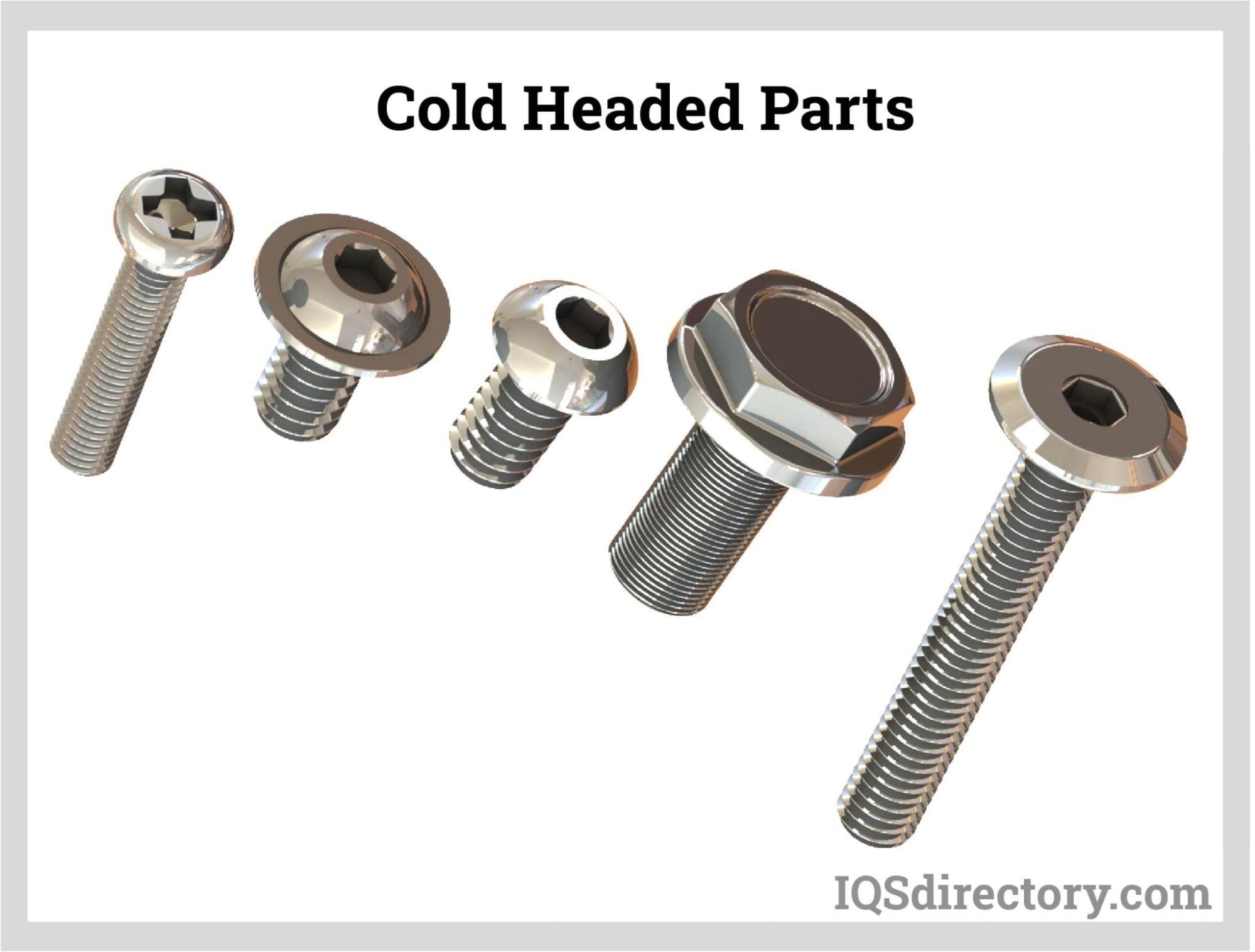 Cold heading, the process of continuously forming a specific shape or design from a metal wire without adding heat.
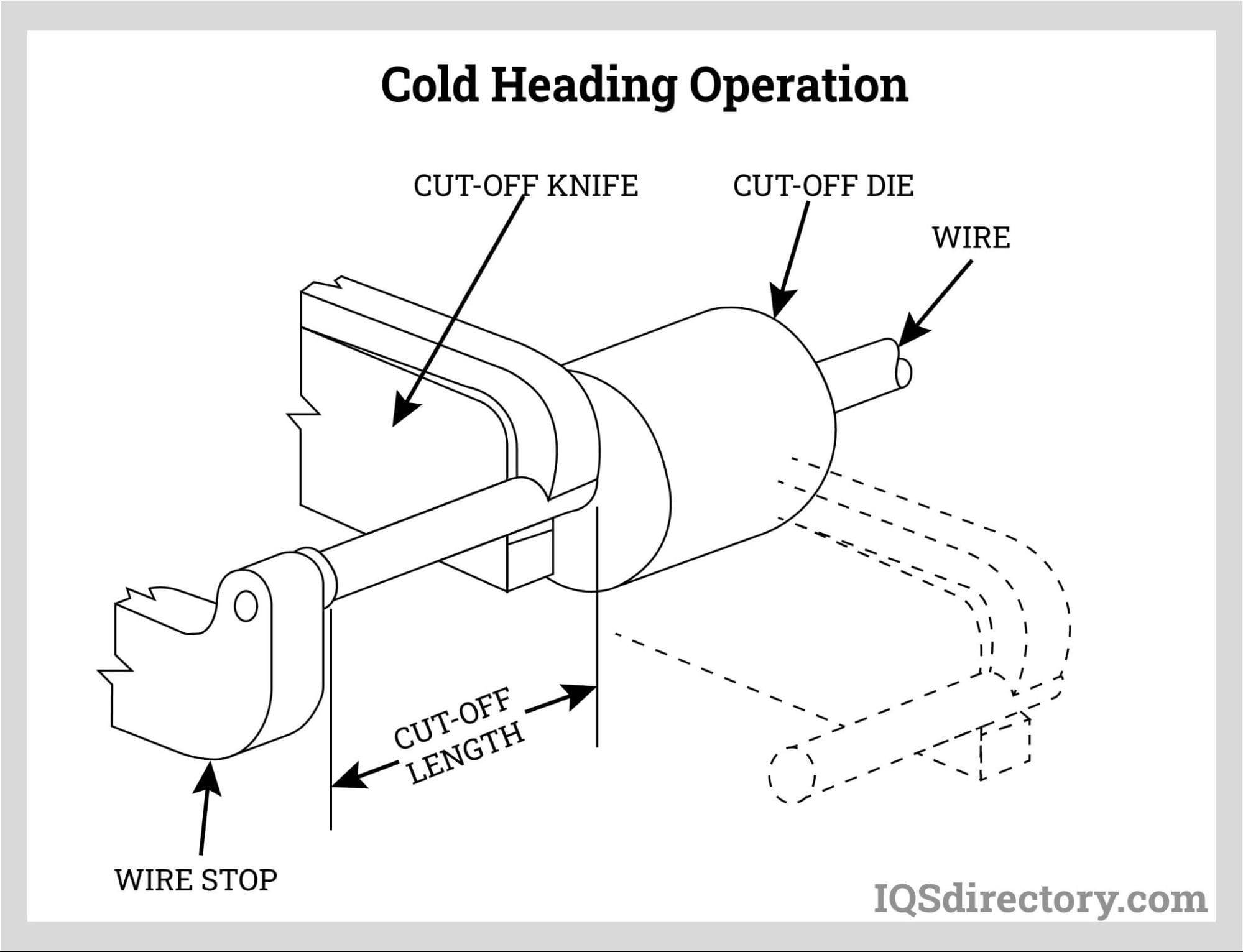
 Cold headers have a specific method to cut and measure a piece of the wire coil.
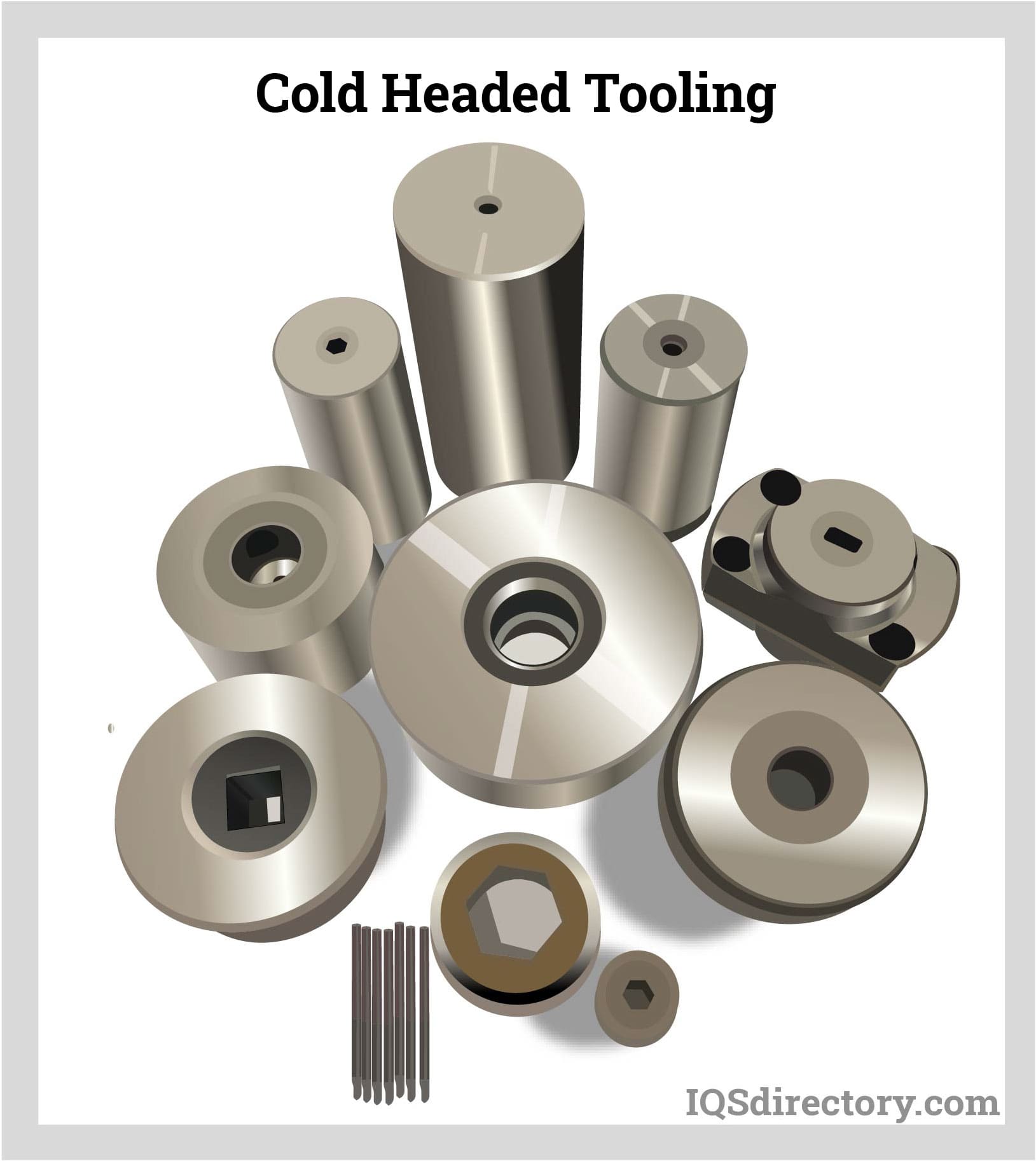
 The process using high-speed automated part formers or cold headers which is capable of transforming simple wire into an intricately designed parts.
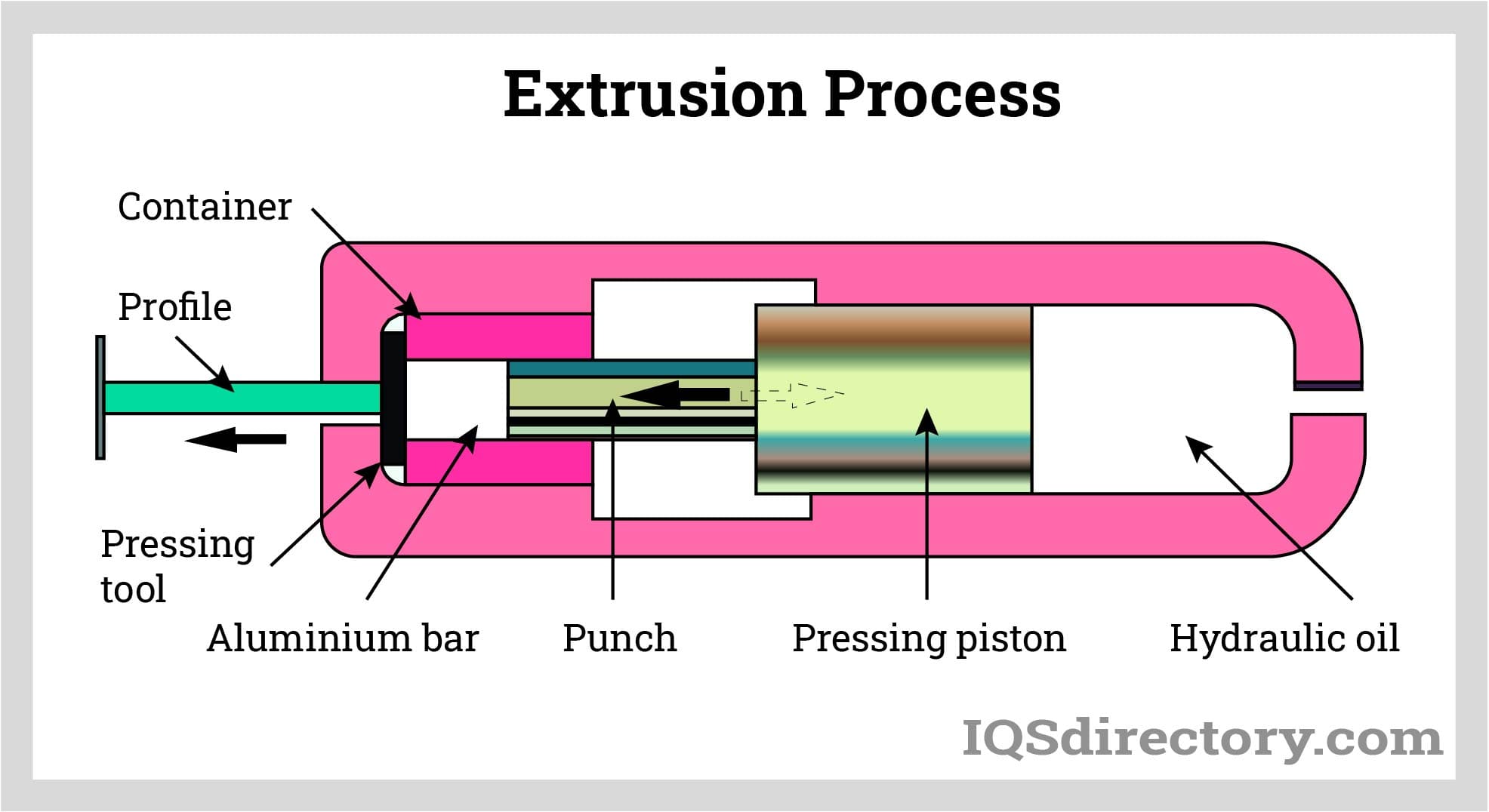 Cold heading extrusion, the process of increasing the length while decreasing the diameter.
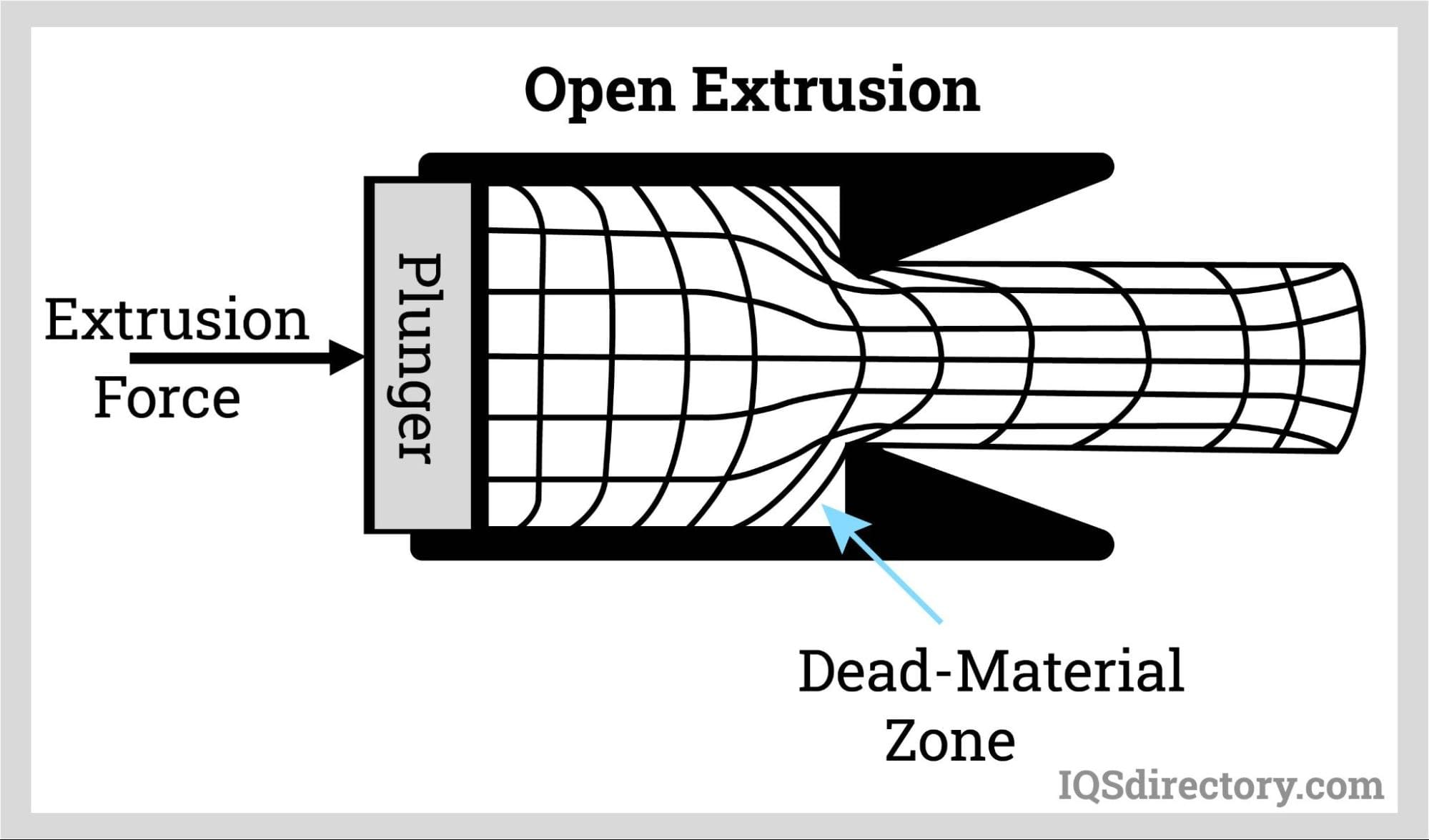 Open extrusion allows the extruding part of the tool to be located close to the top side of the die.
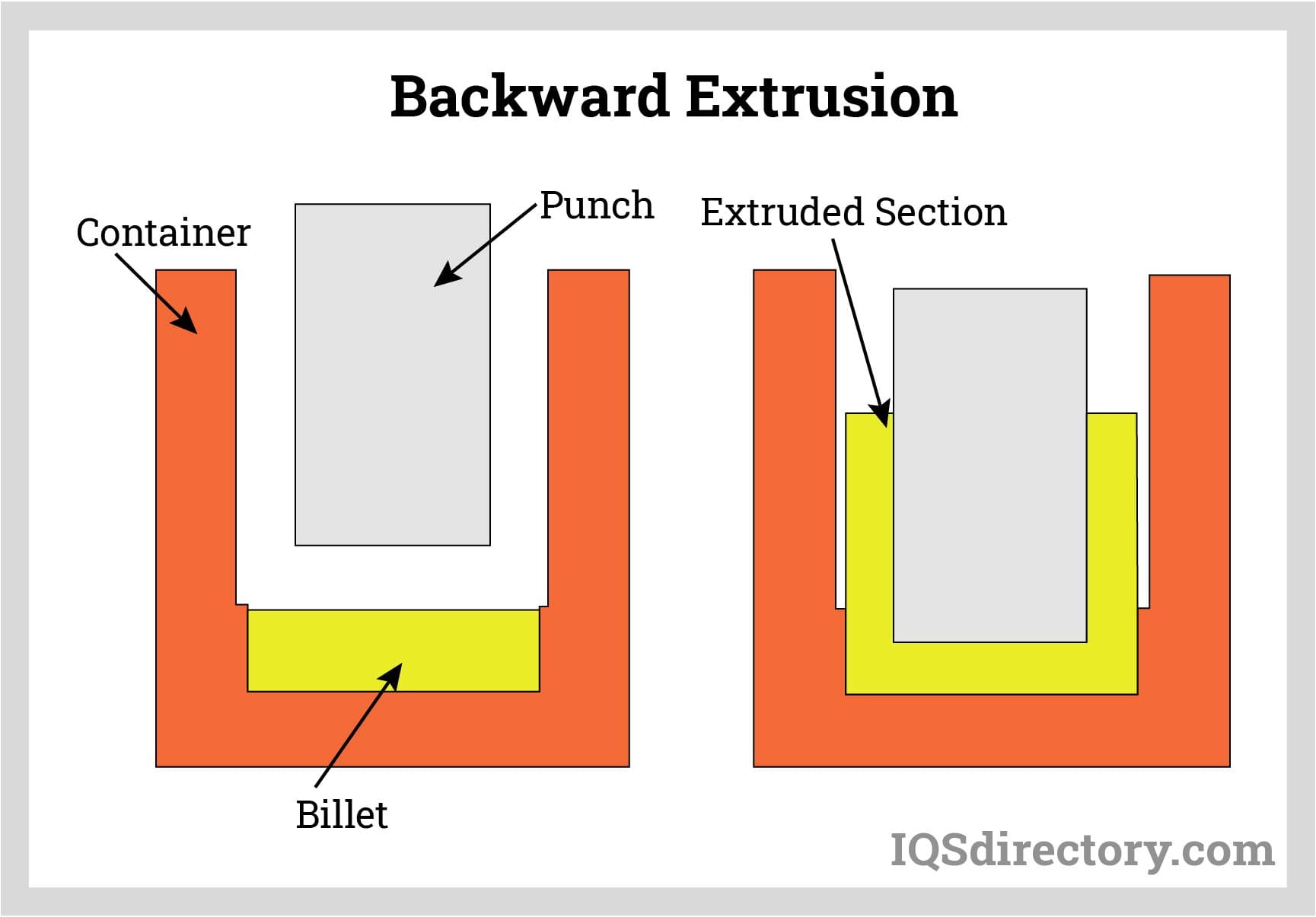 Backward extrusion a pin is driven into the part contained inside the die thus making hollow parts.
Types of Cold Headed Parts
- Cold Extrusion
- A popular cold working process in which materials are forced through dies or around punches to produce variable lengths of cross-sectional and profile shapes.
- Cold Formed Steel
- Any steel components fabricated by the cold forming process.
- Cold Headed Bolts
- Some of the most common parts that are made using cold headed metal forming processes. These, along with screws and pins, make up the bulk of cold headed fasteners.
- Cold Headed Pins
- Made by manufacturers of cold headed parts. These pins have a head that is formed and shaped using the punch and die process. You can find companies who manufacture these pins on IQS Directory.
- Cold Headed Rivets
- Hold together materials by spreading the tip via hammering and protruding through the material.
- Cold Headed Screws
- Can be made using a wide range of metal alloys. The use of a screw driver or allen wrench is necessary for securing this type of threaded fastener.
- Cold Heading Wire
- Created through either hot or cold processes as needed to best suit the creation of cold headed parts for which it serves as the body. This wire must be suited to cold processing as well as the final use for the finished part.
- Impact Extrusion
- A cold forming process that produces collapsible tubes out of soft metals through impact with a punch, or ram.
- Orbital Forming
- A popular alternative to cold heading that offers not only fastener production possibilities, but also expands the capabilities of tool fastening.
- Stainless Steel Pins
- Cylindrical fasteners made from a particular variety of steel alloy commonly used for its high tensile strength, durability and resistance to both heat and wear even in harsh or corrosive environments.
- Steel Pins
- Fasteners made from steel wire that is sharpened at one end and headed at the other.
Processes of Cold Working
Cold working operations can be divided into four main categories: squeezing, bending, drawing, and shearing. Some of the more common cold working operations include: cold rolling, cold forging, extrusion, sizing, swaging, cold roll forming, and drawing.
Squeezing Methods
As the name suggests, apply cold working through various methods of compression (via rollers, hammers, presses, etc.). Methods and machinery used for cold squeezing often closely parallel those used in hot-working processes.
- Cold Rolling
- An extremely common method of cold working. It involves passing metal through a pair of rollers in order to reduce the metal to a sheet of uniform thickness.
- Extrusion
- Another popular method of cold working in which material is pushed through a die opening possessing a smaller diameter than the material itself. Since this method depends on extreme pressure, it works best on softer material (such as aluminum and tin) as opposed to harder ones (such as iron and steel). In essence, extrusion is the opposite of drawing (in which material is pulled rather than pushed). You can find manufacturers who are able to do this process here.
- Cold Forging
- Refers to processes that shape metal by compressing it in a cavity resembling the desired shape. Cold heading (creating enlarged sections on the end of a piece) and upsetting (creating enlarged sections elsewhere on a piece) fall within this group of processes. In one sense, cold forging represents the opposite of extrusion since it increases the diameter of a piece. In another sense, cold forging can be considered as a larger family of extrusion-like processes since they involve compressing material within a cavity. Extrusion methods are often used as part of larger cold forging operations.
- Sizing Methods
- Most closely reflect the “squeezing” category. They involve compressing material until it assumes a certain thickness. In comparison, swaging processes reduce the diameter of tubular metal by hammering.
Bending Methods
Involve deforming material around a type of axis. These methods change the shape of worked material without changing its volume.
- Cold Roll Forming Machines
- Like cold headers, are present in most cold working shops and perform a common variation of bending. A roll forming machine consists of a series of rolls, commonly made of steel or roller dies. These series of rolls are used to shape smooth surfaced strips and sheets of precise thickness into specified cross dimensional shapes by continuously passing metal between them.
Drawing Methods
Comprise yet even more popular types of cold working. These methods involve filing or hammering a rod to a point before placing it into a small hole or die. A grip is secured to this point in order to pull the metal through the die. This method effectively stretches the rod while simultaneously shrinking its diameter. Drawing methods change both the shape and the volume of worked material.
Shearing Methods
Initially, shearing methods may appear to be unrelated to general cold working since they involve the mechanical cutting of material. However, shearing is classified as a form of cold working since it involves cutting without removing excess material (like screw or many types of machining) or using excessive heat (like hot working). For example, die cutting machines cut material into a specific shape while water jet machines cut material using highly pressurized water; their usage qualifies as a form of cold working since it has the same type of effect on metal as other cold working methods (e.g. lack of surface hardening or warping, precise dimensional accuracy, etc.).
To accommodate the diverse needs of industries, many shops offer additional cold working operations such as piercing, trimming, thread rolling and pointing in addition to the aforementioned processes. If a certain feature cannot be created directly by cold working, it is often possible to append that feature in a secondary operation. Thus, cold heading service providers may also offer services such as knurling, drilling, patching, tapping, shaving, milling, and broaching as needed.
Cold Working Equipment
Cold working equipment and processes are as variable as the many different operations they provide. As in most fields, however, fundamental tools and methods do exist.
Dies are a common tool used in virtually every type of cold machining. These machines serve to confine and direct the material in order to create the desired shape and dimensions. Typically, they consist of materials such as tool steel or tungsten carbide. Dies often work together with punches, which are typically used to transfer the required force from the machine to the part being created. This force must exceed the metal’s elastic limit in order for the metal to undergo plastic deformation and permanently take on the shape of the punch and die mechanism. Typically, a metal blank is fed into a die, where a punch is then able to strike it with enough force to cause the desired plastic deformation.
Two variations of die usage are the single die and multi die methods. Material can be left in a single die and punched multiple times; alternatively, it can be transferred among multiple dies while being punched. These variations are reflected by the use of the cold header, one of the most common pieces of equipment found in a cold working shop. While a single die, two blow header is sufficient for some standard cold heading processes, the production of more complex or custom products requires shops to have a multi-die, multi blow header. Multiple dies are used to reduce size by progressively working the metal down. They also allow a number of shape options (such as eccentric, offset, square or elliptic) as well as the production of collars, necks, lugs, flats or fins on any point along the length of the stock shape or blank.
Things to Consider When Purchasing Cold Headed Parts
Since the field of cold working is so variable, it is important to follow this standard piece of consumer advice: look for a supplier that is both willing and able to meet your specific needs. Some more factors to consider when investigating cold headed parts suppliers follow below:
- Material Capabilities
- The specific properties of cold-worked material play a significant factor in the overall cold working process. Consider how much a manufacturer invests in specialized or customized alloys or materials to meet consumer needs.
- Tooling Capabilities
- Discuss with your supplier the range and use of their machine capabilities. In some cases, multi-die equipment (such as a six station machine) may result in higher production rates while single die operations may improve product consistency.
- Economic Efficiency
- Consider a supplier’s track record of reducing customer costs with cold-headed parts. Cost reductions due to cold working can range as high as 70%. Investigate specific data that supports any claims of cost savings and reductions.
- Specialty or Secondary Operations
- A manufacturer or supplier may offer a specialized type of cold working process most appropriate for your situation. For example, specialty cold heading focuses on producing low volume parts from high cost materials, such as bronze. Additionally, a desired product may require some type of secondary finishing (e.g. threading the stem of a T-bolt formed by cold forging/upsetting). If this is the case, consider a supplier’s offerings in secondary processes.
Cold Headed Parts Terms
- Anti-Seize Compound
- A compound used on the thread of fasteners to prevent the galling of mating surfaces and improve corrosion resistance so the parts can be disassembled later.
- Bearing Stress
- The stress that is applied by a fastener to a joint face.
- Chatter
- Surfaces that are rough or otherwise unsatisfactory, caused by a slight jumping of the tool away from the work or the other way around.
- Clamping Force
- The force that is exerted on the joint by the fastener.
- Clench
- A fastener’s ability to hold together previously separated materials.
- Cold Work
- The process of deforming metal at room temperature by hammering, drawing or forming.
- Concentricity
- The condition in which two fastener surfaces share the same center.
- Creep
- The permanent deformation of a fastener resulting from the application of stress and heat.
- Die Impression
- The portion of the die surface that shapes the forging.
- Eccentricity
- The degree of difference between the centers of a fastener’s surface at different points.
- Extrusion
- The process of forcing metal to flow through a die orifice in the same direction in which energy is being applied (forward extrusion) or in the reverse direction (backward extrusion), in which case the metal usually follows the contour of the punch or moving forming tool.
- Fatigue Strength
- A fastener’s fracture resistance ability during subjection to variations of stress.
- Heading
- The manipulation of wire, rod or bar stock in dies to form parts that generally contain portions that are greater in cross-sectional area than the original wire, rod or bar. Basically, heading is the creation of a head on a metal part via cold form molding.
- Impression
- A cavity, or series of cavities (multiple), machined into a forging die to produce a desired configuration in the workpiece during forging.
- Insert
- A piece of steel that is tightly fixed in a die. The insert may be used to fill a cavity, to replace a portion of the die with a grade of steel that is better suited for service or to function as a small die with the impression fastened to a master die.
- Joint
- The material(s) that the fastener connects together.
- Lead Thread
- A measurement indicating the length between the beginning of a thread and the point at which the thread reaches its fullest size.
- Overtapping
- The process of tapping a thread after plating so that its tolerances will comply within specification and allow the internal and external threads to assemble.
- Pitch
- The distance between two threads.
- Preload
- The immediate tension of a fastener after tightening, which will reduce over time.
- Ram
- The main reciprocating member of a press, guided in the press frame, to which the punch or upper die is fastened.
- Shank
- The part of the fastener body between the head and the threaded portion.