AGVs
Advancements in automation have revolutionized the design and utility of automatic guided vehicles (AGVs), expanding their applications across various industries. These innovations have transformed how companies manage production, improve safety, and enhance operational efficiency.
Frequently Asked Questions About AGVs
What are the main benefits of using AGVs in manufacturing?
AGVs reduce labor costs, improve workplace safety, and enhance productivity by performing repetitive tasks without fatigue. They eliminate risks of human error, streamline workflows, and offer precise handling of materials in industrial facilities.
Which industries commonly use AGVs today?
AGVs are used across industries such as food and beverage, aerospace, metal, paper, and e-commerce. They handle tasks ranging from towing airplane engines to performing delicate assembly or order fulfillment with robotic precision.
What are the most common types of AGVs?
The most common AGV types include towing vehicles for heavy loads, fork-equipped AGVs for stacking, and heavy-load carriers that can move over 250,000 pounds. Unit load AGVs and smaller models serve specialized or cleanroom applications.
How have AGVs evolved since they were first developed?
Since the first wire-guided machine in 1954, AGVs now use laser guidance, magnetic tape, and advanced sensors. Modern versions integrate robotic arms, enabling complex functions such as assembly, packaging, and logistics tasks with greater autonomy.
What safety features are built into AGVs?
AGVs include lasers, obstacle sensors, safety bumpers, and visual indicators to prevent collisions. Zone and accumulative blocking systems ensure controlled traffic flow, while alarms and lights alert workers to vehicle movements in busy facilities.
What factors should companies consider before adopting AGVs?
Businesses should evaluate operational needs, budget, and infrastructure compatibility. While upfront costs can be high, advances in vision technology are reducing expenses. With proper planning, AGVs deliver strong long-term efficiency and ROI for factories and warehouses.
The Benefits of Going Automated
When companies need to scale production to meet growing demand, they often face challenges such as hiring and training additional personnel. Training consumes time and resources, diverting focus from core operations. In contrast, AGVs require no learning curve—they are immediately operational upon deployment. Once programmed for specific tasks, they seamlessly integrate into workflows, delivering savings through reduced manpower, time efficiency, and risk mitigation.
AGVs require only programming and route calibration to adapt to a facility’s needs. This eliminates the risks of human error, which can lead to accidents or compromised products. Automation reduces dependence on manual labor and the costs associated with employee injuries or product recalls. These vehicles excel in roles such as loading, palletizing, towing, and lifting, offering unparalleled precision and reliability. Unlike humans, AGVs perform consistently without fatigue, enhancing workplace safety and productivity.
Automation in Manufacturing
The integration of AGVs addresses human limitations by handling tasks that were once unachievable. Industries ranging from food and beverage to aerospace rely on these vehicles for their precision and adaptability. For instance, AGVs tow multi-ton airplane engines or perform delicate tasks requiring robotic dexterity, such as tooling changes. Their ability to operate autonomously reduces risks and maximizes efficiency, making them indispensable in diverse sectors.
The 3 Most Common Types of AGVs
The most common AGV types include towing vehicles for moving heavy loads, fork-equipped vehicles for lifting and stacking, and heavy-load carriers capable of handling over 250,000 pounds. Unit load AGVs transport pallets and totes, while smaller models serve in offices or clean environments, automating tasks like mail delivery.
Each type of AGV is engineered for specific functions, from lightweight maneuverability to heavy-duty transport. They save time and reduce labor costs while performing tasks beyond human capacity. For example, towing AGVs mitigate hazards associated with moving heavy equipment, while fork AGVs replace the need for skilled lift operators. Heavy-load carriers dominate industries like metal and paper, where materials such as coils and ingots require robust handling.
The Evolution of Driverless Vehicles
The journey of AGVs began in 1954 when Arthur “Mac” Barrett unveiled the Guide-o-Matic, a wire-guided towing machine. Today, AGVs utilize laser guidance, magnetic tape, and advanced sensors, enabling precise navigation and collision avoidance. Modern innovations include robotic arms for intricate tasks like assembly and order fulfillment, further expanding their utility in manufacturing and e-commerce.
Common AGV Components
AGVs are equipped with traction motors, lithium-ion batteries, onboard computers, and payload interfaces such as forks or conveyors. These components enable seamless integration with central control systems and other AGVs in the network. Advanced safety features, including lasers, contact bumpers, and navigation systems, ensure smooth operations in dynamic environments, preventing accidents and optimizing productivity.
Considerations for AGV Adoption
Choosing the right AGV involves assessing specific operational needs, budget constraints, and infrastructure compatibility. While high costs remain a barrier, advancements in passive machine vision and other technologies are driving the development of more economical and versatile models. As automation continues to evolve, AGVs are becoming indispensable assets, delivering unmatched returns on investment.
AGV Images, Diagrams and Visual Concepts
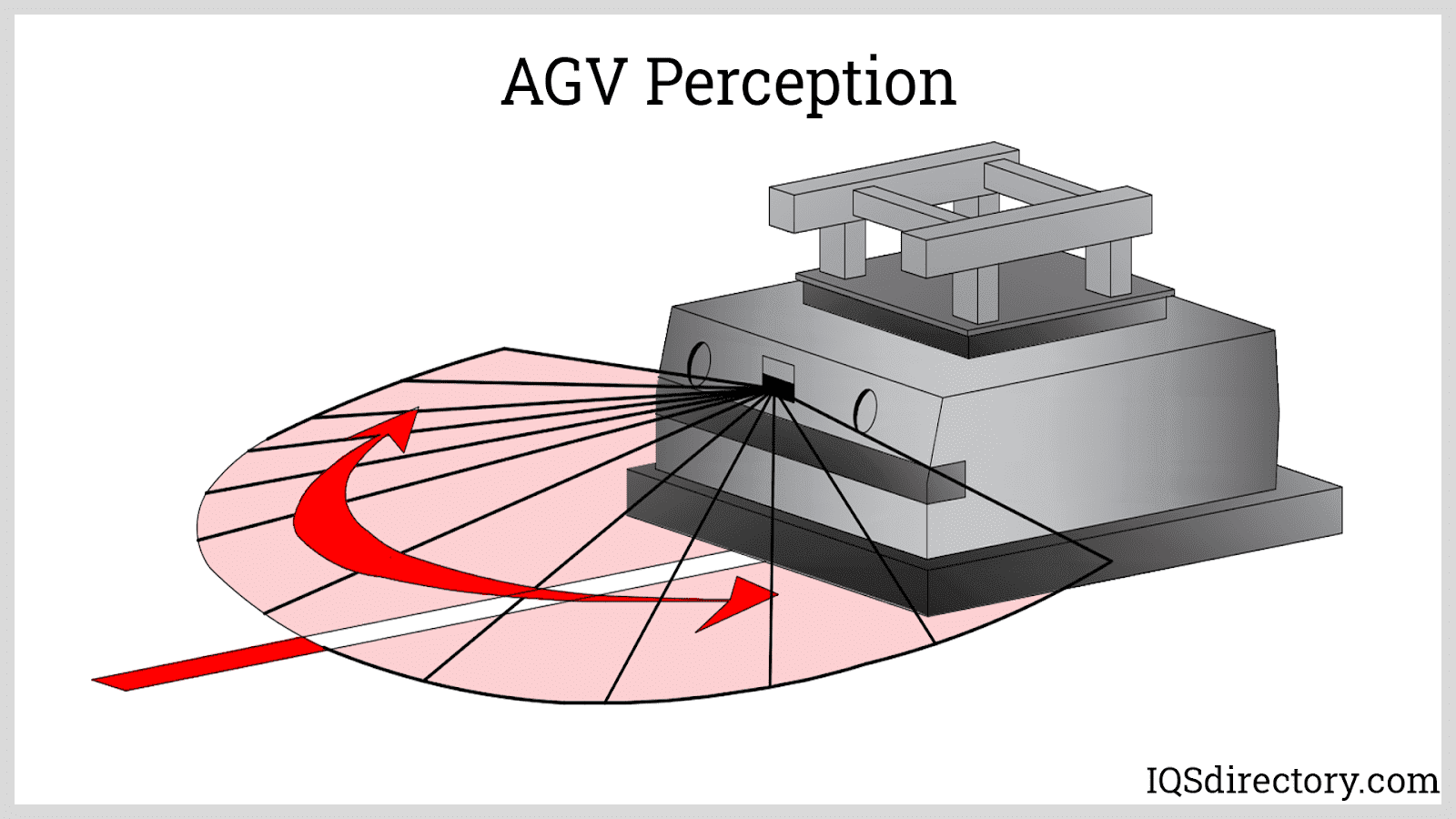
The perception of mobile robots, similar to robotic arms, is achieved using sensors.
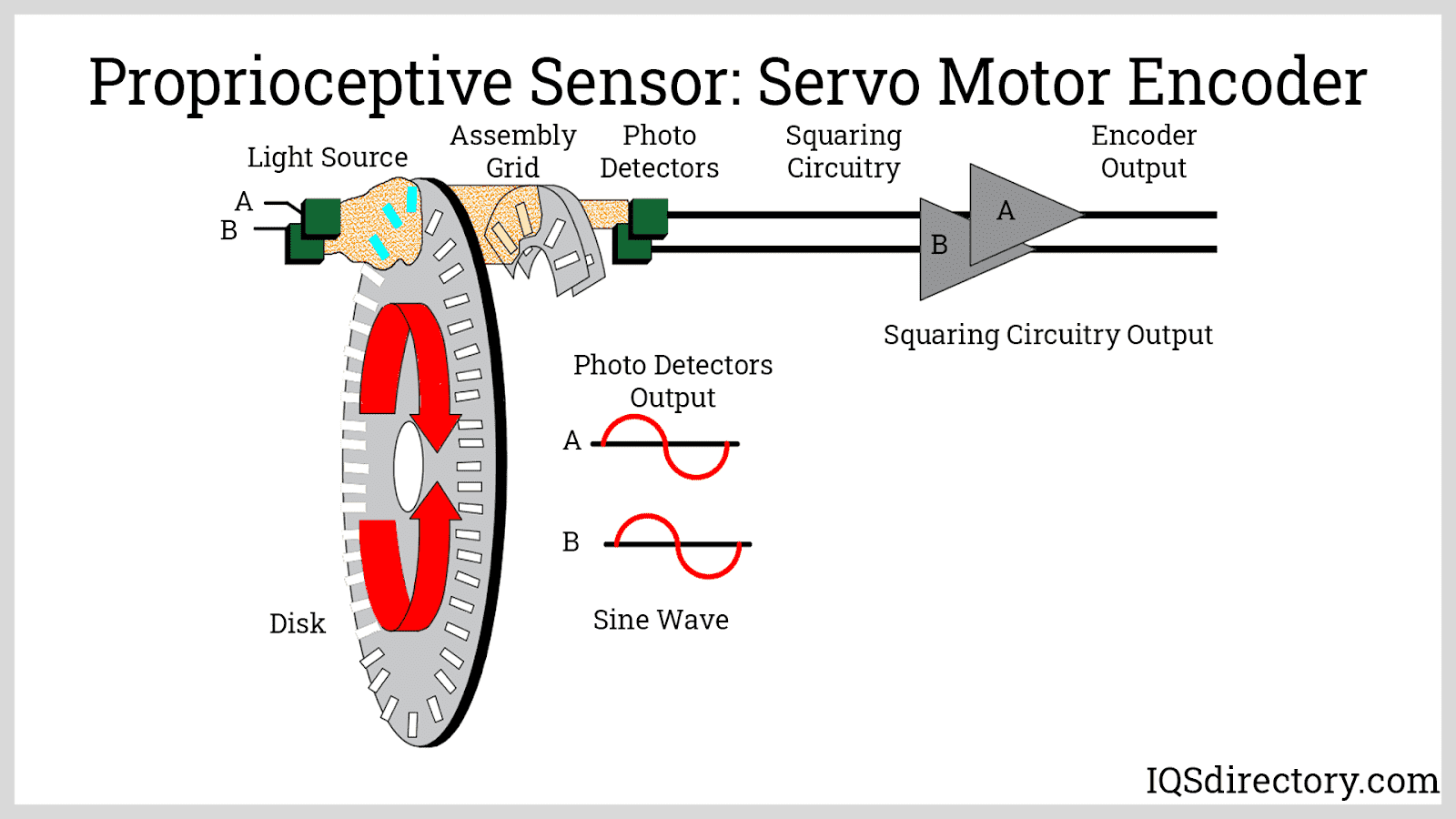
Proprioceptive sensors measure internal parameters such as motor speed, load, temperature, system voltage, and current

A combination of acceleration and heading sensors are commonly referred to as the Inertial Measurement Unit (IMU)




AGV Terms and Definitions
Acoustical Operating Indicator
A system that controls sound and volume to alert the surrounding area when the AGV is in motion, enhancing safety and awareness.
Accumulative Blocking
A traffic control feature where the AGV uses detection sensors to slow down or stop when necessary. Once a safe gap is established between vehicles, the AGV resumes motion. This system ensures smooth operation and prevents collisions.
Antenna
A component enabling wireless communication that provides the AGV with instructions and traffic control information.
Automated Guided Vehicle Systems
The integrated combination of computers, software, and technology that serve as the "brains" of an AGV. These systems allow AGVs to perform complex functions beyond basic operations.
Automatic Charge
A feature enabling the AGV’s battery to recharge automatically. A copper plate embedded in the floor interacts with the AGV's conductor to initiate charging. Once charged, the AGV resumes operation.
Automatic Guided Vehicle Display
An interface that provides critical information for operating the AGV system efficiently and maintaining productivity.
Automatic Guided Vehicle Operator’s Pendant
A joystick-equipped device designed for manual control of the AGV when needed.
Automated Material Handling
The automated process of relocating or stocking materials using devices like AGVs, enhancing efficiency and reducing reliance on manual labor.
Clamp
A specialized device installed on some AGVs, enabling them to grip cylindrical or circular objects such as barrels and position them as required.
Communication
The exchange of commands within the AGV system, including directions to move, stop, or adjust speed. Communication methods include infrared, radio signals, guide wire data, and inductive loops.
ID Tag
Floor markers that indicate specific points where the AGV must stop or change direction, ensuring accurate navigation.
Local Dispatching
A method of AGV dispatching controlled from a nearby source, suitable for simpler systems. Examples include onboard sensors, data couplers, and manual keys.
Multi-Directional Wheels
Wheels that enable the AGV to move not only forward and backward but also sideways and to spin, offering enhanced maneuverability.
Navigation
The process by which an AGV determines its position and travel path. Common navigation methods include laser, optical, wire, camera, and inertial systems.
Odometer
A device used to measure the distance traveled by the AGV, often incorporated to calculate position and monitor speed.
Obstacle Sensor
An ultrasonic sensor that detects obstructions, prompting the AGV to slow down or stop to avoid collisions.
Open Path
A flexible navigation system that allows the AGV to select from multiple pathways, ideal for crowded or space-constrained environments.
Power Transfer
The process where the AGV supplies power to pickup and delivery stations, eliminating the need for additional wiring.
Remote Dispatching
A communication system where a central controller sends instructions to AGVs. This can be accomplished using RF networks, infrared communication, or broadband connections.
Safety Bumper
A detection device designed to sense obstacles in front of or behind the AGV, enhancing operational safety.
System Monitoring
The comprehensive analysis of the AGV system, tracking metrics such as runtime, transaction queues, and service records to maintain efficiency.
Tug and Tow
A function enabling the AGV to pull or tow multiple items, such as wheeled products, making it especially useful in applications like moving shopping carts or trailers.
Vehicle Monitoring
The assessment of individual AGV components and their performance. Key metrics include runtime, battery status, and error logs.
Visual Operating Indicators
Flashing lights that signal the direction of the AGV’s travel during operation, increasing visibility and safety.
Zone Blocking
A safety method managed by the AGV system controller that restricts access to specific guide path sections, allowing only one AGV to operate in a given zone at a time.
More AGV Information