Vacuum Forming
Vacuum forming is a simplified form of thermoforming. A sheet of plastic is heated to a vacuum form temperature and shaped to a mold. It is then stretched onto the surface of the mold using a vacuum. The sheet of plastic is then allowed to cool down and ejected from the mold using the reverse pressure. This is used for transformation of plastics into different objects.
For easier removal of the formed plastic from the mold, draft angles are incorporated in the design of the mold. Mechanically or pneumatically stretching the formable sheets before applying the vacuum enables the depth of parts being formed to be adjusted accordingly. Conventionally, the suitable materials used in vacuum forming are thermoplastics.
Quick links to Vacuum Forming Information
History of the Vacuum Forming Process
In the 1860’s John Wesley Hyatt discovered the process of making celluloid, the first artificial plastic. Together with his brother, they patented this plastic and discovered that it could be heated in molds to form different shapes such as sheets and rods.
Centuries earlier however, the Romans would import tortoise shells which contain keratin from the Orient. They would use hot oil to shape this material into different food utensils. It can therefore be argued that it was the Romans who discovered thermoforming because they began heat forming.
In the 20th century, the heating of plastics and forming over a mold evolved to become the thermoforming as known today. Through the 1940s and 1950s, vacuum formed plastics were first conceived as display and marketing tools that were developed from vacuum casting and molding technologies. In 1950, a machine for making articles from thin sheets of plastic was patented.
In 1964, a machine for plastic sheet vacuum forming was perfected and patented. These vacuum forming machines and thermoplastics used an older concept whereby vacuums in different forms of casting and molding were used to remove excess air. By the 1970s, the technology was being advanced and perfected towards the methods we have currently.
The popularity of vacuum form can be explained by its advantages. Products formed through the vacuum forming process are precise to their design specification. The one heated sheet allows for exactness of the specified design, a desirable feature for products designed to fit with each other.
The plastic vacuum forming is cost effective because the materials used are inexpensive, low pressures are required and the tools are less intricate. Certain items can be produced with a single sheet of plastic reducing the quantity's cost. Recycling of already used plastic further contributes to cost saving.
The vacuum form process is versatile and flexible allowing creation of unique products and shapes. The quicker turnaround time is attractive for business because time can be invested somewhere else to perfect the operations and profits.
The process consists of placing a plastic sheet in its cold state into the forming clamp area. A heat element is used here to the desired temperature such that the plastic can be formed. A mold is raised from below to form different products with the hot plastic. Trapped air is removed by use of the vacuum system. Cooling follows with a reverse air supply being activated for the release of the plastic from the mold. This process comprises seven main steps: clamping, heating, sheet level, pre-stretch, vacuum, plug assist and cooling and release.
- Clamping
- It is essential that the frame used is sufficiently powerful in order to hold plastic sheets firmly during the process. The frame should be able to handle the thickest plastics that will be formed on the vacuum form machine.
- Heating
- Typically, the heaters used in this process are infrared elements placed in an aluminum plate. Regardless of the materials used, the best vacuum form results are obtained: the plastic sheet is heated uniformly throughout its thickness and the surface area. Quartz heaters are used in the more sophisticated processes. They have a lesser thermal mass, and thus enable a faster response time.
- The heating process utilizes pyrometers which provide accurate control of the heating temperatures. They sense the melting temperature of the materials being heated and interact with the control of the operating process. Pyrometers work together with a computerized system that provides precise temperature readouts.
- Sheet Level
- This is the third step in the vacuum form process although it is not found in all machines. It utilizes a photo-electric beam that scans between the bottom heater and the plastic sheet being heated. This is used to determine whether the plastic sags down to break the beam. If it does, a small volume of air is injected to lift the sheet and stop the sagging.
- Pre-Stretch (Bubble)
- It is the fourth step and also unavailable in some machines. Pre-stretching is carried out once the plastic reaches the vacuum form temperature (plastic state). This ensures that there is an even wall thickness once the vacuum is applied. The method used to control the bubble height should ensure consistent results are obtained.
- Vacuum
- The actual vacuum is applied at this step. After pre-stretching the materials, a vacuum is applied to aid in the formation of the sheet. The air trapped in between the mold and the plastic sheet is removed by a vacuum pump. The vacuum pumps used must maintain a differential pressure of about 27mm of mercury. With a larger thermoform machine, vacuum reservoirs are used together with large volume vacuum pumps. This process allows for a two stage application of vacuum, hence rapid molding the heated materials.
- Plug Assisted Vacuum Forming
- It is the step that follows the application of the vacuum especially when the straight vacuum forming does not distribute a plastic sheet evenly over the mold. It is not available in some machines. The plug pushes the plastic sheet into the mold before application of the vacuum to make it spread more evenly. This enables the materials to reach to the bottom of the mold preventing them from thinning out.
- Cooling and Release
- This is the last step in a vacuum form process. Upon forming, the plastic is allowed to cool before it is released. When the release is done too early, deformation of the mold occurs resulting in a rejected product. The cooling process is made more rapid by fitting and activating fans and mist sprays once the product is formed. The cooling temperatures are controlled to ensure a uniform cooling and release of the formed parts.
- Finally, trimming and finishing is carried out whereby excess materials are removed. Finishing also involves processes such as drilling of holes, cutouts and slots as well as decoration, printing, strengthening and assembly.
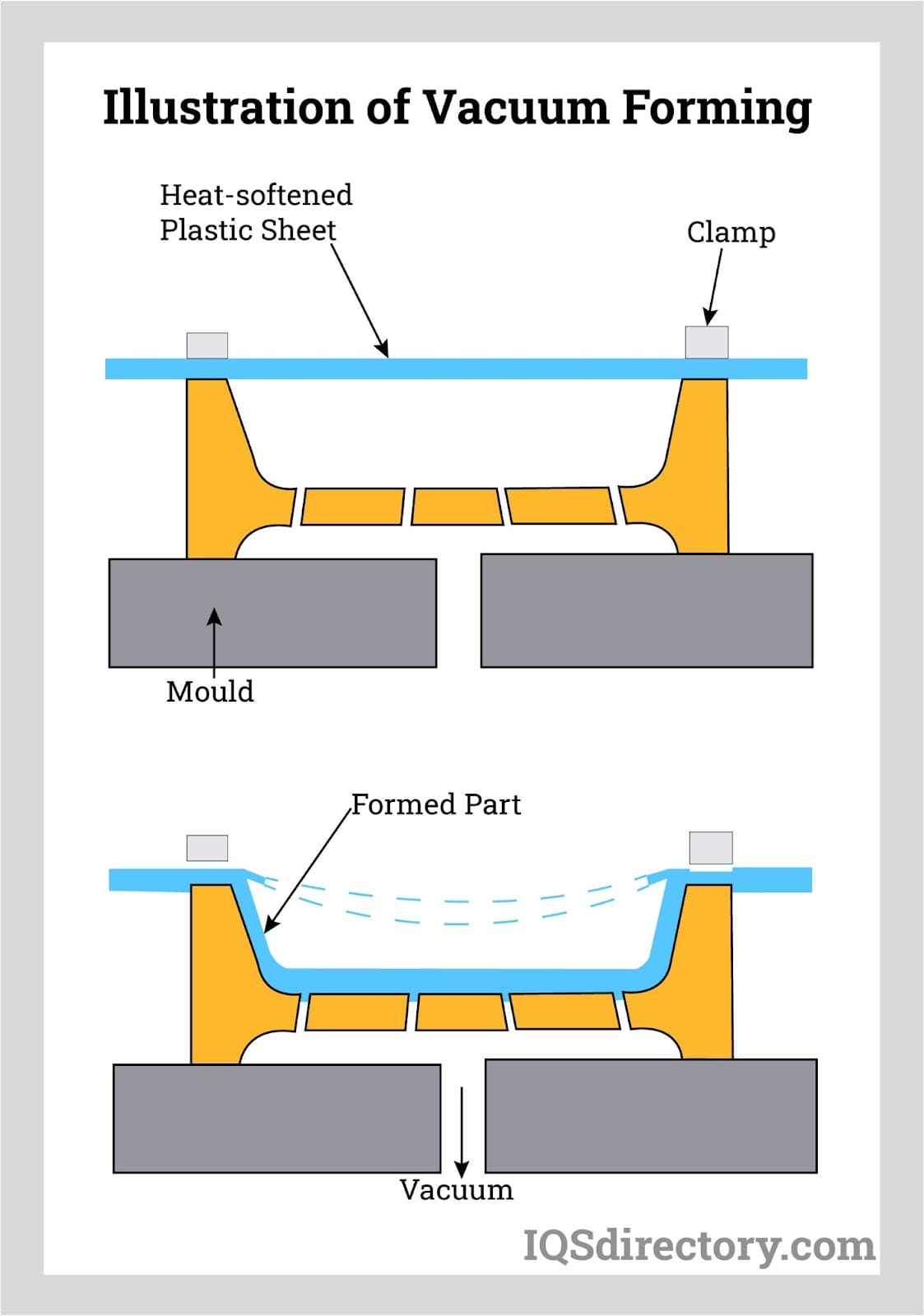 Vacuum forming uses heat to contort plastic or other material to the shape of the mold.
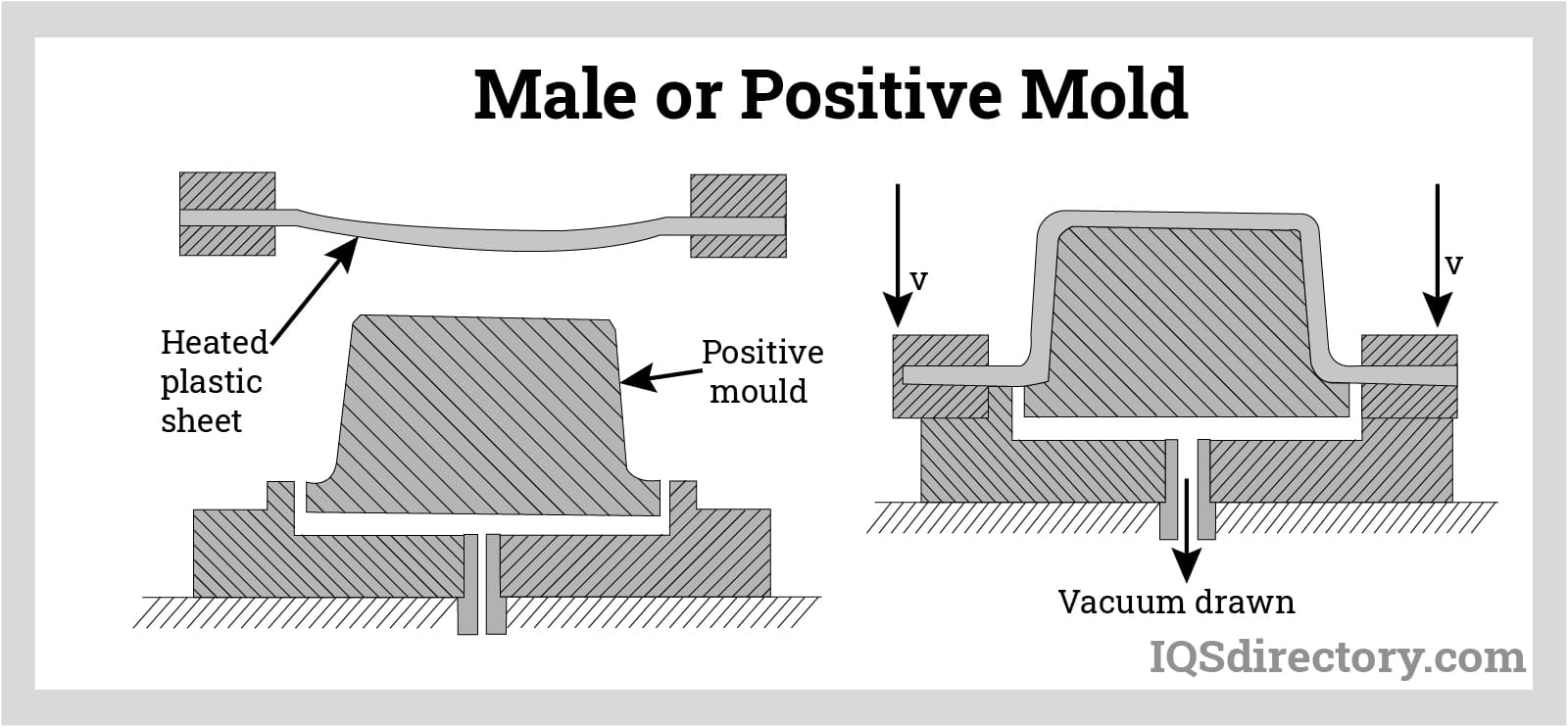 Male mold shapes the plastic on the outside layer of the mold, which helps contour the plastics inner dimensions.
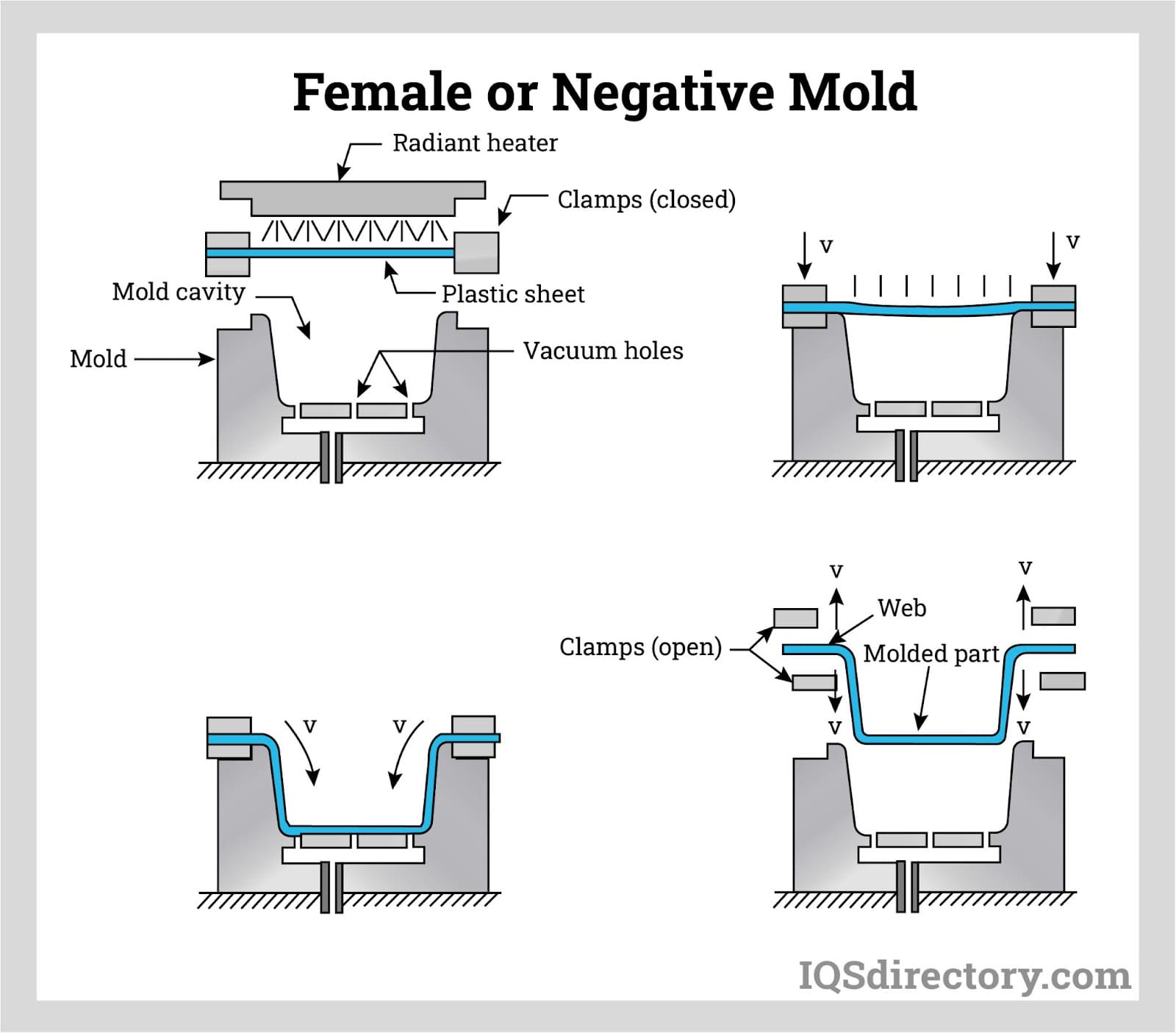 The female mold the plastic is placed inside the mold to contour the outside dimensions of the plastic.
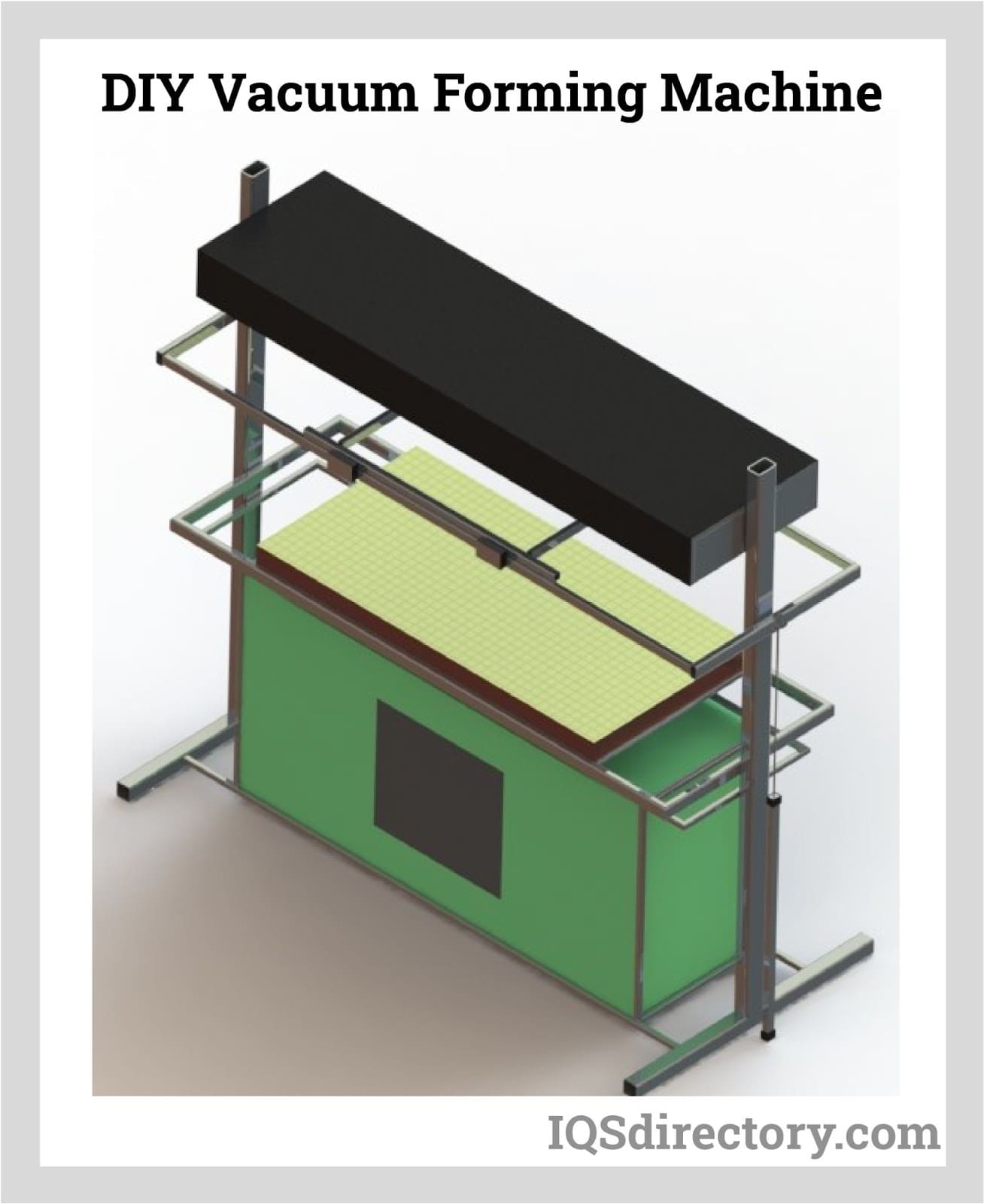 An example of a vacuum forming machine which this machine are mainly used for small-scale production.
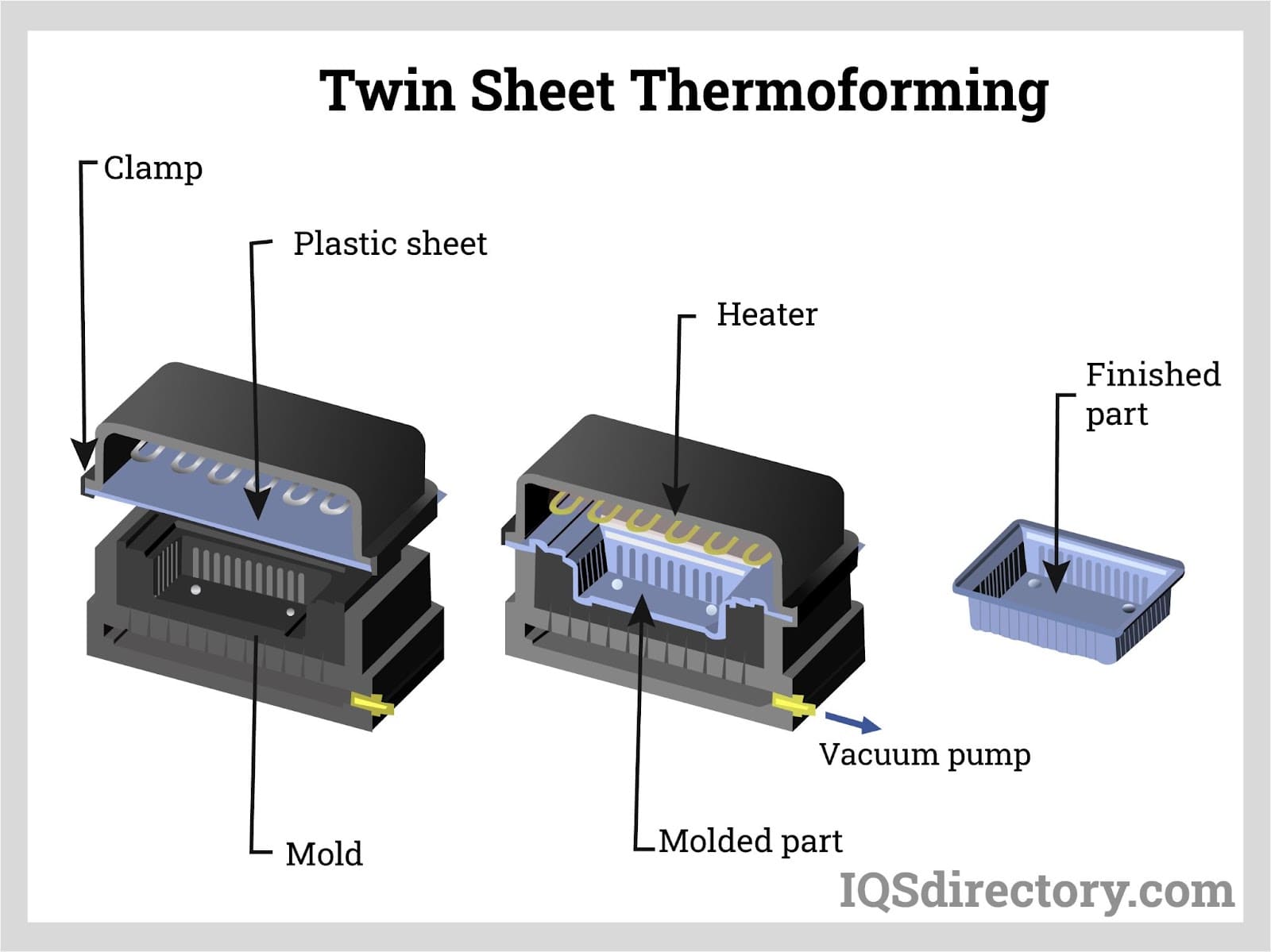 Twin sheet thermoforming process is done either by pressure forming or vacuum forming but with two molds.
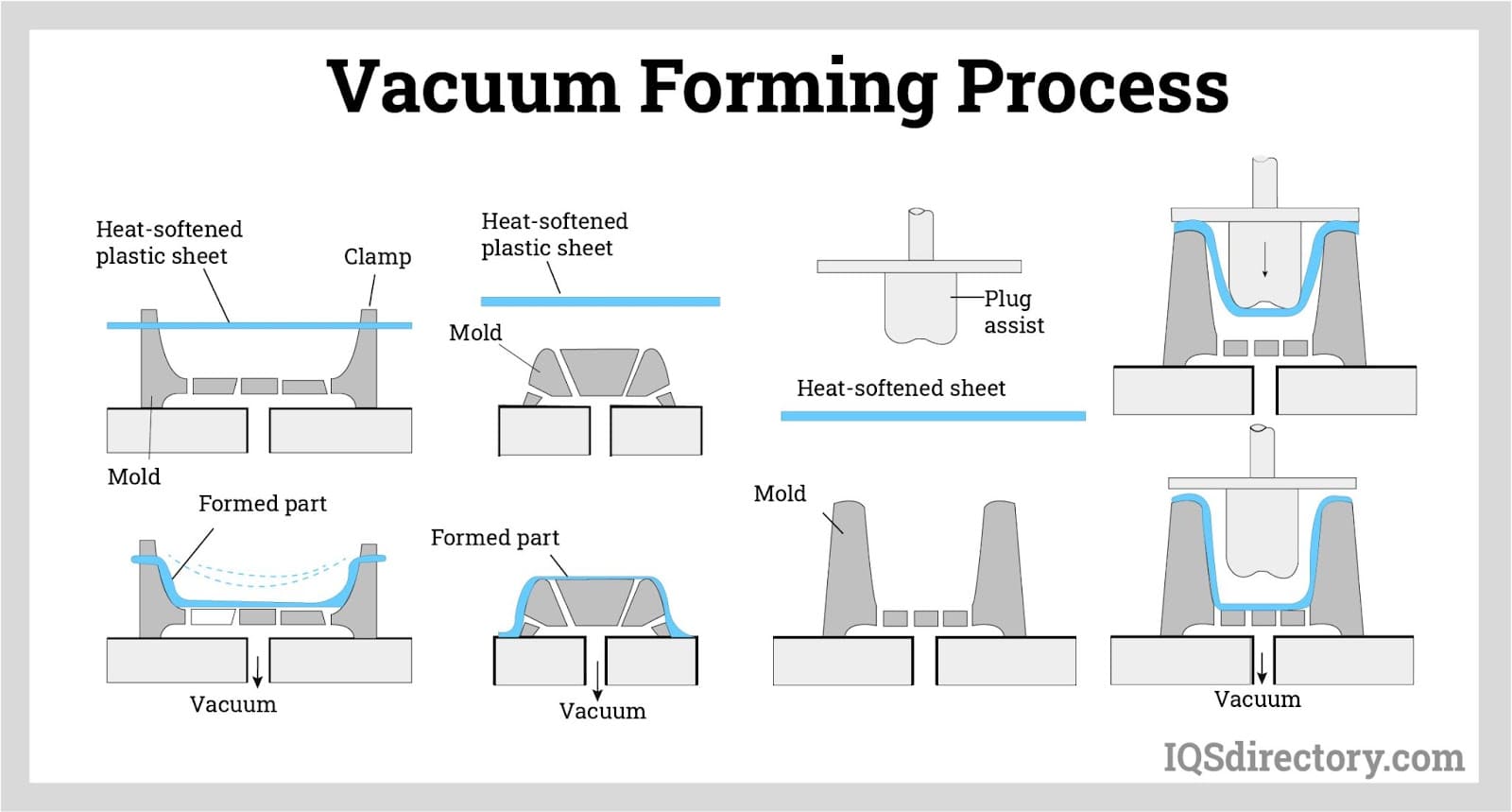 Vacuum forming process involves clamping the material, heating the material, stretching with a plug assist, and removing the extra air between the sheet and the mold.
- Blister Packs
- Clear plastic, non resealable packaging used for products that could be tampered with.
- Clamshells
- Plastic packages that have hinges to open and close like a clam’s shell.
- Drape Vacuum Forming
- Like snapback forming except that the thermoplastic sheet is stretched to the base of the mold. In both cases, the use of air to stretch the material prior to vacuum sealing and application to the mold permits the material to thin uniformly.
- Plastic Covers
- Vacuum formed plastics designed to secure, contain and protect objects from environmental conditions such as weather, lighting, dust, water or other debris.
- Plastic Forming
- A group of manufacturing procedures that take thermoplastics and form them through molding processes into a wide variety of plastic products for numerous industrial, commercial and domestic applications.
- Plastic Packaging
- Encompasses all storage or containment devices produced through the manipulation of any number of polymer resins.
- Plastic Trays
- Shallow platforms with raised edges intended to stop contents from sliding or rolling off of the surface.
- Plug Forming
- A thermoforming procedure that uses a plug or male mold to press the heated thermoplastic material into the female mold prior to the application of a vacuum. This method helps uniformly distribute the sheet.
- Pressure Forming
- A thermoforming procedure that involves applying pressure to the top of the plastic sheeting while the vacuum force pulls downward. Pressure forming is done through air pressure or mechanical means, and provides greater precision because the plastic is able to attain a greater definition of shape in the mold.
- Snapback Vacuum Forming
- The process of pre-stretching the sheet material with a vacuum box. A partial vacuum is then applied to the box, just enough for the necessary stretching, and the mold is pushed into the material where the box is vented to atmospheric pressure that draws on a vacuum.
- Straight Vacuum Forming
- Vacuum thermoforming using only female molds that produce a material distribution that is the opposite of the results obtained from male molds.
- Thermoforming
- Involves heating and stretching plastics.
- Twin Sheet Thermoforming
- A plastic processing technique involving vacuum forming two separate plastic sheets simultaneously before welding them together to create a hollow part or product.
- Vacuum Formed Plastics
- Created by a thermoforming process that uses a vacuum to suck the plastic sheet into a mold.
- Vacuum Molding
- A type of manufacturing method that takes thermoplastics and forms them through a molding process into a wide variety of plastic products.
- Vacuum Packaging
- Can refer to both those items held or displayed in reduced oxygen containers and any and all packaging materials produced through vacuum forming.
A wide range of materials are used in the process of vacuum forming. The desirable properties of a thermoplastic material for this process include low forming temperatures, good flow, thermal strength, low shrinkage upon cooling and high impact strength.
The most common materials used for a vacuum form include polyester (PET), polyvinyl chloride (PVC), high density polyethylene (HDPE), low density polyethylene (LDPE), polypropylene (PP), polystyrene (PS), polycarbonate, acrylonitrile butadiene styrene (ABS), acrylics, and Kydex, a PVC-based thermoplastic.
With polyester, a vacuum form is easily attained at low temperatures. It is characterized by fast cycles and excellent fabricating performance. Its major use is in the production of packaging materials such as food containers, beverage containers and packages for processed meat. With PVC, food wrappers, blister packaging and vegetable oil bottles are produced. PVC is strong, tough and has good transparency and chemical resistance.
Although high density polyethylene (HDPE) can be difficult to form, it has a significant application in the production of milk bottles, cereal box liners, plastic bags and margarine tubes. Just like HDPE, low density polyethylene (LDPE) forms poorly as well. Once formed, it is suitable for production of garment bags, squeezable food bottles, plastic bags and shrink wraps.
Polystyrene is one of the most commonly used thermoplastics in a vacuum form. It forms easily at significantly low temperatures hence fast cycle times and no pre-drying requirement. High impact polystyrene is tough and inexpensive. However, it has a poor UV resistance hence not suitable for outdoor use. Its major application is in production of fast food trays, disposable plastic silverware, egg cartons and compact disc jackets.
Acrylonitrile butadiene styrene (ABS) is a hard, rigid, adequately weather resistant material with a satisfactory impact strength. It contains a bit of rubber contents which give it improved impact resistance. ABS is applied for luggage, vehicle parts, sanitary parts and electrical enclosures. The desirable features of acrylic are its hardness, high quality thermoplastic and good clarity. Some signs, baths, sanitary ware and roof lights are made using acrylic.
The main purpose of a vacuum form is the formation of different objects from plastics. Some permanent objects produced in this process are protective covers and turnpike signs. The process produces a large variety of products ranging from simple packaging elements to extreme impact aircraft cockpit covers.
The versatility of a vacuum former promotes its widespread application in different industries. Numerous thermoplastic materials can be transformed into different objects and shapes using the vacuum form process. Transparent materials such as acrylic are also appropriate for vacuum forming and are widely used in aerospace as passenger cabin windows. It is a low level technology that provides an easy way to mold.
A range of industries utilize the vacuum form to come up with different products as discussed here.
Aeronautical manufacturers apply a vacuum thermoform to produce interior trim panels, covers and cowlings. The interior sections of NASA space shuttles are made using a thermoform machine.
A wide range of products from agricultural suppliers are manufactured from plastic materials that undergo vacuum forming. A few examples include animal containers, agricultural machine parts, flower tubs, seed trays and clear growing domes among others.
With pharmaceutical manufacturers, a vacuum thermoform is applied when producing blister packs. The cavities on a blister pack are made from a sheet of plastic by using a heating element. The cavities are then covered using a seal of another plastic or aluminum foil to protect and deliver unit doses of capsules, tablets and lozenges.
Building and construction industries utilize a vacuum form in the manufacture of various parts such as PVC door panels, molds for concrete paving, molded ceiling features, drainpipes, roof lights and internal door liners. Fireplaces, porches as well as other parts utilize vacuum forming products.
The automotive and vehicular industries highly rely on vacuum forming for many vehicle parts including wheel hub covers, bumpers, mudguards, liners, seat backs, storage racks, ski-boxes, door interiors, windshields, protective panels, batteries and other electronic housings.
Hospitals and other medical applications depend on vacuum form for production of prosthesis, pressure masks, radiotherapy masks, parts of wheelchairs and dental castings are made from vacuum forming.
There are other industries that rely on vacuum forming to produce different elements including furniture, packaging materials, bathtubs, shower surrounds, souvenirs, point of sale displays, cosmetic cases and cutlery.
- Customization Through Design
- The vacuum plastic thermoforming process is similar in most machines. However, several customizations are made to meet particular requirements. For instance, the mold used to form the parts can be a male (protruding) or female (recessed). The parts and articles being formed determine the mold that will be used.
- A pressure form process is quite similar to the vacuum forming only that pressure thermoforming utilizes the vacuum environment together with an additional air pressure that increases tightness of the plastic sheet on the mold. This is used in the creation of very detailed vacuum formed plastics.
- Machinery and Customization
- A specific tooling and machinery is used in the process of vacuum forming. These are used for both the primary production of the parts and secondary customization before they are made ready for the customer. The tools and equipment used depend on the type of product, size, thickness and the quantity needed.
- Trimmers, scalpels and heated knives are used for finishing and trimming the product into the desired specifications. Other machines used for trimming include vertical and horizontal band-saws, roller-presses, guillotine, punch press and hand held power routers. CNC machining companies offer services that are precise in drilling of holes and creation of other customization features on injection molded plastics.
- Customization is done through embossing and engrossing of various marks and texts as specified by the customer.
Choosing the Right Manufacturer
There are many manufacturers in the vacuum forming plastic industry. Any good manufacturer can be found but it is essential for a customer to get the right manufacturer. The right manufacturer ensures that all needs of the client are met. When a custom plastic is needed, the right manufacturer will be able to deliver it.
- Black Points
- The dark particles that appear in plastic film during thermoforming processes because of contamination.
- Bleed
- The characteristic of some plastics of losing their colors when coming into contact with water or certain solvents. Also, this is the undesirable movement of materials to the surface of plastic or into an adjacent material.
- Blister
- Thermoformed semi-rigid plastic shells, typically made to conform to the shape of the product being packaged.
- Boss
- A protrusion on a plastic part that adds strength, assists with alignment in assembly and allows for fastenings.
- Burn Holes
- Portions of thermoformed plastic where vacuum and heat produce an opening in weak or thin points.
- Degradation
- A change in the structure of a plastic material.
- Denest
- The detachment of thermoformed parts, like blisters, from one another for the next phase of the packaging procedure.
- Destaticization
- The process of removing static electricity from plastic so that less dust clings to it.
- Die Cutting
- The use of a steel rule to cut finished sheets of blisters or blister cards to create individual pieces.
- Draft Angle
- The degree to which the sidewall of a blister or clamshell is tapered to smooth the progress of the removal from the thermoforming mold and denesting of the blister.
- Embossing
- A technique that creates depressions in a specific pattern on plastic film and sheeting.
- Environmental Stress Cracking
- The tendency of thermoformed plastic to crack under the influences of certain chemicals.
- Female Mold
- A concave mold, referred to as a negative or cavity mold.
- Fold-Over Blister Card
- A blister card that is scored and die cut, permitting entrapment of the blister between the two halves of the card. This supplies a seal between two boards or between a board and a blister flange, especially useful when blister packaging heavy items.
- Gas-Flush
- During vacuum packaging, the chamber is flushed with nitrogen, keeping the plastic from sucking down tightly to fragile products.
- Heat-Sealing
- The process of joining two or more plastics together with the application of heat and pressure.
- Male Mold
- A convex mold, referred to as a positive or protruded mold.
- Pock Marks
- The result of inadequate contact of the plastic material with the surface of the mold due to trapped air, moisture on the surface of the mold or low pressure in irregular indentations on the material’s surface.
- Prototype
- A model of an intended part. Prototypes show the final size as well as the design.
- Reprocessed Plastic
- Thermoplastic material derived from industrial plastic scrap from a different processor.
- Sag
- The flow of heated plastic sheeting in a thermoforming procedure in which molten plastic sheets sag before forming. The distance of the sag is determined by an electric eye and is good for determining the forming readiness of the material.
- Sandwich Heating
- A heating procedure before forming a thermoplastic sheet that involves heating both sides.
- Scrap
- Any plastic material, which is not part of the product, that results from a molding procedure. This material is typically tip scrap and can be reused.
- Sheet Train
- The construction required to create plastic sheeting, consisted of an extruder, die, polish rolls, conveyor, draw rolls, cutter and a stacker.
- Thermal Expansion
- The minute change in length or volume of a material when subjected to heat.
- Two Piece Blister
- A double blister for encapsulating a product for product visibility on two sides.
- Undercut
- An indentation or protrusion that hinders the removal from a mold.
- Unit Dose Packaging
- Medicine blister packaging in terms of single dosages for clarity purposes.
- Vacuum Form Table
- A machine that produces vacuum formed parts and products.