Machine Vision
Machine vision systems are advanced technological solutions that replicate human vision functions. In industrial environments, machine vision (MV) describes the computer-based visual inspection and control of automated manufacturing processes. Within systems engineering, machine vision is considered distinct from computer vision, which is typically categorized as a branch of computer science.
Machine Vision FAQ
What is a machine vision system?
A machine vision system uses cameras, lighting, and software to capture and analyze images for inspection and process control. These systems perform repetitive, accurate tasks in industrial automation that would be time-consuming or inconsistent for human operators.
How does machine vision work in manufacturing?
Machine vision in manufacturing uses digital cameras and pattern recognition software to inspect, measure, and identify products. It applies image processing techniques like edge detection, segmentation, and barcode reading to ensure consistent quality and process efficiency.
What are the main components of a machine vision system?
Every machine vision system includes lighting to illuminate objects, cameras or sensors to capture images, and image processing software that analyzes the visual data to guide inspection, measurement, or sorting operations.
What are common applications of machine vision?
Machine vision is used for automated inspection, quality control, robotic guidance, barcode reading, and process measurement. In industrial settings, it improves speed, accuracy, and repeatability on production lines across North America and beyond.
What are the benefits of using machine vision systems?
Machine vision systems minimize human error, detect surface flaws, measure components with precision, and ensure consistency in high-volume manufacturing. They also streamline data collection for real-time process optimization and quality assurance.
What types of cameras are used in machine vision?
Common camera types include line-scan and area-scan cameras, CCD cameras, and smart cameras. Line-scan models capture one row of pixels at a time, while area-scan cameras record complete images instantly. Smart cameras combine imaging with onboard processing.
How do machine vision standards improve system performance?
Industry standards like GigE Vision and EMVA ensure compatibility, reliable performance, and consistent data measurement across machine vision equipment. These standards allow easier integration between cameras, software, and control systems used in production environments.
The History of Machine Vision Systems
The evolution of machine vision systems dates back to the 1950s, when psychologist James J. Gibson introduced the concept of optical flow. Building on this, Gibson created two-dimensional imaging technology that leveraged statistical pattern recognition. In 1960, Larry Roberts at MIT completed a PhD thesis on extracting 3D geometric information from 2D images, which inspired global research and led to the development of 3D machine imaging.
During the 1970s, MIT further contributed by offering a machine vision course within its Artificial Intelligence Lab, focusing on practical vision tasks such as edge detection. In 1978, David Marr introduced a new approach to image analysis in computer vision, where operators started with a 2D sketch and applied computer technology to achieve a 3D interpretation.
By the 1980s, machine vision moved from academic research into industrial manufacturing. Vision systems were used to read numbers, letters, symbols, and barcodes. The decade also saw the introduction of the first smart cameras. In the 1990s, digital signal processing (DSP) enhanced smart cameras, making machine vision technology more diverse, affordable, and widely available.
Today, machine vision systems are used worldwide and the sector continues to grow rapidly. Analysts forecast that by 2022, the global machine vision market will reach $15.46 billion. Asia Pacific holds around 30% of the market, followed by Europe and North America.
Benefits of Machine Vision Systems
Machine vision systems provide numerous benefits for users. They reduce errors associated with human inspection and reliably detect defects or details that the human eye might miss. Machine vision systems sort products more efficiently than manual processes. Their versatility allows them to capture and interpret data in various ways. Additionally, these systems enable rapid and convenient quantification of image information, making it easy to transfer data for further computer analysis.
How Machine Vision Works
Machine vision operates using digital cameras and pattern recognition software. While machine vision technology has advanced significantly, computers still lack the flexibility of human vision, so machine vision systems are typically programmed for repetitive, consistent tasks.
These systems process images through methods such as thresholding, stitching, pixel counting, filtering, color analysis, segmentation, blob detection and extraction, edge detection, pattern recognition, barcode reading, neural network or deep learning, optical character recognition, and metrology or gauging. They may use multiple methods in sequence for thorough image processing.
- Thresholding
- A technique that applies a specific gray value to separate sections of an image. Thresholding can also convert image regions to white or black based on their relative grayscale value.
- Stitching
- Also known as registration, this method combines adjacent 2D or 3D images into a single composite image.
- Pixel Counting
- A process where the system counts dark or light pixels within an image. Pixels are the smallest elements in a display, each representing a tiny sample of the original image.
- Morphological Filtering
- Morphological filtering uses lattice theory to analyze and process digital images. Lattices are abstract structures formed by partially ordered sets, where every pair of elements has a unique supremum and infimum.
- Color Analysis
- This process uses color information to isolate features, assess quality, and identify specific items, products, or parts within an image.
- Segmentation Process
- Segmentation divides a digital image into multiple segments, making the images easier to analyze and interpret for further processing.
- Blob Detection
- Blob detection and extraction identify regions in an image that differ from their surroundings, such as a dark spot in a lighter area. These regions, or blobs, are groups of connected pixels with distinct characteristics.
- Edge Detection
- A method where the system locates and defines the edges of objects in an image, helping to outline or sketch the shape of the object.
- Pattern Recognition
- Software recognizes, matches, or counts specific patterns in an image, even if they are partially obscured, rotated, or vary in size.
- Barcode Reading
- The machine vision system scans barcodes and compares them to stored reference values. This process verifies codes, allowing transactions to proceed or signaling the need for corrective action.
- Neural Net
- Neural networks and deep learning systems learn to identify patterns and make complex decisions over time as they process new data. These systems mimic animal brain structures by forming new neural connections during learning. Deep learning may be supervised, semi-supervised, or unsupervised.
- Optical Character Recognition
- An automated system for reading printed text in images, such as serial numbers or product codes.
- Metrology or Gauging
- The accurate measurement of object dimensions, such as length, width, or height, in units like millimeters, inches, or pixels.
Machine Vision Images, Diagrams and Visual Concepts
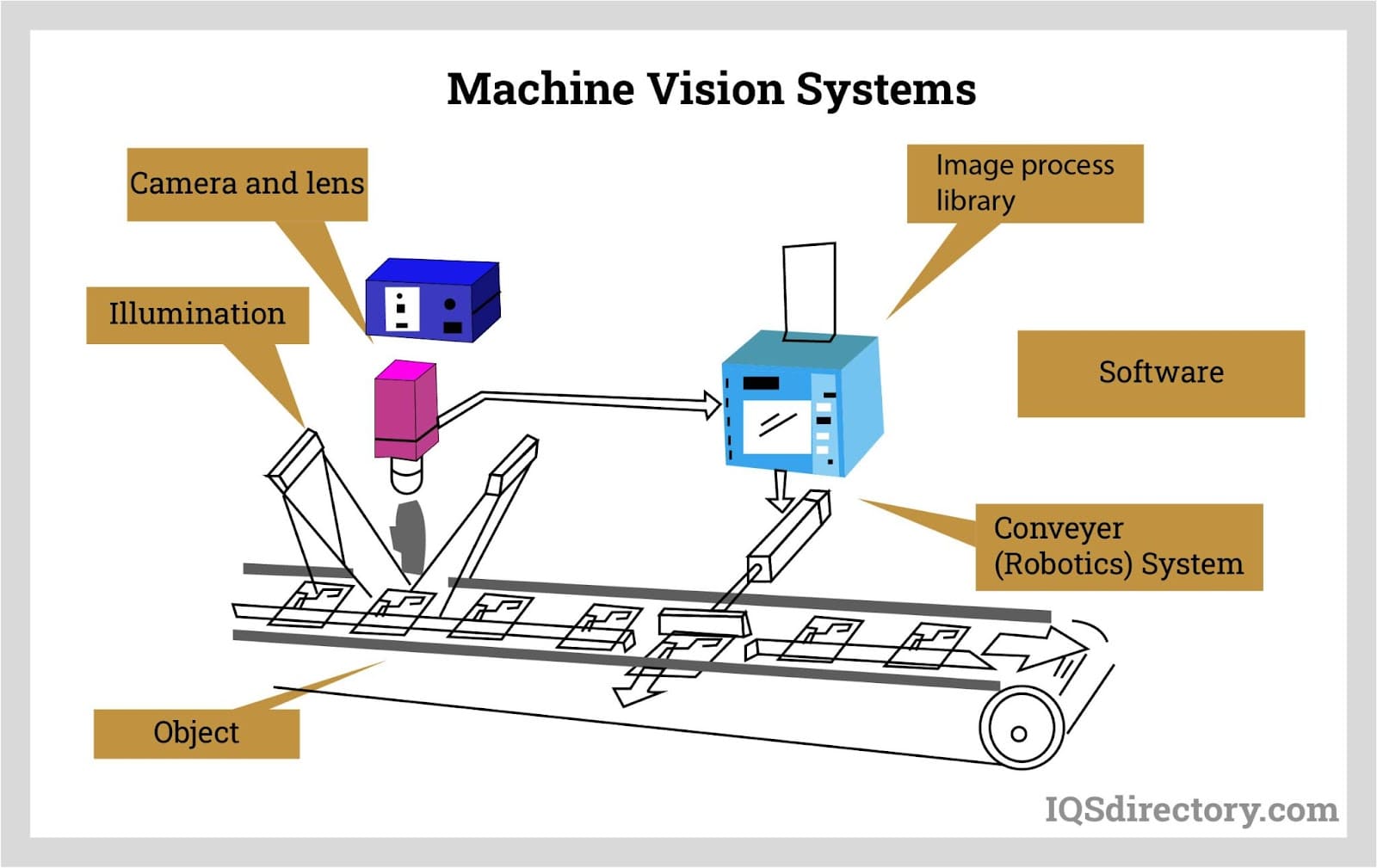 Machine vision systems integrate electronic components, computing hardware, and advanced software algorithms to process and analyze captured images from their environment.
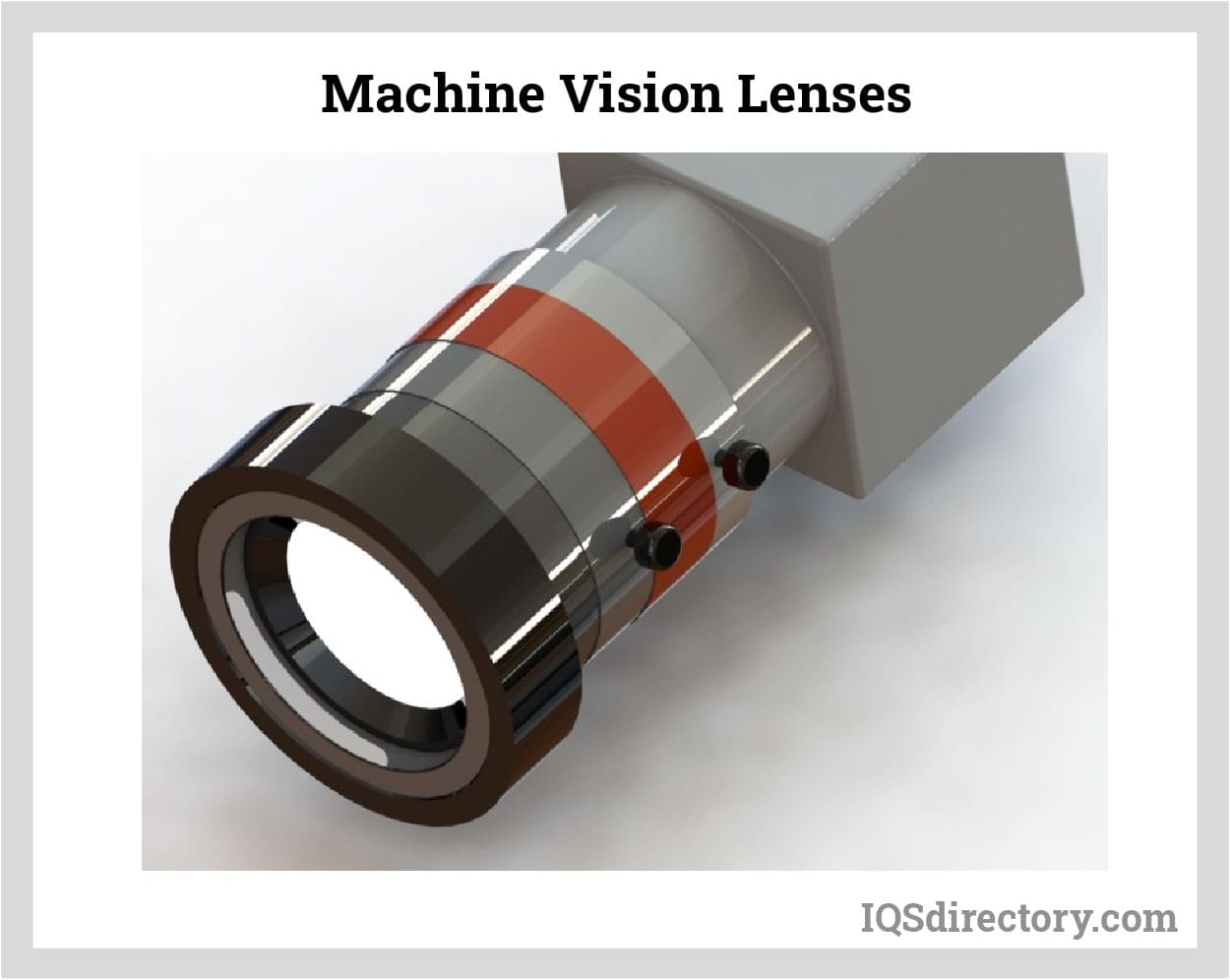 The lens focuses and projects images onto an image sensor located inside the camera.
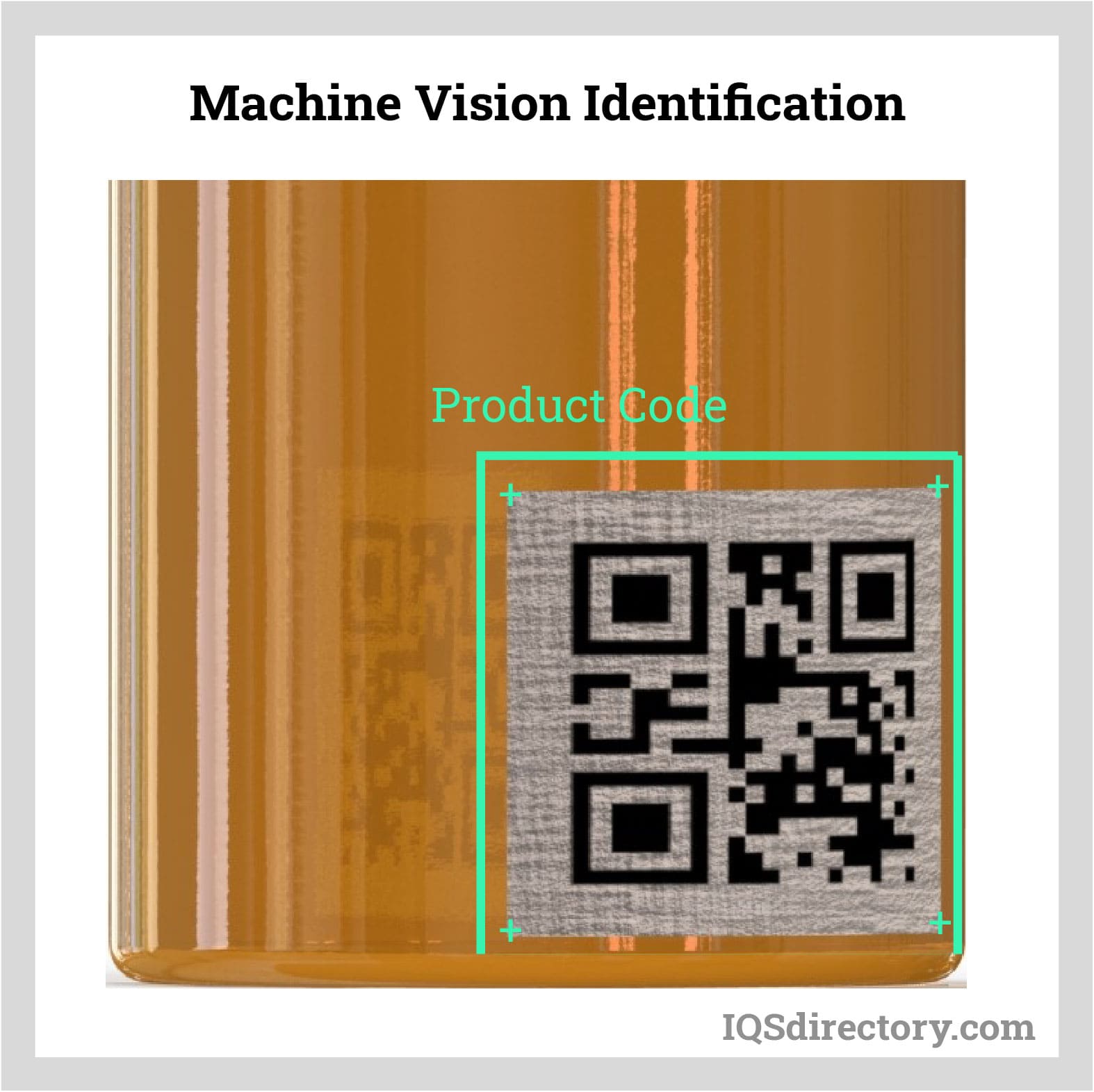 Machine vision identification systems scan and interpret barcodes, 2D codes, direct part markings, and printed characters to improve product traceability.
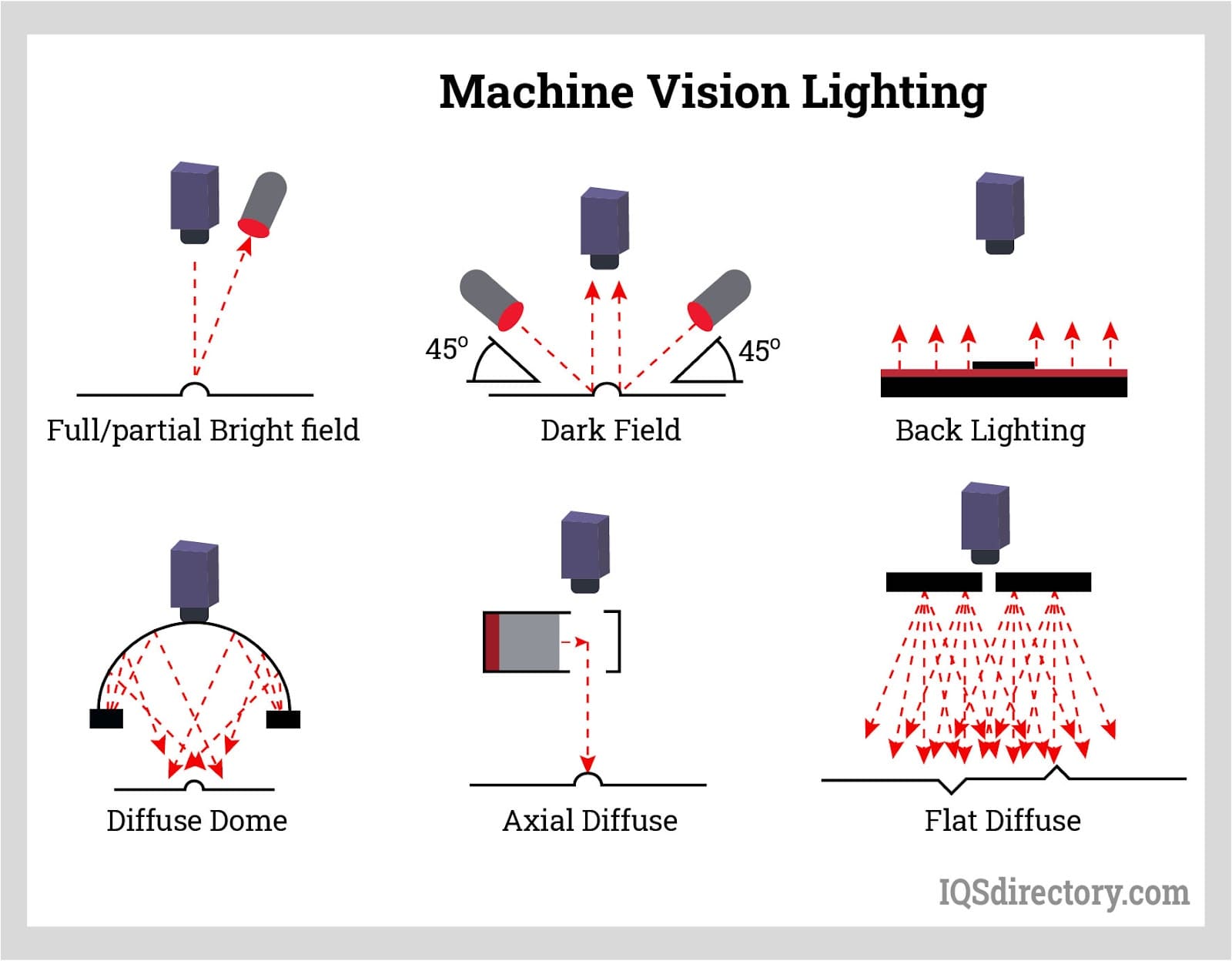 The lighting component illuminates the object, enhancing its features for optimal viewing and image capture by the camera.
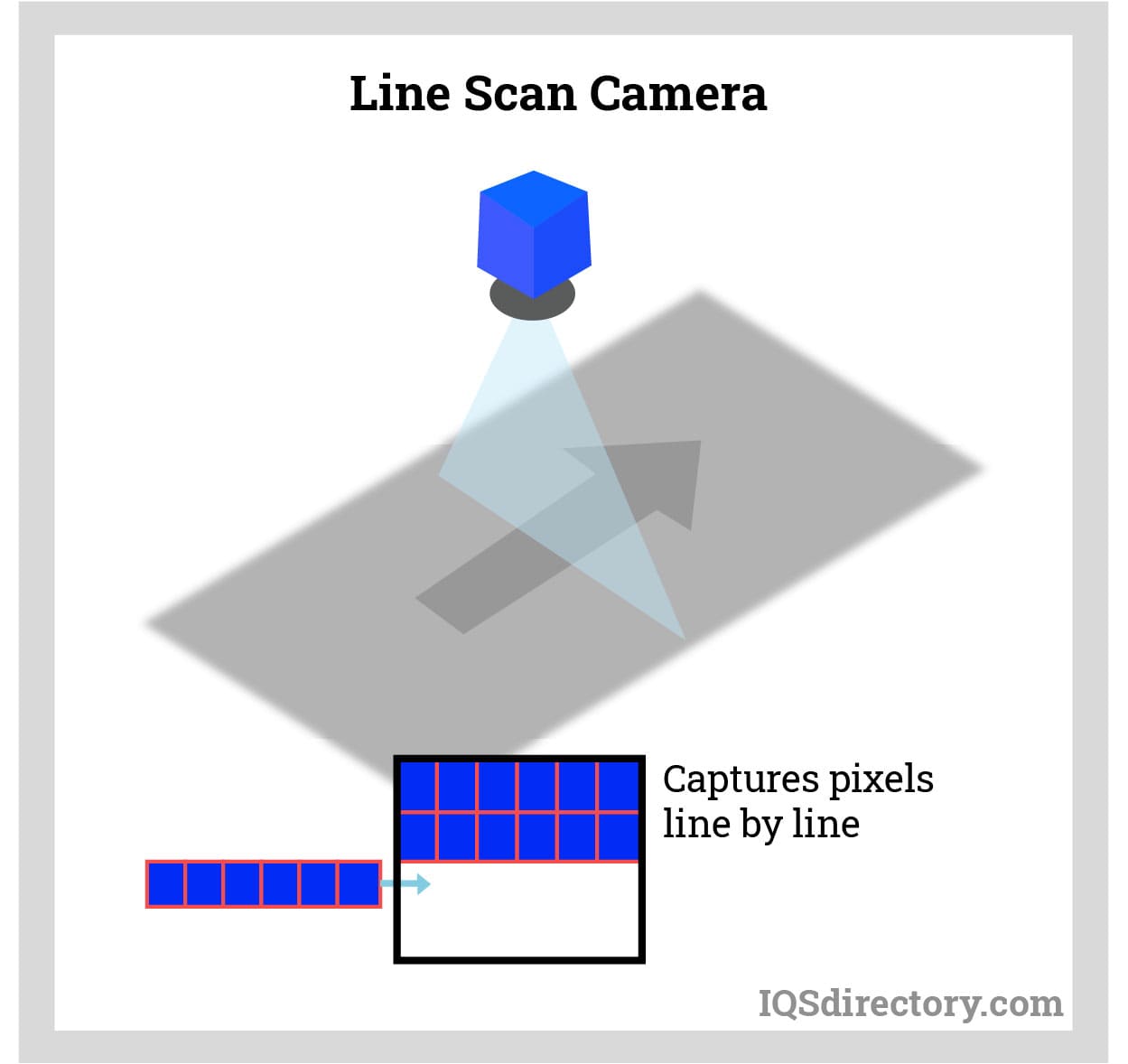 Line-scan cameras capture digital images one line at a time, constructing the complete image by assembling pixel rows sequentially.
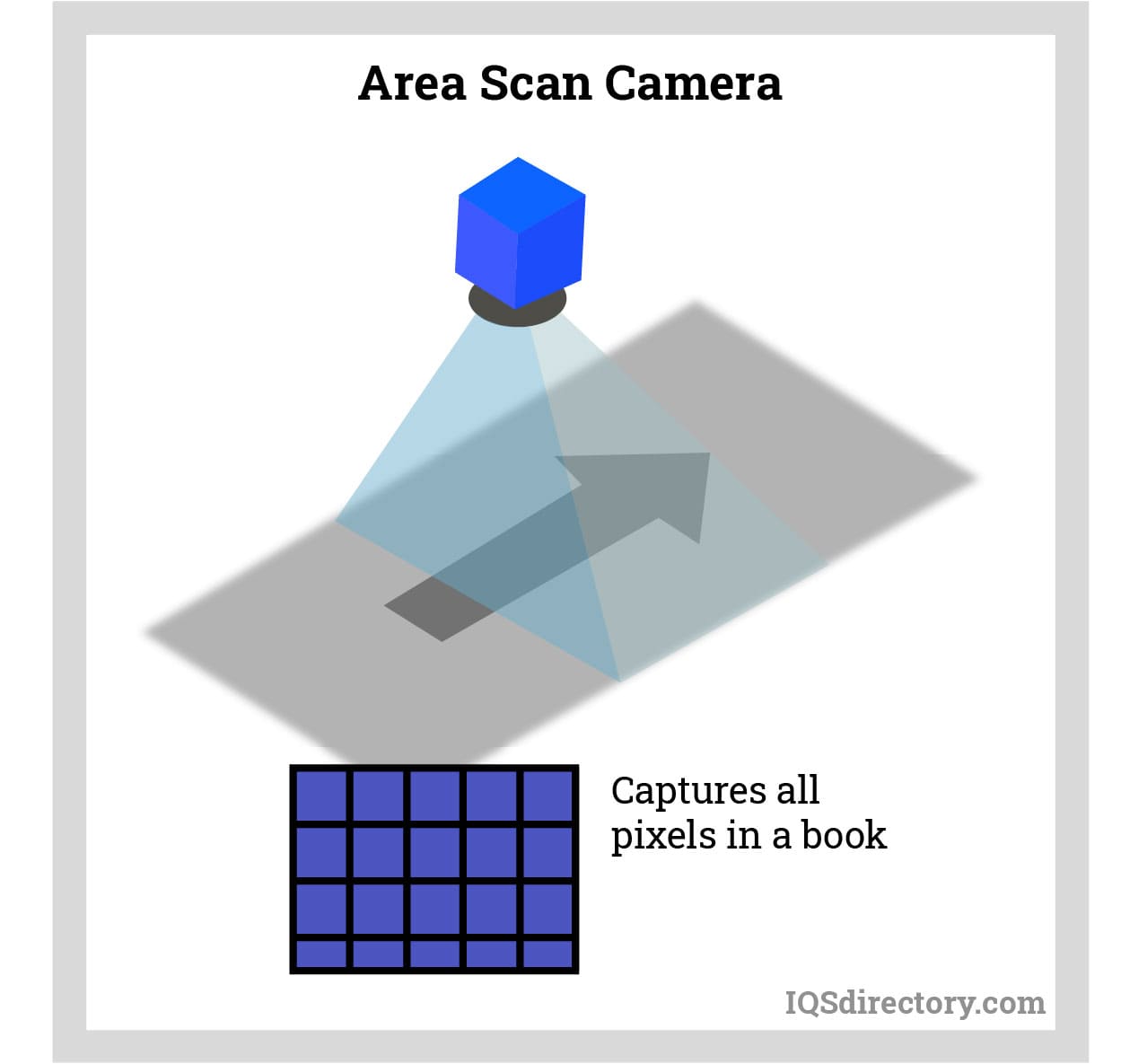 Area scan cameras use rectangular image sensors to capture entire images in a single exposure, producing digital images with defined pixel dimensions.
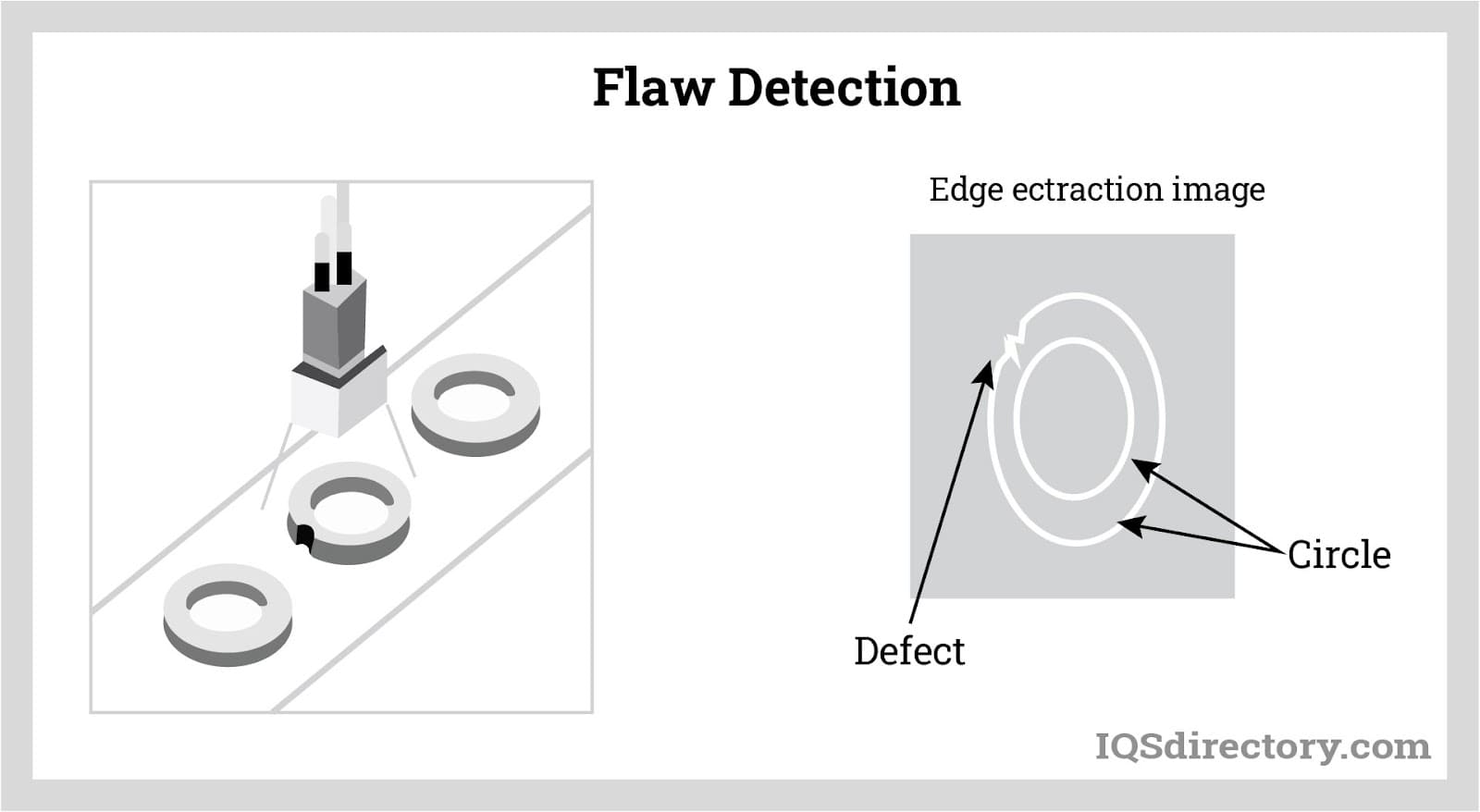 Machine vision systems detect surface irregularities on parts, which can impact product performance and reliability.
Machine Vision Types
- CCD Cameras
- Employ charge coupled device (CCD) chips to capture image data. These chips convert photons into digital or electrical signals, which can then be stored as image files on a computer, eliminating the need for film-based data extraction.
- Laser Inspection Systems
- Utilize photoelectric sensors together with laser beams. Laser inspection systems are used for applications such as barcode or serial number scanning, identifying microscopic surface defects, and counting parts during production. Additionally, laser inspection can create detailed 3D models of scanned surfaces.
- Optical Inspection Systems
- Conduct product inspection using machine vision. Vision inspection systems are often integrated into assembly lines for tasks like scanning serial numbers, counting items, and checking for defects.
- Optical Sorting Systems
- Systems designed to leverage machine vision technology for automated product sorting applications.
- Magnetic Imaging Systems
- Operate with magnetically responsive materials. By combining magnetic properties and specialized sensors, these systems generate visual representations similar to x-ray images.
- Smart Cameras
- Machine vision cameras equipped with onboard imaging software and processing circuitry for capturing high-resolution images. Due to limited storage, they are typically linked or integrated with the main vision system.
- Robotic Vision Systems
- Semi-autonomous machines like AGVs that navigate industrial settings using computer vision for limited visual perception and guidance.
Machine Vision Applications
The primary objective of machine vision is to deliver image-based information for analysis of products, surfaces, or images. Machine vision applications include automation process control, quality screening, automated inspection, robotic guidance, integrated systems, and both hardware and software product manufacturing along assembly lines.
Machine vision is implemented throughout assembly lines for measurement, counting, inspection, or reading serial numbers on items like die casted products. It has replaced humans in repetitive or error-prone tasks and is essential in automation scenarios where a robot arm or AGV requires visual guidance.
Machine Vision Equipment Components
While machine vision systems may vary by design, they share three essential components: specialized lighting for machine vision, an imaging device such as a digital camera or vision sensor, and dedicated image processing software.
- Imager Component
- For digital cameras, manufacturers may either integrate them within the main machine vision unit or keep them separate. If separate, the camera can be connected to the main system via specialized intermediate hardware, a frame grabber housed in a computer, or direct interfaces such as USB, FireWire, or Gigabit Ethernet. Integrated cameras are known as smart sensors or smart cameras, capturing high-precision images.
- Image Processing Software
- Also called vision software, this programming extracts and interprets raw image data from cameras or sensors, converting it into actionable information. It enables functions such as counting, measuring, inspecting, and sorting for operators.
Standards and Specifications of Machine Vision
Machine vision systems must comply with various industry standards, depending on the region. One of the main standards is set by EMVA (European Machine Vision Association), which focuses on accurate measurement methods and transparent data presentation. EMVA also supports general programming compatibility to facilitate data sharing and flexible applications. EMVA collaborates with organizations such as AIA (North America), JIIA (Japan), VDMA (Germany), and CMVU (China).
The GigE Vision standard, developed by AIA, is another widely adopted interface standard that ensures cost-effective gigabit ethernet communication for cameras. For more details, consult with your suppliers and industry experts.
Choosing the Right Machine Vision System Manufacturer
When seeking a machine vision product or system, it is essential to consult with an experienced provider who can recommend the most suitable technology for your needs. Refer to the list of machine vision system manufacturers on this page, each recognized for reliability and strong brand reputation. Before reviewing their profiles, prepare a detailed list of your requirements. This will help you have productive discussions with potential manufacturers. Include key information such as primary applications (barcode scanning, inspection, quality control, etc.), budget, project timeline, required standards, delivery preferences, and support needs. After compiling your criteria, compare the offerings of listed manufacturers. Select three or four candidates of interest and reach out to discuss your project in detail. Review each supplier’s vision solutions, services, and capabilities, and choose the manufacturer that best fits your application.
Machine Vision Terms
- 3-D Imaging
- A technology that creates three-dimensional images from a series of two-dimensional cross-sectional images, with computers assembling the 3D image from various scans or pictures.
- Acquisition
- The process of capturing external information to be analyzed by a vision system.
- Aperture
- The diameter of a lens, which determines how much light reaches the photoconductive image sensor.
- Attenuation
- The reduction or weakening of signal strength.
- Chroma
- The aspect of color that includes both hue and saturation levels.
- Decompression
- The act of restoring original data from its compressed form.
- Depth of Focus
- The range within which the sensor-to-object distance results in a sharp focus through the lens.
- Digital Imaging
- The conversion of a video image into a pixel-based format using an analog-to-digital converter, with each pixel's value stored in a computer.
- Dichroic Filter
- A filter that transmits light based on wavelength rather than polarization, allowing one color to pass through while reflecting another when illuminated by white light.
- Fiber Optics
- Delivery of light or optical images through bundles of transparent fibers, using internal reflection. Coherent fiber optics maintain spatial organization to relay images.
- Focal Plane
- The plane perpendicular to the lens axis at the point where the image is in focus, typically at the sensor.
- Frame Rate
- The number of image frames displayed or captured per unit of time.
- Gauging
- Non-contact measurement and dimensional analysis of an object.
- Gray Scale
- The range of shades from white to black in a digitized image, with black as zero and white as one.
- Halogen Lamp
- An incandescent lamp containing a halogen gas, such as iodine, that cycles between evaporation and redeposition on the filament.
- Image Analysis
- The technique of identifying objects and shapes within images, used in applications from movie colorization to guided missile navigation.
- Image Plane
- The flat surface of the imaging sensor, set perpendicular to the viewing direction and focused by the lens.
- Infrared
- The electromagnetic spectrum region just beyond visible red light, characterized by longer wavelengths.
- Laser Technology
- Commonly used in generating 3D images of surfaces, lasers emit high-intensity light with unique electrical properties.
- Machine Vision Products
- Include all systems and components used for applying computer vision technology in industrial and manufacturing processes.
- Pattern Recognition
- The classification of images into defined categories using statistical or algorithmic methods.
- Pixel
- Short for picture element; the smallest component in a digital image array.
- Process Imaging
- The imaging of manufacturing processes at both the design and production stages, often used for quality control.
- Sharpening
- An image processing technique that enhances edges by adding a low-pass filtered image to the original, resulting in clearer boundaries.
- Shutter
- A device, either electronic or mechanical, that controls how long the imaging surface is exposed to light, helping reduce motion blur.
- Spatial Filtering
- A method of enhancing images by modifying their spatial frequency content.
- Zoom Lens
- A multi-element lens that maintains focus while continuously adjusting image size, which can be motorized or manually controlled.