Rotational Molding
Rotational molding, also known as rotomolding, is a plastic product fabrication process by which hollow plastic goods are formed and manufactured. This process relies on a revolving mold and high heat.
Quick links to Rotational Molding Information
The History Rotational Molding
Rotational molding originated with a British man named R. Peters, who in 1855, used biaxial rotation and heat to make metal shells for artillery and other hollow vessels. His main goal was to create consistent wall thickness and density among the vessels. While his discovery was significant, engineers didn’t really put it into use until around 50 years later.
In 1905, an American named Fred A. Voelke made the next big breakthrough in rotational molding when he found you could use the method to manufacture hollow wax objects. Five years later, G.S. Baker and G.W. Perks used this method to make the first hollow chocolate eggs.
The world of rotomolding expanded again in the 1920s, when R.J. Powell used the process to mold plaster of Paris. Gradually, in the 1940s and early 1950s, plastic rotational molding found traction, and toy makers started using it to make hollow toys, particularly doll heads. The molder machines used for manufacturing were quite crude; they featured automobile parts, such as rear axles, and they were driven by electric motors and heated by gas burners. Molds were made from nickel and copper, while PVC was the primary mold material. To cool down the molds, they used cold water baths.
With the success of hollow plastic toy production, industries started adapting rotational molding to their applications, such as the manufacturing of traffic safety equipment, armrests, and buoys. As a number of manufacturers embraced the method, more efficient and bigger designs, featuring indirect heating systems, became available on the market.
The next stimulus to rotomolding occurred in Europe when a new system of heating was created; it took the process from using the original direct gas jets to the current indirect high velocity air system. During the 1960s, engineers developed the Engel process. Using this process, manufacturers were able to use a new raw material, low-density polyethylene, and a new cooling system were used to make large hollow containers. The cooling system required only that you turn off burners, so the hardening process could start while the mold was still in motion.
In 1976, manufacturers banded together to form the international trade group known as the Association of Rotational Moulders (ARM) in Chicago. Shortly thereafter, in the ‘80s, engineers introduced new raw materials, such as nylon and polycarbonate, into the lineup. Using these, they could make plastic fuel tanks, water tanks, and industrial molds. In the late ‘80s, researchers at the Queen’s University Belfast did extensive work that led to the development of more precise monitoring and control systems for cooling processes.
Today, the possibilities continue to expand with rotomolding as engineers and scientists develop new materials and more efficient ways of doing things.
Benefits of Rotational Molding
Rotational molding services have several advantages over other forming services. First, molders are able to change colored plastics without extensive line cleanings or die purgings, which saves on time and added costs. Second, rotational molding does not require pressure, which helps to limit tooling costs as well as energy-related costs. Equipment costs are also low because the cast or welded molds they use are significantly less expensive than other kinds. Plus, most of the excess material created during this process can be recycled; this is not only economical, but environmentally friendly too.
In addition, rotomolding’s even and seamless coating of style produces strong outside corners with virtually no stresses. This seamless coating is especially advantageous to those making pressure vessels and tanks, as any little seam or crack can lead to pressure vessels bursting. Finally, using this method, a product or prefinished mold part can be assembled inside a single mold. Unlike alternative methods, which involve tooling of a new die even for small changes, roto molding provides great flexibility. Due to this flexibility, the design time can once again be cut down significantly.
Materials in Molded Products
To make a rotationally molded product, manufacturers typically use a powdered polymer resin, and in fact, more than 80% of the material used in rotomolding comes from the polyethylene family. Examples of these plastics include LDPE (low-density polyethylene), LLDPE, PEX and HDPE. Other common rotomolding materials include polypropylene, PVC, nylon and polycarbonate.
- Polyethylenes
- Characterized by hardness, rigidity, high ductility, impact strength, low friction, excellent chemical resistance, low permeability and good electrical insulation.
- Polypropylene
- Resin is quite similar to polyethylene, but it has greater thermal resistance and improved mechanical properties. It can also be made translucent when uncolored.
- Polyvinyl Chloride PVC
- PVC, or polyvinyl chloride, comes in both rigid and flexible form. Both plastics have high hardness, good elasticity, good chemical resistance, and good insulation properties. Their insulation properties, though, are not as good as polyethylene and polypropylene.
- Nylon
- The name “nylon” refers to a whole family of synthetic polymers. Generally speaking, nylon materials have properties of: high melting point, excellent abrasion resistance, superior colorfastness, durability, and good chemical, thermal and UV resistance.
- Polycarbonate
- Which is naturally transparent, is strong, tough, and resistant to heat, with excellent dimensional and color stability.
- The molds are usually made out of either stainless steel or aluminum, which are welded together or die cast.
- Stainless Steel
- Corrosion resistant, rust resistant, stain resistant, durable and strong.
- Aluminum
- A low-density metal with high corrosion resistance.
Rotomolding Manufacturing Process
The manufacturing process begins with a rotomoulding machine with arms called spindles. These spindles support the molds in which the plastic material is contained. The molding machine transports the molds from the loading area to a heating chamber and then to a cooling chamber. From start to finish, the rotational molding process consists of four different stages. They are completed in anywhere from 15 to 90 minutes.
- Charging Phase
- In the first stage, which is referred to as the charging phase, the metal mold is loaded with a measured quantity of raw plastic material and is sealed shut. Different types of machines have distinct loading mechanisms.
- Heating Stage
- In the second stage, the mold is heated in a heating station, usually an oven, as it slowly rotates on the vertical and horizontal axes of the spindles. The axes rotate the mold at varying speeds so that the plastic material does not accumulate. Rotation continues until the plastic powder is molten and evenly coated on the interior walls of the mold. This ensures uniform wall thickness.
- In this step, the critical part is the time for which the mold remains in the heating station. If the mold stays for too long, the plastic material can degrade, which will decrease the finished product's ability to withstand impact. Conversely, if the mold remains for an inadequate time, the plastic pallets would not melt and stick on the mold wall. Insufficient melting can lead to large bubbles in the finished product, rendering it useless.
- The reason that manufacturers start this process with fine powder resin is because rotomolders use low pressure and would struggle to get the plastic to coat the mold cavity evenly. The plastic material can feature additives that contribute to corrosion resistance and static resistance, and the finished molded product assumes these properties when it emerges from the molding process.
- Cooling Stage
- The third phase of rotational molding is a cooling stage that cures the plastic within the mold, using cold air and water. This cold air often comes from a fan, which stays pointed at the mold until the plastic hardens.
- The mold usually sets in about ten minutes. As the material cools down and hardens, it starts to shrink, which facilitates the removal of the product from the mold. The cooling process is also critical, and the rate of cooling must be regulated carefully. If a product is cooled down rapidly, it can result in disfigurement of the finished product. There was a time when an operator would determine the length of the time for cooling down the mold; however, modern machines have sensors that monitor the temperature of the molds.
- Removal Phase
- The last phase is the removal of the product from the mold by an operator. After the plastic has fully dried, the mold is reopened and the solid plastic part is manually removed. Because shrinking often occurs, removal can prove to be difficult. For applications that require additional strength, reinforcing ribs can be fabricated into the part.
Designing Rotationally Molded Parts
When designing rotationally molded parts, manufacturers must make important decisions, like what type of material to use, what additives to employ and what rotomolder type to use. To make these decisions, they consider factors such as: product size, product shape, requested product color, and required product strength, flexibility, thermal resistance, etc.
If the application calls for it, manufacturers can create a custom mold. They can also create a part with a custom finish, color or texture. They can even mold logos, graphics or labels right into the parts. These imprints will not come off and are parts of the mold construction. If a design demands reinforced joints, they can also be easily added. For more information about custom rotational molding, talk to your manufacturer.
Rotationally Molded Plastics Images, Diagrams and Visual Concepts
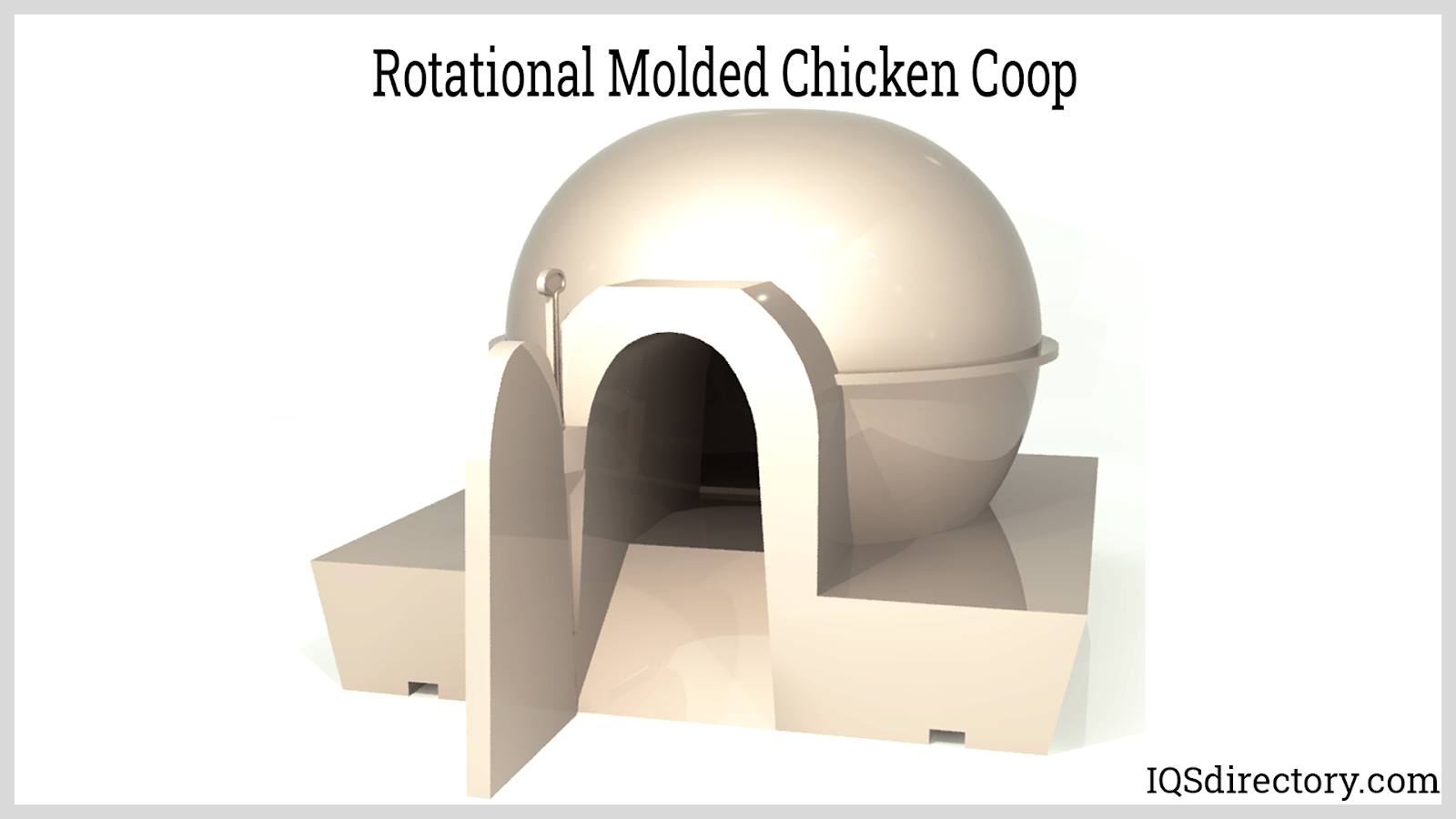 An example of the products that can be produced using rotational molding.
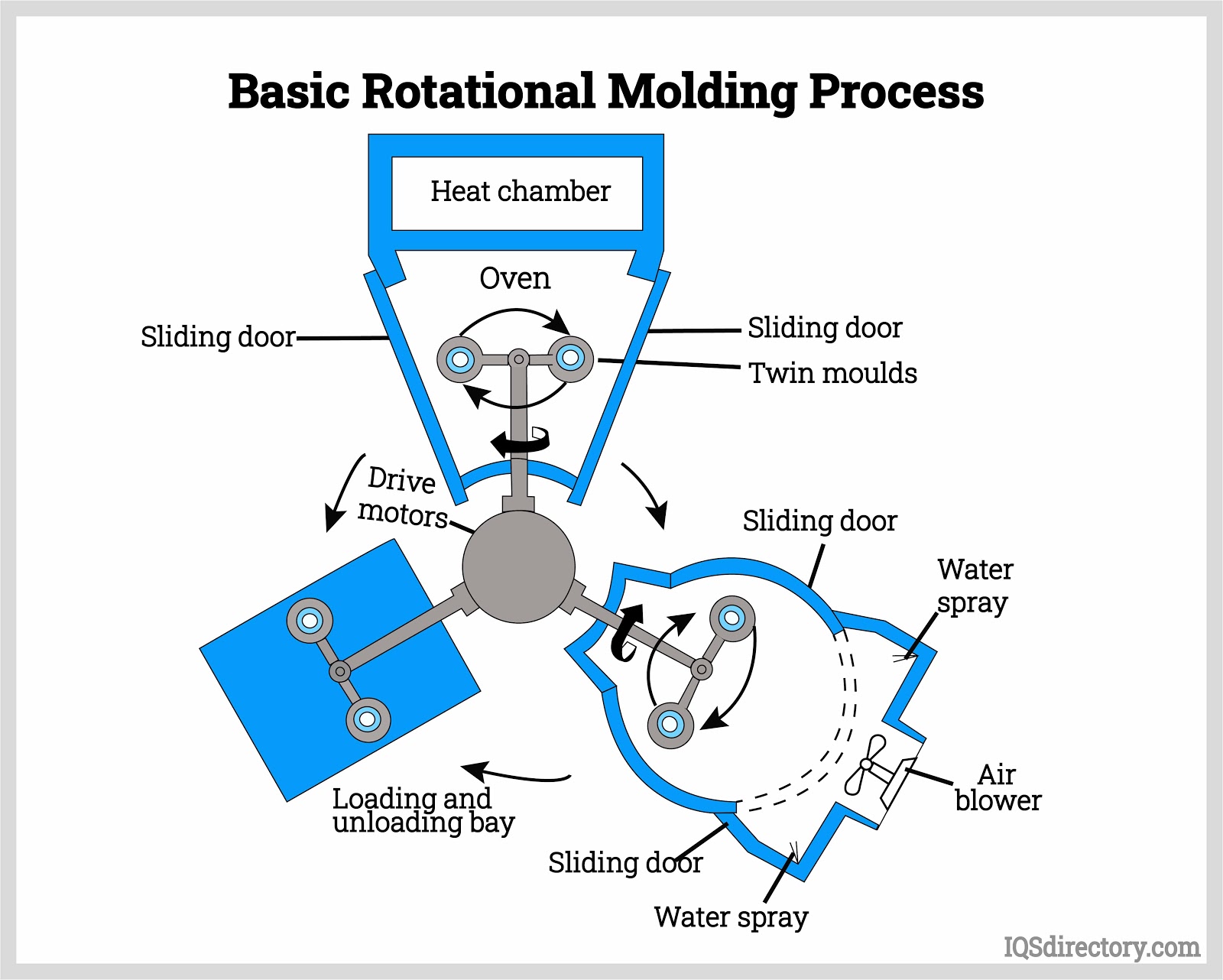 The basic process of rotational molding.
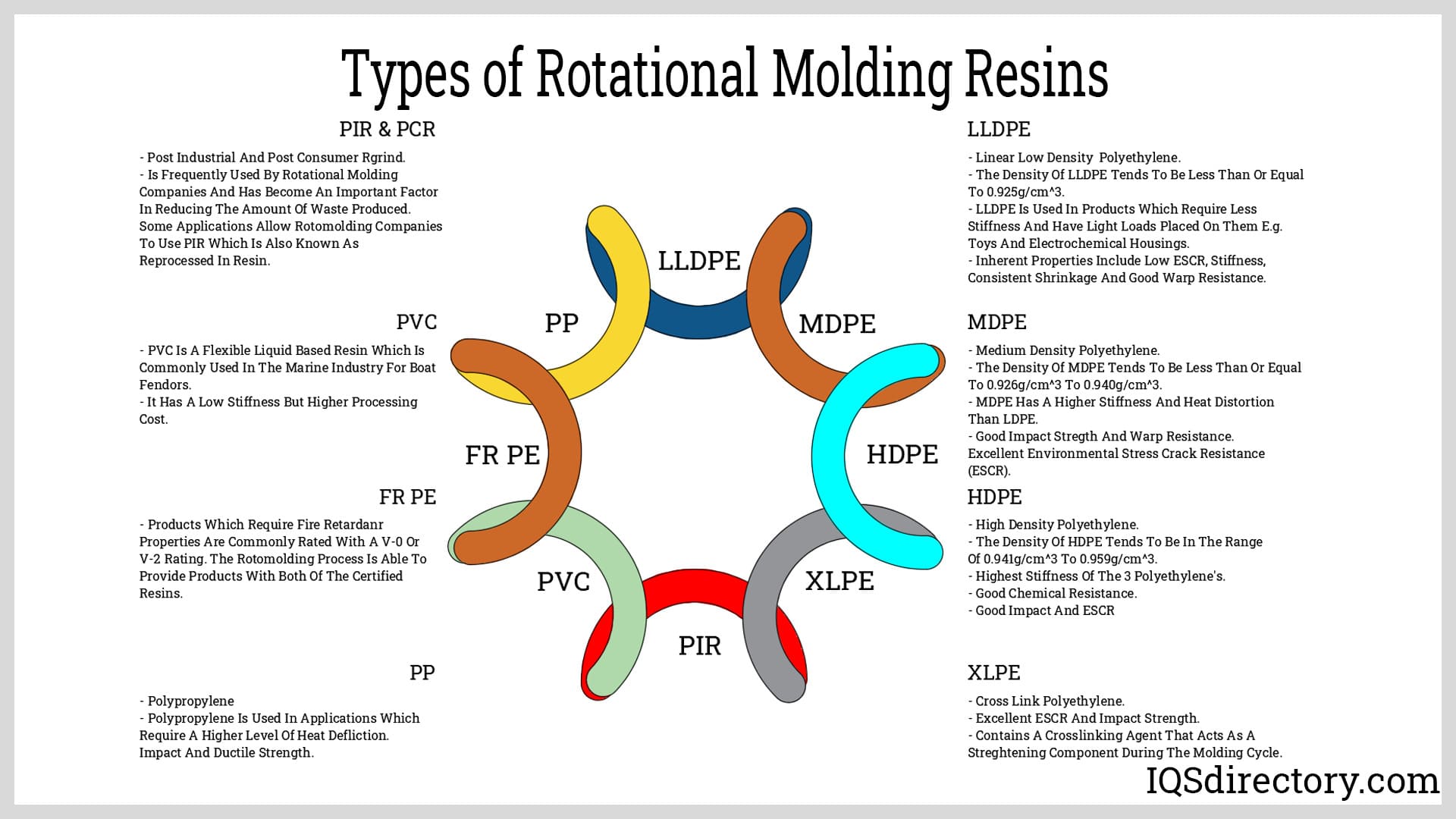 The different materials that are used in the rotational molding process.
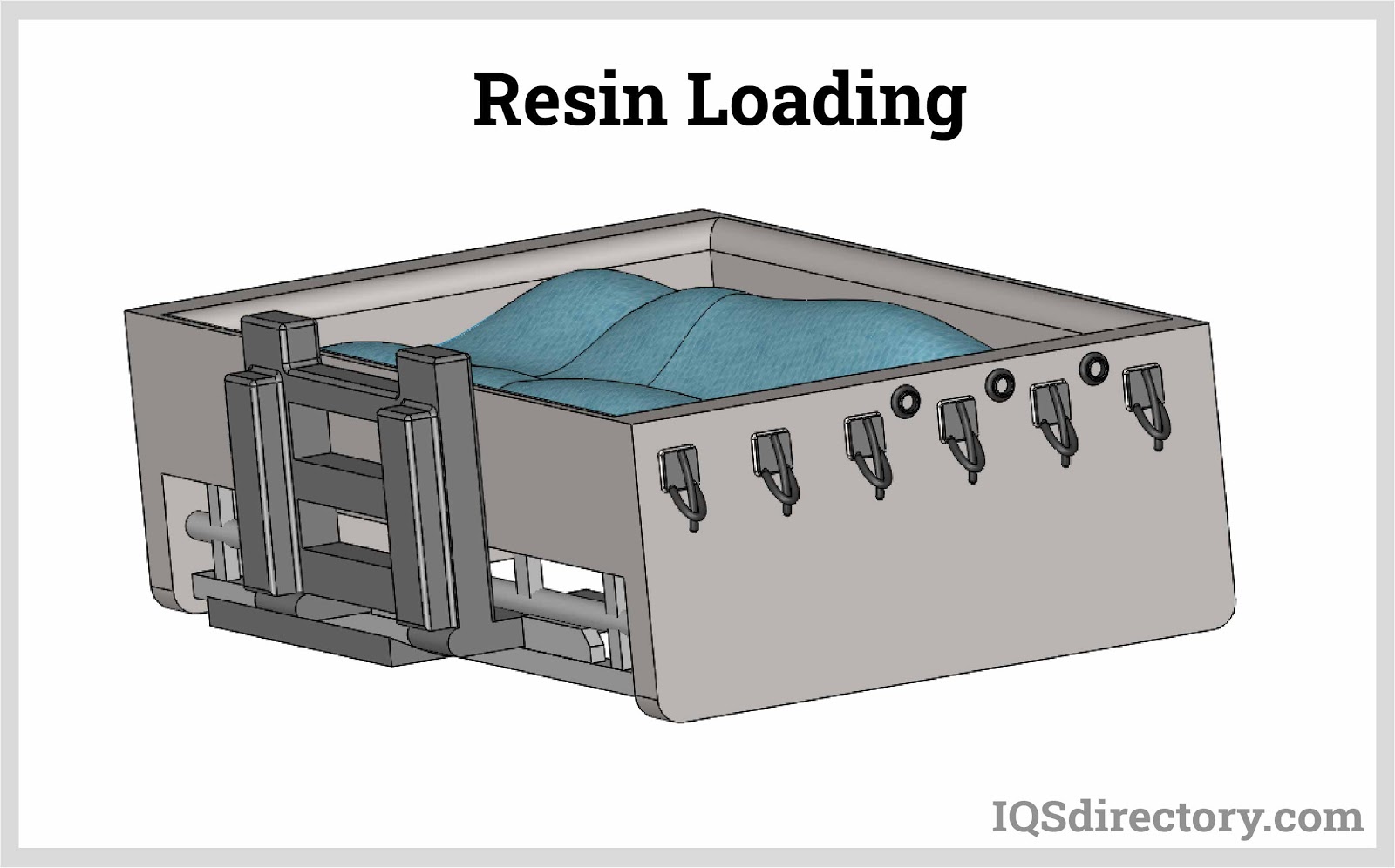 Measuring the quantity of the polymer, which is in powdered resin form which must be fine sizes, homogeneous, and dried.
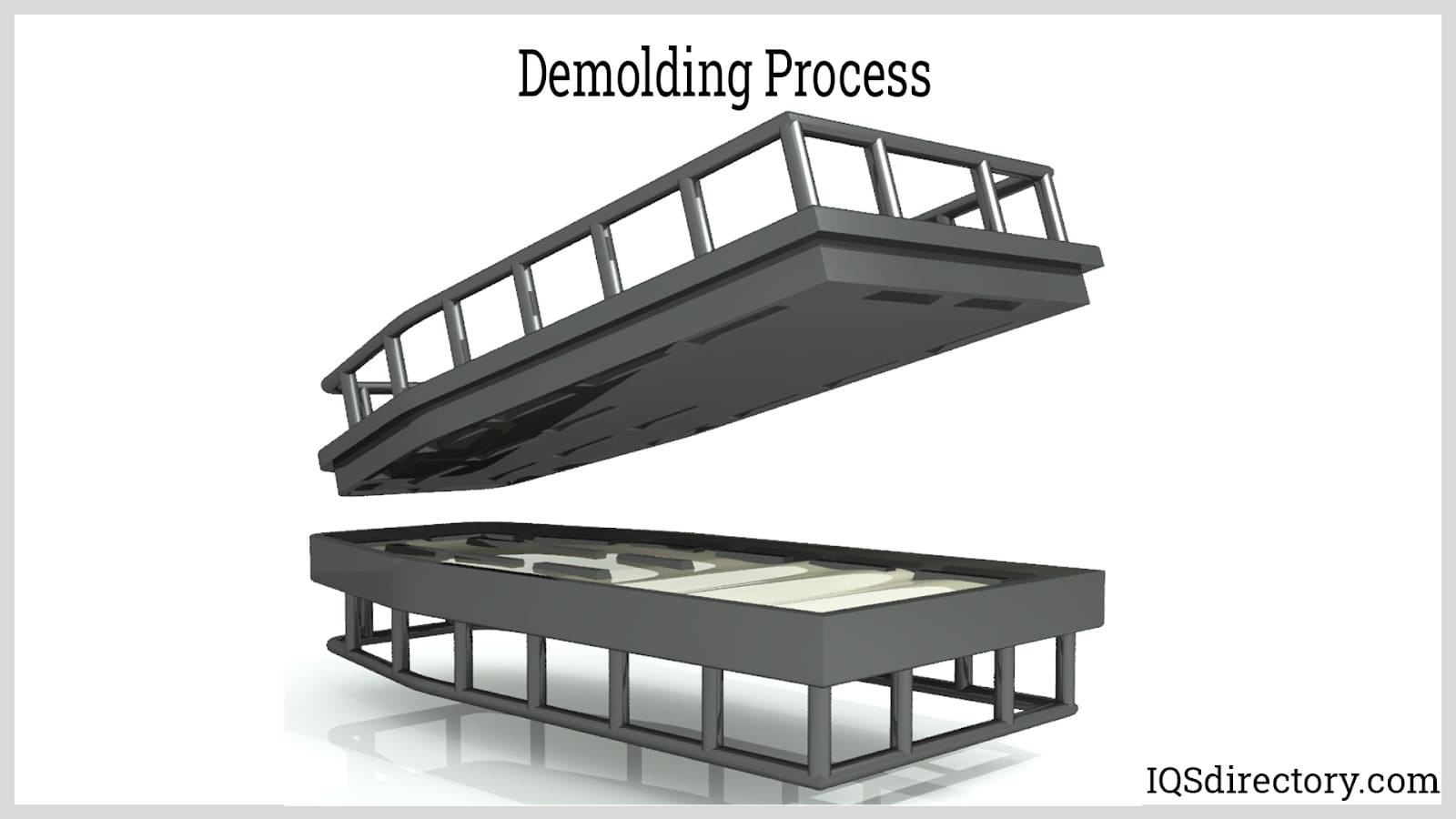 The cooling process to remove the mold which ejects airs to life the part out of the tool.
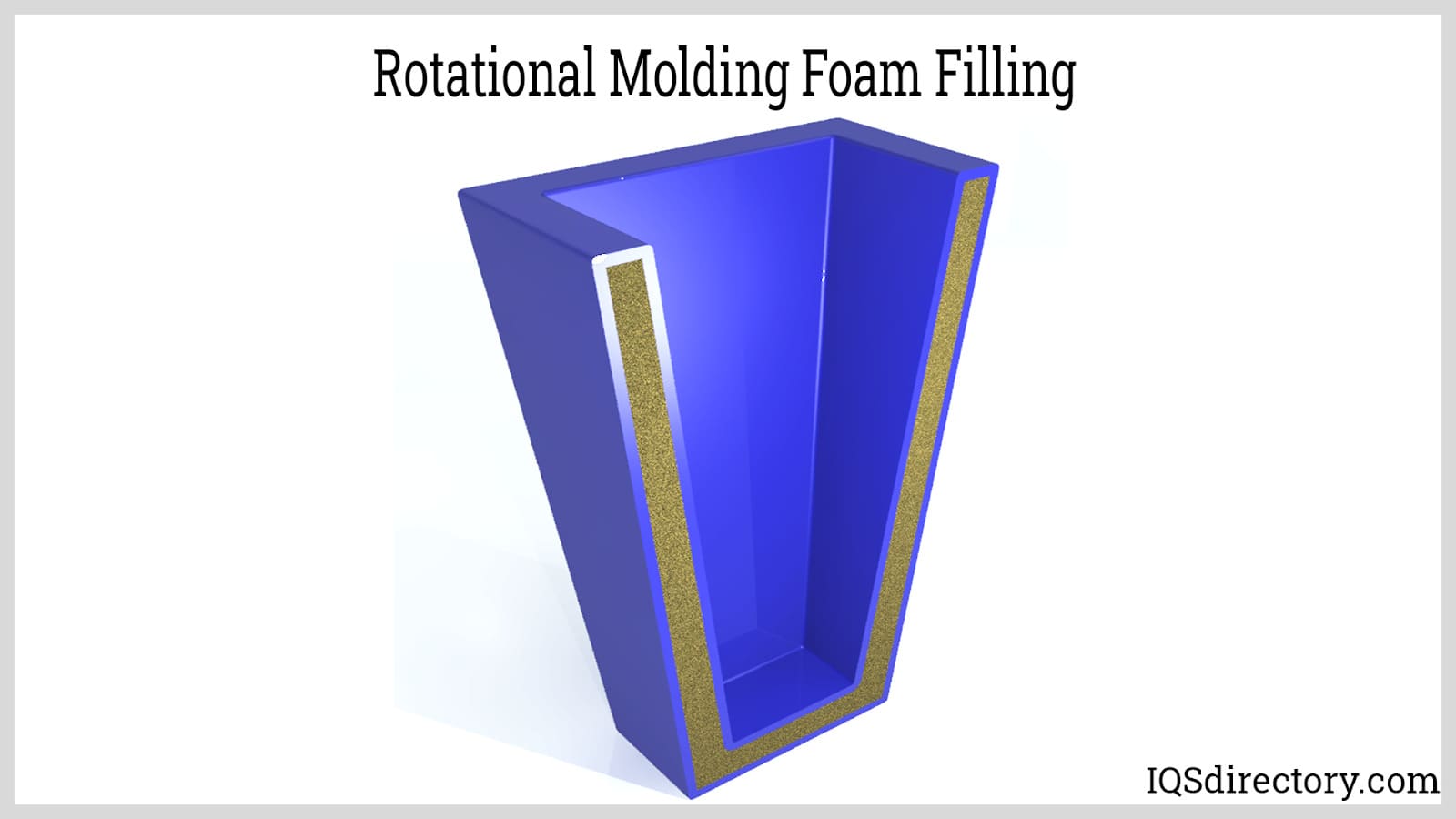 An example of secondary processes depending on the finished product.
Types of Rotationally Molded Plastics and Processes
- Cross-Linked Polyethylene
- An ideal material for rotomolded products that will be exposed to extremely cold temperatures.
- Custom Rotational Molding
- Services allow customers to design rotomolded products to their specifications.
- High-Density Polyethylene
- Offers high-flow molding and high molecular weight performance in rotationally molded parts. Properly rotomolded HDPE products will have interior gloss development, ductile cold temperature impact performance and an off-gas odor that confirms the chemical cross-linking reaction.
- Linear Low Density Polyethylene
- Provides superior fit and finish to rotationally molded products. Rotomolded LLDPE products also have high impact, tensile and dielectric strength.
- Plastic Rotational Molding
- The process of rotating molten plastic material in a mold in order to shape it into a useful product.
- Polyethylene
- A lightweight plastic that has a low modulus of elasticity. Rotationally molded PE products are thick in desired places and have good impact resistance.
- Polyvinyl Chloride
- Also referred to as “vinyl,” has excellent transparency, chemical resistance, long-term stability, good weatherability, flow characteristics and stable electrical properties. PVC can be either rigid or flexible.
- Rotational Molders
- Also known as rotational moulders or roto moulders, are used to fabricate hollow plastic parts.
- Rotational Moulding
- The low pressure process used to create hollow plastic components.
- Rotationally Molded Fuel Tanks
- Seamless polyethylene (PE) tank structures that retain molded-in logos, warnings, serial numbers and other full color graphics when exposed to salt water, sunlight, solvents, cold weather and other severe conditions.
- Rotationally Molded Plastics
- One-piece products created on a rotational molding machine.
- Rotomolds
- Machines used to make hollow, one-piece plastic parts.
- Rotomolded Products
- Hollow plastic parts formed by rotational plastic molding processes.
- Rotomolded Tanks
- Hollow plastic containers used for the storage of materials, often in bulk quantities.
- Rotomolding
- Also known as rotomoulding, is the four-step process used to make hollow plastic components.
Types of Rotomolder Machines
The machines used to power rotational molding are called rotomolders.
Rotomolders commonly have four parts: oven, molds, mold spindles, and cooling chamber. Molds give shapes to plastics and are manufactured by two methods, welding or casting. The oven is used for heating the molds, whereas the mold spindles help in giving uniform coating; they are mounted on a rotating axis. The cooling chambers assist in hardening the material by exposing the mold to low temperatures.
Rotomolders come in a variety of designs, including carousel, clamshell, rock and roll, vertical, and shuttle machines. This design variation allows for both simple and complex design.
- Carousel Type
- This is the most common bi-axial rotational molding machine. Per application requirements, it can either have four or six stations. The carousel rotational molder is designed in such a way that if one arm remains in the heating station, the other will serve in the cooling station, and the third arm will serve the loading or unloading area.
- Clamshell
- This type of machine rotates molds using a mechanical arm, so that it can easily be rotated at different axes. The advantage of this machine is that the cooling and heating processes are done in the same chamber. This makes the machine compact, so it takes a lot less space than other options. Moreover, the design is less expensive.
- Rock and Roll
- This machine has a specific application; it fabricates long and narrow parts. The machine can have one or more arms based on the need; machines that have two arms are called shuttle type machines. The arm rotates a mold at 360 degrees at one axis, and concurrently, rocks the mold at 45 degrees along a different axis. The machine is used for making high-volume products and is considered cost effective due to the use of smaller heating chambers.
- Vertical Machines
- These machines are also known as over rotating machines. They have different cooling and heating areas and can be loaded and unloaded from the front. Based on the requirements, these machines can be of varying sizes. They are energy efficient because they have small and compact cooling and heating chambers. When it comes to capability, they are the best, still taking a lot less space than multi-armed machines.
- Shuttle Type
- As the name implies, these machines shuttle the mold between the heating and cooling chambers and can rotate it bi-axially. Shuttle type machines are considered low-cost, as they can produce large-size products. For different needs, the footprint of a machine can be modified.
Applications of Rotational Molding
Customers rely on the rotomolding (roto molding) process because rotomolded parts have single piece construction, uniform wall thickness and high tensile strength. These qualities make for an excellent product. In addition, they have low tooling costs and require little further fabrication work.
Rotational molders are used to fabricate plastic products for a wide range of industries and applications, including food and beverage processing, pharmaceutical, wastewater management, agricultural, plumbing, sporting goods, packaging, material handling, chemical, fuel/oil, marine, road construction, automotive and toy manufacturing.
The average rotational mold product, like a storage tank or fuel tank, is hollow with large capacities, with consistent thickness and density.
Examples of rotomolded parts and products include outdoor furniture, kayaks and canoes, playground slides, safety cones, footballs, sports helmets, plastic rotomolded tanks, beverage bottles, large trash containers and all sorts of hollow bins.
Things to Consider When Choosing Rotational Molding
For a quality rotomolded part, you need a quality rotomold contract manufacturer. Google searches, though, can produce intimidating information overload and uncertainty. That’s why IQS exists. We’re here to help you cut out the riff raff and find worthwhile molding service providers right away. To learn about those worthwhile manufacturers, check out the list we’ve provided near the top of this page. Peruse their respective websites, write down a few in whom you’re especially interested, and then reach out. When you talk to them, make sure to detail your specifications, including the function, industry standards, size, shape, color, product size, strength and general qualities you’re looking for in your product. In addition, make clear your timeline and budget. Jot down the info they offer you, then compare and contrast. Look not only for skill, but for customer service. Choose the manufacturer that you feel can best serve you, and then get started!
Variations and Similar Processes to Rotational Molding
Common methods that compete with the rotational molding process include: extrusion, injection molding and blow molding.
- Extrusion
- A process used to create products with a fixed cross-sectional profile. Instead of a mold, it uses a die through which it forces material. The two big draws of extrusion are the facts that it can be used to create very complex cross-sections and the fact that it can work with brittle materials that rotational molding cannot. The latter is due to the fact that extrusion only introduces compressive and shear stresses. It also creates an excellent surface finish product.
- Injection Molding
- Process involves a ram, hopper, heated barrel, nozzle and mold. During this mold process, the mold stays cold as the molten material is forced into it by the plunger and through the nozzle. This way, the material begins to solidify quickly as it forms under pressure. While rotational molding and injection molding are both great plastic molding processes, injection molding works better for metal. Also, it is faster than rotational molding, and if you need sharp threads, this process is the better choice.
- Blow Molding
- Another molding process by which hollow plastic parts are made. Like the others, it starts when manufacturers melt a plastic material. The big way in which it differs from other mold processes is the fact that, to create molded products, manufacturers take this melted plastic and form it into a parison, which is a tube-like piece of plastic with a hole in one end through which compressed air can pass. They then take the parison, clamp it into a mold and blow air into it. The air pressure causes the parison to expand until it touches the walls of the mold. Once it takes on this form, it’s allowed to cool and harden. Then, manufacturers open up the mold and eject the part.
- Almost exclusively, plastic blow molding is used to create bottles.
Rotational Molding Terms
- Blow Molding
- A common process used to form hollow, thermoplastic shapes, such as bottles and containers. Two general types of blow molding are extrusion and injection blow molding.
- Chemical Cross Linking
- The process in which individual polymer particles are joined together by a molecular bond.
- Chemical Resistance
- The ability of a material to withstand various chemical agents. Plastic is capable of enduring many of these chemicals, making it very useful for holding tanks and other containers.
- Corrosion
- The oxidation and deformation of a material, such as the rusting of iron, due to a chemical reaction.
- Cycle Time
- The time it takes from the first stage of rotational molding, in which the plastic is loaded, until the plastic completes its final stage and is removed from the mold.
- Deflashing
- The removal of unwanted material from a molded product, especially from the areas where parting lines of the mold may have caused excess material to be formed.
- Density
- A significant parameter for polyethylene (PE) that affects the properties, such as stiffness and impact strength, of the end product.
- Elasticity
- The ability of a material to return to its original form after stress has been applied and quickly removed.
- Fusion Temperature
- The temperature at which the plastic resin melts and begins to adhere to the surface of the mold.
- Grind Ability
- The ability of a plastic to be ground into a fine powder. Most plastics are ground prior to being loaded into the mold.
- Impact Resistance
- The measure of the ability of a plastic to withstand fracture by shock.
- Plastic
- A generic name for semi-synthetic or synthetic materials that can be extruded or molded into films or objects. Plastic materials are also used for coatings and adhesives.
- Polymer
- A chain of molecules that is formed by the bonding of individual repeating units (monomers).
- Pour Ability
- The measure of the speed of a plastic powder when poured through a funnel. For a plastic powder to be acceptable for rotomolding, it must be capable of flowing at least 185 grams/minute.
- Resin
- Any of various semisolid or solid natural organic materials that are usually translucent or transparent. Resins are mostly utilized in plastics, adhesives and coatings.
- Spindles
- The “arms” of the rotational molding machine that are responsible for moving the molds between different stages. Spindles also spin on the horizontal and vertical axes to create a uniform filling within the mold.
- Thermal Stability
- The ability of a resin to withstand specified temperatures. Less thermally stable materials can be rotomolded only under controlled conditions with extreme care.
- Thermoplastic
- A material that will soften when repeatedly heated and cooled. Examples of thermoplastics include polyethylenes, polypropylene (PP), vinyl and nylons.