CNC Machining
CNC machining is a manufacturing process that utilizes specialized computer programs to instruct the automated design and production of high precision parts for a number of industries. An acronym, CNC stands for computer numerical control. This refers to a broad range of CNC manufacturing processes utilized throughout the production process to create small or large volumes of identical precision parts quickly and efficiently.
Quick links to CNC Machining Information
CNC Machining Overview
While CNC milling is the most common type of CNC manufacturing machines available, most CNC machine shops offer a number of detailed operations. Additional machine work may include CNC cutting, CNC drilling and CNC grinding. Oftentimes these mechanisms are incorporated into a single cell or unit with CNC tool changers used to automatically engage the proper tool for a specific task. Many CNC services will also incorporate prototype machining at the onset of continual or short-run productions to ensure that the needs of the customer or application are met. The creation of prototypes and CNC work in general minimizes waste material and eliminates error. Room for human error is likewise significantly reduced through precision machining as the tools are fully automated. A single worker can oversee several operating machines at once. While the workforce can be reduced, it is essential that operations and equipment are carefully monitored. Without regular maintenance and calibration the accuracy of CNC machines may falter. It is important to consider the needs and specifications not only of the client, but of the equipment as well to ensure successful automated product manufacturing.
CNC Machining Images, Diagrams and Visual Concepts
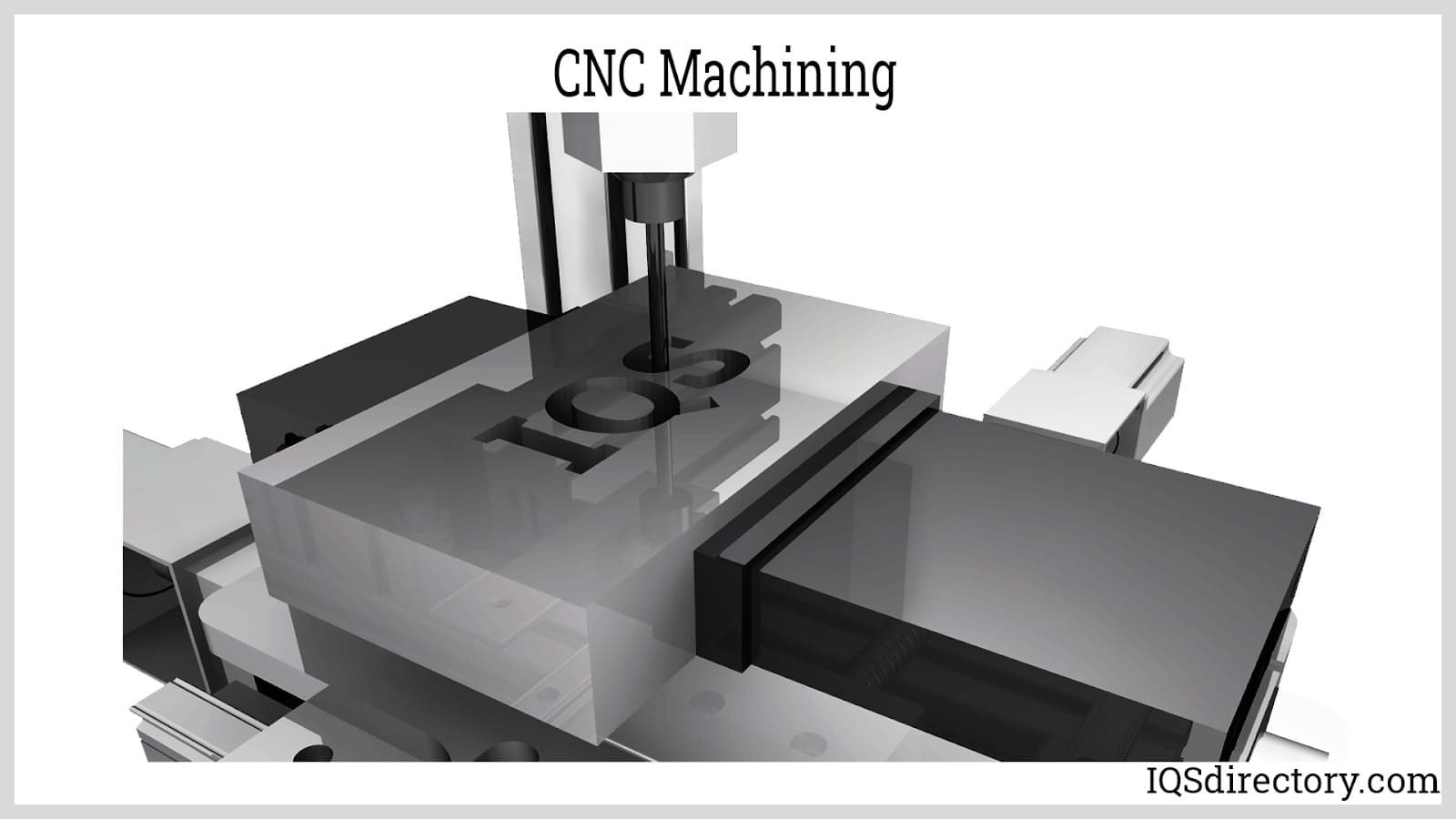 CNC machining is an electromechanical process that manipulates tools around three to five axes, with high precision.
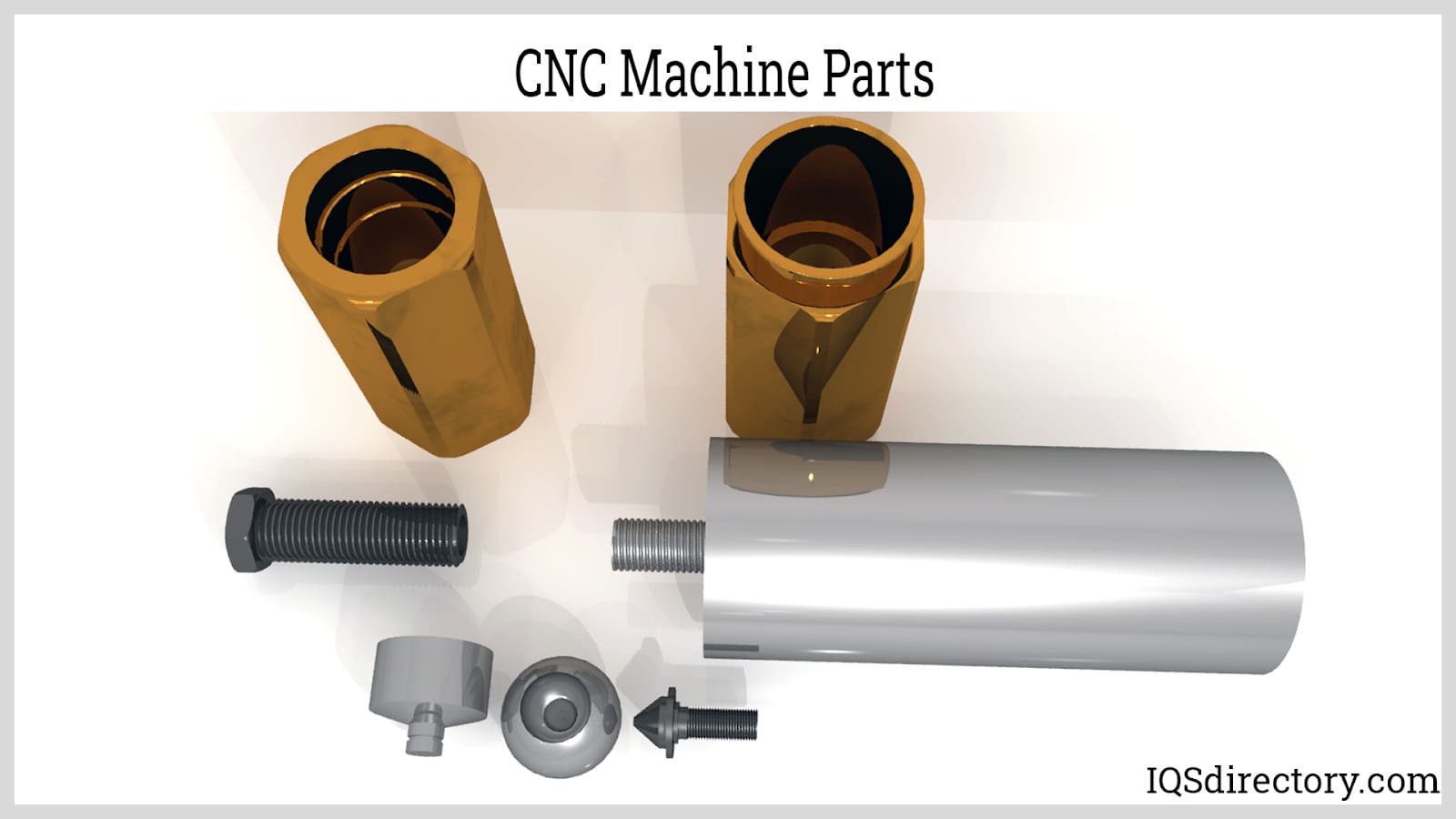 Examples of parts made using CNC machining with precision and accuracy.
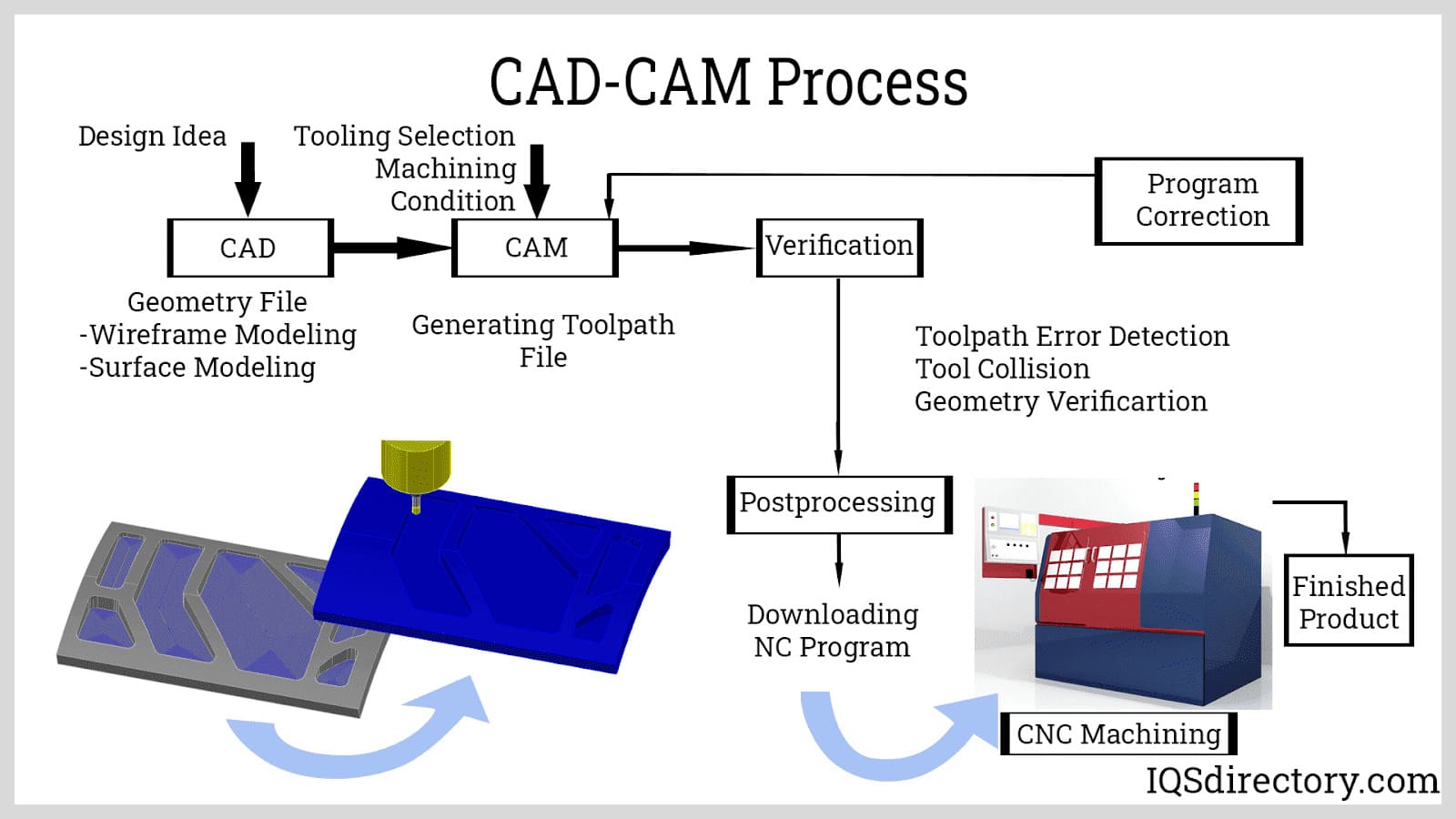 CAD-CAM, descriptive term for the software used for designing components using a CNC machine.
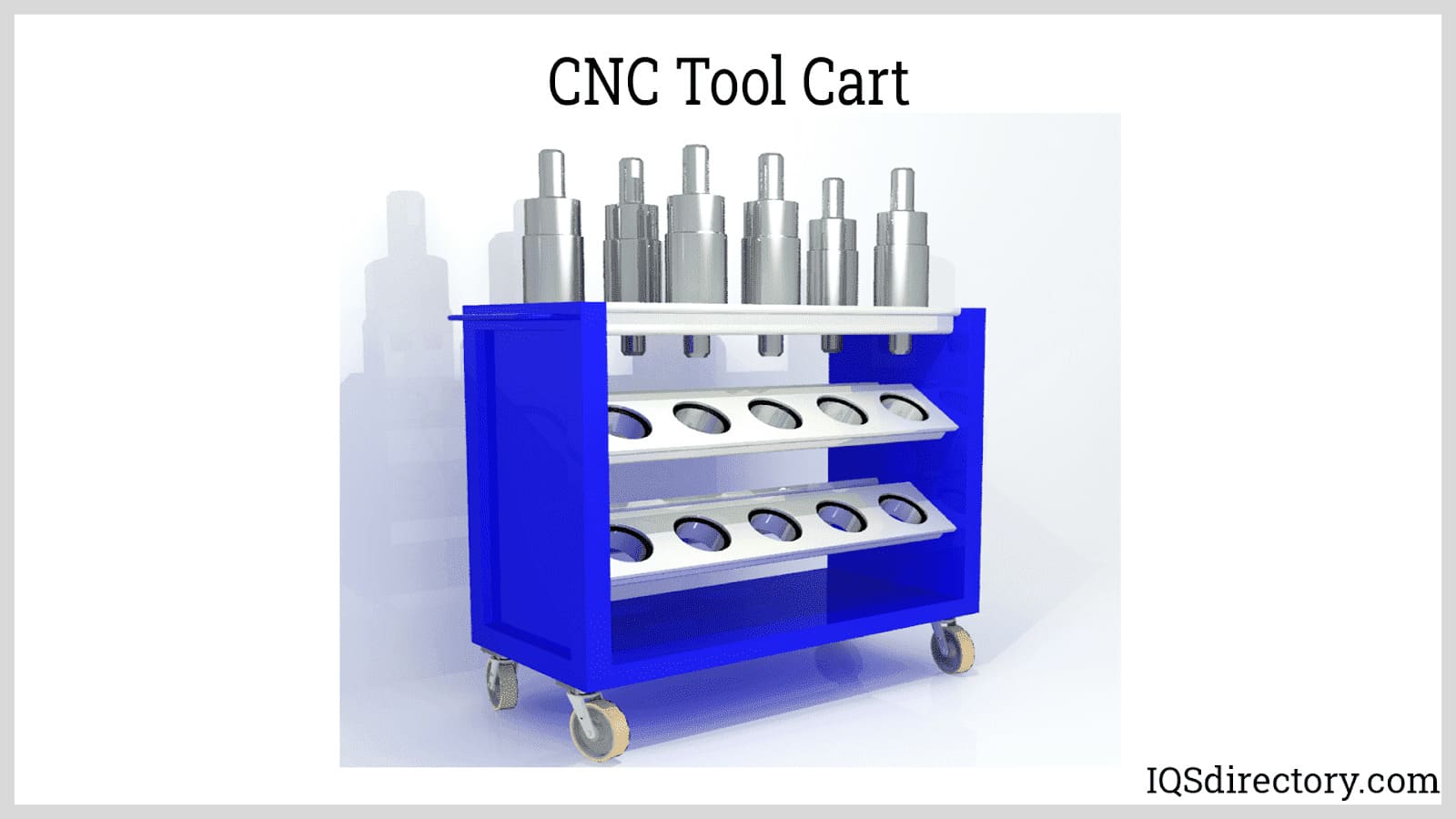 THe different tools used in CNC machining.
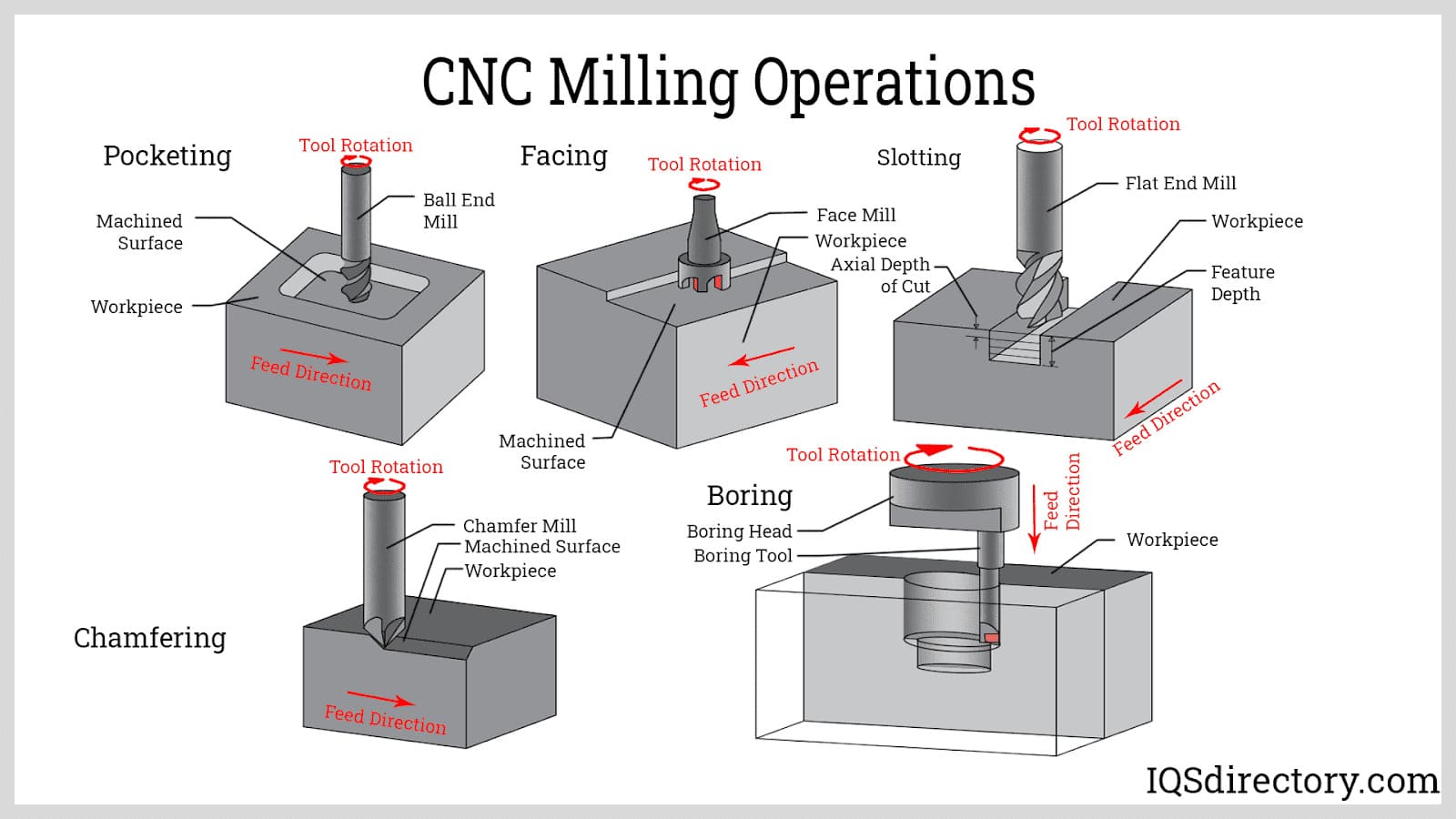 Operations and configurations that are used during the milling process.
CNC Machining Types
- CNC Cutting
- A precision manufacturing process that uses a number of different mechanical techniques in conjunction with computer numerical controlling software to remove excess material and create complex two dimensional and three dimensional shapes.
- CNC Drilling
- Employs computer automated machines to bore precision threads or holes into surfaces of variable material composition and thickness.
- CNC Grinding
- Uses an abrasive wheel, disc or belt to provide automated precision material removal and surface finish in a number of industrial and commercial applications.
- CNC Machine Shop
- A place where materials are shaped by CNC machines.
- CNC Machines
- Utilize computer logic to instruct and inform the design and production of precision parts through the use of computer automated machinery.
- CNC Manufacturing
- A production process that utilizes specialized computer software to direct complex automated machine components in the design and production of precision parts and components.
- CNC Milling
- Also known as "CNC turning," is possibly the most common kind of CNC machining. CNC milling machines are classified according to the number of axis points that they use. Typically these machines have at least three axes, X and Y for horizontal movements, and Z for verticals; some machines, however, utilize five axis points with extra pivot points.
- CNC Punch Machines
- Cut parts on computer numeric control systems.
- CNC Services
- Those operations provided by CNC machine shops that often integrate every step of the design and production of precision parts via the use of computer automated machinery.
- CNC Work
- Encompasses all tasks associated with and performed through the use of computer numerically controlled machinery which allows for the fast, efficient and accurate production of precision parts.
- Machine Work
- Shapes materials into precise forms.
- Precision Laser Machining
- The precision cutting of parts with CNC machines controlled laser to ensure accuracy.
- Precision Machining
- The process that uses a computerized machine to ensure exactitude.
- Prototype Machining
- The fast and accurate production of a single or low-volume conceptual model or “mock-up” of a product utilizing CNC machinery. Prototypes are used to prove feasibility, but often are not as efficient or well-designed as later production models.
Using a CNC Machine Shop
It is important to consider the exact processes necessary to design and create a given part in order to select the proper CNC machine shop. Considerations include diameter or dimensional capacities, software, material capabilities, production volume allowances and the specific machinery available. Dimensional and material capabilities vary widely among CNC providers. The diameter capacity is expressed in a range listing the upper and lower limits. Volume requirements may also be articulated in this manner. The material capabilities, however, should be specific. Common materials include any number of metals, glass, ceramic, wood and plastics. The capacity for different materials is largely dependent upon the machines used at a particular shop. While some manufacturers employ a limited number of machines, most provide a wide variety. Services such as broaching, etching, honing, screw machining, casting and forging may be had in addition to the aforementioned drilling, grinding, cutting and milling. Although CNC machining produces precision finished parts that rarely require secondary finishing, optional operations include anodizing, electroplating, heat treating, stress relieving, lapping, polishing, painting, welding and more are often available. Each of these programs is controlled by specific software that operates off any number of computer languages. G code, a standardized system of number and letter combinations, is a universal CNC language, though some manufacturers utilize other controllers such as bitmap, conversational, drawing exchange format, M-code or product specific software.
Once the proper facility, materials and software are chosen, the computer numerical control machining begins with collaboration between the manufacturer and the client. The use of computer assisted design (CAD) and computer aided manufacturing (CAM) as well as other advanced programming such as photo imaging allow for the product to be completely conceptualized in-house. These programs then convert the schematics and measurements of the item into code, which will direct the equipment. From this point the raw materials are loaded into the machine. Usually in the form of a billet or other stock shape, these pieces of glass, metal or plastic are cast, forged, rolled or extruded in advance and may be supplied by either the consumer or the machining shop. For products requiring only one piece of equipment, this is the only manual operation. Shops offering multiple services on different machines may have workers transfer materials between processes, or this step may also be automated. With the materials in place, the software is activated. No matter the specific computerized language chosen, this code is what dictates the behavior of the machinery. The computer is used to activate a series of commands that are performed in sequential order as needed. CNC programming instructs the positioning, pressure applied, depth and all other movements of these automated devices. These movements easily produce high precision identical parts in rapid succession, a process that would take much longer if performed manually.
Since its beginnings in the 1970's, CNC machining software and capabilities have greatly improved and expanded. Despite the complexities of the machining and the computer coding, CNC programs are known for having a highly accessible interface that is far easier for beginners to operate than would be the machines it automates. Manufacturers may offer a hands-on approach allowing clients to play an integral role in the design of a part and the schematic used to produce it. Often a prototype, or working model, is first produced before long run production begins to ensure the most efficient use of materials and machinery. While this is possible with manual operations, CNC machining offers rapid prototyping and, since the code is stored in the computer system, the final product is guaranteed to be an identical replica of the prototype. After production ceases the code may also be filed for future use. The use of CNC machining therefore ensures the production of high precision, high quality parts and components that are made quickly and to the exact specifications of industrial purchasers representing a broad array of applications including military, automotive, aerospace, metallurgy and more. CNC manufacturers provide not only a finished product, but they also aid in the design, streamlining and upgrading of operations as per the request of the client.
CNC Machining Terms
- A-Axis
- A CNC machining tool using a circular axis motion or slide about the x-axis; values along the a-axis are the degrees of rotation about the x-axis.
- Absolute System
- A CNC machining system that refers to all positional dimensions in reference to a shared datum point; includes both feedback and input.
- Analog
- Referring to a CNC machining system which utilizes electrical voltage ratios or magnitudes to represent physical axis positions.
- American Standard Code for Information Exchange (ASCII)
- The American Standards Association established ASCII as a data transmission code in America.
- Axis
- The relative movements of a workpiece or precision CNC machining tool that moves along a primary direction, consisting of three linear axes, which are at ninety degree angles from each other; the X,Y for horizontal movement and Z for vertical movement.
- Axis Inhibit
- A characteristic of a numerically controlled unit that gives CNC machine work operators the ability to withhold command information from CNC machining and CNC milling tool slides.
- Axis Inversion
- Also called Mirror Image. This CNC machining service command procedure is used to create a reverse or mirrored part by reversing the plus and minus values along a given axis; mirror imaging makes a left oriented part using a right handed oriented tool path; circular interpolation also reverses.
- Basic Control Language (BCL)
- A CNC machining controller language using the EIA/ANSI 494 software.
- B-axis
- Circular motion of CNC Machining tools along and around the y-axis.
- Block
- A single line of NC code representing enough information for precision CNC machining tools to execute a single arc or line movement.
- Block Delete
- A function allowing the CNC machine work control system to ignore any select block of code, at the CNC Machining operators control.
- CAD/CAM
- Computer Aided Design / Computer Aided Manufacturing; this is the use of computers to assist in both CNC tool developments and CNC manufacturing phases.
- Computer Aided Design (CAD)
- Utilizing computers to assist the development phase of CNC machining designs.
- Computer Aided Manufacturing (CAM)
- Utilizing computers to assist in manufacturing processes by the computerized control of the tooling process.
- Clockwise Arc
- Coordination between two axes produces an arc and it’s curvature is clockwise in respect to the part being machined and the Cartesian planes.
- Counterclockwise Arc
- Coordination between two axes produces an arc that has a curvature that is counterclockwise in respect to the part undergoing precision CNC machining services and the Cartesian planes.
- Linear Interpolation
- A control function in CNC machining services in which data points are created between given coordinate positions to permit simultaneous movement along one or more axes of motion in a linear path.
- Manual Part Programming
- The process of creating a manuscript in the machine control language format that defines the series of commands for a CNC machine.
- Modal
- The retention of information by CNC machining computer systems until new information is received to replace it.
- Offset
- A displacement of a precision CNC machining tool along an axial direction the same as the difference between the real length and the inputted CNC milling tool length.
- Overshoot
- The quantity to which axis motion goes beyond the targeted value.