Electrical Discharge Machining
Electrical Discharge Machining (EDM) is a precision machining and advanced manufacturing process used to shape electrically conductive metals and alloys through controlled spark erosion. Often researched under terms such as spark machining, spark eroding, wire burning, wire erosion, and die sinking, EDM removes material from a workpiece through rapid, repeatable electrical discharges between an electrode and the part. Those discharges occur across a carefully managed spark gap filled with dielectric fluid, allowing manufacturers and contract machining providers to produce tight-tolerance features, fine details, deep cavities, intricate internal geometries, and precision contours without direct cutting pressure. Because the process is non-contact, EDM is widely used for hardened steel, carbide, titanium, nickel alloys, tool steel, stainless steel, and delicate components that may deform under conventional machining. Buyers often compare EDM with CNC milling, grinding, laser cutting, broaching, and conventional drilling when evaluating accuracy, surface finish, burr-free edges, small-hole capability, tooling life, and production feasibility. The most common machine categories are Die Sinker (RAM), Wire EDM, and Hole Drilling or Hole Popper systems, with additional specialty EDM processes available for micro machining, tooling repair, prototype work, low-volume production, and precision part manufacturing across aerospace, medical, electronics, automotive, and tool-and-die applications.
Electrical Discharge Machining (EDM) FAQs
What is Electrical Discharge Machining and how does it work?
Electrical Discharge Machining, or EDM, is a non-contact machining process that shapes electrically conductive materials with controlled electrical discharges between an electrode and a workpiece separated by dielectric fluid. Each spark removes a tiny amount of material, making EDM a strong choice for precision machining, close tolerances, complex cavities, sharp internal corners, fine slots, and intricate profiles in hard metals where conventional cutting tools may struggle.
What are the main types of EDM processes?
The main EDM process types are Die Sinker EDM, Wire EDM, and Hole Drilling EDM. Buyers may also encounter Micro EDM, Micro Wire EDM, Electrical Discharge Grinding, and Metal Disintegration Machining. Each process serves different manufacturing goals, from mold cavity production and precision profile cutting to small-hole drilling, broken tap removal, micro-feature machining, and ultra-fine detail creation.
What are the advantages of using EDM for manufacturing?
EDM offers several production benefits: it machines hardened conductive materials, supports complex part geometry, delivers fine surface finishes, and reduces mechanical stress because there is no direct contact between tool and workpiece. It is especially useful for tooling, mold making, aerospace parts, medical components, electronics, and any job where accuracy, repeatability, feature detail, and dimensional consistency matter more than raw removal speed.
What materials can be machined using EDM?
EDM can machine only electrically conductive materials, including tool steel, hardened steel, stainless steel, carbide, brass, copper, titanium, Inconel, and copper tungsten applications. Material choice affects electrode wear, flushing performance, metal removal rate, recast behavior, and final finish, so process settings are often tuned for the alloy, hardness, thickness, and feature size being produced.
How does dielectric fluid function in EDM?
Dielectric fluid controls the EDM spark gap until ionization occurs, then supports stable discharge, cooling, and debris removal. Oil-based dielectric is common in sinker EDM, while deionized water is widely used in wire EDM. Clean fluid and proper flushing improve cut stability, surface quality, dimensional accuracy, wire performance, and machine uptime.
When should a manufacturer choose EDM over conventional machining?
Manufacturers often choose EDM when conventional cutting struggles with hardened materials, deep ribs, thin walls, micro holes, narrow slots, or intricate shapes. EDM is also a strong fit when part distortion must be minimized, when a surface finish target is demanding, or when a project calls for repeatable precision in molds, dies, fixtures, prototypes, or short-run production components with complex geometry.
What are common EDM applications in industry?
Common EDM applications include tool and die making, injection mold cavities, extrusion tooling, aerospace cooling holes, medical device components, broken tool removal, prototype parts, precision blanking dies, and fine-feature parts in automotive and electronics manufacturing. Buyers frequently search for EDM solutions when they need complex geometry, hard-material machining, dependable high-accuracy part production, or a machining method that protects delicate features.
The History of EDM
While the major EDM methods developed along different timelines, they all rely on the same underlying principle: controlled erosion by electrical discharge. That idea dates back to Joseph Priestley in 1770, and it later evolved into one of the most practical precision machining technologies for conductive materials, hard-tooling applications, close-tolerance tooling, and fine-detail manufacturing where repeatability and geometry control matter.
Die Sinker EDM, often called plunge EDM or ram EDM, emerged as researchers looked for a way to manage erosion in electrical contacts. In the early 1940s, Russian inventors Boris and Natalya Lazarenko showed that spark erosion could be controlled in dielectric fluid, laying the groundwork for the resistor-capacitor EDM circuit. Around that same period, Harold Stark, Victor Harding, and Jack Beaver advanced EDM equipment for removing broken drills and taps from aluminum castings. As spark repetition, flushing, servo control, and power settings improved, sinker EDM became a practical shop-floor process for cavity machining, mold making, die work, tooling repair, and complex form generation in hard conductive materials.
Wire EDM took shape during the 1960s and 1970s as manufacturers searched for a more precise way to cut hardened steel dies and profiles. Instead of a formed electrode, wire EDM uses a continuously fed fine wire that follows a CNC-controlled path through the workpiece, making it well suited for intricate contours, punch and die components, medical parts, aerospace features, fixture plates, and production runs where dimensional consistency matters. The move from manually guided concepts to software-driven wire paths helped establish wire EDM as a trusted process for precision cutting, burr-minimized edges, and repeatable high-accuracy part geometry.
Advantages and Disadvantages of EDM
Electrical Discharge Machining is often chosen because it solves design and production challenges that traditional cutting methods cannot address as efficiently. For buyers comparing EDM services, the main question is usually not whether EDM is faster than milling or drilling, but whether it delivers better geometry, better predictability, tighter tolerance control, or better results for the specific part, material, and feature set.
- It produces complex shapes, narrow slots, deep ribs, sharp internal corners, and fine detail that can be difficult to achieve with conventional machining, especially in hardened steel, carbide, and intricate tooling components.
- It supports excellent surface finish options and repeatable dimensional accuracy for tooling, molds, dies, fixtures, and precision components where tolerance repeatability affects downstream assembly or tool life.
- It machines hardened steel, carbide, titanium alloys, and other difficult conductive materials without the cutting-force issues common in contact machining, making it attractive for post-heat-treat work and hard-material applications.
- Because there is no direct tool pressure on the workpiece, EDM helps protect thin walls, delicate sections, and fragile part features from distortion, deflection, chatter-related damage, and burr formation.
- It works especially well on small workpieces and micro features where traditional cutting tools may introduce too much force, chatter, tool deflection, or breakage during machining.
EDM also comes with tradeoffs that buyers should weigh during process selection, cost review, and supplier evaluation, particularly when lead time, volume, material thickness, or electrode requirements shape the quoting process:
- Skilled EDM programmers and machinists are needed to manage electrode design, machine setup, flushing, burn strategy, taper control, offset compensation, and finish requirements.
- Material removal rates are usually slower than many conventional machining methods, especially on roughing-heavy jobs, thick sections, or applications where multiple skim passes are needed.
- Power use and machine operating costs can be higher depending on cycle time, dielectric management, wire consumption, consumables, and feature complexity.
- For RAM or sinker EDM, custom electrode design and fabrication add another step to lead time, project planning, tooling preparation, and total machining cost.
EDM Images, Diagrams and Visual Concepts
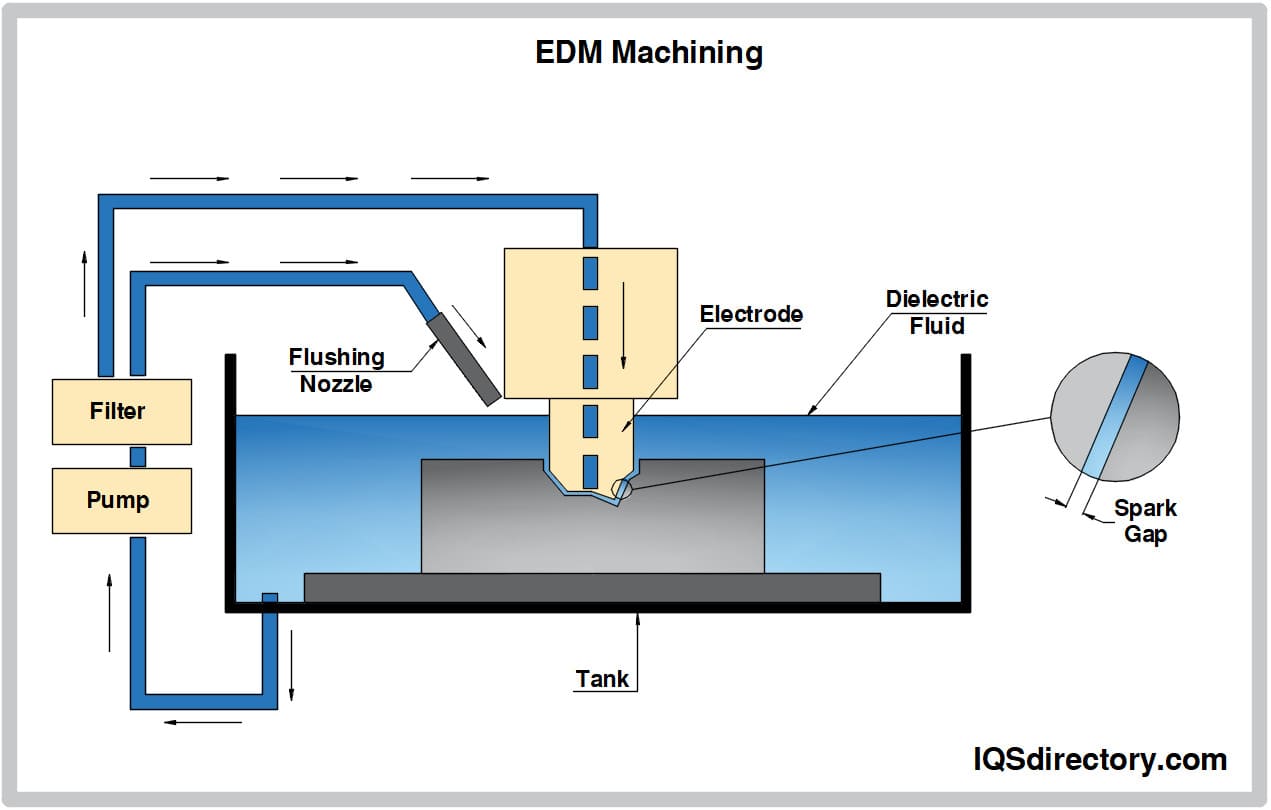 The basic funstions of an EDM machine to remove material using thermal energy.
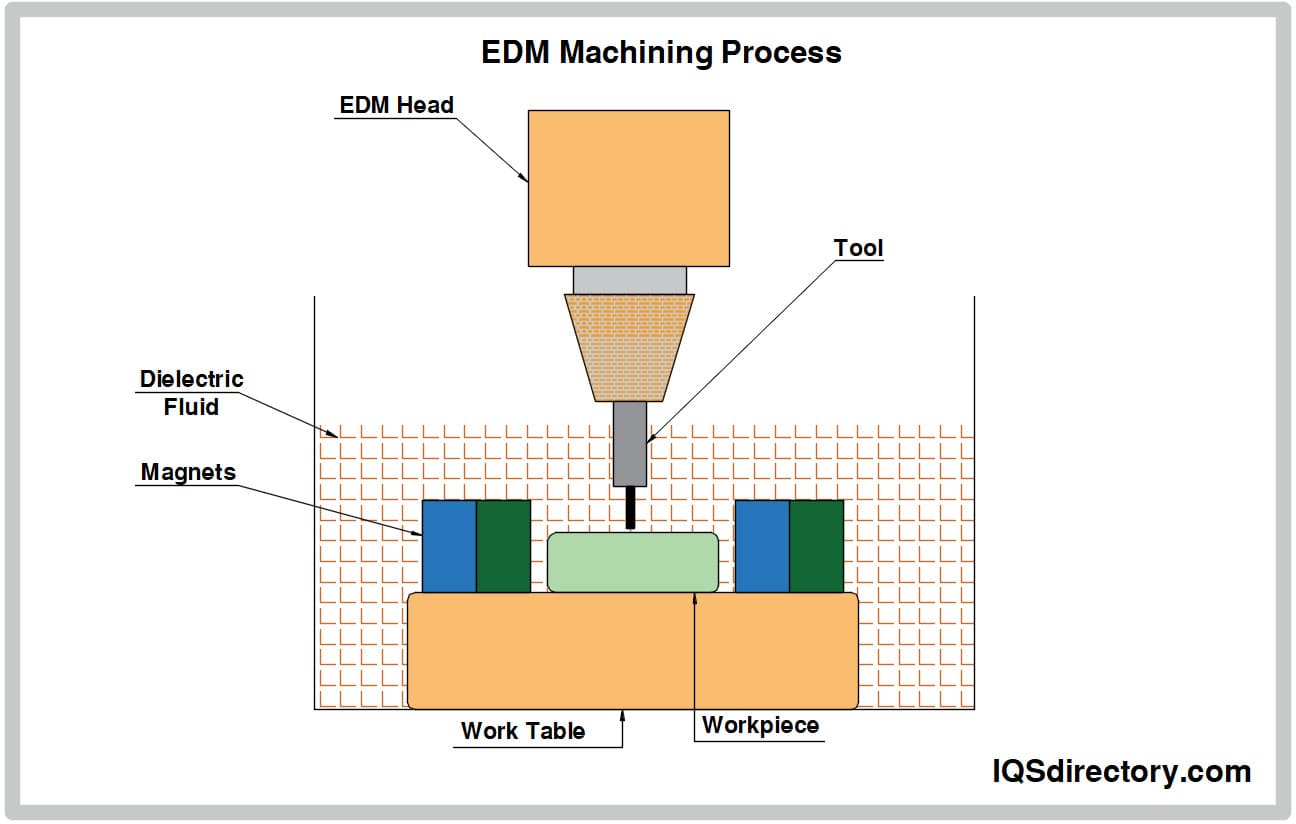 EDM machining process, the material is removed from the part to be machined and the electrode tool, the gap increases between the work and the tool, which must maintain a constant gap and arcing voltage to prevent a short circuit.
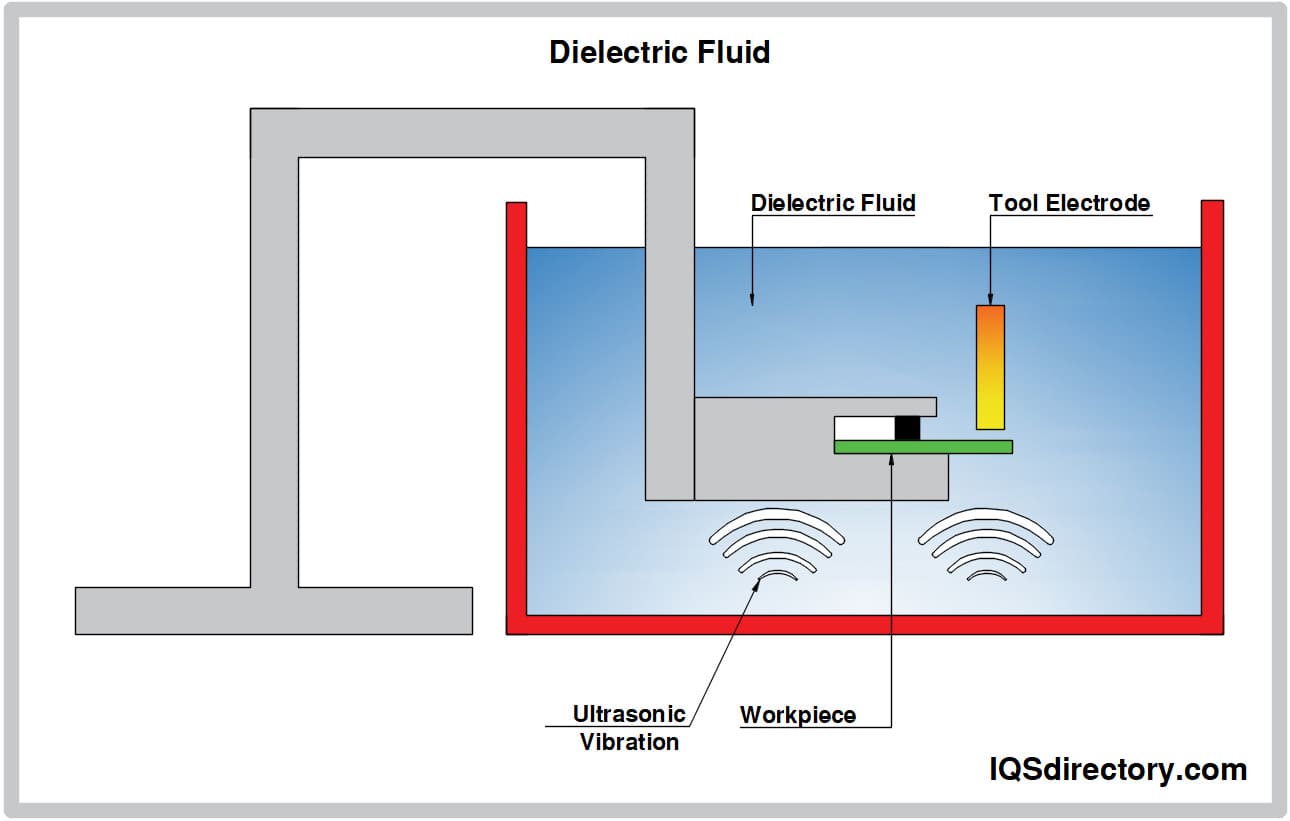 The different types of dielectric fluids are kerosene, paraffin oil, lubricating oil, transformer oil, or distilled water.
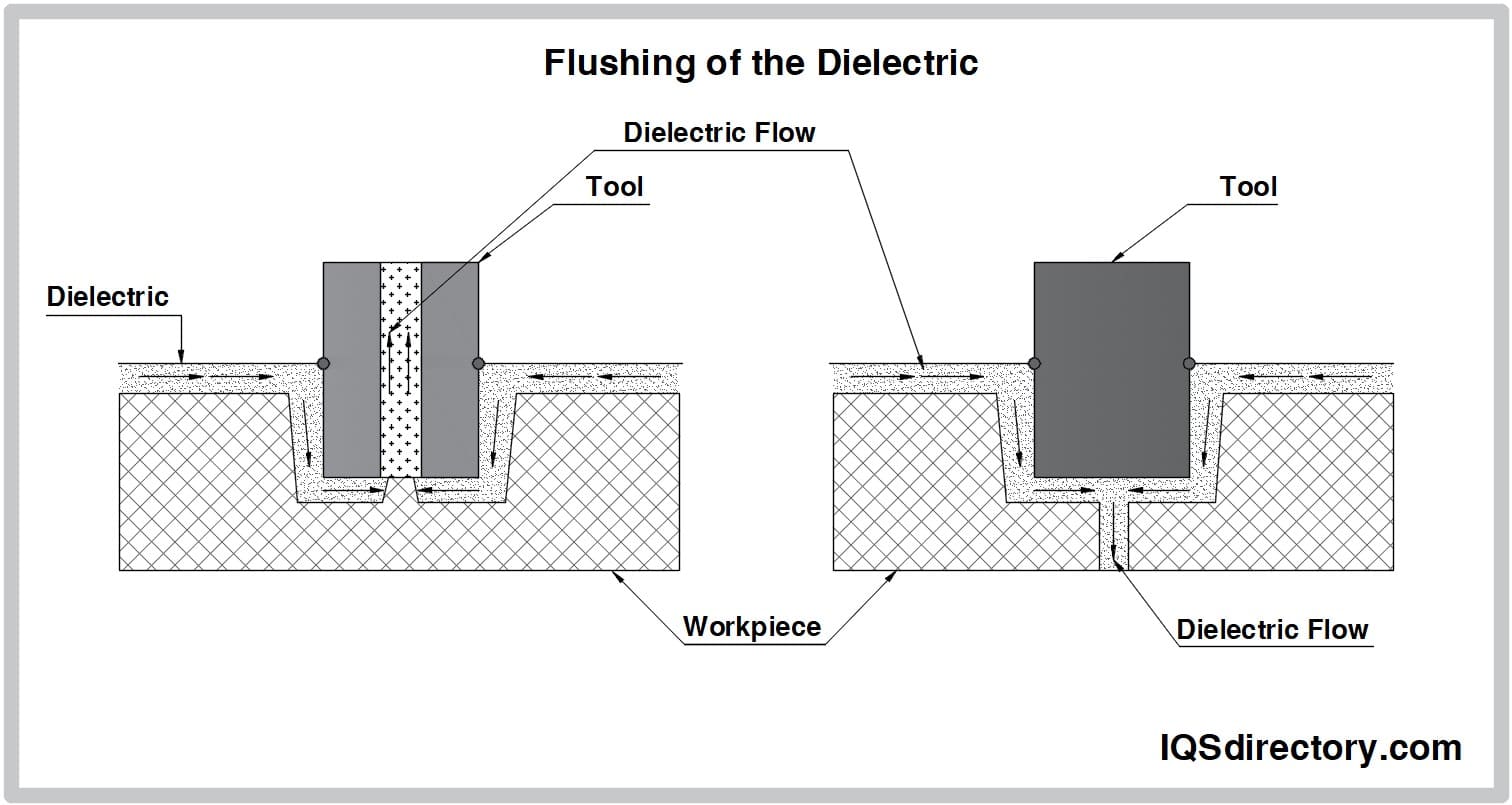 A proper circulation of the dielectric fluid at the gap that is between the workpiece and electrode tool in EDM machining.
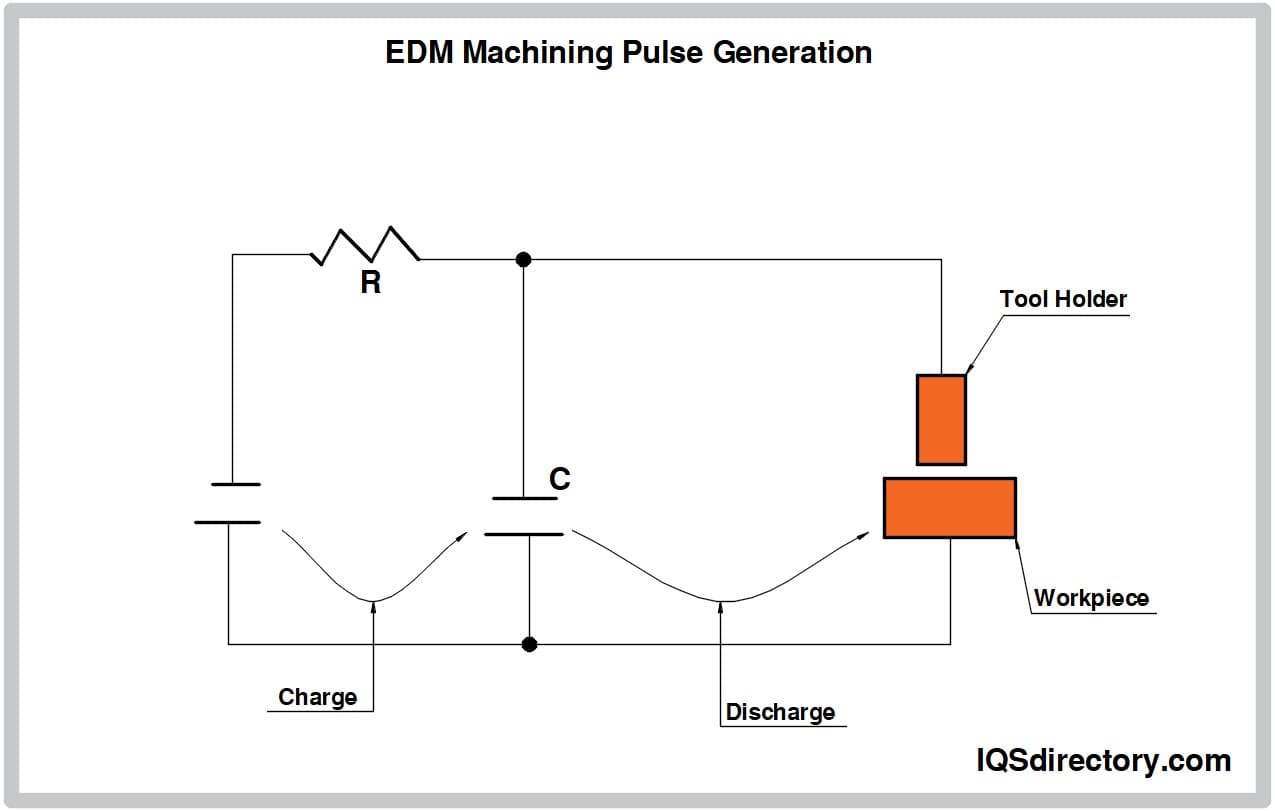 The tool and part machined, a spark is generated, in the presence of a dielectric medium, which removes material from the surface of the workpiece.
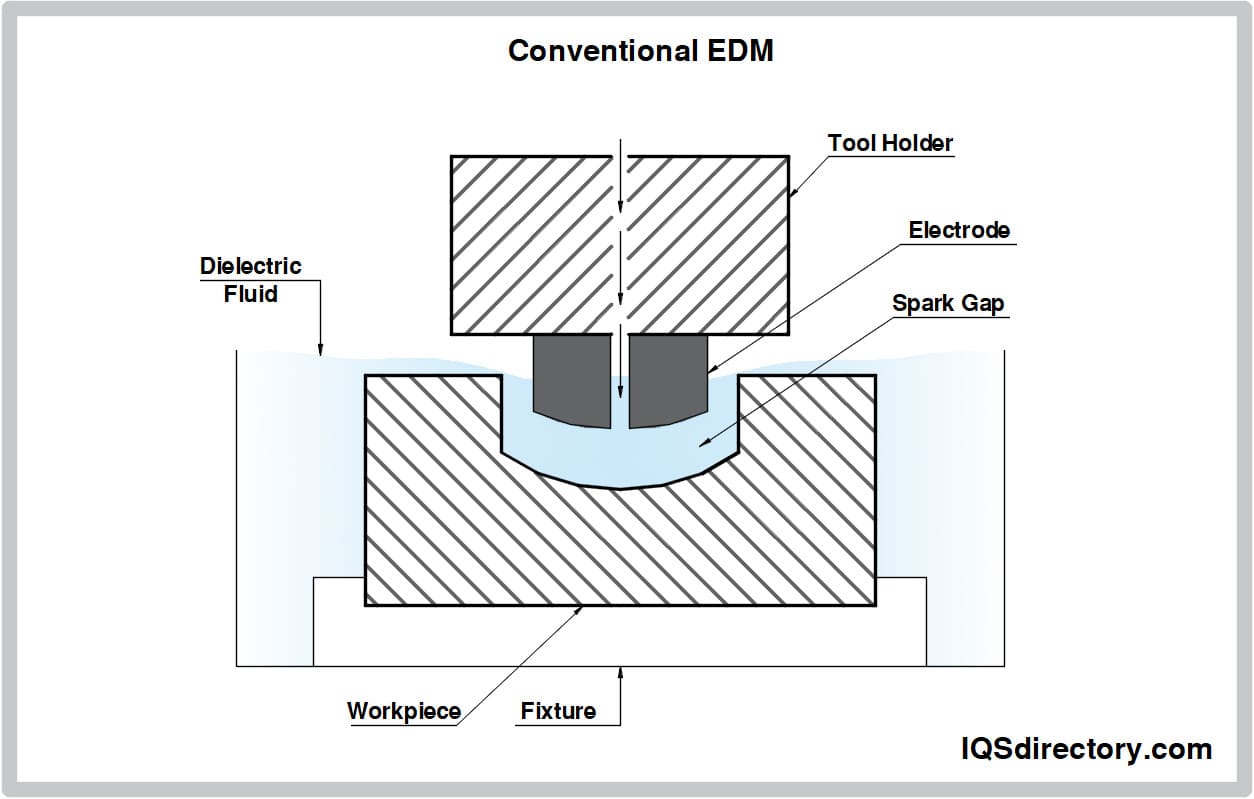 Conventional EDM makes use of machining to create a distinctive shape of an electrode, then sunk deep into the material to be machined.
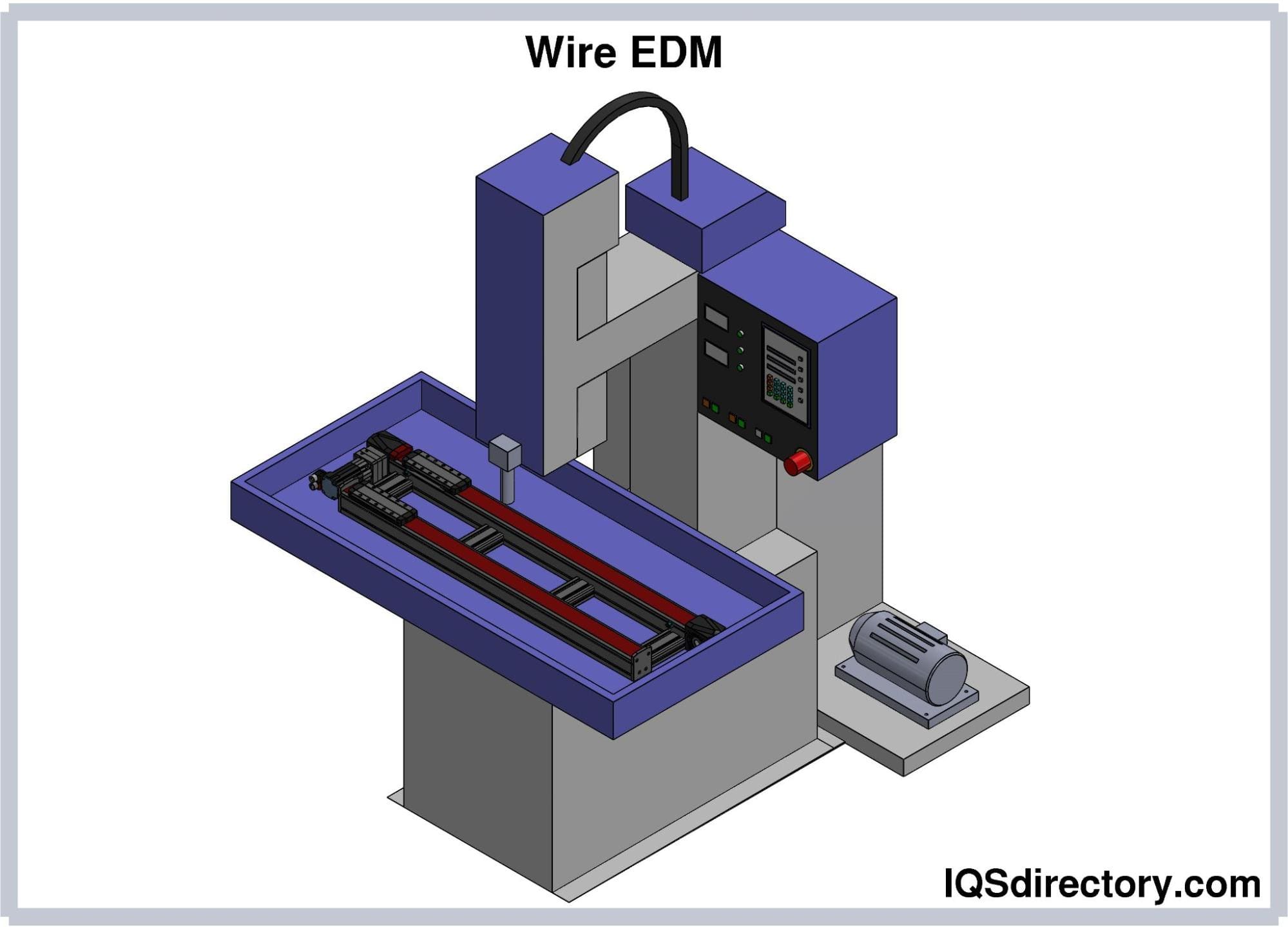 Wire EDM Machines uses deionized water to conduct electricity to cut through metal while preventing rust.
EDM Types
-
Double Rotating Electrodes
This EDM method employs rotating electrodes to erode a revolving workpiece. By adjusting the relative positions and angular velocities of both the workpiece and the electrode, different shapes can be created for specialty profiles, precision contours, and advanced conductive-part machining.
Electrical Discharge Grinding (EDG)
In this process, a rotating electrically conductive wheel acts as the electrode tool for electrical discharge erosion. EDG is an alternative method for sharpening diamond and carbide-tipped cutting tools, helping reduce costs associated with diamond grinding wheels while supporting fine edge preparation and tool refurbishment.
Electrical Discharge Machining (EDM)
This process uses a tool electrode to gradually transfer a mirror image of itself onto the workpiece, making small holes, cavities, and precise shapes in electrically conductive materials used in molds, dies, fixtures, and production tooling.
Micro Electrical Discharge Machining (micro EDM)
A miniature ram-type machine that typically uses a diamond V-groove to spin the tool electrode up to 10,000 rpm. Electrode diameters as small as five microns can be used to produce micro-holes and other shapes in thin, electrically conductive materials for electronics, medical components, and other precision micro-manufacturing applications.
Micro Wire EDM
This process uses a tungsten wire electrode with a diameter as small as 10µm to machine parts ranging from 0.1 to 1 mm in size. These tiny parts cannot be formed through conventional semiconductor processes. Specially designed wire movement systems, spark generators, and monitoring systems help control the low energy levels necessary for these operations and support precision cutting of very small conductive components.
Sinker EDM
Also known as plunge EDM or ram EDM, this method removes metal by using rapid electrical discharges to erode the material, making it well suited for mold cavities, deep ribs, sharp details, and formed internal features.
Small Hole EDM
This process employs electrical discharges to create microscopic holes in materials for start holes, cooling passages, flow holes, and fine-diameter drilling applications in hard conductive alloys.
Wire Electrical Discharge Machining (Wire EDM)
Wire EDM is a commonly used process in which a wire electrode moves longitudinally through the workpiece, eroding material along the path. A CNC machine with specialized software precisely controls the movement of the wire relative to the workpiece, supporting accurate profile cutting, tight corners, and repeatable production quality.
Hole Drilling EDM
The advantages of EDM make it ideal for specific hole-making applications. If a pilot hole has already been drilled, the wire can be threaded into it to finish the process using Wire EDM. In cases where a pilot hole is not present, a dedicated EDM hole-making machine is used. The Hole Drilling EDM (also called a "Hole Popper") utilizes a turning conductive tube as the electrode and continuous dielectric fluid flow to flush the cut. This method is also useful for creating the pilot hole needed for wire threading and for producing precision cooling holes in hard alloys.
EDM Applications
-
Metal Disintegration Machining (MDM)
MDM machines are designed to remove broken tools from workpieces. The process is specifically intended to remove only the center of a bolt, tap, or stud, leaving the hole intact for further processing, repair, or thread recovery.
Small Hole Drilling
This process has various applications. For wire-cut EDM, it is used to create a hole in a workpiece through which the wire can be threaded for the wire-cut operation. A small hole drilling EDM head is mounted on a wire-cut machine and is used to machine large, hardened parts without the need for conventional pre-drilling. It is commonly used to drill rows of holes at the beginning and end edges of turbine blades for jet engines. These holes allow gas to flow through, enabling the engine to operate at higher temperatures. Additionally, this method is employed to make spinnerets for synthetic fibers, fuel-system components, and other fine-hole applications.
Coinage Die Making
Coinage die making is used to produce dies for creating badges, jewelry, and for blanking or piercing operations. Typically, the positive master is made from sterling silver, as it is somewhat eroded during the process and is generally used only once. Once the master is used, the negative die is hardened and used with a drop hammer to produce stamped flat parts from cutout sheets with fine detail and repeatable form.
Prototype Production
While the EDM process has traditionally been used in tool, mold, and die industries, it is increasingly being employed for producing prototype and production parts. This is especially true in industries such as aerospace, electronics, automotive, and medical manufacturing, where production quantities are relatively low and feature complexity is high.
EDM Materials
Any workpiece machined with EDM must be electrically conductive, but conductivity alone does not decide process success. Material hardness, alloy family, thickness, feature geometry, and finish expectations all influence electrode choice, spark settings, flushing strategy, metal removal rate, and cycle time. High-nickel alloys, carbide, and other difficult materials can be machined successfully when parameters are matched to the application and the required tolerance window.
Because EDM is a thermal machining process, it can create a recast layer, a heat affected zone, or micro-cracking if settings are not optimized. At the same time, EDM remains attractive because it is a low-force process that avoids the mechanical stress associated with direct cutting. Common EDM-related materials and electrode choices include brass, copper, copper tungsten, graphite, hardened steel, stainless steel, titanium alloys, carbide, and other conductive materials used in precision machining.
When choosing electrode material, buyers usually evaluate resistivity, wear resistance, machinability, surface finish goals, and the size of the feature being produced. The right electrode-workpiece combination supports better burn stability, lower wear, predictable part quality, and more consistent production results across repeat jobs.
Dielectric Fluid
A RAM or sinker EDM machine usually uses hydrocarbon oil as the dielectric fluid, while wire EDM typically uses deionized water in the cutting zone. In both cases, the dielectric serves several process functions at once: it maintains the proper spark gap, cools the work area, and helps carry away eroded particles so the burn remains stable, accurate, and repeatable over long machining cycles.
As dielectric fluid ages or becomes contaminated, discharge stability can decline. Dirty fluid can change conductivity, interfere with spark thresholds, increase arcing risk, and reduce cut consistency. For that reason, continuous flushing and filtration are part of good EDM process control, machine maintenance, and part quality management.
Dielectric fluid life depends on fluid type, filter performance, contamination level, and machine usage. Shops often monitor the condition of oil-based dielectric over time and replace it when age, debris load, or measured properties show that performance is slipping. A refractometer or comparable test method can help determine when replacement is justified and when process consistency may be affected.
When selecting dielectric fluid, manufacturers look at metal removal rate, electrode wear, flushing behavior, particle suspension, finish requirements, and machine compatibility. If you are comparing EDM providers, asking how they manage dielectric cleanliness, filtration, flushing, and consumable control can reveal a great deal about process discipline and expected part quality.
Things to Consider When Choosing EDM
-
There are, of course, other ways to cut parts. When compared to conventional machining, electrical discharge machining (EDM) has its own set of advantages and disadvantages. Whether EDM is the best choice depends largely on the specifics of your application, your part geometry, and the conductive material being machined.
Some features of electrical discharge machining can help determine if it's the right process for your material. EDM is generally slower than other machining methods, but it often offers more accuracy, finer detail, and better predictability for complex conductive parts.
Considering Design To optimize the use of EDM, consider relaxing the surface finish requirements when the application allows. This lets manufacturers complete the part in fewer passes, resulting in higher metal removal rates and more efficient cycle planning. Additionally, design the part so that the amount of stock removed by the machine is minimal. Use traditional techniques to remove the majority of the stock, leaving finishing operations, detail features, or close-tolerance geometry to the EDM process. This approach can reduce both cost and time for each part.
Another design consideration is the use of fixtures. Many parts can be stacked and machined simultaneously, or a single part can undergo multiple EDM operations at once. When enlarging existing holes or reshaping them, through holes are preferable to blind holes, as they allow dielectric fluid to flow more easily through the machined area and improve flushing performance.
Considering Manufacturers As manufacturers expand their businesses, many are taking full advantage of new machinery that can help them succeed. EDM is a process that may not always be the first choice, but when its benefits are understood, it can be a very effective option for precision production, tooling support, and complex-part machining.
Look for a contract manufacturer with extensive experience and a reputation for excellent customer service. The right manufacturer will be confident in their ability to complete the job to your specifications and support part quality, schedule expectations, and repeatability. Even though the equipment for EDM can require a significant investment, manufacturers should prioritize high-quality EDM machines, process control, inspection capability, and skilled programming. Seek out manufacturers who are committed to delivering precision and quality in every project.
EDM Terms
-
Altered Metal Zone
A zone on a metal surface that has been thermally and structurally altered by the EDM process.
Billet
An uncut block of graphite supplied by a manufacturer and commonly machined into an EDM electrode.
Burning
A colloquial shop-floor term used to describe the EDM process or a sinker EDM operation.
Capacitor
An electrical device used to store electrical energy in EDM power circuits and pulse-generation systems.
Center Flow
Dielectric fluid that is pumped through the workpiece or electrode for flushing purposes so debris can be removed from the spark gap.
Crater
Small holes on the workpiece surface created by EDM sparks, also known as pits, which influence finish and texture.
Dielectric Fluid
A non-conductive liquid that fills the space between the electrode and the workpiece, insulating them until the required voltage and gap are achieved. Once ionized, it becomes conductive, allowing current to flow to the workpiece while cooling the material and flushing away debris.
Diametrical Sparking Distance
The difference in size between the electrode and the crater it creates on the workpiece.
Discharge
The spark produced in the EDM process.
Edge Finder
An electrically operated tool used to precisely locate the workpiece in relation to the electrode. When the workpiece is within 0.0001 inches of the electrode, a signal or buzzer alerts the operator.
EDM Drilling
A specialized process that uses electrical energy in the form of sparks to create holes in metal parts.
EDM Machining
A process that shapes and forms metal parts using electrical energy.
Electrode
The tool used in the EDM process, made of electrically conductive material. The shape of the electrode mirrors the desired shape in the workpiece, with compensation for the overcut.
Eroding
The process of removing material through electrical discharge machining.
Finish
The surface texture resulting from the EDM process, typically measured as min Ra (U.S.).
Finish Cut
The final cut made on a workpiece. To achieve the desired finish and size, the rough cuts should leave just enough material for the finish cut to remove.
Flushing
The action of forcing dielectric fluid through the gap to remove debris created during the EDM process.
Gap Voltage
A measurement of the voltage across two points in a complete cycle: open gap voltage is measured across the electrode and workpiece before the spark, while working gap voltage is measured as the spark current discharges.
Graphite
One of the four types of carbon, commonly used as electrode material due to its high resistance to heat and ease of machining.
Heat Affected Zone (HAZ)
The area beneath the recast layer where metal properties change due to exposure to high heat.
Off-Time
The time interval between sparks during the EDM process.
Overcut
The difference in size between the electrode and the cavity, as an EDM crater is always larger than the electrode. Overcut can be measured as total overcut (diametrical overcut) or overcut per side.
Peak Current
The highest current available during each pulse from the power supply.
Recast Layer
A layer of material formed when melted metal solidifies on the surface of the workpiece.
Roughing (Hogging) Cut
An EDM method that removes the most material in the shortest amount of time.
Spark
The electrical discharge between two conductors during the EDM process.
Spark Gap
The space between the electrode and the workpiece at the point where the discharge occurs.
Spark Intensity
The energy contained in each spark during the EDM process.
Surface Finish
The smoothness or roughness of the machined surface, often measured in min Ra in the U.S.
Wear
The erosion of the electrode during the EDM process.
Workpiece
Any metal part subjected to the electrical discharge machining process.