Please fill out the following form to submit a Request for Quote to any of the following companies listed on
Get Your Company Listed on this Power Page
Introduction
Information about spiral brushes including their types and uses with a list of manufacturers
You will learn:
What is a Spiral Brush?
How Spiral Brushes are Made
Types of Spiral Brushes
Uses for Spiral Brushes
And much more ...
Chapter 1: What is a Spiral Brush?
A spiral brush has its bristles or filaments wound in a helical corkscrew pattern to form a cylindrical brush or twisted stem brush. This unique spiral wound construction creates a flexible, high-contact cleaning surface that allows the brush to clean tubes, pipes, conveyors, channels, and other rounded or irregular shapes. The choice of spiral brush depends on the filament material, brush diameter, and core design, with options ranging from nylon bristles and abrasive fibers to twisted steel wire for more aggressive scrubbing and deburring applications.
The applications for spiral brushes include removing debris from a belt conveyor, dusting surfaces, guiding product, and lightly cleaning components without damaging the finish. Spaces between the loops in a spiral brush vary from tightly wound coils to nearly a foot or more apart, depending on the brush design and intended use. The most common and well known form of spiral brushes has a metal channel down the middle with filaments pointing outward, which are referred to as open wound cylinder brushes or open coil brushes. These industrial brush styles are often selected for cleaning, polishing, sweeping, wiping, and surface finishing in manufacturing environments.
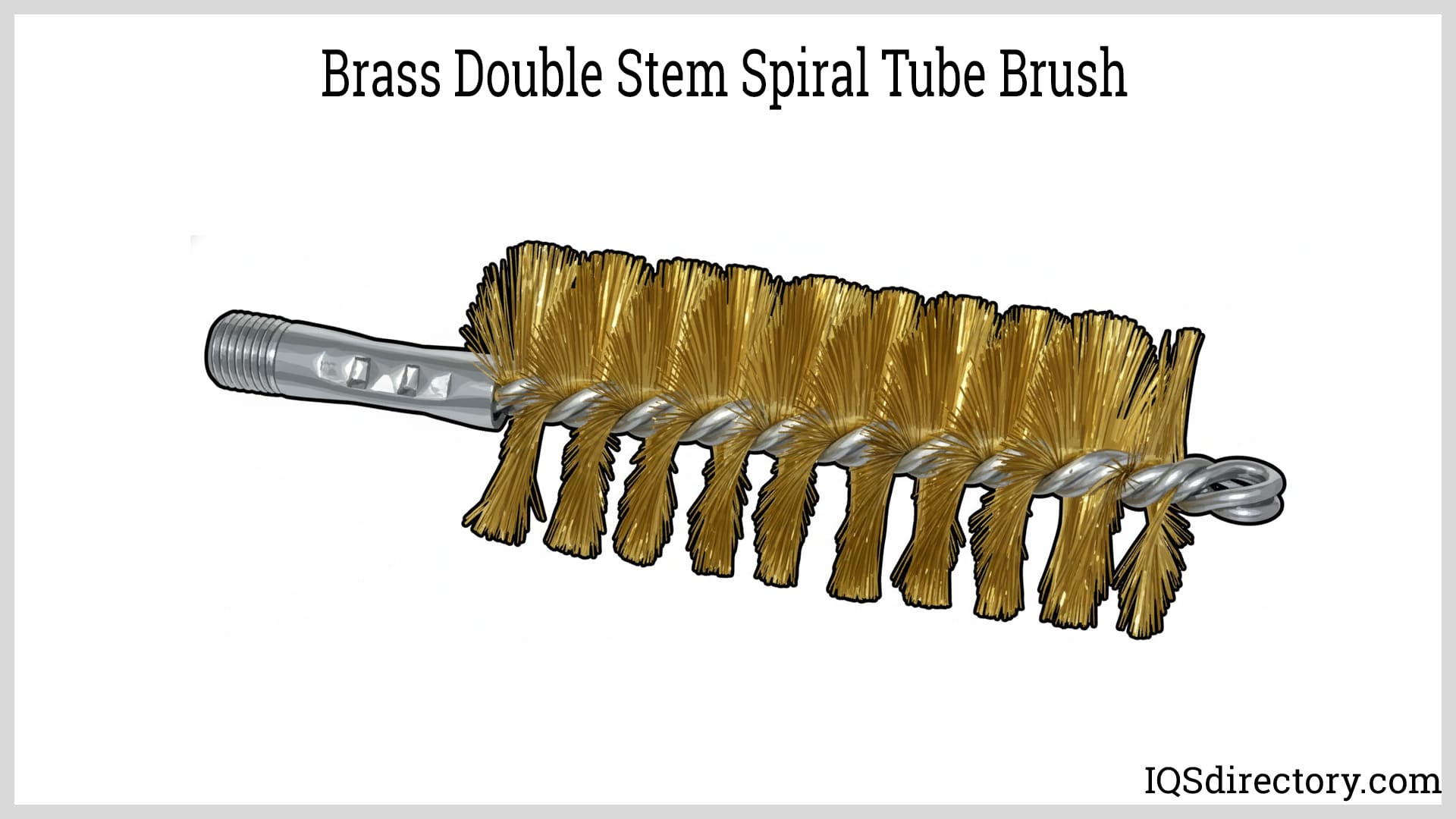
Other forms of spiral brushes include inside spiral shape, staple set shape, and epoxy wound. The generic primary forms of spiral brushes are in reference to the type of stem, which are single and double stemmed. A third category is in reference to the types of filaments and is referred to as twisted wire that has wire twisted around the stem. Of the two stem types, single stem is the one that most people recognize and are familiar with, while double stem brushes with two stems are more heavy duty and are often chosen for demanding industrial cleaning, conveyor maintenance, and high-wear applications. Buyers evaluating spiral brushes often compare filament density, fill material, brush flexibility, and operating environment to determine the best fit for their application.
The initial spiral brushes were introduced during the first industrial revolution as a means for cleaning tubes and bottles. Since their first use, spiral brushes have continued to develop, grow, and expand and have become an essential part of modern technological development. Today, these custom brush solutions are used across manufacturing, food processing, packaging, and maintenance operations where consistent debris removal, product handling, and precision cleaning are critical.
Chapter 2: Spiral Brush Filaments and Bristles
The versatility of spiral brushes has made them an essential part of industrial operations. Their use includes surface finishing, deburring, cleaning, and polishing. The different bristle types allow spiral brushes to gently clean and polish a finished product or aggressively remove burrs and rust. Although common forms of spiral brushes are still in demand and widely used for industrial and residential projects, specialized spiral brushes are constantly being developed to meet unique and unusual applications.
The process for the manufacture of spiral brushes involves several steps that are carefully followed to ensure the quality of a spiral brush. The most important part of spiral brush manufacturing is in regard to the choice of filaments or bristles. What would seem to be an easy task, actually involves several considerations such as bristle diameter, spacing, type of material, length, and other factors. The final purpose of a spiral brush, which is outlined in its design, serves as a guide to the type, kind, dimensions, and attributes of a spiral brush’s filaments or bristles.
The nature of the work that a spiral brush can perform is in regard to the brush’s types of bristles. While some applications require a soft touch as part of a finishing process, other applications necessitate a more aggressive approach with brush bristles that can tear away finishes and surface coatings. It is for these reasons that the choice of bristles or filaments for a spiral brush are carefully considered in order to match the right brush with an application.
Wire Spiral Brush Filaments
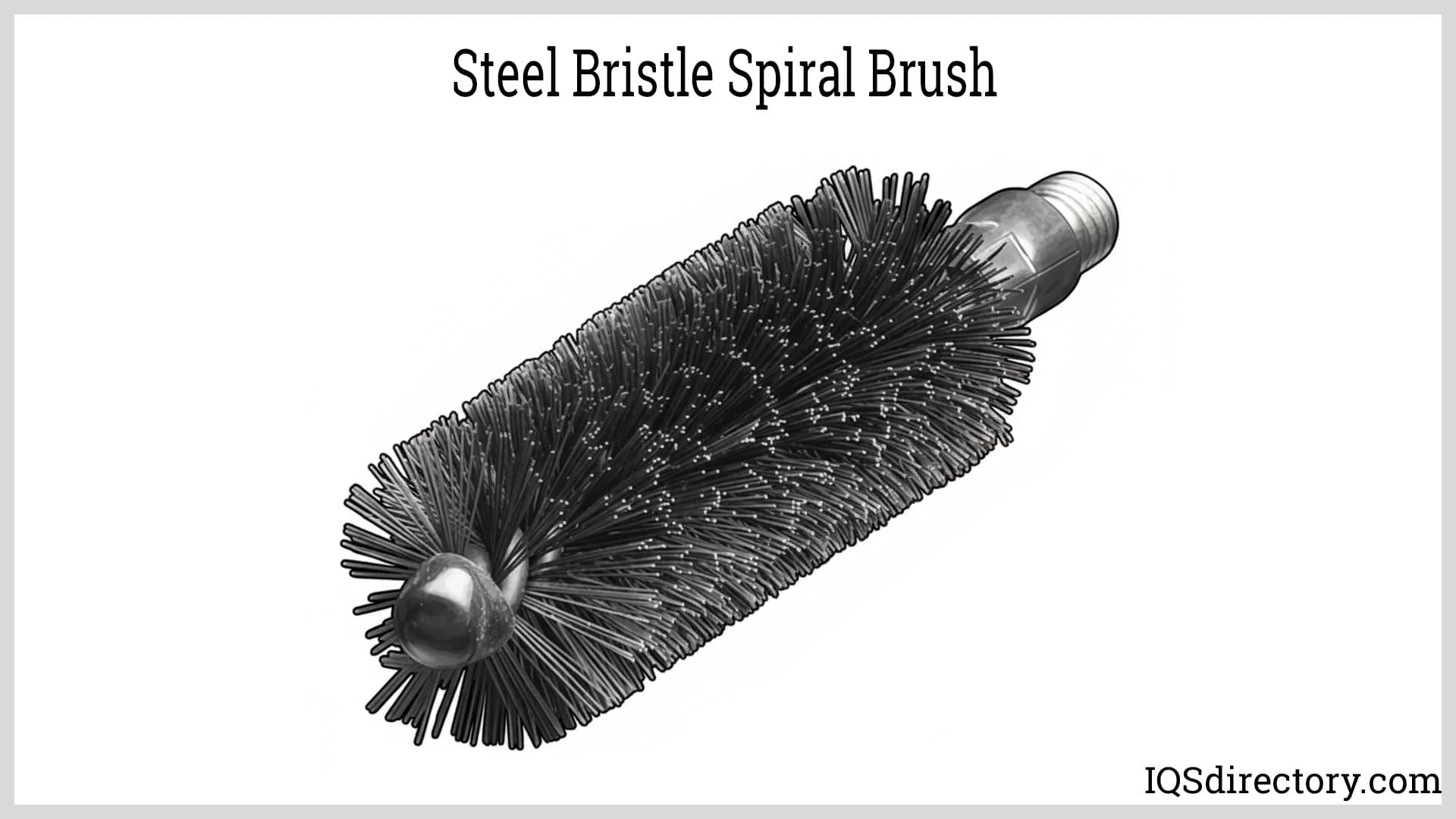
Of the various types of spiral brushes, wire spiral brushes are the most aggressive and are used to remove surface finishes for cleaning and preparing surfaces for treatment. The various metal filaments are designed for specific purposes and applications. The selection of filaments is the determining factor in regard to how the brush will be used.
Steel
The use of steel bristles requires careful examination since hardened steel can not be used due to it being too difficult to form into wire bristles. The factor that influences the hardness of steel is in regard to the amount of carbon that is used. As the carbon content increases, the steel becomes harder and less machinable. Prior to forming steel into wires for brushes, the steel is tempered, heated and slowly cooled, which softens the steel, making it formable.
The durability and strength of steel make it an ideal material for producing aggressive brushes that are designed to remove hard materials. Spiral brushes with steel bristles are long lasting and resilient, capable of cleaning and deburring metals.
Stainless Steel
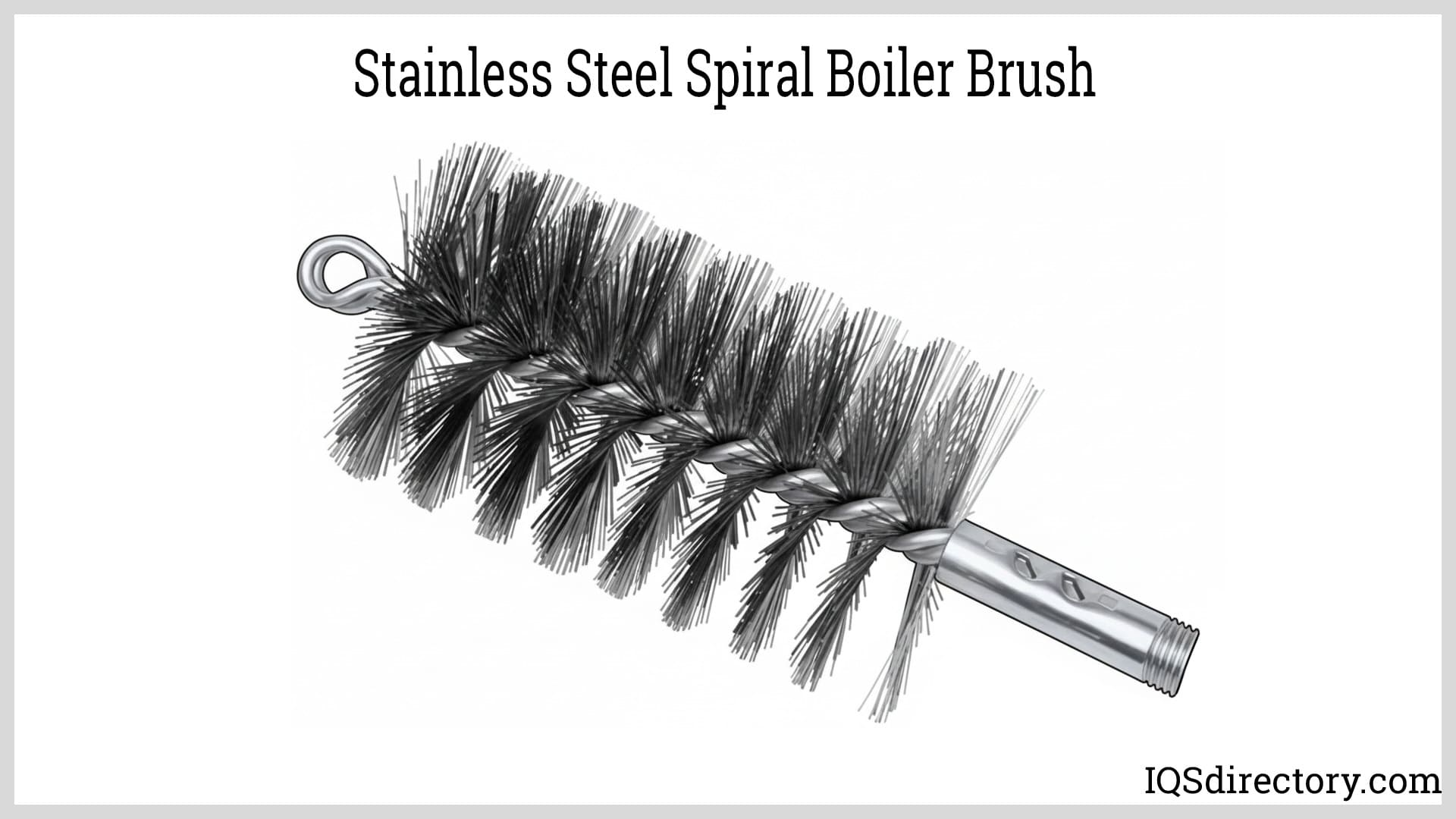
Stainless steel has a very long list of alloys that vary in accordance with their blend of chromium, silicon, nickel, carbon, nitrogen, and manganese that are added to iron to form stainless steel. The grades of stainless steel used for spiral brush bristles are grades 302, 304, and 18-8. The characteristics of stainless steel bristles are toughness, abrasiveness, and resistance to high temperatures. The chromium content of stainless steel makes it resistant to rust and corrosion, which is one of the reasons for its wide use.
Stainless Steel Grade 302 – Grade 302 stainless steel has more carbon and is commonly used in its wire form. Although grade 302 is less resistant to corrosion, it is used for spiral brushes due to its strength at 585 MPa with a yield strength of 240 MPa. In addition, there is less chance of breakage with 302 due to its elongation, another factor that makes it ideal for filaments in spiral brushes.
Stainless Steel Grade 304 – Grade 304 has greater resistance to corrosion due to its high chromium content. Its yield strength and tensile strength are less than 302 at 205 MPa and 515 MPa, respectively. The malleability of 304 makes it easy to work with and form, a reason that it is used for spiral brush filaments. Grade 304 is generally preferred over 302 due to its better machinability and formability.
Stainless Steel Grade 18-8 – Grade 18-8 is from the 300 series of stainless steels, as is 302 and 304. It has a high chromium content, which makes it difficult to work and makes it a challenge as spiral brush filaments. The characteristic of grade 18-8 that has led to its wide use is its exceptional resistance to corrosion. The high hardness of grade 18-8 makes it difficult to work and shape. On the other hand, its high hardness gives it impressive strength that provides the ability to be bent without losing its durability. As with grade 304, grade 18-8 is long lasting and does not deteriorate over time.
Brass
Brass is an alloy of copper and zinc that is soft metal that is conductive and is used to reduce static. Due to brass’ copper content, it is highly resistant to corrosion. The addition of a small amount of aluminum enhances this property and makes it easier to transform brass into bristles. A common brass alloy used to produce brass wire for spiral brushes is alloy 260 that is softer than steel and stainless steel such that it won’t scratch hard metals.
The rust and corrosion resistance of brass bristles along with their softness allows spiral brushes to be used with water and mild bleach. When choosing bristles for a brush, and brass is a possibility, the determining factor is how aggressive the cleaning needs to be. Brass spiral brushes are softer and gentler on delicate and fragile surfaces.
Bronze
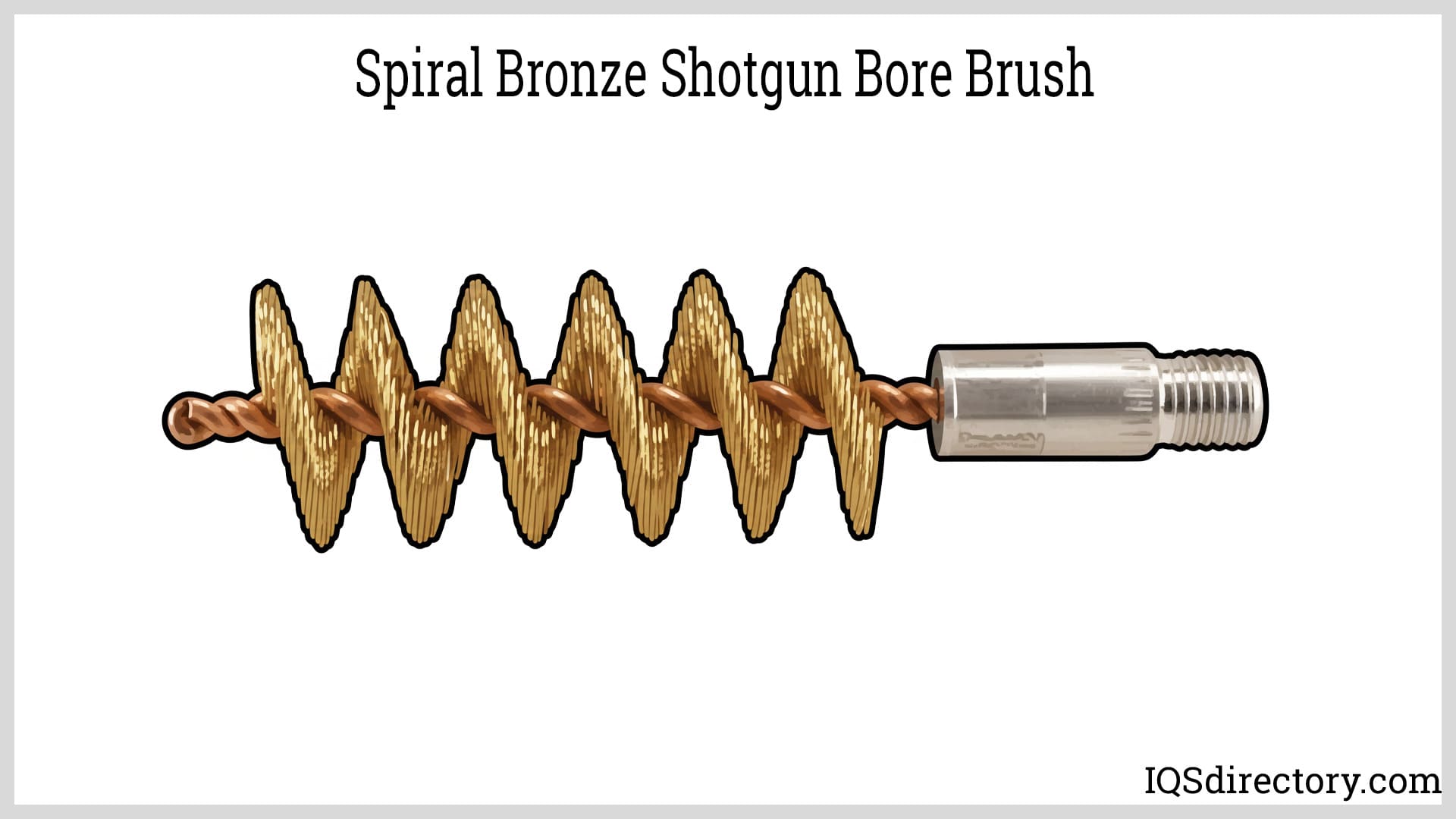
Bronze is hard and stiff. As with other types of spiral brush bristles, it comes in various forms of alloys with alloy 510 with a 95% copper content being the most popular. The addition of tin to bronze wire enhances the wire’s fatigue and tensile strength. The fact that bronze does not spark when used against metal surfaces makes it ideal for use in hazardous environments. Since it is a conductor of electricity, bronze spiral brushes can be used where static reduction is necessary.
The abrasion resistance of bronze wire enables the wire to have a long useful life and ensures a spiral brush’s effectiveness in abrasive conditions. An attribute of bronze bristles is their springiness after repeated use, which adds to their longevity and resilience. Although not a major property of spiral wire brushes, bronze filaments are nonmagnetic, a factor that enables them to be used in conditions where there is magnetic interference.
Synthetic Spiral Brush Filaments
Natural fibers were the first materials used to produce brushes. They were selected in accordance with their durability, which wasn’t very long. Although wire filaments were a good substitute for natural materials, the metal filaments are too aggressive and can be damaging. The middle ground between the two materials has been synthetic brush filaments that have higher durability, chemical resistance, and higher elastic recovery than natural filaments without the damaging results of wire filaments.
Aluminum Oxide
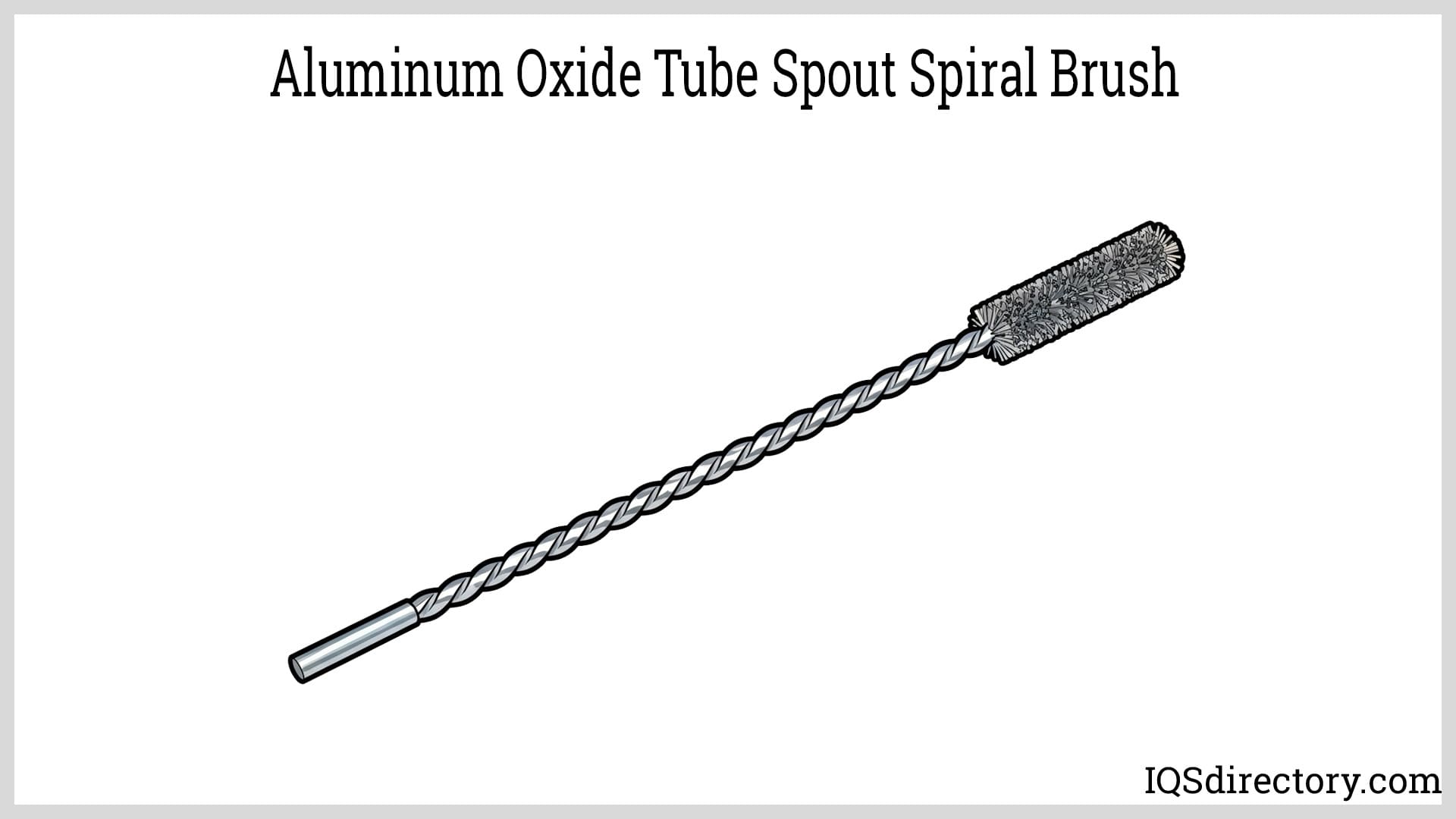
Aluminum oxide filaments are used for abrasive applications due to the abrasive nature of the filaments that contain aluminum grains. The structure of aluminum oxide filaments include nylon that has had aluminum oxide particles added. The amount of aluminum oxide that is added determines the level of grit that the filaments have, which is measured by the size of the abrasive particles. As the number of particles increases, the grit of a filament diminishes.
Spiral brushes with aluminum oxide filaments are very aggressive and have a long useful life. They are resistant to the effects of heat and chemicals, a factor that makes them ideal for applications that demand and require high-quality finishes.
Nylon
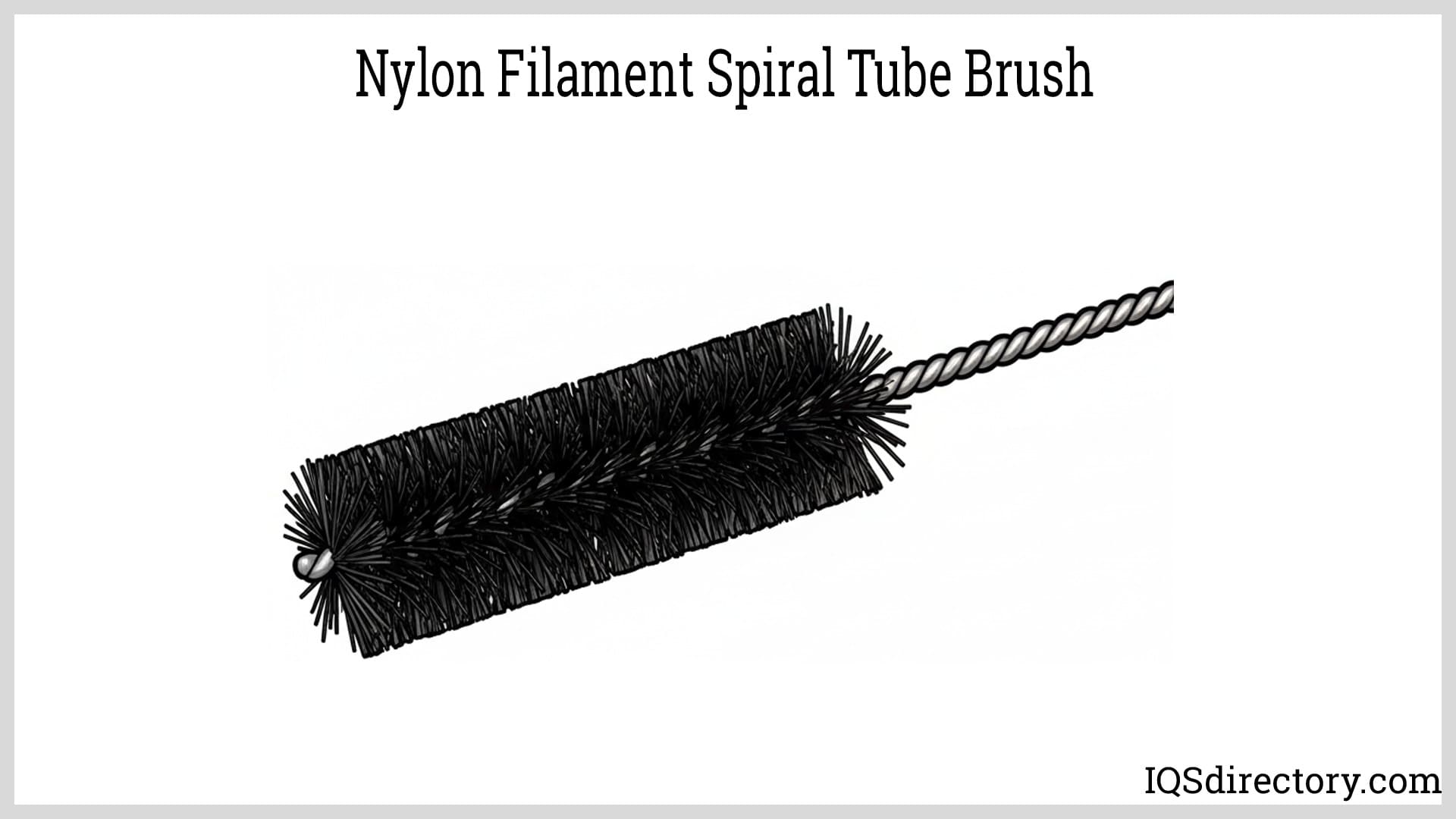
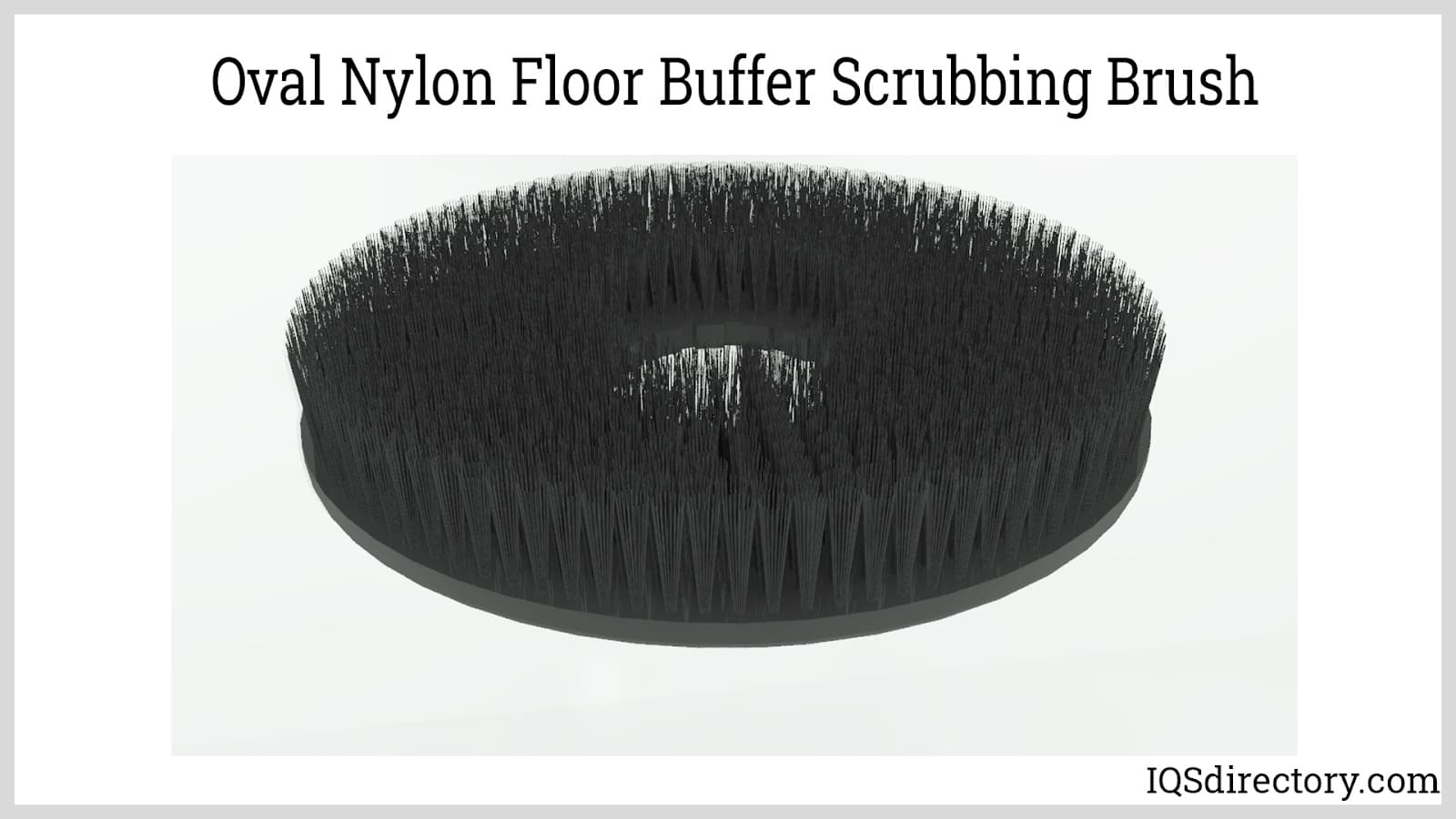
Nylon spiral brush filaments are economical and are used for industrial applications such as cleaning, polishing, and dusting. Their high wear resistance gives them a long useful and productive life. Nylon spiral brush filaments are resistant to most chemicals and do not corrode easily. They have a somewhat limited heat resistance at around 120°C (248°F) but can be modified to withstand higher temperatures. The filaments have exceptional elasticity which allows them to be severely stressed. After which, they immediately return to their normal shape when the stress is removed.
Although nylon spiral brush filaments are not necessarily impact resistant, they can withstand a certain level of impact without breaking. They are produced in a wide array of colors, sizes, hardnesses, and shapes in order to meet the requirements of different applications. This aspect of their manufacturing is in order to meet the standards of diverse industrial applications.
Silicon Carbide
As with aluminum oxide spiral brush filaments, silicon carbide spiral brush filaments begin with nylon that is injected with silicon carbide grit. The many varieties of silicon carbide filaments are in regard to the level of grit they possess, which varies from 80 up to 500 grit sizes. The properties of silicon carbide filaments are very similar to aluminum oxide in regard to toughness and abrasiveness. The addition of silicon carbide to the nylon fibers extends the useful life of spiral brushes.
Spiral brushes with silicon carbide filaments are the first choice for the finishing of ferrous metals. Their long life is due to the low breakage rate of the filaments, which is greater than many metal wire spiral brushes. Silicon carbide, also known as SiC, filament fibers range in diameter from 5 micrometers (µm) up to 150 µm and are composed of silicon and carbon molecules.
Polypropylene (PP)
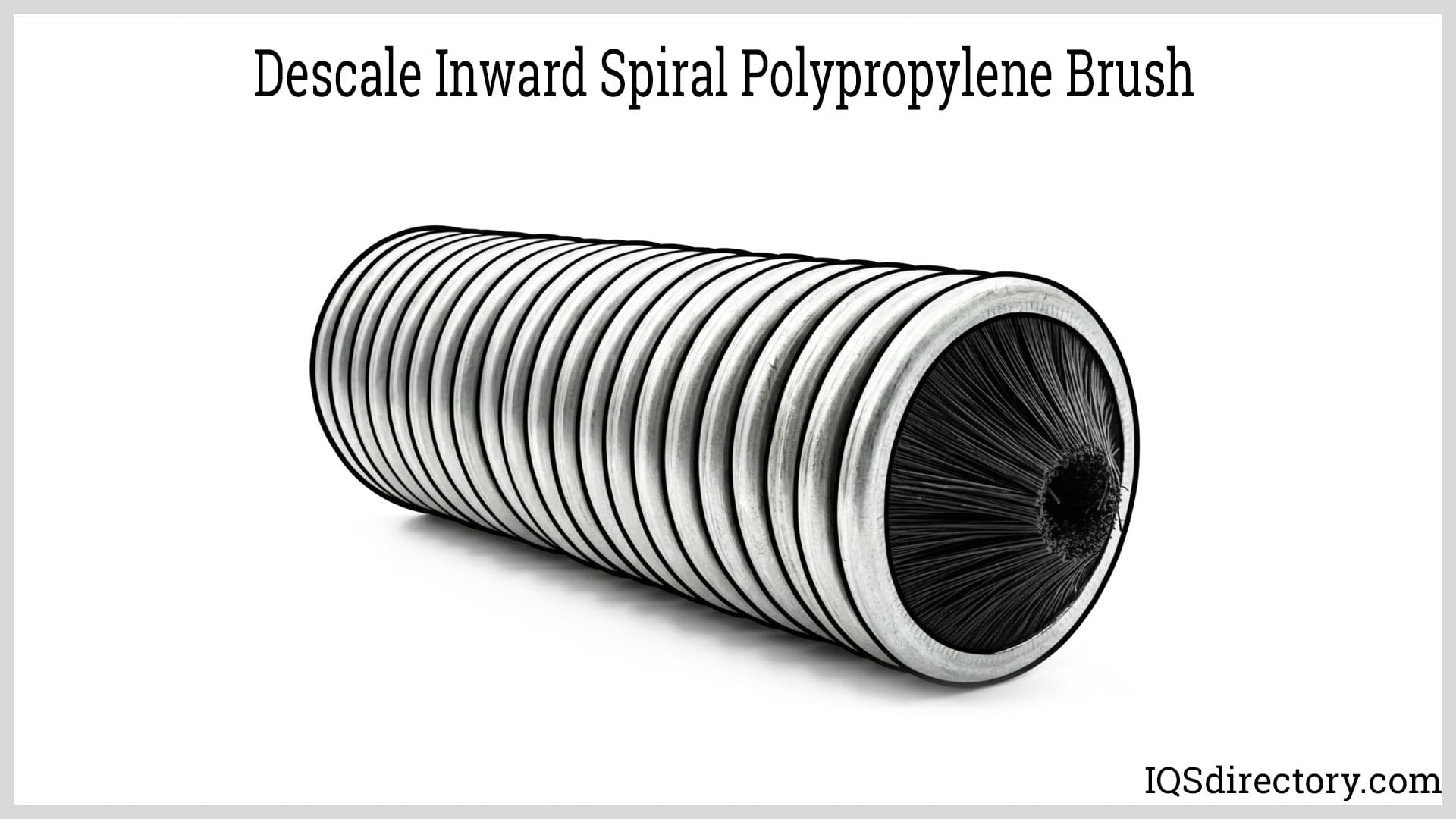
Polypropylene spiral brush filaments are inexpensive, have exceptional mechanical properties, very low water absorption, and resistance to certain chemicals. As with many of the synthetic spiral brush filaments, polypropylene has excellent bend recovery. The outstanding characteristic of polypropylene filaments is their ability to retain their stiffness in wet conditions. Their design takes several forms with the goal of providing multiple surfaces for cleaning and liquid retention.
The filaments produced using polypropylene are regarded as the lightest type of plastic used to produce spiral brushes. The high hardness of polypropylene filaments enables it to resist the rigors of harsh and demanding environments. The down side of polypropylene is its poor elasticity, temperature and wear resistance, and poor rate of recovery. These factors limit the use of polypropylene in regard to certain applications. The main benefit of polypropylene brushes is their low water absorption that makes them ideal for water based part washing.
Ceramic Grit
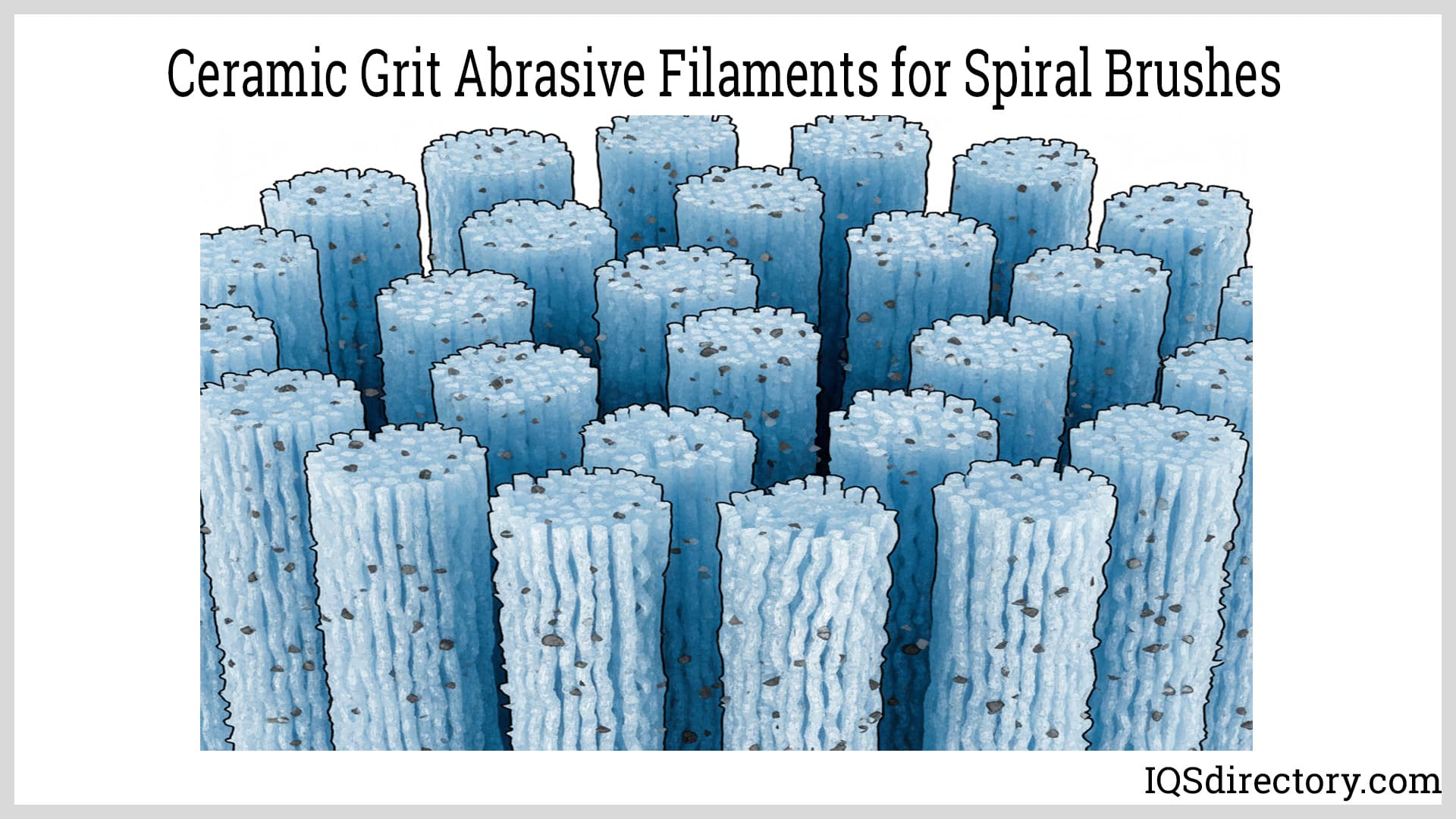
The use of ceramic grit is the same as it is for aluminum oxide and silicon carbide. The distinguishing feature of ceramic grit filaments is how highly aggressive it is. It fractures easily to create sharp edges to form filaments capable of deburring and sanding. In addition, the stability and strength of ceramic grit give filaments a long productive life. The amount of ceramic grit placed on nylon fibers to form ceramic grit filaments varies between 80 grit and 120 grit.
Ceramic grit filaments for spiral brushes are formed by mixing the grit with nylon. When in use, the nylon flexes releasing the ceramic material to attack the surface of the item to be treated. The sharp ceramic particles cut into the surface of a material removing uneven surfaces, burrs, and other unwanted aspects. The flexibility of the nylon allows the filaments to flex and conform to the shape of the item being treated. Ceramic grit spiral brush filaments deliver six times throughput and cutting action compared to aluminum oxide and silicon carbide.
The unique structure of ceramic grit allows it to self-sharpen by striking surfaces that fracture the grit and create more edges. This aspect of the grit enables its filaments to tackle rigorous and challenging applications and gives it longevity.
It must be noted that aside from silicon carbide, aluminum oxide, and ceramic grit the other form of grit is diamond grit that is also attached to nylon fibers. In most cases, manufacturers produce diamond grit filaments by special order due to the expense of the grit. Diamond grit is a deep cutting grit that has a grit level of 36 to 80 grit for aggressive work, 120 to 220 grit for finishing and 302 to over 500 grit for fine polishing. It is important to remember that as the level of girt increases, the finer and more precise is the type of filament.
Natural Spiral Brush Filaments
Natural filaments were the first types of filaments and originated hundreds of years ago. They are made from materials found in nature and come from plants and animals. Natural filaments do not have the same resilience as synthetic and metal filaments but are necessary for precision and delicate work that do not require cutting into a surface. They are widely used in many industries and have been in demand for many years.
Animal Hairs
In the category of animal hairs are horse hair, boar’s hair, goat hair, and oxen hair. These four types are most commonly used but are not the exclusive types of animal hairs used to produce brushes. Other animal hairs include squirrel, badger, weasel, and mink, which are selected for their texture and are used for brushes beyond spiral brushes. The use of animal hairs for the manufacture of brushes has diminished over the years due to the rise of synthetic filaments.
In the case of spiral brushes, horse and boars’ hair are mainly used for spiral brushes while goat and ox hair filaments, as with the other forms of animal hairs, are used for paint brushes, makeup brushes, and other forms of brushes. Unlike synthetic and wire spiral brushes, natural brush filaments don’t have the strength and resilience to endure the industrial uses of spiral brushes. Natural filament spiral brushes for industrial applications are used for gentle cleaning, dusting, and polishing, usually with wood surfaces, leather, and musical instruments.
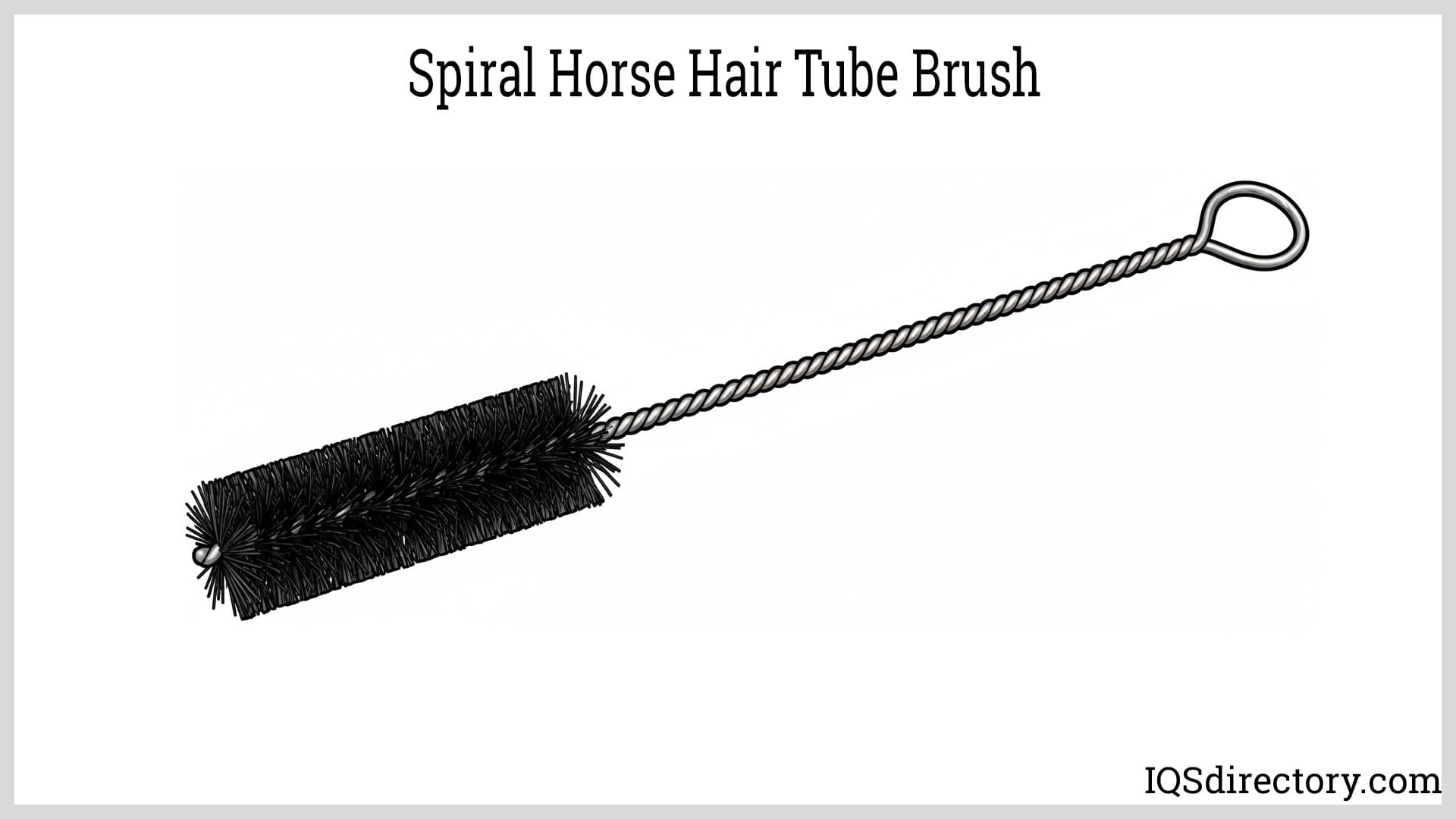
Horse Hair – Horse hair filaments are made from the hairs of the mane or tail of horses. They are valued for their ability to clean and polish surfaces, where metal or synthetic brushes are too aggressive. In most cases, horse hair spiral brushes have stiff filaments and have an operating temperature up to 202.44°C (400°F). To improve the versatility and use of horse hair brushes, the hairs are mixed with synthetic or wire filaments to meet the requirements of a special application.
The fine natural horse hair fibers are soft enough such that they do not scratch surfaces and are capable of removing the smallest of dust particles, work around details, and buffing or polishing various types of surfaces.
Boar’s Hair – Boar’s hair spiral brushes are generally not used for industrial applications. They are best known as round hair brushes with a spiral barrel to hold the filaments. The round shape of boar’s hair spiral brushes is used for curling, volumizing, and smoothing hair as well as detangling. The stem or handle of boar’s hair brushes are made of wood or plastic and have the filaments injected tightly into holes that hold the boar’s hairs in place.
Vegetable Filaments
As with animal hair, vegetable filaments have been replaced with synthetic types of filaments due to synthetic filaments having more strength and durability. Also, like animal hair, vegetable filaments do have usefulness for some industrial applications. Manufacturers have found that vegetable filaments have resistance properties and may have a long working life. Vegetable fibers that are commonly used for spiral brushes are Tampico and palmyra or bassine.
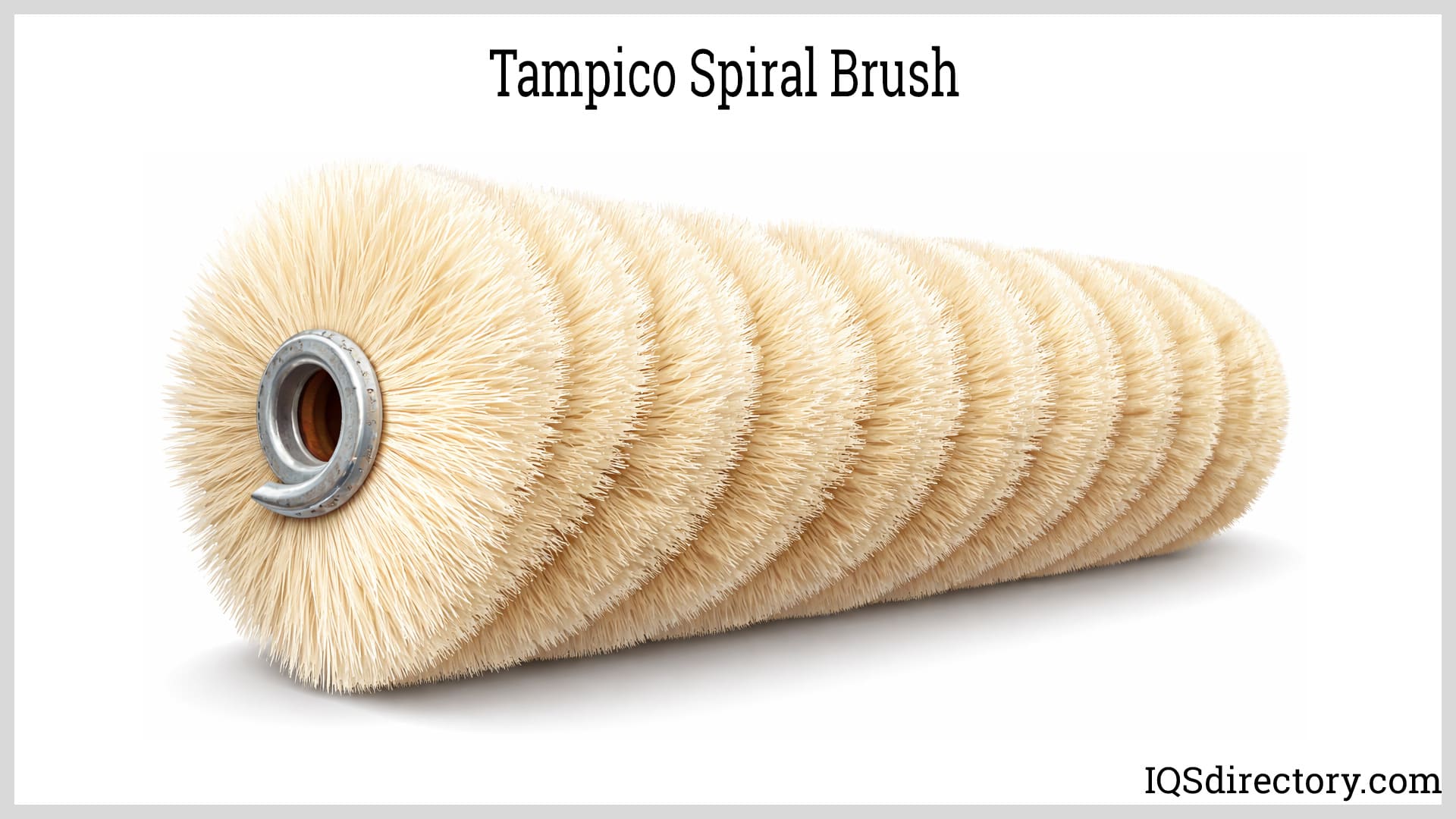
Tampico – Tampico is known for its heat, alkali, and acid resistance with high heat tolerance, anti-static properties, and a natural abrasiveness. Tampico is from the agave plant and is biodegradable. Although it does not have the strength of most synthetic filaments, Tampico is resistant to heat and chemicals.
Bassine – Bassine has natural stiffness, water resistance and provides a long useful life. These attributes have led to its use on conveyor systems. Bassine is made from Borassus Flabelliformis, a palm tree in Southern Asia. The material is used to produce brushes due to the coarseness of the fibers from the plant. Regardless of being a natural form of filaments, bassine is exceptionally durable with resistance to heat, chemicals, alkaline, and acidic solutions.
Union – Union is a combination of Tampico and Bassine fibers, which make spiral brushes versatile. Aside from possessing the properties of Tampico and bassine, union filaments have exceptional water absorption properties and high resistance due to the blending of the two types of fiber.
Spiral bristles or filaments are unlike straight bristles in that they are arranged in a corkscrew pattern. The filaments are capable of being twisted and shaped together to be able to move in several directions and reach difficult areas that standard brushes may miss. Bristles or filaments for spiral brushes have many capabilities and are exceptionally durable, which is the main reason for the wide use. Of the three categories of spiral brush filaments, synthetic, wire, and natural, synthetic brushes are the most widely used due to their cost and longevity.
Leading Manufacturers and Suppliers
Chapter 3: Spiral Brush Filament Characteristics
Although the filaments or bristles of spiral brushes may seem to be a simple aspect of the structure of a spiral brush, there are certain characteristics of the filaments that determine the cleaning or scrapping power and effectiveness of a spiral brush. The factors that have the most impact are in regard to the diameter of the filaments, their length, and whether they are crimped or straight. In addition to these basic factors, filaments or bristles can be wound or twisted together to form a unified filament with multiple bristles.
Crimped
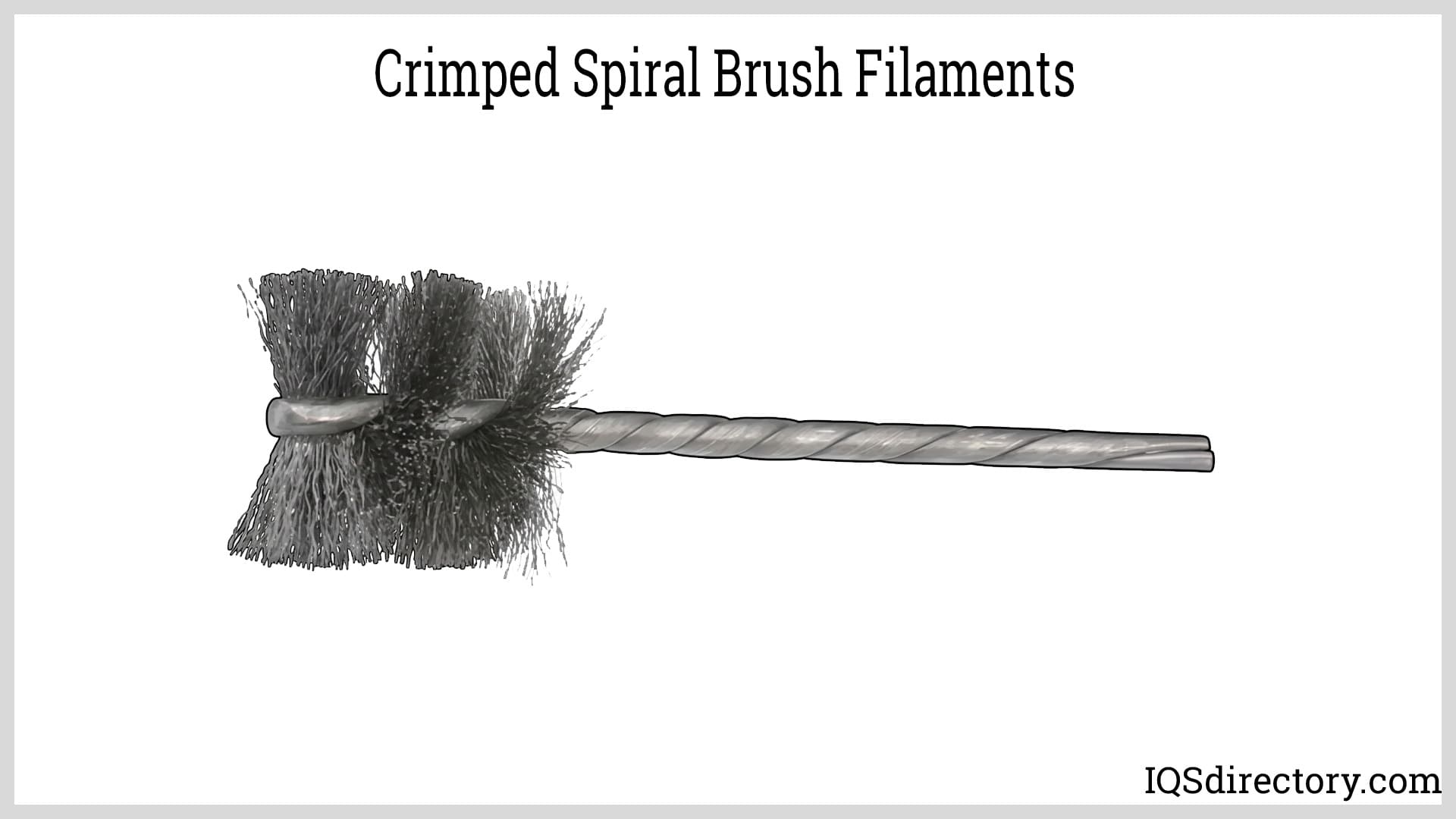
The purpose of crimped filaments is to spread and separate the filaments. This makes the filaments look fuller and broader. This is essential for spiral brushes in that the crimped filaments make the brush filaments appear as one surface instead of a twisted or wound surface. Crimped filaments appear as wavy lines that weave up and down along their length.
The filaments are defined by the number of waves per inch and the depth of the waves or their amplitude and frequency. Common crimps are #3, #5, and #6.5.
The wave in the filaments is designed to increase the surface area of the filaments. For spiral brushes, crimping enables the brushes to trap and capture debris from surfaces that are being cleaned. Crimped filaments do not mat and immediately spring back after enduring compression. In spiral brushes, they have a wide flare.
Straight or Level
Unlike crimped filaments, straight or level filaments are kept in their original form without being bent and have a flat configuration. They are normally tightly packed together before being twisted into a spiral brush. The lack of crimping allows straight filaments to be closer together. The sturdy shape of straight filaments enables them to protrude into gaps in a surface to remove isolated debris. In contrast to crimped filaments, straight filaments are restricted in their use to lighter and less abrasive applications due to the low density of the filaments.
Filament Diameter
The diameter of a filament is the measurement across the diameter of a filament using a micrometer or calipers. Filament diameters are between 0.0762 mm (0.003 in) up to 1.524 mm (0.06 in). As the diameter of a filament increases, its stiffness increases. Small diameter filaments are softer, flexible, and good for finishing smooth, delicate surfaces. Large diameter filaments are stiffer and more aggressive, designed for heavy duty applications such as deburring or removing paint.
Filament Length
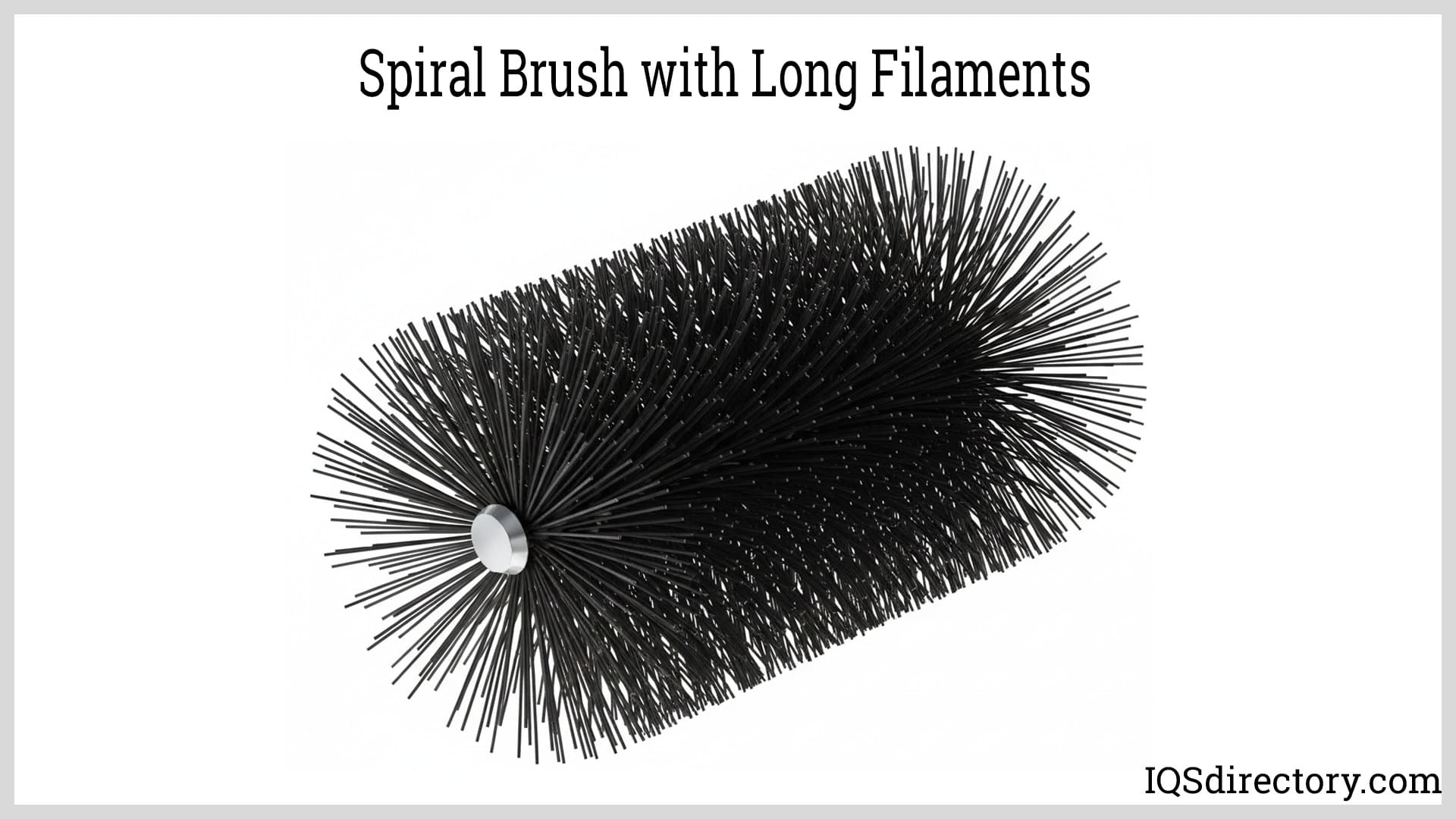
As with the diameter of filaments, the length of spiral brush filaments affects their stiffness. Shorter filaments are stiff, rigid and hard while long filaments are more flexible and softer. The differences in the lengths of filaments determine the types of applications for which a spiral brush will be used. Since longer filaments are more flexible, they are ideal for uneven surfaces. They are not as aggressive and can smooth a surface removing debris.
Shorter filaments are very aggressive and can dig into a surface. The aggressiveness of short filaments allows them to smooth surfaces, remove surface coatings, and prepare components for the application of coatings or paint.
Chapter 4: Types of Spiral Brushes
The categorization of spiral brushes takes several forms, which include brush structure, brush filaments or bristles, manufacturing method, structural material, and the direction of the filaments. In addition to the many categorizations, spiral brushes have different names including tube brushes, spring brushes, and twisted wire brushes. As may be assumed, with all these variations, it is somewhat challenging to break down the types of spiral brushes into a simple list.
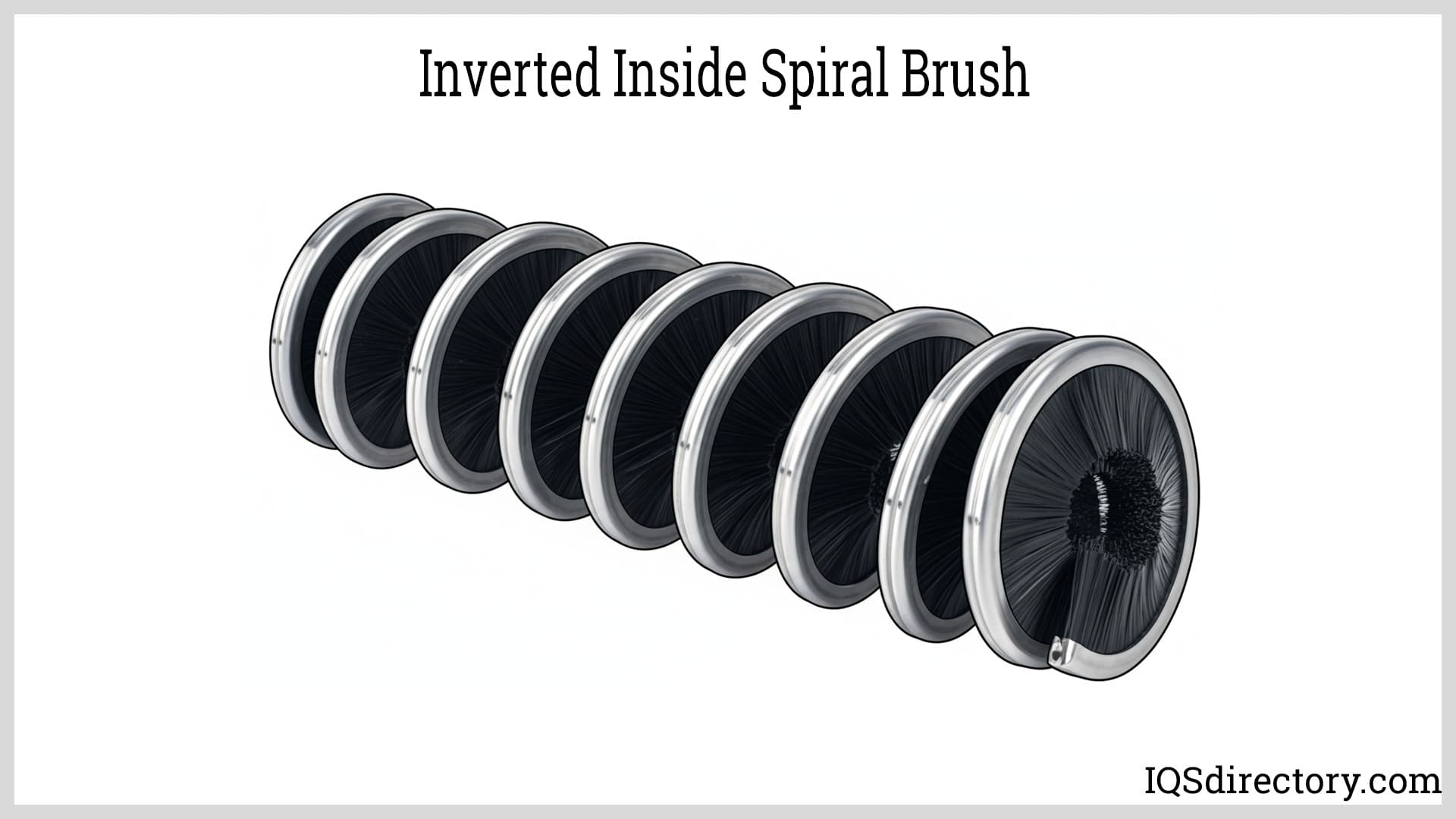
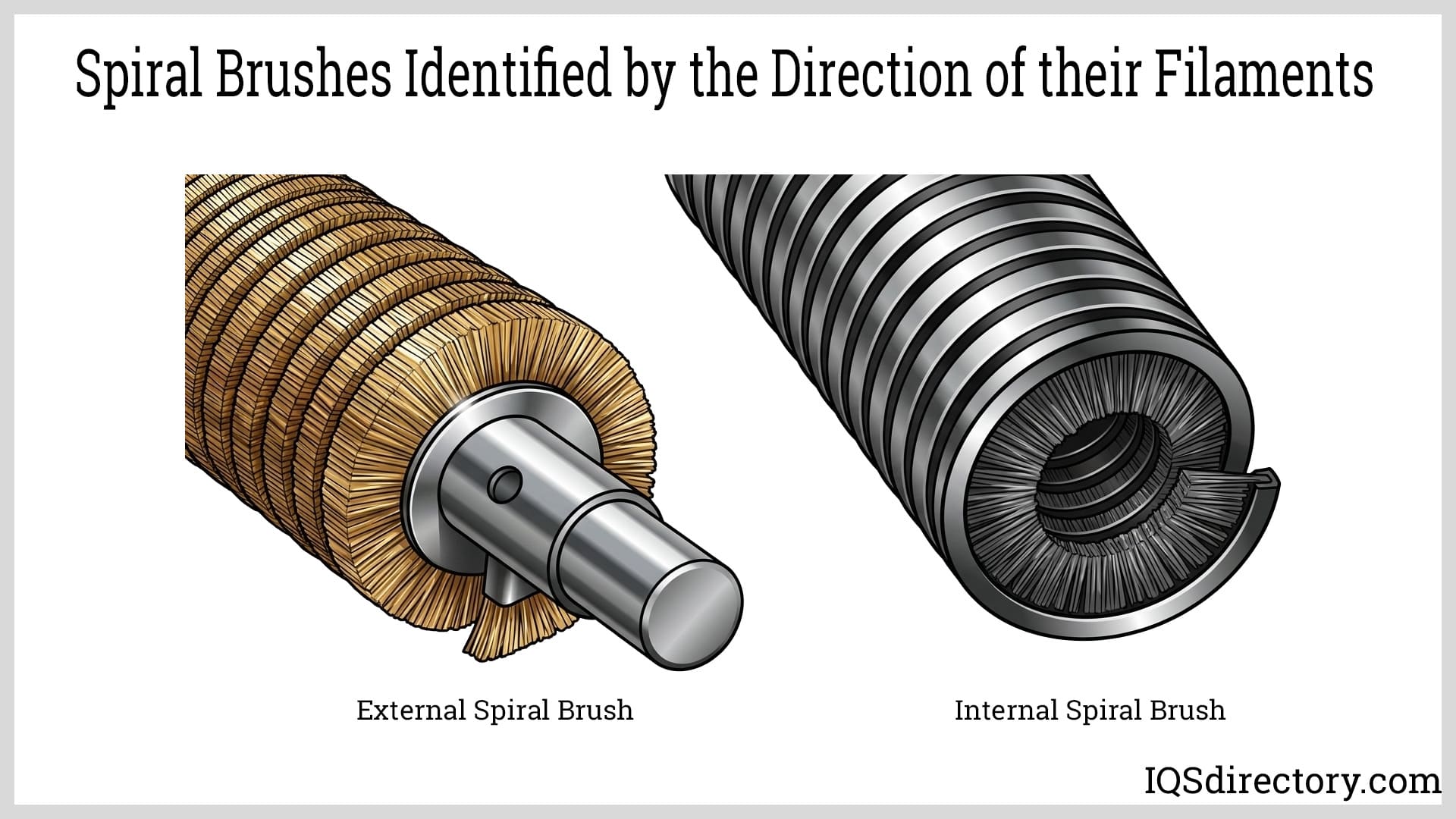
One factor, regarding the types of spiral brushes, that is easy to understand is the direction of the bristles, which can be outward away from the stem of the brush or inward away from the holder of the bristles. Spiral brushes with outward bristles can have inverted and external spirals that can be left or right-hand wound. When the bristles are pointed inward, the brushes are referred to as inverted spiral brushes. These two types of spiral brushes are the easiest to remember due to their very obvious differences.
Twisted In Spiral Brushes
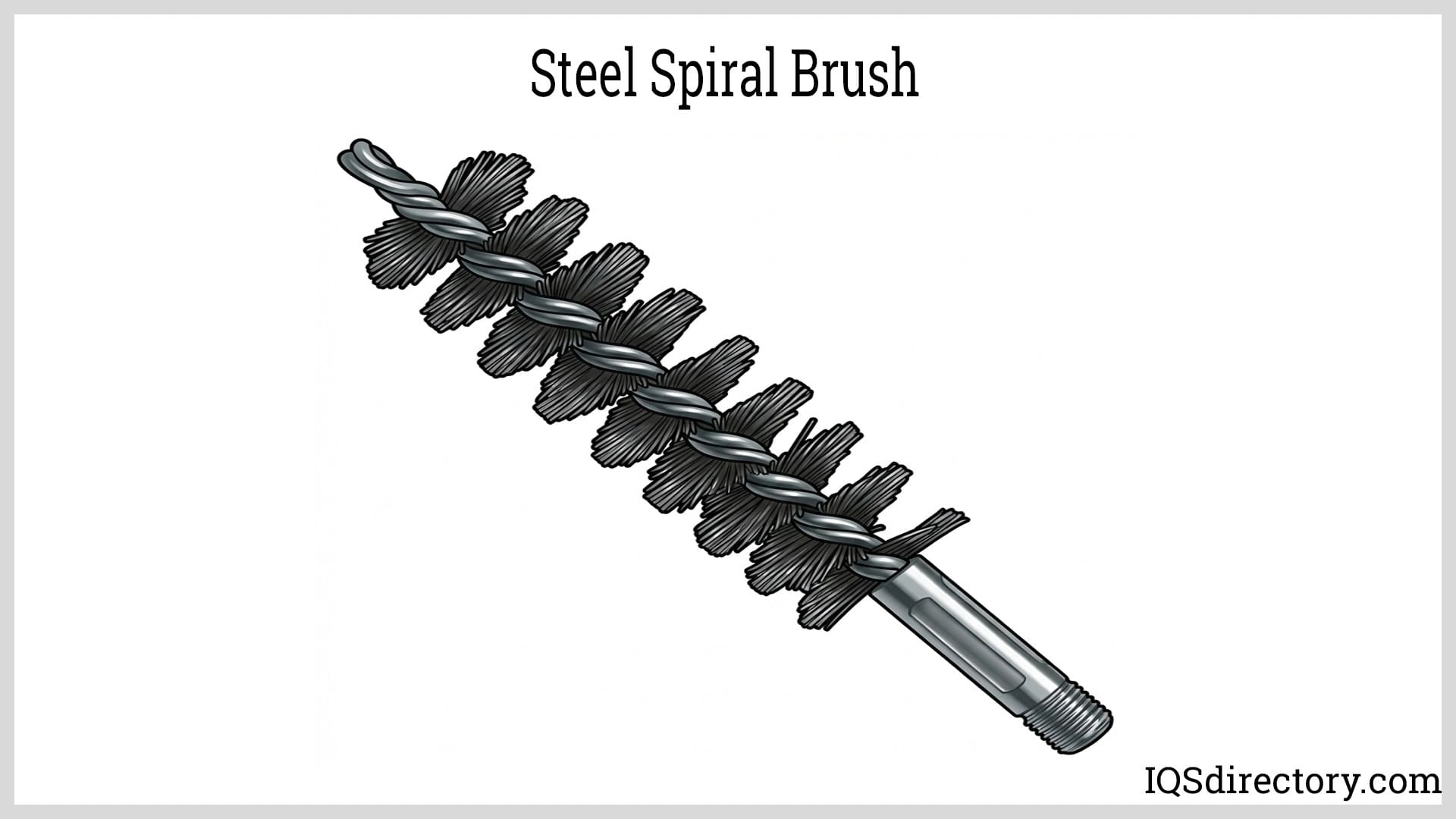
The term twisted in is a descriptor of the process used to manufacture twisted in spiral brushes. It refers to placing the filament material, straight or crimped, between two or more stem wires. The placement of the filaments determines the distance between the clusters of filaments, which may vary from very little distance to close to an inch of separation. Once the filaments are properly positioned, the stem wires are forcefully twisted to firmly hold the filaments in their permanent position.
As with many types of spiral brushes, the configurations of twisted in spiral brushes take many forms as regards length, stems, and types of filaments. Their design enables them to clean hard to reach areas, such as pipes, tubes, cracks, and valves. The many uses of twisted in spiral brushes is in part due to the different ways they are made.
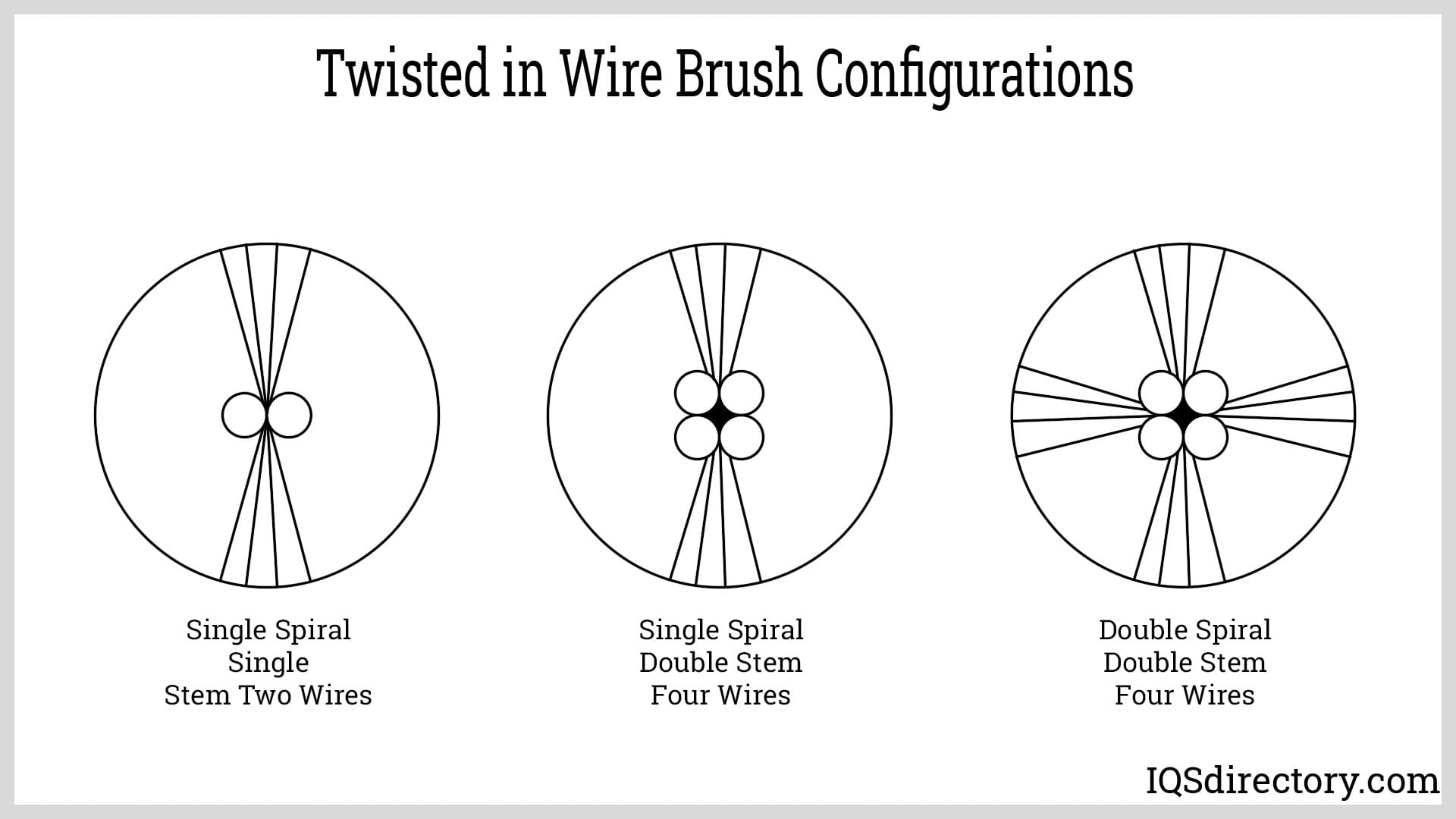
Single Spiral/Single Stem (2 Wire) – Single spiral/single stem spiral brushes are the simplest design and include filaments twisted between two stem wires with a single wire on each side.
Single Spiral/Double Stem (4 Wire) – Single spiral/double stem brushes have filaments twisted between four stem wires with two stem wires on each side.
Double Spiral/Double Stem (4 Wire) – With double spiral/double stem brushes, filaments are twisted between four stem wires with two layers of filaments. The layers are perpendicular to each other with a stem wire in each quadrant.
In addition to the varying stem and filament structures, the tips, the portion of the stem above the filaments and opposite the handle, of twisted in spiral brushes vary in accordance with the applications for which the brush will be used. The types of tips include cut and square, rounded, bristled, looped, threaded, and dipped in epoxy.
Inside Spiral Brushes
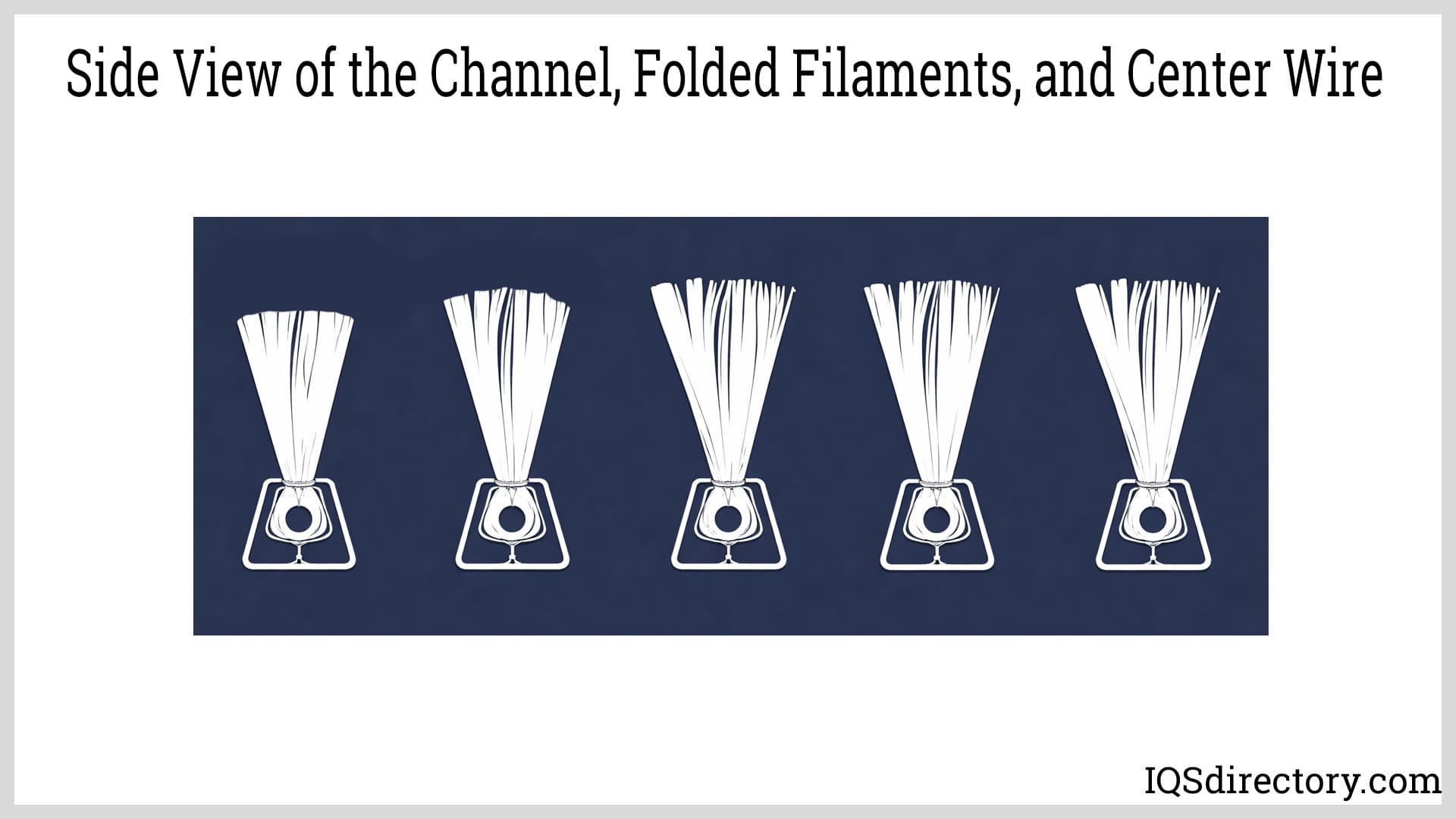
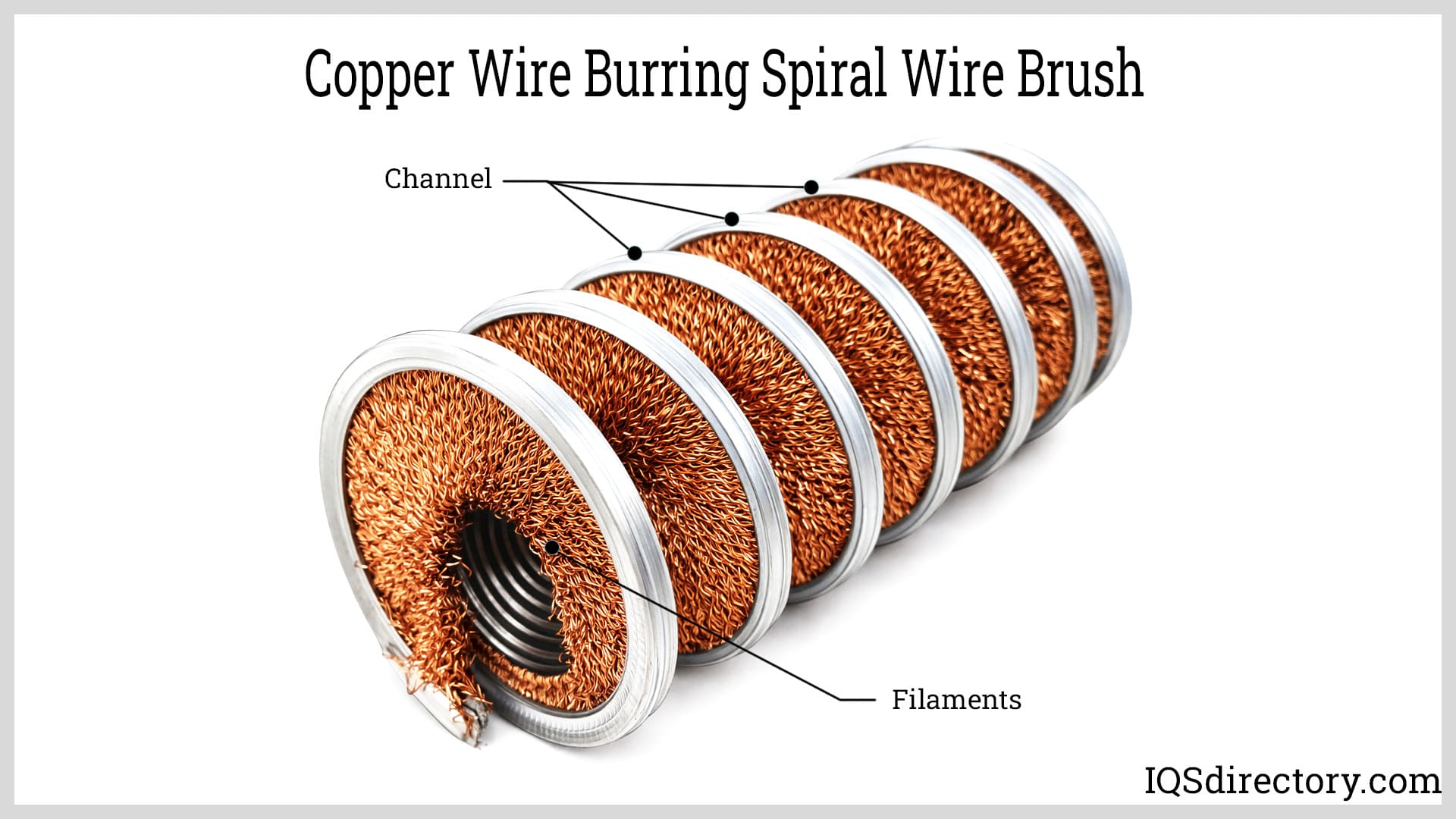
Inside spiral brushes are a combination of strip brushes and spiral brushes. The initial shape of an inside spiral brush is that of a channel strip brush that consists of a narrow, long “U” shaped metal channel that is a fraction of an inch wide. As the “U” shape is formed, filaments or bristles are folded in half into the forming channel with a center wire placed along the folded portion of the filaments. During the process, the channel squeezes and holds the filaments as a metal folding mechanism tightly closes the channel over the folded portion of the filaments.
To change the channel or strip brush into a spiral brush, it is wound around a cylindrical core or mandrel to form a spring-like spiral coil. The winding process can create a tight cylinder like coil by winding the strip brush such that the channel makes contact along its length. For other applications, the strip brush can be wound loosely such that it forms an open coil that is similar to a spring with a small separation between the segments of the winding.
The finished version of an inside spiral brush is a helically wound strip brush that has the shape of a cylinder, which can have any diameter and length. When wound tightly, an inside spiral brush can take on the appearance of a solid cylinder.
Outside Spiral Brush
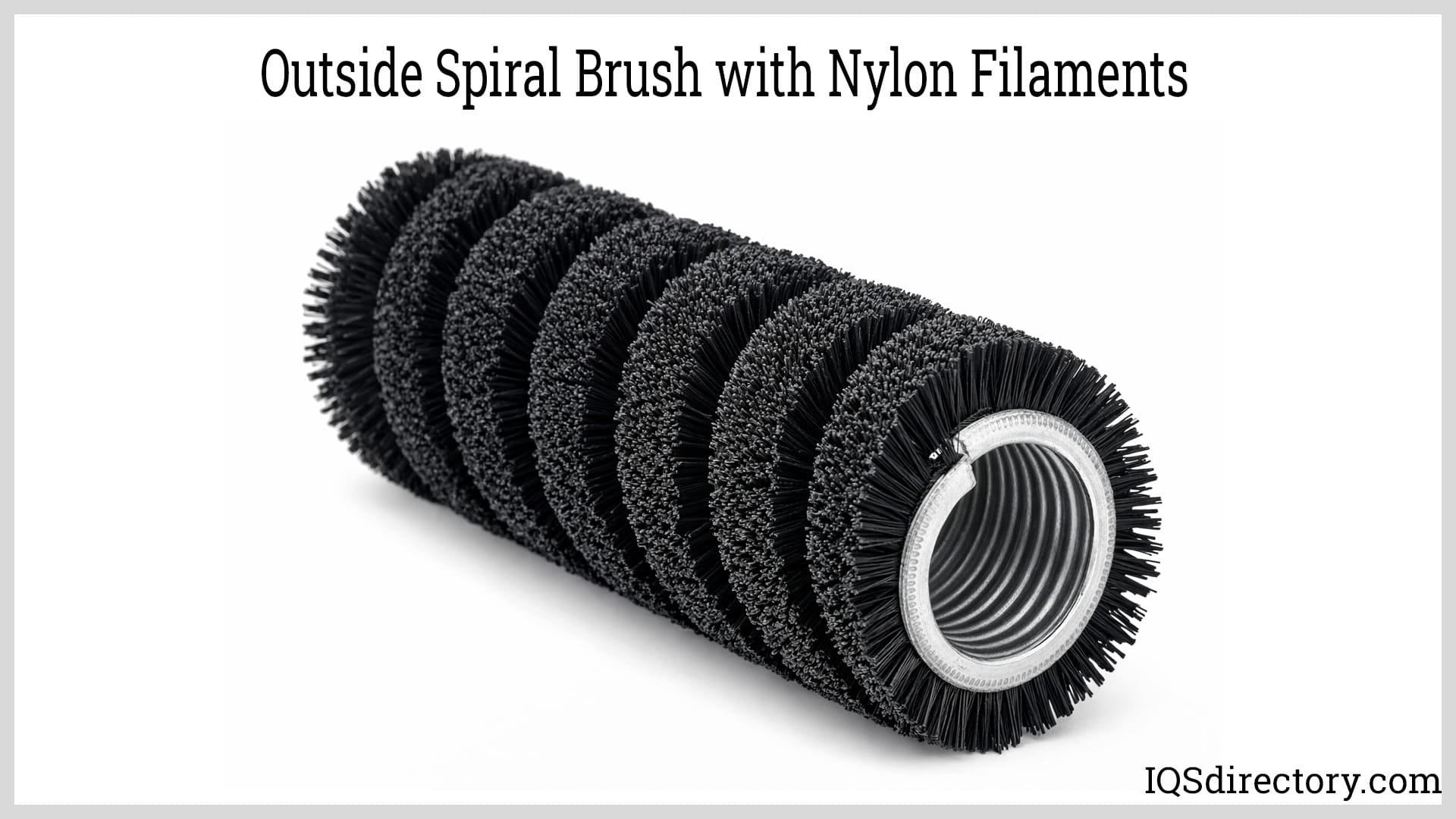
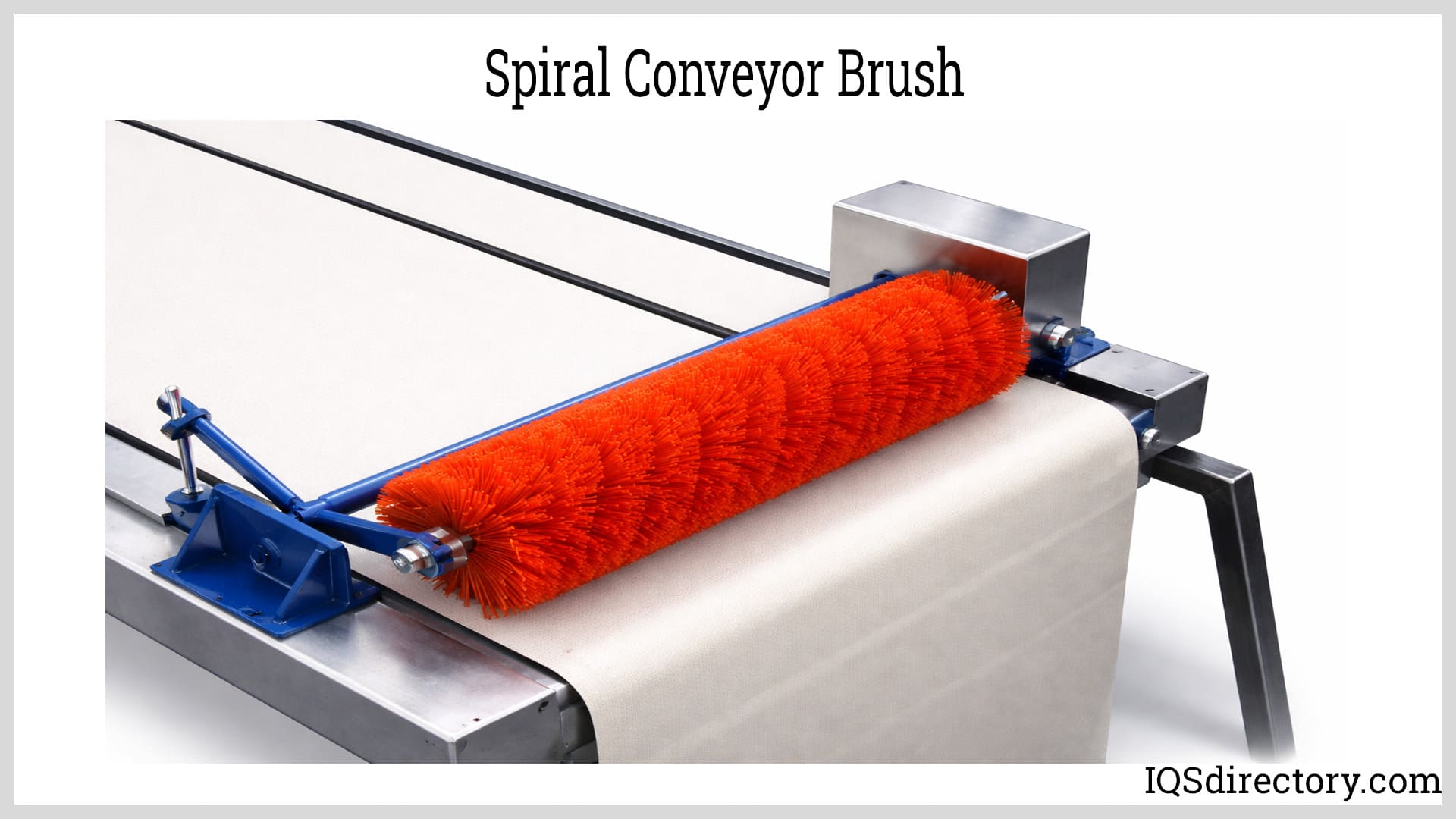
The reverse of inside spiral brushes are outside spiral brushes that are formed the same way as inside spiral brushes but with the filaments in the channel pointing outward from the channel and away from the center. Unlike inside spiral brushes, the shape and structure of outside spiral brushes allow them to have a core. The shape and design give the spiral brushes high flexibility enabling them to conform to the shape of surfaces since they can bend and contract with exceptional elasticity. The close positioning of the bristles enables outside spiral brushes to handle a wide range of preparation and cleaning challenges. They are ideal as conveyor brushes where some versions have a measured space between each row of brush, called lead.
Staple Set Spiral Brush
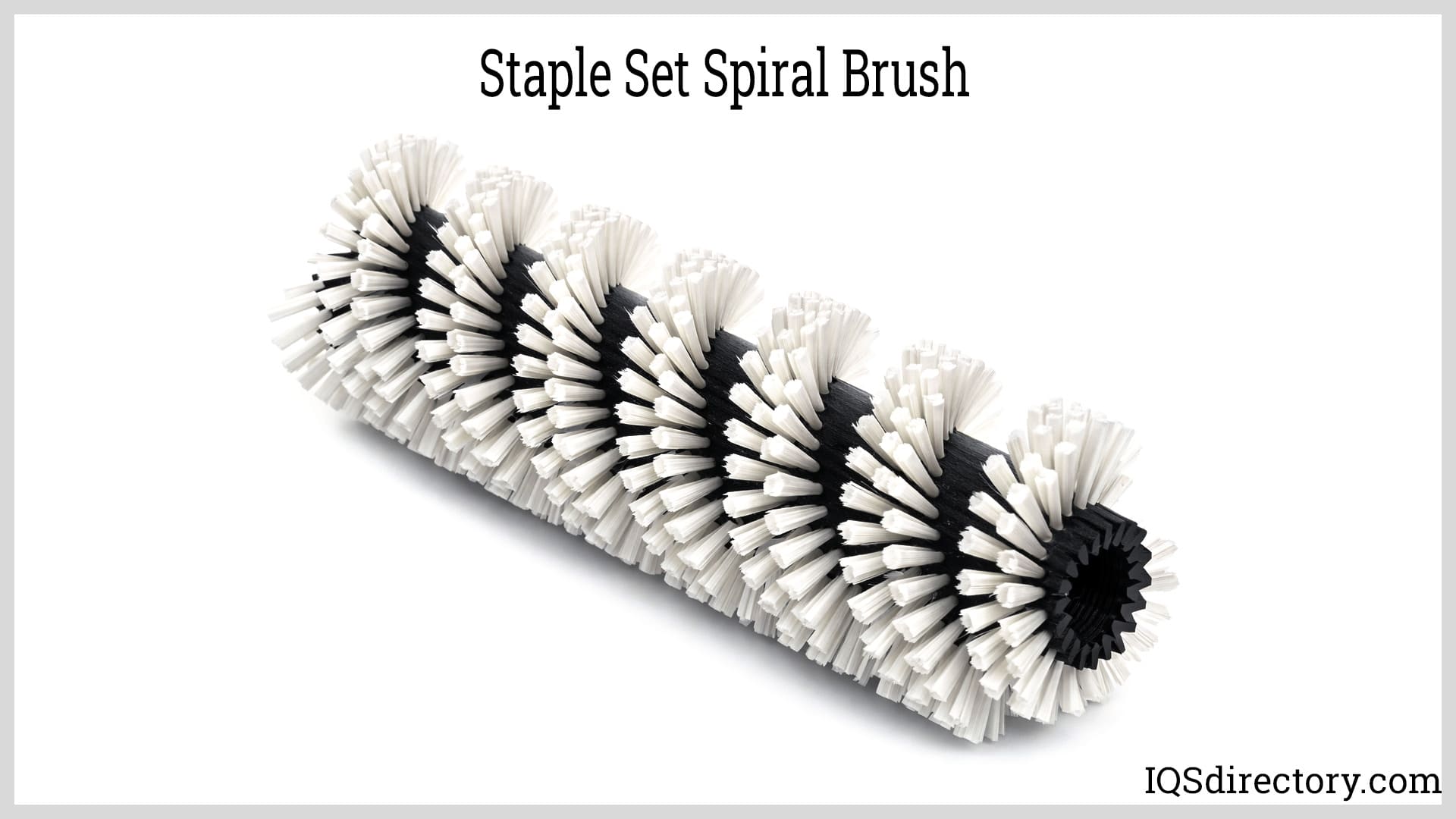
The structure of staple set spiral brushes is very much like several other varieties of brushes in that the filaments are placed in groups called tufts in holes that have been positioned in a pattern along a cylinder made of wood or plastic. Once the tufts are placed in the holes, they are secured with staples. Spiral brushes can have different patterns of tufts including straight, staggered, chevon, or a spiral pattern that is similar to the helical pattern found in an inside spiral brush.
Although the staple method may be used for constructing these brushes, it is very common for such spiral brushes to be made using a tube with internal collars. This form of spiral brush is made of metal, usually steel, stainless steel, or aluminum. The tube design enables the brushes to be used for industrial applications and be mounted on a shaft.
Twisted Knot Brushes
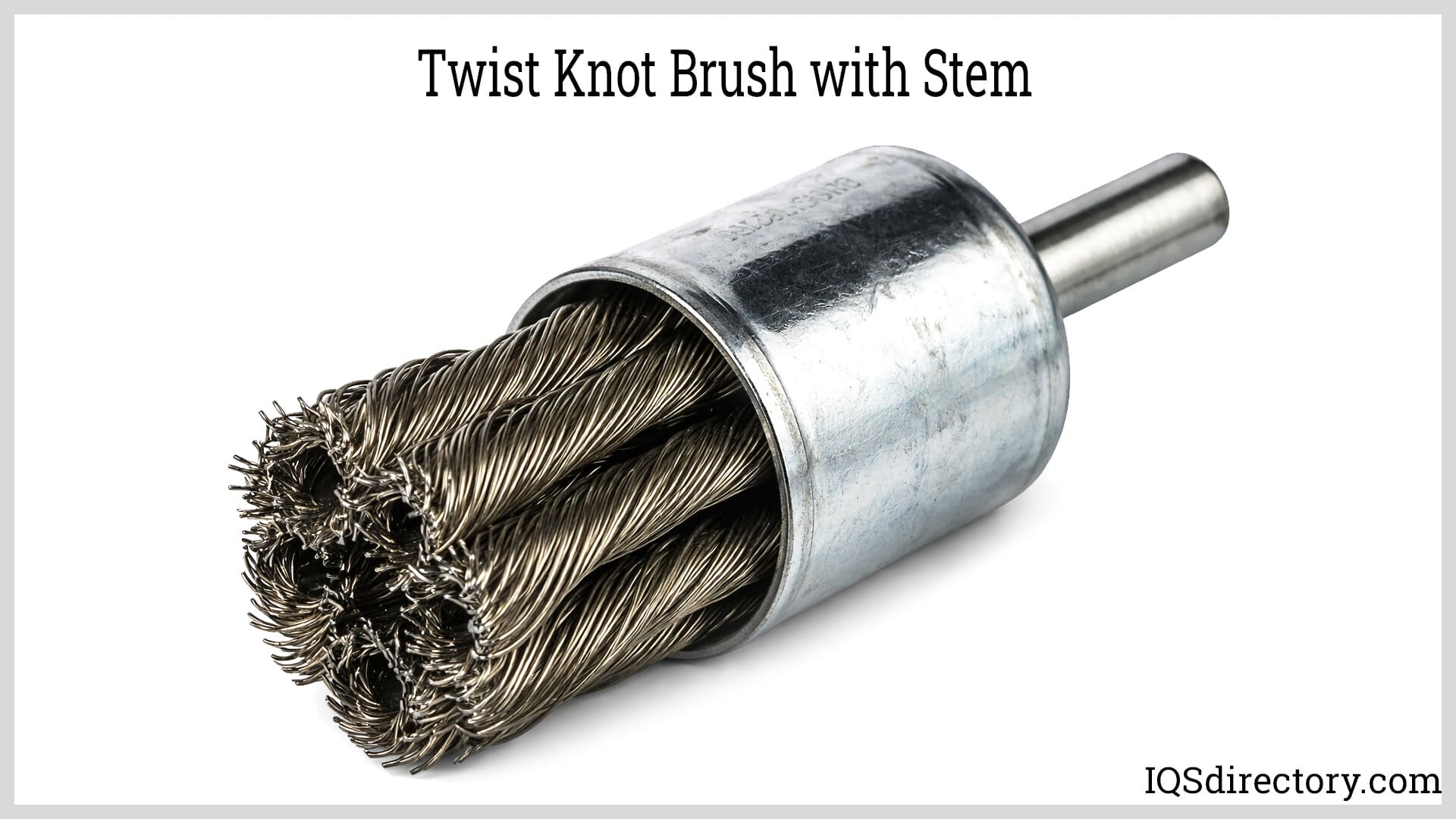
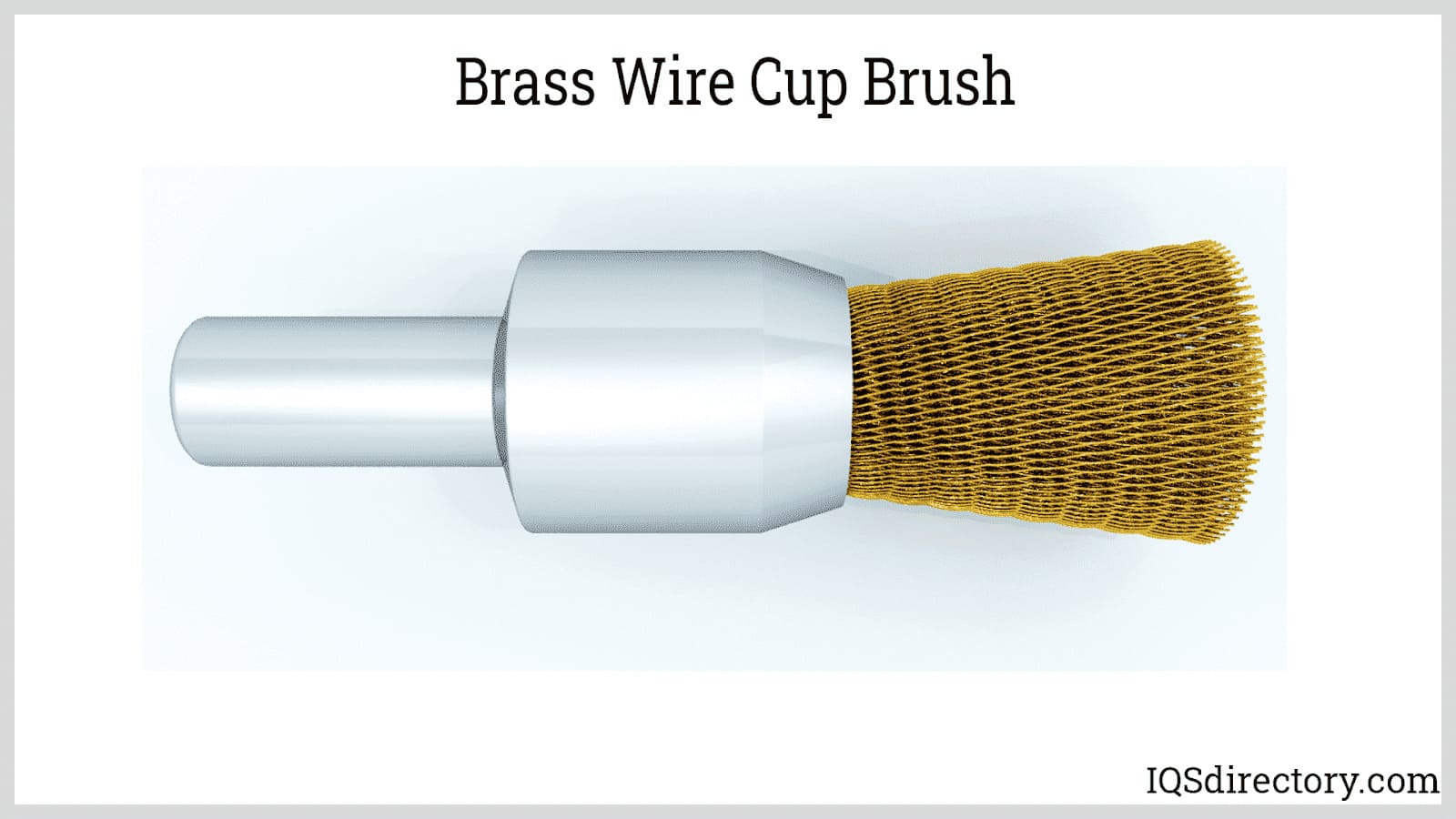
Twisted knot brushes are cup brushes that have bundles of crimped wires that are knotted or bunched mounted on a central shaft. They are very aggressive brushes that are designed to remove heavy debris, rust, paint, and impurities from the surface of metals. Twisted knot brushes are an essential part of metal working and industrial applications. The filaments of twisted knot brushes are tempered wire. The diameters of the brushes range between 76.2 mm and 508 mm (3 in and 20 in), a factor that enables twisted knot brushes to be used for any number of applications.
The design and placement of the bristles in twisted knot brushes allows each cluster of bristles to function independently when attacking a surface. The individual edges are able to cut aggressively, much like a cluster of multiple brushes.
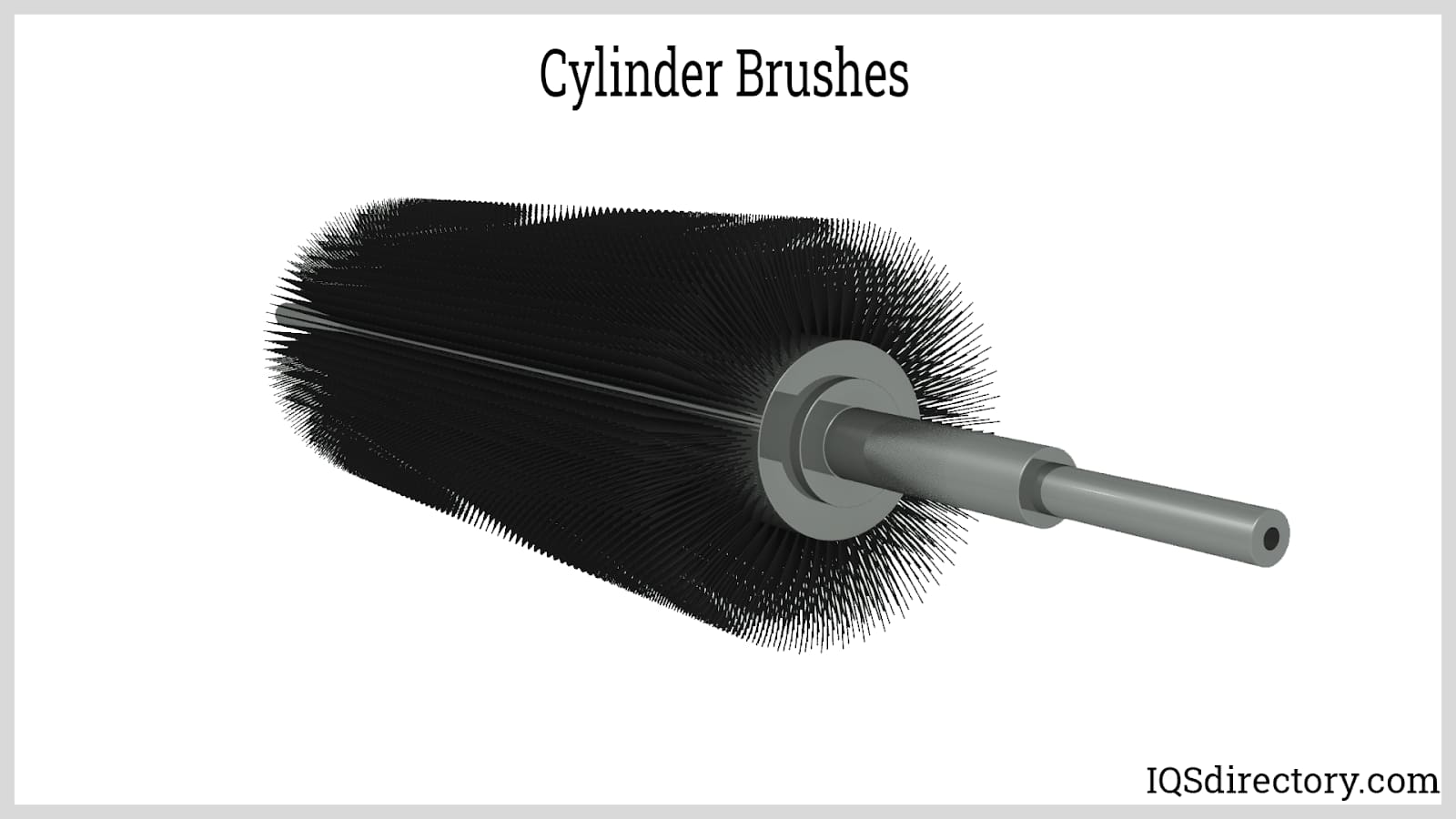
Cylinder Brushes
The category of cylinder brushes is very broad and includes several different names of brushes such as rotary brush, wound brush, cylindrical brushes, spiral brushes, and coil brushes. Outward spiral brushes, when tightly backed, are part of the classification of cylinder brushes. In addition, most staple set brushes are also in the category with the tube version of staple in brushes being composed of a metal cylinder.
Cylinder brushes are mounted on stems, shafts, or handles with many of them being attached to a source of power that assists in directing the brush. A common form of cylinder brush is a conveyor cleaning brush that is placed at the outlet end of a conveyor, after and below the head roller. The types of conveyor cylinder brushes take several forms with outside twisted channel brushes being used.
Chapter 5: Uses for Spiral Brushes
There is an unlimited number of uses for spiral brushes that include scrubbing, deburring, cleaning, polishing, and the application of powders, coatings, and various other liquids. The origination of the first spiral brush was during the first industrial revolution where they were used for cleaning tubes and made of twisted in wires. Conveyor spiral brushes were introduced in the mid twentieth century as mass production became widely used.
Scrubbing
The high rotational speed of a spiral brush and its helical bristles enable the brush to conform to the texture and form of a surface such that it can dislodge dirt, grime, dust particles, and various forms of debris. The rapid rotation and scrubbing action remove the need for substantial force to complete a cleaning job. The different shapes, sizes, and materials of spiral brushes make them adaptable and flexible enough to fit any type of cleaning project.
The dynamic nature of spiral brushes enables them to clean any form of surface in accordance with their types of filaments. The variations in scrubbing brushes covers the full spectrum of cleaning tools from steel wire filament brushes for cleaning and preparing surfaces to more gentle filaments for cleaning bath tubs and showers. Spiral brush manufacturers provide a full array of spiral brushes from ones for industrial use to ones for cleaning grandma's floors. This aspect of spiral brushes is their reason for their popularity.
Conveyor Cleaning Brush
The function of a conveyor cleaning brush is to remove matter from conveyor belts to assist in efficiency and prevent delays. When items or products move along a conveyor, they leave various forms of deposits. If the matter is allowed to remain, a conveying system can slow and become harmful. As with all spiral brushes, the choice of filaments determines the effectiveness of a conveyor brush. Of the types of filaments available, nylon is the most common due to its flexibility and longevity.
Spiral conveyor belt brushes have a cylindrical shape and rotate on a shaft that sweeps a conveyor belt as it passes. The main use of spiral conveyor belt brushes is for cleaning flat or cleated conveyor belts due to their ability to remove fine particles and other forms of debris. The differentiation between conveyor brushes is in regard to the density of the filaments where close wound and open spirals provide different cleaning options.
Surface Preparation
A common use of spiral brushes is for surface preparation prior to the application of a coating or paint. Items to be treated with a coating or paint can have various forms of contaminants on them that would obstruct the application. Spiral brushes, with high-speed rotation, are used to remove oil, rust, dust, dirt, debris, and other materials from workpiece surfaces to ensure tight adherence of surface applications. The rate of rotation and types of filaments determine the aggressiveness of the cleaning process. The type of spiral brush used for the process is chosen in accordance with the material to be treated.
The unique characteristics of spiral brushes make them ideal for surface preparation. Their bristles are constructed such that they make constant contact with the surface that is being treated and are flexible enough to match the contour of a surface. In industrial settings, spiral brushes are highly regarded as a necessary tool for product preparation and the success of coating applications.
The uses for spiral brushes are a few of the primary methods for utilizing this valuable tool. Brush manufacturers and spiral brush manufacturers can provide a long list of ways to insert a spiral brush into a process. The structure, form, and shape of spiral brushes makes them adaptable to any cleaning application.
Conclusion
The many forms of spiral brush include helically shaped filaments that are wound or placed around a core or directly into a shaft. The design creates perfect bristle coverage such that they make consistent contact with a surface.
The filaments or bristles of spiral brushes take several forms depending on the purpose and use of the brush. The three general types of filaments are natural, wire, and synthetic, with synthetic and wire being the most commonly used for spiral brushes.
Spiral brushes have found a permanent place in manufacturing as product removers for conveyors, tube cleaning, and applying coatings to products. The cylindrical structure gives spiral brushes their versatility and adaptability.
The adaptability of spiral brushes is due to their many forms, which range from outward bristles to inward bristles as well as wire cores, wood cores, or plastic cores. This characteristic enables spiral brushes to be used for a wide range of applications.
The different structures, shapes, designs, and types of spiral brushes allow manufacturers to work with their clients to find the perfect spiral brush for an application. The durability, strength, and resilience of spiral brushes enables them to endure the stress of industrial operations.
Leading Manufacturers and Suppliers
Related Posts
Bottle Brushes
A bottle brush is a brush with flexible and pliable bristles connected to a long stem or handle made of plastic, wood, or wire. The bristles of a bottle brush can run about halfway up the handle and form a shape similar to a tube or be clustered at...
Cleaning Brush
A brush is a tool with bristles made of hair, wire, metal, synthetic fibers, or various natural materials that are attached to a handle made of wood, plastic, wire, or metal. Some varieties of brushes are adapted to be connected to power tools for heavy duty work such as...
Cylinder Brush
Cylinder brushes are also known as "coil brushes," "rotary brushes," or "spiral brushes." Cylinder brushes are formed by rolling a metal strip around a cylindrical rod (or mandrel) until it reaches a designated interior brush diameter...
Nylon Brushes
A nylon brush is a brush that has nylon polymer filaments that are exceptionally tough, strong, flexible, and have excellent elasticity. The various types of nylon filaments, which are durable and abrasion resistant, are the most commonly used fiber for the manufacture of brushes…
Wheel Brushes
Wheel brushes are circular brushes that are often used for deburring items during the beginning stages of surface finishing and during the final stages of polishing. Wheel brushes brush in a straight line and...
Wire Brushes
A wire brush is an abrasive tool that has stiff bristles made from a variety of rigid materials designed to clean and prepare metal surfaces. The filaments of wire brushes are small diameter pieces of inflexible material that are closely spaced together as a means for cleaning surfaces...
Types of Brushes
A common representation of a brush is a handle with some form of bristles and is the one that most people have in mind when thinking of a brush. Writing a description of brushes is more challenging since there is such a wide variety of types, styles, uses, and designs...