O-Rings
O-rings are circular, ring-shaped mechanical seals engineered to prevent leakage of gases, liquids, air, and chemicals within mechanical systems. These precision sealing components function by compressing between two mating surfaces, forming a tight barrier that blocks media escape. Because of their simplicity, reliability, and adaptability, O-ring seals are widely used in industrial equipment, hydraulic systems, pneumatic assemblies, and fluid transfer applications where consistent sealing performance is required.
O-Ring FAQ
What is the main purpose of an O-ring?
An O-ring is a circular sealing component designed to prevent leaks between joined surfaces by compressing and filling gaps. It creates a dependable seal in systems handling air, fluids, or chemicals.
How did O-rings become widely used in manufacturing?
O-rings became widely adopted during World War II for aircraft hydraulic systems, then expanded into automotive, industrial, and agricultural applications due to their efficiency, affordability, and durability.
What materials are commonly used to make O-rings?
Common materials include nitrile rubber, silicone, Viton, neoprene, EPDM, and PTFE. Each material offers different resistance to heat, chemicals, and pressure based on the application.
What are the advantages of using O-rings over other seals?
O-rings provide strong sealing capability, low cost, flexibility, and high pressure tolerance while requiring minimal space and maintenance compared to other sealing solutions.
What industries commonly use O-rings?
Industries such as aerospace, automotive, food processing, medical, oil and gas, chemical processing, and manufacturing rely on O-rings for dependable sealing performance.
How should O-rings be installed to prevent leaks?
Proper installation involves lubrication when appropriate, avoiding sharp edges, ensuring correct alignment, and preventing twisting or over-stretching during placement.
The History of O-Rings
The development of O-rings dates back to the late 19th century, with early patents laying the foundation for modern sealing technology. Their widespread adoption began in the 20th century when industrial demand for reliable sealing solutions increased. During wartime manufacturing, O-rings became integral in hydraulic systems, where leak prevention directly impacted equipment performance.
Following this period, O-rings transitioned into mainstream industrial use, supporting applications in automotive production, fluid power systems, and heavy equipment. Advances in polymer science led to the creation of high-performance elastomers capable of withstanding extreme temperatures, aggressive chemicals, and varying pressures, expanding their use across industries.
Over time, engineering improvements and stricter quality control practices elevated O-ring reliability. Today, manufacturers implement rigorous testing standards, ensuring sealing components perform consistently in demanding environments, including aerospace, energy production, and precision manufacturing systems.
Advantages of O-Rings
O-rings continue to be a preferred sealing solution due to their efficiency, adaptability, and performance across a wide range of operating conditions.
Flexibility Advantage
O-rings conform easily to mating surfaces, allowing them to seal uneven or imperfect interfaces while maintaining consistent performance.
Airtight Seal
When compressed, O-rings create a tight seal that prevents leakage, supporting both vacuum applications and pressurized systems.
Cost Efficiency
Manufacturing processes such as injection molding allow for high-volume production, reducing costs while maintaining quality.
Wide Size Availability
Standard and custom sizes are readily available, allowing engineers to match O-ring dimensions to precise application requirements.
Temperature and Pressure Performance
Modern elastomers enable O-rings to perform in extreme heat, cold, and high-pressure environments without compromising sealing ability.
Component Protection
O-rings reduce wear and mechanical stress on surrounding parts, helping extend equipment lifespan.
O-Ring Design
O-ring manufacturing typically involves compression molding or injection molding, both of which produce consistent shapes and dimensions. Injection molding is widely used for large-scale production due to its efficiency and repeatability.
Material selection plays a major role in O-ring performance. Engineers evaluate chemical exposure, temperature range, pressure conditions, and lubrication requirements when choosing materials. Elastomers such as nitrile, silicone, and fluorocarbon compounds are commonly selected for their balance of flexibility and durability.
In addition to traditional round profiles, O-rings can be manufactured in custom shapes to meet specific sealing challenges. This flexibility allows them to be used in specialized equipment where standard designs may not provide optimal sealing performance.
O-Ring Images, Diagrams and Visual Concepts
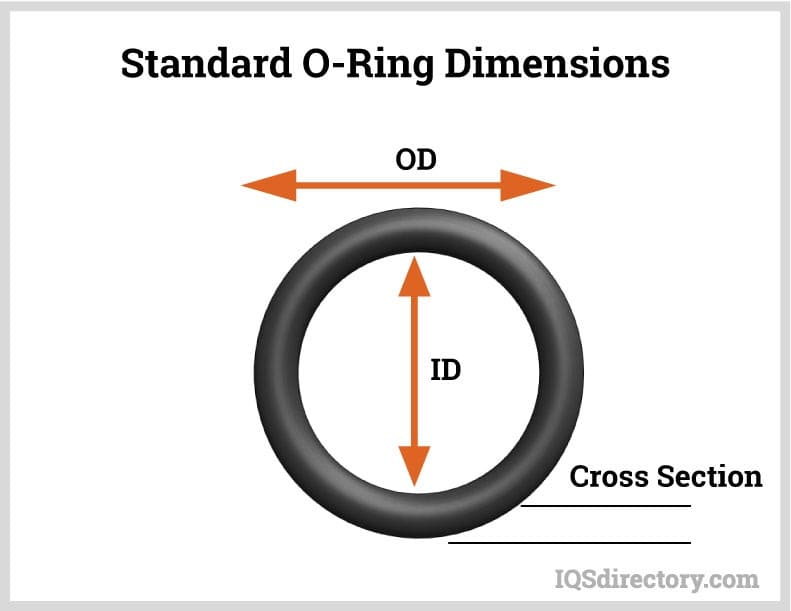 The standard dimensions of an o-ring includes inner diameter (ID), outer diameter (OD), and cross sectional (CS) diameter.
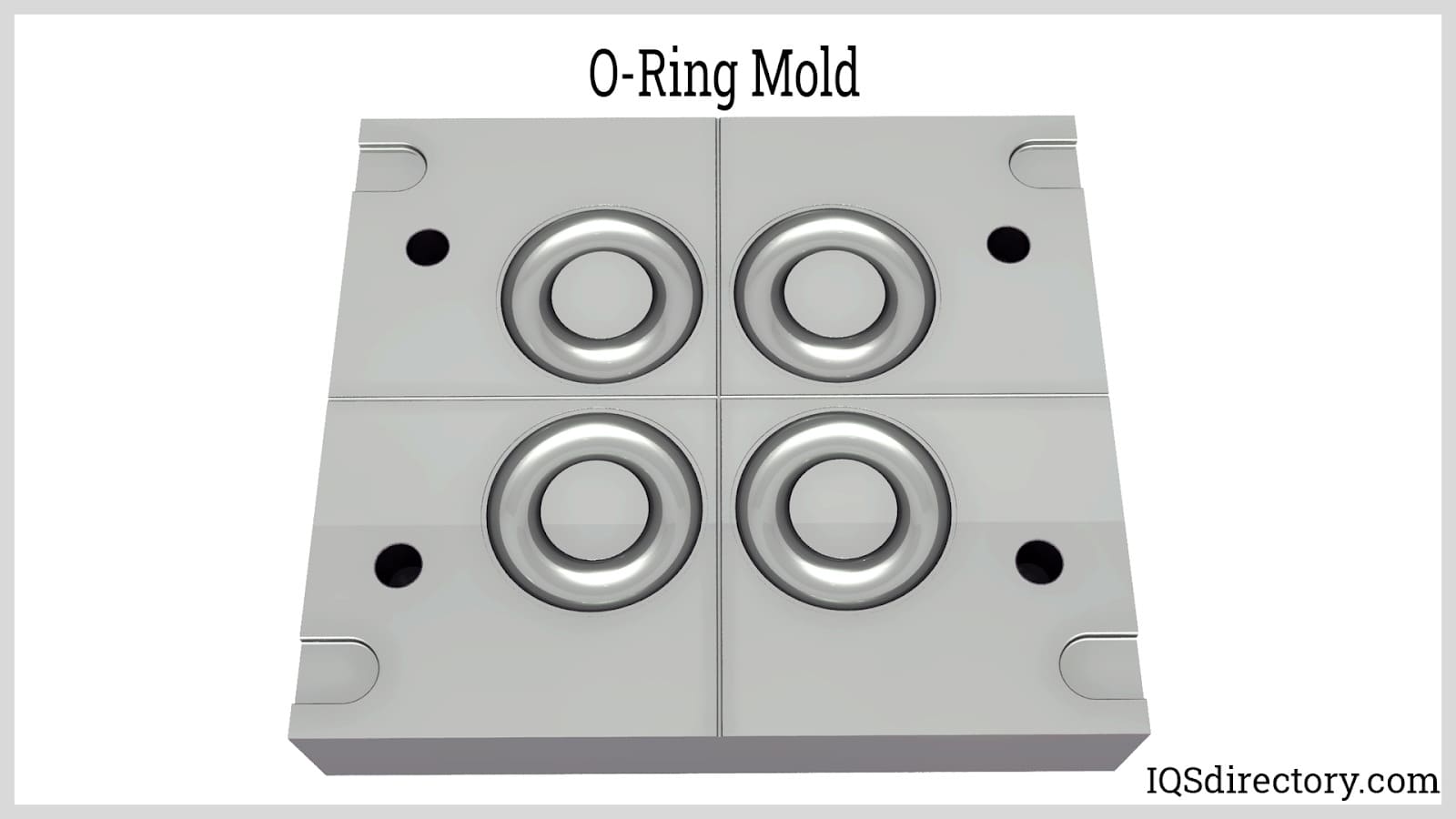 The material use for the o-rings are made from two halves and then compressed.
O-Ring Types
Different O-ring types are designed to meet varying operational requirements, including chemical resistance, temperature stability, and pressure tolerance.
Silicone O-rings perform well in high-temperature environments, while nitrile O-rings are commonly used in oil and fuel applications. EPDM O-rings are suited for water and solvent exposure, whereas Viton O-rings offer strong resistance to chemicals and heat.
Metal O-rings are selected for extreme environments where elastomers may not perform effectively. Static and dynamic O-rings are also categorized based on whether they are used in moving or stationary components.
Applications of O-Rings
O-rings are widely used in sealing applications across multiple industries, including hydraulics, pneumatics, aerospace, chemical processing, and water treatment systems. Their ability to maintain a seal under pressure makes them suitable for pumps, valves, compressors, and engine components.
In dynamic systems, O-rings seal moving parts such as pistons and rotating shafts. In static systems, they prevent leakage in fixed joints such as fittings, lids, and enclosures. Their versatility allows engineers to use them in both simple consumer products and complex industrial machinery.
Features of an O-Ring
O-rings feature a circular cross-section that deforms under pressure, allowing them to fill gaps between mating surfaces. This deformation enhances sealing performance by increasing contact pressure as system pressure rises.
Their elastic properties also allow them to recover their original shape after compression, maintaining sealing performance over repeated cycles. This makes them suitable for long-term use in systems requiring consistent operation.
O-Ring Installation
Installing an O-ring involves ensuring proper alignment, avoiding damage during placement, and applying lubrication when necessary. Care should be taken to prevent twisting or over-stretching during installation.
After installation, verify that the O-ring is evenly positioned and not distorted. Proper installation techniques help maintain sealing performance and reduce the likelihood of premature failure.
Standards and Specifications for O-Rings
O-rings are manufactured according to industry standards that define dimensions, materials, and performance characteristics. Organizations such as ISO and SAE provide guidelines that help ensure consistency and reliability across applications.
Things to Consider When Purchasing O-Rings
When sourcing O-rings, it is important to evaluate supplier reliability, material compatibility, and application requirements. Buyers should consider pressure ratings, temperature range, chemical exposure, and required tolerances when selecting a sealing solution.
- Confirm supplier capabilities and delivery options.
- Provide detailed specifications and operating conditions.
- Evaluate customization options for specialized applications.
- Review lead times and production capacity.
Proper Care for O-Rings
Proper storage and handling help extend the lifespan of O-rings. Protecting them from excessive heat, light, and chemical exposure prevents material degradation. Keeping replacement O-rings readily available supports efficient maintenance and reduces downtime.
O-Ring Terms
Elastomer
A flexible material used in sealing applications.
Gland
The cavity where the O-ring is installed.
Compression
The deformation of an O-ring to create a seal.