Adhesives
Adhesives are engineered bonding materials used to join two separate substrates into a durable connection that resists separation, vibration, moisture, and wear. In industrial settings, an adhesive can do far more than hold parts together. Depending on formulation, it may seal gaps, fill voids, support lamination, contain liquids, dampen vibration, or create a smoother finished surface. Each system is built around resins, curing chemistry, and performance targets so the finished bond delivers the needed adhesion, cohesion, flexibility, and service life while using materials such as epoxy in applications that demand high-performance bonding.
Adhesives support modern engineering, assembly, and manufacturing across a wide range of industrial and commercial processes. Formulations may include casein, starch, natural rubber, butyl rubber, amino resins, polyurethane, polyvinyl acetate, acrylics, silicones, and specialty additives chosen for bond strength, cure profile, chemical resistance, and temperature stability. Adhesive suppliers and compounders fine-tune these materials to match substrate compatibility, line speed, environmental exposure, and end-use performance.
Adhesives FAQ
What are adhesives used for in industrial applications?
Adhesives are used in industrial applications to bond metals, plastics, composites, wood, glass, paper, and ceramics in sectors such as construction, automotive, electronics, packaging, medical devices, and appliance manufacturing. They create durable bonds without bolts, rivets, or welding, and many formulas also provide sealing, vibration damping, waterproofing, and gap filling for assemblies that need both strength and a clean finished appearance.
How do adhesives differ from mechanical fasteners?
Unlike mechanical fasteners, adhesives distribute stress across the bonded area instead of concentrating force at a few drilled or welded points. That helps preserve substrate integrity, reduce visible hardware, limit corrosion pathways, and support smoother surfaces. Adhesive bonding can also improve noise reduction, insulation, impact absorption, and lightweight product design in applications where appearance and performance both matter.
What are the main types of industrial adhesives?
The main types of industrial adhesives include silicone, acrylic, epoxy, polyurethane, hot melt, cyanoacrylate, anaerobic, pressure-sensitive, and UV-curing systems. Each class is designed around different cure methods, service temperatures, substrates, and production requirements. When buyers compare adhesive types, they usually look at bond strength, open time, flexibility, chemical resistance, environmental exposure, and processing speed.
How are adhesives tested for strength and performance?
Adhesives are tested through tensile, shear, peel, impact, cleavage, and fatigue evaluations to measure how a bond performs under real operating conditions. Manufacturers and engineers use these test results to compare formulations, confirm substrate compatibility, and verify that an adhesive can withstand load, shock, repeated movement, moisture, and long-term service demands.
What factors affect adhesive curing and bonding quality?
Curing and bond quality are influenced by temperature, humidity, surface energy, cleanliness, adhesive viscosity, joint design, and substrate preparation. For strong adhesion, the material must properly wet the surface and then cure under the right conditions, whether that cure is triggered by heat, pressure, moisture, UV light, or a chemical reaction. Small changes in application method can noticeably affect final bond performance.
What are the benefits of using adhesives in manufacturing?
Adhesives give manufacturers load distribution, design flexibility, lower part count, and a cleaner finished look than many screws, nails, or welds. They can reduce vibration, limit galvanic corrosion, improve sealing, and support mixed-material assemblies. For many production environments, adhesive bonding also helps streamline assembly while maintaining durability, appearance, and product reliability.
How have adhesives evolved over time?
Adhesives have evolved from natural glues made from plant and animal materials to advanced synthetic systems engineered for speed, consistency, and specialized performance. Modern developments such as PVA, epoxy, polyurethane, acrylic, silicone, and emerging bio-based and nanostructured adhesives have expanded what manufacturers can bond and how well those bonds perform in demanding environments.
History and Evolution of Adhesives
The history of adhesive bonding reaches back to prehistoric toolmaking, when early people used natural tars and plant-based materials to join stone components. Over time, ancient civilizations developed glues from animal byproducts and plant extracts for woodworking, decoration, and assembly. Those early bonding materials laid the groundwork for the sealants, structural adhesives, and specialty compounds used in modern manufacturing.
By the eighteenth century, adhesive production had begun shifting from small-batch craft methods toward organized commercial manufacturing. Later industrial and consumer developments, including household glues and synthetic resin systems, accelerated the move away from purely natural materials. As chemistry advanced, producers gained better control over cure speed, shelf life, durability, and compatibility with different substrates.
Today, adhesive science continues to expand through polymer research, surface engineering, and biomimetic design inspired by natural structures such as gecko feet. Current formulations include construction adhesives, tapes, plastisols, thermally conductive compounds, flexible sealants, and specialty bonding systems built for electronics, transportation, medical products, and high-volume assembly lines.
Very few modern products are completely untouched by adhesive technology. From packaging and flooring to electronics and transportation interiors, adhesives remain a foundational part of manufacturing because they support bonding, sealing, insulating, protecting, and finishing in one integrated material solution.
Benefits and Advantages of Adhesives
-
Structure and Bonding Benefits
One of the main benefits of adhesives is their ability to bond surfaces without cutting, drilling, or heavily altering the joined materials. That makes them valuable when manufacturers need strength without compromising appearance or structural design. With so many formulas available, buyers can select products based on substrate type, cure conditions, flexibility, temperature range, and exposure to moisture or chemicals.
Adhesive Appearance Advantages
Adhesives generally require less heat and less invasive processing than many welding or fastening methods, which can help protect sensitive materials and delicate finishes. Because the bond line is often hidden, adhesives support cleaner aesthetics while also contributing insulation, sealing, and vibration control. This combination makes them useful in applications where product appearance and performance need to work together.
Multiple Adhesive Options
Industrial adhesives span many chemistries, with acrylic, silicone, and polyurethane systems representing only part of the larger market. Cure mechanism is another major differentiator. Hot melts set as they cool, UV adhesives cure with light exposure, anaerobic compounds cure in the absence of oxygen, and pressure-sensitive adhesives bond when force is applied. Some specialized products are even designed for thermal management or electrical conductivity in electronics and touchscreen assemblies.
Selecting the right adhesive can shape product quality, assembly speed, maintenance life, and field performance. Whether the job involves flooring, labels, countertops, transportation components, or structural bonding, the best results come from matching the adhesive to the substrate, operating environment, and production method. Manufacturers that help customers compare open time, cure speed, flexibility, bond strength, and chemical resistance bring added value during the sourcing process.
Uses and Applications of Adhesives
Adhesive manufacturers develop custom and standard industrial bonding products for woodworking, packaging, labeling, construction, automotive, electronics, appliance assembly, textiles, and bookbinding. Among the many options, epoxy adhesives are well known for high bond strength, chemical resistance, and durability in repair, filling, and structural joining. Adhesive technology is present almost everywhere, from household cabinetry and office furniture to aircraft interiors and commercial equipment, and can even work as reinforment support around hardware assemblies.
To support these varied applications, adhesive systems are paired with many application tools and dispensing methods. In addition to glue guns and cartridge dispensers, manufacturers use brushes, spray guns, roller coaters, curtain coaters, and air-actuated equipment to control bead size, coverage, and repeatability. Medical and healthcare uses also continue to grow, including wound closure, wearable devices, transdermal patches, laminates, and device mounting where clean placement and reliable adhesion are required.
Adhesives are also deeply integrated into consumer electronics and electrical assemblies, where they support display bonding, shielding, grounding, thermal pathways, and part retention. In the automotive sector they are used for labels, interior trim, mirrors, lighting, gaskets, and structural components. Their broad use across daily life reflects the versatility of adhesive bonding as a dependable manufacturing solution.
Adhesive Images, Diagrams and Visual Concepts
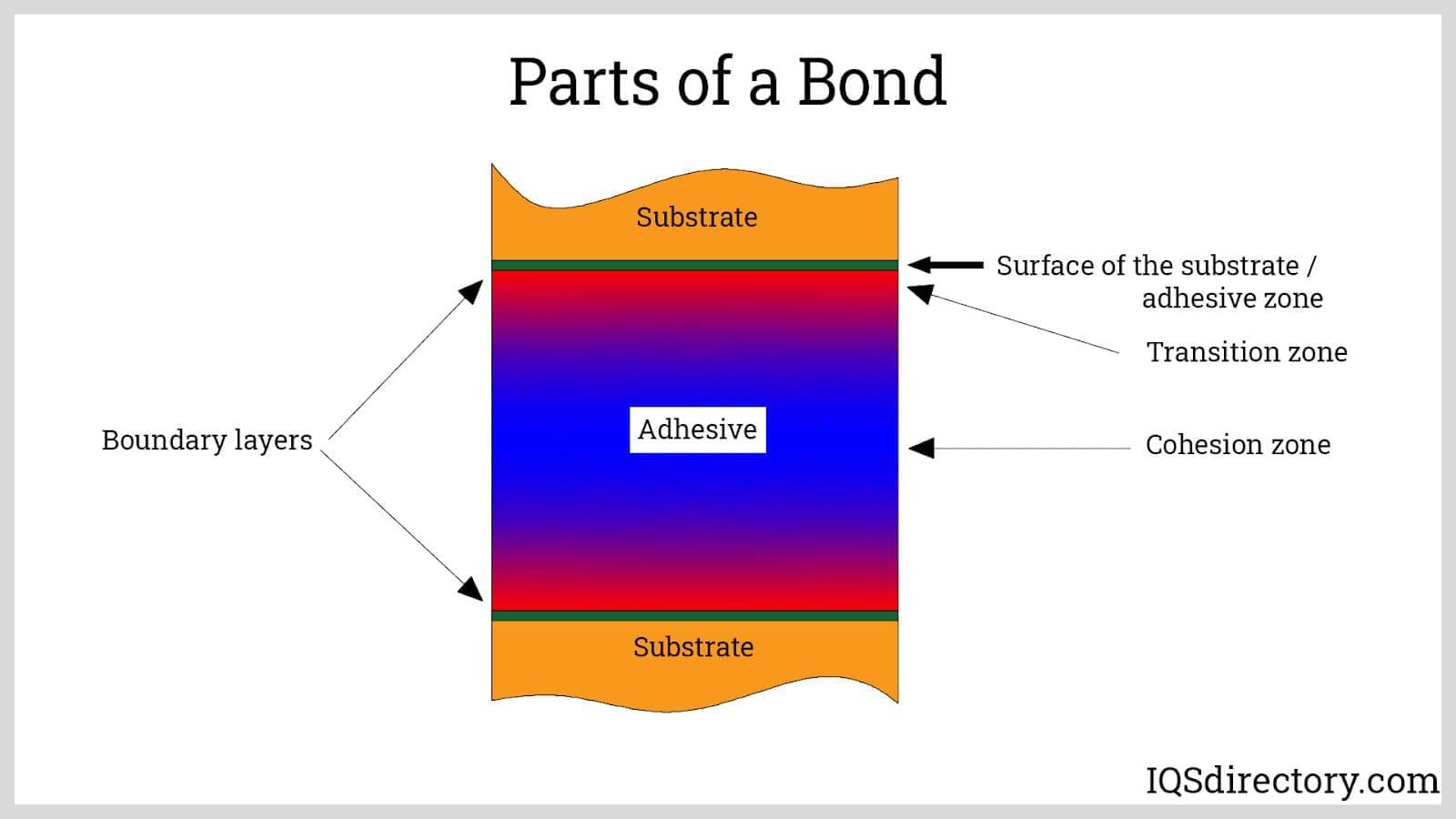 The different parts and layers of an adhesive bond
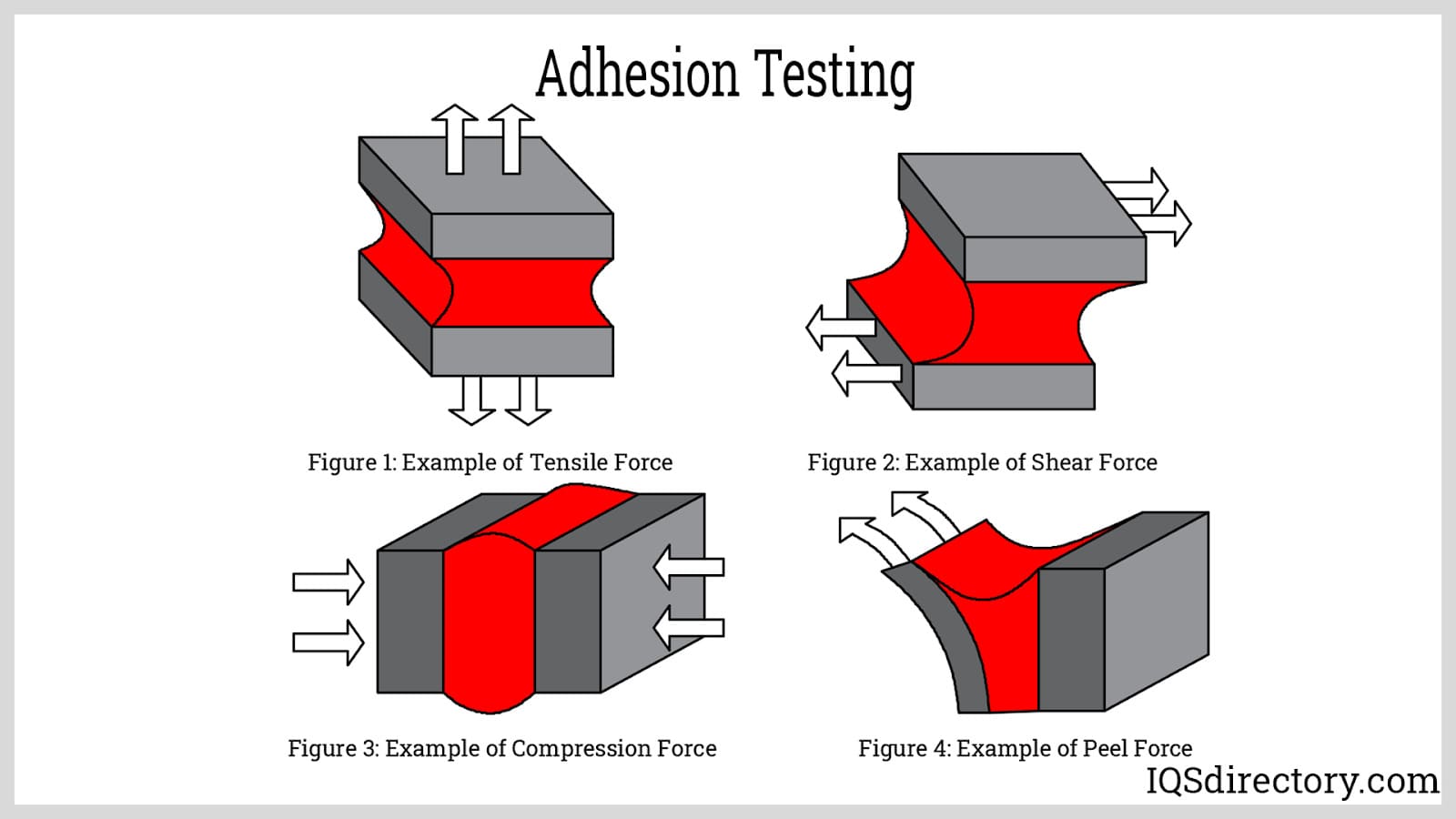 Tests for comparing relative qualities of the adhesive.
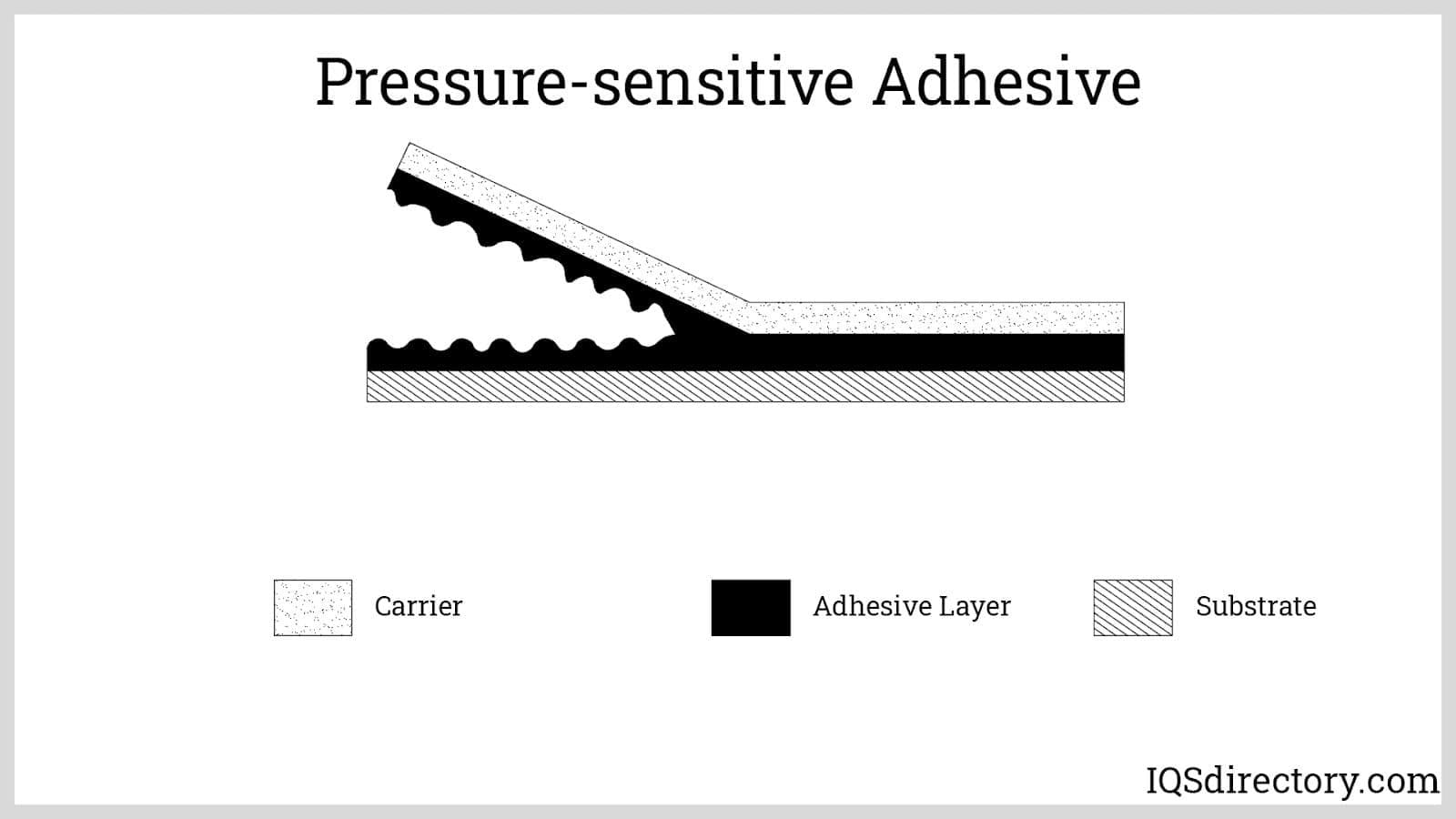 Using pressure to establish an adhesive bond.
 Adhesive must "wet out" the surface to be bonded for optimal adhesion and covers a surface in order to increase the contact area and attractive forces between the adhesive and the bonding surface.
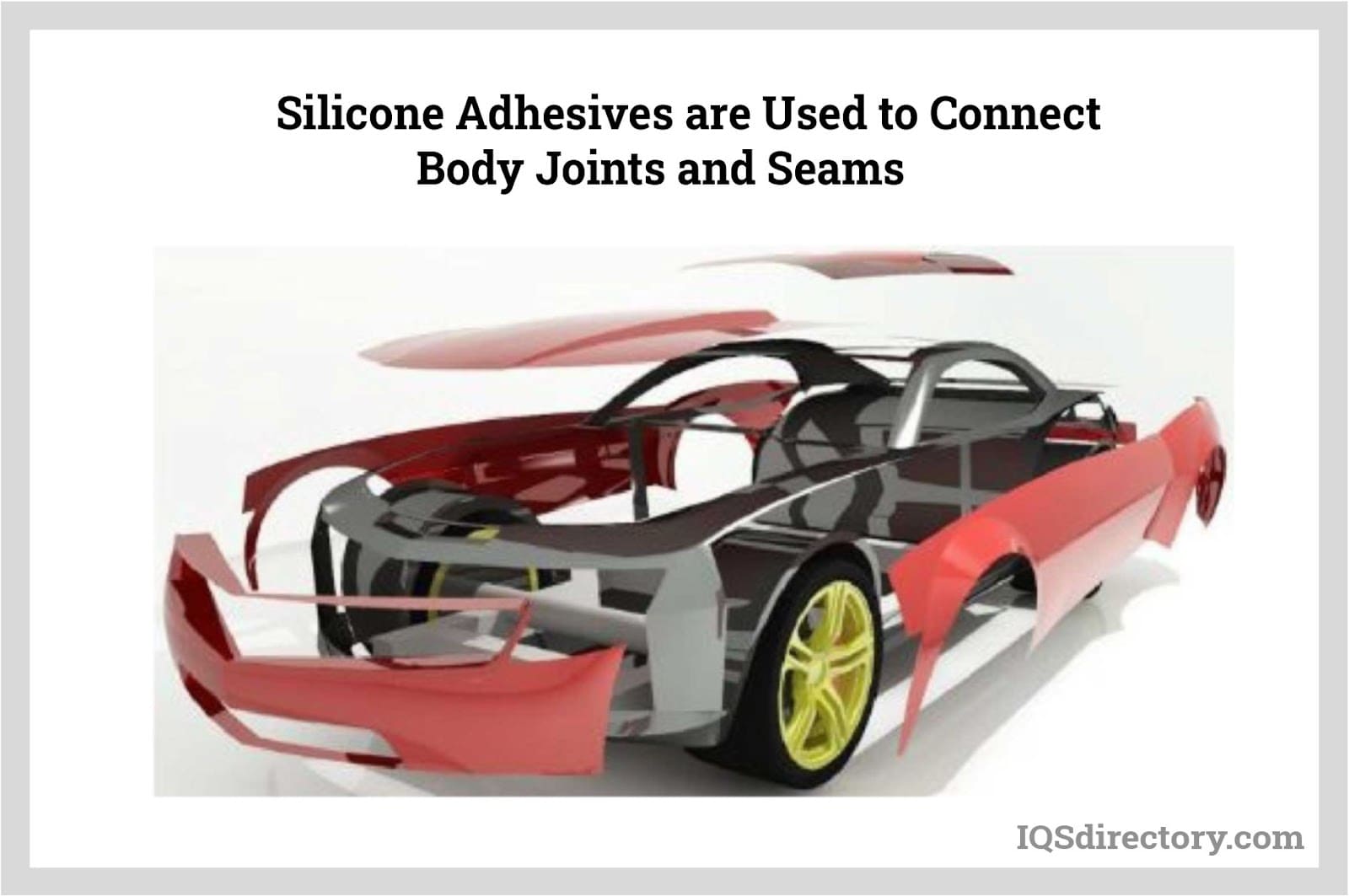 Silicone adhesives are durable, weathering resistance, waterproof, impact resistant, does not crack or peel, and makes a flexible bond.
Adhesive Types
-
Acrylate adhesives bond quickly at room temperature and offer strong resistance to weathering, UV exposure, and many environmental conditions. They adhere well to metals, plastics, glass, ceramics, and wood, making them a common choice for industrial bonding, signage, assembly, and general-purpose manufacturing.
Adhesives manufacturers produce bonding materials, sealants, applicators, and related accessories for industrial, commercial, and consumer use. Many suppliers also offer formulation guidance, process support, and help with product selection based on substrate, cure method, and service environment.
Aerosol Adhesives
Aerosol adhesives are spray-applied bonding products valued for fast coverage, convenience, and controlled application on foam, fabric, insulation, trim, laminates, labels, and upholstery. They are available in temporary, repositionable, and permanent strengths for both light-duty and production-scale work.
Anaerobic Adhesives
Anaerobic adhesives cure when oxygen is excluded and the material contacts reactive metal surfaces. They are widely used for thread locking, retaining cylindrical parts, gasketing, and sealing where leak prevention and vibration resistance are important.
Conductive adhesives, also called electrically conductive adhesives, provide bonding along with electrical or thermal conductivity. They are used in electronics, sensors, circuit assemblies, shielding applications, and component attachment where solder alternatives or lower-temperature processing are desirable.
Cyanoacrylate Adhesives
Cyanoacrylate adhesives are fast-setting one-component products that form a rigid bond with very small application amounts. They are often selected for rapid assembly, small parts, repair work, and tight-fitting surfaces that need quick fixture time.
Epoxies, or epoxy resins, are versatile materials used in coatings, encapsulation, composites, and high-performance adhesive systems. They are known for strong chemical resistance, durability, and the ability to formulate for demanding industrial environments.
Epoxy adhesives are valued for high bond strength, strong chemical and heat resistance, and the ability to bond many materials. They can be formulated to cure quickly or slowly and to remain rigid or somewhat flexible depending on the application.
Hot melt adhesives are applied in a molten state and solidify as they cool, making them well suited for fast production lines. They are commonly used in packaging, product assembly, bookbinding, carton sealing, and other processes that need rapid set times.
Industrial Adhesives
Industrial adhesives are high-performance bonding products designed for manufacturing environments where reliability, repeatability, and service life matter. They are formulated to handle specific load conditions, substrates, cure windows, and exposure requirements.
Laminating adhesives are used to bond thin layers of material in films, sheets, labels, graphics, and composites. They may be supplied in rolls or sheets and are applied with presses, rollers, or hand tools depending on the process.
Methacrylate Adhesives
Methacrylate adhesives provide strong gap filling, peel strength, impact resistance, and flexibility while bonding many materials, including some surfaces that are less than perfectly prepared. They are often used in transportation, composites, plastics, and structural assembly.
Membrane Press Adhesives
Membrane press adhesives are formulated for heated lamination processes and are designed to set quickly after activation so parts can be unloaded, trimmed, and moved through production with minimal delay.
Moisture Cure Adhesives
Moisture cure adhesives react with humidity in the air or moisture in the substrate to form a cured polymer bond. Silicone and polyurethane systems are common examples, offering flexible and durable performance across many assembly and sealing applications.
Polyurethane Adhesives
Polyurethane adhesives are available as one-part or two-part systems and are known for strong, flexible bonds across dissimilar materials. They are widely used when manufacturers need toughness, impact resistance, and a little more movement than a rigid epoxy typically allows.
Pressure-sensitive adhesives form a bond when pressure is applied and are commonly coated onto tapes, labels, films, foams, and flexible materials. They support clean application to wood, metal, paper, plastic, and many flat surfaces.
Silicone adhesives create lasting bonds while also serving as sealants in applications that need flexibility, weather resistance, heat resistance, and moisture protection. They are common in construction, electronics, transportation, and appliance assembly.
Thermoset Adhesives
Thermoset adhesives cure into a permanent network that does not soften again with heat. Epoxies, polyesters, silicones, rubbers, and polyurethanes in this category are often used where high temperatures or demanding service conditions are expected.
Two-Part Adhesives
Two-part adhesives contain multiple components that react after mixing to form a strong cured bond. Epoxy, acrylic, polyurethane, and silicone systems in this category are used when performance requirements justify the added mixing step.
Ultraviolet Adhesives
Ultraviolet adhesives cure when exposed to UV light, allowing fast and precise processing in applications such as medical devices, fiber optics, electronics, and transparent assemblies.
Urethane Adhesives
Urethane adhesives bond many materials while offering toughness and flexibility at lower temperatures. Their long-term performance depends on proper formulation and exposure conditions, especially where heat or prolonged moisture may be present.
Water-Based Adhesives
Water-based adhesives use water as a carrier or diluent and are common in paper converting, packaging, labeling, woodworking, and other applications that benefit from lower solvent content and easy processing.
Adhesives Production Process
Developing the Right Adhesive Compound
To develop the right adhesive compound, manufacturers evaluate operating temperature, pressure, cure environment, UV exposure, moisture, flexibility, chemical contact, and expected service life. Buyers often start with practical questions: Will the bond face outdoor weather? Does the substrate need to flex? Is fast line speed required? These performance targets guide the selection of resin, additives, cure chemistry, and viscosity.
Mechanical Bonding and Adhesive Spread
Adhesives are formulated to solve different bonding challenges, and one of the most important is how well the material spreads over the substrate. Successful bonding depends on viscosity, wetting behavior, and surface contact. Low-viscosity products flow and level more easily, while higher-viscosity compounds may stay in place for gap filling or vertical applications. Because temperature affects flow, both the adhesive and the substrate condition matter during application.
Relative Adhesion Strength
Adhesion strength affects whether an adhesive spreads into pores, microtextures, and surface irregularities or pulls back on itself. When attraction to the substrate is strong enough, the adhesive can create better contact area and stronger mechanical interlocking. That improved wet-out usually supports better long-term bond performance.
Setting Temperatures and Curing Speeds
Adhesives vary widely in activation temperature and cure speed. Hot melts soften at elevated temperatures and set as they cool, while other systems remain open long enough for positioning before they harden. Production lines often compare fixture time, full cure time, and process window to make sure the adhesive matches assembly speed and part handling requirements.
One-Part and Two-Part Adhesives
Adhesives are available as one-part and two-part systems. Two-part products require mixing before use so a chemical reaction can begin, which is common with epoxies, acrylics, and urethanes. One-part products carry latent bonding chemistry that activates through heat, moisture, oxygen exclusion, radiation, or pressure. Cure time can range from seconds to days depending on formulation and job conditions.
Adhesive Forms and Performance Metrics
Manufacturers supply adhesives as liquids, pastes, films, foams, powders, aerosols, tapes, pellets, granules, and solid sticks. No matter the form, buyers compare performance using metrics such as impact, fatigue, tensile, shear, cleavage, and peel strength along with cure time, flexibility, ductility, substrate compatibility, and resistance to moisture or chemicals.
Adhesives Terms
-
Adhesive
A bonding material formulated to join surfaces together through adhesion to the substrate and cohesion within the adhesive layer itself.
Adherend
A material surface being bonded by an adhesive in an assembly or coating process.
Cleavage Strength
The resistance of a bonded joint to cracking or separating when stress is applied in a way that opens the bond line.
Curing
The hardening process through which an adhesive develops usable bond properties by cooling, drying, moisture reaction, radiation, or chemical cross-linking.
Curtain Coating
An adhesive application method in which parts pass through a flowing curtain of material for broad, even surface coverage.
Encapsulant
A protective adhesive-based coating that surrounds or seals a component to guard against moisture, contamination, vibration, or environmental exposure.
Fatigue Strength
The ability of an adhesive bond to withstand repeated loading and unloading over time without failing.
Impact Strength
The ability of a bonded joint to resist sudden shock or abrupt force without cracking or separating.
Peel Strength
A measure of the force needed to peel one bonded material away from another, often used to compare flexible adhesive systems.
Release Paper
A removable carrier or protective liner used with adhesive films, tapes, and laminating products until the bond surface is ready for use.
Resins
Base polymer materials, whether natural or synthetic, that contribute body, bonding behavior, and performance characteristics to adhesive formulations.
Roll Coating
An adhesive application method that uses rollers to spread a controlled layer of material across a surface for efficient, repeatable coverage.
Screen Printing
A patterned adhesive application technique that pushes material through a mesh screen to control placement and coating thickness.
Shear Strength
The ability of a cured adhesive bond to resist forces acting parallel to the bonded surfaces.
Substrate
The surface or base material to which an adhesive is applied, also called the adherend in many bonding discussions.
Tensile Strength
The resistance of an adhesive bond to pulling or stretching forces that try to separate the joined materials.
Transfer Printing
A method for applying a thin, accurate adhesive layer in a defined pattern, often used in paper converting, packaging, and similar processes.
Wet Strength
The measure of an adhesive’s bond strength immediately after being immersed in a liquid under controlled conditions of time, temperature, and pressure.