Wire Forms
Wire forms are custom-shaped metal components created by bending, cutting, straightening, and finishing wire to meet exact design requirements. This flexible wire fabrication process supports everything from simple two-dimensional parts to complex three-dimensional wire assemblies used for support, containment, positioning, guarding, suspension, and product display across demanding industrial applications.
Wire Forms FAQs
What are wire forms used for in manufacturing?
Wire forms are custom-shaped metal components used throughout automotive, healthcare, electronics, construction, retail, and industrial equipment manufacturing. They function as springs, guards, baskets, racks, hooks, clips, frames, and retainers, delivering support, protection, spacing, organization, and reliable performance in both light-duty and heavy-duty applications.
How are wire forms fabricated?
Wire forms are fabricated by selecting the right alloy and wire gauge, straightening coil stock, and then bending or shaping the material into a precise configuration. Common production methods include CNC wire forming, hydraulic pressing, fourslide forming, stamping, welding, and secondary finishing operations such as deburring, coining, plating, powder coating, or custom assembly.
What materials are commonly used for wire forming?
Common wire form materials include carbon steel, stainless steel, brass, copper, aluminum, and specialty alloys selected for strength, corrosion resistance, conductivity, finish, and cost. Stainless steel is often chosen for demanding environments, while copper and brass are favored for electrical performance, appearance, and formability.
What is CNC wire forming?
CNC wire forming uses computer-controlled equipment to bend wire into accurate 2D and 3D shapes with consistent repeatability. This process supports tight tolerances, shorter setup times, reduced variation, and faster changeovers for custom parts, prototypes, and production runs.
What industries rely most on wire forms?
Industries such as automotive, healthcare, aerospace, electronics, construction, warehousing, and retail rely heavily on wire forms. These parts are used in suspension systems, battery contacts, instrument trays, merchandising displays, storage racks, fan guards, filtration screens, and countless OEM assemblies.
How do wire baskets differ from wire racks?
Wire baskets are enclosed wire assemblies built for storage, washing, transport, or parts handling, while wire racks and wire shelves are more open frameworks used for display, staging, drying, and organization. Both can be customized by size, finish, load capacity, and wire diameter for industrial, medical, or retail environments.
What should be considered when selecting a wire form manufacturer?
When choosing a wire form manufacturer, review their design support, forming capabilities, material knowledge, finishing options, and responsiveness. For complex or high-tolerance projects, request a prototype or first article so you can confirm fit, performance, and manufacturability before full production begins.
Wire Form Products
- Wire Displays
- Wire displays include a broad range of functional wire products such as grids, racks, shelves, baskets, and point-of-purchase fixtures. Wire grids, or grid panels, are formed from intersecting horizontal and vertical wires, creating an open framework similar to wire mesh or metal gratings while remaining lighter in weight and easier to customize for merchandising, storage, and display programs. Wire Shelves and racks extend outward from walls and fixtures to create sturdy, flat storage surfaces that improve visibility, organization, and use of available space.
- Wire Basket
- Wire baskets are durable, cage-like containers used for display, storage, washing, transport, and protective handling applications. Their open designs improve visibility, drainage, airflow, and access while still maintaining dependable structural integrity.
- Wire Hardware
- Wire hardware includes diverse wire forms that function as useful tools, accessories, support components, and handling aids. Typical examples include wire hooks and screens, each customized to match a specific load, environment, mounting method, or product-handling requirement.
- Wire Hooks
- Wire hooks are straightforward yet highly useful components formed by bending wire into shapes such as S-hooks, C-hooks, and J-hooks for hanging, connecting, supporting, separating, or securing products and equipment.
- Wire Screens
- Wire screens are produced by weaving or arranging slender metal wires into precise crisscross patterns. The result is a permeable barrier suited for filtration, guarding, screening, sorting, airflow management, and controlled material passage in both industrial and commercial settings.
- Wire Guards
- Specialized wire guards provide dependable safety and equipment protection by separating operators from moving machinery and helping prevent damage to sensitive components. Our wire guards include fan guards, finger guards, window and flooring protectors, face guards, and fixture shields built for reliable performance in demanding environments.
Wire forms are widely used components across a broad range of industries, including commercial and retail, medicine and healthcare, energy storage, maintenance, industrial washing, lighting, automotive, aerospace, construction, hardware, and storage. Below are examples that show how buyers and engineers use wire forms to solve support, handling, guarding, organizing, and motion-control challenges.
- Automotive
- In the automotive sector, wire springs are among the most common wire forms and appear in virtually every major vehicle system. Compression coil springs and volute springs help support suspension assemblies, while torsion springs, tension springs, retaining clips, shaped wire components, and contact forms support latches, interiors, battery systems, electrical connections, and under-hood assemblies.
- Healthcare
- Healthcare applications demand strict sterilization and hygiene standards, which means wire forms must be cleanable, consistent, and built for repeated processing cycles. Ultrasonic washers, for instance, rely on precisely engineered wire-form metal baskets to hold medical instruments securely while also protecting sensitive washer components such as transducers. Other healthcare wire forms include gauged trays, hand tools, positioning devices, and stainless steel assemblies used where corrosion resistance and washdown performance matter.
- Household
- Many everyday household products incorporate wire forms, including mouse traps, clothes hangers, shelving accessories, appliance parts, kitchen organizers, and small mechanical components that benefit from light weight and dependable spring action.
- Electronics
- Within electronic devices, wire forms serve key roles. Antennas are often carefully shaped wire components, while spring-based forms support battery contacts, conductive pathways, retention features, and smooth opening and closing action in many electrical products.
- Commercial and Retail
- In commercial and retail environments, wire forms support merchandise displays, especially in point-of-purchase fixtures designed to improve product visibility and shopper access. Wire racks and shelving units add storage efficiency, while guards and protective forms help shield equipment used by staff.
- Construction and Hardware
- Construction and hardware applications use wire forms in many ways, from clips and pins to wire hooks, springs, anchors, brackets, and protective screens. These products support assembly, fastening, routing, spacing, and general jobsite utility across residential, commercial, and industrial projects.
Wire Form History
Wire forming has a long manufacturing history. Early wire forms were shaped by hand and often appeared in jewelry and decorative metalwork, where skilled artisans relied on manual bending techniques that are still used today for specialty work and short custom runs.
The industrialization of wire forming accelerated during the late 17th century with Great Britain's establishment of its first wire mill, which helped expand material availability and encouraged the development of more consistent production methods and forming techniques.
Modern wire form manufacturing advanced dramatically with the introduction of computer numeric control (CNC) equipment. CNC technology enables accurate, automated fabrication of wire forms and shaped wire parts, allowing manufacturers to repeat complex geometries, reduce variation, improve throughput, and move more easily from prototype development to full-scale production.
Manufacturers can create wire forms from a wide range of materials, including steel, stainless steel, brass, copper, aluminum, and specialty alloys. Material selection affects strength, corrosion resistance, conductivity, finish, spring characteristics, and cost, which is why steel remains one of the most common choices in wire forming.
- Steel
- An alloy primarily composed of iron and carbon, steel is affordable, widely available, and known for high tensile strength. It is often selected for general-purpose wire forms, heavy-duty applications, and parts that need a strong balance of cost and performance.
- Stainless Steel
- A steel alloy valued for strength, corrosion resistance, cleanability, and long service life. Stainless steel is often selected for medical, food, washdown, outdoor, and high-humidity environments, and it is available in multiple grades for different performance needs.
- Brass
- With its gold-like appearance, brass offers a useful mix of appearance, formability, and thermal conductivity. It is often chosen for decorative components, specialty hardware, and selected electrical or low-friction applications.
- Copper
- With its distinctive reddish hue, copper performs well across a range of temperatures and stands out for outstanding electrical and thermal conductivity. It is often chosen for contacts, conductive components, and formed parts used in electrical assemblies.
- Aluminum
- Aluminum offers a strong strength-to-weight ratio along with good corrosion resistance, durability, and ease of handling. It is often selected when lower weight, easier transport, or a clean finished appearance are priorities.
- Wire Selection
- The first step in wire forming is choosing the right wire material, diameter, temper, and finish for the application, load requirements, environment, and forming method.
- Wire Straightening
- Wire forming typically begins with straightening the wire, which is often supplied in coil form ranging from small coils to very large production spools. During this stage, stress-related deformation is removed so the material can feed consistently into downstream equipment. Manufacturers work to minimize preventable stress through proper handling, rolling, and setup, and in some applications a rotary arbor or similar straightening method is used to improve feed accuracy and part consistency.
The wire straightening stage is very important because imperfections at this point can carry through to the finished part. High-quality mill products should be selected, and factors such as wire helix, camber, and feed consistency should be monitored closely to reduce scrap and improve repeatability.
- Application of Force
- Wire forms are produced by applying controlled force, either manually or mechanically, to reshape wire into a required geometry. Depending on the application, manufacturers can create round, oval, square, flat, hexagonal, triangular, elliptical, and D-shaped forms for both simple parts and complex custom configurations.
The simplest wire shaping method uses a hand-held lever and spindle, while more advanced production relies on hydraulic presses, die-based benders, air benders, fourslide equipment, and computer-controlled forming systems. For higher-volume or tighter-tolerance work, CNC wire forming supports efficient production of pre-programmed parts in complex three-dimensional configurations.
- Finishing/Secondary Operations
- To deliver a cleaner finished product, manufacturers often perform secondary operations after primary wire forming. These can include cutting, stamping, heading, coining, deburring, plating, coating, polishing, and other finishing steps that improve appearance, fit, corrosion resistance, or handling safety.
When choosing a wire form design and fabrication method, manufacturers evaluate several important factors that influence cost, performance, lead time, and long-term durability:
- Volume Required (Large or Small)
- Tolerance Value Required
- Mechanical and Chemical Characteristics
- Configuration of the Design
- Intended Application
These factors should be considered in relation to both the finished part and the real-world environment in which it will operate.
In addition to those broader design considerations, manufacturers also evaluate wire form ends and interior geometries. Both are customized according to how the part will be mounted, loaded, assembled, or used in service. Below are some common end treatments and geometry options chosen in wire form production:
- Machine Cut End
- This is a straight cut made by a machine die, such as a guillotine knife. The burrs created by the cut are typically very small, making this style acceptable for many general manufacturing applications where a simple end condition is suitable.
- Chamfered End
- This is a straight cut made by a machine die, such as a guillotine knife. The burrs created by the cut are typically very small, making this style acceptable for many general manufacturing applications where a simple end condition is suitable.
- Winging
- Also known as swaging, this process presses a die onto the wire to displace the metal and create a wing-type shape that can support fastening, locating, or assembly needs.
- Pierced Swaging
- This is a two-step process in which the wire is first pressed to create a swaged shape and then pierced through the center, producing an end feature suited for fastening or connection.
- Custom-Shaped Hole
- Similar to pierced swaging, this option creates a custom hole at the end of the wire. After the wire is pressed and shaped by a die, a second custom punch produces the opening required for the application.
- Chisel Point and Turned End
- A die removes metal in a punch operation to create a chisel point. This approach is relatively coarse but effective for certain uses. A turned end can also be produced when diagonals are removed in a jagged punch pattern.
- Ball End
- To create a ball end, a lathe is used instead of a die, producing a smooth rounded end with no sharp edges and a more finished appearance.
- Groove
- A groove is created using a lathe and is typically used to hold a retaining ring or support assembly retention.
- Cold Heading
-
Cold heading involves two gripping dies. The first die holds the wire firmly while the second forms the material into a flat or round head. This method is used for button heading, carriage heading, collar heading, and other headed wire components.
Manufacturers can create custom wire forms to meet highly specific performance and assembly requirements. They may apply powder coating to improve appearance and surface protection, develop custom assemblies in many shapes and dimensions, and work with a wide range of wire diameters. To complete a custom wire fabrication program, many suppliers also offer secondary services such as nickel plating, painting, anodizing, and powder coating.
- Manual Lever
-
The oldest and most common method of wire form fabrication involves a hand-held lever and spindle. In this process, an operator manually bends wire around a post and an anvil, a solid iron block with concave sides and a flat top, to create the required form.
- Machine with Preset Pins
- Some wire forming equipment includes preset pins for different bending operations. These machines represent early semi-automated wire forming methods. While they improve efficiency over manual bending, they still require operator input and can introduce more variation than modern CNC systems.
- Hydraulic Systems
- Hydraulic systems are another common method for wire form production, typically using a press, dies, and feed equipment. In this process, material is loaded from a straightening machine and formed under the supervision of an operator. Because straightening helps remove accumulated stresses and improve consistency, it remains an important part of the workflow. As equipment has advanced, many hydraulic systems now include pick-and-place robotics that reduce manual handling and improve throughput.
- Fourslide Machines
-
An alternative to hydraulic presses, fourslide machines are highly versatile and can also produce stampings. These machines work on a single workpiece from four sides, increasing forming speed and supporting multi-directional shaping. Modern fourslide equipment with multipurpose dies can produce high volumes of simple wire forms with strong repeatability and shorter turnaround times.
- CNC Wire Bending Machines
- The most advanced method of wire bending uses computer numerically controlled (CNC) machines capable of both two-dimensional and three-dimensional bending. CNC wire forming offers outstanding versatility, allowing quick adjustments between projects and making it especially useful for custom wire forms, precision parts, and production programs that require repeatable dimensions.
To produce the wide variety of wire forms used across industry, manufacturers rely on several wire forming processes. Common examples include coil making, roll forming, metal stamping, and welding, each selected according to part geometry, tolerance, production volume, and end use.
- Coil Making
- Also known as spring making or coil winding, this process wraps wire around mandrels or metal blanks to create coils used in springs, retaining components, and other circular or helical wire products.
- Roll Forming
- Roll forming is a versatile process used to produce flat, round, and shaped wire parts. It is a continuous operation that uses rollers, tooling, and die punches to shape the material efficiently for repeat production.
- Metal Stamping
- Metal stamping is another major wire forming technique in which wire is shaped using a stamping press. Common methods include fourslide stamping and deep drawn stamping. Fourslide stamping, also called multislide stamping, uses four horizontal forming slides so the wire can be shaped from multiple directions, while deep drawing is used when a deeper formed profile is needed.
- Welding
- Welding refers to several processes used to join metal wire, including electric resistance welding (ERW), metal inert gas (MIG) welding, and tungsten inert gas (TIG) welding. ERW uses electric current and mechanical pressure to join wire, while MIG and TIG rely on shielding gases to help maintain weld quality. TIG welding offers a high level of control, while MIG welding is often chosen for faster wire form construction and production efficiency.
When considering a wire form purchase, it is often wise to work with a custom manufacturer that can match the part to your exact application, production volume, material needs, and finishing requirements. At the same time, buyers should evaluate not only forming capability and tooling knowledge, but also communication, project support, and overall service quality.
If you have a particularly complex request, ask for a prototype or sample run. This helps confirm dimensions, fit, finish, and performance before you move into tooling, scheduling, or a larger production commitment.
To find the right manufacturer, review the companies listed above and compare their capabilities, materials, secondary services, production capacity, and responsiveness. Contact one or more suppliers to discuss your wire form specifications, prototype needs, and production goals.
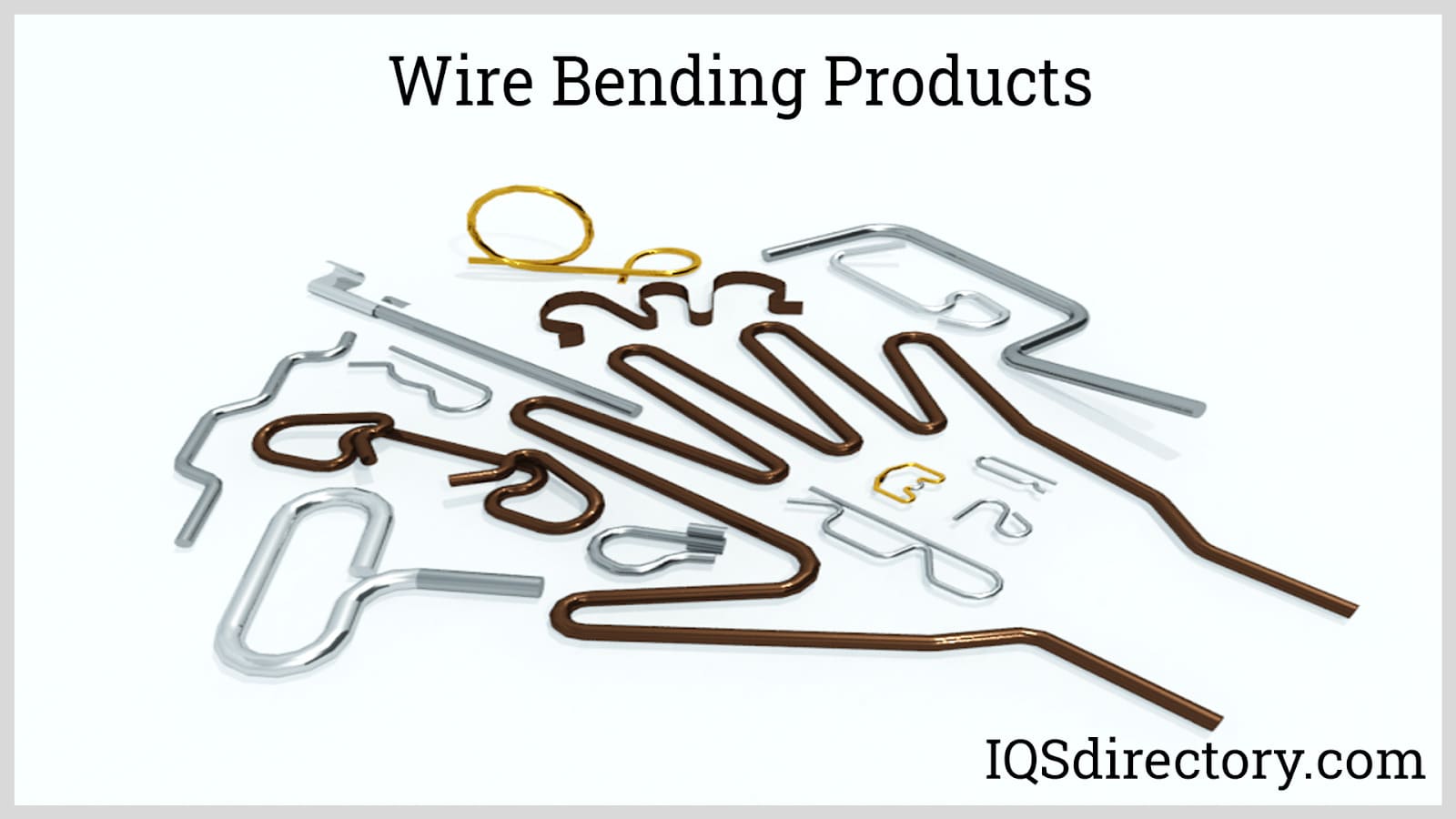 Wire bending process showing how wire can be shaped into a wide range of configurations to fit many industrial and commercial applications.
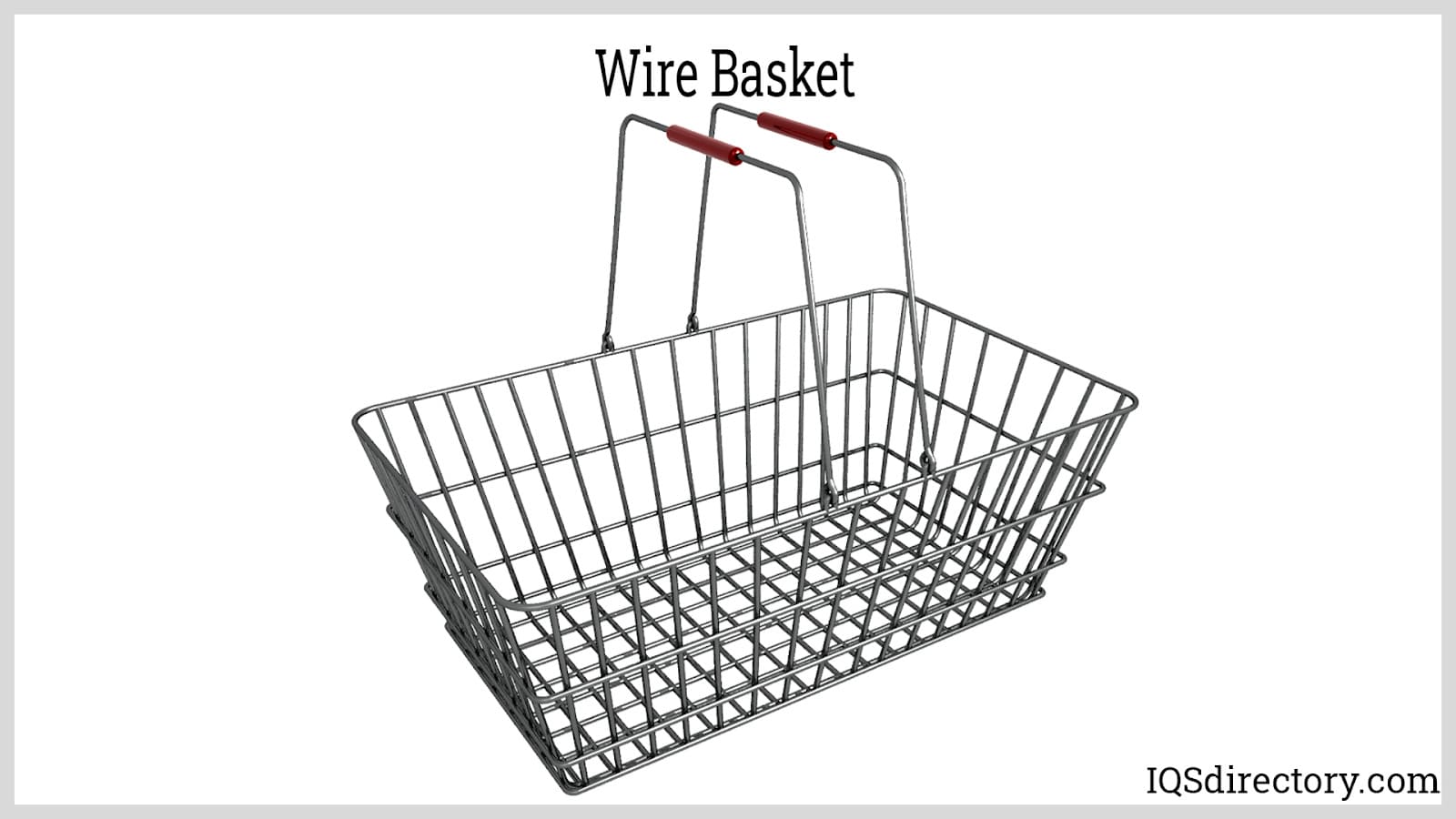 Wire baskets are made from wires that are woven or welded together to create a basket shape suited for storage, washing, transport, or parts handling.
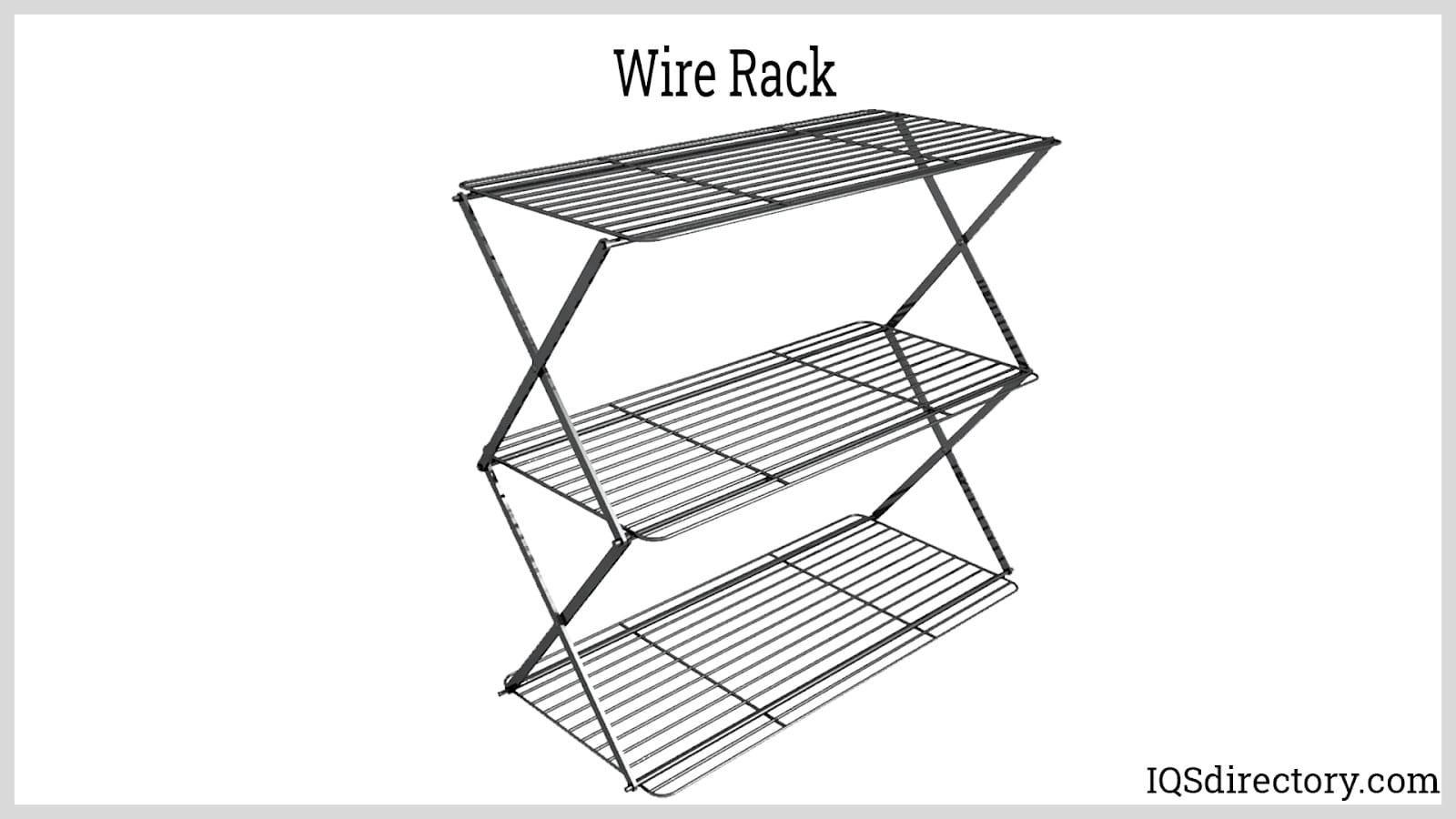 Wire racks are produced by feeding wire from blank lengths or spooled coil and bending it into defined forms that support storage, display, and organization.
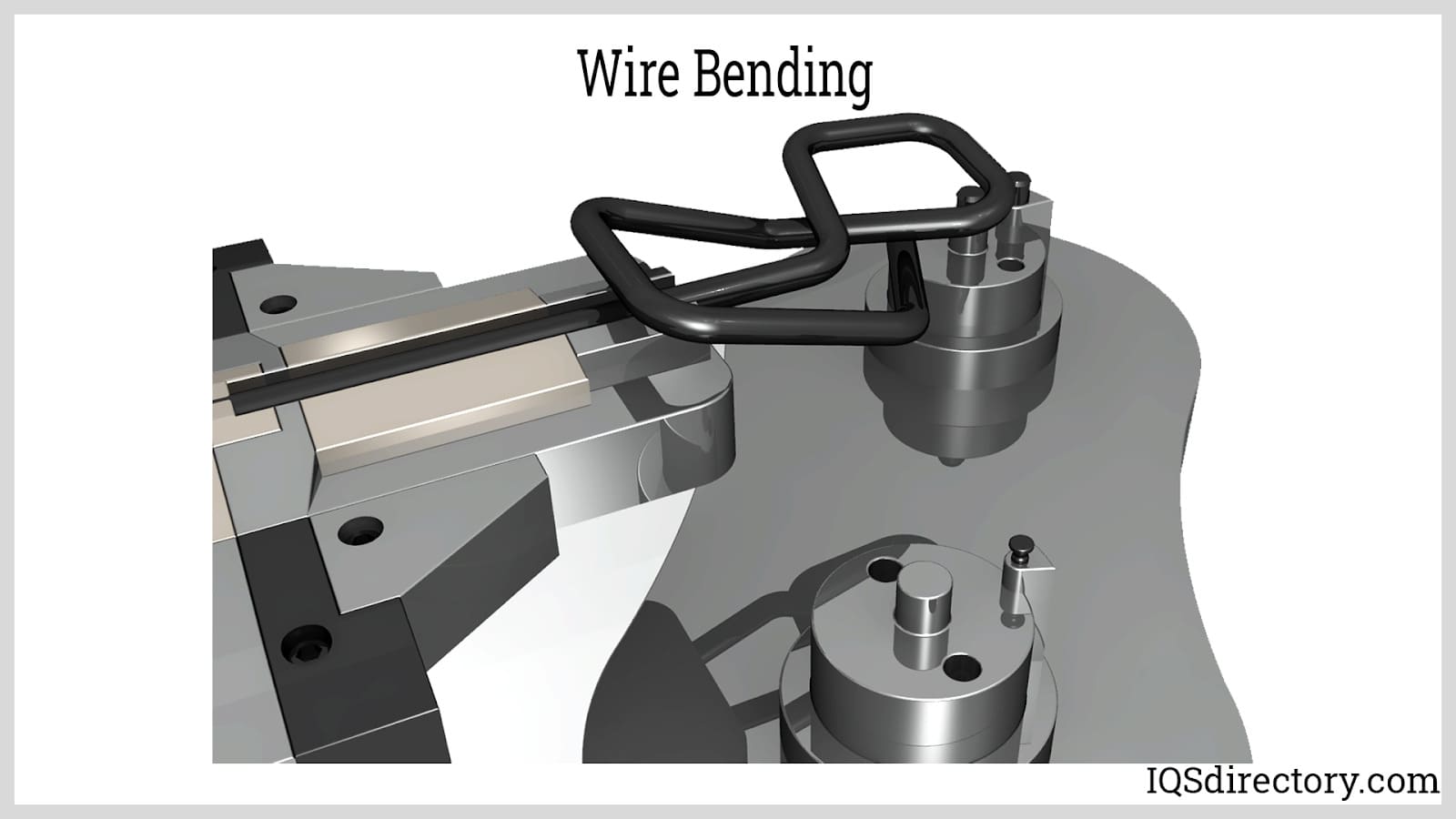 Wire bending produces a wide array of shapes and configurations and can reduce scrap because the wire is formed efficiently before final cutoff.
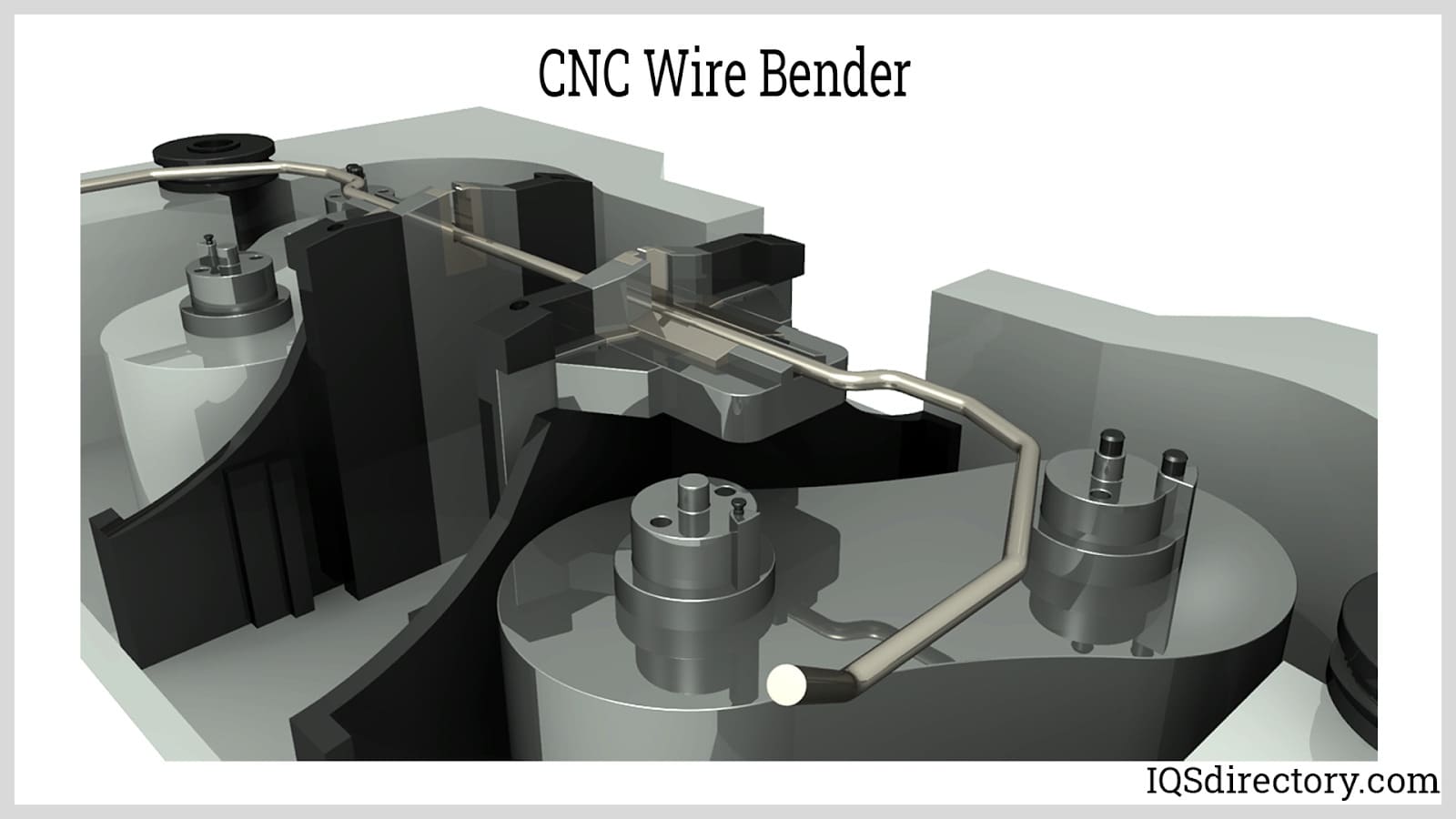 CNC bending, short for “computer numerical controlled” bending, is known for high accuracy and repeatable part quality.
 Hand machines feature a spindle and hand lever and may use rotary dies or geared mechanisms that increase bending pressure for manual forming tasks.
- Coil
- Wire shaped into rings or spirals.
- Flat Springs
- Flat or curved steel pieces formed into a coil and designed to provide a nearly constant force over a working range.
- Medical Wire Forms
- Used in orthopedic and prosthetic devices where a secure closure or formed retaining feature is needed.
- S Hooks
- Wire hooks used for connecting or hanging components.
- Spring Washers
- Springs that store energy to help maintain tension beneath the nut or bolt they support.
- Springs
- Coiled materials that bend when a load is applied and return toward their original position when the load is removed.
- Wire Baskets
- Used across industries for storing and displaying products.
- Wire Displays
- Often used for showcasing items such as books, food, apparel, and packaged goods. Wire displays can be customized to meet specific merchandising and manufacturing needs.
- Wire Fabrications
- Include many types of wire forms tailored for a wide range of industrial, commercial, and consumer uses.
- Wire Forming
- Encompasses the range of processes used to shape wire into functional forms, assemblies, and finished products.
- Wire Grids
- Also known as wire grid panels, these consist of interwoven horizontal and vertical wires that form an open framework for display, guarding, or storage.
- Wire Guards
- Protective devices used to help shield parts, people, and machinery from damage or unwanted contact.
- Wire Shapes
- Commonly called wire forms, these parts are made from wire shaped into specific designs for support, retention, connection, or display.
- Wire Shelves
- Made from various materials and widely used in retail environments, including food, apparel, and general merchandise settings.
- Wire Screens
- Metal wires woven in a crisscross pattern to create open yet protective barriers for screening, filtering, or guarding.
- Wire Tubing
- Produced for both industrial and consumer use, offering durability, versatility, and a range of load capacities, wire densities, and configurations.
- Active Coils
- Coils that deflect freely when subjected to a load.
- Closed Ends
- The ends of coils that touch each other, created by reducing the pitch at the end of a compression spring.
- CNC (Computer Numerical Control)
- Machines that use computer memory and programmed instructions to control operations, commonly used in the manufacture of wire forms and shaped wire parts.
- Deflection
- The movement of the spring arms or ends when a load is applied or removed.
- Elastic Limit
- The maximum strain a material can endure without experiencing permanent deformation.
- Fine Blanking
- A precise blanking technique that produces smooth, accurate cuts and may reduce the need for secondary finishing operations.
- Free Angle
- The angle between the torsion spring arms when the spring is in an unloaded position.
- Gauge
- The measurement of the thickness of a wire used in wire forms.
- Helix
- The spiral shape of a spring, whether it is open or closed.
- Hooks
- The open ends of extension springs.
- Hysteresis
- The loss of mechanical energy during the cyclic loading and unloading of a spring. This is related to the space between the loading and unloading deflection curves.
- Load
- The force applied to a spring that causes it to deflect.
- Multislide Stamping
- A stamping or forming process in which pieces and segments are shaped from multiple directions.
- Pitch
- The distance between the center of one adjacent active coil and the next in a spring.
- Rate (R)
- The change in load for each unit of deflection, typically expressed in pounds per inch (N/mm).
- Rod Bending
-
A general term for forming tools used to create bends in a workpiece, ranging from small handheld devices to automated production machines.
- Set
- Permanent deformation that occurs when a spring is stressed beyond the material's elastic limit.
- Spring Index
- The ratio of the mean coil diameter to the wire diameter.
- Stress Relief
- A process involving exposure to low heat to reduce residual stresses in a spring.
- Torque
- A measurement of a torsion spring's twisting action in relation to the distance from the spring’s axis.
- Wire Forming
- The process of shaping wire into various forms.
- Wire
- A flexible cylindrical rod or strand of metal produced through the metalworking process known as drawing. It is available in many materials and thicknesses and is used to create a wide range of parts, components, and finished products.