Storage Racks
Storage racks are stands or frameworks that are used to display, store, and organize products, parts, equipment, tools, materials, boxes, and pallets for the efficient use of space within warehouses, manufacturing facilities, shipping areas, and product assembly rooms.
Storage rack manufacturers produce industrial storage racks for heavy duty usage according to the product specifications and required accessibility. Racks are commonly designed to hold inventory that has been palleted, and are constructed using metals such as aluminum and steel which are strong and durable. Metal storage racks, especially steel storage racks are employed for these applications, but some lighter weight racks are made of materials such as titanium, wood or particle board. Storage racks hold many kinds of inventory, from boxed goods to long carpet rolls or tubing.
Quick links to Storage Racks Information
History of Storage Racks
During the early 1900s, most products were transported by trucks, railways, and boats. At this time, the only means to move the heavy boxes was done by manual labor. This was time-consuming and incurred high labor costs. This changed in 1915, after the forklift had been in development for some time by a variety of companies. The forklift turned out to be pivotal to the success of warehousing. With it, workers found they could make pallets of boxes regardless of the weight of each individual box. This allowed for much faster loading and unloading times and less strain on the worker. As technology evolved, the forklift was eventually modified to lift pallets several meters into the air. Once this was possible, engineers designed the first of many storage racks, the pallet rack.
In the late 1920s, warehouse workers used the first ever vertical pallet storage equipment systems. This quickly led to the development of multi-level storage racks, which can hold more than one layer of pallets. With their help, warehouse owners were able to expand their spaces upwards as well as outward. These taller buildings allowed them to stack pallets to two to four high. This efficient use of space made storage much more cost-effective.
As time went on, warehouse operators and engineers came up with more and more storage rack designs. For example, in 1968, Thomas J. Finlayson received a patent for the drive-in pallet rack, a type of storage rack that allows forklift operators to drive their load directly to the storage rack for placement. Then, in 1986, Charles Agnoff invented the gravity flow storage system, a clever and energy efficient storage system that is still in use today. Today, storage racks can cater to all requirements, from portability, to ergonomics to accessibility.
Storage Rack Design
- Production Process
- Before beginning production, manufacturers must map out the space in which the storage system will be placed, and make note of its requirements. In particular, they think about: inventory accessibility, inventory rotation, stored product diameter and weight, building height, floor space, building layout (where are the doors, etc.) These notes help them decide how the system must be built, what features it requires, from what materials it must be made, etc.
- To create the storage system, manufacturers usually weld together pieces that have woven, extruded, molded or otherwise pre-formed.
- Rack Materials
- Most storage racks are made from some sort of strong and durable metal, like steel, stainless steel or aluminum. Others are made from strong and lightweight metals, like titanium. Still others, though significantly fewer, are made from wood or particle board. In addition to solid metal, many metal storage racks are made from or feature details made from wire.
- While they can be made of any metal, stainless steel is the most common because of its durability, resistance to temperatures and ability to deter oxidation which leads to rusting.
- Considerations and Customization
- Storage rack manufacturers offer a wide range of standard rack options in different sizes and designs. However, they can customize any design. When designing a custom storage rack, manufacturers make decisions according to the product specifications, required accessibility and customer budget. They can custom fabricate all specifications, including: height, width, depth, weight lb capacity, material, and finish.
Storage Rack Images, Diagrams and Visual Concepts
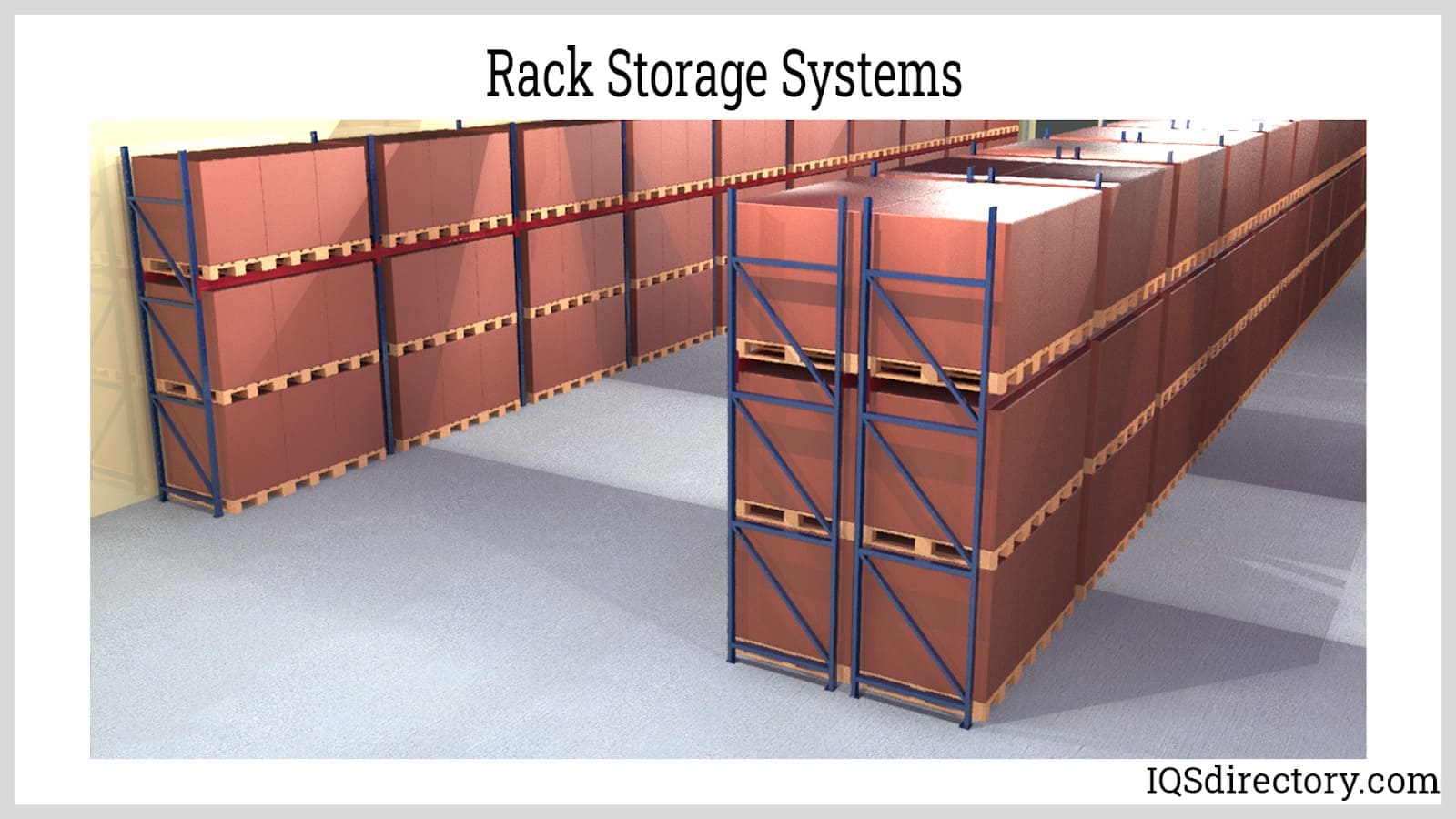 Storage rack system depends on the items or materials being stored, which can affect the decking and the configuration of the racks.
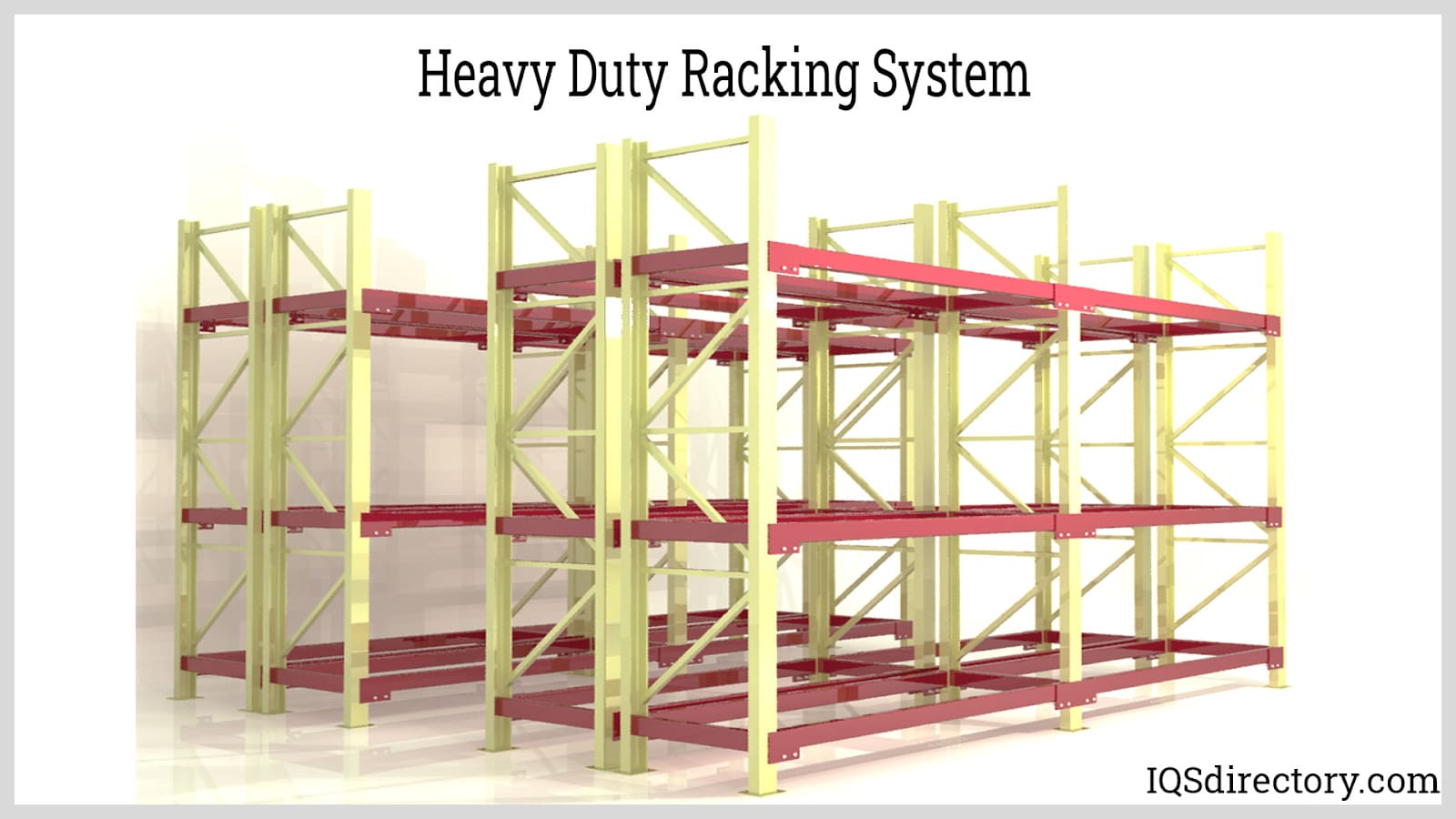 Heavy duty systems are for products that have a heavier weight making the racks more sturdy and able to support the items.
 Pallet rack decking includes solid, wire mesh, wire, bars, wood, metal, and punched sheets for storage.
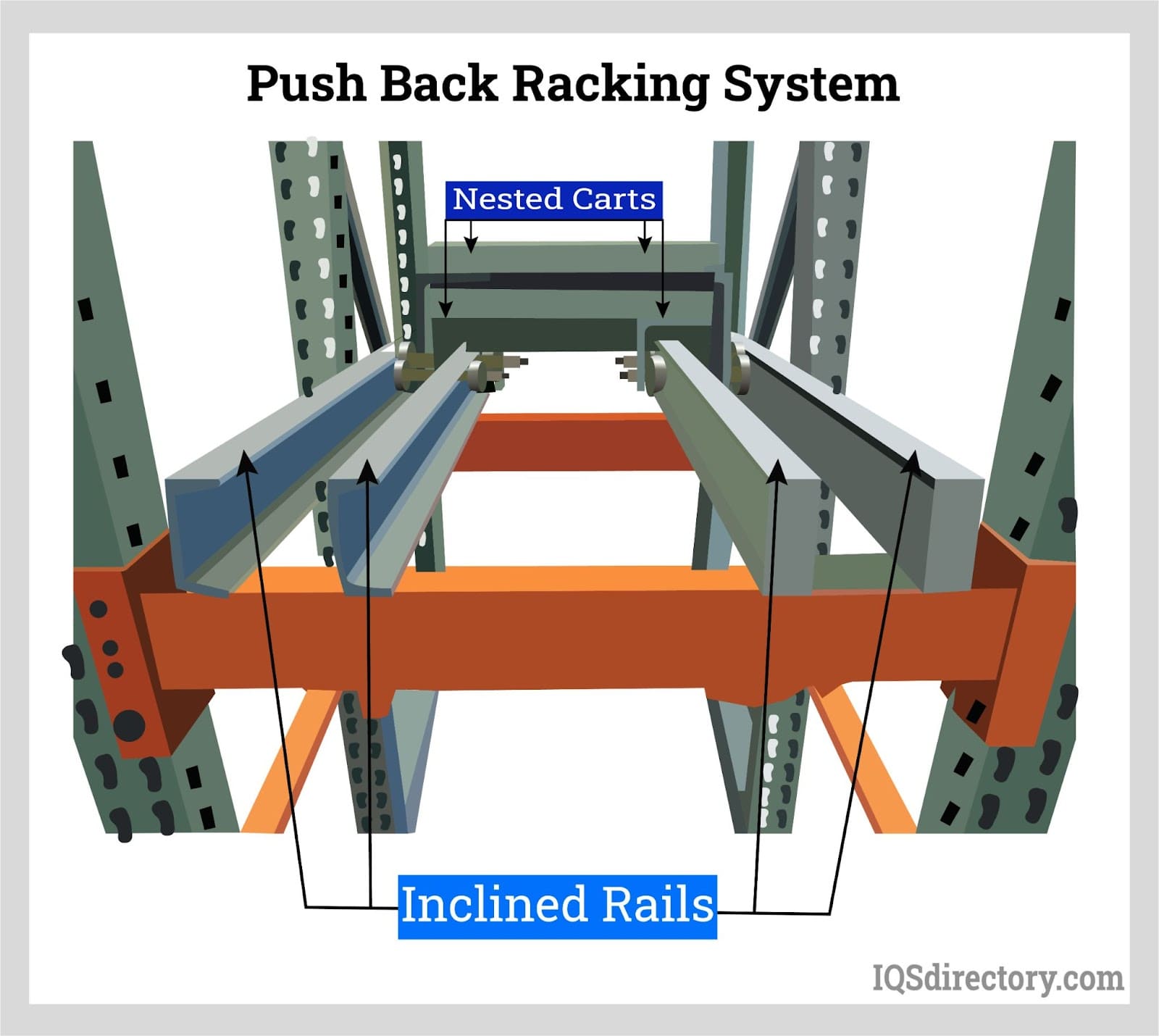 Push back pallet racking is ideal for density storage when space is limited, which utilizes last in first out.
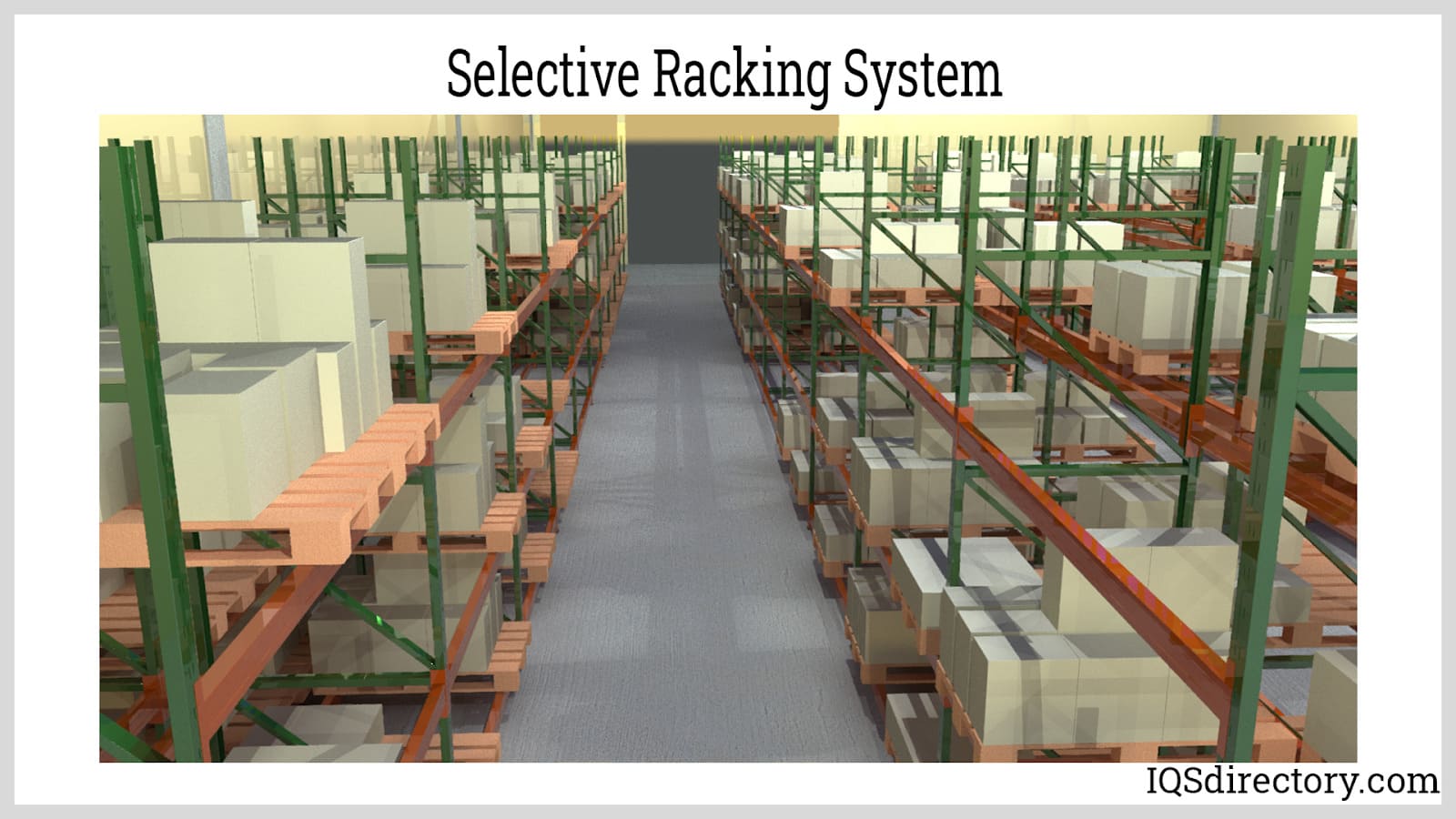 Selective pallet racking has the lowest storage density and is used in where products are at a low volume in storage.
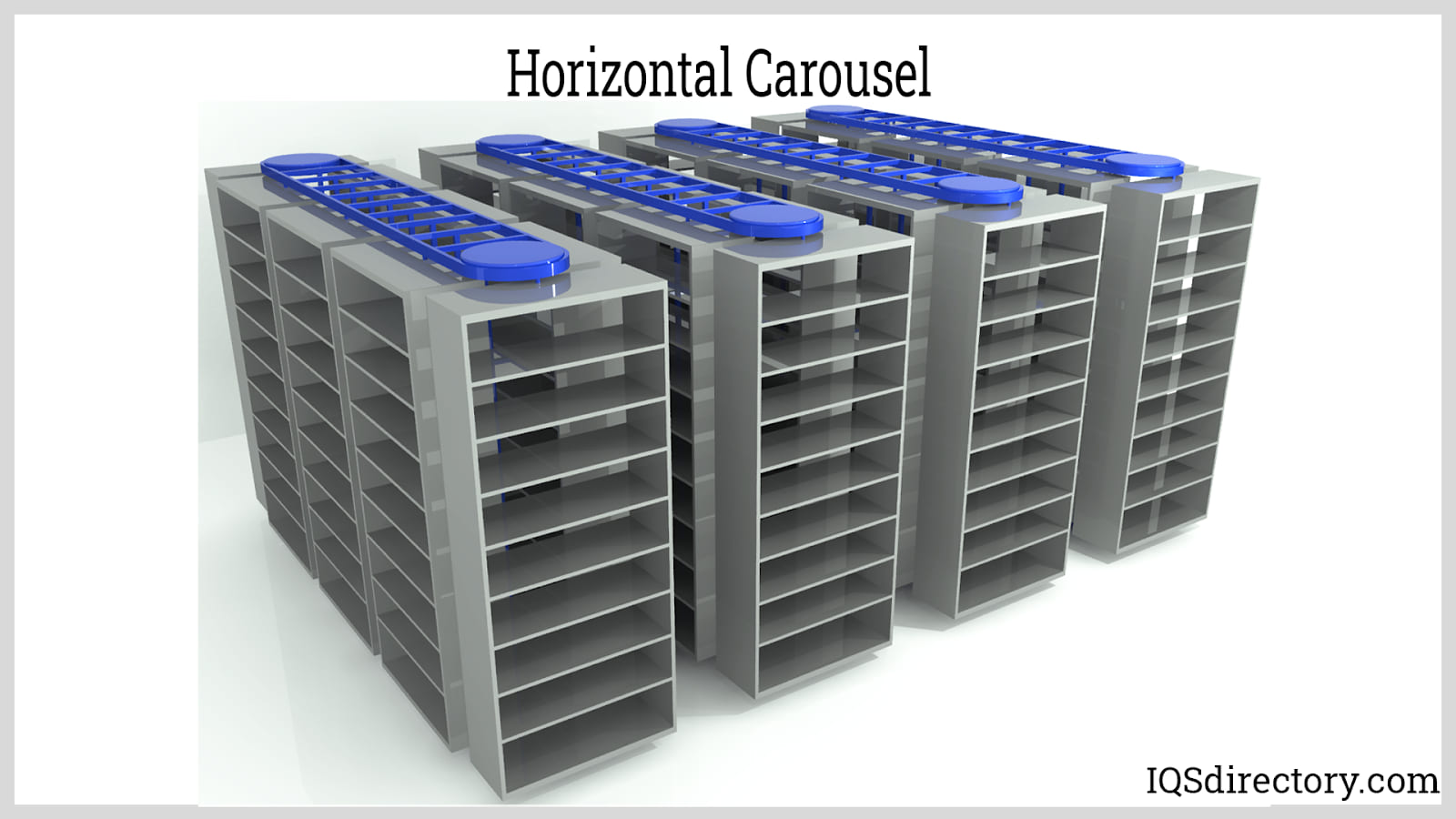 Horizontal carousels are sorting devices used with small parts and products, to conserve space while organizing materials or products.
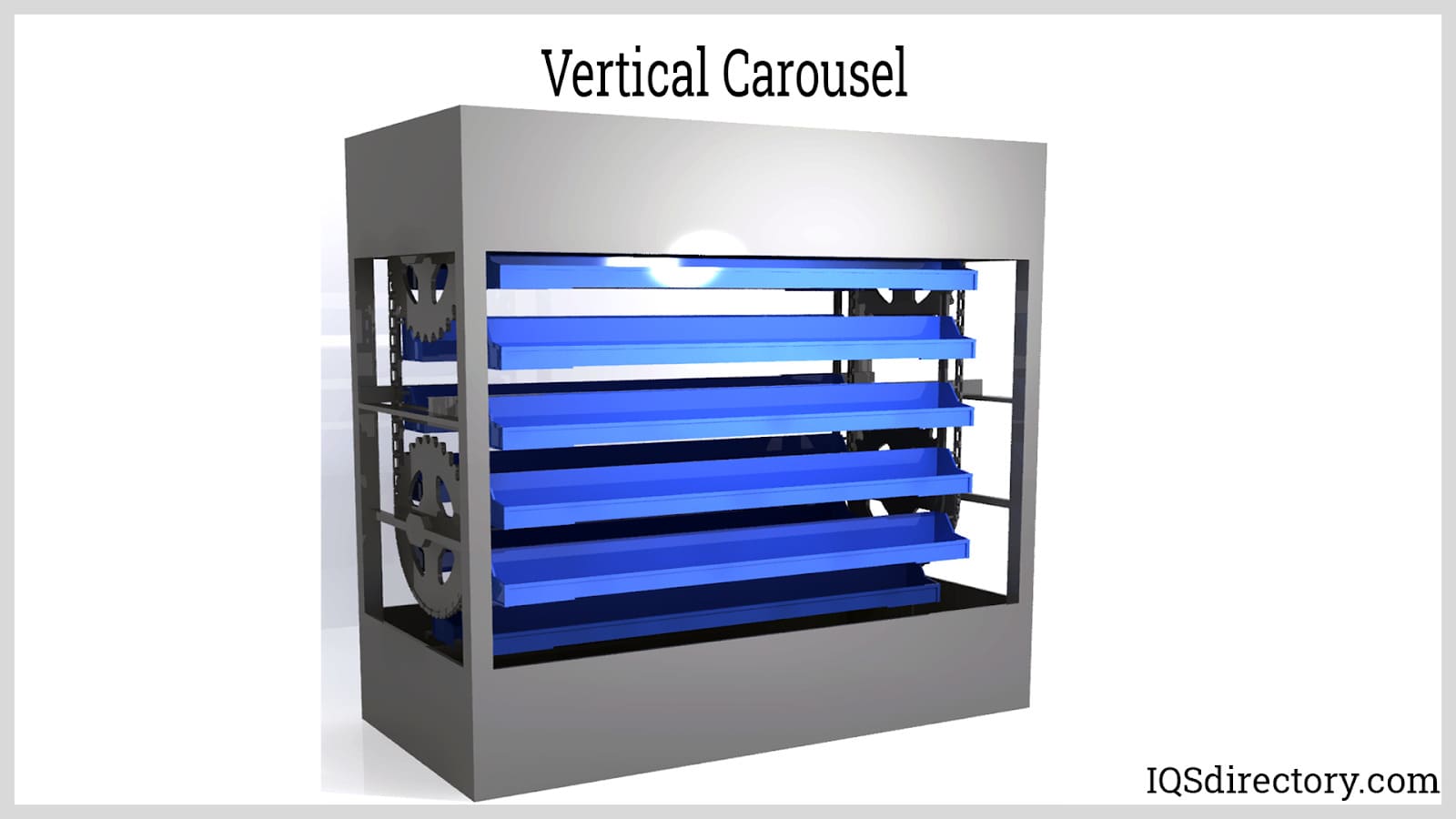 Vertical carousels is much like horizontal carousels except they sort items vertically.
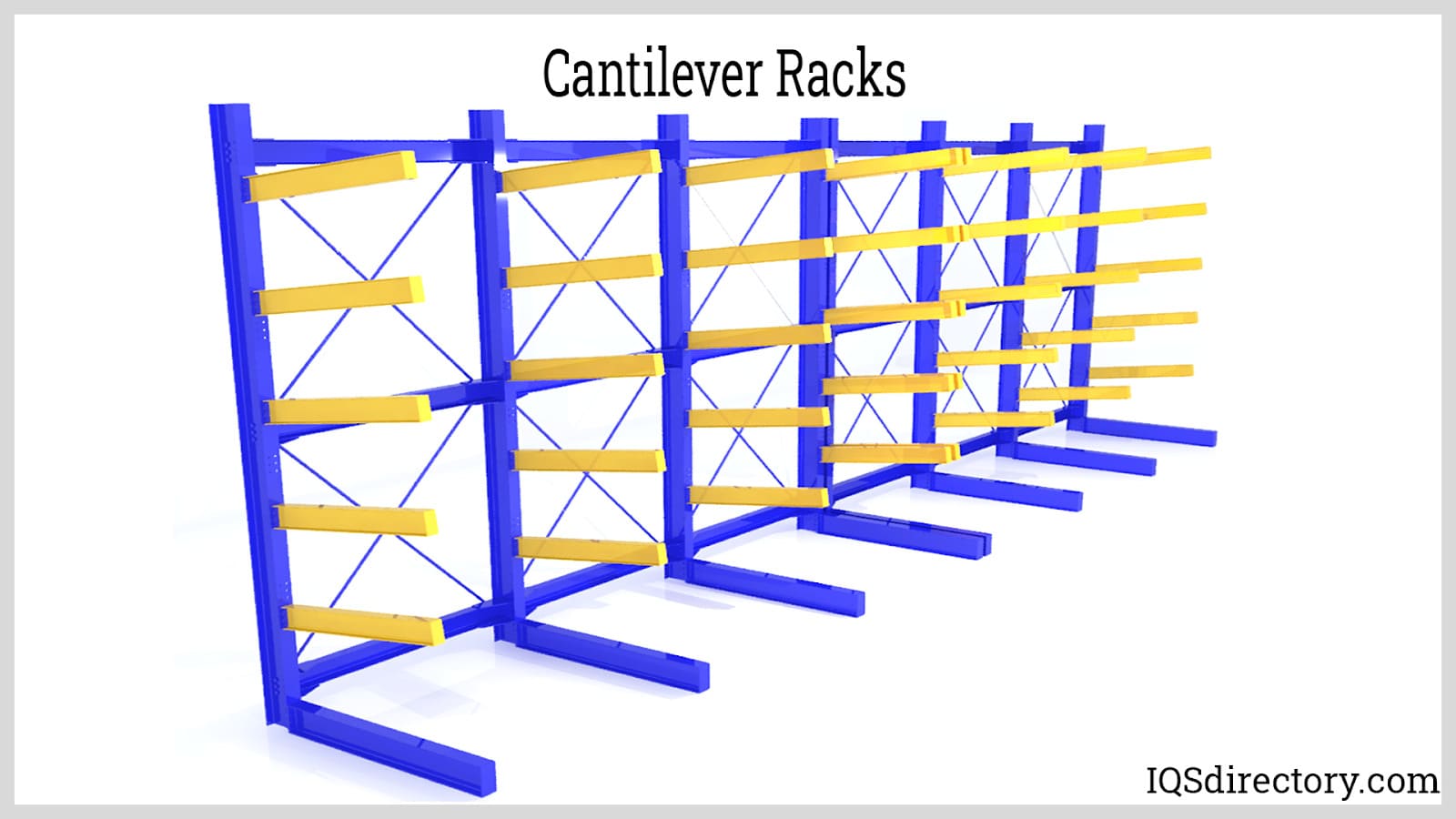 Cantilever racking store products with length or with irregulary shaped items.
Types of Racks
- Pallet Racks
- Storage racks designed to hold inventory that has been palleted. They provide the advantage of vertical stacking and storage. They are usually deep, allowing a large number of pallets or boxes to be stored at once. Open on all sides, pallet rack systems are a great choice when you must be able to access all goods on the rack without having to shift other items.
- Roller Racks
- A type of flow and push-back pallet rack. They’re named after the fact that they feature rollers, which make them easy to push or pull. They do not require the assistance of forklifts, and are best for use with systems in which workers move things frequently. To capitalize on the force of gravity, manufacturers can equip roller racks with a slanted rail of rollers. They help move extra heavy loads. When a new load is put on a cart, it pushes the one at the face back; when the front load is picked, the carts behind it gently move forward. Push-back storage racks have easy one-sided access and are capable of being placed against an obstruction, such as a wall.
- Warehouse Racks
- Allow forklifts to easily locate the pallets stacked on industrial shelf units. These shelves are often a series of rails or rollers that are situated on an incline. This way, when the front load is removed by a forklift, the rest of the items automatically move forward and waste no space while taking advantage of gravity to aid in moving the loads.
- Cantilever Racks
- Specially designed to hold long, thin products like rails, boards, and beams or sheet metal, while others are well suited for pallets and large boxes. Cantilever racks are composed of uprights, arms and brace sets and are ideal for storing long, heavy items that must be kept off the floor. They are modular in nature, allowing extra components to be added as storage requirements change.
- Drive-In Racks
- Efficiently use all available space and are ideal when rotation is not a factor. Drive-in racks are beneficial for warehouses in which many pallets are used.
- Drive-Thru Racks
- Designed to be accessible from both sides and use a first-in/first-out inventory rotation. Drive-thru racks are suitable for applications in which there is a high volume, a low mix of products.
- Gravity Racks
- Similar to push back racks, except loads are placed on one side and flow towards the other. Gravity racks are used for both cartons and pallets and allow pickers to keep their distance from the forklifts that load the rack from the other side.
- Carton Flow Rack
- A live storage system in which cartons are deposited on one side and are driven by gravity to gently flow to the other side. A type of flow rack relying on gravity and specifically designed for the storage of cartons, carton racks provide high-density, dynamic storage. Carton flow rack systems provide an easy-access, ergonomic way for the product to always flow to the front position.
- Using carton flow racks cuts labor costs by reducing the number of required pickers by half or more as well as floor space since fewer aisles will be needed to store the same number of cartons. Both the backside and the front of carton flow racks are used for storage making them useful for high-density storage.
- Carton flow racks have two distinct frame styles:
- Square front carton flow racks are vertical frames with straight shelving and are advantageous for picking full cartons.
- Layback carton flow racks are vertical frames with diagonal shelving and are beneficial for picking from open cartons.
- They also feature several types of shelving, including: straight shelves, knuckled shelves, weld-in trays and reverse knuckled shelves. Of these, straight shelves are the most common, followed by knuckled shelves. Knuckled shelves are very useful for picking individual items up out of cartons. Reverse knuckled shelves are good for use with split case picking applications in which items must be removed from the front of the cartons.
- Industrial Storage Racks
- Metal frameworks used to hold goods. Industrial racks are designed for heavy duty usage. For this reason, they’re usually made from a strong and durable metal like steel or stainless steel.
- Steel Storage Racks
- Easy to clean and sanitize, can handle washdowns, and exhibit a smooth, shiny surface. Stainless steel is also fire and heat resistant, which increases work safety in facilities with combustibles for flammable materials.
- Wire Racks
- Shelving systems used for storage, display or organizing products, equipment or material. They are fabricated from welded or woven wire mesh decks that are attached to a series of vertical metal rails. Wire storage racks utilize decks made of wire mesh instead of using wood, plastic, or particleboard is cost effective and durable. As they are manufactured in a grid pattern, they are porous and offer high visibility. Also, because the deck isn't a solid surface, it prevents any dust buildup. It also offers product ventilation if needed.
Applications of Storage Racks
Storage rack systems are used primarily to save space and to provide a means of inventory organization for ease of product and material accessibility. Other types of storage racks are commonly used in the home and office, as well as in workshops, retail facilities, plants, and factories. Some, like chest freezer racks, are designed for very specific applications.
Manufacturers have storage racks to make things simpler. Storage racks hold many kinds of inventory, from boxed goods to long carpet rolls or tubing. They serve a wide range of industries, including: material handling, food and beverage, military, industrial, commercial business, education, healthcare, government, and others.
Features of Storage Racks
Depending on the type of product, most facilities work with a FIFO (first in, first out) or LIFO (last in first out) method of organization, both of which have specific areas for stocking and material picking done by workers or lift trucks.
The FIFO technique separates the stocking, which is done in the rear, and picking, which is done in the front. FIFO is often used with perishable food items that could spoil or expire and keep inventory from getting lost or buried inside the shelves. LIFO is mostly used for push back racks, which are also on a slant but are positioned in rows of two, without an aisle between them. This eliminates the option to stock from the rear, leaving one aisle space to stock and pick from. Since products can sit for long periods of time in the back of the shelves with LIFO, it is used for only nonperishable items. The main benefit is the space saved from less required aisle space and the ability to double up storage shelf space.
Things to Consider When Purchasing Storage Racks
For the best storage rack system, you need to work with the right manufacturer. This manufacturer will be able to meet all of your specifications, including your: budget, timeline and standard requirements. To find what you’re looking for, check out the storage rack companies we have listed on this page.
IQS Directory provides an extensive list of storage rack manufacturers and suppliers. Utilize our website to review and source storage rack manufacturers with our easy-to-use features which allow you to locate storage rack companies that will design, engineer, and manufacture storage racks for your exact specifications.
Our request for quote forms makes it easy to connect with leading storage rack manufacturers. View company profiles, website links, locations, phone number, product videos, customer reviews, product-specific news articles and other production information. We are a leading manufacturer directory who will connect you with the right manufacturers whether you are looking for storage rack shelves, warehouse storage racks, or industrial storage racks.
Rack Accessories
Storage rack accessories include: shelving, drawer rack add-ons, castors, baskets, bumpers, feet, anchors, dividers, braces, arms and more. To learn what accessories might best serve your application, talk to your supplier.
Storage Racks Terms
- Barrel Beam
- A structural angle that is welded to a beam, which prevents cylinder-shaped objects from rolling off.
- Cantilever
- A horizontally projecting structure that is supported at one end and carries a load along its length.
- Clear Aisle
- A term that refers to the area from rack to rack in a storage area, subtracting any pallet or load overhang.
- Clear Stacking Height
- Available vertical storage space.
- Deck
- A roofless platform that is connected to at least two sides of a storage rack. The deck is the surface upon which the products are placed.
- Dedicated Aisle
- An aisle in a warehouse that serves one function only, which could be either storage or order selection.
- Double Deep
- Refers to pallets that are stored two deep, one behind the other. This stacking arrangement allows access to the pallets only from the front position and is suitable for high volume-low variation applications.
- First-In First-Out (FIFO)
- A product rotation method in which the first and oldest product is picked first.
- First-In Last-Out (FILO)
- A storage system in which the first and oldest product is picked last, allowing for minimal selectivity.
- First-In, Still Here Somewhere (FISHS)
- Inventory that has been lost or buried.
- Fork Bar Spacers
- Items that provide clearance between beams and loads, providing a means for entry of forklifts.
- Forklift
- A small industrial vehicle with two elongated prongs used for lifting and transporting cargo.
- Insert Plates
- Heavy plates that are welded inside flanges of uprights, adding capacity and strength.
- Mezzanine
- Floorings elevated above the main floor, creating storage both under the mezzanine and on it.
- Pallet
- A movable platform that is used to move and store cargo. Pallets are commonly made of wood or plastic.
- Post Guard
- A device used to protect uprights from damage due to impact.
- Stacker
- A small rolling device with elongated forks, similar to a forklift, that is used to move products and cargo. Some varieties of stackers feature mechanical lifts, while others are manual.
- Storage Aisle
- An aisle in which loads are stacked or materials are picked.
- Wall Tie
- A device that maintains distance between upright rack posts and the walls. Wall ties also increase stability.