Pressure Transducers
Pressure transducers are instruments that convert physical pressure into electrical signals. Broadly, a transducer is any device that changes energy from one form to another. Pressure transducers specifically detect pressure and transform this mechanical force into an electrical output.
Transducers are integral parts of pressure sensors (also known as pressure transmitters). While the terms sensor, transducer, and transmitter are often used interchangeably, a pressure transducer is technically just one component of a pressure sensor. However, since pressure transducers are commonly used as pressure sensors, this article will also discuss various types of pressure sensors.
Pressure Transducer FAQs
What is a pressure transducer and how does it work?
A pressure transducer converts physical pressure into an electrical signal. It detects mechanical force and translates it into measurable electrical output, typically in psi or bars, allowing accurate pressure monitoring in gases and liquids.
How are pressure transducers different from pressure sensors and transmitters?
While the terms are often used interchangeably, a pressure transducer specifically converts pressure into an electrical signal. A pressure sensor may include the transducer plus additional electronics, while a transmitter sends that signal to other systems for processing.
What materials are used in modern pressure transducers?
Modern pressure transducers are typically made from ceramic, stainless steel, copper, and other durable metals. These materials ensure precision, corrosion resistance, and long-term performance across industrial and environmental applications.
What are common applications for pressure transducers?
Pressure transducers are used in industries like aerospace, automotive, chemical processing, and meteorology for monitoring pressure levels, navigation, leak detection, and altitude measurement in critical systems.
How often should pressure transducers be calibrated?
Pressure transducers should be calibrated regularly to maintain accuracy and safety. The ideal calibration frequency depends on the application, but periodic checks ensure reliable readings and consistent performance over time.
What types of pressure transducers are available?
Types include piezoresistive, piezoelectric, differential, and strain gauge-based transducers. Each design measures pressure through unique electrical or mechanical responses suited for specific industrial or scientific uses.
What factors influence the design of a pressure transducer?
Design depends on media type, pressure range, temperature limits, space constraints, and environmental conditions such as vibration or corrosion. Manufacturers tailor these factors to ensure reliable, application-specific performance.
The History of Pressure Transducers
- Pressure Transducers in the 1800s
- Transducers, sensors, and transmitters have been essential since the Steam Age. The development of pressure transducers dates back to the 1800s, following the discovery of pressure but before widespread use of electricity. Early scientific research focused on materials that could transduce magnetic and electric fields. In 1842, James P. Joule demonstrated that a magnetic field could cause an iron bar to contract.
- During this century, researchers also made significant progress in understanding mechanical strain and resistance. In 1843, Sir Charles Wheatstone conducted experiments using a circuit now known as the Wheatstone Bridge. Although the circuit was invented by Samuel Hunter Christie a decade earlier, Wheatstone refined and popularized it. His work showed that changes in length or tension affected the balance of his circuit. The Wheatstone Bridge soon became useful as a pressure-sensing device, and today it is primarily used to measure unknown electrical resistances.
- In 1856, Lord Kelvin found that resistance changes under strain, presenting his findings to the Royal Society of London without knowledge of Wheatstone's earlier work. Lord Kelvin’s discoveries led to the creation of the strain gauge, a key instrument utilizing pressure transducers. In 1880, Jacques and Pierre Curie discovered the piezoelectric effect, where applying mechanical pressure to quartz crystals generates an electric charge. Using this knowledge, the Curie brothers learned to polarize crystals and, by 1881, demonstrated that electric fields could cause crystals to mechanically deform.
- Pressure Transducers in the 1900s
- During World War II, manufacturers used nickel materials for transduction. In 1946, after the war, researchers identified barium titanate, a ceramic material, as a new pressure transducer medium. The 1950s saw the development of lead zirconate titanate, a superior transducing material for sonar applications.
- Since the 1950s, pressure transducers have advanced significantly. Modern technology and new materials have allowed sensors and transducers to become smaller and more precise. While a typical pressure sensor is about a cubic inch, miniature sensors can be less than 1/100th of that size, with accuracy often within one percent. Today’s pressure transducers use materials such as ceramic, copper, stainless steel, and other metals.
The evolution of pressure transducers reflects broader advances in materials science, electronics, and industrial automation. From early mechanical devices to today’s highly accurate digital sensors, pressure transducers have enabled safer, more efficient systems across countless industries. Engineers and buyers often ask: “How has the transition from analog to digital pressure transducers improved measurement reliability?” or “What historical material breakthroughs still influence modern transducer design?” Understanding this progression helps teams select the right technology for current and future applications.
Design of Pressure Transducers
When designing a pressure transducer, manufacturers consider factors such as the type of material or system involved (solid, liquid, slurry, corrosive, abrasive, etc.), the kind of pressure to be measured, available installation space, ambient environmental conditions (such as vibration and heat), and the intended method for measuring and displaying pressure.
Based on these criteria, manufacturers select specifications like the appropriate pressure range (psi) and operating temperature range. Depending on the application's requirements, suppliers may integrate pressure transducers with other devices or mechanisms to enhance data collection and functionality.
Key design elements include the sensing element (diaphragm, strain gauge, or crystal), housing material for corrosion and pressure resistance, electrical output type (analog 4-20mA, voltage, or digital), and protection ratings for dust, water, or explosion-proof environments. Modern designs often incorporate temperature compensation, signal conditioning, and diagnostics to improve accuracy and reduce drift. Common buyer questions include: “What design features are essential for high-pressure or corrosive media applications?” or “How do diaphragm material and thickness affect transducer performance and lifespan?” Careful attention to these factors ensures the transducer delivers precise, repeatable measurements while withstanding real-world operating stresses.
Pressure Transducer Features
Pressure transducers can have a variety of features and components. For safety, manufacturers might include alarms and automatic shut-off switches when needed. All pressure transducers generally have a sensing element (either in direct or indirect contact with the process medium) and a transducing element that generates either an optical or electrical output signal. Most modern pressure transducers also incorporate an integrated circuit (IC microchip or silicon chip), which is a miniaturized electronic circuit used to maintain accuracy and communicate with other equipment.
Contemporary sensors often operate using the principle of piezoresistance, meaning that materials conduct electricity differently under varying pressure levels. The transducer detects force and converts it into electrical energy, which is then measured and interpreted by a sensor. Information is typically displayed in psi (pounds per square inch) or bars, corresponding to atmospheric pressure at sea level.
Additional useful features include overpressure protection, reverse polarity protection, zero and span adjustment, and various output configurations (millivolt, voltage, or current). Many industrial models offer explosion-proof or intrinsically safe certifications for hazardous locations. Teams evaluating pressure transducers frequently consider: “Which features improve long-term stability and reduce maintenance in my process?” or “How does output signal type affect integration with existing control systems?” Selecting the right combination of features ensures reliable operation, easy integration, and compliance with safety standards.
Pressure Transducer Images, Diagrams and Visual Concepts
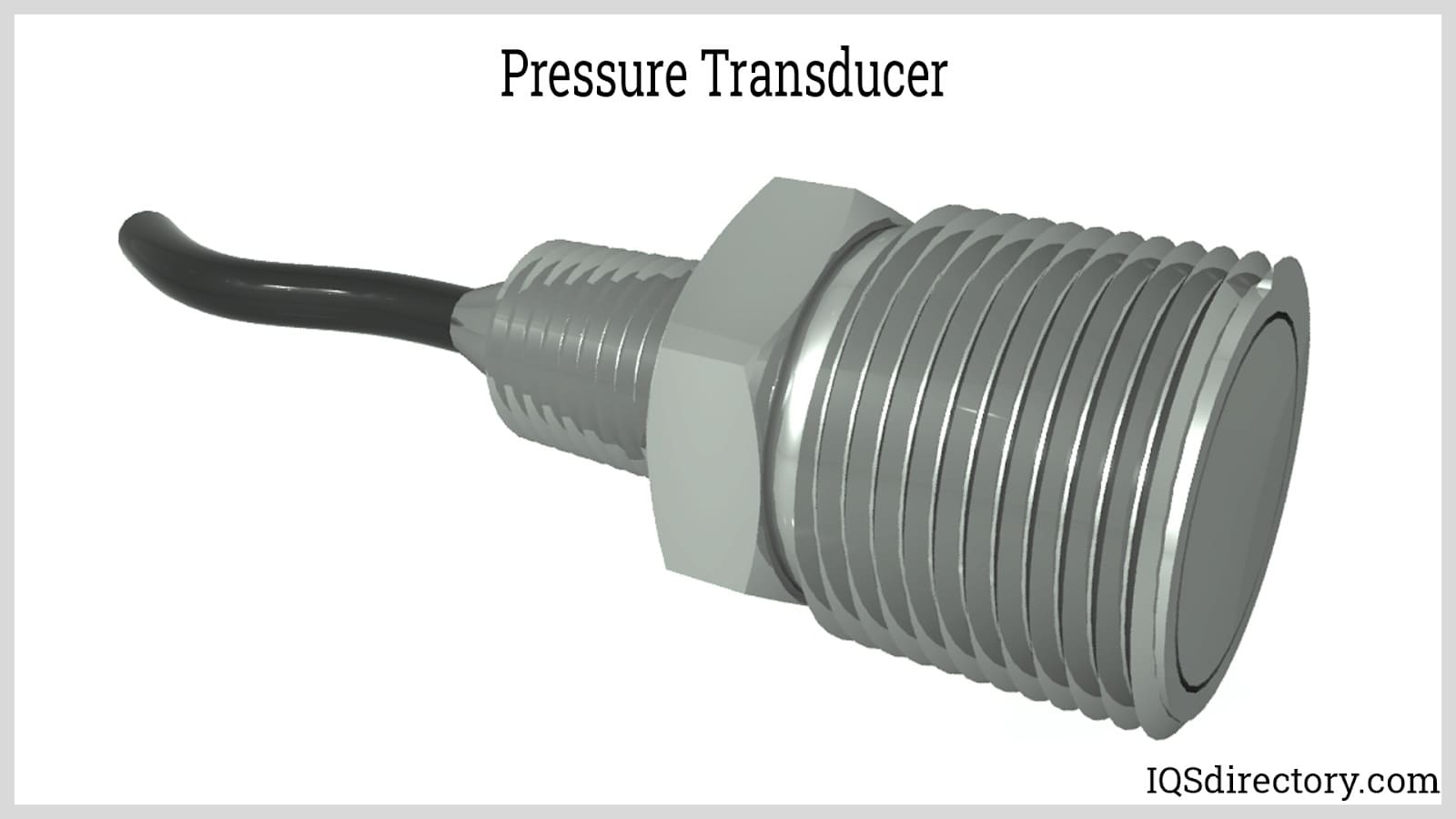 Pressure transducer, a mechanical device that converts applied pressure into a measurable electrical signal.
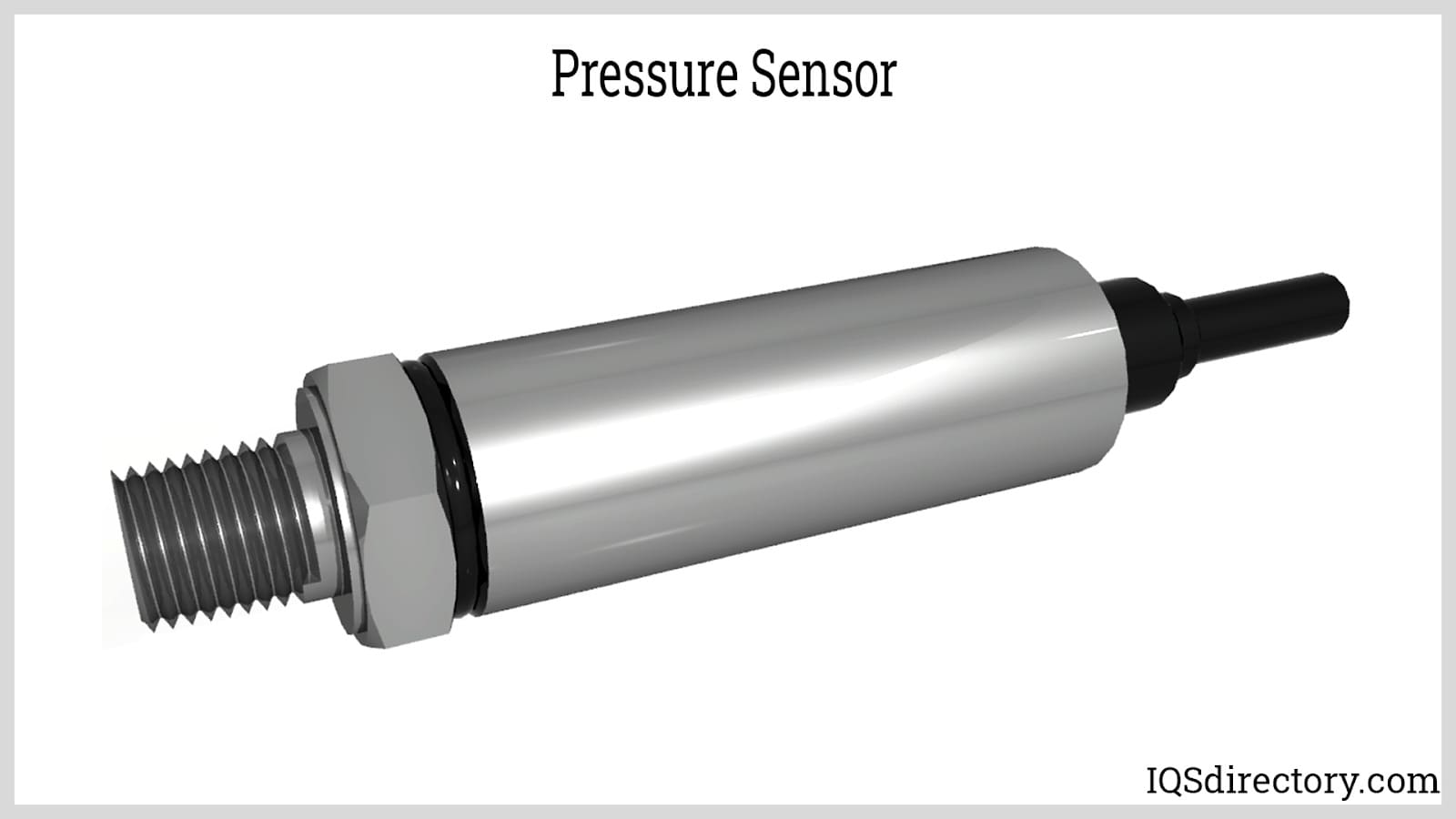 Pressure sensor is an element that directly receives the pressure exerted by fluids.
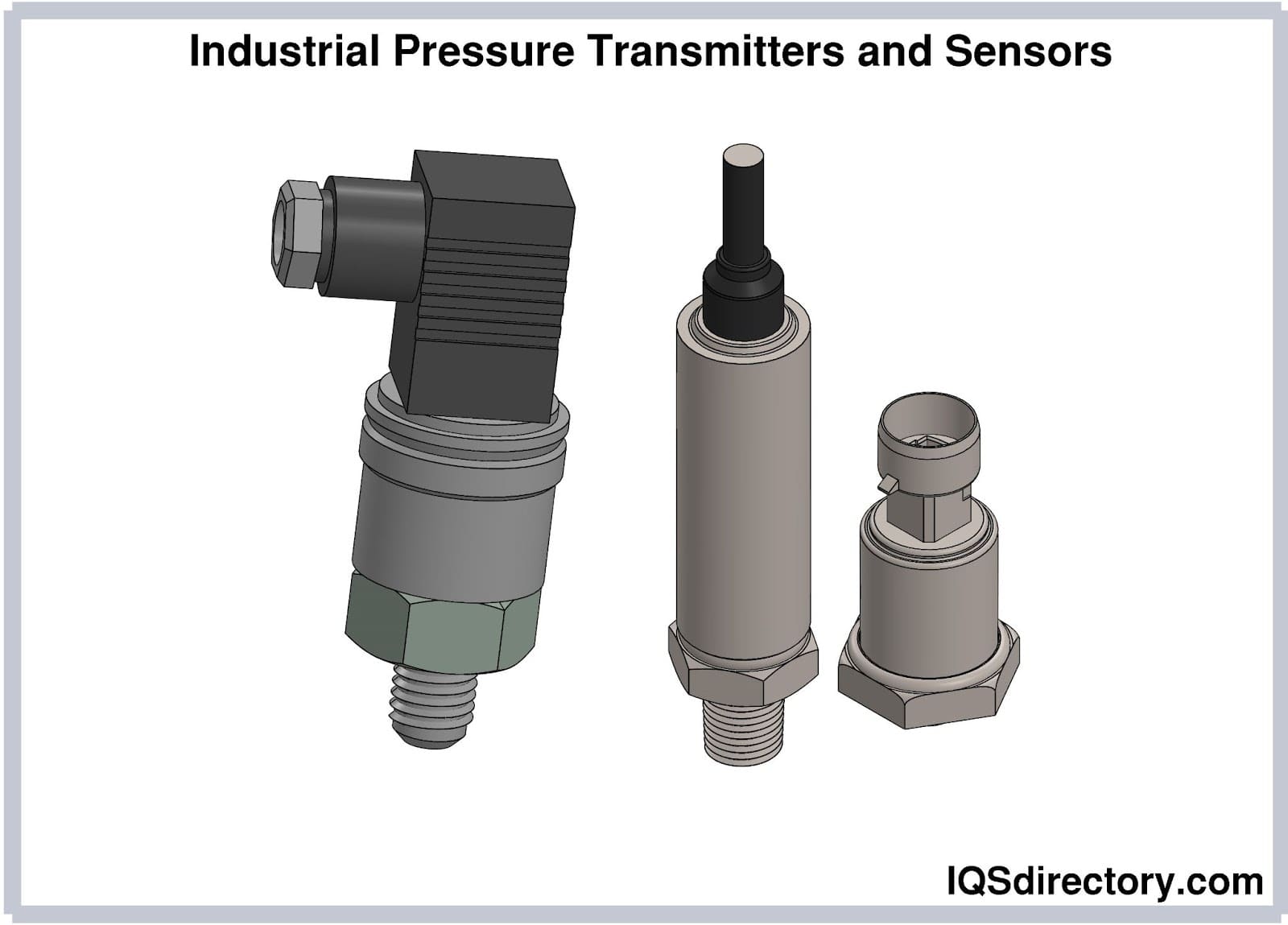 Pressure transmitters delivers a low-impedance current output that is typically designed to be connected to an industrial standard 4-20mA for sensing and control.
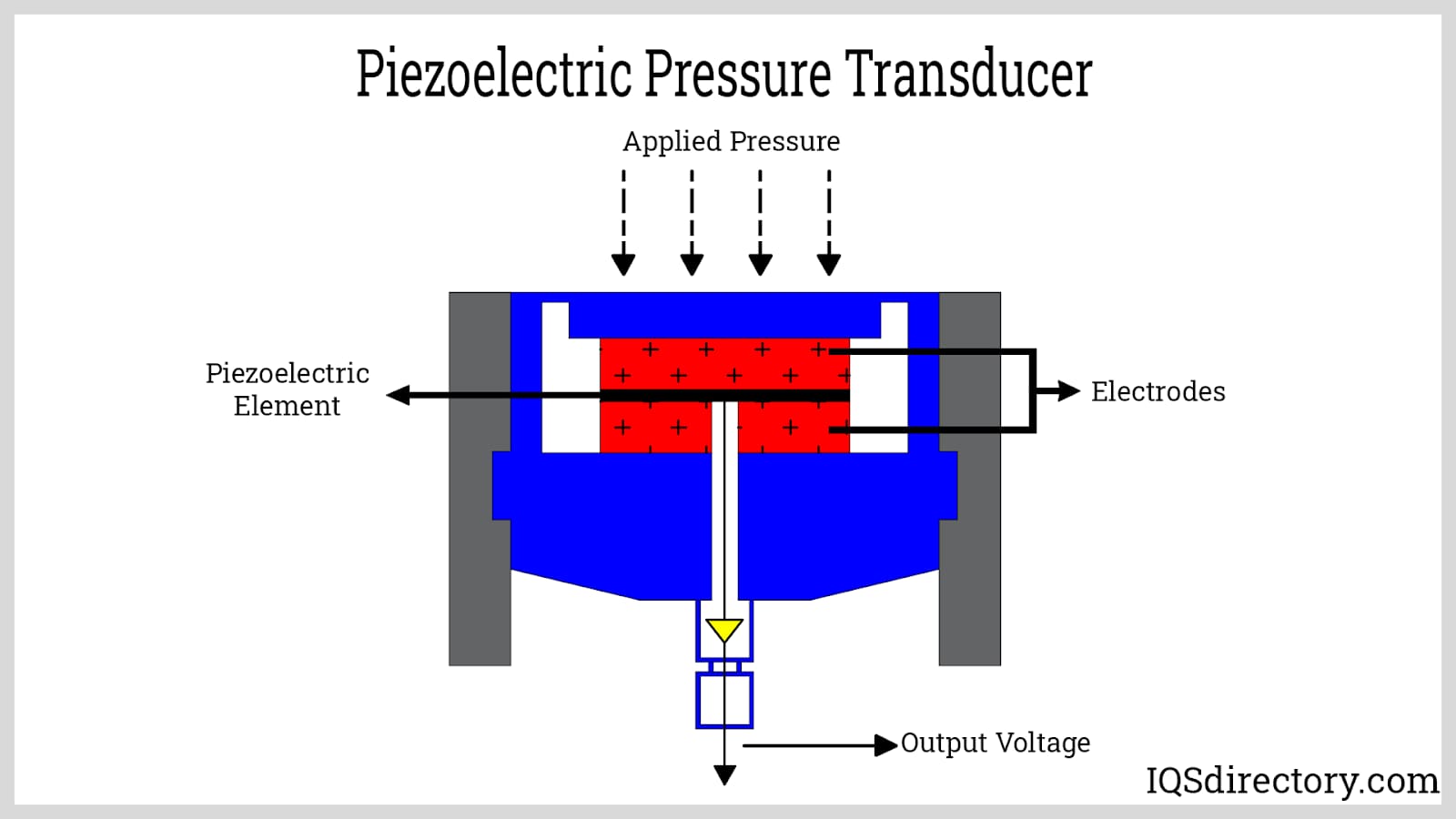 Piezoelectric pressure transducers do not use external voltage for their working principle.
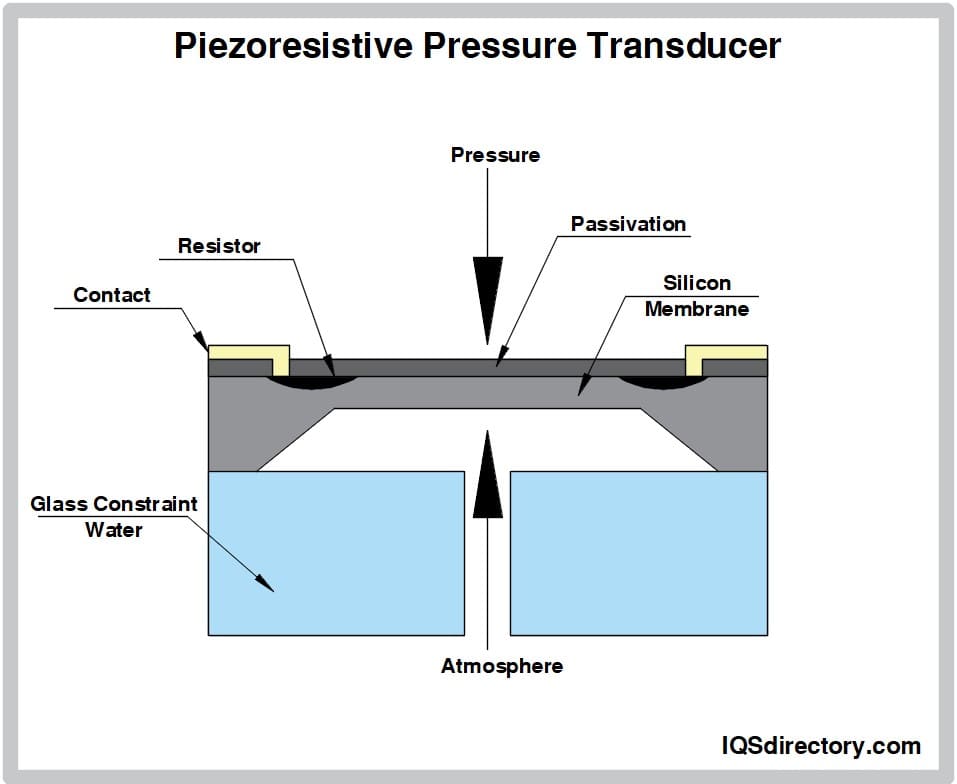 Piezoresistive pressure transducer, uses a resistance change of the semiconductor to measure the applied pressure.
Pressure Transducer Types
There are numerous types of pressure transducers, and a broad selection of sensors and instruments utilize pressure transducers in their operation.
Devices that rely on pressure transducers to detect and report pressure levels include: air pressure sensors, absolute pressure sensors, atmospheric pressure sensors, differential pressure sensors, miniature sensors, pressure calibrators, pressure regulators, pressure sensors, pressure transmitters, level transmitters, strain gauge based transducers, level transmitters, sealed pressure sensors, submersible liquid level transmitters and transducers, general-purpose transducers, industrial grade transducers, temperature transducers, torque transducers, and vacuum pressure sensors.
- Air Pressure Sensors
- These are among the most frequently used pressure sensors. They measure the force of air acting on the sensor and convert this information into a readable format. Air pressure sensors are commonly paired with air compressors or pneumatic equipment.
- Air pressure sensors fall into three main categories: absolute pressure sensors, atmospheric pressure sensors, and differential pressure sensors. Each type measures air pressure differently relative to ambient conditions.
- Absolute Pressure Sensors
- These sensors measure pressure independent of ambient conditions. Absolute pressure sensors reference a perfect vacuum (0 psi) rather than atmospheric pressure. For example, atmospheric pressure is about 14.7 psi at sea level, as measured by an absolute pressure sensor.
- Atmospheric Pressure Sensors
- Also called barometric pressure sensors, these measure the weight of air above a specific location. The sensors convert this force into an electrical signal that can be displayed and are mainly used in meteorological applications.
- Differential Pressure Transducers
- These calculate the difference between two or more pressure points using separate inputs. They are useful for identifying pressure drops and monitoring flow rates in sealed or pressurized systems and can output electrical, mechanical, or pneumatic signals in response to fluid pressure.
- Miniature Pressure Sensors
- Miniature pressure sensors are designed to measure gas or liquid pressure with minimal disturbance. They are often used in sensitive medical or biological environments where low sensor volume is important, such as in blood pressure or medical pressure monitoring.
- Pressure Calibrators
- These devices test the accuracy of pressure sensors to ensure safe and efficient operation. Pressure calibrators compare input from a known system to the pressure gauge reading, helping operators quickly verify gauge accuracy and maintain safety.
- Pressure Regulators
- Pressure regulators control and maintain gas or liquid pressure within a system by adjusting valves to balance flow with demand. They can also alert operators if pressure exceeds safe limits to help ensure operational safety.
- Pressure Sensors
- Pressure sensors measure the psi of gases or liquids, monitor changes, and are often integrated with safety features like automatic shut-off switches. They send pressure readings to other devices for further action.
- Pressure Transmitters
- Pressure transmitters are used to measure, monitor, and transmit pressure data for liquids and gases.
- Strain Gauge Based Transducers
- These transducers convert pressure into an electrical output by straining bonded strain gauges on the diaphragm. The resulting deformation causes an electrical resistance change that is proportional to the applied psi.
- Level Transmitters
- Level transmitters measure the amount of solids, liquids, or slurries in a container and convert this data into a usable format. They typically provide alerts or automatically activate shut-off switches for process control.
- Sealed Pressure Sensors
- These sensors are built to measure pressure changes relative to a fixed reference point, rather than to atmospheric pressure.
- Submersible Liquid Level Transmitters
- Designed for municipal liquid level measurement and other applications, these transducers are used in water and wastewater treatment, well depth, and offshore water depth monitoring. They feature durable, watertight cables for complete submersion.
- General-Purpose Transducers
- General-purpose transducers are suitable for a wide variety of electronic psi measurement applications and offer high accuracy.
- Industrial Grade Transducers
- Industrial grade transducers are engineered for industrial pressure measurement. Their circuit boards are protected with silicone gel to guard against vibration, shock, and humidity, and use advanced surface mount technology.
- Temperature Transducers
- Temperature transducers measure heat by converting energy input into a temperature reading. They may be inserted directly into a material or measure temperature via thermal radiation, and are made to suit a wide range of temperature requirements.
- Torque Transducers
- Torque transducers measure rotational force in both static and dynamic rotating systems. They operate by converting mechanical torque into a corresponding electrical signal, similar to other transducer types.
- Vacuum Pressure Sensors
- Vacuum pressure sensors detect pressure lower than atmospheric pressure and can display the difference between measured and atmospheric values. While similar to absolute pressure sensors, they are distinct devices with specific uses.
When selecting pressure transducer types, many professionals ask: “Which pressure transducer type is best for high-vibration or corrosive environments?” or “How do piezoresistive versus piezoelectric transducers compare for my application?” These comparisons help match the transducer’s operating principle to the specific media, pressure range, accuracy needs, and environmental challenges of the installation.
Pressure Transducer Applications
Pressure transducers and pressure sensors are essential in critical environments. Typical uses include navigation, leak testing, altitude detection, monitoring of pressure levels, and high-pressure sensing. These applications serve industries such as chemical processing, automotive, aerospace, aviation, meteorology, and more.
Additional common applications include hydraulic and pneumatic systems, HVAC and refrigeration equipment, oil and gas exploration, water and wastewater management, medical devices (such as ventilators and infusion pumps), food and beverage processing, and test & measurement equipment. In many cases, pressure transducers provide real-time data for process control, safety interlocks, or predictive maintenance. Buyers and system designers often explore: “What pressure transducer applications are common in the oil and gas or automotive sectors?” or “How can pressure transducers improve efficiency and safety in my process line?” Understanding these real-world uses helps ensure the selected transducer delivers reliable performance where it matters most.
Standards and Specifications for Pressure Transducers
The standards you require depend on your specific industry, application, and location. Consult with industry professionals to ensure you are selecting the right specifications. Generally, it is best practice to select pressure transducers certified by ASTM International for quality assurance.
Other important standards include those from ISA, IEC, and NEMA for hazardous locations, as well as industry-specific requirements (e.g., 3-A Sanitary Standards for food processing or SIL ratings for safety instrumented systems). Key specifications to review include pressure range, accuracy, output signal, temperature compensation range, overpressure rating, and ingress protection (IP rating). Compliance with these standards ensures compatibility, safety, and long-term reliability across diverse operating conditions.
Choosing a Pressure Transducer Manufacturer
To ensure you receive top quality pressure transducer products, it's important to work with a reputable manufacturer. We’ve compiled a detailed list of trusted manufacturers to assist you. Before reviewing their options, identify your requirements such as pressure rating (psi), available space, compliance standards, budget, delivery timeline, and post-delivery support. As you compare manufacturers, match their offerings with your specifications. Narrow your choices to a few promising candidates, discuss your project with them, and select the one that best meets your needs.
Additional evaluation criteria include technical support availability, customization capabilities, traceability of materials, calibration services, and warranty terms. Many procurement teams ask: “What questions should I ask potential pressure transducer manufacturers to verify quality and suitability?” A thorough comparison process helps secure a supplier that delivers consistent performance, on-time delivery, and responsive support throughout the product lifecycle.
Proper Care for Pressure Transducers
Maintaining pressure transducer reliability requires regular calibration and backup systems. To learn about the most effective care procedures for your specific transducer, consult with your pressure transducer supplier.
Best practices include periodic recalibration (typically annually or per manufacturer guidelines), inspection for physical damage or contamination, protection from extreme temperatures or corrosive media when not in use, and proper storage in clean, dry conditions. For harsh environments, consider installing protective enclosures or snubbers to dampen pressure spikes. Routine maintenance minimizes drift, extends service life, and helps prevent unexpected downtime in critical processes.
Pressure Transducer Accessories
Nearly all pressure transducers require accessories, and the right choice depends on your application. Common pressure transducer accessories include digital displays, connector cables, conduit connectors, mounting adapters, installation tool kits, and junction boxes for terminations.
Other useful accessories include pressure snubbers to protect against surges, diaphragm seals for corrosive or viscous media, cooling elements for high-temperature applications, and signal conditioners or isolators for noisy electrical environments. Selecting compatible, high-quality accessories ensures proper installation, accurate readings, and long-term system reliability.
Pressure Transducers Terms
- Accuracy
- The sum of errors from nonlinearity, repeatability, and hysteresis, expressed as a percentage of full scale output.
- Axial Load
- A force applied along or parallel to the main axis of a component.
- Best Fit Straight Line
- The sensitivity of a sensor is ideally linear, though minor non-linearity can occur. BFSL uses all data points to define a straight line that minimizes the error between the curve and the line.
- Burst Pressure
- The highest pressure an object can withstand before rupturing or failing.
- Calibration
- A process where known pressure values are applied to an instrument, and its output is recorded under specific conditions to ensure accuracy.
- Dead Volume
- The internal volume of the transducer’s pressure port at standard temperature and barometric pressure.
- Differential Pressure
- The difference between a measured pressure value and a set reference point.
- Error
- The variance between the actual pressure and the value indicated by the transducer.
- Excitation
- The voltage or current supplied to the transducer’s input terminals to enable proper operation.
- Gauge Pressure
- Pressure measured in relation to the surrounding atmospheric pressure.
- Hysterisis
- The greatest output difference observed when pressure is increased and then decreased over the instrument’s full range.
- Linearity
- The maximum deviation of a calibration curve from a straight line that passes through the upper and lower range values, using the average of readings in both directions.
- Noise
- Unwanted signals that can introduce errors, such as radio frequency interference, electromagnetic interference, power line hum, or broadband noise.
- Output
- The electrical signal generated by the transducer when pressure is applied.
- Peak Pressure
- The highest pressure value detected during a measurement cycle.
- Pressure Rate
- A consistent change in pressure during a defined period of time.
- Repeatability
- The degree to which a series of consecutive output measurements, taken under identical input and operating conditions, agree with each other during full range traverses.
- Sensing Element
- The component of the transducer that directly responds to applied pressure.
- Variable Pressure
- A fluctuation in the pressure being monitored or controlled.
- Zero Balance
- The transducer’s rated output signal with no load and rated excitation, usually stated as a percentage of the rated output.