Plastic Extrusions
Plastic extrusion is a continuous manufacturing method used to produce a wide range of plastic shapes and products for industrial, commercial, and consumer applications. Because the process runs continuously, manufacturers can produce long lengths of consistent plastic profiles, tubing, pipe, film, sheet, trim, and custom shapes with strong dimensional repeatability and cost control.
While the term polymer extrusion is often used as a near synonym for plastic extrusion, but the phrase can be too broad. In technical use, a polymer is a large molecule composed of many similar smaller molecules called monomers. However, when "polymer" and "extrusion" are used together, they usually refer to elastomers, rubber, and plastic processing rather than the full polymer category.
Plastic Extrusions FAQ
What is plastic extrusion?
Plastic extrusion is a continuous plastics manufacturing process in which thermoplastic resin is melted, pressurized, and pushed through a die to create a uniform cross section such as tubing, pipe, profiles, channels, film, sheet, or insulated wire coating.
Which industries use plastic extrusions?
Plastic extrusions serve automotive, construction, HVAC, plumbing, appliances, electrical, medical, food processing, and chemical handling markets because they offer repeatable dimensions, durable performance, low weight, corrosion resistance, and practical production economics.
What products are commonly made through plastic extrusion?
Common extruded products include PVC channels, plastic strips, tubing, medical tubing, window frames, fencing, decking, films, sheeting, laminated coatings, edge trim, weather seals, and wire insulation used in both standard and custom applications.
What materials are used in plastic extrusion?
Common extrusion materials include PVC, HDPE, LDPE, PETG, polypropylene, acrylic, polystyrene, butyrate, ABS, nylon, and other thermoplastics selected for stiffness, flexibility, clarity, heat tolerance, chemical resistance, impact strength, or outdoor durability.
How does the plastic extrusion process work?
Plastic pellets or resin enter a hopper, move through a heated barrel by way of a rotating screw, and are forced through a die that forms the profile. The extrusion is then cooled, sized, pulled, and cut to length for packaging or secondary operations.
What are the advantages of plastic extrusion?
Benefits include high-volume output, low scrap rates, strong material flexibility, competitive part pricing, process efficiency, and the ability to add finishing, sizing, embossing, punching, or other post-extrusion adjustments while the material is still workable.
What is coextrusion in plastics?
Coextrusion combines two or more plastics into a layered profile by feeding separate materials into one die. This lets manufacturers blend properties such as rigidity, softness, color, barrier performance, UV resistance, or chemical resistance in one extrusion.
Applications of Plastic Extrusion
Plastic extrusion supports a broad range of plastic product development needs, from commodity profiles to engineered components with demanding tolerance targets. Buyers often turn to extruded plastics when they need long continuous parts, lightweight substitutes for metal, custom channels, multi-lumen tubing, protective trim, or weather-resistant shapes for outdoor service. The process is widely used in automotive manufacturing, building products, HVAC systems, plumbing, chemical processing, appliances, food and beverage operations, retail displays, and electronics.
Plastic Extrusion Products
The plastic extrusion process is used to produce a wide array of plastic components, from cable guides and glazing accessories to fluid transfer parts and electronic housings. Other examples of products created through plastic extrusion include PVC channels, plastic strips, profiles, PVC pipes, all-purpose tubing, medical tubing, weather stripping, decorative and functional trim, fencing, deck railings, window frames, plastic films and sheeting, thermoplastic coatings, and wire insulation.
History of Plastic Extrusion
Early extrusion-related equipment appeared in the 1800s, when inventors began developing ways to reclaim, soften, and shape rubber compounds more efficiently. Those early machines laid the groundwork for modern extrusion by showing how heat, pressure, and mechanical force could turn raw material into repeatable continuous forms.
Modern thermoplastic extrusion expanded rapidly in the 1900s as improved screws, dies, and process controls made it easier to produce higher-quality plastic pipe, tubing, film, and custom profiles. Developments in twin-screw technology, resin formulation, and downstream cooling systems helped move extrusion from a niche method into a high-output manufacturing platform.
Today, the market continues to grow as manufacturers look for faster throughput, tighter tolerances, lighter assemblies, and materials tailored for weatherability, impact resistance, sanitation, and regulatory requirements. That shift has pushed many extrusion companies to invest in better line speed control, in-line inspection, coextrusion capability, and more refined die design.
Materials Used in Plastic Extrusion
- Thermoplastics
- Thermoplastics soften with heat, can be formed into useful shapes, and solidify again when cooled. That repeatable behavior makes them well suited for extrusion, regrind use, and many high-volume manufacturing programs.
- HDPE
- HDPE offers a strong strength-to-weight ratio, good impact performance, moisture resistance, and broad chemical resistance. It is commonly chosen for durable extruded parts, pipe, liners, and outdoor components.
- LDPE
- LDPE is flexible, tough, and useful where softness, bendability, or squeeze performance matters. It can be extruded in translucent or opaque forms for tubing, film, and flexible profiles.
-
- PETG
- PETG can be used for rigid or semi-rigid extrusions that need clarity, impact resistance, and clean appearance. It is often evaluated for displays, guards, packaging components, and formed parts.
- PVC (Vinyl)
- PVC, also called vinyl, is one of the most widely used extrusion materials because it can be formulated as rigid or flexible, offers good insulation value, and resists many chemicals, moisture, and weather exposure. PVC extrusions, are widely used for pipe, tubing, siding, flooring trim, edge protection, and many construction-related profiles.
- Butyrate
- Butyrate is valued for clarity, toughness, and dimensional stability, making it a fit for specialty profiles and parts that benefit from a clean finished look.
- Polypropylene
- Polypropylene is lightweight, chemically resistant, and useful where heat tolerance and fatigue resistance matter. It is often considered for tubing, packaging, appliance parts, and industrial profiles.
- Polystyrene
- Polystyrene is economical and easy to process, which has made it common in packaging and disposable products, though project teams often weigh cost against end-use and sustainability goals.
- Acrylic
- Acrylic extrusions provide optical clarity, weather resistance, and a polished appearance. Acrylic is often chosen for display parts, lenses, guards, and clear tubing where visibility matters.
Plastic Extrusion Process
The plastic extrusion process follows the same general sequence across many product lines, although temperatures, screw designs, cooling methods, and puller speeds change with the resin, profile geometry, tolerance target, and required finish.
Typical plastic extrusion steps include the following:
The line begins with resin pellets, powder, or a custom compound loaded into a hopper above the barrel. Depending on the job, the feedstock may include virgin resin, colorant, UV package, filler, flame-retardant additive, or approved regrind.
Gravity drops the material into the barrel, where the screw starts moving it forward at a controlled rate.
Inside the channel, a long, rotating screw moves the plastic forward. The friction generated by the screw’s rotation causes the plastic to melt. In some extruders, additional electrical heating elements help bring the resin to a stable melt. By the end of the barrel, the material should be fully mixed, pressurized, and ready for shaping.
The melt is then forced through the extrusion die, which sets the final profile geometry. The plastic exits the die as a newly extruded product.
After leaving the die, the material is cooled and sized so it holds the intended dimensions and surface finish.
Finally, the extruded plastic is cut, wound, or coiled and then prepared for shipment or sent for secondary work such as labeling, printing, punching, drilling, anti-static treatment, or other finishing steps.
Plastic Extrusion Design and Customization
When designing standard or custom plastic extrusion products, manufacturers compare material performance, line capability, die geometry, wall thickness, tolerance range, and downstream finishing needs. Material selection should match the application’s service temperature, chemical exposure, impact load, appearance target, and regulatory demands. The chosen manufacturing method—whether hot, cold, or warm extrusion—is selected around part geometry, tolerance needs, stress levels, and production volume.
Manufacturers may also offer custom extrusion options such as custom profile extrusion, custom tubing extrusion, custom plastic pipe extrusion, coextruded seals, and extrusion coating lamination to support product development, OEM sourcing, and replacement part programs.
Machinery Used in Plastic Extrusion
- Extruder
- The extruder includes a feed hopper, heated barrel, screw, drive system, and controls that move, melt, mix, and pressurize the resin before it reaches the die.
- Die
-
At the end of the barrel is the die, the shaping tool that gives the extrudate its final cross section. In plastic extrusion, the die directs molten resin through a carefully engineered opening that matches the intended profile.
Every die is designed around the target part. Simple dies produce basic shapes—for example, a circular die forms a plastic rod, while a square die creates a continuous square profile. Hollow products use mandrels or pins, and flat dies can create textured sheet used in mats, liners, or protective surfaces.
Plastic Extrusion Images, Diagrams and Visual Concepts
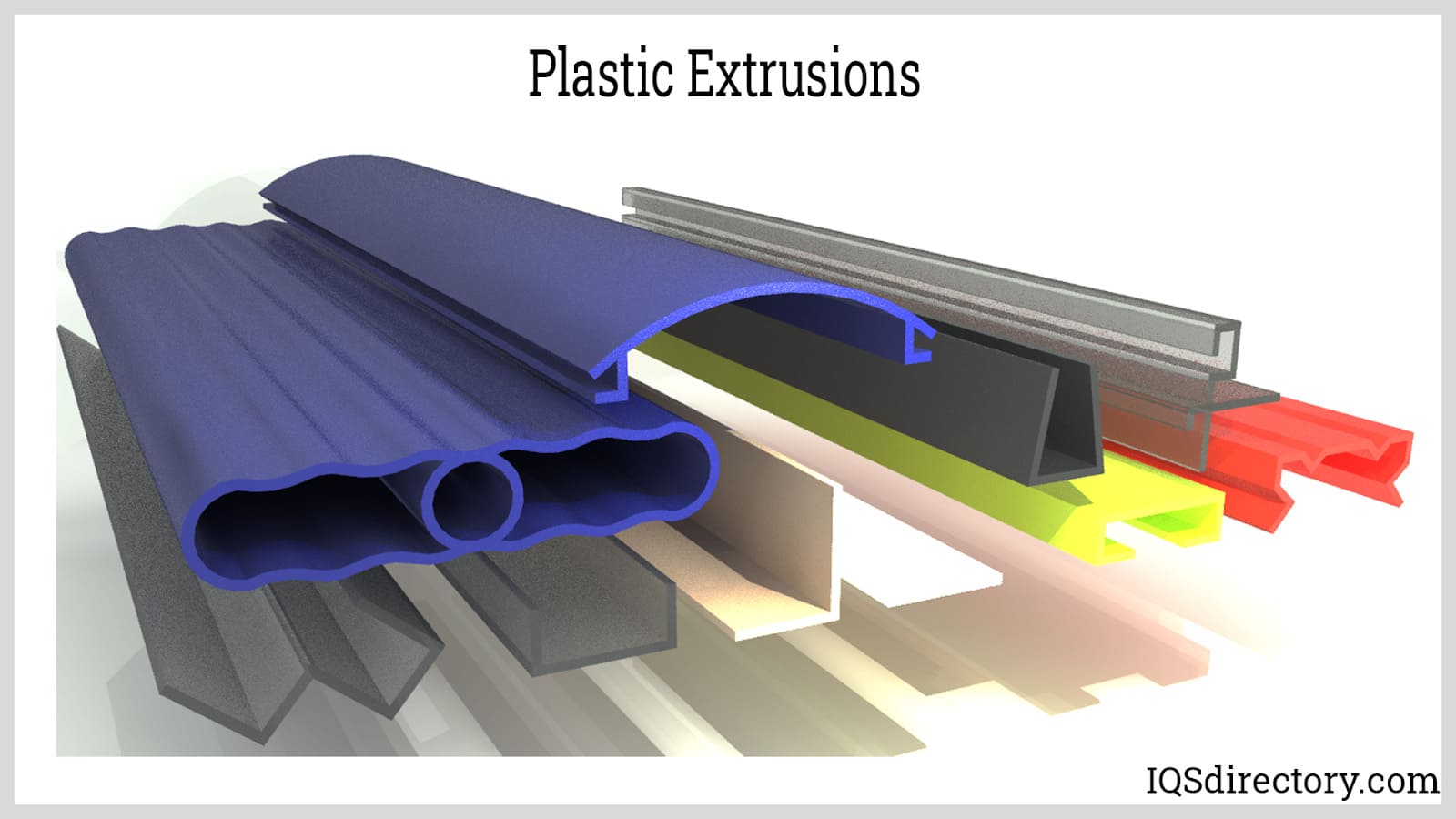 A high-volume process in which thermoplastic resin is melted and pushed through a shaping die.
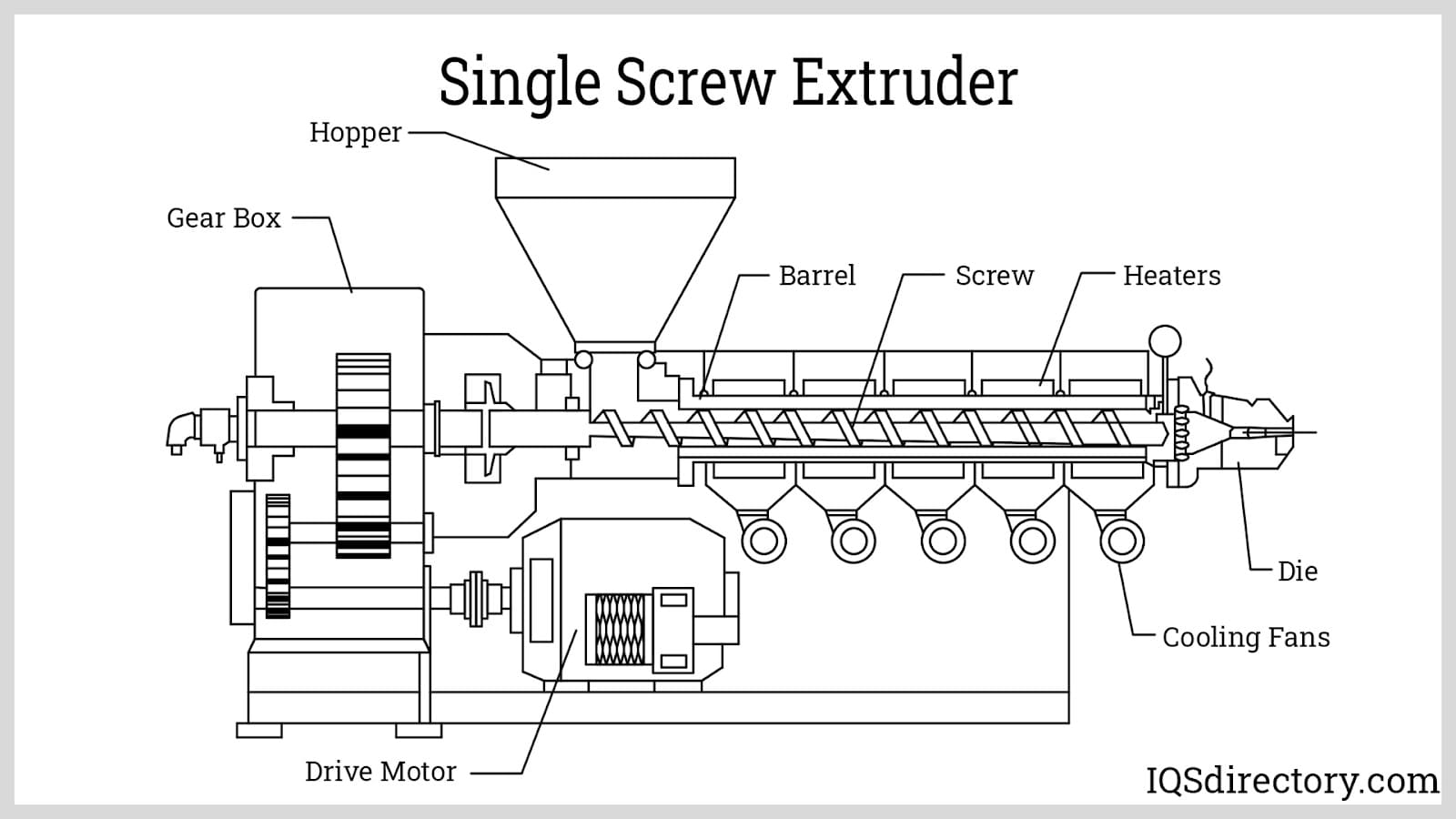 A common extrusion machine used for steady, repeatable production.
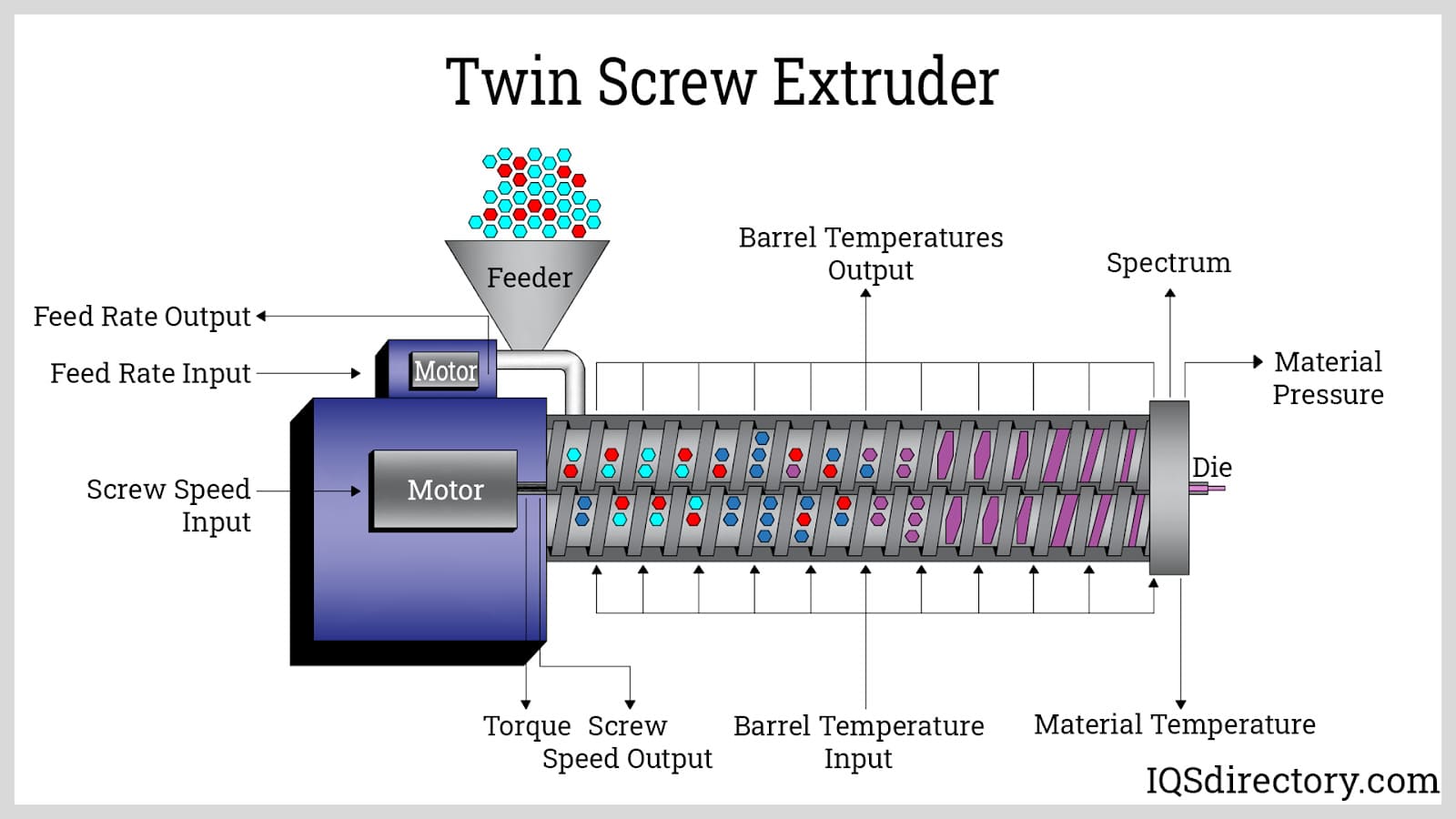 Twin-screw equipment is used when higher mixing and material control are needed.
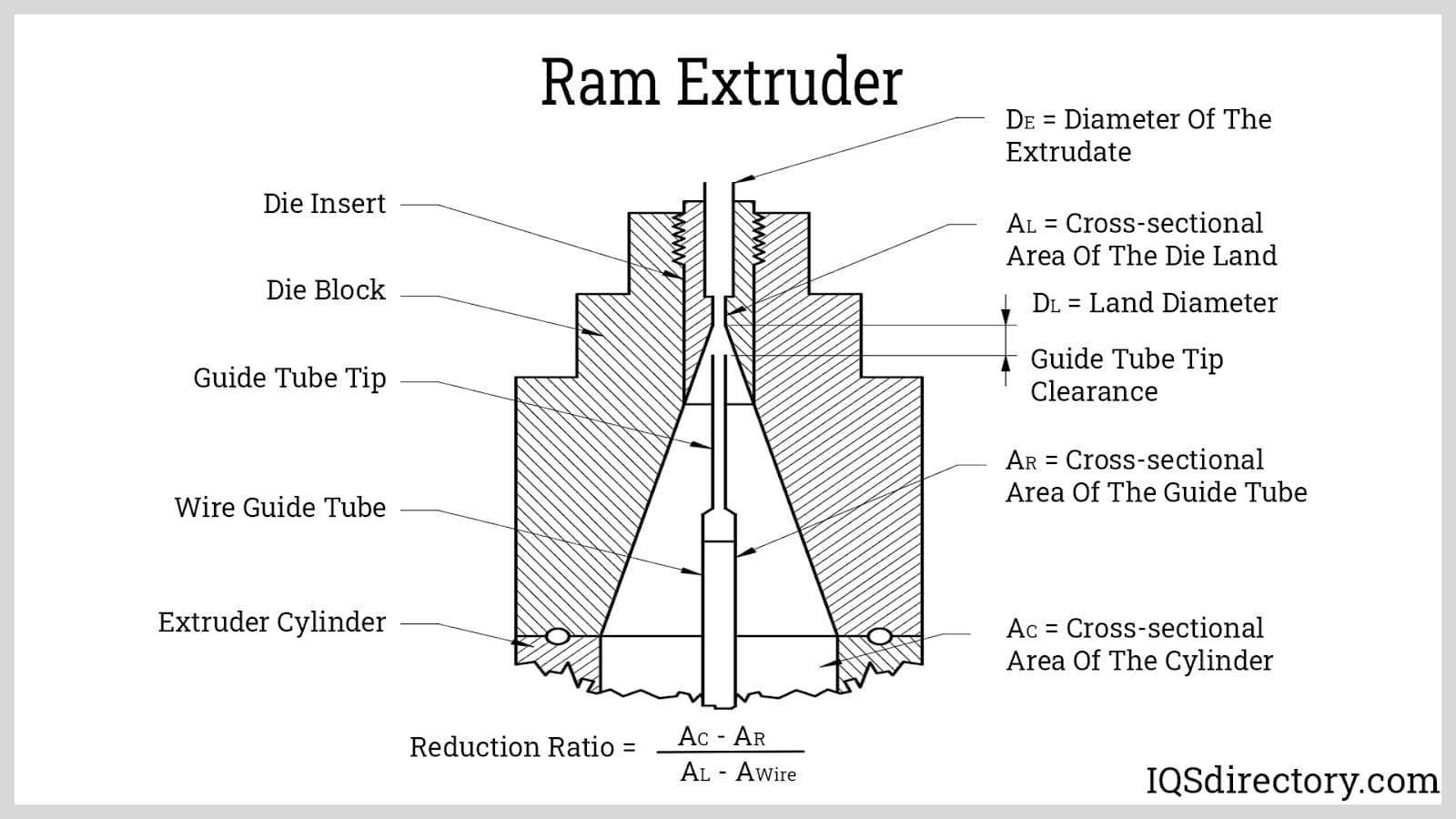 Ram extruders are more common in specialized or batch-oriented applications.
Plastic Extrusion Variations and Similar Processes
- Extruding Standard Profiles
- Standard profile extrusion uses a heated barrel and die to produce channels, trim, tubes, and other constant-cross-section parts. Mandrels and pins can create hollow areas, while process tuning helps control lumen size, wall thickness, and dimensional consistency.
- Extrusion with Multiple Extruders (Coextrusion)
- Coextrusion uses multiple extruders to join different resins in a single layered part. This approach is common when a profile needs a soft sealing layer, a rigid structural layer, color contrast, barrier performance, or weatherable outer surface.
- Extrusion for Making Plastic Shopping Bags
- Blow film extrusion is the technique used for producing plastic shopping bags and films. In this variation, resin leaves an annular die, air inflates the tube, and draw speed helps set film thickness. Blow film extrusion is widely used for flexible packaging, liners, and bag production.
- Extrusion for Making Kernels
- Some lines are used to compound materials and pelletize them for later processing. Instead of a finished profile, the output becomes uniform pellets that can be used in later extrusion, molding, or blending operations.
- Extrusion with 3D Printers
- 3D printing also relies on controlled extrusion, although it builds shapes layer by layer rather than as a continuous profile. It is useful for prototyping, fit checks, and short-run concept work.
- Plastic Injection
- Plastic extruded parts are closely related to injection molded plastics, which are produced using a mold rather than a continuous die. Injection molding is better for discrete three-dimensional parts, while extrusion is often preferred for long continuous shapes with a constant cross section.
Benefits of Using Plastic Extrusion
- Efficiency
- Plastic extrusion supports high-speed, high-volume output, which helps reduce unit cost on long runs and repeat orders.
- Low Wastage
- Trim scrap and start-up material can often be reclaimed, which helps reduce waste and improve material yield.
- Formability
- Because many thermoplastics process efficiently, extrusion can support strong throughput with practical energy use.
- Low Cost
- Continuous production, practical tooling costs, and broad resin availability make extrusion a cost-conscious choice for many programs.
- Flexibility
- Extrusion is flexible enough to support rigid or flexible materials, standard or custom profiles, and single-layer or multi-layer constructions.
- Allows Post-Extrusion Alteration
- Because the material remains workable just after the die, manufacturers can size, emboss, punch, laminate, print, or otherwise refine the product in-line.
- Versatility
- The process can produce many shapes, sizes, colors, textures, and hardness levels, provided the cross section stays consistent through the product length.
Points to Consider When Using Plastic Extrusion
To support stable output, processors watch head pressure, heating-zone temperature, screw speed, and melt uniformity closely. Many quality issues trace back to variation in those areas, so line setup and process control play a large role in finished-part consistency.
- Variations in Concentration of Raw Materials
- Finished-part quality depends on steady raw material composition and a uniform melt. Thin-gauge extrusion is especially sensitive to pressure variation, so processors pay close attention to blending, moisture control, and the ratio of virgin resin to approved regrind.
- Melt-bank Uniformity
- Uneven melt-bank conditions can lead to visual defects, inconsistent gloss, or polishing marks. Processors manage this by balancing die-to-roll distance, roll temperature, and die design so the material stays stable through cooling and pull-off.
- Design of Rolls
- Thin-gauge work often demands roll systems that can hold load without distorting the sheet or profile. That may call for upgraded rollers, shafts, and bearing support depending on the width and output rate.
- Roll Deflection
-
Roll deflection can affect thickness control and surface quality. Common responses include:
- Crowned Rolls – Pre-ground camber can offset deflection, though it limits flexibility when jobs change.
- Counter-bending Rolls – Counter-bending can help, but it also narrows the operating window.
- Roll Skewing – Roll skewing is often favored when wider operating flexibility is needed.
Choosing the Right Plastic Extrusion Manufacturer
If you are comparing plastic extrusion companies, start by reviewing material options, tooling experience, tolerance capability, secondary services, lead times, and willingness to quote custom work. Buyers often search by profile type, resin family, end use, or industry standard, so it helps to ask whether a supplier handles custom tubing, coextrusion, color matching, fabrication, packaging, and repeat production support. A strong extrusion partner should be able to discuss your specifications clearly and recommend a process that fits performance and budget goals.
Plastic Extrusion Terms
- Adiabatic Plastic Extrusions
- Plastic extrusions Extrusion driven mainly by internally generated heat within the melt.
- Back Pressure
- Resistance that opposes forward melt flow in the extruder.
- Barrel
- Housing that contains the screw or plunger assembly.
- Barrel Liner
- Replaceable inner sleeve that forms the barrel surface.
- Calendering
- Roll-based finishing process that smooths or forms plastic.
- Cladding
- Extruded weather-resistant PVC panels used as siding or coverings.
- Compound
- Prepared plastic blend ready for extrusion, molding, or related processing.
- Compression Section
- Screw section where channel volume drops and pressure rises.
- Cooling Tank
- Water-filled unit used to cool extrudate after the die.
- Cure
- Cross-linking process used to improve material properties.
- Decompression Section
- Two-stage screw area where channel volume increases for venting or control.
- Die
- Tooling that shapes molten plastic as it exits the extruder.
- Die Plate
- Primary support plate used within the die assembly.
- Dry Blend
- Premixed resin and additives prepared for later processing.
- Extrudate
- Material that exits the die as the formed product.
- Extruder Size
- Minimum inside diameter of the extruder barrel.
- Extrusion Coating
- Process that applies molten plastic directly onto a substrate.
- Haul-off
- Pulling device that continuously removes extrudate from the die.
- Heat Aging
- Heat exposure test used to evaluate long-term material retention.
- Melt
- Heated plastic condition ready for shaping and forming.
- Melt Strength
- Ability of molten plastic to hold shape during processing.
- Outer Die Ring
- Die component that forms the outside of a tube.
- Pellets
- Small resin feedstock pieces melted during extrusion.
- Ram Extruder
- Extruder that uses a plunger to push material through the die.
- Plastic Channels
- Extruded channels used to contain, seal, guide, or protect flow.
- Plastic J Channels
- J-shaped extrusions often used to support or finish trim.
- Plastic Trim
- Linear plastic profiles used for finishing, sealing, or protection.
- Resin
- Base polymer material used to make plastic products.
- Screw
- Rotating helical component that moves, melts, and mixes resin.
- Screw Extruder
- Extrusion machine that uses rotating screws to process resin.
- Take-up
- Reeling device used for collection or downstream processing.
- Thermoset
- Material that sets permanently and cannot be remelted for reuse.
- Thermoplastic
- Plastic family that can be reheated and reprocessed.
- Torpedo
- Device near discharge that further blends and equalizes the melt.
- Trunking
- PVC channel used to route and protect wires or pipes.
- Vacuum Sizing
- Cooling and sizing method that uses vacuum on the extrudate surface.
- Vinyl
- Common trade term for PVC-based material.
More Plastic Extrusions Information