Parts Washers
Parts washers serve an important function in the parts manufacturing process, handling one of the final steps—cleaning, degreasing, and drying parts before surface treatment, finishing, and shipment. After products are machined, forged, stamped, or fabricated, they often carry residual oils, chemicals, burrs, abrasive dust, paint, and other process debris. These contaminants can interfere with finishing coatings such as zinc coating and electroplating, and they can also reduce assembly quality, paint adhesion, and downstream performance. Industrial parts washers solve that problem with precise, repeatable parts cleaning that prepares surfaces for coating, plating, inspection, packaging, or final assembly.
Frequently Asked Questions About Parts Washers
What is the main purpose of a parts washer in manufacturing?
A parts washer cleans, degreases, and dries components after machining, forging, or fabrication. It removes contaminants such as oils, carbon, metal chips, coolants, and residue so parts are ready for coating, plating, inspection, packaging, or final assembly.
What types of parts washers are commonly used in industrial settings?
Common types include solvent and aqueous parts washers, along with ultrasonic, cabinet-style, rotary drum, immersion, and conveyor systems. The best choice depends on part size, material, production volume, contamination level, and the degree of automation required.
How do aqueous parts washers differ from solvent-based systems?
Aqueous washers use water-based or pH-neutral solutions along with heat, spray pressure, agitation, or ultrasonic energy to remove contaminants. Solvent-based systems dissolve grease effectively, but many facilities now prefer aqueous cleaning because it supports safer handling and aligns more easily with modern environmental requirements.
What industries rely most on parts washers?
Parts washers are widely used in automotive, aerospace, electronics, medical manufacturing, machining, metal finishing, and general industrial production. They help clean components before painting, powder coating, plating, lubrication, testing, or assembly.
What are the benefits of using modern parts washing systems?
Modern parts washing systems can improve cycle consistency, reduce labor, support cleaner surfaces, and help lower maintenance demands. Many also use aqueous or biologically assisted cleaning processes that promote efficient operation while delivering dependable cleaning quality for high-volume production.
How should industrial parts washers be maintained for long-term efficiency?
Operators should avoid overloading, remove burrs before cleaning, choose the right cleaning solution, monitor filtration, and follow the service schedule recommended for the washer. These steps help maintain cleaning performance, protect components, and extend equipment life.
Are there safety or quality standards for parts washers?
Yes. Parts washers should comply with OSHA safety standards and may be specified with ISO or ASME requirements depending on the application. Systems used in military, aerospace, or other tightly regulated environments may also need to meet Mil-Spec cleanliness or performance requirements.
Applications of Parts Washers
Industrial parts washers are widely used to remove contaminants such as carbon, grease, metal chips, cutting fluids, polishing compounds, and shop debris from metal components. Their applications range from cleaning small items like nuts, fasteners, screws, and precision machine parts to larger workpieces such as automotive assemblies, rail bearings, diesel engine blocks, hydraulic components, and even wind turbine gearboxes. For buyers comparing parts cleaning systems, the real question is often not whether cleaning is needed, but which washer technology delivers the right balance of throughput, cleanliness, and operating cost.
Beyond general manufacturing, industries such as electronics, automotive, aerospace, and medical production also rely on industrial cleaning equipment. These washers are often used before painting, powder coatings, zinc coating, lubrication, passivation, electroplating, or final assembly—steps that depend on clean, residue-free surfaces. When end users search for ways to improve adhesion, reduce rejects, or meet tighter cleanliness targets, a well-matched parts washer is often a practical answer because it supports repeatable surface preparation across both low-volume and high-volume production.
Design of Parts Washers
Parts cleaning equipment generally includes a water heater, filtration system, pumps, scrubbers, brushes, spray nozzles, controls, and a cabinet or enclosed wash chamber. In more advanced parts cleaning systems, buyers may also see rinse stages, blow-off stations, drying sections, oil skimmers, turntables, and programmable controls designed to improve cleaning consistency.
Water heaters in parts washers can be powered by gas, electricity, or steam. The filtration system captures waste and debris produced during the cleaning cycle so wash solution stays usable longer. Pumps increase spray pressure, while scrubbers and brushes help dislodge stubborn contaminants from part surfaces and recesses. To break down contamination, washers may use hot water, detergents, solvents, vapors, acids, or alkaline solutions, with some formulas designed for specific soils or metals. Cabinets, also called enclosures or housings, are commonly made from stainless steel, although certain models may include glass or plastic components depending on visibility, corrosion resistance, and process needs.
Design options for parts washers and systems are extensive. Some washers are fully automated, with CNC machines or programmable controls adjusting settings, while others require manual loading. Depending on the design, parts may be front-loaded or back-loaded and cleaned in a basket, tray, rack, by a robotic arm, on a rotary table, or by conveyor. Most modern parts washers are aqueous, using water combined with chemical or natural cleaners to soak, blast, spray, or boil away soils. Some solutions include inhibitors that help prevent unwanted reactions between the cleaner and non-ferrous metals.
Because unfinished parts vary so widely across industries, parts washer manufacturers often provide custom designs. These systems can range from stand-alone basket immersion parts washers to more complex machines that combine deburring, aqueous tumbling, rinsing, drying, and paint preparation in one integrated system. Advances in industrial technology now make it possible to combine multiple finishing steps in a specialized washer designed around part geometry, throughput goals, cleanliness standards, and available floor space.
Accessories for Parts Washers
To simplify parts washing tasks and improve process control, several accessories are commonly used. Cleaning brushes, oil-absorbing pads, washer heaters, filters, turntables, and parts baskets can improve wash coverage, solution life, and handling efficiency. When buyers ask which accessories matter most, the answer usually depends on part size, soil load, cycle frequency, and whether the goal is faster throughput, cleaner rinse results, or easier maintenance.
Installation of Parts Washers
Each industrial parts washer has its own installation requirements, including utility connections, drainage, ventilation, solution filling, floor load considerations, and operator access. To support proper setup and safe performance, follow the installation instructions supplied by the manufacturer or system supplier and verify that the machine is configured for the intended cleaning chemistry and production environment.
Proper Care of Parts Washers
To help your metal parts washers perform well over the long term, it helps to follow proven maintenance and operating practices that support efficiency, solution life, and cleaning consistency.
Here are some expert tips for running your parts washers efficiently for many years.
- Avoid Storage of to-be-Cleaned Metal Pieces
- Parts should move directly from the production line to the washer whenever possible. Storing parts with oil and grease allows extra dirt and residue to accumulate, which adds strain to the parts cleaning machinery. That often leads to longer cycle times, heavier solution loading, and higher maintenance or repair costs.
- Remove Burrs Before Cleaning
- Burrs on metal parts can complicate the cleaning process by preventing detergents or solvents from reaching every surface. Burrs may also break loose during cleaning and interfere with the filtration system. Removing burrs before washing can improve cleaning coverage and reduce unnecessary strain on the system.
- Don't Put Too Many Parts in a Batch
- Overloading the washer basket reduces the space needed for proper spray reach, solution flow, and part-to-part exposure, which can leave contamination behind. Smaller, better-balanced loads may lower batch output slightly, but they usually produce cleaner parts and more consistent results.
- Choose the Right Cleansing Solution
- Select the cleaning solution based on the type of contaminant and substrate involved. For oil-based soils such as cutting fluids, hydrocarbon-based cleaning methods may deliver the best results. For water-based residues such as grinding or lapping compounds, aqueous parts washers are often more effective and easier to manage in production.
- Make Sure Your Operators are Properly Dressed
- Operators can accidentally transfer contaminants such as oils, lint, and hair that interfere with the washing process. Hairnets, lint-free gloves, work coats, and suitable protective garments help keep parts cleaner while also helping protect operators from exposure to wash chemicals or heated solutions.
Parts Washer Standards
Because parts washers operate around workers and often use heat, pressure, and chemical solutions, the wash system should comply with OSHA standards and any plant-specific safety requirements. Depending on the application, buyers may also request ISO and/or ASME certification for general quality assurance. The exact standards depend on part use, cleanliness expectations, and industry regulations. For example, washers used for military or aerospace products may need to meet Mil-Spec requirements.
Things to Consider When Purchasing a Parts Washer
Selecting the right parts washer for machine parts, fabricated components, castings, or assemblies can be challenging, even when the basic cleaning process seems straightforward. Buyers often compare aqueous vs. solvent systems, manual vs. automatic operation, footprint, cycle time, and the cleanliness level needed for coating, plating, inspection, or assembly.
To help you choose your wash system, use the list of considerations below.
- What materials are your parts made from, and are those metals or substrates sensitive to certain cleaning chemistries?
- How large are your machine parts, what shapes do they have, and are there recesses, blind holes, or internal passages that must be cleaned?
- Do you need a wash-rinse-dry system, or will a wash-only system handle your production requirements?
- What type of contaminants do you need to remove from your parts? (carbon, oil, grease, mold release agents, corrosion, dust, metal chips, cutting fluids, compounds, and similar soils)
- How experienced are your engineers and operators in cleaning machine parts and maintaining process consistency?
- What environmental, wastewater, ventilation, or worker-safety concerns should be addressed before installation?
With these considerations in hand, the next step is choosing the right manufacturer. Start by browsing the listing above and visiting supplier websites. Reach out with any questions you may have. Look for a manufacturer who is knowledgeable, responsive, and able to design a high-quality cleaning system that fits your specifications, budget, production rate, and timeline.
Parts Washer Images, Diagrams and Visual Concepts
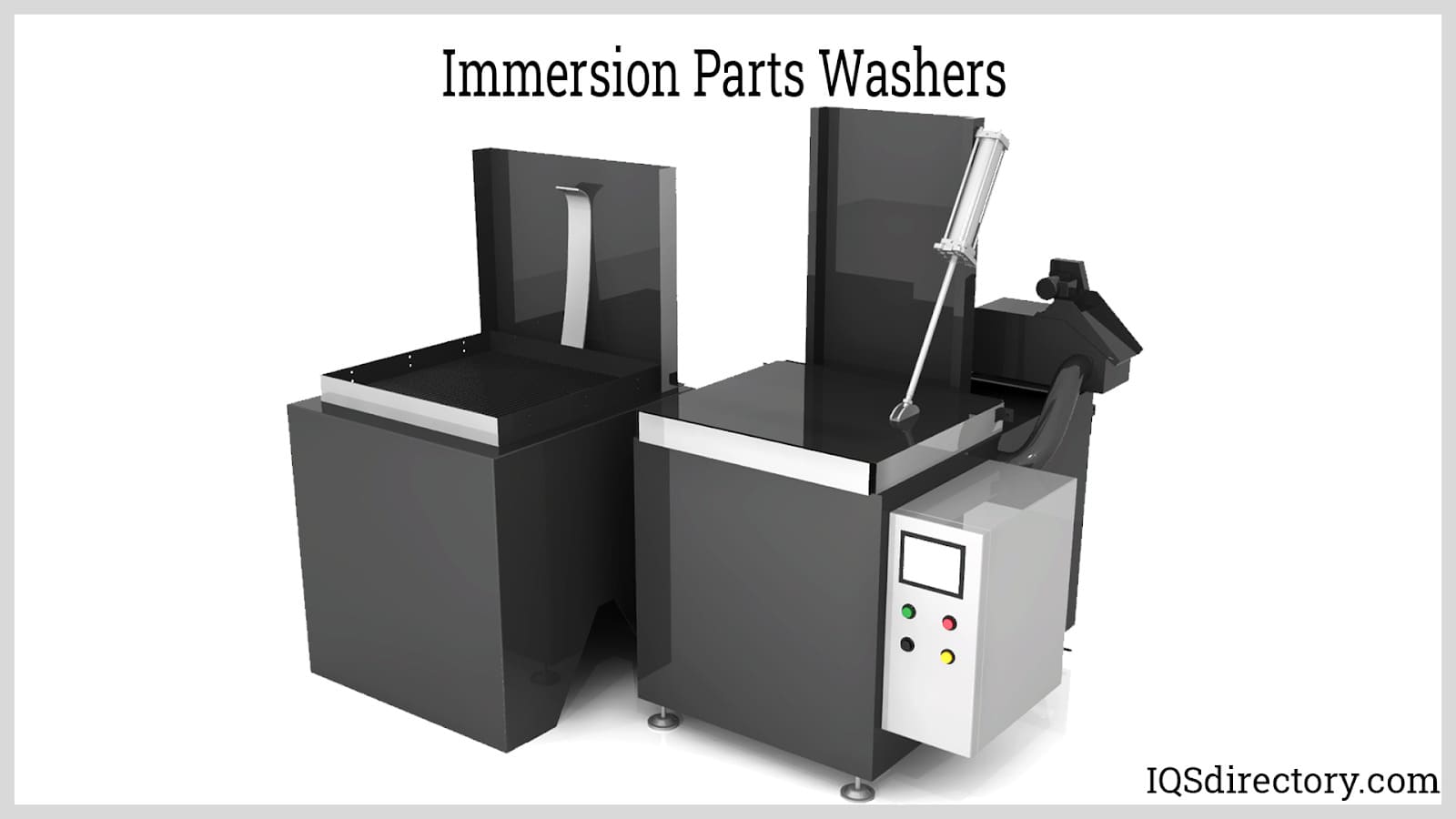 Immersion parts washers use agitation or oscillation in a cleaning solution to clean parts thoroughly and reach detailed surfaces.
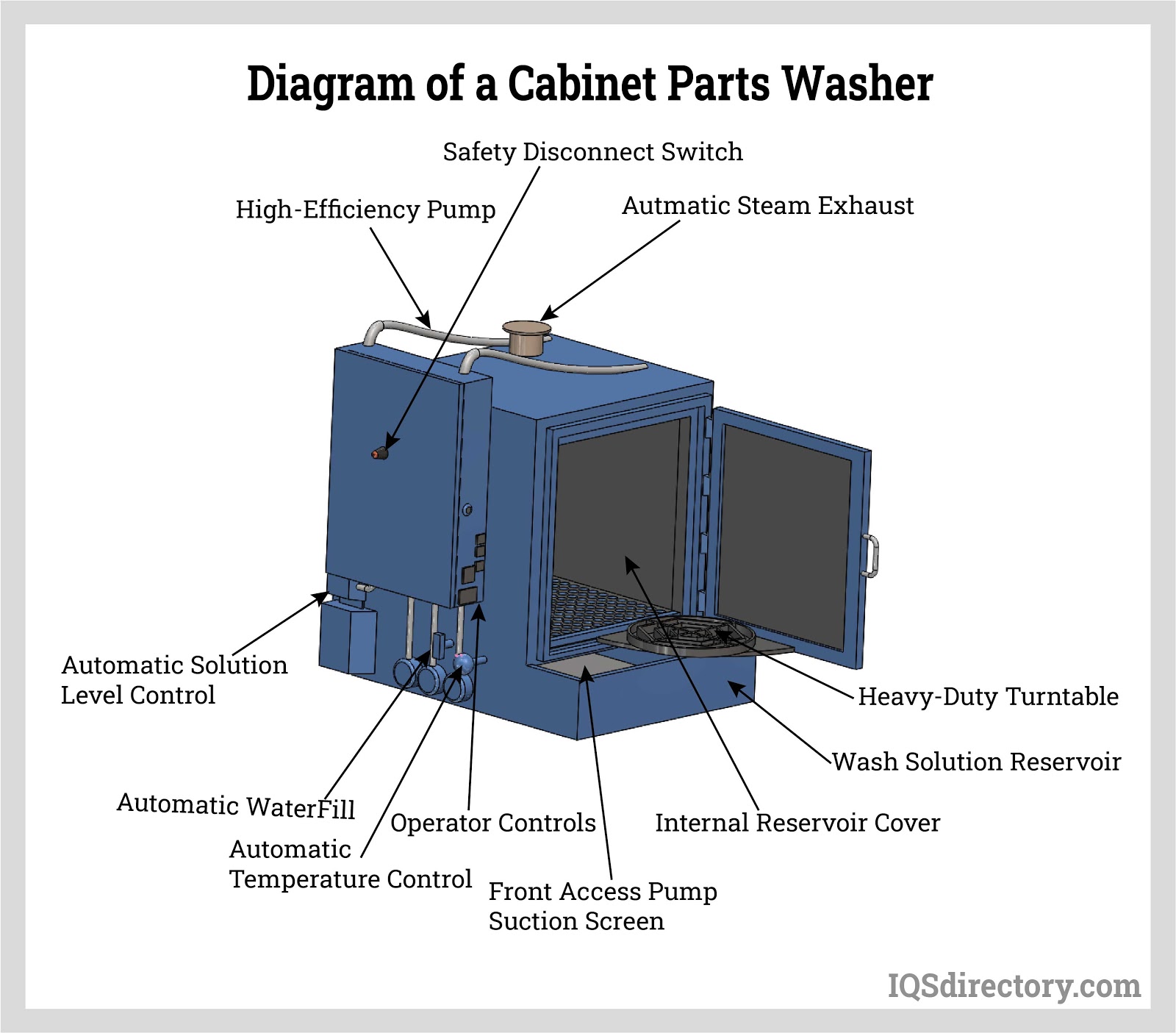 This diagram highlights the main components involved in a cabinet-style parts washer system.
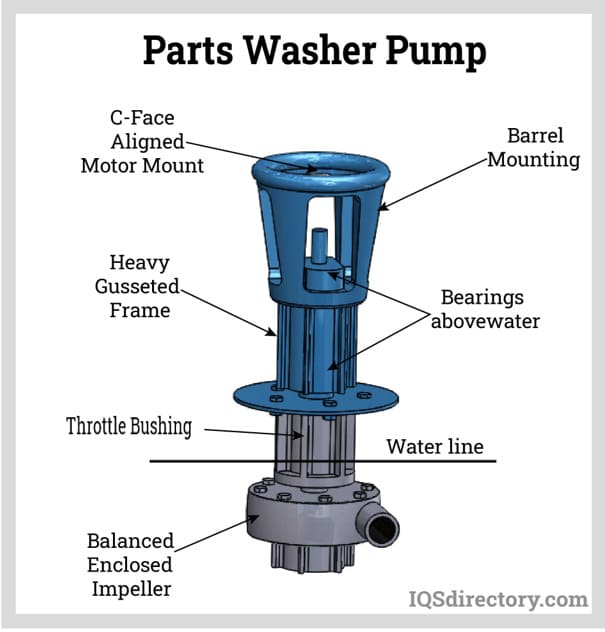 The pump supplies pressure to the wash system and helps deliver cleaning solution through the nozzles.
 This detergent is formulated to remove grease, grime, oil, chemicals, and soil from high-volume parts production.
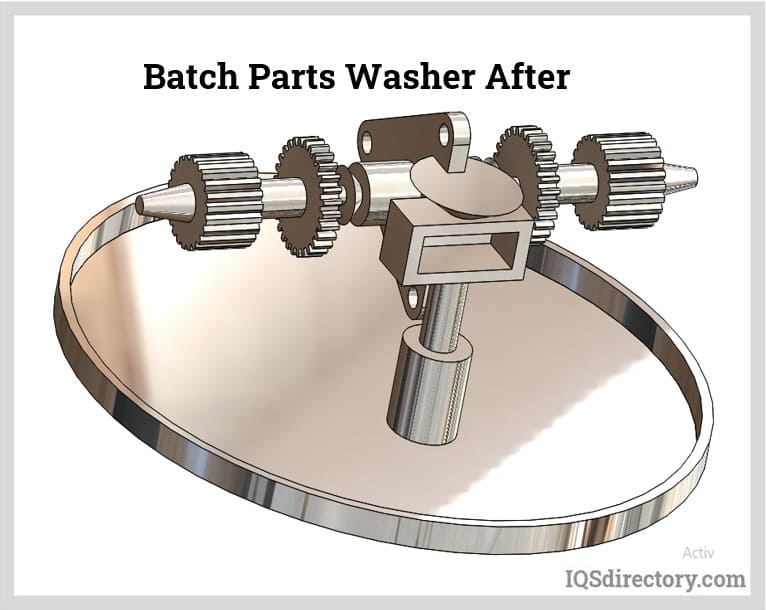 This image shows how parts may look after a completed batch washing cycle.
Parts Washer Types
Broadly, washers are either solvent or aqueous-based:
- Solvent Parts Washer
- These washers clean metal parts by dissolving dirt, grease, and residue. The earliest parts cleaning equipment was solvent-based and often required large volumes of petroleum-derived solvents. Over time, many solvent cleaner variations were introduced. Even so, because of environmental and handling concerns, solvent-based parts washers are now less common in many facilities, and it can be harder to source solvents that satisfy current safety and compliance expectations.
- Aqueous Parts Washer
- Aqueous washers use pH-neutral or water-based solutions to loosen and remove contamination from metal surfaces. In some cases, semi-aqueous cleaners that combine a small amount of solvent with water are used. These systems typically rely on detergent, water, heat, spray pressure, or mechanical action, often through jet spray or power wash processes, to deliver effective industrial parts cleaning.
In addition to these categorizations, parts washer systems can be broken down by their level of automation, from manual to semi-automatic, and, most commonly, fully automatic.
- Manual Cleaning Washer
- These are typically drum- or vat-style systems suited for lower-volume cleaning. They can be a good fit for shops that clean parts for 30 to 40 minutes a day and for operations that handle many small parts without needing a fully automated line.
- Semi-Automatic Washer
- These washers include some automated stages but still require manual loading and unloading, or they may work in combination with conveyor handling for added efficiency. They are often chosen when buyers want more throughput than a manual unit without moving to a fully automatic system.
- Automated Cleaning Washer
- Automated washers are usually best for operations where parts are cleaned for long periods every day, often more than 45 minutes. Moving to automation can save labor, improve cleaning repeatability, and lower per-part cleaning cost in continuous production.
Some modern washers are classified by their functionality:
- Cabinet-Style Parts Washer
- These washers are cabinet-shaped enclosures that use heated aqueous spray and mechanical action to remove grease, carbon, and shop residue from metal parts. Cabinet-style washers often include a fixed or retracting turntable that holds and rotates parts during the cycle to improve spray coverage.
- High-Pressure Spray Washer
- Often configured as a cabinet-style washer, a high-pressure spray washer uses strong water jets to clean parts from multiple angles. These systems commonly pair hot water with aqueous detergents or other cleaning chemistry to deliver aggressive spray cleaning where heavy residue must be removed.
- Ultrasonic Cleaner
- Ultrasonic cleaners use a cleaning bath where ultrasonic energy causes the liquid to vibrate and create microscopic bubbles that collapse against the surface of the part. This action is very effective for cleaning hard-to-reach areas, internal passages, fine features, and small machine parts.
Finally, some other parts washer varieties include green washers, spray washers, rotary drum washers, drum washers, conveyor parts washers, immersion/agitating washers, small parts washers, and automotive part washers.
- Green Washer
- These washers use biologically assisted cleaning methods that combine pH-neutral solution, heat, and microbe activity to help break down grease and hydrocarbons. The cleaned solution can then be filtered and reused, making this style attractive for facilities looking for environmentally mindful cleaning options.
- Spray Washer
- Spray washers are equipped with an enclosed conveyor or chamber that moves parts through a controlled spray process. They typically use multiple nozzles to apply water or wash solution, and while they may be less intense than certain high-pressure systems, they are well suited for steady production flow.
- Rotary Drum Washer
- In these washers, smaller parts tumble through a rotating drum that washes, rinses, and dries them. A spiral conveyor inside the drum moves the parts through the process so all sides receive cleaning exposure.
- Drum Washer
- Drum washers clean larger containers such as barrels or pails that hold chemicals, paints, or adhesives. These washers clean both the interior and exterior surfaces, often using spray or rotary action and then drying with air or heat.
- Conveyor Parts Washer
- Unlike cabinet-style washers that rely on turntables, conveyor parts washers use a conveyor to move parts through wash, rinse, and sometimes dry stages. These systems may use a simple belt conveyor or an overhead conveyor system depending on part size and production layout.
- Immersion Washer/Immersion Agitation Washer
- These washers submerge parts in a bath of cleaning solution. By combining agitation, spray, or ultrasound, they remove contamination from both large and small parts. Impellers or paddles create mechanical energy that keeps the solution moving and improves cleaning action.
- Small Parts Washer
- Designed for small parts like fasteners and screws, these washers often use rotary or immersion methods to clean large quantities of compact components efficiently.
- Automotive Parts Washer
- These washers clean automotive parts such as engines, transmissions, pneumatic parts, and hydraulic components, often using hot water, detergents, spray pressure, or ultrasonic cleaning to deliver thorough removal of oil, grease, and shop residue.
- Agitating parts washers
- Cleaning tools that use agitators to improve solution movement and increase the efficiency of the cleaning process.
- Aqueous Cleaning Systems and Aqueous Parts Washing
- These systems use water-based chemicals, detergents, saponifiers, and other additives to cleanse parts. The cleaning action may include agitation, rotation, or jet spray, and the solutions may be alkaline, acidic, or neutral depending on the contamination and substrate.
- Automatic parts washers
- These systems are controlled by computers or programmable logic that automate the cleaning process for medium- to large-scale operations.
- High-Purity Cleaning
- This cleaning process is designed for very tight cleanliness requirements, making sure parts are free from contamination that could interfere with later manufacturing steps or quality demands.
- Gross Cleaning
- A common form of industrial cleaning focused on removing the bulk of oil, chips, dirt, and other major contaminants from a product before the next step.
- Industrial Washers
- Machines designed for cleaning industrial parts and components in manufacturing, fabrication, and production environments.
- Parts Cleaners
- Machines designed to clean components after they come off the production line so they are contaminant-free before moving into finishing, assembly, or shipment.
- Parts Washers
- Large-scale machines used to clean industrial components, especially where production volume and cleaning consistency matter.
- Parts Cleaning Equipment
- A broad term for the machinery used in a parts washing process, including washers, filters, pumps, rinse stations, and dryers.
- Parts Cleaning Systems
- Machines and process systems used to wash parts on an industrial scale, often selected for factories, plants, and continuous production lines.
- Parts Washing Machinery
- A collective term for the machines and supporting equipment used to clean industrial parts.
- Precision Cleaning
- A cleaning process that makes sure parts meet a specified cleanliness level before entering the next production stage.
- Ultrasonic Cleaning
- A cleaning method that uses ultrasonic waves to create bubbles in a solution. When the bubbles collapse, they transfer energy that helps dislodge contamination from the surface of the part.
Parts Washer Terms
- Abrasive Media
- A substance used for aggressive cleaning, commonly made from materials such as sand, garnet, steel, or aluminum oxide.
- Acid
- An aqueous solution with a pH less than seven on a 1 to 14 scale. Acids with a pH below three are considered strongly acidic.
- Acid Cleaning
- The use of acids combined with surfactants to remove rust, scale, or metal residue. Acids with a pH lower than six are generally not effective degreasers.
- Acid Pickling
- The use of mineral acids to remove scale and rust from metal surfaces.
- Knife
- A device that generates a pressurized curtain of air to cleanse, cool, or dry surfaces.
- Alkaline Cleaning
- An aqueous cleaning process with a pH above 7 that uses phosphates, silicates, or other alkaline salts with surfactants in water.
- Biodegradable
- Materials that can be naturally broken down by microorganisms into simpler chemical compounds.
- Bioremediation
- A natural cleaning process that uses microorganisms such as bacteria, enzymes, or fungi to break down organic compounds in waste or pollutants.
- Blow-Off
- The use of pressurized air to clean a surface or remove excess water after washing.
- Buffers
- Solutions of salts in aqueous cleaning systems that maintain a stable pH level as soils and metals interact with the wash chemistry.
- Builders
- Additives that improve detergent performance by sequestering minerals such as magnesium and calcium, though some builders can contribute to environmental concerns.
- Cascade Rinse
- A rinsing process in which the product moves through a sequence of tanks while water from the last tank flows back toward earlier stages, creating progressively cleaner rinsing.
- Centrifugal Drying
- A drying process in which a spinning basket separates excess oils, water, or other liquid from parts, often supported by a turbine fan to improve drying.
- Closed-Loop System
- A cleaning system in which water is purified and recirculated after treatment. This setup can reduce fresh water use by relying on filtration methods such as reverse osmosis or ion exchange.
- Conductivity
- The measure of an aqueous mixture’s ability to conduct electricity, often used as an indicator of water purity.
- Contract Cleaning
- Outsourcing cleaning work to companies that specialize in cleaning industrial parts and components through aqueous cleaning, solvent cleaning, or analytical testing services.
- Convection Oven Drying
- A drying method that evaporates water from components by circulating heated air inside a chamber.
- Corrosion Inhibitor
- A substance used to slow or prevent the chemical reaction that leads to rust or corrosion.
- Cosolvent System
- A cleaning process that uses a combination of two solvents for cleaning and rinsing, with each solvent contributing different cleaning characteristics.
- Degreaser
- A solvent or cleaning material used to remove grease, oils, or fats from a substrate.
- Deionized (DI) Water
- Water purified by removing ionic species so it reaches a higher level of cleanliness and consistency.
- Detergent
- A solution made from surfactants that helps make grease and oil water-soluble, allowing soil to be emulsified and removed during cleaning.
- Diphase Solvents
- Solvent cleaners that contain an insoluble aqueous layer, often used with paint stripping applications and denser chlorinated solvents.
- Dispersing Agent
- A substance that improves the stability of particles suspended in a liquid-solid or liquid-liquid mixture, also known as an emulsifying agent.
- Emulsification
- The process of dispersing liquid or solid globules into a bulk liquid, creating micelles that help lift soils from a surface.
- Eductor
- A device that circulates large amounts of solution within a tank or cleaning system.
- Filtration
- The process of cleaning the wash solution and removing contaminants so the fluid can be reused without leaving soil or particulates on the part.
- Hydrophilic
- Describes a surfactant or material that is water-soluble and readily interacts with water.
- Hydrophobic
- Refers to substances that resist water or do not mix easily with it.
- Immersion
- A cleaning method in which parts are submerged in an aqueous solution so the chemistry can work by soaking and contact time.
- Inhibitors
- Additives that help prevent unwanted chemical reactions between an aqueous cleaner and the substrate, often reducing corrosion on non-ferrous materials.
- Liquid Agitation
- The use of mechanical energy to circulate cleaning solution through a system, helping lift contaminants from parts with simple or moderately complex shapes.
- Micelle
- A structure formed when compounds with hydrophilic and hydrophobic properties trap oils that are otherwise not water-soluble.
- Nozzle Drying
- A drying method in which air is directed at specific areas of a part through nozzles to remove water.
- Pressure Drying
- A drying process in which forced air enters the passages of a cleaned component to remove moisture efficiently.
- Rinse Stage
- The step in which washed components are flooded or sprayed with clean water or another rinse solution.
- Sequestrant
- A substance that binds with chemicals or ions to prevent unwanted reactions.
- Solubility
- The ability of one substance to dissolve into another substance, usually measured in grams per liter when discussing cleaning chemistry.
- Solvent
- A liquid used to clean a part by dissolving or loosening the contaminants on its surface.
- Sludge
- Heavy contaminants that settle at the bottom of an aqueous cleaning solution.
- Soaking
- The process of immersing components in a cleaning solution so the chemistry can lift contamination from the surfaces over time.
- Substrate
- Any item, component, or surface being cleaned in an industrial parts washing process.
- Surfactant
- An additive that lowers surface tension between an aqueous cleaning solution and hydrophobic soils, helping loosen and remove contamination. Detergents are largely made up of surfactants.
- Terpenes
- Organic compounds found in essential oils and commonly used in semi-aqueous cleaners, often derived from natural sources such as citrus or pine.
- Vacuum Drying
- A drying method that uses vacuum conditions to evaporate water at relatively low temperatures, making it a good fit for heat-sensitive materials.
- Vertical Part Agitation
- An up-and-down motion used to clean components with cavities, helping the cleaning solution reach interior surfaces and remove contaminants effectively.
- Wastewater
- Soiled water produced during the cleaning process that typically requires treatment before disposal or reuse.