Metal Stamping
Metal stamping is a high-precision metal forming method that converts flat sheet metal, strip stock, or coil into consistent parts with exact dimensions by using a stamping press and custom tooling. This broad manufacturing category includes multiple sheet metal forming processes, including punching, blanking, embossing, bending, coining, flanging, and deep drawing. Together, these operations support the efficient production of stamped metal components for OEM supply chains, contract manufacturing programs, and custom fabrication projects that demand speed, repeatability, and dependable quality.
Metal Stamping FAQs
What is metal stamping used for?
Metal stamping forms sheet metal or coils into precise components used in industries like automotive, aerospace, defense, electronics, medical device manufacturing, and consumer products. It is well suited for high-volume production of uniform parts, brackets, clips, enclosures, terminals, panels, and other components that require repeatable tolerances, durability, and efficient throughput.
Why is metal stamping considered cost-effective?
Metal stamping delivers fast cycle times, strong material utilization, and repeatable output, which lowers labor demands and reduces per-part costs in medium- and high-volume runs. Reusable dies, automated feed systems, and in-die operations also help manufacturers limit waste, streamline production, and reduce the number of secondary steps needed after forming.
Which materials are commonly used in metal stamping?
Common metal stamping materials include carbon steel, stainless steel, aluminum, brass, copper, nickel alloys, zinc-coated metals, titanium, and beryllium copper. Material selection depends on the application’s strength requirements, conductivity, corrosion resistance, weight targets, formability, and finishing needs.
What are the main processes involved in metal stamping?
The main metal stamping processes include blanking, punching, bending, embossing, coining, flanging, and deep drawing. Manufacturers may use single-hit dies, progressive dies, transfer dies, or fourslide systems depending on part geometry, production volume, material characteristics, and tolerance requirements.
How does metal stamping support sustainable manufacturing?
Metal stamping supports more efficient manufacturing by improving yield from sheet or coil stock, reducing scrap, and enabling long production runs with steady process control. When paired with recyclable metals, simulation software, and optimized tooling layouts, stamping can help manufacturers reduce material waste and improve overall production efficiency.
What industries rely most on metal stamping?
Automotive remains one of the largest users of metal stamping, followed by aerospace, electronics, telecommunications, defense, appliance manufacturing, industrial equipment, and healthcare. These markets depend on stamped components for structural performance, dimensional consistency, and scalable production.
What types of stamping presses are used in manufacturing?
Manufacturers use mechanical presses, hydraulic presses, progressive presses, transfer presses, gap-frame presses, straight-side presses, and fourslide machines. Each press type offers different advantages in tonnage, speed, stroke control, flexibility, and suitability for simple or complex part geometries.
How has metal stamping technology evolved over time?
Metal stamping has advanced from early coin striking and manual screw presses to CNC-guided equipment, automated coil handling, robotic transfer systems, simulation software, and process monitoring. These developments help manufacturers improve consistency, reduce setup errors, and support more demanding part designs across modern production environments.
- Cost-Effective
- Metal stamping is one of the most economical metal forming options for repeat production because it combines fast press speeds, efficient labor usage, and stable part consistency. As order volume increases, the per-piece cost often drops, making stamping attractive for OEMs, distributors, and buyers comparing metal fabrication methods such as machining, casting, die casting, or conventional fabrication. Well-designed stamping dies also tend to support long production runs with dependable repeatability, which helps purchasing teams manage total manufacturing cost more effectively.
- Precise
- Metal stamping delivers excellent repeatability, tight tolerances, and dependable dimensional control for both simple and complex components. Precision stamping supports cleaner bends, more consistent material flow, improved deep draw performance, and more predictable outcomes across long production cycles. That level of accuracy matters in markets where fit, alignment, and assembly performance have to remain consistent from the first part to the last.
- High Quality
- The metal stamping process supports strong part quality, attractive surface finish, dependable wear performance, and accurate feature reproduction. Stamping can process harder and more demanding alloys than many buyers expect, including stainless steel, nickel, cold-rolled steel, aluminum, brass, bronze, and galvanized steel. These material options help manufacturers match strength, corrosion resistance, conductivity, or appearance to the exact needs of the finished application.
- Fewer Secondary Processes
- Modern stamping systems can combine multiple forming, cutting, punching, and assembly functions in one production sequence, reducing the need for separate finishing steps. Simulation software also helps tool designers test geometry before building full tooling, which can cut down on trial-and-error during launch. For buyers asking how to reduce post-processing, shorten lead times, or improve manufacturing flow, this is one of stamping’s biggest advantages.
- Versatile
- Metal stamping presses, including fourslide presses, can produce flat and three-dimensional components while integrating cutting, bending, pressing, and forming operations into a controlled workflow. Manufacturers may also add value through in-die tapping, in-die welding, fastener insertion, stud placement, or automated assembly. This flexibility allows stamping to serve everything from lightweight electronic contacts to larger structural components used in transportation, industrial equipment, and appliance production.
- More Eco-Friendly
- By using material efficiently and supporting consistent repeat production, metal stamping can help reduce scrap generation and improve overall manufacturing yield. When recyclable metals, optimized nesting, and process controls are added to the mix, stamping becomes a smart option for companies looking to improve operating efficiency while limiting unnecessary waste.
Metal stamping is widely used to manufacture high volumes of uniform, production-ready parts at fast speeds and competitive costs. Applications span automotive, aerospace, military and defense, healthcare, electronics, telecommunications, construction products, industrial machinery, and research and development environments where consistent tolerances and scalable output are required.
Among these, the automotive sector remains one of the largest users of metal stamping because vehicle production depends on repeatable body panels, reinforcement components, brackets, clips, and precision structural parts. Consumer electronics also rely heavily on stamped metal because lightweight, conductive, and tightly formed components are needed for connectors, housings, shielding elements, and internal assemblies.
Ongoing investment in tooling, automation, process simulation, and improved press controls continues to expand what metal stamping can do. High-efficiency systems and refined forming methods help reduce tearing, wrinkling, distortion, and setup variation, making the process more attractive for manufacturers seeking dependable output, better process control, and cleaner production flow across demanding programs.
Metal stamping produces shapes and subcomponents that become the building blocks for countless finished products across commercial and industrial markets.
Copper and brass stamped components are often found in household fixtures, plumbing accessories, terminals, decorative hardware, and jewelry applications. Precision brass stampings are also used in gauges, eyelets, fittings, and specialty components where appearance, conductivity, or detailed geometry matter. Steel stampings are commonly used to form larger, more structural parts, including automotive stampings. Deep-drawn stampings, which create seamless hollow forms, are widely used for cookware, housings, reservoirs, covers, and other functional products.
Beyond these applications, metal stamping is widely used for electronic stampings, medical stampings, metal clips, spring clips, laser-cut and stamped support parts, metal brackets, and many structural and functional assemblies. In transportation markets, stamped parts appear in exterior body panels, door components, lids, reinforcement members, interior supports, and dimensional panels that must fit precisely during assembly. In aerospace and electronics, stamped metal may be used for connectors, housings, navigation hardware, landing gear subcomponents, shields, and other precision-engineered parts.
Metal stamping also supports defense and military manufacturing, where rugged, repeatable components are required for aircraft systems, communication hardware, equipment housings, support structures, and other demanding assemblies that must hold up in hard-use environments.
History of Metal Stamping
Few metalworking methods have influenced manufacturing as deeply as metal stamping. Although modern industrial stamping expanded rapidly in the 20th century, the basic idea of shaping metal with force and tooling reaches back to the earliest periods of human metalworking.
One of the earliest known uses of metal stamping was coin striking. Historical evidence indicates that coins were struck in the 7th century BC by the Lydians, who used engraved dies and hammer-driven force to imprint images onto metal blanks. That early approach established the same core principle that still defines stamping today: controlled pressure applied through a shaped tool to create a repeatable form.
That basic process changed gradually over the centuries until the mid-16th century, when German silversmith Marx Schwab developed a screw press that could shape metal into coins using a die. The machine required a large team to operate, but it moved stamping forward by introducing a more controlled and repeatable production method that helped lay the groundwork for modern press technology.
Metal stamping expanded dramatically during the Industrial Revolution as manufacturers adopted it for bicycle parts and other repeat products. The process later became even more important when Henry Ford and other mass-production pioneers used stamped metal to improve assembly-line efficiency and lower the cost of making vehicles. As production methods matured, stamping became tightly connected to modern large-scale manufacturing.
Today, metal stamping remains a foundation of modern production, supporting everything from spring clips and brackets to enclosures, terminals, and structural assemblies. As automation, simulation, tooling design, and material science continue to improve, stamping remains one of the most practical and scalable ways to form metal components for current and future markets.
Even during periods of manufacturing slowdown, metal stamping has remained a major part of industrial production because it serves durable sectors such as transportation, aerospace, appliances, electronics, and construction-related manufacturing. Demand tends to follow broader trends in infrastructure investment, vehicle output, reshoring strategies, and the expansion of advanced manufacturing programs.
Growth in global metal stamping is often tied to rising demand for infrastructure components, electric and conventional vehicle systems, industrial equipment, and high-volume precision parts needed by developing and expanding economies. Buyers researching long-term supplier capacity often look at these trends when evaluating whether a stamping partner can support future production goals, tooling investments, and quality expectations.
The primary processes in the metal stamping industry include embossing, blanking, bending, fourslide stamping, flanging, and coining. Among these, blanking remains one of the most widely used because it supports fast, repeatable production of uniform forms that can move directly into downstream operations. Embossing and bending also continue to grow because they add structure, shape, and design functionality to a broad range of stamped products.
- Blanking Process
- Blanking is widely used in aerospace, automotive, electronics, and industrial production because it creates consistent flat forms quickly and efficiently. The process is well suited for manufacturers that need strong throughput, repeatability, and dependable edge definition before additional forming or assembly takes place.
- Embossing Process
- Embossing adds raised or recessed detail that can improve both function and appearance. It is commonly used for identification marks, strengthening ribs, decorative surfaces, branding features, and formed patterns that help parts perform better or look more refined in the finished assembly.
- Bending Process
- Bending remains one of the most practical forming operations in stamping because it supports a wide range of angles, thicknesses, and configurations. Manufacturers value it for its flexibility, ease of adjustment, and ability to create structural forms without moving the part into a completely different production process.
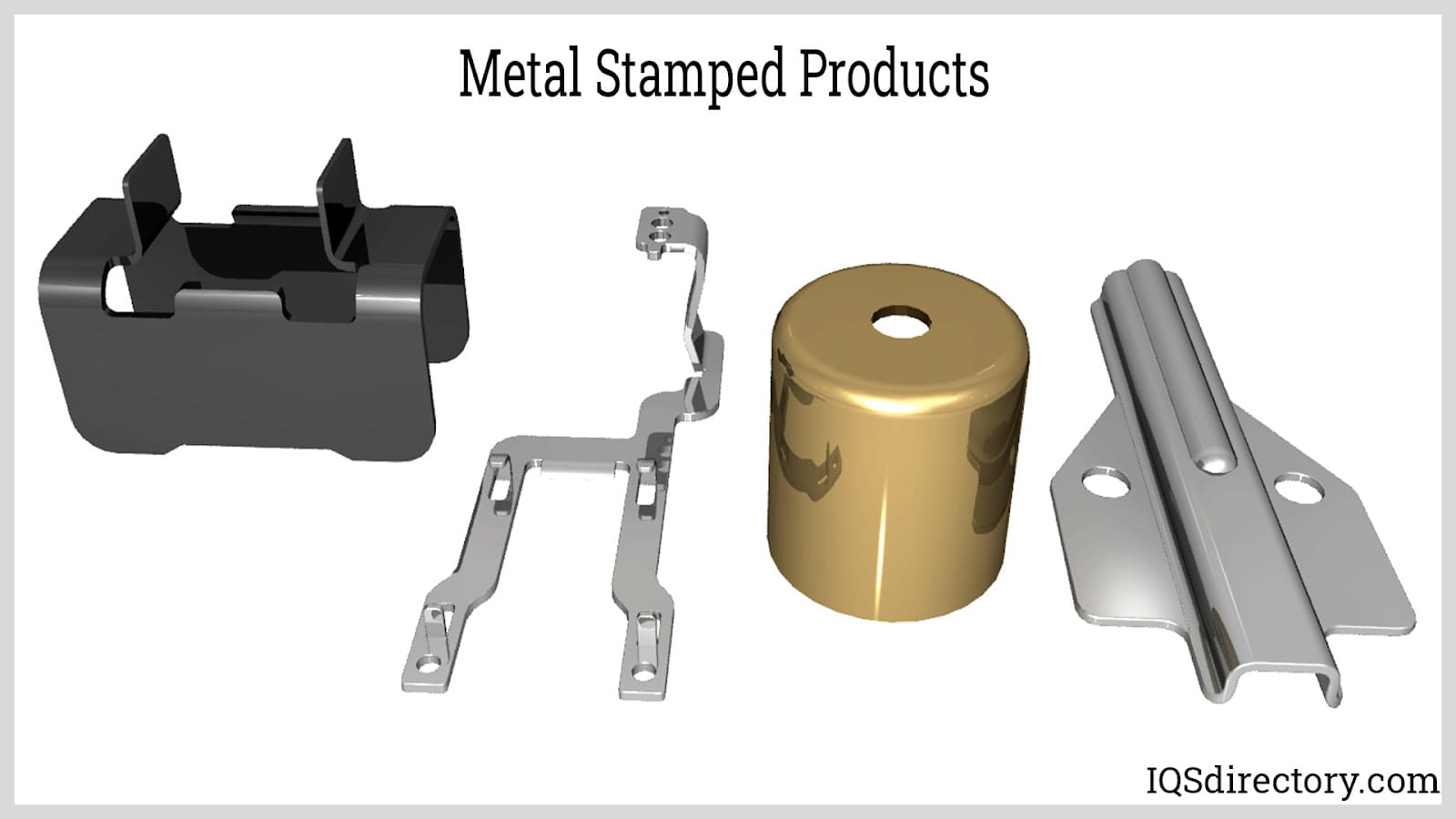 Examples of products made from metal stamping.
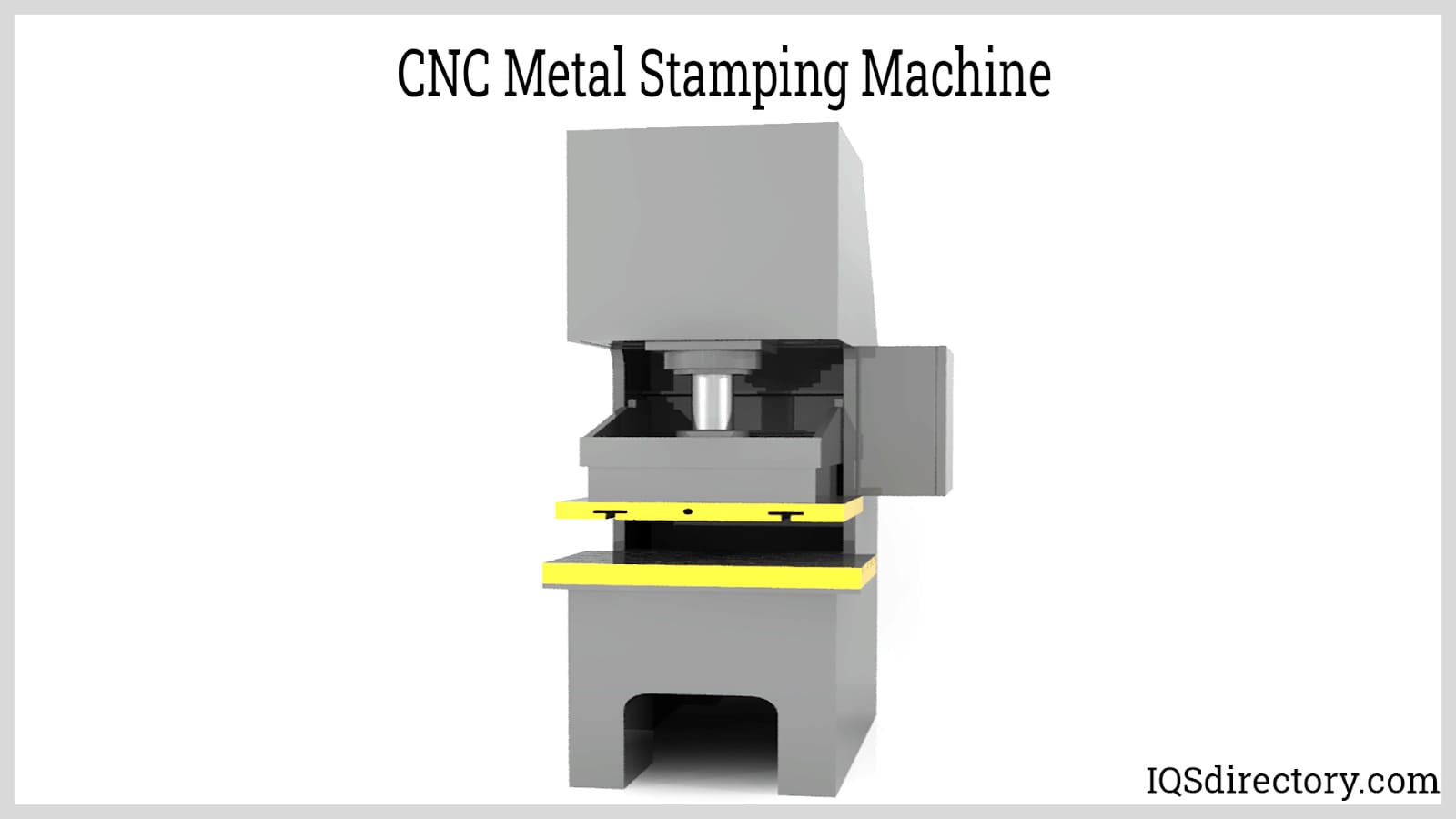 Metal stamping machines can cut, punch, form, and shape metals with computer-guided precision for more accurate parts and repeatable production.
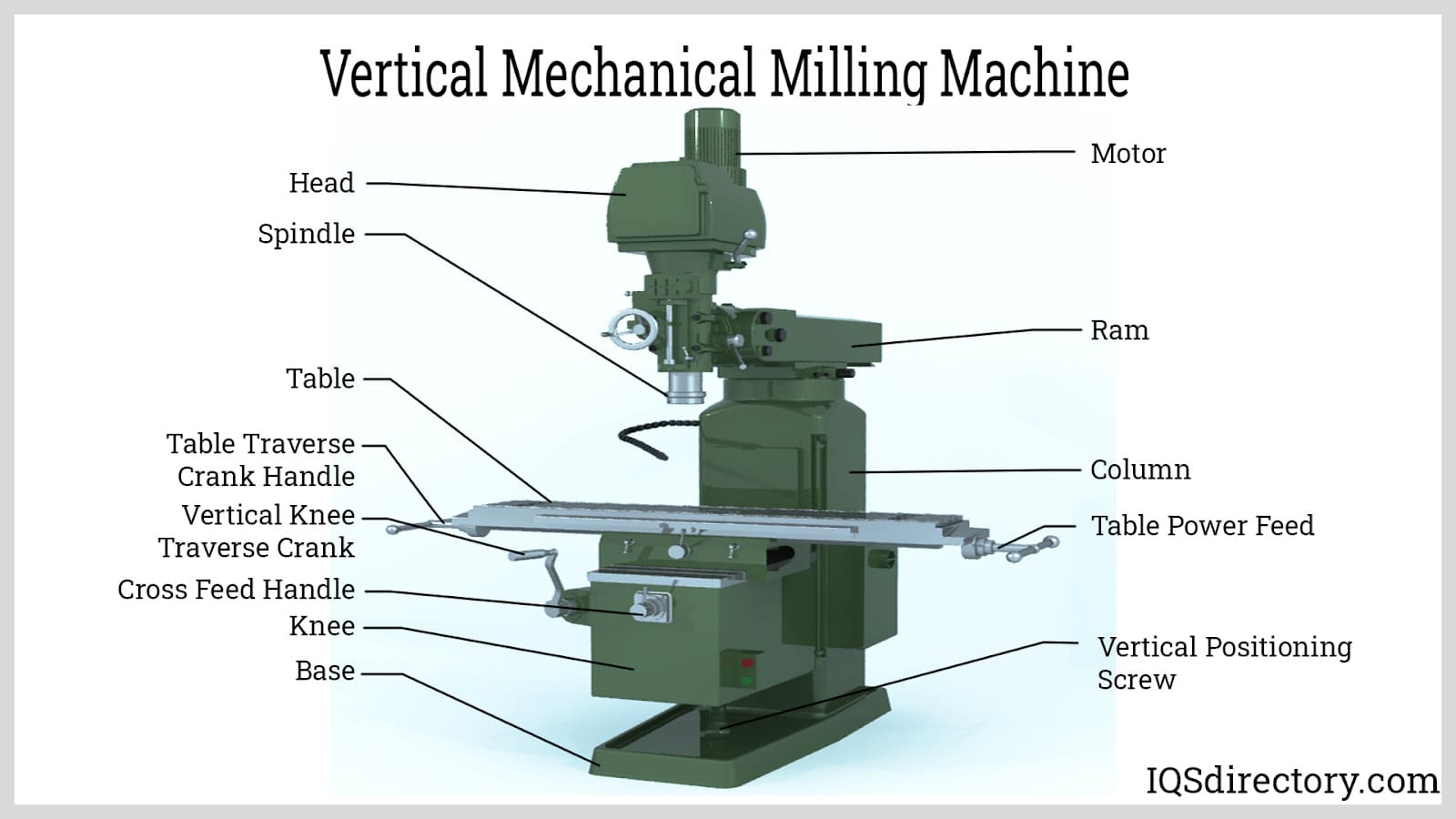 Vertical milling machines use precise motion control to shape metallic material for tooling, dies, and related production needs.
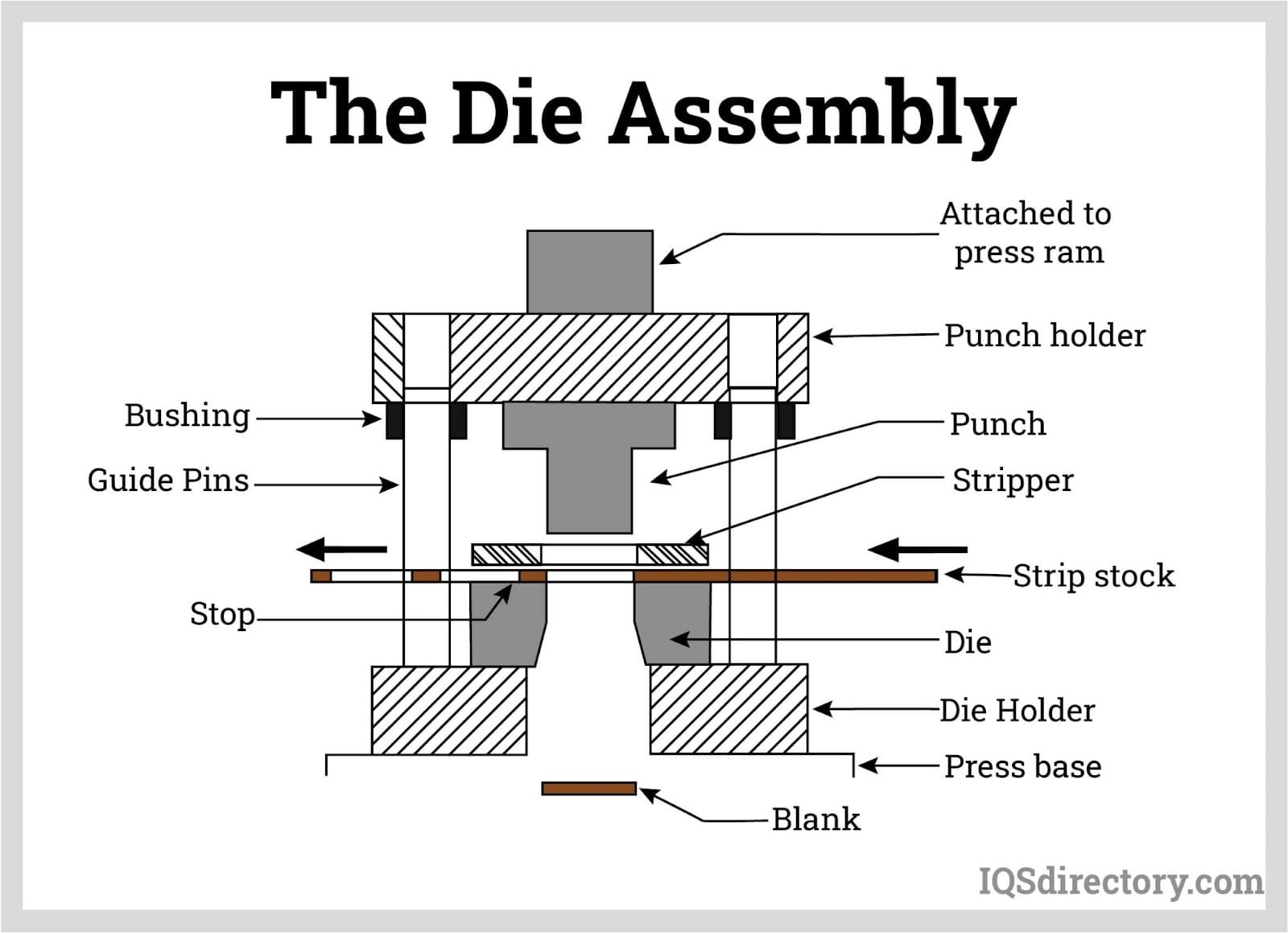 Dies are tooling assemblies used to shape raw material into customized stamped parts with consistent dimensions.
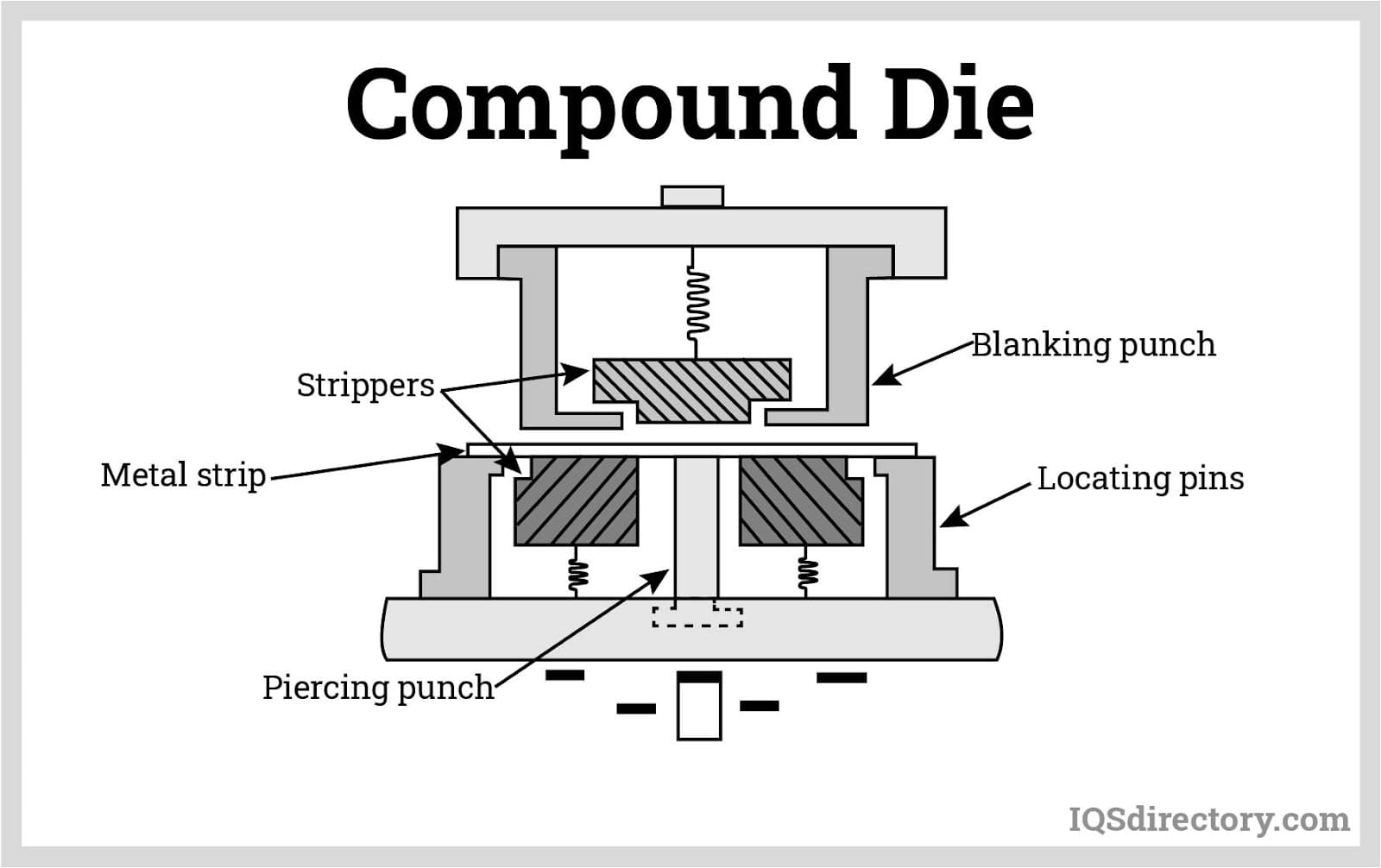 Compound dies perform more than one cutting action during a single press stroke.
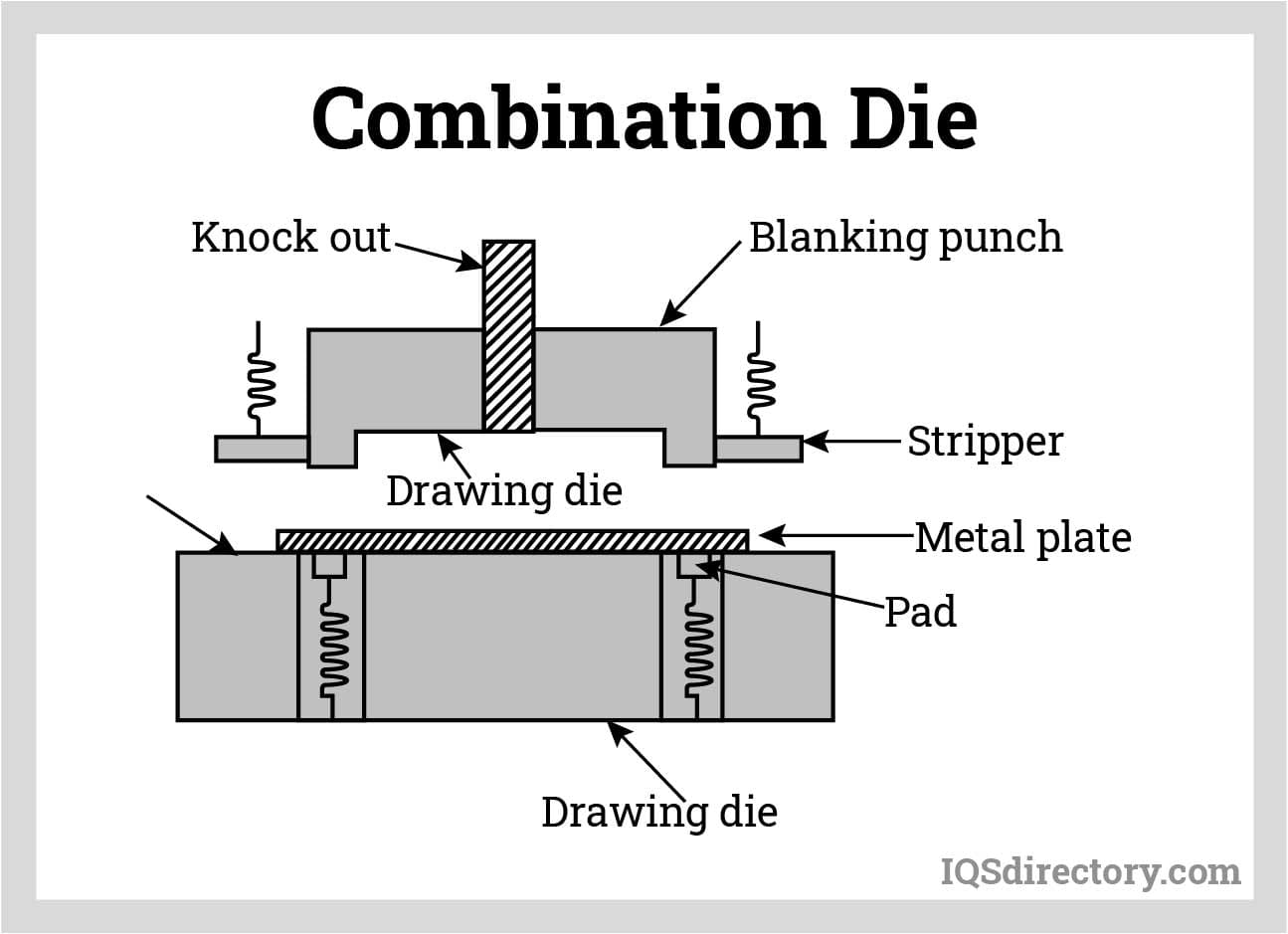 Combination dies can perform multiple cutting and forming operations in one stroke.
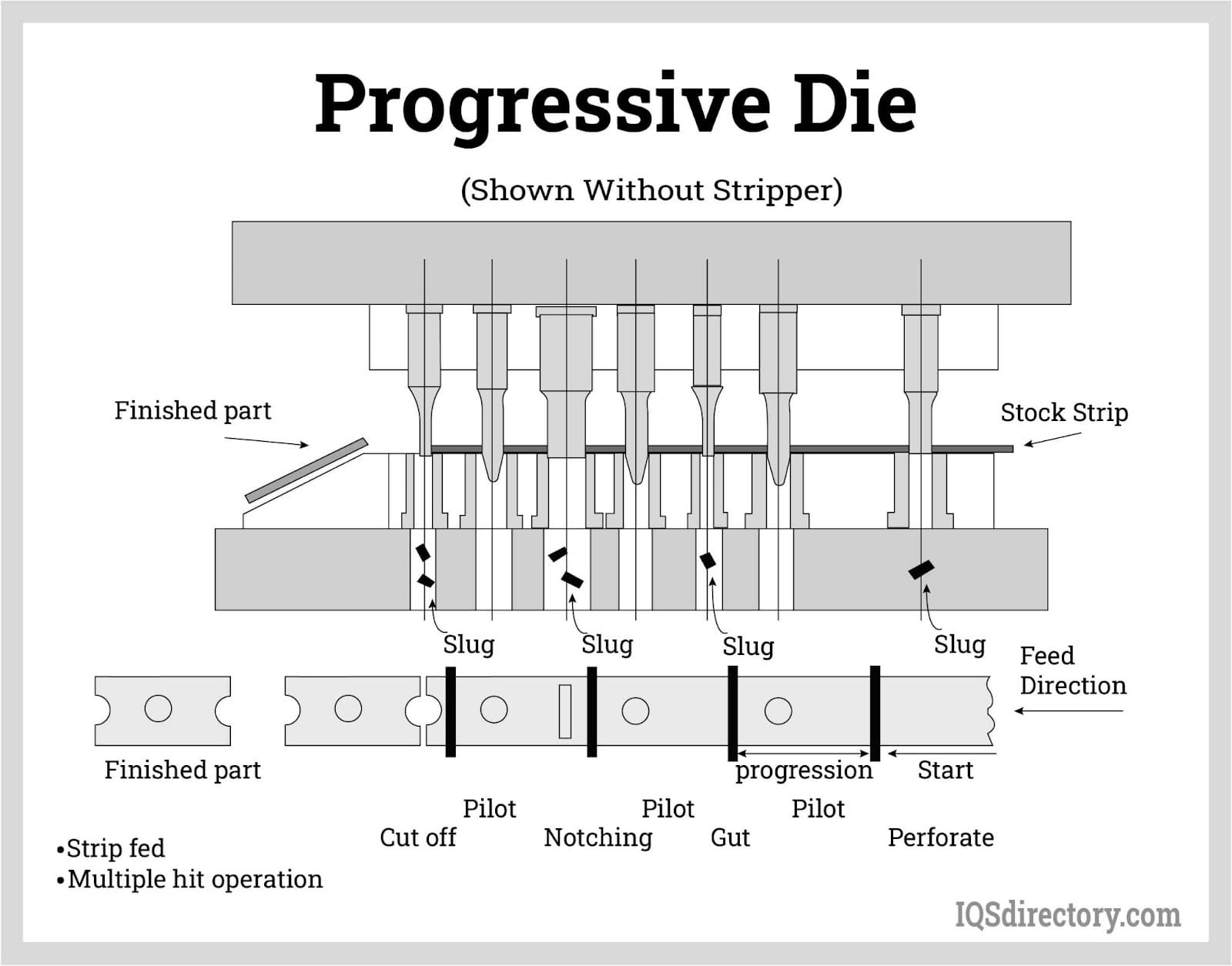 Progressive dies gradually form a workpiece as the strip moves through a series of stations arranged to complete each step in sequence.
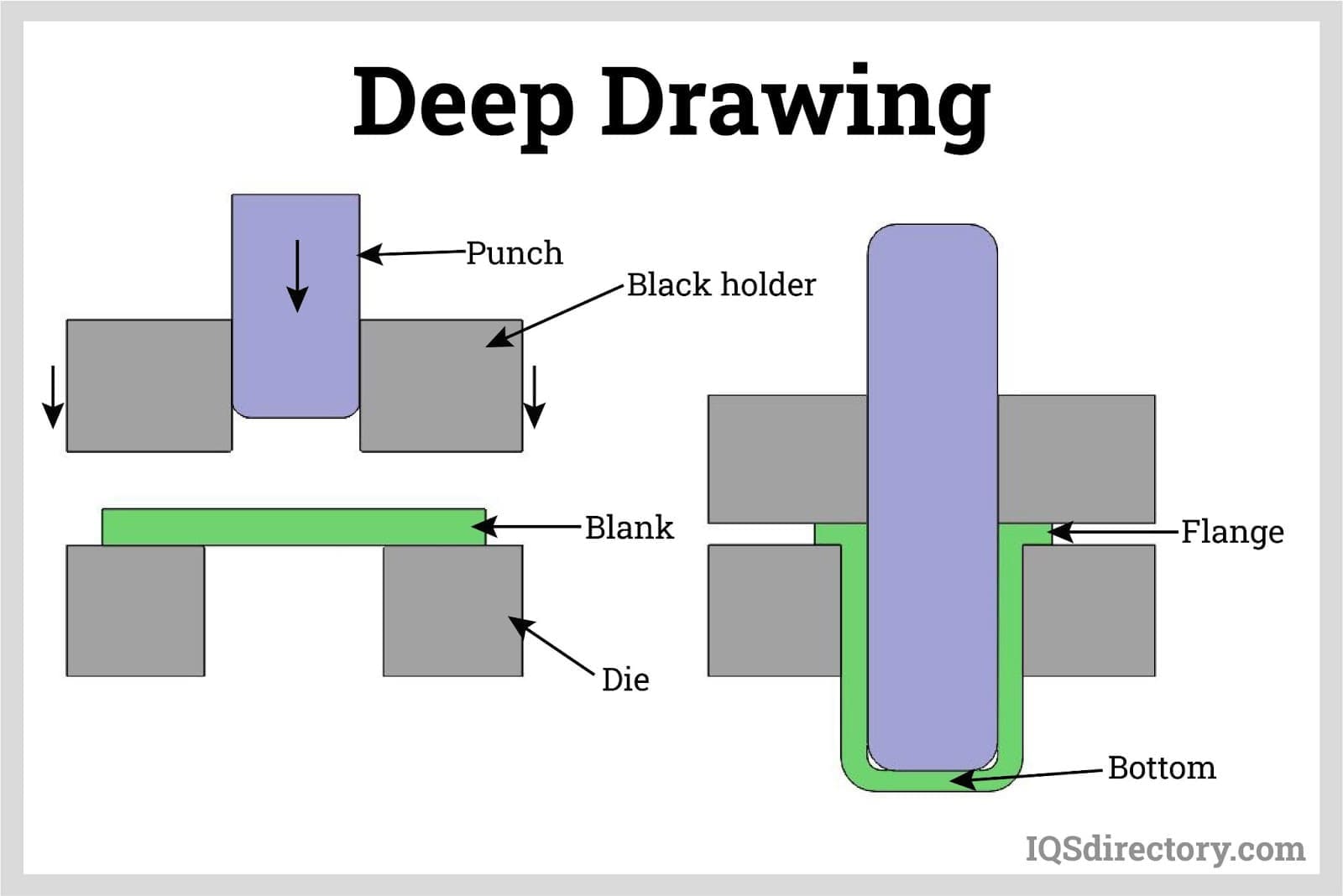 The drawing process forms a blank into a seamless hollow shape and can produce parts with varying diameters and deeper profiles.
The metal stamping process utilizes a wide range of materials, and selecting the right metal is a major part of design, cost control, and performance planning. Common options include steel, aluminum, zinc, nickel, titanium, brass, copper, and alloys such as beryllium copper, each bringing its own balance of strength, conductivity, corrosion resistance, formability, weight, and finishing compatibility.
- Steel
- Steel offers high tensile strength, strong durability, dependable wear performance, and broad availability across many grades. Depending on the alloy and finish, it can also provide good corrosion resistance and solid thermal performance, making it a practical material for structural, automotive, industrial, and appliance-related stampings.
- Aluminum
- Lightweight and corrosion resistant, aluminum is valued for its conductivity, workability, and lower mass. It is often chosen for applications where weight reduction matters, such as electronics, transportation, enclosures, and formed parts that need a clean appearance or strong resistance to environmental exposure.
- Zinc
- While pure zinc is relatively brittle, zinc plays an important role in protective coatings and alloy systems. In stamped products, zinc-based finishes and zinc-containing materials are often used to improve corrosion resistance and extend service life.
- Nickel
- Nickel is valued for corrosion resistance, ductility, and its role in high-performance alloys. It is frequently used where environmental durability, conductivity, or plated surface performance are part of the specification.
- Titanium
- Titanium combines high strength with relatively low weight and strong corrosion resistance. These qualities make it attractive for aerospace, medical, defense, and other demanding applications where performance, long service life, and weight savings are important design goals.
- Brass
- Made primarily from copper and zinc, brass is often selected for decorative stampings, electrical parts, fittings, and specialty components that benefit from conductivity and an attractive finish. It is highly workable, though buyers should still match alloy choice to the actual wear and environment of the final application.
- Copper
- Copper is soft, highly formable, and known for excellent thermal and electrical conductivity. It is frequently stamped into terminals, contacts, connectors, and conductive components, and it also serves as the foundation for alloys such as brass and beryllium copper.
- Beryllium Copper
- Beryllium copper is one of the strongest copper-based alloys and is known for conductivity, formability, wear resistance, and durability. Because heat treatment can further improve its strength, it is often chosen for demanding stamped parts used in electronics, aerospace, instrumentation, and other precision-driven environments.
The metal stamping process involves pressing flat metal stock into exact shapes defined by the die set. It is used when manufacturers need repeatable parts with reliable geometry, controlled material flow, and production speeds that support medium- to high-volume output.
- During press operation, the slide or ram moves toward and away from the press bed in a controlled cycle. The die set contains the cavity and tooling geometry needed to form the metal, with the upper die mounted to the press slide and the lower die mounted to the bed.
- A key element of the die system is the punch, which drives the shaping action by forcing the material into or through the die cavity. This can happen in a single operation or across multiple stages. In many high-volume programs, progressive stamping is used so the material can move through a sequence of stations that gradually shape, pierce, bend, or cut the part until the final form is complete.
- After forming, metal stampings may move through secondary steps that improve performance, finish, or readiness for assembly. Common examples include plating, cleaning, heat treating, and deburring, with each step chosen according to the application, material, and part specification.
Plating improves corrosion resistance, solderability, conductivity, and surface wear performance. Gold, palladium, nickel, and tin are common choices depending on electrical, cosmetic, and environmental requirements. In some cases, metal can be pre-plated before stamping to simplify downstream processing.
Cleaning, also referred to as degreasing, removes oils, films, and residues left from the stamping operation so parts are ready for finishing, assembly, inspection, or shipment.
Heat treating processes change the internal structure of the metal to improve hardness, strength, or spring properties. Many materials are stamped in a softer state first so they can form without cracking and are then heat treated afterward to reach the required performance level.
Deburring removes sharp edges, slivers, and minor imperfections so the finished part is safer to handle and better suited for final use. Depending on the geometry and material, deburring can be performed by mechanical abrasion, vibratory finishing, brushing, tumbling, or chemical methods.
When developing a metal stamping process, manufacturers evaluate part shape, overall size, material thickness, tolerances, bend radii, hole placement, finish requirements, and the service conditions the part will face. They also review corrosion resistance, strength targets, assembly requirements, and industry standards to make sure the stamped component performs as intended in real-world use.
To improve outcomes before tooling is built, many companies use stamping simulation software to model the forming sequence in a virtual environment. This helps identify wrinkles, splits, springback, thinning, and other forming issues early in development. By reviewing these conditions ahead of production, toolmakers can compare alternatives, refine geometry, and reduce launch risk while improving cost efficiency and part quality.
After the simulation phase, manufacturers build a die with the exact dimensions and forming features required to create the finished part. Because dies are reusable, they support consistent mass production once the process is dialed in. If the stamped component needs extra corrosion protection, conductivity, hardness, or visual refinement, secondary finishing operations can then be added to round out the specification.
- Stamping Press
-
A stamping press applies controlled force, speed, and motion to shape metal accurately. Presses may be mechanical, hydraulic, or hybrid, and the right choice depends on part geometry, tonnage needs, stroke characteristics, run size, and the type of forming operation being performed.
- Mechanical Press: Stores energy in a flywheel and transfers force through a crankshaft, eccentric drive, or related mechanism, making it well suited for high-speed production.
- Hydraulic Press: Uses hydraulic pressure to move one or more rams in a controlled sequence, giving manufacturers strong control over force throughout the stroke.
-
Both press types are available in a wide range of frame designs, tonnages, stroke lengths, shut heights, and operating speeds, allowing manufacturers to match equipment to exact production goals.
- Gap Frame
- A gap-frame press is often used for smaller jobs or applications where stock is loaded manually and access to the working area matters. Straight-side styles are more common for progressive die and transfer die work where rigidity and alignment are especially important.
- Hydraulic Press
- Hydraulic presses apply full force through the stroke and are available in C-frame, straight-side, H-frame, and four-column designs. They are often chosen for deep drawing, high-tonnage work, short runs, and applications where controlled pressure is more important than maximum operating speed.
- Progressive Press
- Progressive presses are built for high-volume manufacturing and move coil-fed material through multiple stations that shape the part step by step. The final station cuts the completed part free, creating a continuous and efficient production flow for repetitive programs.
- Transfer Press
- Like progressive presses, transfer presses use multiple stations, but they work with separate blanks or part forms rather than a continuous coil carrier. This setup gives manufacturers more flexibility for larger parts, deeper forms, and more complex shapes that need room to move independently between operations.
- Fourslide Press
- A fourslide press uses four moving slides to shape the workpiece from multiple directions in a coordinated cycle. This makes it a practical choice for intricate components that require several bends or forming actions in a compact production space.
- Variations and Similar Processes
- Squeezing
- Squeezing shapes a metal plate by applying pressure within a die rather than relying on a more abrupt cutting action. It can produce smooth walls and controlled surfaces while reducing the amount of follow-up machining needed in some applications.
- Pinch Trimming
- Pinch trimming is used to trim the vertical walls of deep-drawn or stretched parts. By pinching the metal between hardened die sections, it creates a clean finished edge that works well for drawn vessels and similar formed shapes.
- Bending
-
Bending reshapes metal along a straight axis and can be adapted to different materials, part sizes, and performance requirements. Common methods include:
- Wipe Bending: Often used for clips and formed edges, though it is less suitable for very high-strength metals or jobs that demand the tightest precision.
- V-Bending: Produces a controlled V-angle with lower force demand and is widely used for efficient, accurate forming.
- Forging
- Forging is a metal shaping method that uses compressive force from hammers or dies to create dense, durable components. As one of the oldest metalworking techniques, forging is often compared with stamping because both are used for formed metal parts, though the processes serve different design and production goals. It is typically classified by temperature:
- Cold Forging: Performed at room temperature for strong, tightly controlled parts.
- Warm Forging: Uses moderate temperatures to balance strength and formability.
- Hot Forging: Uses high heat to maximize material flow, making it useful for demanding aerospace and automotive parts.
- Line Die Method
- The line die method is often used for large parts that are not practical to make in one continuous press sequence. Operators or robotic systems load parts from station to station, making the method cost-effective for oversized components and lower-volume runs with more complex handling requirements.
- Transfer Die Method
-
In the transfer die method, multiple custom dies are arranged in a sequence within a single press, and transfer rails move the part from one station to the next. This improves part handling and supports more complex geometry than some simpler methods.
- Handles large parts efficiently using automated rail movement.
- Allows part rotation during transfer to support more demanding geometries.
- Can be programmed for different part variations, speeds, and stroke lengths.
- Progressive Die Method
- Also called progressive stamping, this method is one of the fastest and most automated approaches in metal stamping. A metal strip carrier moves through timed stations that cut, form, and finish the part in sequence, making it ideal for high-volume production that values repeatability and speed.
For the best metal stamping results, choosing the right manufacturer matters. Buyers often compare production quality, tooling knowledge, tolerance capability, available press capacity, secondary services, inspection standards, and lead times before moving forward. The strongest suppliers are those that can deliver the required part quality on schedule while staying aligned with budget and long-term production needs.
Beyond price and quality, experience with materials, tooling strategy, process control, and shipping logistics can shape the success of a project. A supplier that understands your specifications, application environment, and delivery expectations is more likely to support smoother launches and more dependable repeat orders. To simplify that search, review manufacturers that show a consistent commitment to precision, quality, and responsive service. The manufacturers we list have demonstrated reliability and professionalism in the metal stamping market.
- Alloy
- A material made from two or more elements, usually metals, combined to create a new set of mechanical, thermal, or chemical properties.
- Annealing
- A heat treatment that softens metal by heating and slowly cooling it, improving ductility and reducing internal stress before or after forming.
- Base Metals
- Widely available metals such as aluminum, zinc, lead, nickel, and tin that are generally less expensive and more reactive than precious metals.
- Blankholder
- A device that holds the blank securely during drawing or forming so the metal flows in a more controlled way.
- Blanking
- A stamping operation that cuts a defined shape from sheet or strip stock to produce a blank for final use or downstream forming.
- Bottoming Stamp
- A stamp, mark, or identifier used to show that a formed part corresponds to the bottom section of a die or tool set.
- Brazing
- A joining process that bonds metals by melting a filler material with a lower melting point than the base metals.
- Burrs
- Jagged edges, raised fragments, or unwanted projections left on a part after cutting, piercing, or punching operations.
- Cam
- A mechanical device that moves at an angle relative to the press stroke to support side action or specialty forming operations.
- Column Press
- A four-post, single-slide press configuration used in certain metal stamping operations.
- Compound Die
- A die that performs more than one operation, such as blanking and piercing, in a single press stroke.
- Crank Press
- A mechanical press driven by a crankshaft that converts rotary motion into the linear movement needed for stamping.
- Cup
- A cylindrical or cup-shaped drawn part closed on one end, often created during early stages of deep draw forming.
- Deburr
- A finishing operation that removes burrs, sharp edges, and surface irregularities from stamped metal parts.
- Dope
- A lubricating compound applied to metal stock to improve forming and help prevent scoring or tearing during drawing.
- Draw Bead
- A rib-like feature on a die surface used to regulate material flow during deep drawing and help control wrinkles or distortion.
- Ductility
- A material property that describes how well a metal can bend, stretch, or deform before fracturing.
- Deep Drawn Stampings
- A forming method that creates three-dimensional stamped parts whose depth exceeds their diameter, typically using controlled drawing operations.
- Eyelets
- Small ring-shaped metal parts used to reinforce holes in softer or thinner materials.
- Ferrous Metal
- A metal containing iron, such as steel, that generally offers strength but may require coating or treatment to resist rust.
- Fourslide Stampings
- A stamping process used for parts with complex bends or multi-directional forming requirements, produced with a machine that drives tooling from several sides.
- Ferrules
- Metal sleeves or rings used to join, reinforce, terminate, or fasten other materials or components.
- Hard Tooling
- Dedicated tooling designed to produce one part configuration efficiently across higher production volumes.
- Heat Treating
- A secondary operation that increases hardness, strength, or spring properties by using controlled heating and cooling cycles.
- Insert Molding
- A process that surrounds a metal component with molded plastic to create a single integrated part or assembly.
- Lead Time
- The total time from order placement to completed delivery, including production, finishing, and shipment.
- Mechanical Press
- A press that uses a mechanically driven system to move the punch and apply force during the stamping cycle.
- Metal Washers
- Flat disk-shaped parts used to spread load under a fastener, reduce localized stress, and protect the joined surface.
- Non-Ferrous Metal
- A metal with little or no iron content, such as aluminum, copper, or zinc, often chosen for corrosion resistance or conductivity.
- Notching
- A cutting operation that removes material from the edge or corner of a blank to help create the final shape.
- Plating
- A finishing process that deposits a thin metallic coating on a stamped part to improve corrosion resistance, appearance, wearability, or conductivity.
- Precious Metals
- High-value metals such as gold, silver, and platinum that resist oxidation and are often used where conductivity, appearance, or corrosion resistance matters.
- Punch Press
- A press that reshapes or pierces metal by applying compressive force through a punch and die arrangement.
- Secondary Operations
- Post-stamping processes such as cleaning, plating, heat treating, deburring, and assembly that refine or improve the finished part.
- Soft Tooling
- A more flexible tooling approach that can support multiple part variations or shorter-run development work.
- Stroke
- A full cycle of motion in a stamping press, from the start of force application through return to the starting position.