Lubrication Systems
Lubrication systems are designed to pump and apply lubricant in controlled intervals and pressure to various machine parts or components. First introduced as manually-operated machinery, lubrication equipment has advanced to offer automatic lubricators that are able to provide a more efficient and reliable method of applying lubricants.
Lubrication Systems FAQ
What is the main purpose of a lubrication system?
A lubrication system delivers oil or grease to moving machine parts at controlled intervals and pressures, reducing friction, wear, and heat while extending equipment lifespan and improving overall performance.
When were lubrication systems first used?
Lubrication systems date back to ancient Egypt, where olive oil was used to move heavy stones. By the 14th century BC, animal fats lubricated chariot axles, marking early progress in lubrication technology.
What industries commonly use lubrication systems?
Lubrication systems are widely used in automotive, manufacturing, power generation, oil and gas, and steel processing industries to maintain machinery performance and prevent premature wear or overheating.
What is the difference between automatic and manual lubrication systems?
Automatic lubrication systems operate on programmed cycles to apply lubricants precisely and consistently, while manual systems depend on human operators and are more prone to over- or under-lubrication errors.
What are the main components of a lubrication system?
A typical system includes a pump station, lubricant reservoir, and filters. These components work together to distribute, store, and clean lubricants before they reach critical machine parts.
How do synthetic lubricants improve system performance?
Synthetic lubricants, developed in the 1950s, are engineered for specific applications and extreme conditions. They provide better temperature resistance, oxidation stability, and longer service life than mineral oils.
What standards regulate lubrication systems and lubricants?
Lubrication systems and lubricants follow standards from the American Petroleum Institute (API) and the International Standards Organization (ISO), including API oil quality marks and ISO 21.260 for system performance and safety.
The History of Lubrication Systems
Lubrication technology has advanced a lot in recent years, but did you know humans were using lubrication systems as long ago as the time of the ancient Egyptians? Let’s go over a few significant moments and eras of the lubrication industry.
- Early Lubrication Systems
- According to archeological discoveries, back in the 17th century BC, the Egyptians were using olive oil as lubricant to help them move large stones and other heavy objects. This is the earliest physical evidence we have of lubricant use. By the 14th century BC, they had moved on to using tallow, or animal fats as lubricants to grease their chariot axles.
- The lubrication industry really took off centuries upon centuries later, in the 1850s, and 1859 marked the year that Americans successfully drilled their first oil well. This took place in Titusville, Pennsylvania. The word about the success quickly spread, and just as quickly, the age of petroleum began.
- Petroleum and Oil as Lubricants
- The suppliers of petroleum products enjoyed a steady demand for their product for many years. This demand exploded, though, during the 1920s, with the help of the fast-growing auto industry. They quickly began processing their petroleum-based oils, so that they would better lubricate car parts. During this time, manufacturers came up with many successful oil treatment processes, such as the still popular solvent refining.
- The following decade, oil lubrication system manufacturers focused on improving their products. They did so by introducing additives that inhibited oxidation and corrosion, improved viscosity indexes and enhanced pour points. During the 1940s, use of these additives in automobile engine lubricant formulas became an industry staple. They greatly improved automobile performance and service life; before the introduction of these formulas, engine oils would have to be changed out every 80 to 100 hours. Also during the ‘40s, as steam locomotives gave way to diesel locomotives, railway technicians in the United States began analyzing the oil they used with simple spectrographic equipment and physical tests. They did so to decrease engine failures.
- In the 1950s, the US Navy used similar spectrometric techniques to keep track of the quality of lubricant in their aircraft jet engines. At the same time, Rolls-Royce engineers were conducting oil analysis experiments on their jet turbines. This practice continued to spread, and within a decade, the Air Force and American Army also adapted their own oil analysis programs.
- The Rise of Synthetic Lubricants
- Another big moment for the lubrication system industry took place in the 1950s, when scientists developed synthetic lubricants. This allowed them to diversify and create lubricants tailored better to specific applications, such as multigrade auto engine oils, which were also developed during this decade.
- During the 1970s, the development of hydro-pressing technologies like two-stage hydro-cracking improved oil performances even more. In the last 30 years or so, the lubricants used by lubrication systems have become much more advanced, in terms of how they are processed and their quality. For example, many manufacturers now use hydro isomerization, which is when you dewax base oils by transforming wax molecules into high quality base oil.
- Modern technology allows manufacturers to rise to the robust demands of modern machinery, including energy efficiency, environmental friendliness and performance reliability.
Benefits of Lubrication Systems
There’s a reason that people use the idiom, "like a well-oiled machine." It’s because a well-oiled, or lubricated, machine works far better than a poorly oiled machine. Lubrication systems are vital systems that allow operators to safely and efficiently operate their machinery for years longer than they could without them. Their many benefits include: friction reduction, corrosion reduction and resistance, temperature control and efficiency. In addition, because the lubricated oil keeps your machinery running so well, you will end up spending less time and money on maintenance and repairs.
Design and Customization of Lubrication Systems
Manufacturers design lubrication systems by considering factors such as: flow balancing, pump sizing (oil volumetric flow rate), minimum oil pressure, level of filtration and best drainage intervals. Considerations like this are determined by application specifications, such as if the application is mobile.
Manufacturers can customize your lubrication system in a number of ways. For example, to alter your system’s filtration level, they can design a filter with specialized filters. Other customization equipment features include: fittings, pressure levels, oil drainage intervals, valve construction and lubricant composition. Lubricant composition starts with the base oil. To help manufacturers and consumers keep track, the American Petroleum Institute (API) classifies base oils in groups I through V. Base oils are used to make lubricants. Base oils in Group I are the cheapest base, but they also have the greatest percentage of sulfur. They are mineral-based, and have a fairly low temperature resistance range, between 32? and 150?. On the other end of the spectrum, group V base oils are typically esters that can stand extremely high temperatures and can remove dirt and grease from surfaces better than others. Your manufacturer will choose the base oil after considering your application's requirements.
Lubrication System Images, Diagrams and Visual Concepts
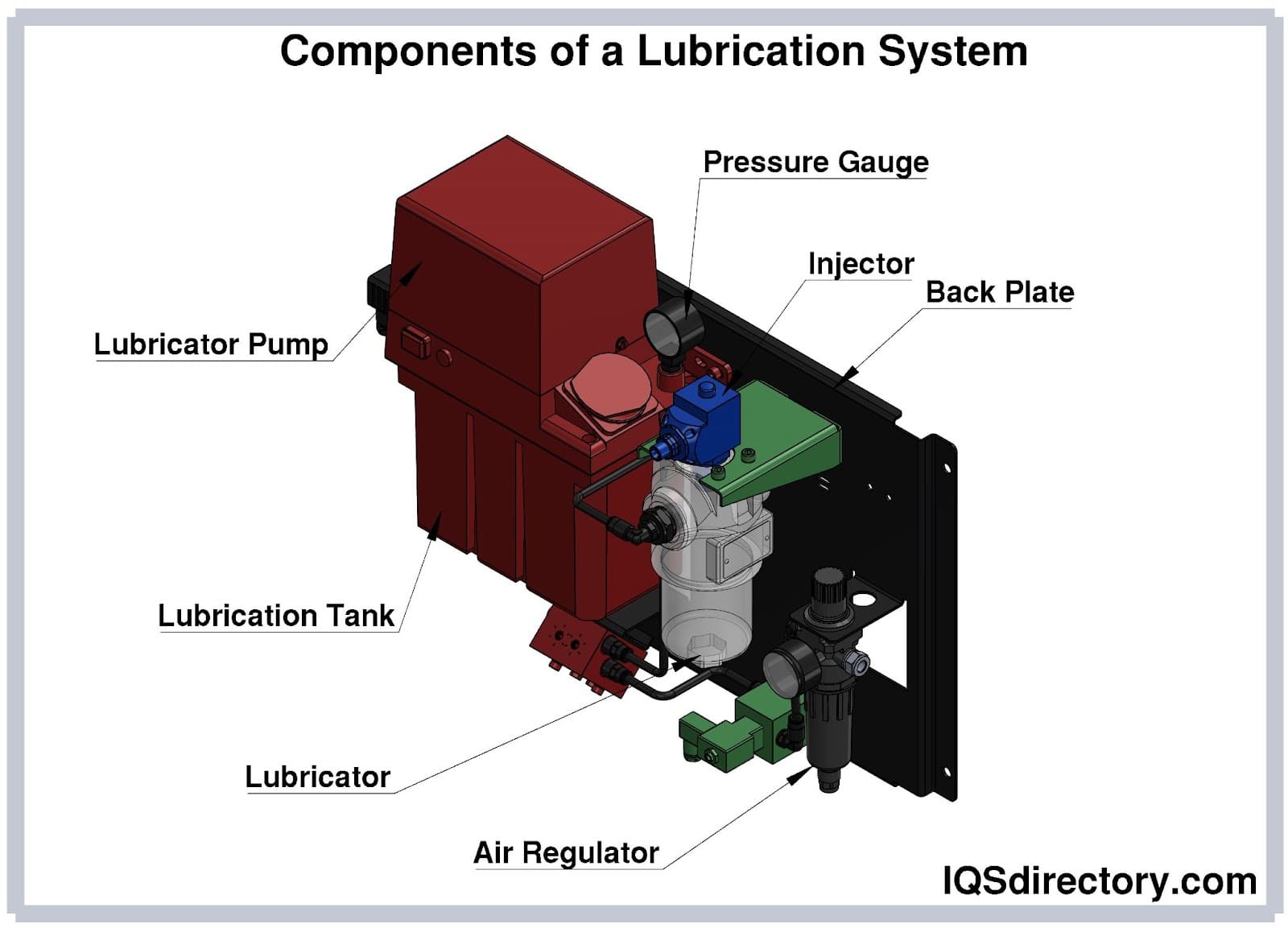 Lubrication systems distributes lubricant to moving machine parts to reduce friction between sliding or rolling machine elements.
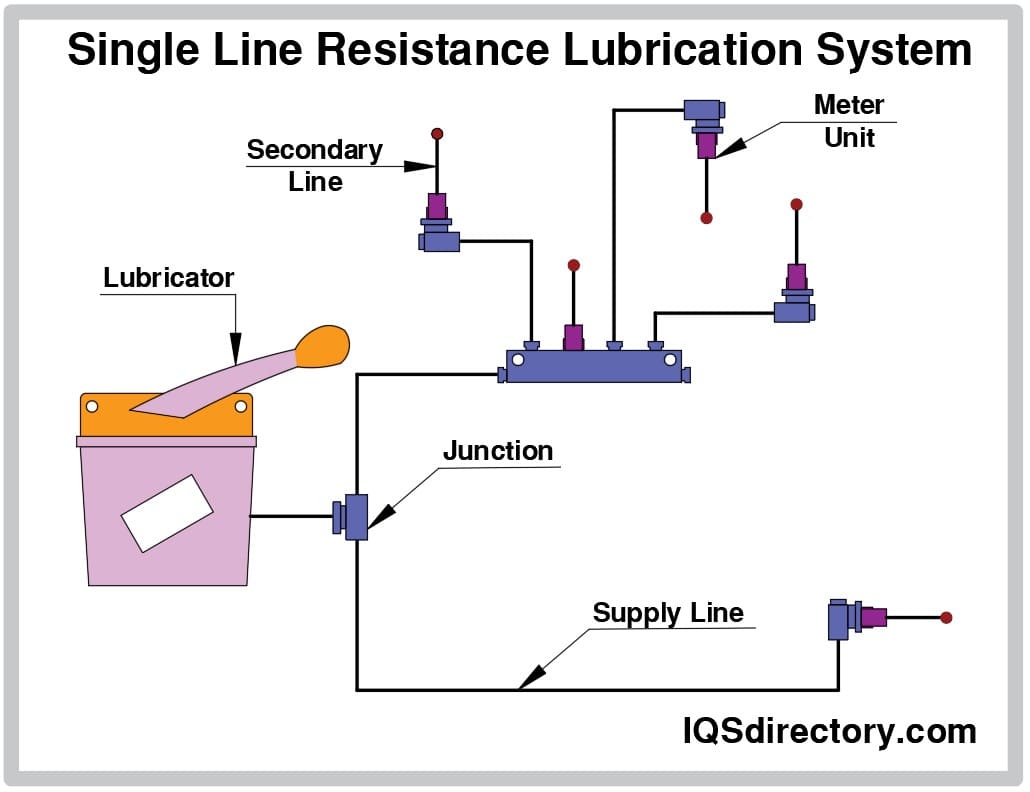 Single line resistance lubrication systems consist of a central pump that distributes lubricantes to single or multiple supply lines parallel to each other.
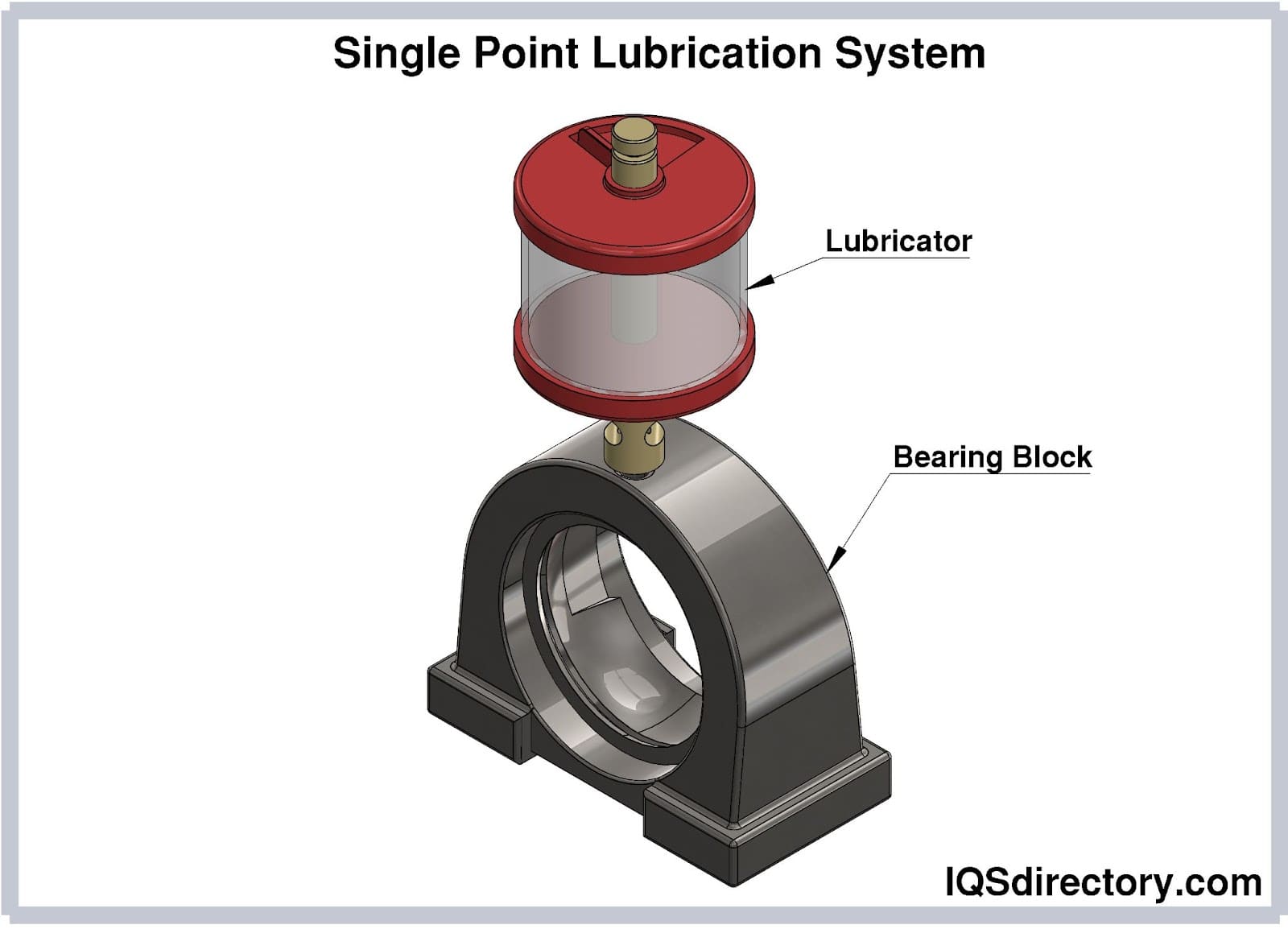 Single point lubrication systems apply lubricant to only one lubrication point in the system.
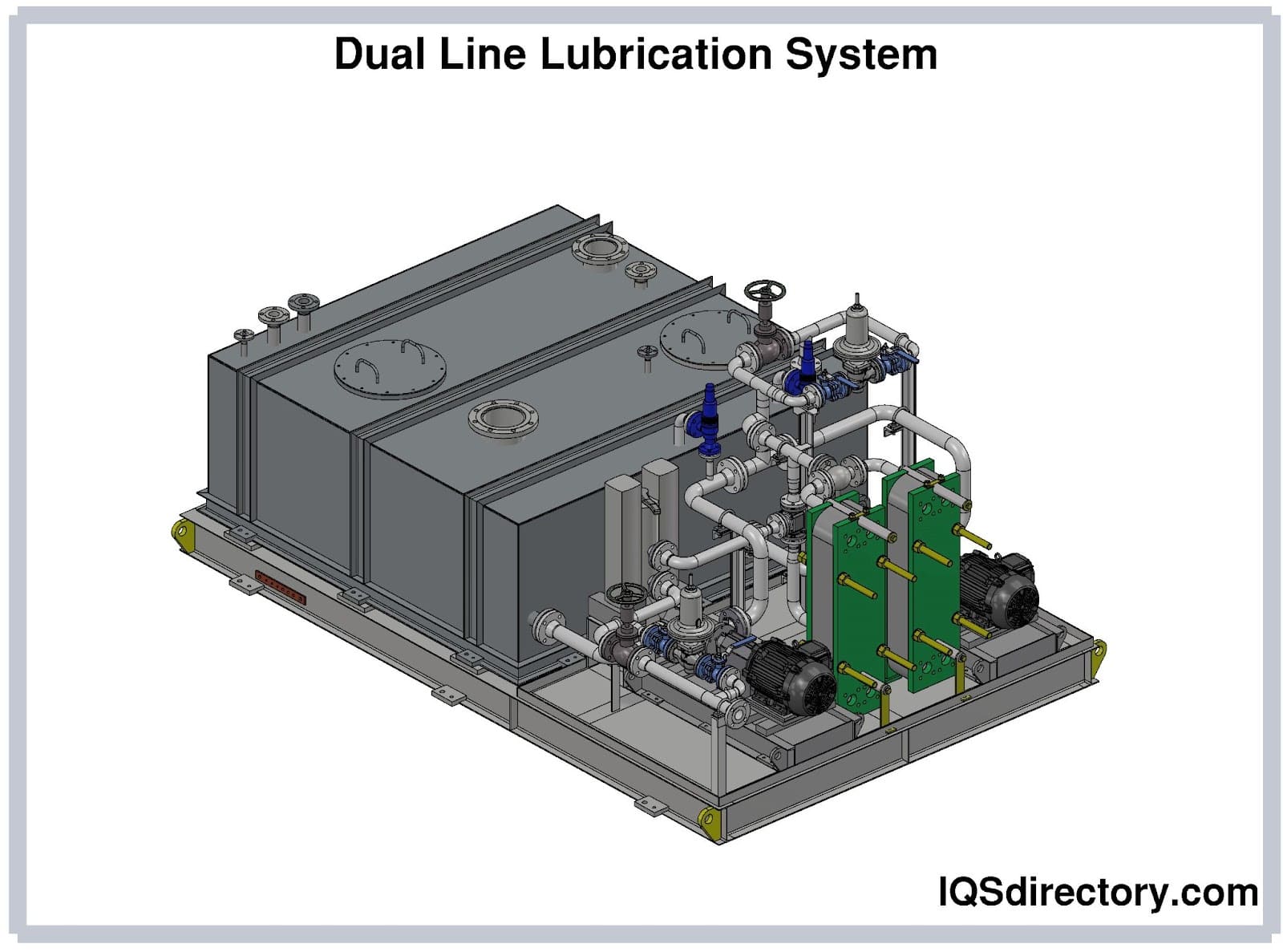 Dual-line lubrication systems, operates a two-phase alternating cycle where the lubricant is pumped to the first supply line and moves the inlet which discharges the pistons of all injectors in one direction.
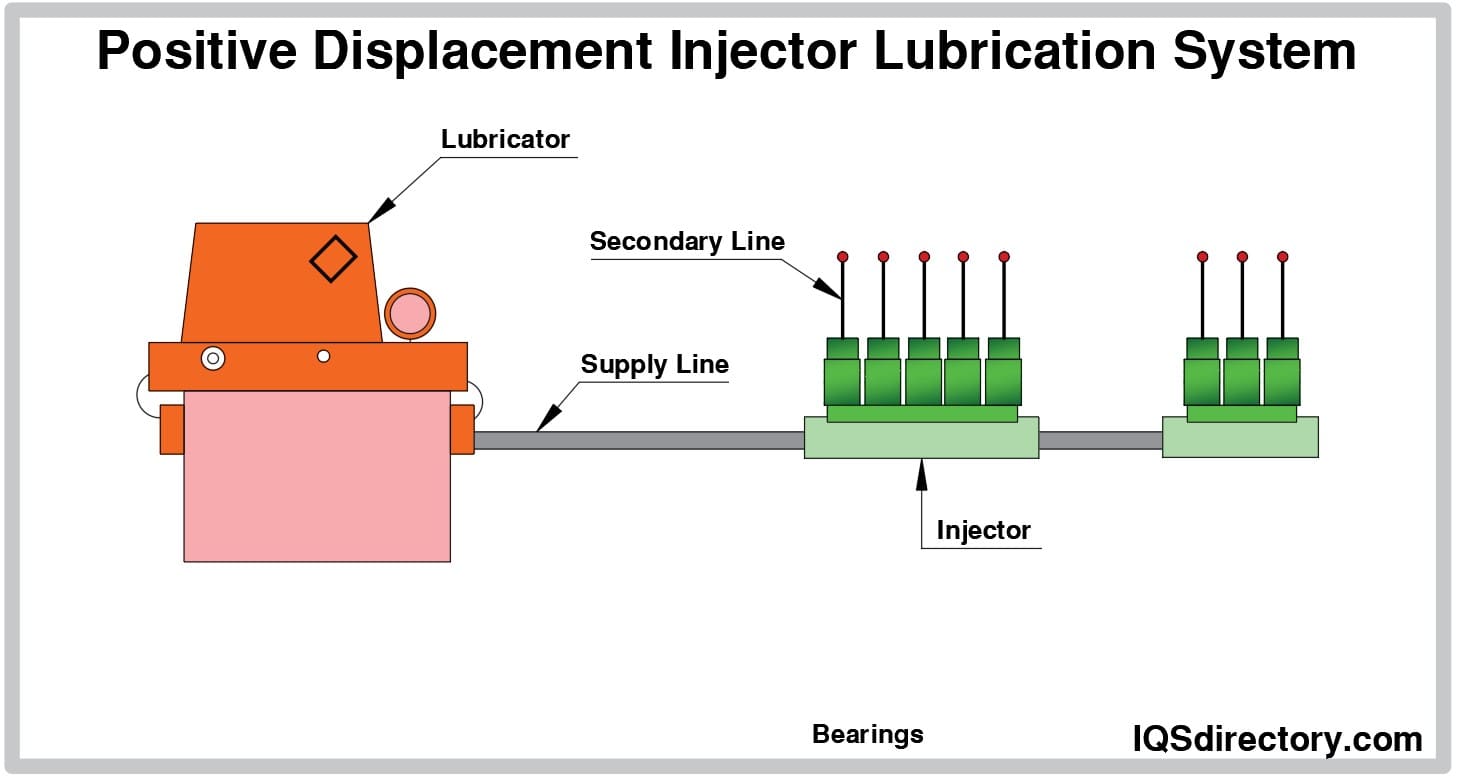 Positive displacement injector lubrication systems are driven by a central pump that generates pressure which distributes the lubricant over several supply lines.
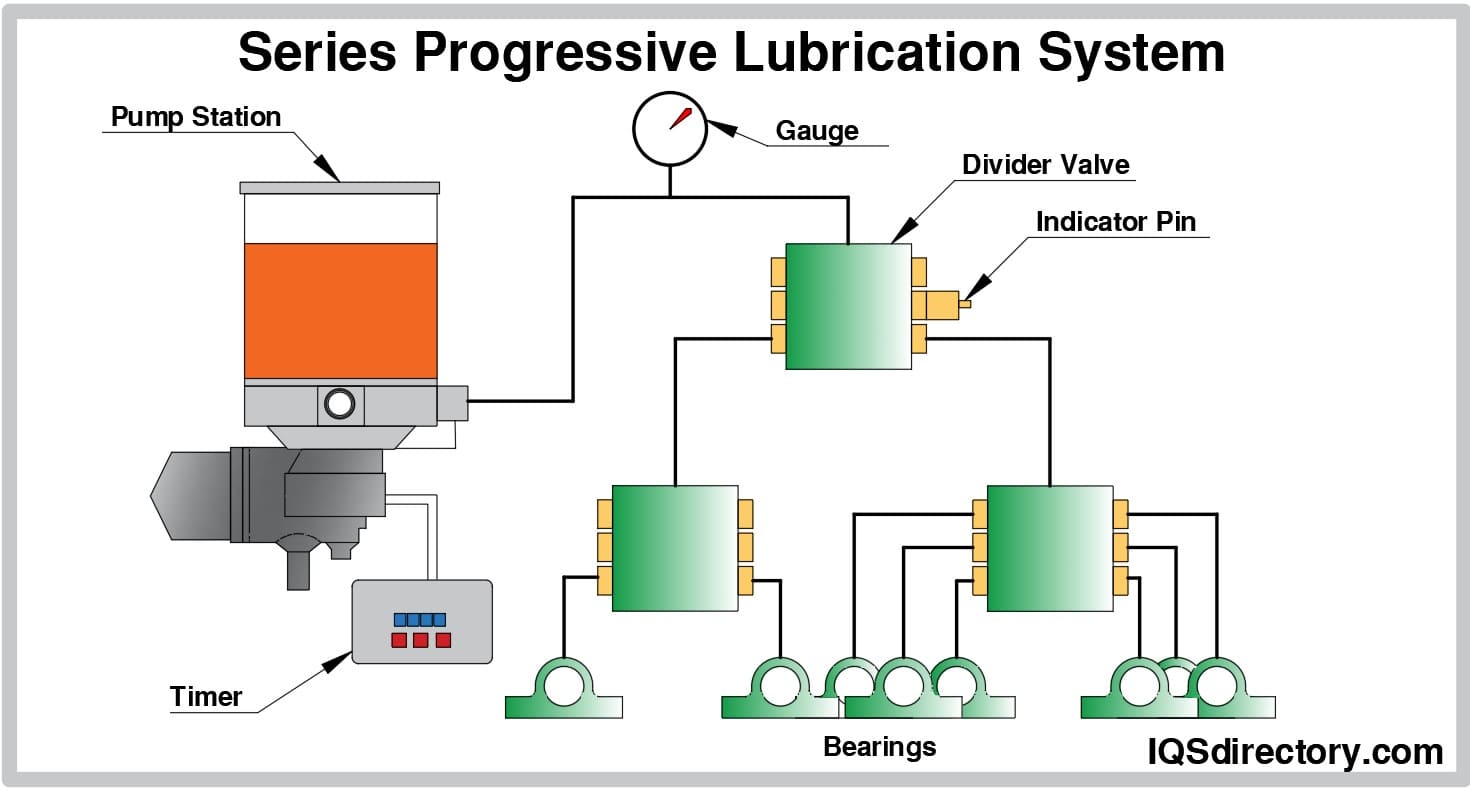 Series progressive lubrication systems, the pump is connected to the master divider block, which distributes lubricante to secondary divider blocks.
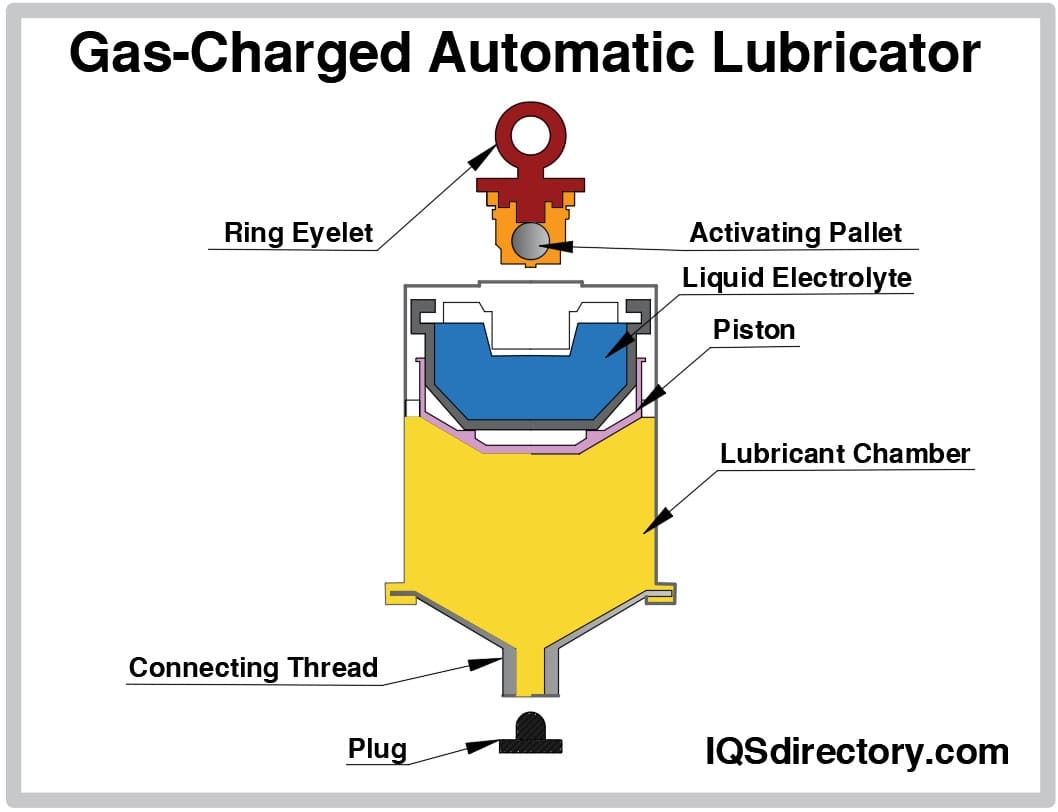 Gas-charged automatic lubricators consist of a cylinder with the pressure generator and lubricant stored in different chambers sepatated by a piston.
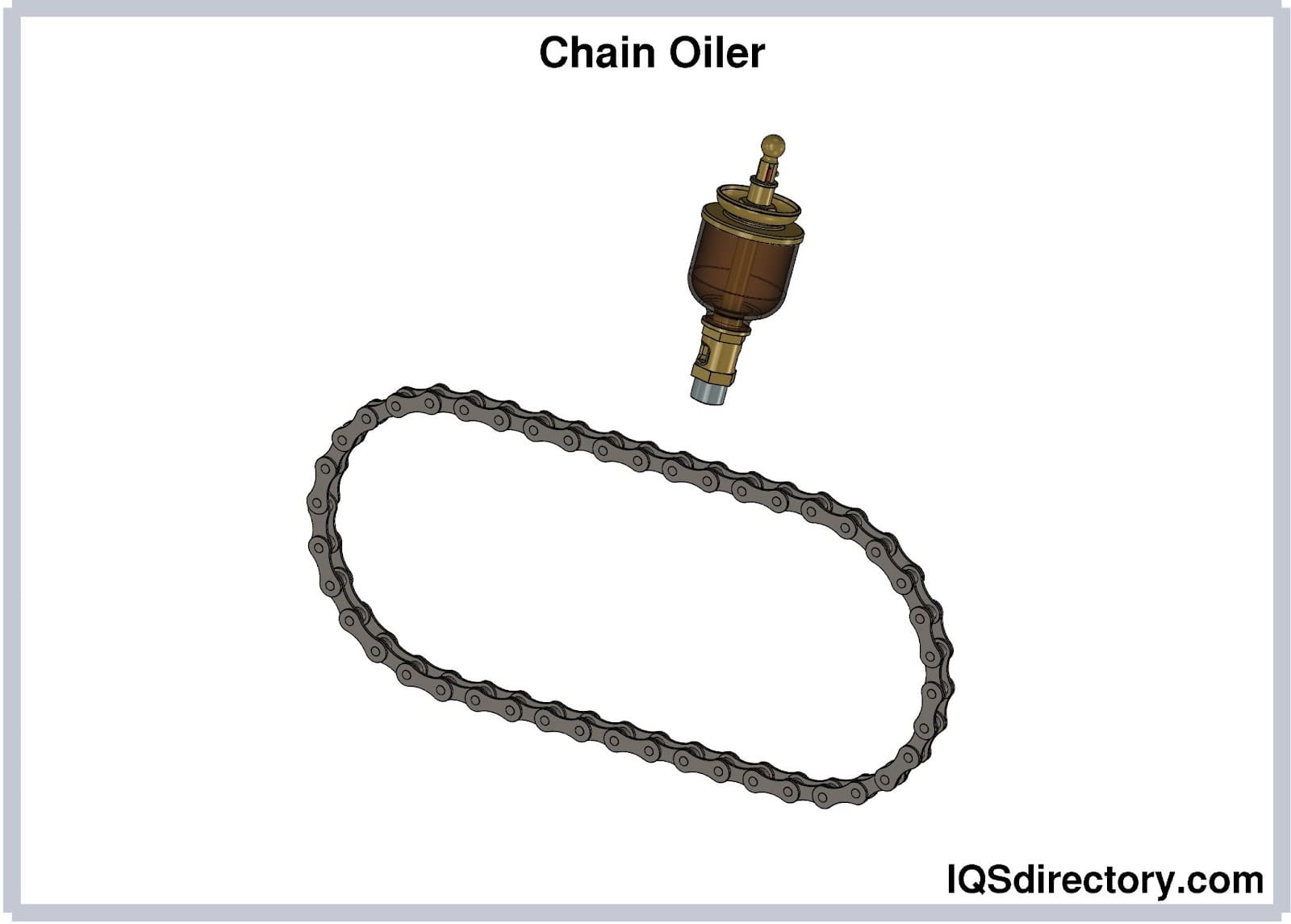 Chain oilers are devices used to supply oil lubricant automatically on chains and sprocket assemblies.
Types of Lubrication Systems
Lubrication systems are broadly categorized as either automatic or manual.
- Automatic Lubrication System(s)
- Run on computer programs and are typically part of a centralized system.
- Centralized Lubrication System
- Use an automatic lubricant delivery method in order to lubricate more than one machine part at a time. Most commonly, centralized lubrication systems are a part of the machines that they lubricate; however, they do require separate maintenance. Some benefits of automatic lubrication systems are that they reduce downtime and labor cost since they do not require operators, and also decrease the potential for human error since the machines operate in response to programming.
- Manual Lubrication System(s)
- Either completely human operated, as is the case with spot lubrication guns, or partially human operated, like chain lubricators. Manual lubricators come across the problem of the human error factor. Another disadvantage of manual lubrication systems is that there is often an increased chance of "famine or flood," which refers to the lubricator completely missing an area or over-lubricating an area.
- Chain Lubricator
- Require the mounting of the machine to the chain and the programming of flow rate and length of chain into the device, which is then able to run automatically.
- There is a wide variety of different lubricators that can be incorporated into lubrication systems, and some of the more common ones include oilers, grease dispensers and air lubricators.
- Oilers
- Also known as oil dispensers, include a vast array of types including constant level oilers, chain oilers and oil mist lubricators. Primarily, oilers are devices that function to provide lubricating oil to a specific machine component. Although the main term can be defined broadly, the different types serve a more specific purpose.
- Constant Level Oiler (CLO)
- Function by maintaining the optimum fluid level in a piece of equipment that naturally becomes depleted as a result of friction and wear caused by repeated use.
- Chain Oiler
- Or chain lubricators, serve the specific purpose of applying oil to lubricate chains, which are a series of metal or plastic links used for movement in various types of equipment. Most often, you’ll see these used in conjunction with a chain conveyor.
- Oil Mist Lubricator
- Designed for application to rolling element (anti-friction) bearings. Oil mist consists of an atomized amount of oil suspended or carried in a certain volume of dry air under pressure. It is mixed at a ratio of 1 volume of oil to 200,000 volumes of air. The system originates at a mixing valve, or oil mist generator. From the mixing valve, the mist moves into the piping system, or header, and finally out to the rolling elements. Frequently, the oil mist lubricator features branch lines, connected to pumps and drivers, delivering the mist hundreds of bearings throughout a larger system.
- Grease Dispenser
- Commonly referred to as a grease pump, a grease dispenser does just that. It is exactly like oil dispensers, except that this system type dispenses a different lubricating material. Instead of liquid oil, the grease dispenser applies grease, which is oil that has been thickened to a semi-solid state.
- Air Lubricator
- A little lower on the public knowledge scale, air lubricators are unique in terms of operation and have been around for decades, although not well known outside of industry. Air lubricators utilize pneumatic power in order to apply lubrication; however, lubrication systems can also be powered by other means.
Lubrication Equipment Components
Common lubrication equipment components include:
- Main Lubricant Oil Pump Station
- There is one main lubricant pumping station that connects to several smaller lubricators. The main pump station is used to move the lubricants throughout the system and to the parts requiring lubrication. The various lubricators are connected to the pumping station by means of fluid lines and valves, such as the divider type valve, that monitor the amount of lubricant being dispensed. The divider valve measures positive displacement lubricant by dividing and proportioning input flow. To move, pump stations rely on a certain amount of pressure.
- While the pump station is one of the most important components of the lubrication system, the other two main components are the lubricant reservoir and filter.
- Lubricant Oil Reservoir
- A reservoir is an area, typically a small tank-like container, which stores lubricants that have returned from the area of lubrication.
- Lubricant Filter
- Or lube filter, is important because it is used to remove abrasive contaminants that may have found their way within the lubricating system and could prove harmful to the lubricator itself and/or machinery being lubricated.
Lubrication System Applications
Lubrication systems reduce the friction between two surfaces moving in proximity to one another by introducing a lubricant between them. Lubricating systems are essential components in many industries and applications because the lubrication they provide keeps parts and products running smoothly and safely. Specifically, they keep them from becoming prematurely worn or sparking fires.
The industries in which lubrication systems are used include: automotive (where oil dispensers provide clean oil to the engine, and maintain proper temperature and pressure), industrial manufacturing (where chain oilers, automatic lubricators and grease dispensers lubricate conveyors, pump elements, electric motors and other types of vital assembly and process equipment), oil and gas (uses petroleum as a lubricator for cranes, generators, top drives and more), power generation industry (uses central lubrication systems to maintain lubrication from within power plant turbine island), and steel processing (for the lubrication of equipment such as dust collectors, furnaces and kilns).
Primarily used in equipment with rotating or moving parts, additional industries, such as construction, food and beverage, printing, wastewater and mining, all utilize a variety of lubrication equipment, including air lubricators, grease pumps and oilers such as constant level oilers.
Safety and Compliance Standards for Lubrication Systems
A few different organizations have written safety and compliance standards for lubrication systems and lubricants. Two of the most prominent include the American Petroleum Institute (API) and International Standards Organization (ISO). API lubricant standards we’ve already outlined above. Note that they also award certification to engine oil marketers that meet specified requirements, which allow them to use the API Engine Oil Quality Marks. It never hurts to work with a manufacturer with this certification. ISO standards include ISO 21.260, which details performance, design per application and safety standards for lubrication systems. ISO 75.100 complements ISO 21.260 with standards for lubricants, industrial oils and related products.
Things to Consider When Purchasing a Lubrication System
It’s important to get a lubrication system on which you can rely. For that, you need the best advice and the soundest products. Find those by partnering with a trusted lubrication system provider, such as those we’ve listed towards the top of this page. Those with whom we partner are vetted, high quality providers. Get an idea of what they offer by browsing their respective web pages. Select the right one for you by reaching out to three or four in whom you’re most interested, and presenting them with your questions and concerns re: your specifications, budget, time frame and industry requirements. After you’ve talked to them, look at their answers side by side, and choose the manufacturer in whom you have the most confidence.
Lubrication System Terms
- Anhydrous
- Devoid of water.
- Ash
- The amount of inorganic material in a lubricant, expressed as a percentage by weight.
- Compounded Oil
- Mineral oil to which has been added vegetable or animal oil or chemical lubricating oil additives to enhance certain physical or chemical properties of the finished blend.
- Controller
- Electrical device that includes a timer and a monitor.
- Degradation
- The failure of a machine or lubricant over time.
- Divider Valve
- A valve that measures positive displacement lubricant by dividing and proportioning input flow.
- Dry Lubrication
- A condition in which there is no lubrication between two moving parts.
- Film Strength
- Also referred to as "lubricity," it is an oil or grease’s ability to lubricate.
- Friction
- The resistance to motion between two surfaces in contact.
- Injector
- A positive displacement (oil or grease) lubricant measuring valve that dispenses lubricant when main line pressure rises and resets/primes when its compressed return spring forces the measuring piston back to its rest position at the point at which the main line pressure is vented.
- Lube Cycle
- The time period from one lubrication event to the start of the next.
- Lube Fault
- Incomplete or elongated lube cycle caused by a failure of the cycle switch or pressure switch.
- Monitor
- A device that checks the operation of a lubrication system against a designated time frame.
- NLGI Number
- A numerical scale for the classification of the consistency range of lubricating greases based on the ASTM penetration number. NLGI grades are in order of increasing consistency (hardness).
- Oxidation
- The process of combining a substance with oxygen; all petroleum products are subject to oxidation of some degree. The reaction increases with rise in temperature.
- Oxidation Stability
- A lubricant’s ability to resist reaction with oxygen.
- Squeeze-Film Lubrication
- The state of lubrication in which surfaces thickly coated or flooded with lubricant move toward each other at sufficient speeds to develop fluid pressure sufficient to support a load of short duration.
- Stroke Counter
- The device that schedules the frequency of lubrication in a system.
- Tribology
- The science of the mechanisms of friction, lubrication and wear of interacting surfaces that are in relative motion.
- Viscosity
- The property of a fluid, semi-fluid or semi-solid substance that causes it to resist flow. Viscosity is defined as the shear stress on a fluid element divided by the rate of shear.