Hydraulic Motors
Hydraulic motors (often misspelled as “hydrolic” motors) function by transforming hydraulic pressure into force capable of producing substantial power. These motors act as actuators, converting the pressure and flow of hydraulic fluid into torque and rotational motion.
They play a critical role in the broader field of hydraulics, a specialized branch of power transmission that utilizes pressurized liquids to generate mechanical energy. Power transmission itself refers to the process of converting energy into usable, functional forms. This field includes three major categories: electrical power, mechanical power, and fluid power. Fluid power is further subdivided into hydraulics, which relies on liquid pressure, and pneumatics, which involves the energy of compressed gases.
In industrial and mobile equipment, hydraulic motors are chosen when designers need compact rotary power, dependable torque, and strong performance under load. They are commonly evaluated by torque output, rotational speed, displacement, pressure rating, efficiency, and how well they match the hydraulic pump, valves, and fluid circuit around them. Because the hydraulic motor is only one part of a larger hydraulic system, its real-world performance depends heavily on system design, fluid condition, and application demands.
Hydraulic Motors FAQ
What does a hydraulic motor do?
A hydraulic motor converts hydraulic pressure and fluid flow into torque and rotational motion. It serves as an actuator in hydraulic systems, transforming pressurized liquid energy into mechanical movement that drives machinery or equipment.
How does a hydraulic motor work?
Hydraulic motors operate by channeling pressurized fluid—usually oil—through gears, vanes, or pistons inside a sealed housing. The fluid’s pressure forces internal parts to rotate, producing mechanical power used to drive connected equipment or systems.
What are the main types of hydraulic motors?
The three primary types of hydraulic motors are gear, vane, and piston motors. Gear motors use interlocking gears, vane motors use a slotted rotor with extending vanes, and piston motors employ radial or axial pistons to generate rotary motion.
What is the difference between a hydraulic motor and a hydraulic power unit?
A hydraulic motor is a single component that converts fluid power into motion, while a hydraulic power unit is a complete system including a reservoir, pump, valves, and actuators. The motor functions as part of this larger power transmission assembly.
Why are hydraulic motors used in heavy machinery?
Hydraulic motors deliver high torque in compact sizes, making them ideal for heavy-duty applications such as cranes, excavators, and agricultural machines. Their ability to produce strong, consistent power makes them reliable for demanding industrial use.
What causes hydraulic motor failure?
Common hydraulic motor failures result from poor maintenance, contaminated or incorrect fluid, and misalignment during installation. Internal leakage and exceeding temperature or pressure limits can also degrade performance and cause breakdowns.
How can you extend the life of a hydraulic motor?
To extend a hydraulic motor’s lifespan, use clean, compatible fluid, maintain proper filtration, and ensure system components—like pumps and valves—match the motor’s pressure and flow requirements. Regular inspection helps prevent premature wear or damage.
History of Hydraulic Motors
Hydraulic power can arguably be traced back to the dawn of civilization, as humans have long harnessed the energy of flowing water. One of the earliest and simplest hydraulic concepts involved using moving water to turn wheels. For a broader look at hydraulic history, see our article on Hydraulic Cylinders.
The development of hydraulic motors took a significant step forward during the Industrial Revolution. Around that time, English industrialist William Armstrong began exploring more efficient uses of hydraulic power after noticing the shortcomings of traditional water wheels during a fishing trip. One of his early innovations was a rotary engine powered by water. While it didn’t gain much traction at the time, this design served as a foundational model for what would eventually evolve into rotary hydraulic actuators.
Over time, hydraulic motor technology developed alongside advances in pumps, seals, metallurgy, valves, and fluid formulation. As industries demanded stronger, more controllable rotary power, hydraulic motors became a practical answer for machines that needed sustained torque and dependable motion under harsh working conditions. That long development path explains why modern hydraulic motors now appear in everything from construction equipment to conveyors, marine gear, and mobile drive systems.
Advantages of Hydraulic Systems and Motors
Hydraulic systems offer several benefits within the broader domain of power transmission, including efficiency, simplicity, adaptability, and a generally high level of safety. These and other advantages are explored in more detail in our article on Hydraulic Pumps.
Hydraulic motors specifically bring two notable advantages to the table:
Hydraulic Power
Hydraulic motors are capable of delivering significantly more power than similarly sized motors from other categories, making them well-suited for heavy-duty applications where larger loads must be moved.
Compactness
When space is limited, compact hydraulic motors provide an effective solution. These motors often feature short stroke lengths—sometimes under an inch—making them ideal for use in tight or constrained spaces.
One notable drawback of hydraulic motors is their relatively inefficient use of energy sources. Systems that rely on hydraulic motors can consume considerable quantities of hydraulic fluid. On large-scale job sites, for instance, it’s common for hydraulic machinery to require 100 gallons or more of hydraulic oil for operation.
For many users, the real appeal of hydraulic motors is the combination of torque density, ruggedness, and controllable output. They can deliver strong rotary force in applications where electric or mechanical alternatives may require more space, more complex gear reduction, or additional conversion components. This is one reason hydraulic motors are common in drive systems, winches, conveyors, wheel hubs, augers, and machinery that must perform under heavy load or in rough outdoor conditions.
Differences Between Hydraulic Motors and Hydraulic Power Units
Because they’re frequently used interchangeably in casual conversation, it’s important to clarify the distinction between hydraulic motors and hydraulic power packs (also called hydraulic power units). Technically, a hydraulic power pack refers to a complete, enclosed mechanical system that uses fluid to generate hydraulic power. These units typically include a fluid reservoir, a pump, a network of tubing or piping, control valves, and actuators—namely, cylinders and motors.
It’s not unusual to hear someone describe a hydraulic motor as if it includes all these components—reservoir, pump, and so on. In reality, however, it’s more accurate to understand the hydraulic motor as just one part of the full system. Specifically, the motor is an actuator within the hydraulic power unit—a device responsible for converting the system’s hydraulic energy into usable mechanical motion.
This distinction matters when evaluating equipment or comparing suppliers. A hydraulic motor may be the visible output device that creates torque, but it cannot perform its function without the surrounding hydraulic circuit. Buyers looking for a replacement hydraulic motor, for example, usually need to confirm how it matches the existing pump flow, pressure range, valve arrangement, and shaft or mounting requirements within the full power unit.
How Hydraulic Power Works
Liquids exist as a “middle” state of matter between gases and solids. However, in a crucial way, they behave more like solids: they are nearly incompressible. This characteristic allows force applied at one point in a confined liquid to be transmitted efficiently to another point within the same fluid. That principle underpins the generation of mechanical energy in hydraulic systems. For a more detailed look at how hydraulic power operates, see our article on Hydraulic Pumps.
Because the fluid can transmit force so effectively, a hydraulic system can take relatively modest input energy and direct it into useful output at the actuator. In the case of hydraulic motors, that output appears as rotational force and shaft movement. This is why hydraulic circuits are so often used in machinery that needs turning power rather than only straight-line cylinder motion.
How Hydraulic Motors Work
As previously mentioned, Pascal’s Law applies specifically to confined liquids. For a liquid to behave hydraulically, it must function within an enclosed system—commonly referred to as a hydraulic power pack. These systems consist of three essential components: a reservoir, a pump, and an actuator. Working in unison, they convert the energy stored in pressurized liquid into usable mechanical energy.
Hydraulic motors are critical to this process, as they serve as the actuator that completes the energy conversion. These motors, which transform hydraulic energy into rotational mechanical motion, are relatively simple devices made of rotating elements housed in durable enclosures—typically constructed from steel or iron to endure the high pressure and rapid operating speeds. Conceptually, a hydraulic motor can be considered the reverse of a hydraulic pump, functioning in the opposite direction.
In a typical setup, a hydraulic power unit draws fluid—usually oil—from a reservoir and pumps it through the system using a small pneumatic engine. The pressurized fluid travels from the inlet valve to the outlet valve, passing through a configuration of gears, vanes, or cylinders, depending on the type of motor. As the fluid pushes through, it forces the motor’s internal components to spin, generating rotary motion that is transferred to the connected machinery. Often, not all rotating parts within the motor contribute directly to driving the load; for instance, in a gear motor, only one gear may be linked to the motor shaft. This mechanical transfer of energy differs fundamentally from that of electric motors, which rely on electromagnetic fields generated by current flow to produce rotation.
In operating terms, this means fluid pressure, motor displacement, and internal design work together to determine output torque and speed. Some hydraulic motors are optimized for steady rotation at higher speed, while others are designed for lower-speed, higher-torque duty. That is why hydraulic motor selection usually begins with the type of motion and load the application actually requires, not just with the motor size alone.
Hydraulic Motor Images, Diagrams and Visual Concepts
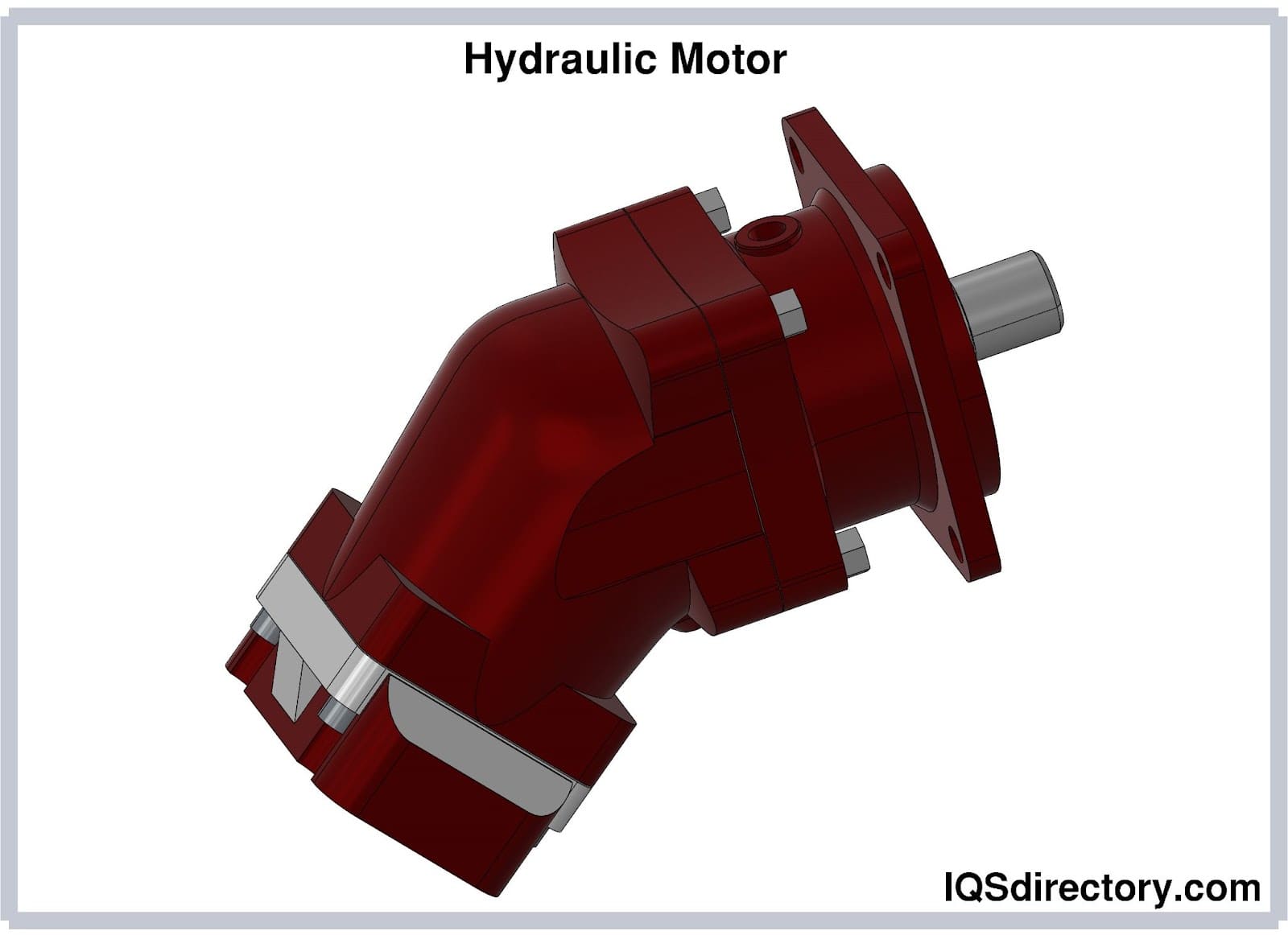 Hydraulic motors, rotary or mechanical actuators which is operated by the conversion of hydraulic pressure or fluid energy to torque and angular displacement.
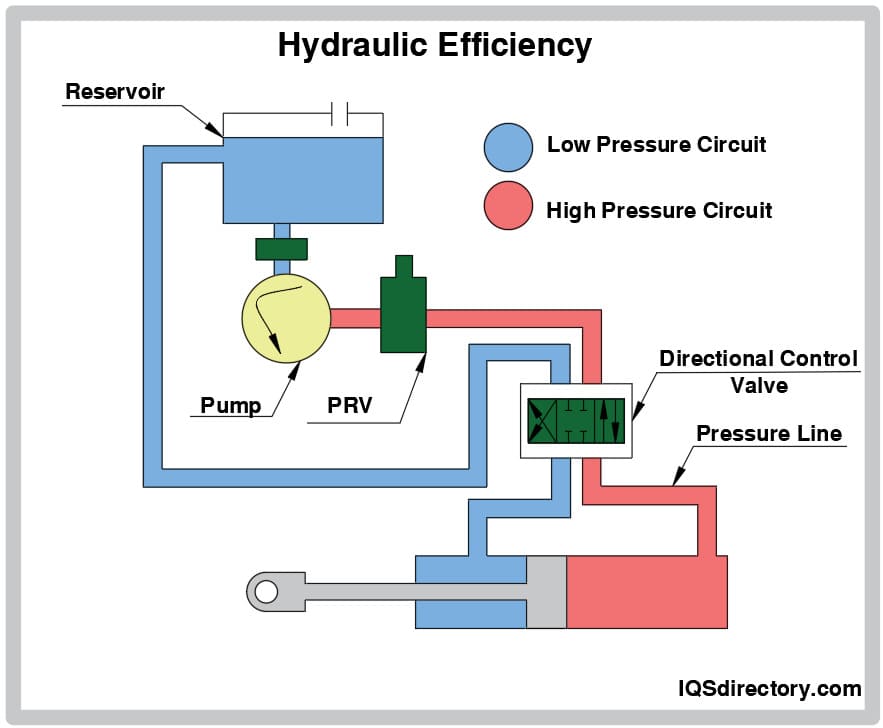 Mechanical efficiency, measures the effectiveness in a machine or mechanical system.
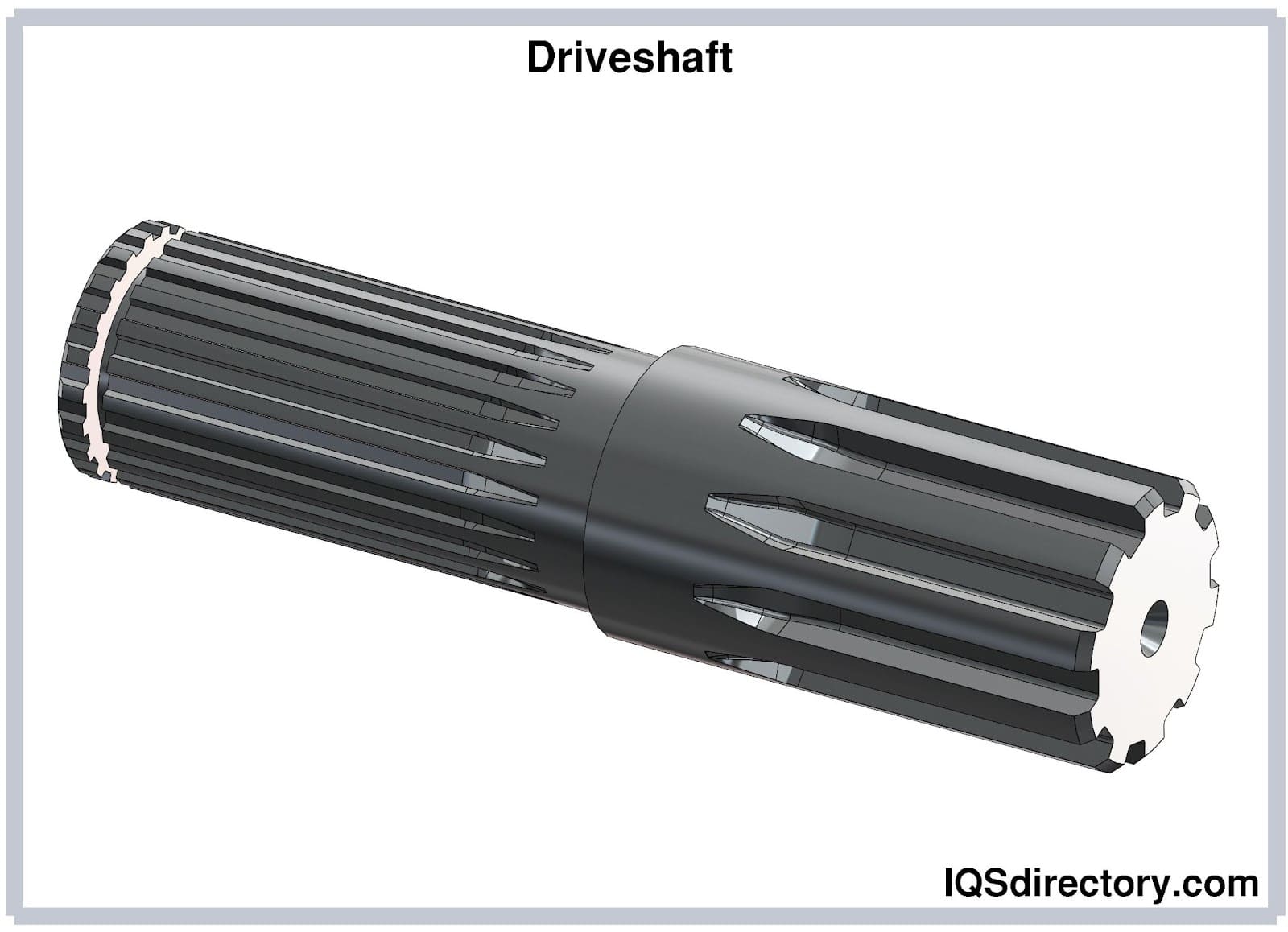 Driveshaft, a part of the hydraulic motor that delivers or transfers the torque created inside the motor to the outside environment where it is used for lifting loads and other applications.
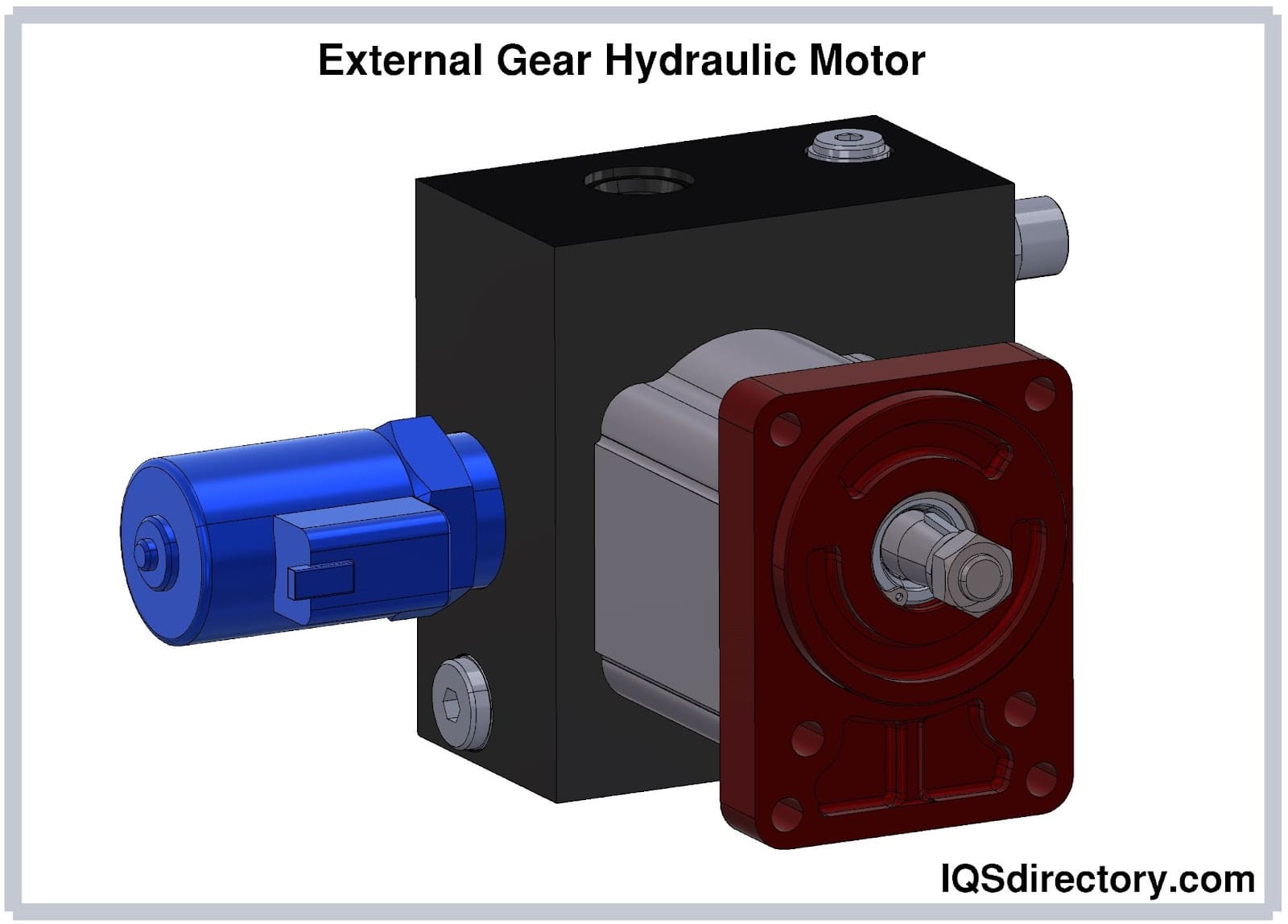 External gear hydraulic motors, operates under high pressure and for longer periods of time.
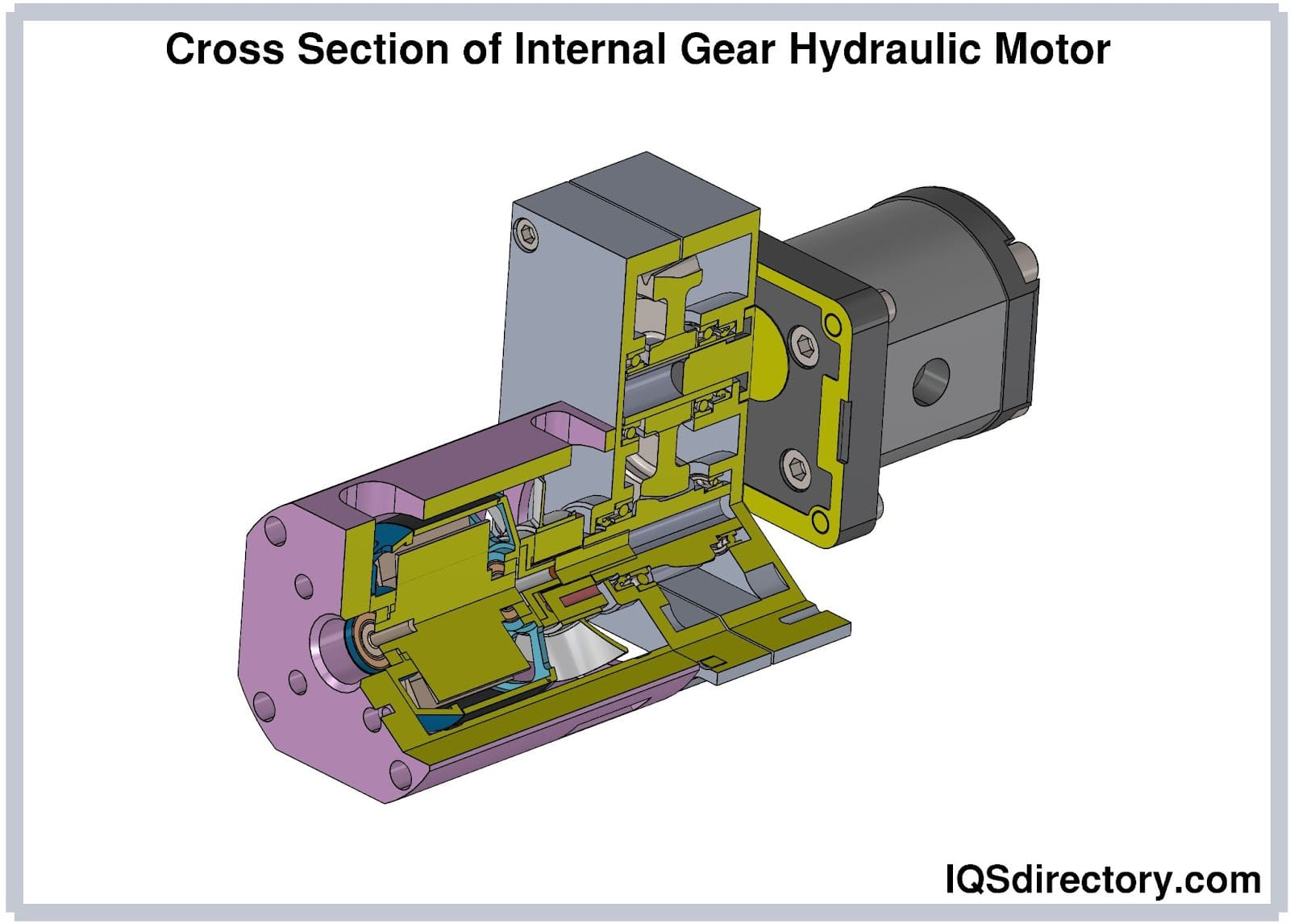 Internal gear motors, low weight and light size allows for smooth operation of the gears.
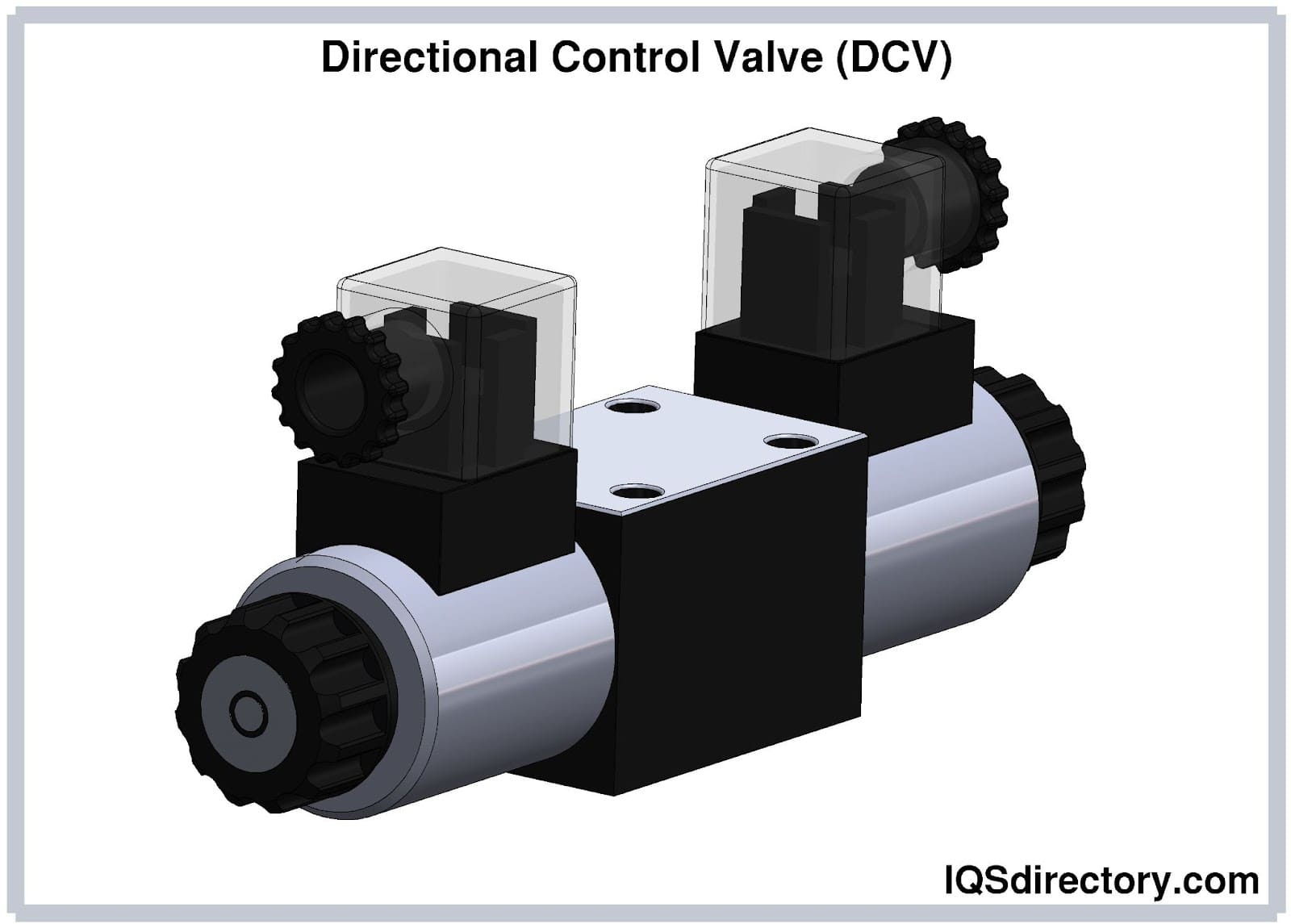 Directional control valves are designed to control fluid flow inside the motor.
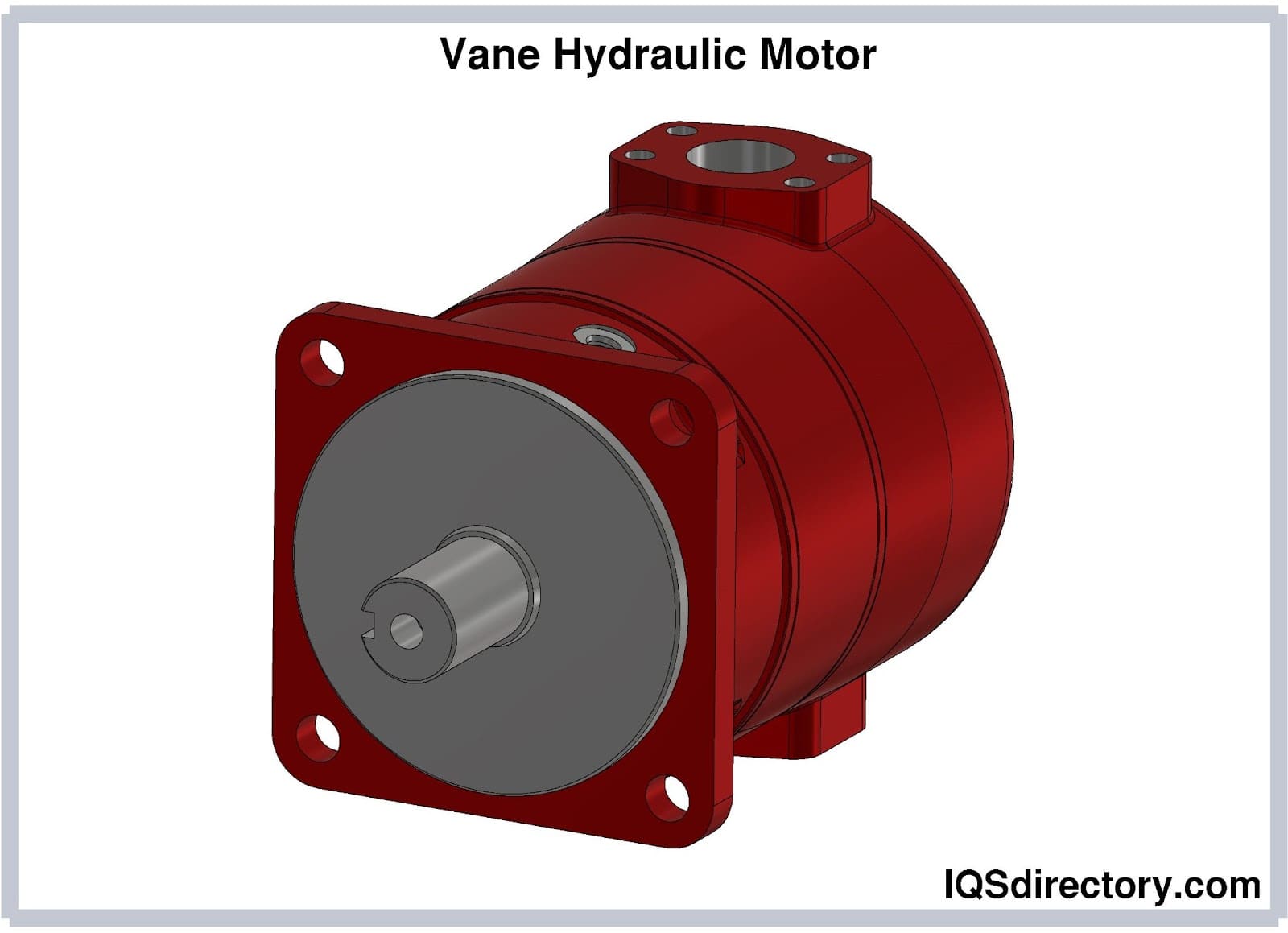 Vane hydraulic motors have a hydraulic balance that prevents the rotor from sideloading the shaft, with the pressure difference develops the torque as the oil from the pump is forced through the motor.
Types of Hydraulic Motors
Hydraulic motors come in three fundamental types—gear, vane, and piston—each distinguished by the configuration of its internal rotating component. These variations are designed to meet the needs of specific applications, performance demands, and environmental conditions.
Hydraulic Gear Motors
These motors operate by forcing pressurized fluid into a gear chamber, where the flow of fluid turns interlocking gears. This rotation generates the mechanical energy required to drive a load.
Piston Type Motors
Piston hydraulic motors are widely used due to their efficiency and strength. Radial piston motors feature pistons arranged around a central shaft with an off-center cam. As fluid enters, it pushes the pistons outward, creating a rotary motion. Axial piston motors, though similar in function, rely on pistons moving parallel (axially) to the motor shaft instead of radially.
Hydraulic Vane Motors
These motors contain a slotted rotor with vanes that extend and retract as fluid flows through the motor’s inlet. The varying pressure against the vanes creates the rotary motion necessary to power machinery.
Hydraulic Wheel Motors
Integrated into wheel hubs, these motors are designed to provide direct rotational force to the wheels of a vehicle. Depending on the system’s size and power needs, a hydraulic wheel motor may drive one wheel or multiple wheels simultaneously.
Speed and Torque Variants
Motors designed for high-speed operation convert hydraulic energy into high-RPM output for applications requiring fast, consistent rotation. In contrast, high-torque models—known as low-speed, high-torque (LSHT) motors—operate at slower speeds but deliver greater rotational force, making them ideal for heavy-duty tasks.
Hybrid Hydraulics
Ongoing innovation continues to enhance hydraulic motor technology. One such advancement is the hybrid hydraulic vehicle, which uses fluid power to recover braking energy more efficiently than traditional electric hybrids.
Hydraulic Drive Motors
These motors are key elements in hydraulic power transmission systems, working in tandem with pumps, valves, and actuators to drive machinery in a coordinated manner.
Hydraulic Drum Motors
A compact and enclosed conveyor solution, drum motors integrate the motor, gearbox, and bearings inside the conveyor drum, offering improved efficiency and easy maintenance.
Hydraulic Pump Motors
Used in tandem with hydraulic pumps and cylinders, these motors serve as the driving mechanism that enables fluid movement and mechanical action within hydraulic systems.
Roller Hydraulic Motors
A form of orbital motor, these motors reduce internal friction using hydro-dynamically supported rollers. This design improves durability and supports high-pressure performance.
Rotor Hydraulic Motors
Another orbital type, rotor motors operate using fixed lobes set into the stator. Their construction makes them particularly well-suited for continuous operation under moderate pressure, delivering long-lasting, steady output.
These different hydraulic motor types are not interchangeable in every situation. Some are favored for low-speed, high-torque work, while others are better for faster rotational output or more compact packaging. Buyers often compare hydraulic motor designs based on startup torque, continuous torque, speed range, efficiency, shaft type, mounting arrangement, and resistance to contamination or shock loads. Matching the motor style to the actual duty cycle is one of the best ways to improve performance and service life.
Applications of Hydraulic Motors
Hydraulic systems are widely utilized across numerous sectors, including construction, agriculture, manufacturing, transportation (such as automotive and aerospace), and various marine environments. Hydraulic motors, in particular, are essential components in machinery that requires high-force, pressurized movement. They are commonly found in aircraft systems—where they raise and lower wing flaps—as well as in heavy-duty construction equipment like backhoes and cranes, where they power lifting mechanisms and other large-scale operations. Additionally, hydraulic motors are integral to trenchers, automobiles, and conveyor and auger systems. They're used to drive marine winches, support waste management and recycling processes, operate wheel motors on military vehicles, and power self-driven cranes, excavators, dredging equipment, forestry machinery, and a wide range of agricultural and industrial processing systems.
Because hydraulic motors appear in so many different machines, the application questions can vary widely. A wheel motor on mobile equipment may need different performance characteristics than a conveyor drum motor or a hydraulic drive motor on processing machinery. Yet all of these applications depend on the same core idea: using pressurized hydraulic fluid to create controlled rotary motion where strong torque and rugged reliability are needed.
Things to Consider When Purchasing Hydraulic Motors
While hydraulic power transmission is highly effective across many professional applications, relying solely on one form of power transmission is generally not advisable. Interestingly, the greatest performance benefits are achieved when multiple forms—electrical, mechanical, pneumatic, and hydraulic—are strategically combined into a comprehensive power transmission system. For this reason, it’s worth investing the time to connect with knowledgeable and trustworthy hydraulic manufacturers or suppliers who can help you design and implement a well-rounded hydraulic strategy.
In addition, it's essential to have a detailed conversation with your manufacturer about the advantages and limitations of different motor types to ensure the best fit for your application. For instance, while vane motors are often more cost-effective than piston motors, they typically offer lower efficiency and a shorter operational lifespan. By thoroughly evaluating trade-offs like these, you can make informed decisions and select the most suitable motor to meet your performance and budgetary requirements.
When purchasing a hydraulic motor, buyers often review torque needs, speed range, displacement, pressure rating, shaft output, mounting style, available space, environment exposure, and expected duty cycle. They may also ask whether the motor will run continuously, reverse often, face shock loading, or operate in a contaminated or outdoor setting. A hydraulic motor that looks economical upfront may not be the best long-term value if it is mismatched to the surrounding circuit or the actual workload.
Proper Care for Hydraulic Motors
Despite their apparent simplicity, hydraulic systems require engineers and manufacturers to account for several key variables to ensure performance, safety, and longevity. One of the most crucial factors is the fluid itself—it must serve as an effective lubricant while also being chemically stable and compatible with the system’s internal materials. In addition, the pump, reservoir, and relief valve must be matched in power and capacity to support the motor's performance without overstraining the system.
Common Issues in Hydraulic Motors
Hydraulic motor problems frequently stem from poor maintenance, using the wrong type of fluid, or misapplying the motor beyond its intended parameters. Typical causes of failure include internal leakage from supply lines, misalignment of the motor shaft during installation, and contamination from dirty hydraulic fluid. When a malfunction does occur, identifying and correcting the root cause immediately is essential to prevent further damage.
Motor Operation Limits
Every hydraulic motor is engineered to operate within specific boundaries—torque, pressure, speed, temperature, and load. Exceeding these thresholds can quickly degrade performance. For instance, running a motor at excessively high temperatures causes the hydraulic fluid to thin, undermining its lubricating properties and reducing the overall efficiency of the system. Adhering to a motor’s design limitations is vital to preventing avoidable breakdowns.
Safety Considerations
Though hydraulic systems are often simpler than mechanical or electrical alternatives, they must still be treated with caution. One core safety rule is to avoid direct contact with pressurized components whenever possible. Even when a system appears idle, residual pressure within hydraulic lines can be dangerous if not properly managed.
Good hydraulic motor care usually comes down to clean fluid, proper filtration, correct installation, pressure control, and prompt attention to abnormal heat, noise, or leakage. Preventive maintenance is often less expensive than a full hydraulic motor failure, especially when the motor is part of a larger machine where downtime affects multiple systems at once. Keeping the motor aligned with the rest of the hydraulic circuit helps preserve both performance and service life.
Hydraulic Motor Terms
-
Aeration
The presence of air bubbles within hydraulic fluid, which can reduce efficiency and cause erratic system behavior.
Accumulator
A pressurized container used to store hydraulic fluid. Common types include piston, bladder, and diaphragm accumulators. They function as energy reserves or shock absorbers within a hydraulic system.
Cylinder
A mechanical device that transforms hydraulic energy into linear motion and force.
Displacement
The volume of hydraulic fluid moved through a pump, motor, or cylinder during a set period or single event, such as one revolution or stroke.
Dry Friction Coefficient
A measure of the resistance generated by contact between dry, moving surfaces, such as a motor shaft and its housing.
Filter
A component that removes impurities from hydraulic oil to protect and extend the life of system parts.
Fluid Power System
A power transmission system that uses pressurized fluid to generate, control, and transmit energy.
Gear
A toothed component that transfers mechanical energy by meshing with another gear or toothed element.
Hydraulics
The study and application of force transmission through the use of contained, pressurized fluids.
Hydraulic Tester
An instrument designed to evaluate and diagnose hydraulic system components.
Line
A hose, pipe, or tube used to direct the flow of hydraulic fluid through the system.
Oil
A non-water-soluble, lubricating fluid commonly used in hydraulic systems due to its incompressibility.
Piston
A cylindrical component that moves within a hydraulic cylinder, translating fluid pressure into linear mechanical movement.
Pressure Plate
A flat component in gear or vane pumps and motor cartridges that minimizes slippage and maintains proper clearance between moving parts.
Pump
A mechanical device that moves fluids by creating suction or pressure.
Resistance
A condition in which the flow of hydraulic fluid is hindered by restrictions or obstructions in the system.
Shaft
A rotating component mechanically connected to the workload, delivering torque and rotational motion from a hydraulic motor.
Stroke
The distance an internal component travels in a straight line during actuation, defining the extent of linear movement.
Throttle
A mechanism or restriction that limits the flow rate of hydraulic fluid.
Torque
A measurement of rotational force, often expressed in foot-pounds, applied to produce turning motion.
Valve
A control device that regulates the direction, flow rate, or pressure of hydraulic fluid within a system.
Vane
A flat, moving element in a vane motor or pump that rotates and interacts with hydraulic fluid to generate motion.