Gas Springs
Gas springs are versatile mechanical devices that store energy pneumatically and function through the use of high-pressure gas contained within a sealed gas struts, gas pistons, or gas shocks, these components are often used alongside or as replacements for traditional mechanical springs. Their operation closely resembles that of air cylinders , relying on a piston that extends or compresses in response to the pressure differential between the gas inside the chamber and the external forces acting on it. In most applications, gas springs are designed to exert force through the gas-filled cylinder while also incorporating oil-based shock absorption—commonly referred to as damping. These devices are widely employed to improve the performance of opening, closing, lifting, lowering, adjusting, and damping motions across a broad range of systems.
Gas Springs FAQ
What is a gas spring and how does it work?
A gas spring is a sealed cylinder filled with high-pressure gas that stores energy pneumatically. It operates by compressing or extending a piston to create a pressure differential, generating controlled force for lifting, lowering, or damping motions in mechanical systems.
Why are nitrogen gas springs commonly used?
Nitrogen gas springs are preferred because nitrogen is inert, stable, and nonflammable. Its chemical neutrality prevents reactions with internal components, ensuring consistent performance, longer service life, and safer operation across industrial, automotive, and aerospace applications.
What are the main advantages of gas springs over mechanical springs?
Gas springs offer smoother, more controlled motion, built-in damping, and adjustability. They are compact, easy to install, and require little maintenance. Unlike metal coil springs, their performance can often be restored by adjusting internal pressure rather than replacing the entire unit.
What role does oil play in a gas spring’s operation?
Oil in a gas spring provides hydraulic damping and lubrication. As the piston moves, oil flows through valves, slowing the motion near the stroke’s end to absorb impact and prevent damage, resulting in smoother and quieter operation.
Where are gas springs commonly used?
Gas springs are used in automotive hoods, tailgates, and suspensions, as well as in furniture, medical equipment, aerospace, and manufacturing machinery. Their versatility makes them essential in lifting, damping, and positioning mechanisms across many industries.
Can gas springs be customized for specific applications?
Yes. Gas springs can be customized by adjusting size, material, pressure, and force output. Manufacturers often tailor gas springs to specific environments, such as stainless steel for marine or food processing use, ensuring durability and corrosion resistance.
How should gas springs be maintained and recycled?
Gas springs require minimal maintenance but should be used within specified load limits. At the end of service life, they must be safely depressurized and drained before recycling, as their metal components are fully recyclable and environmentally sustainable.
The History of Gas Springs
Gas springs were originally conceived and engineered by French inventor Paul Giffard in the late nineteenth century. By 1875, they had already made their way to the United States. Early on, the focus of gas spring development centered primarily on the role of internal pressure, often overlooking other important elements such as the materials and construction techniques involved in their design.
It was the automotive industry that ultimately drove the rapid advancement and widespread customization of gas springs in the latter half of the twentieth century. Their first major use came in car trunks and hoods, where they provided controlled, hands-free opening and closing. As demand grew, gas spring manufacturers expanded on both sides of the Atlantic, scaling up production and refining designs. Today, gas springs have become an integral mechanical component across virtually every sector, from industrial machinery and aerospace to medical equipment and consumer products.
Advantages of Gas Springs
Gas springs are often chosen over traditional mechanical springs because they offer several notable advantages. In many cases, air springs prove to be more cost-effective than metal coils for reasons that can be broadly categorized into two key areas:
Superior Performance
Gas springs typically outperform mechanical springs in several ways. The integration of precision-engineered cylinders and pistons—along with their natural damping capabilities—allows for smoother, more controlled movement than metal coils. This level of adjustability makes it easier to fine-tune their function, and should gas gradually leak from the main chamber over time, adjustments can often be made to restore performance. In contrast, a worn coil spring usually needs full replacement. Gas springs also tend to offer greater force output and long-term reliability. Because they are manufactured with exacting standards, they are extremely durable and capable of delivering consistent performance for many years.
Ease of Use
In addition to superior functionality, gas springs are generally easier to work with than traditional mechanical springs. They are more compact and easier to mount or install, often with the help of socket joints or similar hardware. Their high build quality, combined with the absence of external power sources such as electricity, means they require little to no maintenance throughout their service life.
Design and Features of Gas Springs
Gas springs are well suited for a wide array of industrial, commercial, and domestic applications. Despite the diversity of these uses, all gas springs operate according to the same fundamental design and principles. Generally, gas springs consist of a consistent set of core components:
The cylinder—also referred to as the tube or body—is the external housing of the gas spring. It contains all other internal components and features a polished interior surface to minimize friction during operation.
Inside the cylinder is a piston and rod assembly. The rod is connected to the piston and extends outward from one end of the cylinder, while the piston head sits perpendicular to the rod within the cylinder. In combination with the sealing system, the piston forms an airtight barrier that separates the cylinder into two distinct chambers.
Seals, such as O-rings, radial shaft seals, or lip seals, are used to maintain airtight conditions and prevent leakage.
Intake and outlet valves are included to regulate gas movement and maintain pressure balance.
A gas charge or reservoir, typically filled with nitrogen, provides the necessary pressure. Nitrogen is commonly used due to its inert nature, which reduces the risk of chemical reactions with internal components.
A small amount of oil is also present to provide damping and lubrication, further enhancing the spring’s performance and longevity.
While the basic structure may appear relatively straightforward, most manufacturers employ advanced tools such as 3D CAD modeling and other specialized design software to develop gas springs tailored to specific applications. This is critical because, despite the simple appearance, the functionality of these pneumatic devices depends on extremely precise interactions among all their components.
How Gas Springs Work
-
Gas Springs and Physics
Gas springs operate based on a fundamental physics principle: force equals pressure multiplied by area. While the terms "force" and "pressure" are often used interchangeably in everyday language, they have distinct meanings in physics. Force is defined as a one-directional push or pull acting on an object, whereas pressure refers to that force distributed across a surface area. Gas struts are often described as working by increasing the gas pressure inside the cylinder. However, a more accurate explanation is that they function by altering the area over which pressure is applied inside the cylinder. This shift creates a pressure differential that generates the net force needed to move the spring.
When external force is applied or a shock is encountered, the rod connected to external components pushes deeper into the cylinder, moving the piston head toward the opposite end. It’s important to clarify that the piston does not compress the gas by physically squeezing it downward. Instead, it compresses the gas by displacing volume—by occupying more space inside the cylinder, the piston reduces the available space for the gas, causing it to compress.
More precisely, pistons in gas springs have holes or valves that allow gas to flow through or around them, allowing the gas to occupy both sides of the piston within the sealed cylinder. Because no gas escapes the sealed system, it maintains equal pressure on both sides. However, once the piston enters the cylinder, it introduces an internal surface that increases the total area exposed to the gas pressure. This change results in a net force pushing outward—specifically, away from the larger internal area. This output force significantly exceeds the atmospheric pressure acting on the portion of the rod outside the cylinder, causing the rod to extend outward toward the lower-pressure zone.
Using Oil in Gas Springs
Oil plays a critical role in gas spring functionality by creating damping, or cushioning effects, that help regulate the spring’s force and movement. Oil accomplishes this by flowing through the same piston holes or valves that facilitate gas movement. Hydraulic damping refers to oil passing through holes or bores in the piston, while dynamic damping involves oil bypassing valves built into the cylinder walls. Damping typically becomes most noticeable near the ends of the spring’s stroke—both during compression (inward) and extension (outward). The resistance generated by the oil helps absorb force and slows the rod before it can collide with or damage more delicate components. A familiar example of this is seen in automotive shock absorbers or suspension systems, where oil-based damping ensures smooth operation over bumpy terrain.
Pistons in Springs
Pistons are engineered to precisely manage the flow of both gas and oil within the gas spring. They are often designed to slow the flow rate intentionally, as the speed of a gas spring’s movement is directly linked to the speed and volume of fluid movement inside. This controlled flow results in smoother, more predictable spring performance. The ability to moderate fluid dynamics within the spring ultimately translates to better control over the products and mechanisms they power. For instance, a gas spring with well-regulated motion allows a vehicle trunk or cabinet door to close gently, rather than slamming shut—a small but critical detail that highlights the precision and sophistication of modern gas spring design.
Gas Springs Images, Diagrams and Visual Concepts
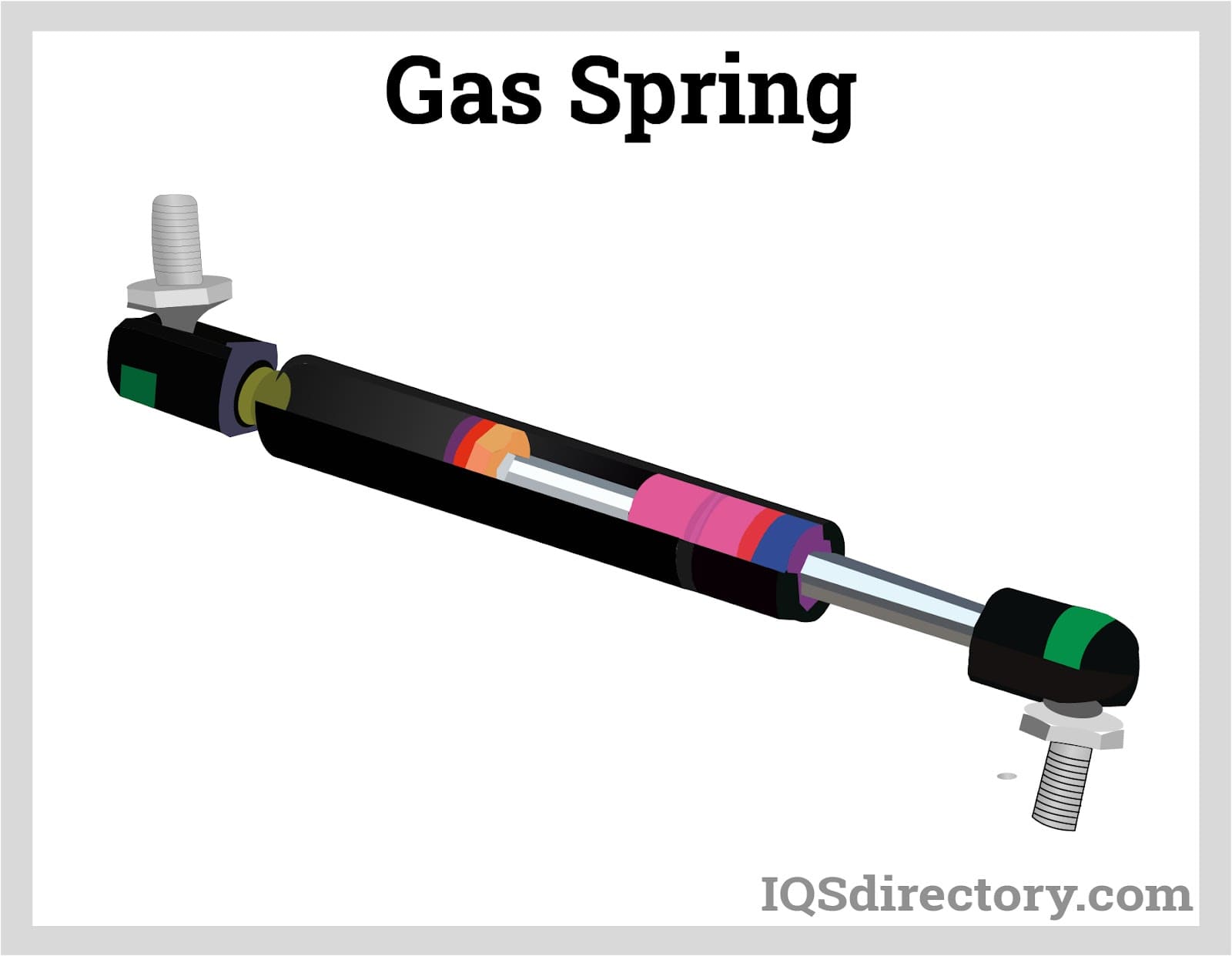 Gas spring, a hydro-pneumatic element that stores potential energy by compressing gas contained in an enclosed cylinder sealed by a sliding piston.
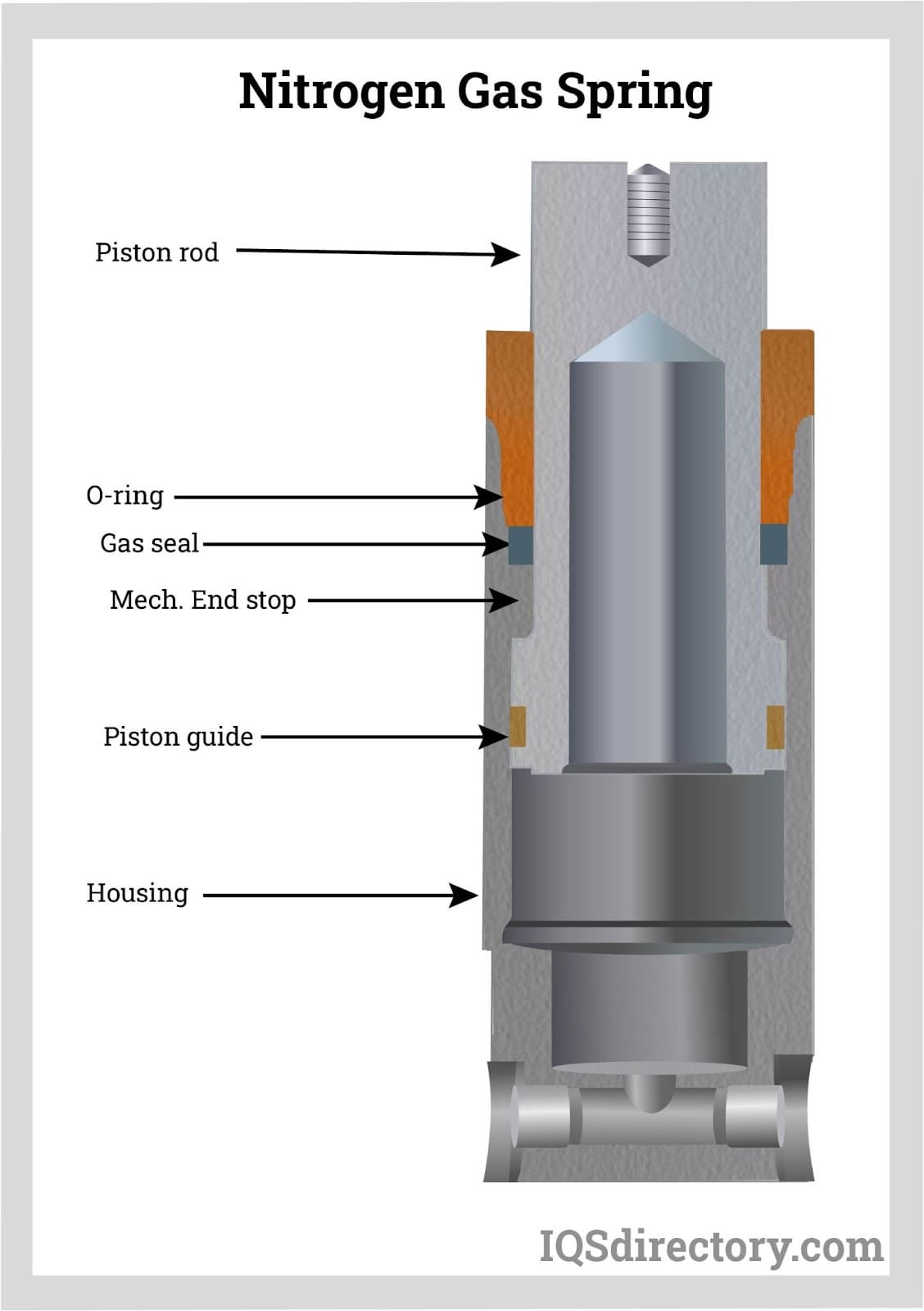 Nitrogen gas springs refers to gas springs because Nitrogen is the gas typically used inside the gas springs because it is inert and non flammable.
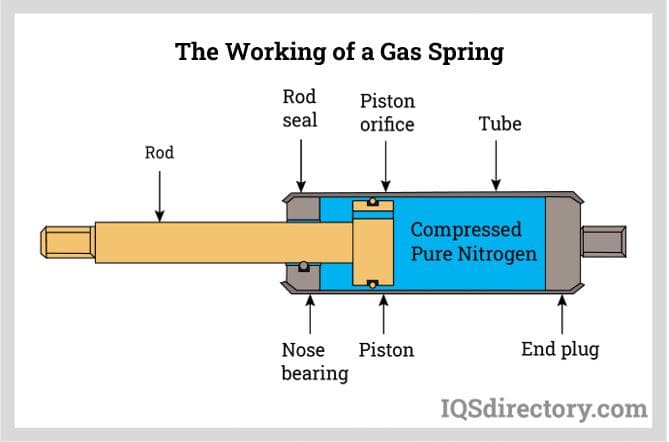 Gas spring’s working principle is based on the use of nitrogen gas with transformer oil 50% and turbine oil 50%, for the sealing, lubrication, and transmission of pressure.
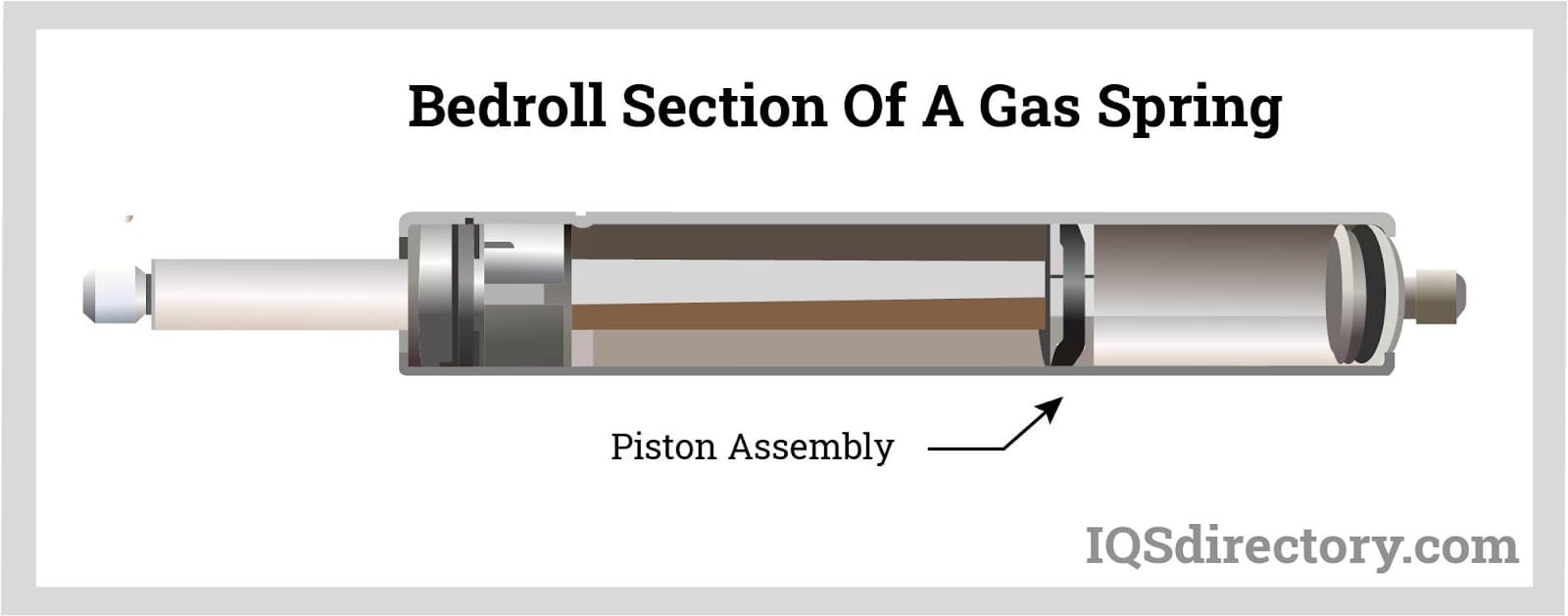 Beadroll Section, the section of grooved tube that functions to retain the guide and seal the package to prevent the damage to the seal package by the extending piston.
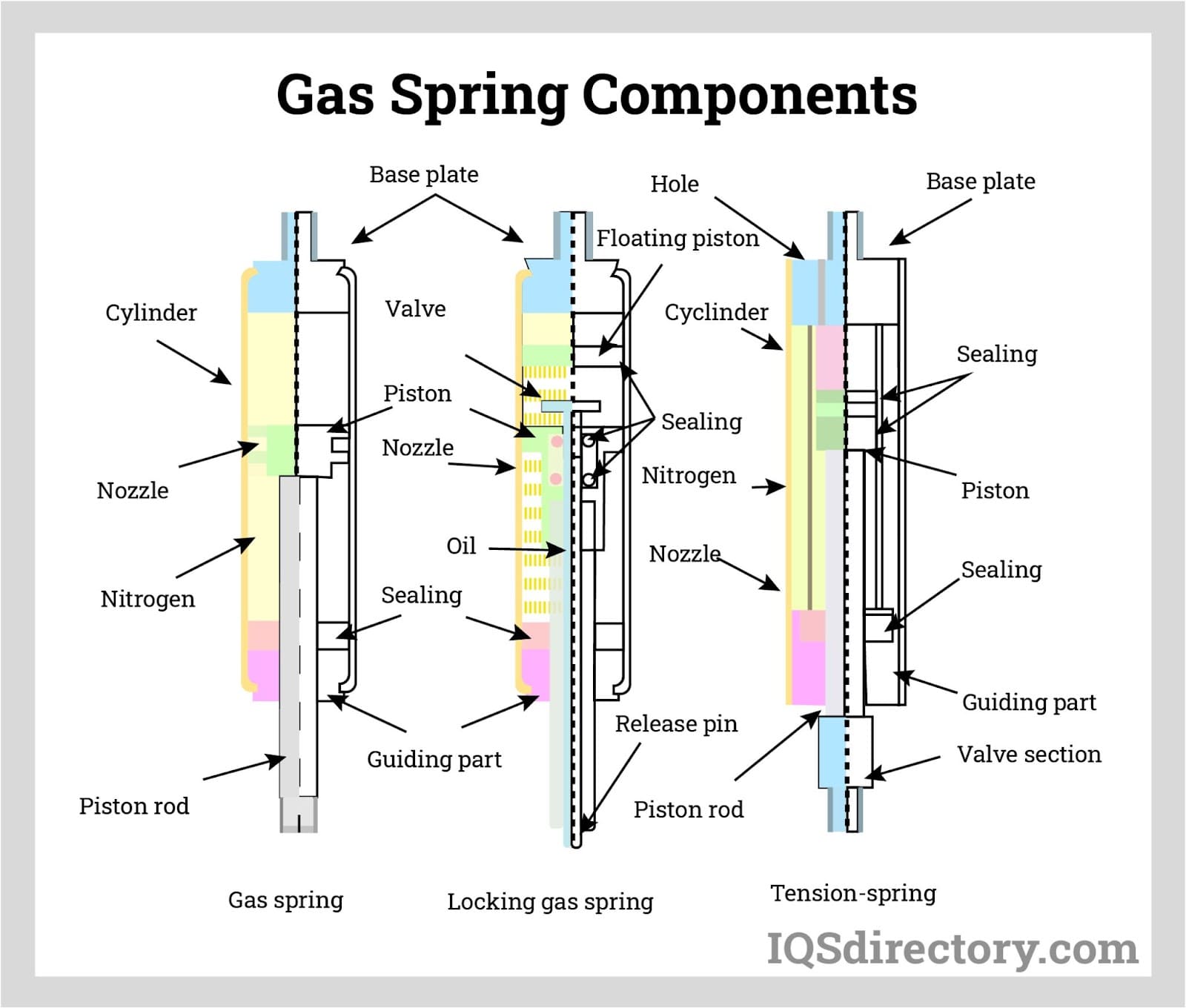 A gas spring consists of several parts, each being integral for the safe and successful operation of the component.
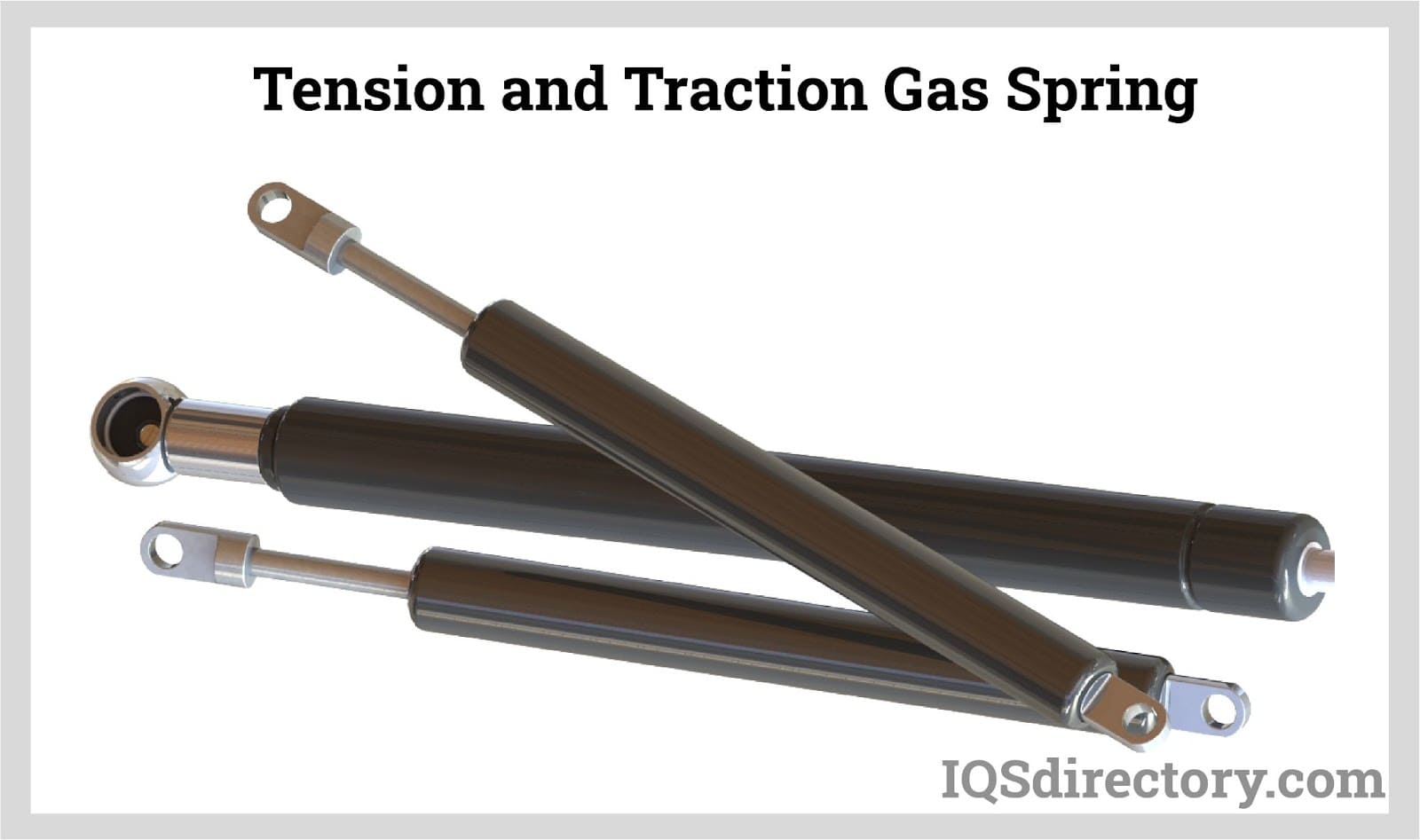 Tension and traction gas springs apply some force or maintain the tension to provides tension on the belt drive and mechanical assemblies.
Types of Gas Springs
There are several distinct types or designs of gas springs, each suited to specific applications based on how they function and what they’re intended to support. While all share the core principles of gas-based motion control, the variations in structure and operation make certain types better choices depending on the use case. Some of the more commonly encountered designs include:
Extension Gas Springs
These serve as counterparts to compression gas springs, which are the most widely used variety. While compression gas springs provide dampening when an external force compresses the piston into the cylinder, extension gas springs are designed to provide isolation or support when the rod is pushed outward—either partially or fully—by the high internal chamber pressure.
Nitrogen Gas Springs
These pneumatic energy storage devices use compressed nitrogen gas to dampen and isolate motion. Known for their longevity and precision, nitrogen gas springs are popular alternatives to mechanical coil or leaf springs, especially in applications that demand consistent performance and reduced wear.
Locking Gas Springs
Equipped with internal mechanisms that allow the rod to lock in place at full extension, these springs are ideal for applications requiring secure positioning, such as in medical equipment where controlled and stable movement is essential.
Adjustable Gas Springs
Functionally similar to locking gas springs, adjustable versions can stop the rod at any point along its travel—not just at full extension. This level of control is particularly valuable in hospital settings, including adjustable beds and emergency trolleys, where fine-tuned motion is required for patient care and mobility.
Reducible Gas Springs
These are designed to allow users to modify the internal pressure by releasing gas during operation. By doing so, the output force can be adjusted to better suit changing requirements in real time.
Tension Gas Springs
Opposite in function to standard compression springs, tension gas springs are engineered to maintain tension and perform controlled pulling actions. They are often found in household furniture, such as cabinets, where they help manage opening and closing with a pulling force rather than a push.
Air Shocks
A specialized form of gas spring built for vibration isolation and damping, air shocks—also referred to as shock absorbers—are common in both industrial and transportation settings. They are used on vibratory equipment like conveyors and mixers, but are more famously associated with vehicle suspensions and aircraft landing gear.
Tool and Die Gas Springs
These industrial-grade gas springs are built for heavy-duty applications and typically feature shorter stroke lengths combined with higher force output. Unlike many other gas springs, they often do not use damping agents, making them ideal for tool and die operations that require compact, high-force solutions.
Dampers
Though gas springs are sometimes casually referred to as dampers, the term technically refers to a different type of device. Dampers are designed to control motion without exerting any significant force. Structurally similar to struts, they act more as resistive mechanisms than active springs. In essence, they can be thought of as gas springs without the gas, focused solely on managing speed and motion rather than delivering force.
Applications of Gas Springs
As previously noted, gas springs serve a remarkably wide range of applications. At their core, gas springs are designed to make the movement of objects easier. Their ability to pneumatically store potential energy during compression—and then release that energy during extension—allows users to carry out lifting and lowering actions that would otherwise require much greater effort. A classic example of this functionality is found in the trunk of a car. When the trunk is unlocked, the energy stored during the previous compression stroke (closing the trunk) is released as an output force, assisting in smoothly lifting the trunk open. Beyond motion assistance, gas springs are also used to hold objects in stable, fixed positions.
These devices have become essential across nearly every industry. Gas springs are used regularly in fields such as furniture manufacturing, medical and rehabilitation equipment, aerospace, office furniture and supplies, agriculture, marine operations, pharmaceuticals, food processing, mechanical engineering, and transportation. In more specialized cases, gas springs appear in equipment like tanning beds, awning extension systems, industrial conveyors, and aircraft landing gear.
Nowhere is their importance more pronounced than in the automotive industry. As demonstrated with the car trunk, gas springs are a key feature in many vehicle components. They are widely used in tailgates, hoods, door supports, suspension systems, sunroofs, seat adjustment mechanisms, and steering dampers—playing a central role in making modern vehicles safer, more convenient, and more efficient to operate.
Customizing Gas Springs
As previously mentioned, gas springs are engineered with a high level of precision, making them exceptionally customizable. Nearly every component or characteristic of a gas spring can be adjusted to meet the demands of specific applications. The following examples highlight how versatile these devices truly are:
While aluminum and stainless steel are standard construction materials for gas springs, manufacturers and suppliers frequently offer alternatives. Highly customized gas springs can be made from specialized materials such as polyurethane or EPDM synthetic rubber, depending on the operational environment and performance requirements.
The type of gas used within a spring plays a critical role in its functionality. Nitrogen is the most commonly used gas due to its inert nature, which minimizes chemical reactivity and enhances stability. However, carbon-based gases are also used in some applications, offering similar benefits and remaining safe for most industrial settings.
Gas springs vary widely in size. They can range from just a couple of inches to several feet in length. Equipment that requires particularly large or powerful gas springs—such as dynamometers used for engine testing—relies on oversized models designed to accommodate heavy loads and extended stroke lengths.
Load capacity is another vital factor and is directly linked to both the internal fluid flow and the force exerted by the spring. This capacity can vary from under one hundred pounds to over eighty-eight thousand pounds, depending on the size, configuration, and materials used.
The ideal specifications for a gas spring are highly dependent on the application and the industry it serves. Similar to mechanical springs, several physical and performance factors must be considered when selecting the appropriate design. These include cylinder diameter, rod diameter, mounting style, maximum width, working temperature range, absorber stroke, extended and compressed lengths, force ratings, and maximum cycle frequency.
Proper customization starts with clearly identifying the most critical conditions under which the gas spring will operate. For instance, body material selection is crucial—not only must it withstand physical stress, but it must also resist any chemical or environmental stressors. Applications in corrosive environments such as food processing, marine industries, or pharmaceutical manufacturing require non-corrosive gas springs.Stainless steel is often chosen for these conditions, while other options like thermoplastics, aluminum, and steel may be treated with black nitride or chrome plating for added durability and corrosion resistance.
By matching the material, size, and performance characteristics of a gas spring to the specific demands of its application, manufacturers can ensure long-lasting, reliable performance in even the most challenging conditions.
Choosing a Gas Spring Manufacturer
Gas spring and industry-specific professionals can offer valuable guidance when selecting the right gas spring for a particular application, helping to ensure both safety and optimal performance. While competitive pricing is certainly important, there are additional key factors to keep in mind when choosing a gas spring supplier:
Levels of Certification
Look for suppliers that meet recognized standards, such as environmentally responsible ISO certifications. These certifications reflect a commitment to quality, safety, and sustainability.
Level of Customer Support
Evaluate the supplier’s willingness to provide hands-on assistance, including services like on-site installation support, technical advice, and troubleshooting.
-
Ability and Willingness to Customize Products for Your Specific Applications
A reliable supplier should not only have the capability to tailor gas springs to your exact needs but should also demonstrate a readiness to work closely with you to develop application-specific solutions.
Proper Care for Gas Springs
Gas springs are precisely calibrated to withstand the demanding application of varying pressures at inconsistent velocities. This level of precision is essential, as failure in many of the industrial applications where gas springs are used could result in serious, even fatal, consequences. Beyond careful engineering, proper usage is critical to ensuring both safety and longevity. This includes adhering strictly to each gas spring’s intended load capacity and operational limits.
One of the key advantages gas springs have over traditional mechanical alternatives is their long service life with minimal maintenance requirements. However, while they generally require little to no upkeep, gas springs should still be responsibly recycled at the end of their usable life—whether due to wear, accidental damage, or system replacement. Once safely depressurized and drained, used gas springs are fully recyclable, just like other metal components, making them a durable and environmentally responsible choice.
Gas Spring Terms
-
Compressed Length
The minimum overall length of the gas spring when the shock is fully compressed.
Damping
Achieved by regulating the flow of gas through a valve at the orifice of the gas damper piston. This creates a cushioning effect that slows the mechanism as it nears full extension, preventing sudden or harsh movement.
End Fittings
Components used to attach the gas spring to the object it is designed to control. These may include various types of mounting brackets, depending on the specific application and purpose.
Extended Length
The maximum length of the gas spring when it is fully extended.
Force
Measured 5mm from the point of full extension, this is a function of the internal cylinder pressure acting on the cross-sectional area of the rod. A larger rod diameter results in a lower force output due to reduced pressure application.
K-Factor
The ratio of compressed force to extended force, with compressed force always being greater than extended force.
Piston
A cylindrical or disk-shaped component that moves or displaces fluid within a larger cylinder under pressure, serving as a key part of the gas spring's internal mechanism.