Forging
Forging is a metal forming process that shapes raw stock through compressive force, creating plastic deformation that transforms billets, bars, and blanks into useful parts. A hammer, press, or die applies concentrated force to redirect grain flow, which helps produce dense, high-strength components with dependable mechanical properties. Forgings may be made through hot, warm, or cold processing, depending on the alloy, part geometry, tolerance goals, and end-use demands. Finished forged products range from small hand tools and hardware to industrial valves, gears, engine components, mining tools, structural parts, and heavy-duty equipment used in transportation, energy, marine, and manufacturing environments.
The forging industry includes a wide range of specialized trades, from blacksmithing, ironworking, and boilermaking to die design, toolmaking, and production support. In addition to hands-on metal shaping, related processes include casting, machining, heat treating, and sheet metal fabrication. Modern forge shops also rely on operators, inspectors, programmers, maintenance teams, and logistics personnel to keep output consistent and lead times competitive. For buyers comparing manufacturing methods, forging often stands out when strength, repeatability, material performance, and production efficiency all matter at once.
Once defined by the blacksmith’s hammer and anvil, forging has advanced into a highly controlled manufacturing discipline supported by hydraulic presses, drop hammers, induction heating, automated handling systems, and precision dies. Some systems apply steady pressure to move metal into a cavity, while others strike, roll, upset, or bend stock into shape. Compared to weld fabrication or casting, forging can reduce voids, improve grain alignment, limit porosity, and lower the need for extensive secondary machining. That combination helps manufacturers produce strong, reliable parts for demanding service conditions while still supporting flexible part designs, high-volume output, and custom production runs.
Forging FAQs
What is forging in metalworking?
Forging is a metalworking process that shapes metal with compressive force from a hammer, press, or die. As the material deforms, its grain flow is redirected, which helps create dense, durable parts with strong fatigue resistance and dependable performance in tools, machinery, transportation systems, and industrial assemblies.
How does hot forging differ from cold forging?
Hot forging heats metal above its recrystallization point so it can be shaped more easily, which suits large parts and complex geometries. Cold forging is performed at or near room temperature and is often chosen for tighter tolerances, smooth finishes, material efficiency, and added strength created by work hardening.
What materials are commonly used in forging?
Common forging materials include iron, carbon steel, stainless steel, aluminum, copper, titanium, nickel alloys, brass, and other engineered alloys. Each material offers a different balance of weight, corrosion resistance, conductivity, heat tolerance, machinability, and strength, which helps manufacturers match the forging process to the part’s service environment.
What are the main types of forging processes?
Major forging methods include open die forging, closed die forging, roll forging, ring forging, upsetting, swaging, and automatic hot forging. Each process supports different production goals, from large custom components and seamless rings to repeatable high-volume parts that require uniform dimensions and dependable mechanical properties.
Why is forging preferred over casting or machining?
Forging is often selected when buyers need higher strength, improved grain structure, better impact resistance, and strong long-term durability. It can reduce internal defects associated with cast parts and may lower material waste or secondary work compared to machining parts entirely from solid stock.
What industries rely on forged components?
Forged parts are widely used in aerospace, automotive, defense, mining, oil and gas, energy, agriculture, rail, marine, and heavy equipment manufacturing. Common examples include gears, shafts, rings, valves, flanges, fasteners, engine parts, and structural components that must perform under high loads, heat, pressure, or repeated stress.
How has forging evolved over time?
Forging began with early hand tools and simple furnaces, then advanced through water-powered systems, steam-driven equipment, alloy development, and precision presses. Today, forge shops use hydraulic systems, automated heating, process controls, and inspection methods to produce complex parts with more consistency, repeatability, and dimensional accuracy.
A Brief History of Forging
As early as 4500 B.C., Sumerians in the Tigris and Euphrates River Valleys were shaping softer metals, heating copper and bronze over fires and forming them into primitive tools. By 750 B.C., during the Iron Age, the development of the bloomery furnace—a stone-and-clay structure that used bellows to intensify heat—expanded the practical use of iron. The Romans valued forging so highly that they associated the craft with Vulcan, the god of fire. Between the 10th and 12th centuries A.D., advancements such as the water wheel, heavier hammers, and forced-air bellows improved output and made forged items more available for agriculture, transport, daily tools, and early trade.
The forging industry expanded further during the Middle Ages, when the need for weapons, hardware, horseshoes, tools, and structural metal parts increased across Europe. Even with growing demand, the trade remained largely manual until the Industrial Revolution. The 19th century introduced steam power, allowing forge equipment to operate far beyond water-powered sites and opening the door to larger shops, greater production capacity, and more consistent part shaping for fast-growing manufacturing sectors.
A major breakthrough came in 1856 with the Bessemer Process, which supported large-scale steel production from pig iron through high-temperature oxidation. With more raw material available, closed-die techniques became more practical for repeatable manufacturing, and companies such as Colt Arms helped demonstrate how forging and machining could work together in mass production. By the 1930s, the modern forging press had taken shape, applying continuous pressure rather than repeated hammer blows and giving manufacturers more control over precision, part geometry, and process consistency.
Products of Forging and Their Applications
Forging transforms metal by redirecting its internal grain structure, which helps produce components known for strength, toughness, and long service life. This process supports both repeat production of identical parts and the creation of complex, application-specific shapes. With forge presses and dies tailored to different tonnage requirements, manufacturers can produce parts for high-load, high-temperature, and wear-intensive environments while also supporting near-net-shape manufacturing, reduced scrap, and dependable part-to-part consistency.
Forged parts play a major role in aerospace, aviation, defense, oil and gas, mining, shipping, transportation, agriculture, construction, and food processing. These products range from bolts, shafts, hubs, couplings, flanges, rings, and fittings to ship anchors, rail components, augers, gears, and large industrial hardware. Buyers often look to forging when a part must resist shock, pressure, vibration, fatigue, or repeated loading over time. Whether the goal is a custom component or large-volume production, forged products remain a foundation of modern manufacturing. You can find forged bolts and other components here on IQS Directory.
Materials Used in the Forging Process
Forging uses a broad range of metals, including iron, aluminum, titanium, copper, nickel, and many alloy families such as brass, stainless steel, carbon steel, and engineered aluminum grades. Custom alloys may also be selected for parts that need a specific mix of strength, corrosion resistance, weight savings, conductivity, or temperature stability. In heat forging, the workpiece is raised above its recrystallization point without melting, allowing it to be shaped more easily under hammering or press force while preserving the properties needed for the finished part.
Iron has been a primary forging material for centuries because of its availability and durability, and it is often alloyed to improve strength, hardness, and temper response. Aluminum, with its lower density, good tensile strength, and corrosion resistance, has long supported aerospace and transportation applications where weight reduction matters. Copper offers strong electrical conductivity and good formability for electrical and industrial uses, while nickel performs well in oxidizing and high-heat environments. Carbon Steel remains a cost-effective option with strong mechanical properties and can be heat treated for added performance. Stainless steel provides corrosion resistance, and titanium offers an appealing balance of strength, light weight, and durability for demanding service conditions.
Forging Processes
The forging process changes the internal grain structure of metal, aligning it for greater strength, toughness, and ductility. In untreated stock, the crystalline grain orientation is more random. Forging encourages organized grain flow that follows the shape of the part, helping improve performance across multiple planes. This is one reason forged shafts, rings, gears, and load-bearing components are regularly chosen for demanding applications. Depending on how the material is displaced, the metal may be described as being "drawn out" or "upset."
Several forging techniques are employed to achieve specific shapes, tolerances, and material properties. Open die forging, closed die forging, roll forging, swaging, cogging, upsetting, and automatic hot forging each fit different production goals. These processes also differ by temperature. Hot forging takes place above the material’s recrystallization point, making stock easier to shape for larger or more complex parts. Warm forging operates below that point but above roughly 30% of it, balancing formability with improved accuracy and less scale formation. Cold forging takes place at or near room temperature and is often chosen when dimensional control, surface finish, and added strength are top priorities.
Open Die Forging (Smith Forging) places a workpiece on a stationary anvil and shapes it with repeated hammer or press contact. Because the dies do not fully enclose the material, metal can flow in response to the applied force. This method supports grain refinement, reduces internal voids, improves fatigue resistance, and allows large parts to be worked progressively. Techniques such as cogging, edging, and fullering help refine thickness, width, and contour. Open die forging is well suited for custom components, short production runs, large shafts, rings, and forged parts that need additional machining after the primary forming step.
Closed Die Forging (Impression-Die Forging) places heated stock inside a die cavity mounted to an anvil or press. A shaped hammer or ram forces the workpiece into the contours of the cavity, while excess material or "flash" is squeezed outward at the die edges. That flash cools quickly and helps build resistance, which improves cavity filling. After the part is formed, the flash is trimmed away to reveal a precise component. This method is widely used for intricate, repeatable, high-strength parts that benefit from closer tolerances and dependable production consistency.
Automatic Hot Forging is a high-speed, fully automated process that often begins with bars heated quickly by induction coils. The material is descaled, cut into blanks, and then moved through upsetting, preforming, final forging, and piercing operations. Because the process is fast and repeatable, it is often used for large production volumes of smaller parts such as nuts, washers, fittings, and other hardware where material utilization and throughput both matter.
Roll Forging passes heated metal stock between grooved rollers until the material reaches the required shape and dimensions. Unlike closed-die forging, this method produces no flash, which can reduce material waste while improving process efficiency. Roll forging also improves grain flow and is commonly used for axles, tapered bars, leaf springs, and similar products that benefit from uniform strength along the length of the part.
Each forging process offers distinct advantages. Hot forging takes advantage of increased malleability at elevated temperatures, reducing the force required for deformation while supporting large part geometries and steady material flow. Aluminum hot forging occurs at relatively low temperatures, and many aluminum forgings include alloying elements such as silicon, magnesium, zinc, copper, or manganese to improve strength, corrosion resistance, and stability for transportation, aerospace, and industrial applications.
Warm forging reduces scale and often strikes a useful balance between formability, surface quality, and dimensional precision. Although it requires more forming force than hot forging, it can achieve narrower tolerances and a cleaner finish, making it attractive for parts that need both strength and tighter dimensional control.
Cold forging allows precise shaping at room temperature, simplifies material handling, avoids surface scale, and can improve the strength of the finished part through work hardening. This method is commonly used with softer or more formable metals such as copper, brass, bronze, gold, silver, and platinum, and it is also valued for fastener production and repeatable high-volume manufacturing. You can find companies specializing in cold forging here on IQS Directory.
Forging Images, Diagrams and Visual Concepts
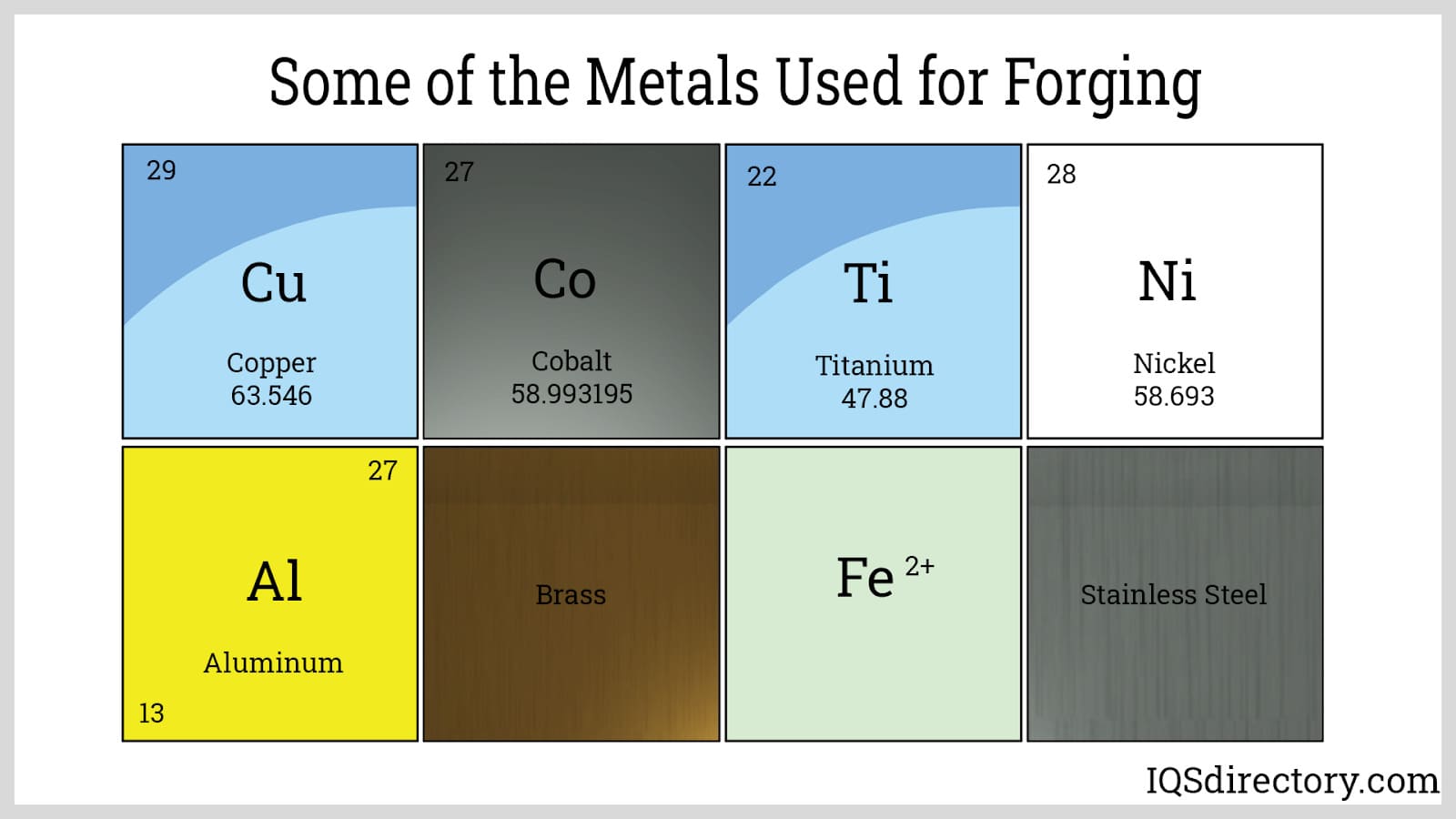 Different types of metal that can be forged, including common industrial materials chosen for strength, conductivity, corrosion resistance, or weight reduction.
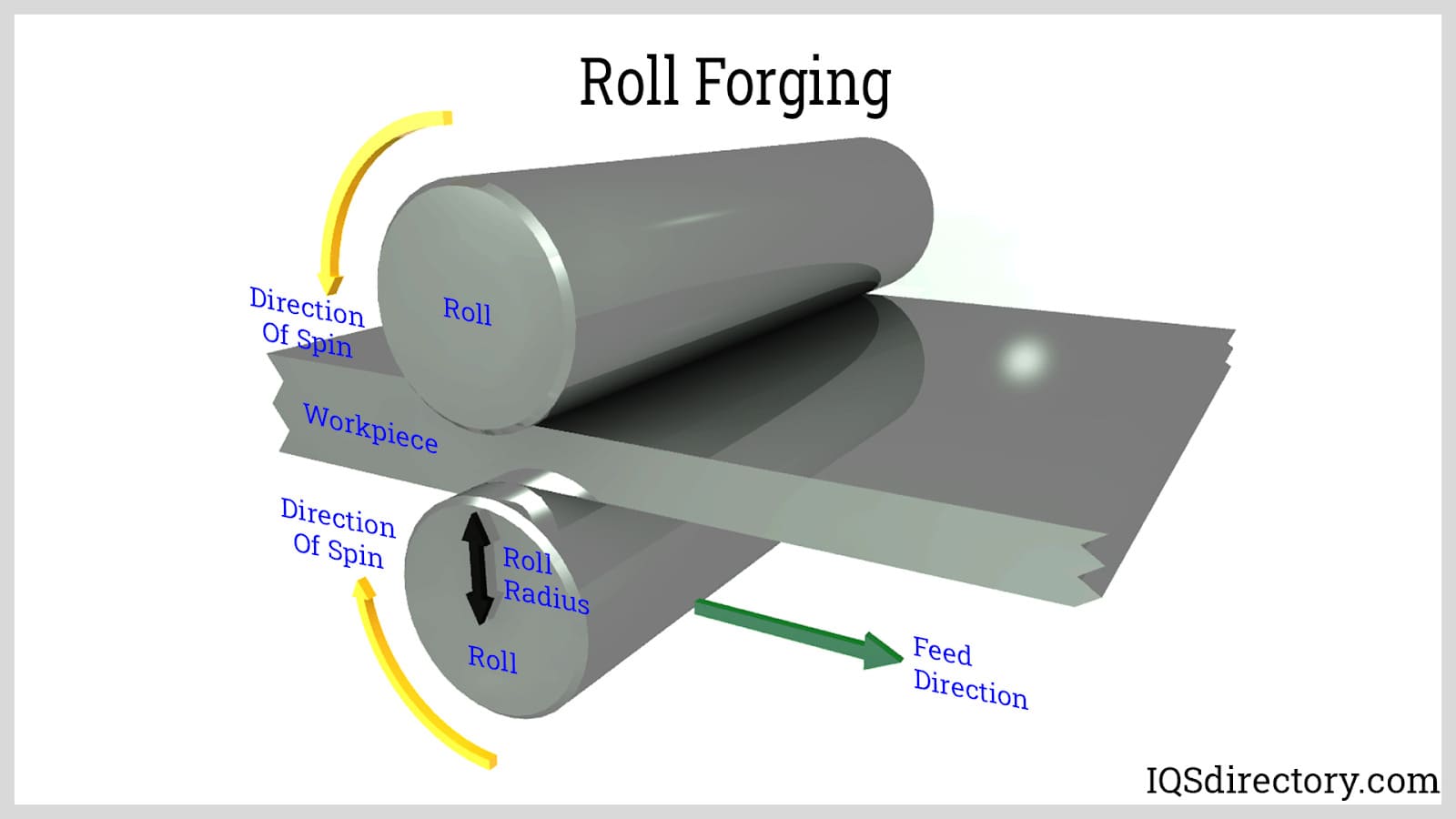 Roll forging uses opposing rolls to shape heated metal into a controlled profile while improving grain flow and reducing material waste.
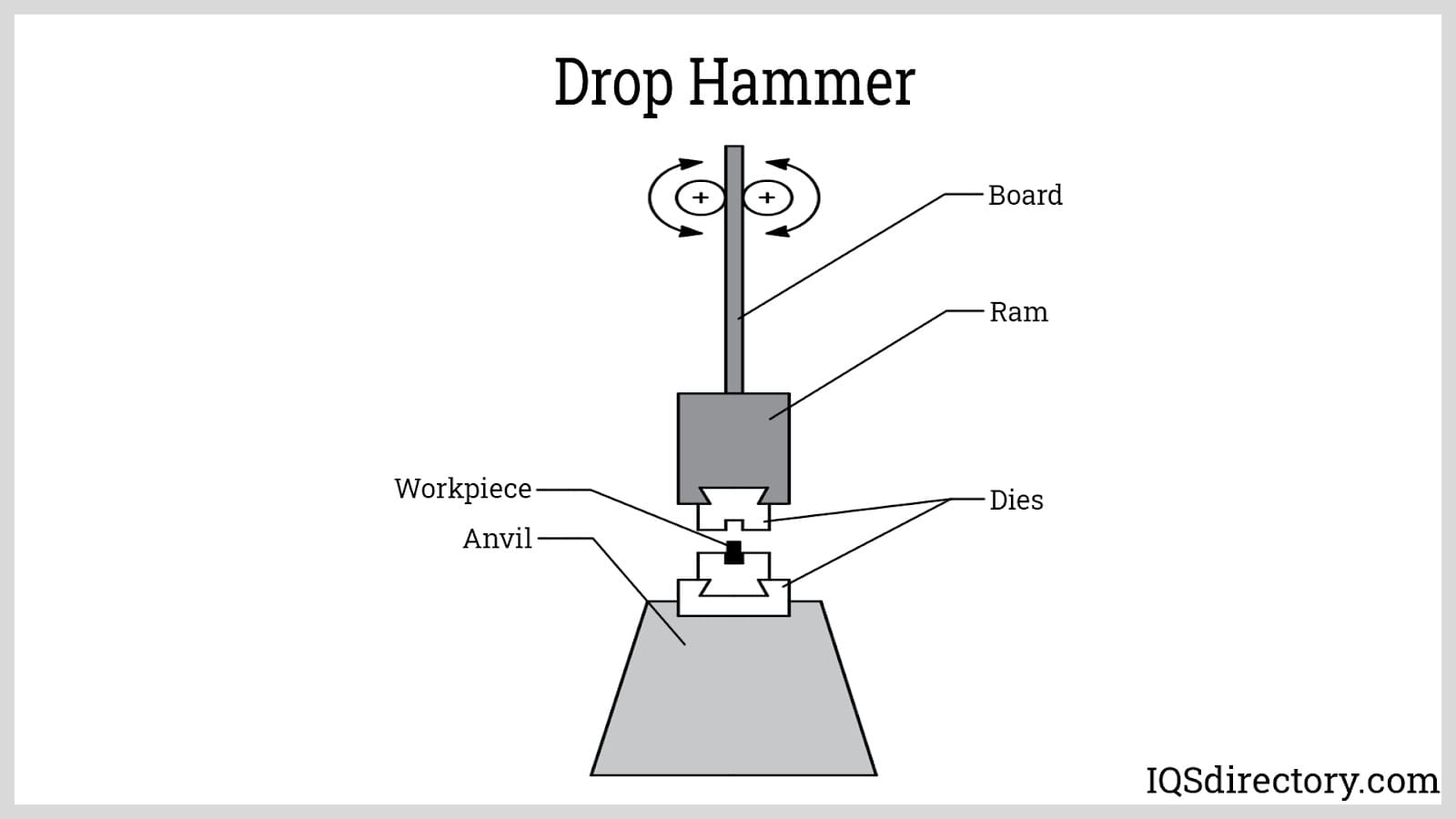 Power drop hammers use pressurized air to raise the ram and deliver a fast, forceful blow that reshapes the workpiece on impact.
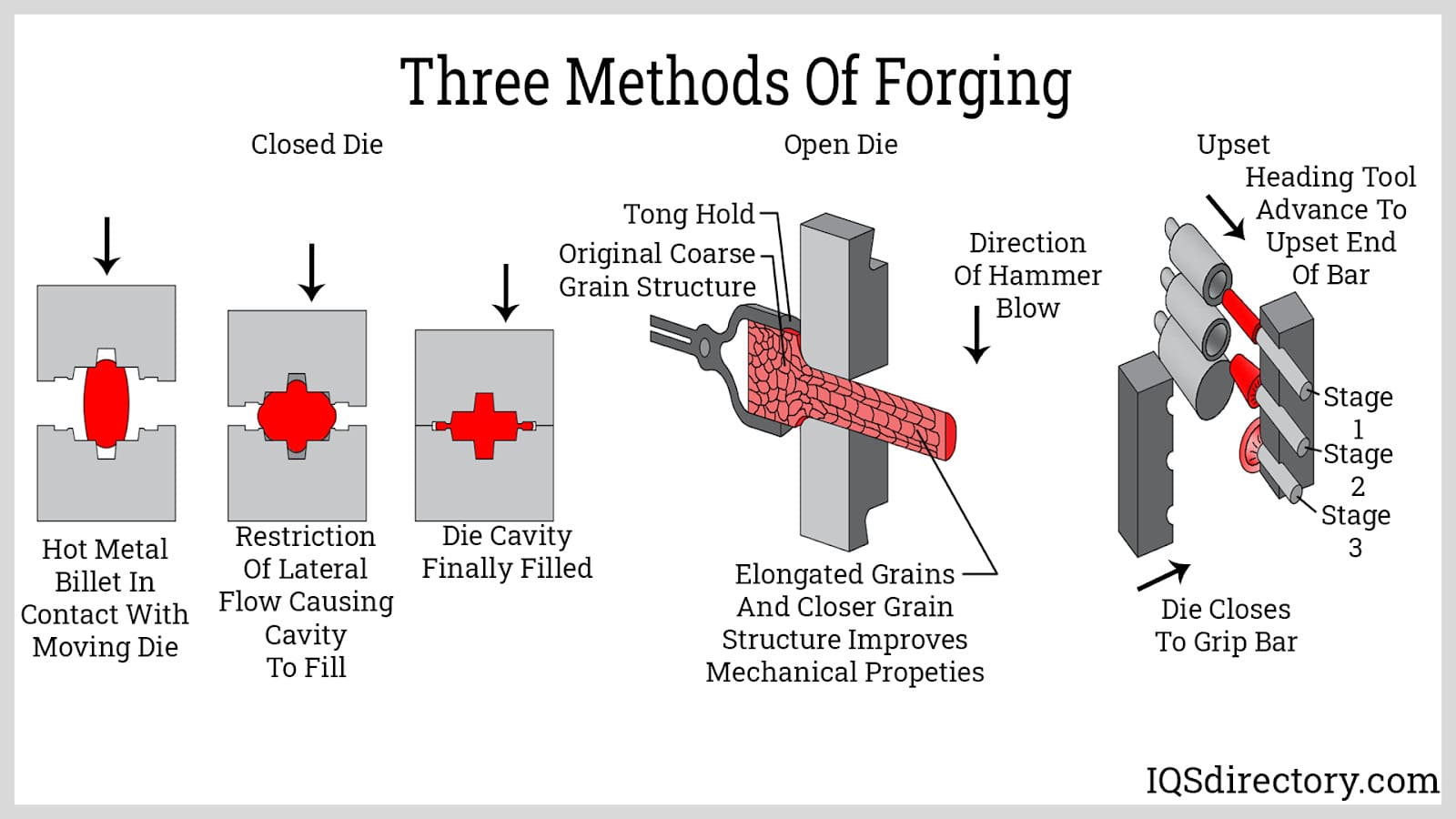 The three different methods of forging help manufacturers compare temperature, tooling, precision, and output goals before choosing a process.
Forging Equipment
Different metals and end-use requirements call for different types of forging equipment. In hot and warm forging, stock must be preheated before forming begins, and that heat may be supplied by a torch, oven, or electrical induction system. Ovens, whether coal or gas fired, offer different benefits. Coal can produce very high heat, while gas systems tend to be cleaner and easier to control for repeatable shop conditions. In cold forging, intense heat is not part of the forming cycle, although mild preheating in some environments can make stock slightly easier to form without approaching hot-forging temperatures.
A drop forge consists of a vertical hammer suspended over a stationary anvil. When released, the hammer falls onto the workpiece, reshaping it while excess energy is absorbed through the foundation. Related systems include counterblow machines and impactors,, which use hydraulic, pneumatic, or electric power to strike metal horizontally. A forging press works differently, applying continuous hydraulic or mechanical force to push raw material into a die shape instead of relying on a single impact. For specialized applications, a ring press forge uses heat and controlled force to form stock into seamless rolled rings, while a roll press forge repeatedly feeds stock between cylindrical rollers to reach the desired profile and dimensional accuracy.
The tooling used in forging must withstand high force, elevated temperature, and repeated contact cycles. Dies that shape metal in presses are commonly produced from high-alloy or tool steel for wear resistance and durability. They may be manufactured through mechanical milling or casting, depending on the application and geometry. In open die forging, the tooling contacts the surface of the metal to guide its form. In closed-die forging, the die halves must align accurately and include a planned amount of flash to meet dimensional goals. Where casting molds are used in die development, a prototype can be embedded in sand or plaster to create a reverse image, cast into metal, and then translated into a durable alloy steel die that can survive repeated production runs.
Whether the work involves artistic metal shaping or large-scale industrial manufacturing, selecting the right forging company can influence quality, lead time, cost control, and downstream machining needs. A jeweler forming gold does not need the same equipment as a producer of high-volume fasteners or heavy forged steel parts. The base metal, part size, tolerance requirements, inspection needs, and production volume all affect which forging method makes sense. Many forging companies also offer heat treating, stress relieving, stock hardening, die machining, and quality testing such as radiography, ultrasonic inspection, or dye penetrant analysis. For buyers asking which forge shop is best for a project, the right answer usually depends on material expertise, press capacity, tooling experience, and the ability to deliver repeatable results.
Forging Terms
- As Forged
- The condition of a part as it leaves the finisher cavity, before trimming, machining, heat treating, coating, or other secondary operations are applied.
- Backward Extrusion
- A forming method in which metal flows opposite the direction of the applied force from the die and punch, shaping the workpiece through controlled displacement.
- Bar
- A hot-rolled metal piece with a uniform cross-section that may be round, square, rectangular, or hexagonal and is commonly used as forging stock.
- Bend
- A lengthwise deformation created during forging or a secondary operation such as trimming, changing the original alignment of the workpiece.
- Billet
- A semi-finished metal product, usually hot rolled, with a uniform cross-section and dimensions larger than many standard bars, used as raw material for further forming.
- Block
- A stage in impression-die forging in which metal is progressively worked into a rough approximation of the final contour before finishing operations refine the shape.
- Bloom
- A semi-finished metal product with a square or round cross-section, often larger than a billet and used as feedstock for rolling, machining, or forging.
- Board Hammer
- A gravity drop hammer that uses vertically raised boards attached to the ram. The boards are lifted by contra-rotating rolls and released so the ram and upper die fall under gravity to deliver impact energy to the workpiece.
- Cavity
- A recessed area in a die that receives and shapes the metal, helping control geometry and dimensional accuracy in die-forging operations.
- Coining
- A precision sizing operation in which pressure is applied to a forged part to improve surface finish, correct deformation, and achieve tighter tolerances.
- Cold Working
- The process of changing a material’s size, shape, and strength through plastic deformation below its recrystallization point, often increasing hardness and strength through work hardening.
- Die
- A tool component in a press used to punch, cut, or form metal by applying force through a defined impression or opening.
- Discontinuities
- Irregularities in a forging, whether internal or external. External discontinuities can include laps, folds, or cracks, while internal issues may appear as porosity or segregated deformation.
- Drifting
- A forging operation used to create a hole or enlarge an existing opening through controlled punching or displacement.
- Efficiency
- A measure of how effectively the applied energy of the equipment is converted into useful deformation of the workpiece, typically expressed as a percentage.
- Extrusion
- A forming process in which metal is forced through a die opening in the same direction as the applied force, producing elongated shapes with a consistent cross-section.
- Flash
- Excess metal that extends beyond the parting line of the die set, helping resist uncontrolled flow and promote complete filling of the die impression before it is trimmed away.
- Flow Stress
- A measure of a material’s resistance to deformation, influenced by temperature, strain rate, and composition, and used to estimate the force needed for forging.
- Forging rings
- Modern forged rings serve major roles in machine tools, turbines, aerospace assemblies, bearings, and high-pressure systems such as pipelines. They are often made from stainless steel, tool steel, aluminum, copper, or alloy steel for strength and durability.
- Large forging
- Forging technology has advanced to support exceptionally large parts used in power generation, marine systems, rail, transportation, construction, and heavy machinery manufacturing.
- Ram
- The moving part of a press to which the punch or upper die is attached. The ram transmits force to the workpiece to shape or cut the material.
- Ring forging
- A specialized process that shapes metal into a hollow circular or cylindrical ring through localized compressive force, producing seamless rings for demanding industrial use.
- Trimming
- A secondary operation that removes excess flash from a forged part so the workpiece reaches its intended dimensions and final shape.
- Twist
- A deformation across the width of a workpiece that causes unwanted rotational displacement. Managing twist helps maintain accuracy in forged components with tight dimensional requirements.