Conveyor Belts
Conveyor belts are material handling systems engineered to move products, components, bulk solids, and packaged goods through manufacturing, warehousing, food processing, mining, and distribution operations by means of rollers, wheels, and pulleys that drive and support a continuously moving conveying surface. These systems can range from simple layouts—such as a belt looped around two rollers mounted on a frame—to highly complex configurations. More advanced conveyor systems manage loading, sorting, inspection, assembly, packaging, palletizing, and shipping with consistent throughput and reduced manual handling. Conveyor belts can also vary widely in size: they may be as small as the drive belts used in household appliances like vacuum cleaners and sewing machines, or as large and powerful as those used to transport farm machinery, aircraft, and even the Space Shuttle.
Conveyor Belts FAQ
What is a conveyor belt used for in industrial applications?
A conveyor belt transports goods, bulk materials, components, or packaged products through manufacturing, packaging, warehousing, and distribution processes. In industrial applications, belt conveyor systems support assembly lines, sortation, inspection, and shipping while improving throughput and reducing manual handling.
Who invented the first conveyor belt system?
The first conveyor belt was introduced in 1795 as a hand-cranked pulley system using a leather belt. In 1892, Thomas Robins developed a conveyor belt for moving coal, helping establish the modern material handling and industrial conveyor systems used in mining, manufacturing, and bulk processing.
What materials are conveyor belts made from?
Conveyor belts are commonly made from rubber, plastic, PVC, polyurethane, silicone, metal mesh, or fabric materials such as polyester and aramid. Each conveyor belt material is selected for strength, flexibility, abrasion resistance, sanitation, temperature range, and suitability for heavy-duty, food-grade, or chemical-resistant applications.
How are food-grade conveyor belts designed for sanitation?
Food-grade conveyor belts are typically made from materials such as Teflon-coated urethane, polyurethane, or silicone and are designed with sealed edges, smooth non-porous surfaces, and washdown-friendly construction. These features help prevent contamination, support sanitation, and simplify cleaning for FDA and USDA regulated processing lines.
What are the different types of conveyor systems used in manufacturing?
Common conveyor systems include roller conveyors, vertical conveyors, vibrating conveyors, pneumatic conveyors, overhead conveyors, and heavy-duty belt conveyors. Each design serves a different material handling need, from moving powders and parts to lifting cartons between levels or transporting large industrial products through production lines.
Why is regular maintenance important for conveyor belts?
Regular maintenance helps prevent belt slippage, stretching, mistracking, and misalignment while supporting safe, efficient conveyor operation. Proper tensioning, lubrication, inspection of pulleys and rollers, and timely replacement of worn components extend conveyor life, improve uptime, and reduce expensive downtime in production and warehouse environments.
Where are conveyor systems commonly found in the United States?
Conveyor systems are widely used in U.S. manufacturing plants, parcel and postal facilities, warehouses, airports, food-processing centers, and agricultural operations. They handle everything from baggage and boxes to packaged foods, parts, and bulk materials in high-volume distribution and production settings.
The History of Conveyor Belts
Conveyor belts and conveyor systems, though now central to modern material handling, are a relatively recent industrial development. The first officially recognized conveyor was introduced in 1795. It used a leather belt stretched across a wooden slider bed and operated by a hand-cranked pulley system for loading materials onto ships. By 1804, the British Navy had developed a steam-powered conveyor for biscuit production, showing how automated conveying could improve output and reduce manual labor.
In 1892, Thomas Robins began developing a conveyor belt system designed specifically to transport coal. These early belts were made from wide leather strips stitched with wire for extra strength, a practical solution for heavy bulk material handling. Then, in 1901, Swedish engineer Sandvik introduced the first steel conveyor belt for moving gravel. A few years later, in 1905, Richard Sutcliffe expanded conveyor use underground, helping mining operations move coal and ore with better speed, consistency, and worker safety.
The roller conveyor made its debut in 1908, opening the door to faster and more efficient unit handling. In 1913, Henry Ford famously implemented the first conveyor belt-driven assembly line in automotive manufacturing, changing production economics and laying the groundwork for modern assembly lines, automated production cells, and continuous-flow manufacturing.
A major leap in conveyor belt technology came in 1957 when the B.F. Goodrich Company patented a rubberized steel belt known as a Mobius strip. The design used a half twist so both sides of the belt surface could wear evenly, extending service life and improving value in demanding conveyor applications. Although later replaced by layered belt constructions with stronger performance and easier maintenance, the Mobius concept represented an important step in conveyor belt engineering.
In 1970, the first all-plastic conveyor belts were patented by Intralox, a Louisiana-based company. As polymer technologies advanced, plastic belts emerged as versatile alternatives to traditional materials, especially where sanitation, corrosion resistance, moisture resistance, and lightweight modular construction mattered. That shift widened the design possibilities for conveyor systems in food processing, packaging, warehousing, and many other industries.
Conveyors of Convenience and Commerce
Conveyor belts play a major role in transporting products that are irregularly shaped, delicate, bulky, or otherwise difficult to handle efficiently by hand. Items can range from pharmaceutical tablets and grains to glassware, live plants, railcar couplers, and large engine blocks. In each case, a properly selected conveyor system improves flow, supports repeatable handling, and helps operations maintain speed without sacrificing product protection.
While many belt conveyor systems run horizontally, others are engineered to move goods vertically, at steep inclines, or around curves and corners. These material handling systems reduce the need for repeated lifting by workers or heavy reliance on forklifts and pallet jacks. Variations of conveyor technology also move people, as seen in escalators, moving walkways, and selected ski lift systems.
Modern conveyor systems often include safety devices, sensors, guarding, and controls that help prevent accidents, reduce product loss, and improve line visibility. A familiar example is the grocery checkout conveyor, which combines controlled movement with automatic stop functions. Drive belts used in automobiles provide another everyday example of how belt technology supports reliable motion, power transfer, and timed mechanical operation.
Conveyors are found across an enormous range of facilities. Manufacturers, packagers, and production companies depend on them to move products through fabrication, filling, sealing, inspection, and packaging stages—whether they are handling bottled beverages, consumer goods, industrial parts, or full-scale vehicles. Logistics companies and parcel carriers use conveyor systems for high-speed sortation, routing, and warehouse automation, making them a foundation of e-commerce fulfillment and modern distribution.
At airports, automated conveyor systems are central to baggage handling, moving luggage from check-in counters to sorting points and departure gates. These systems use scanners, diverters, and sensors to read baggage tags, control routing, and direct each bag to the correct destination with speed and accuracy.
In the food service and food processing industries, conveyor systems are used from harvest to final packaging. Harvesting equipment often uses conveyors to lift crops gently from the field and load them into transport vehicles. After transport, conveyor belts move food through washing, trimming, sorting, cooking, cooling, and packaging. Much of this equipment is built from stainless steel and fitted with food-grade components, while the belts themselves may use urethane or Teflon-coated materials to support sanitation, washdown cleaning, and long service life.
Putting the Belt on Conveyors
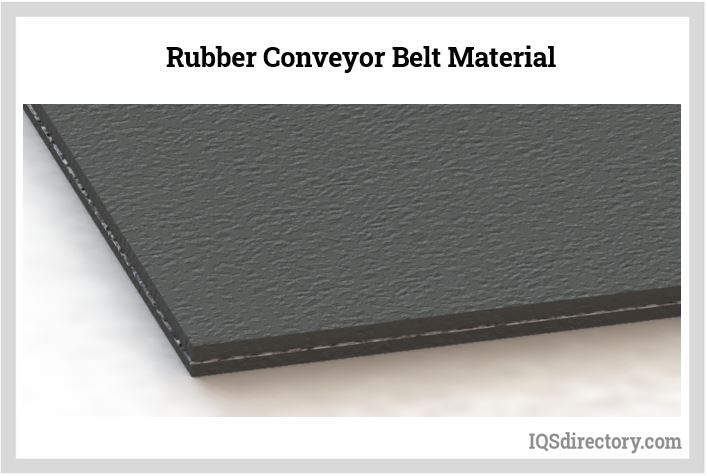
The common conveyor belt is built in multiple layers, with the core layer known as the "carcass." This internal structure is often formed from woven mesh fabric made from steel, nylon, polyester, or similar reinforcement materials and positioned between top and bottom covers. The carcass gives the belt its longitudinal strength, flexibility, and resilience, while the cross weave improves stability and helps protect the belt from lateral damage, stretching, and impact during operation.
Carcass materials may include cotton, polyester, or aramid fibers. Aramid is valued for high tensile strength and heat resistance in demanding conveying environments. The outer covers of the belt are generally made from rubber compounds, plastic, or polyvinyl chloride (PVC), with the final cover selected according to abrasion resistance, oil resistance, chemical exposure, belt tracking needs, and the overall requirements of the application.
Wire belts, also called wire mesh belts, are created by weaving steel cords or forming interlocked metal links. They are often selected for washdown environments, heat exposure, drainage, or applications where airflow through the belt is useful. Solid steel belts made from hinged bars linked together are used when conveyor systems must carry very heavy loads or operate in especially rugged industrial settings.
Food-grade conveyor belts are commonly manufactured from silicone, urethane, polyurethane, or Teflon-based materials and may include anti-microbial properties where the application calls for them. These belts typically feature sealed edges, smooth surfaces, and cleanable constructions that limit contamination buildup and support sanitation programs. Many are also formulated to resist oils, chemicals, and elevated temperatures, and high-heat applications may call for materials such as Kevlar®, Nomex®, or fiberglass.
V-belts, which are typically steel-reinforced rubber belts, come in smooth, cogged, notched, and ribbed configurations to match different drive requirements. These belts are used to transmit power, regulate timing, and manage energy delivery in applications that demand dependable grip and high tensile strength. V-belts are especially well known in vehicles, where they serve as timing belts, fan belts, power steering belts, air conditioning belts, and serpentine drive belts.
Endless conveyor belts are either molded through vulcanization or woven to exact lengths, creating a continuous loop with no beginning or end. This seamless design promotes quiet operation, even wear, and reliable belt tracking. When a belt must be joined, splicing methods such as clipper lacing provide a durable yet flexible connection that supports maintenance access and consistent conveyor performance.
Conveyors Images, Diagrams and Visual Concepts
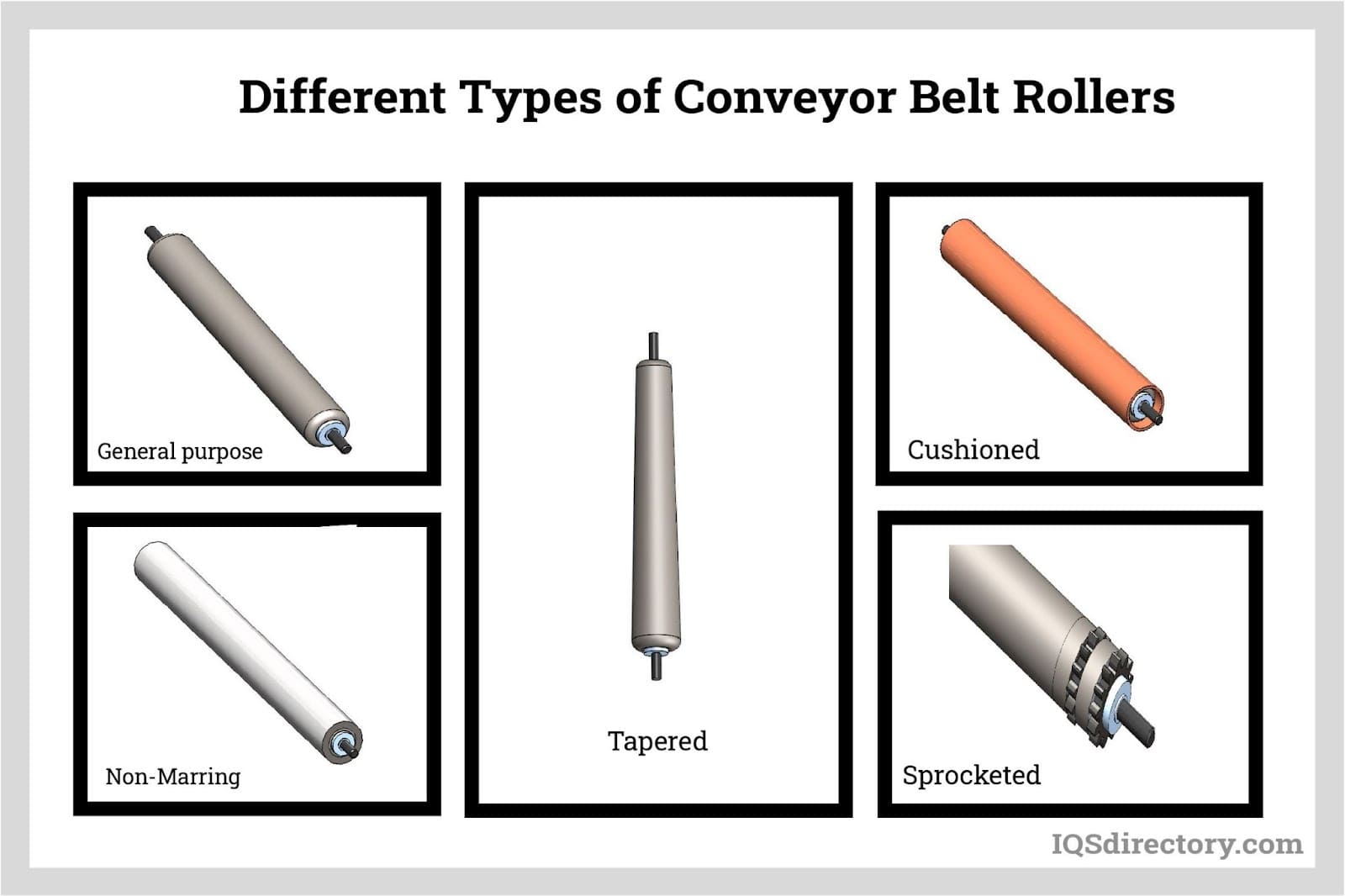 Conveyor belt rollers support both the product load and the return path of the belt, helping maintain stable movement and proper belt tracking.
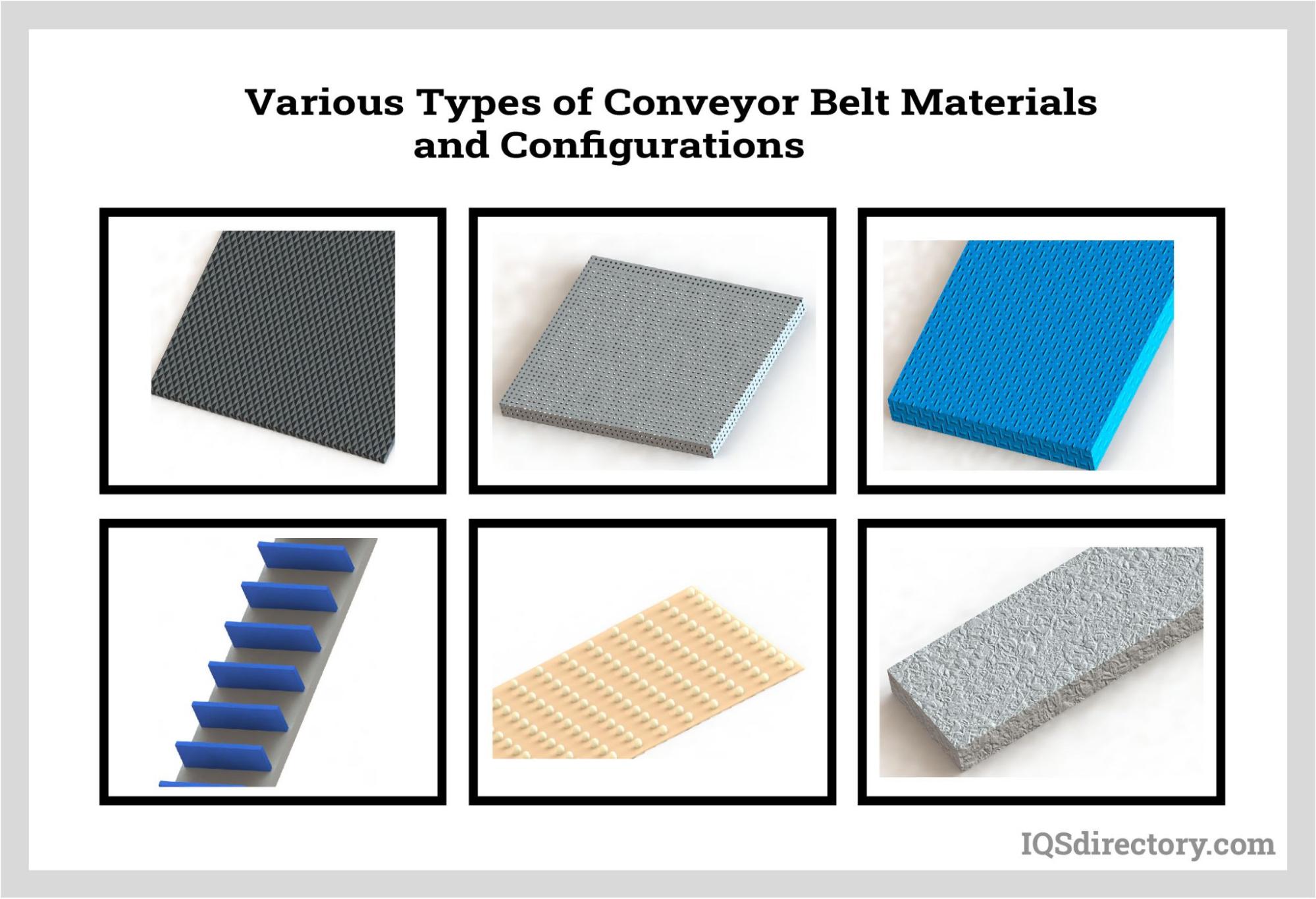 This illustration shows common conveyor belt materials and belt configurations used for unit handling, bulk handling, and specialized industrial conveyor applications.
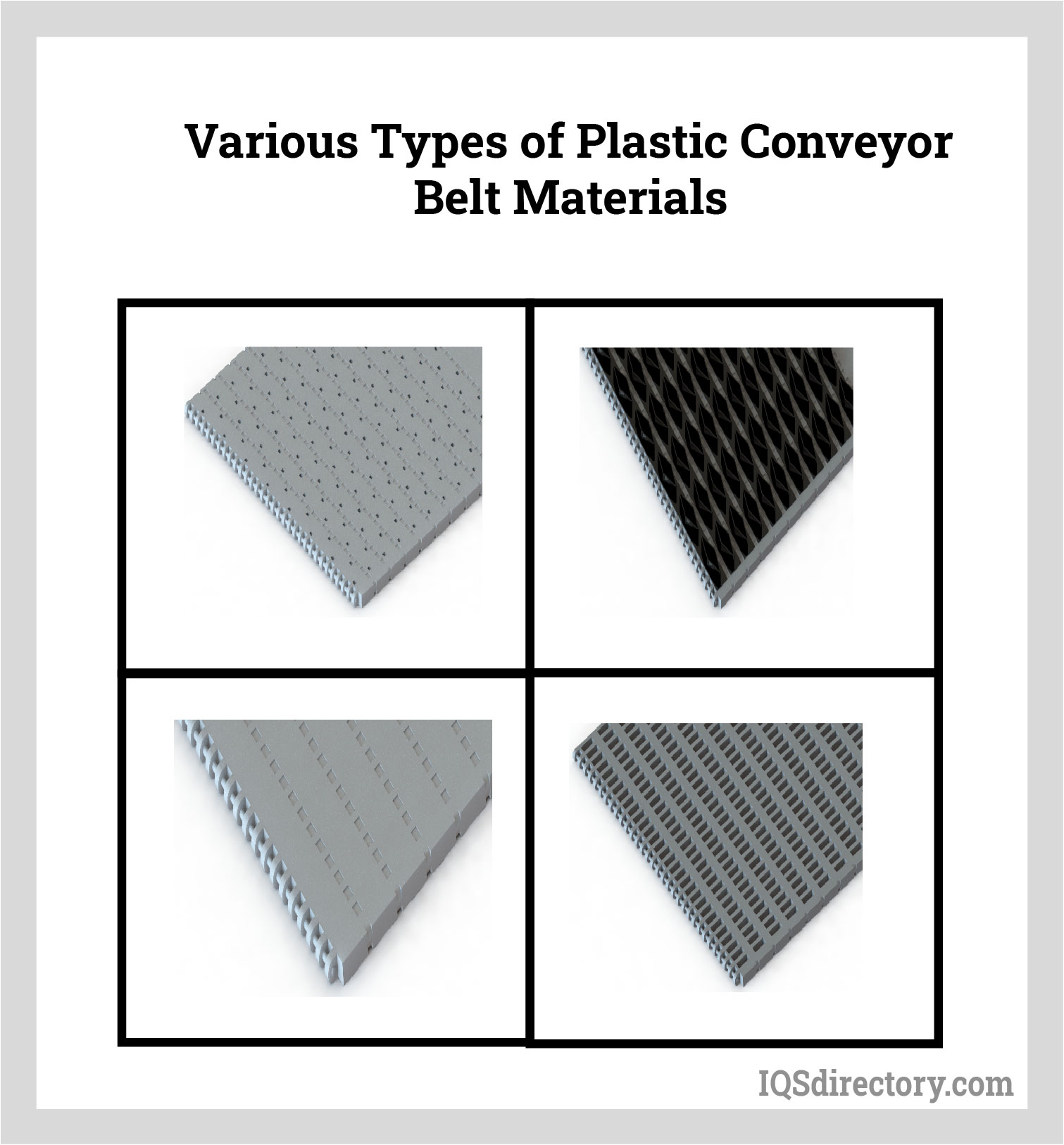 Plastic conveyor belts are lightweight, temperature-resistant, and well suited for bends, curves, inclines, and declines in sanitary or corrosion-resistant conveyor systems.
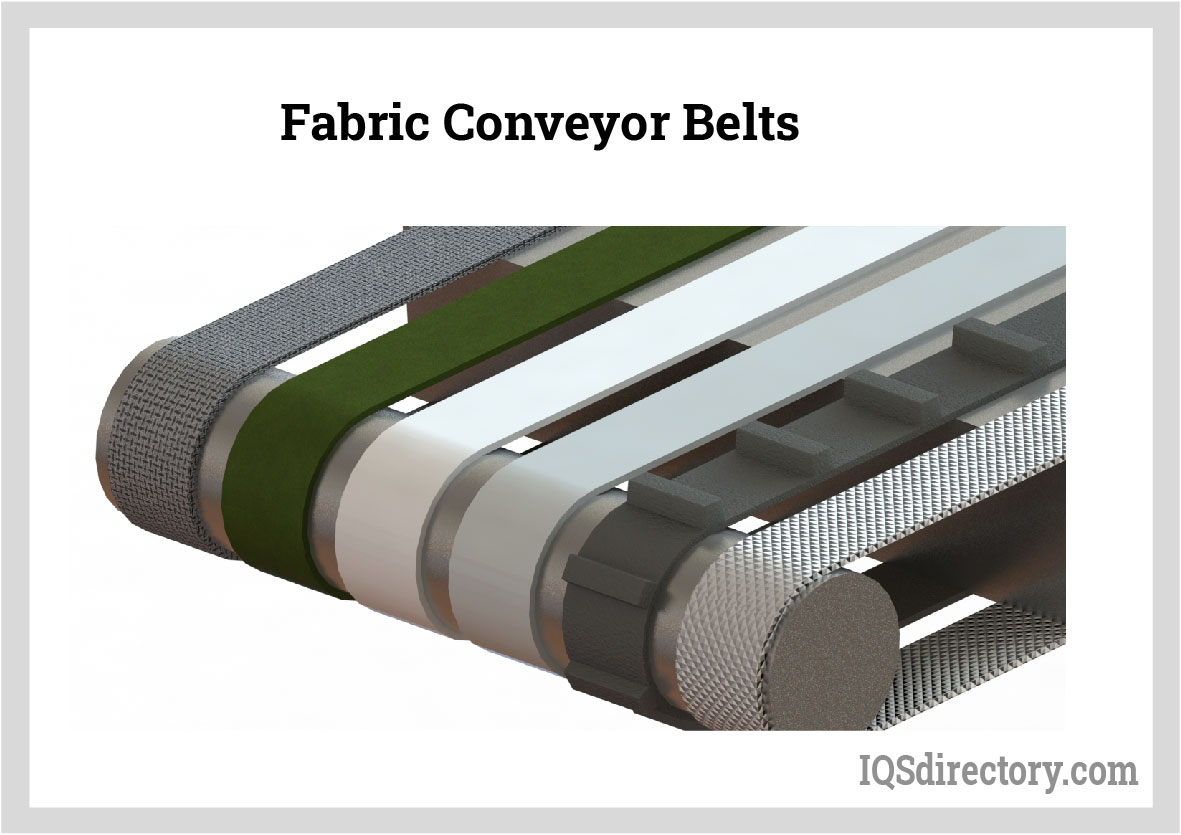 Fabric conveyor belts are cost-effective for shorter conveying systems with lighter capacities and are built from layered synthetic fabrics designed to resist stretch.
 Roller bed conveyor belts use rollers selected for product weight and belt speed so friction is reduced and overall conveying efficiency improves.
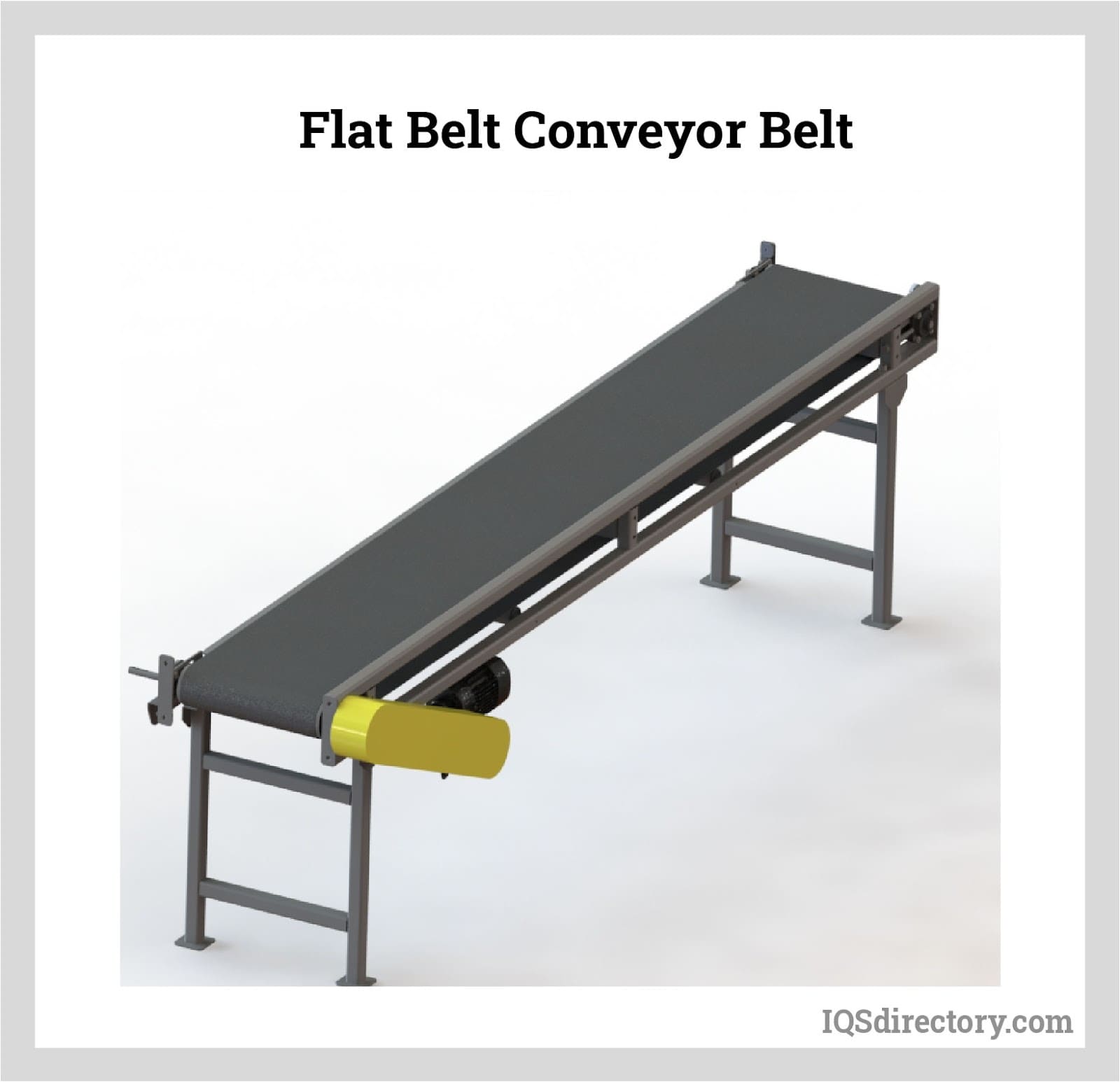 Flat belt conveyor systems use a series of pulleys to move products, parts, cartons, and materials through straight-line material handling operations.
Types of Conveyors
-
Portable Conveyor Belts
These conveyors are designed to move easily from one work area to another, making them useful when mobility matters but a fully permanent installation is not required. Portable conveyor units often use galvanized steel rollers on a sturdy frame and are common on construction sites, loading docks, truck loading areas, and flexible warehouse operations where temporary material flow needs to be set up quickly.
Heavy Duty Roller
These conveyor systems are built to manage loads exceeding 500 pounds and are engineered for reliable service in rugged environments. Heavy duty roller conveyors are often selected for pallets, containers, fabricated parts, and large industrial products where frame strength, roller durability, and dependable throughput are top priorities.
Vertical Conveyor Systems
Also known as spiral conveyors or vertical lift conveyors, these systems move materials between different levels while preserving floor space. A vertical lift raises products on a platform or set of arms, while spiral conveyor systems provide continuous flow along an incline, making them common in warehouses, distribution centers, and multilevel manufacturing plants.
Vibrating Conveyor Systems
These systems use vibration to move materials gently and consistently, making them useful for hot, abrasive, corrosive, dirty, or delicate products. Vibrating conveyors are also widely used in food processing and pharmaceutical applications where controlled product flow, separation, and sanitation matter and where traditional belt handling may be less suitable.
Pneumatic Conveyor Systems
Pneumatic systems use compressed air to move lightweight, powdered, or granular materials such as fly ash through enclosed tubes or piping. Because the conveying path is sealed, pneumatic conveyors are useful where dust control, containment, and product cleanliness are important. Outside industrial settings, similar systems appear in drive-up banking and document transport applications.
Mining and Dredging Operations
In mining and dredging, various types of conveyor systems are employed to handle tough materials. Bucket conveyors, screw (or auger) conveyors, and overland conveyors are key to these operations. Overhead I-beam conveyor systems, typically chain-driven, are used in environments like automotive repair shops and metalworking facilities. These conveyors support the efficient movement of heavy parts and tools across workstations. A comprehensive list of screw conveyor manufacturers is available on the IQS Directory website In mining and dredging, several conveyor designs are used to move abrasive, heavy, or high-volume materials. Bucket conveyors, screw conveyors, auger conveyors, and overland conveyors are all common choices, while overhead I-beam conveyors help move heavy parts in repair shops and metalworking facilities. These systems are selected for durability, carrying capacity, and the ability to keep production flowing under rough service conditions.
Types of Conveyor Belts
-
Anti-Static Belts
Designed with compounds and constructions that limit static buildup, these belts are used where static discharge could interfere with electronics, attract dust, or create handling problems for lightweight products.
Anti-Vibration Belts
Engineered to reduce vibration throughout a conveyor system, these belts are helpful in lines with minor pulley misalignment or equipment that would otherwise transfer vibration into the belt path. Lower vibration can reduce wear, stretching, and surface abrasion over time.
Armored Belts
Armored belts use crosswise reinforcement in the belt cover, often with metal or other durable inserts, to resist cuts and tearing from sharp, jagged, or highly abrasive conveyed materials.
Cable Belts
Cable belts are strengthened with internal metal cables running lengthwise through the belt body. This design provides high tensile strength and dependable performance in long runs, steep inclines, and heavy-duty conveyor applications.
Conveyor Belt Materials
Common materials used in conveyor belts and power transmission belts include rubber, plastic, leather, fabric, PVC, polyurethane, silicone, and several metals. Each belt material is selected for a blend of flexibility, strength, surface grip, sanitation, temperature resistance, and service life.
Endless Belting
Belts manufactured as a continuous loop without seams. Endless belts support smooth tracking, uniform wear, and steady conveying performance where vibration and splice points are best kept to a minimum.
Fin Belts
Fin belts include raised projections that help guide, separate, or position products. They are often used in packaging lines where containers or parts must be oriented before boxing, filling, or downstream automation.
Flat Belts
Flat belts have a smooth, flat conveying surface and are widely used in straight-line conveyor systems that move cartons, packages, and components with stable linear motion.
Industrial Belts
Industrial belts are the broad category of conveyor belts and power transmission belts designed for factory, warehouse, processing, and manufacturing environments where durability and dependable operation are required.
Multi-Speed Belts
These belts are used in systems that require variable speed capability, including selected vehicle and machinery applications where speed changes are part of normal operation.
Nylon Belts
Manufactured from solid extruded nylon, or polyamide, these belts offer strong wear resistance, good durability, and dependable performance in conveying and power transmission applications.
O-Ring Belts
Also called round belts or endless belts, these circular-profile belts are suitable for light-duty and selected heavy-duty low-torque applications where compact belt routing is useful.
Plastic Conveyor Belts
Constructed from molded or shaped plastic materials, these belts are widely used where moisture resistance, chemical resistance, low maintenance, or easy sanitation are required, especially in food, beverage, and washdown environments.
Power Transmission Belts
These belts transfer power from one mechanical component to another within a machine or system, making them common in motors, drives, packaging equipment, and many forms of industrial machinery.
Round Belts
Round belts have a circular cross-section and are commonly used in power transmission and specialized conveying applications where flexible routing and compact pulley arrangements are helpful.
Rubber Belting Rubber belting includes belts made from natural or synthetic rubber compounds such as neoprene or silicone. These materials provide flexibility, grip, and durability across a wide range of conveyor belt and industrial drive applications.
Specialty Belting
Specialty belting refers to custom or non-standard belts built for unique conveying or power transmission needs, including unusual product shapes, environments, temperatures, or machine designs.
Timing Belt
Timing belts are power transmission belts designed to keep mechanical motion synchronized. In automotive and industrial drive systems, they help control shaft timing and repeatable motion with minimal slippage.
Twisted Belts
Twisted belts are designed to replace damaged endless round belts quickly. Because they can often be installed without taking the full drive system apart, they are useful for emergency repairs and reduced maintenance downtime.
Urethane Belting
This term is often used for polyurethane belts in casual conversation, but polyurethane is usually the more accurate material description in belting applications. These belts are chosen for wear resistance, flexibility, and clean operation.
V-Belts
V-belts have a V-shaped cross-section that helps them seat securely in pulley grooves for reliable power transmission. Standard and inverted versions are used in many drives where grip, load transfer, and mechanical efficiency matter.
Maintaining the Beltline
The first step in maintaining a conveyor belt system is selecting the right system for the job. A conveyor should perform the required material handling task efficiently without wasting space, time, or energy. Belt width, layout, drive type, incline, and product characteristics all influence the best design. Once the system is installed, inspection frequency and maintenance intensity should be based on operating hours, load conditions, product type, and the environment in which the conveyor runs.
Take-up adjustment is an important part of conveyor system maintenance because it compensates for slack, stretch, and normal wear in the system. In chain-driven systems, chains can gradually elongate, reducing efficiency and increasing the chance of safety problems. When belt tension is not maintained correctly, belts may mistrack, slip off rollers, twist, or tear. Loose lacing should be replaced promptly, and proper tensioning helps support smooth operation, accurate tracking, and longer belt life.
Because conveyor systems contain continuously moving components, they require consistent lubrication with products suited to the application. Environmental contamination, part wear, and interaction with conveyed materials should be watched closely. Dust from corrugated boxes, powders, or bulk materials can interfere with sensors and moving parts, so good housekeeping and dust control are valuable. Routine inspections should include worn belts, damaged rollers or pulleys, loose fasteners, springs, hooks, rust, and corrosion so the system continues to run safely and efficiently.
Innovative Uses for Conveyors
With conveyor belts now visible in many public and industrial spaces, using the belt surface for messaging has become increasingly practical. Much like the scrolling lines seen on television broadcasts or digital signage, the uncovered portions of a moving belt can carry readable communication. In factories, that message area can be used for safety reminders, quality prompts, or production status cues. In public settings, it can carry public service messaging or promotional content while taking advantage of the conveyor’s constant motion and high visibility.
Finding the Right Conveyor System
When searching for conveyor systems for a business, it helps to start with the full scope of the material handling task. Buyers often ask: what conveyor works best for boxes, pallets, powders, food products, steep inclines, or curved paths? The size, shape, weight, and rigidity of the materials being moved will directly influence the best conveyor type. Travel distance, required speed, line accumulation, turns, elevation changes, and future expansion should all be considered before a system is specified.
A knowledgeable conveyor system representative will review the workspace, product flow, environmental conditions, and operating goals before recommending or designing a system. ISO standards provide detailed guidance related to conveyor safety, performance, and quality for many application types. A reputable supplier understands how to apply those requirements while matching the equipment to the job, whether the need is a heavy-duty bulk material conveyor, a sanitary food conveyor, or a warehouse distribution line. You’ll find a convenient list of producers we work with at the top of this page.
Conveyor Belt Terms
-
Automatic Take-Up
A mechanism used to maintain proper conveyor belt tension by compensating for normal stretching, shrinkage, or movement during operation.
Backstop
A safety device that prevents an elevator or incline conveyor belt from moving backward after the drive stops.
Bed
The flat support surface over which a conveyor belt slides or is carried during normal operation.
Belt Clamp
Metal plates or beams positioned at either end of a conveyor belt to secure the belt during installation, maintenance, or repair work.
Belt Fastener
A mechanical component used to join conveyor belt ends securely so the belt can operate as a continuous loop.
Belt Installer
A tool used to help install belts onto conveyor rollers or pulleys more quickly and with less manual effort.
Belt Width
The full distance across a conveyor belt, measured from one outer edge to the opposite outer edge.
Carrying Run
The loaded portion of the conveyor belt that carries products or bulk materials from the loading point to the discharge point.
C-Clip
A clamping device attached to shafts to keep spools or related components positioned correctly on the conveyor system.
Clinched Selvage
A belt-edge construction method in which a connecting rod is looped through an extra hole and bent back parallel to the belt strip for secure retention.
Drive Sprockets
Sprockets located at the discharge end of a conveyor that pull the loaded belt under power and help maintain positive drive engagement.
Drive Tension
The maximum operating tension a conveyor belt can withstand before failure or permanent damage occurs.
Flexing
The bending action experienced by a conveyor belt as it passes over rollers, pulleys, or sprockets.
Immediate Set
The amount of visible deformation that remains in a belt immediately after a load is removed.
Impact Resistance
A measure of how well a conveyor belt absorbs forceful loading or shock without damage.
Lateral Pitch
The distance across the belt width between the centers of two adjacent drive openings or engagement points.
Mesh
An open, grid-like material construction; in conveyor belting, wire mesh is used as a durable option for heat, drainage, or heavy-duty service.
Pulley
A grooved wheel that guides and supports belts or chains, changes direction, and helps transmit motion in a conveyor belt system.
Reefed
A term describing a belt folded back and forth onto itself, often for storage, handling, or packaging.
Splice
The method of joining two ends of a conveyor belt, often by lacing, mechanical fasteners, or other belt-joining techniques.
Spool
A clutch-like component in some conveyor systems that allows controlled slipping during jams to limit wear and add a layer of operator protection.