Bolts
Industrial bolts are a form of high-strength hardware designed to fasten two or more workpieces together. They feature threads—helical ridges that wrap around the shaft, which enable them to be secured with nuts. In many assemblies, they are selected for strength, repeatability, and the ability to service a joint without cutting or welding the connected parts.
It’s important to note that screws, another type of threaded fastener, share a similar construction with industrial bolts. This similarity often causes confusion, leading many people to use the terms interchangeably. Understanding that distinction helps buyers compare fastening methods, load paths, and maintenance needs more accurately.
Buyers researching industrial bolts often compare bolt grades, thread pitch, corrosion resistance, and material strength before choosing a fastener. In practice, the right bolt supports safe clamp load, dependable joint retention, easier maintenance, and compatibility with matching nuts, washers, and installation tools.
Bolts FAQ
What are industrial bolts used for?
Industrial bolts are used to fasten two or more components with a secure, serviceable joint. They are common in construction equipment, production machinery, structural steel, transportation systems, and plant maintenance because bolted connections combine strength, repeatability, and easier replacement when assemblies need inspection or repair.
How are bolts different from screws?
While both are threaded fasteners, bolts are generally paired with a nut and used through an unthreaded or clearance hole, while screws more often cut into or engage the material itself. In industrial applications, that difference affects joint design, clamp load, serviceability, and how the fastener performs under vibration or repeated maintenance.
What materials are commonly used to make bolts?
Common bolt materials include carbon steel, alloy steel, stainless steel, aluminum, brass, copper alloys, titanium, and selected plastics. Material choice depends on load, corrosion resistance, temperature, weight, conductivity, and the environment in which the fastener will operate.
What are the main parts of a bolt?
The main parts of a bolt are the head, shank, threads, and chamfered end. Together these features allow tool engagement, alignment through the joint, controlled tightening, and smoother nut starting during assembly.
What are the most common types of bolts?
Common bolt types include hex bolts, anchor bolts, carriage bolts, U-bolts, lag bolts, eye bolts, flange bolts, and machine bolts. Each is designed around a particular installation method, substrate, load path, or industry use case.
How are industrial bolts manufactured?
Industrial bolts are commonly manufactured from wire rod through cleaning, coating, cold heading or cold forming, head formation, and thread rolling. This process supports consistent dimensions, strong grain flow, efficient production, and reliable thread quality for high-volume industrial hardware.
Why are bolt standards important in manufacturing?
Standards such as ASTM and ISO help define dimensions, thread form, mechanical properties, tolerances, and material expectations. Standardization improves interchangeability, supports safer assembly practices, and helps buyers match bolts, nuts, washers, and tools across suppliers and projects.
How can you prevent bolts from rusting or corroding?
Corrosion can be reduced by choosing the right material, finish, and storage conditions. Stainless steel, protective coatings, dry storage, routine inspection, and timely cleaning all help extend service life and protect clamp load in outdoor, washdown, or chemically exposed environments.
Applications of a Bolt
Bolts are designed to hold two or more surfaces or components securely together. Due to their versatility, industrial bolts are common components in nearly all types of machinery.
They are widely used across various industries, including military, construction, automotive, aerospace, civil engineering, petrochemical, and architecture.
Because bolted joints can be disassembled without cutting or damaging the assembly, they are preferred in equipment that needs field service, routine inspection, replacement parts, or future upgrades. That makes industrial bolts a practical choice for production lines, structural connections, heavy equipment, transportation assemblies, and general plant operations.
The History of Bolts
Around 200 BCE, Archimedes is credited with inventing the screw pump, which used the principle of the screw. This pump consisted of a shaft with helical threads inside a tube, allowing water to be lifted from low-lying bodies of water for irrigation. While Archimedes is often praised for this invention, historical evidence suggests that he adapted the idea from the Egyptians, who had already been using wooden screw pumps for irrigation. Some historians attribute the creation of threaded screws to another Greek, Archytas of Tarentum, who is said to have come up with the idea of threaded bolts 200 years before Archimedes. This early understanding of helical motion laid the groundwork for later threaded fastener development.
Modern bolts, however, came into use much later, during the 15th century, when German publisher Johann Gutenberg used them to fasten the components of his printing presses. Over time, bolts found their way into other equipment, such as armor and clocks. As the demand for screws and bolts grew, engineers began using bolt-cutting machines. As manufacturing improved, bolts moved from specialty hardware into broader industrial and mechanical use.
Despite these advancements, bolts were still produced on a small scale until the Industrial Revolution, when they became integral to engineering and manufacturing. In the 18th century, engineers created the first thread-cutting machines, paving the way for mass production. However, different companies had their own standards for thread sizes, leading to a market flooded with a wide range of screw threads, which created confusion and inefficiency in the industry. Standardization and machine production helped make bolts more interchangeable and practical for larger-scale manufacturing.
To address this, in 1841, English engineer Joseph Whitworth proposed the idea of standardizing screw threads in industrial bolts. He recommended a consistent thread angle and number of threads per inch, which helped standardize the bolt industry in Britain. At the same time, engineers in America and Canada worked on creating standardized threads for specific bolt diameters. Thread standardization improved fit, reduced confusion, and supported more dependable assembly across suppliers.
During World War II, the need for uniformity became even more pressing as American, British, and Canadian manufacturers worked together to create vehicles and weapons that could be used and repaired across all their nations. This led to an agreement on a unified standard that used imperial measurements, with a 60-degree flank angle, flat crests, and rounded roots to improve fatigue performance.
Since World War II, bolt standards have continued to evolve with updated ISO standards, metric property classes, and more. Engineers have also developed bolts designed for high-temperature environments, using materials like nickel-based alloys. In recent years, there has been significant progress in refining bolts made from materials such as titanium, magnesium, and aluminum. Today, both material science and quality control continue to shape industrial fastener performance.
Advantages of Bolts
Bolts offer several advantages as fasteners. First, they are relatively inexpensive to produce. Second, bolts and nuts are easier to install and replace compared to other fastening methods, such as welded fasteners. Third, inspecting bolts fastened with nuts is simpler and more cost-effective than inspecting welded bolts, which may require time-consuming and expensive x-ray inspections. In contrast, bolts and nuts can typically be inspected visually. Finally, bolts and nuts provide reliable and consistent connections.
Another advantage is flexibility during design and maintenance. Engineers can specify head style, coating, material, diameter, and thread form to match the joint, while maintenance teams can remove and replace worn hardware without disturbing surrounding components. For buyers, that often means lower downtime and more predictable long-term service costs.
Bolt Design
-
Production Process
The manufacturing of standard metal bolts involves several steps. First, manufacturers heat a wire rod in a furnace for approximately 30 hours, followed by a sulfuric acid bath to remove any rust particles. Next, they coat the rod with phosphate to provide rust resistance and lubrication, completing the pre-treatment process.
After pre-treatment, the rods are shaped through cold forming. This involves applying high pressure and using long, round dies to shape the rod at room temperature. Once shaped, the rod is cut into shorter pieces, which are then fed into another die to form the heads of the bolts.
The final step is threading, where the bolts are passed through high-pressure rollers to press in the thread pattern.
Material Design
The materials used in the production of industrial bolts vary widely, including aluminum, brass, copper alloys, plastics, steel, and titanium. Each material offers distinct advantages. For example, aluminum is used for light, electrically conductive bolts that are resistant to corrosion and thermal energy. Brass, known for its low magnetic permeability, is ideal for bolts with oxidation resistance. Copper is chosen for its excellent wear resistance, while plastic provides water resistance for light loads. Stainless steel is highly resistant to chemicals and corrosion, making it ideal for harsh environments.
Design Aspects
Bolt manufacturers must consider several design factors when creating bolts. These include the major diameter of the external thread, the pitch (the distance between the crests of adjacent threads), the helix angle (the slope of the thread), and the thread angle (the V-shaped angle formed by the crest of the threads).
Customization
Bolt manufacturers can create custom fasteners tailored to specific needs. Customization options include variations in material, head type, head marking, screw grade, and tensile strength. They can also produce bolts with either fine or coarse threads, with coarse threads being the most common for general applications. For added durability, bolts can be coated with corrosion-resistant layers to extend their lifespan.
When evaluating bolt design, manufacturers and buyers also look at shear load, tensile strength, preload, joint thickness, operating temperature, vibration, and exposure to moisture or chemicals. These design considerations help determine whether a standard fastener will perform well or whether a custom bolt, coating, or material combination is the better fit.
Parts of a Bolt
-
Head of a Bolt
The head of a bolt serves as the point where tools apply or resist torque during fastening or removal. It also acts as a bearing surface that holds the substrate from one side.
Different types of industrial bolts have various head designs, such as square-shouldered heads, indented hexagonal heads, hexagonal washer heads, trimmed hexagonal heads, and flanged hexagonal heads.
A square-shouldered head features a truss head on a square shank designed to resist motion. Indented hexagonal heads are designed with a depression that fits standard wrench dimensions, making them ideal for use with wrenches. The hexagonal washer head incorporates a washer into the bolt head, providing protection to the assembly from damage during installation. Trimmed hexagonal heads are found on standard bolts and feature clean, sharp corners for a more streamlined design.
Bolt Shank
The shank of a bolt is the long shaft, which has helical threads applied externally. It is the longest part of the bolt, providing the alignment needed for fastening the components together.
Bolt Chamfer
The chamfer refers to the slightly beveled end of a bolt where the nut is fastened. This beveled edge helps ease the insertion of the bolt into the nut, ensuring smoother engagement during assembly.
Understanding these bolt parts helps when comparing fasteners for real-world assemblies. Head design influences tool access and torque transfer, shank dimensions affect alignment and grip, and thread quality helps determine how smoothly the nut runs on and how consistently clamp force develops during tightening.
Bolts Images, Diagrams and Visual Concepts
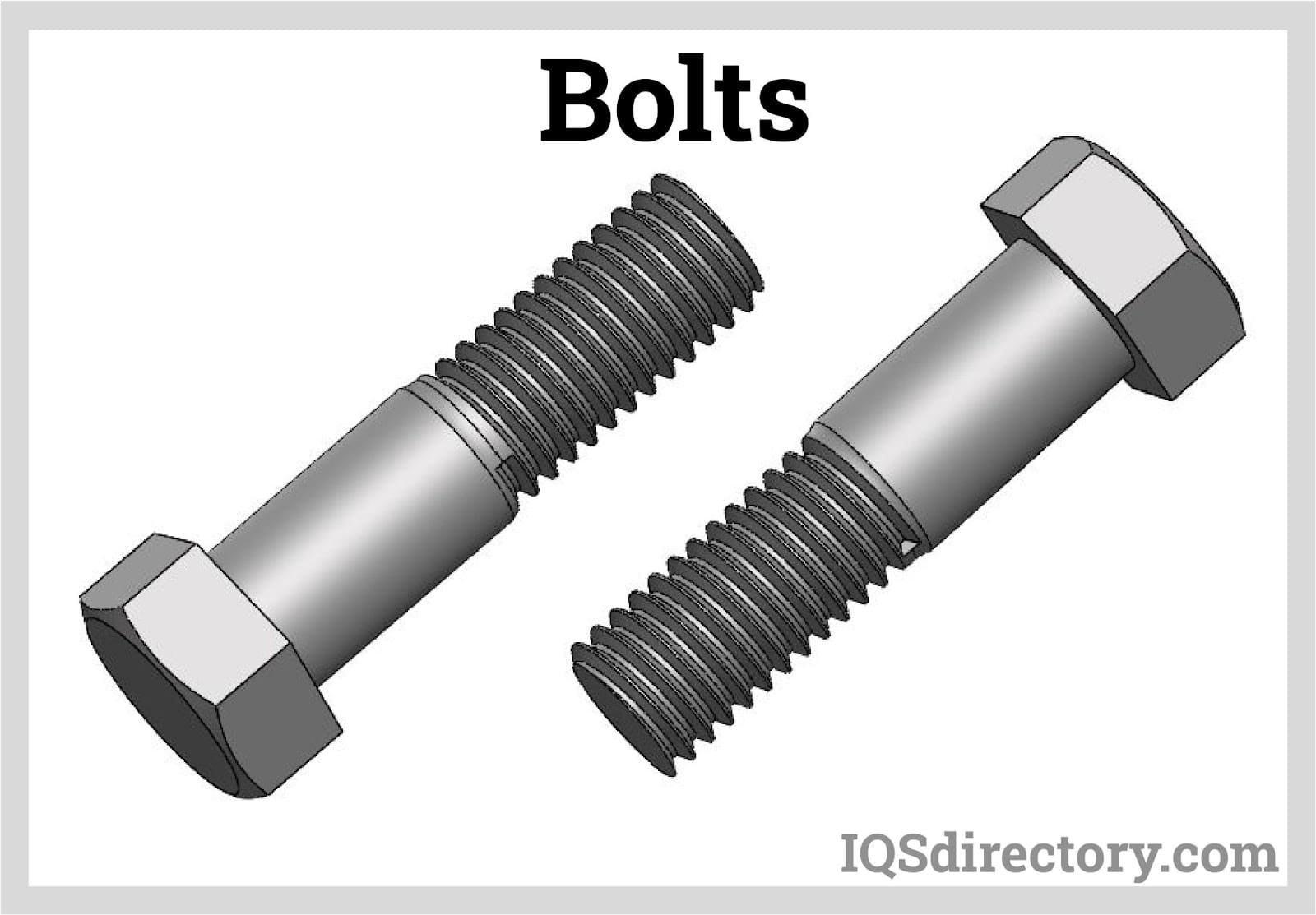 Bolts are used to fasten and secure the faces of assemblies using a nut and connects aligned unthreaded holes by being placed through the aligned holes which is secured with the a nut. In industrial fastening, this bolted joint style is widely used when parts must stay secure yet remain removable for inspection, service, or replacement.
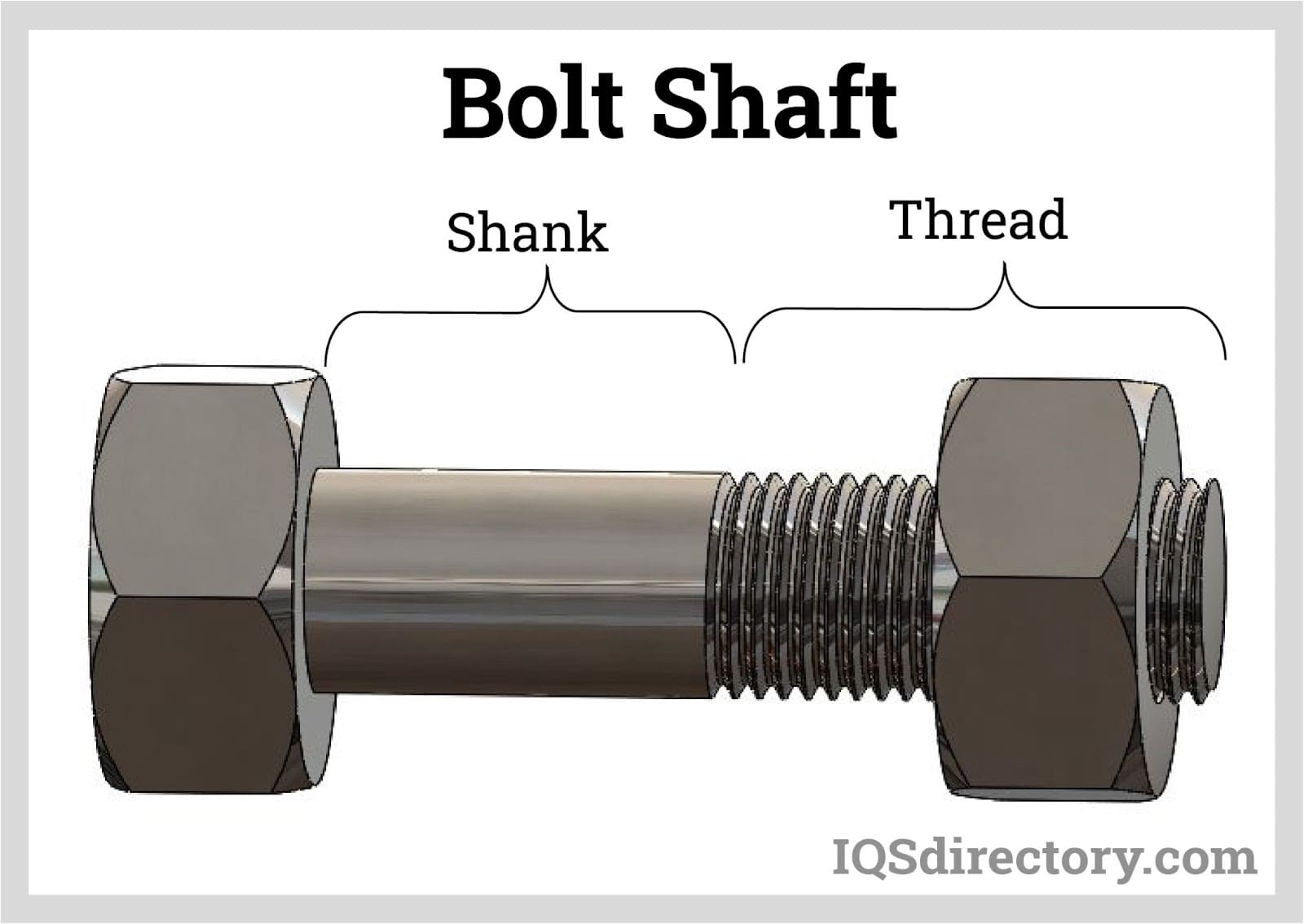 The shaft, a cylindrical member that bears the shear forces acting on the bolt and prevents the radial movement of the parts. The bolt shaft also helps maintain alignment between joined parts and contributes to how the assembly resists shear forces under load.
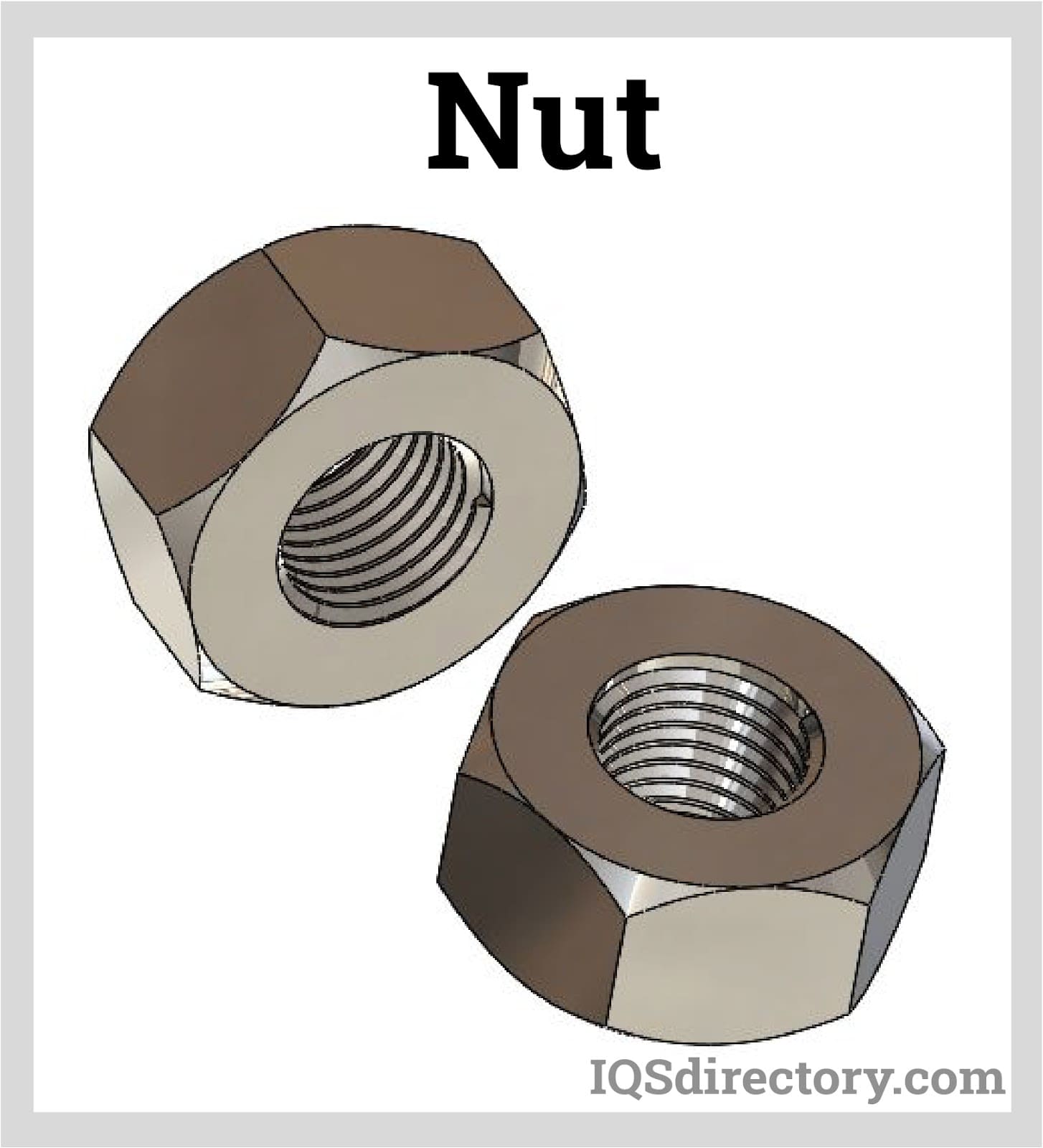 The nut is the female member of a bolted joint that contains a threaded hole providing clamping force and prevents axial movement. Paired with the correct thread size and grade, the nut creates the clamping action that keeps the joint tight during operation.
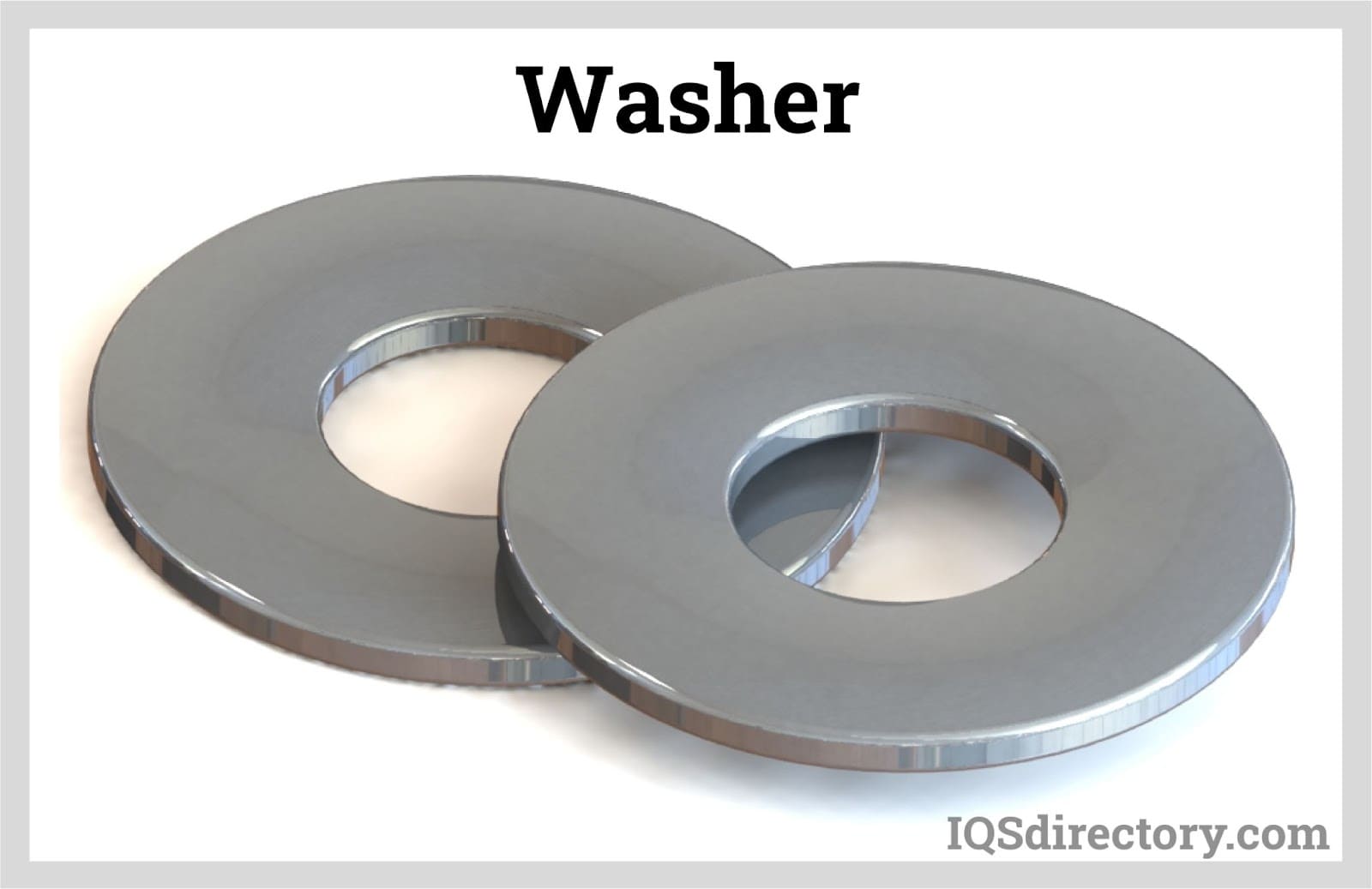 A washer, a thin plate with a concentric hole at its center placed under the bolt head and the nut to distribute the load of the threaded fastener over a larger area. Washers can also help reduce surface damage, improve load distribution, and support more consistent tightening in softer materials.
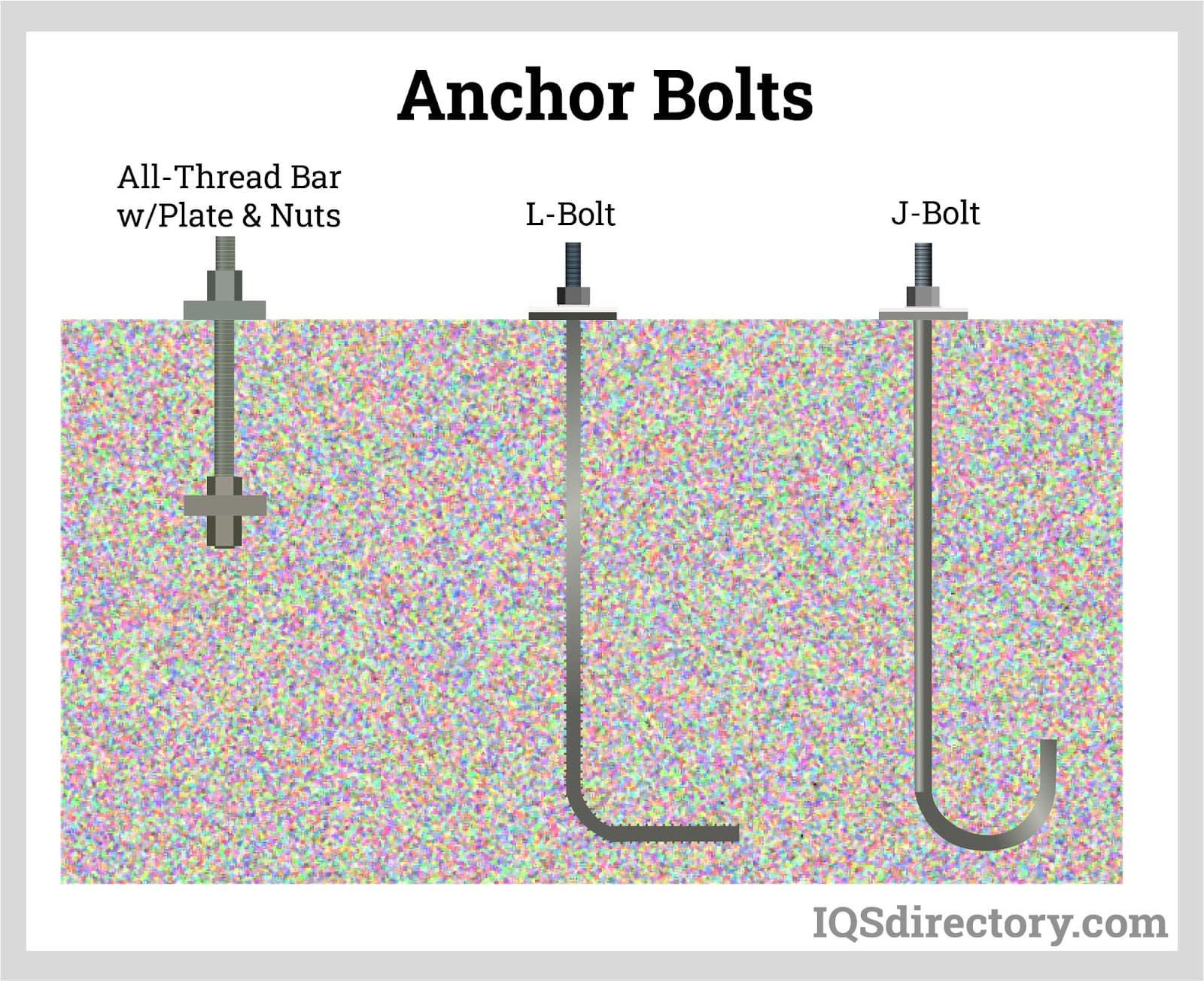 Anchor bolts are designed to join components into concrete surfaces. They are commonly specified for structural steel, machinery bases, guardrails, supports, and other concrete anchoring jobs.
 Serrated flange bolts are almost similar to standard flange bolts in construction, except the circular flange under their heads for a firmly grip. The serrations improve grip and can help resist loosening in applications exposed to vibration or repeated movement.
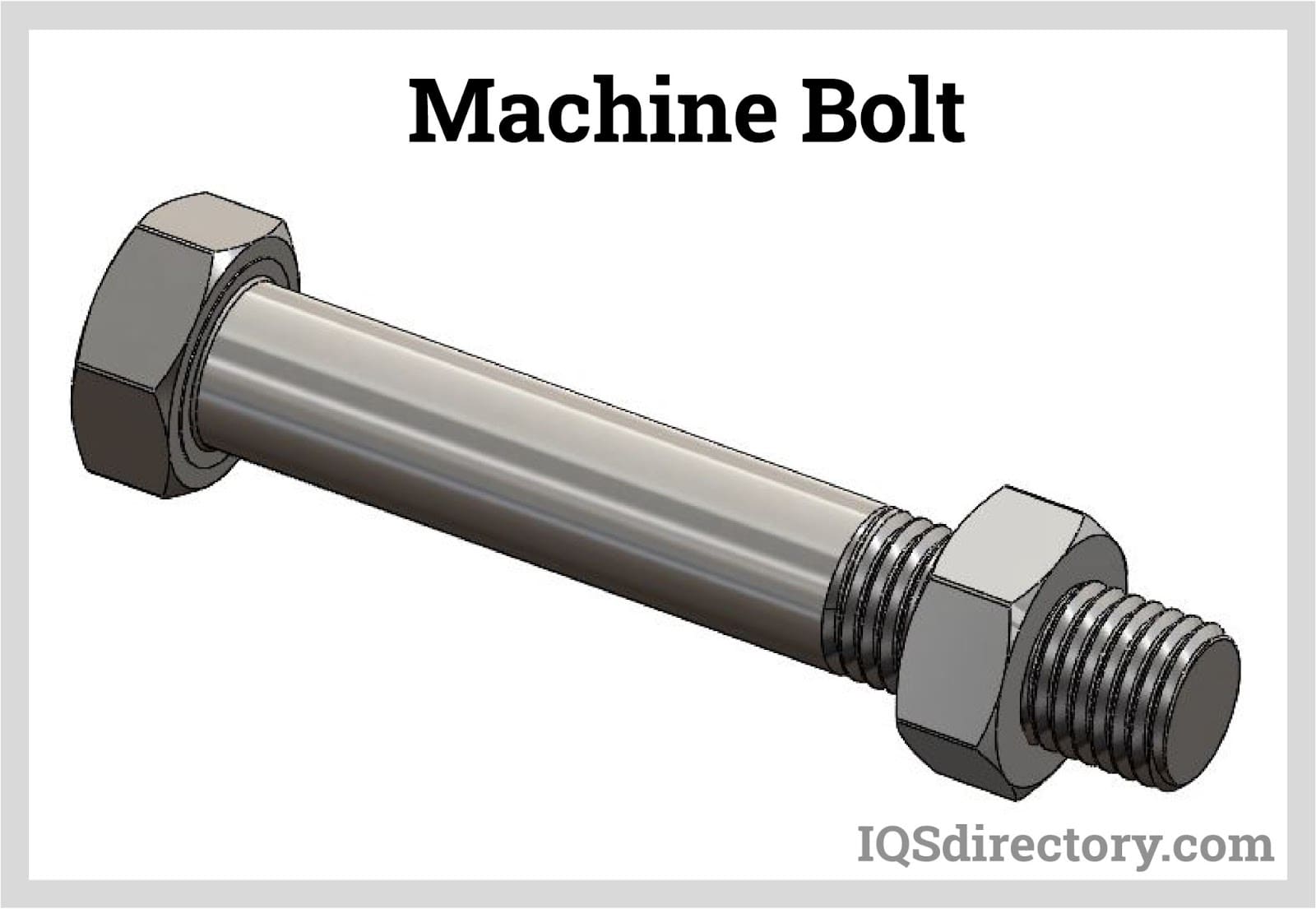 Machine bolts are often chosen for equipment assembly, metal fabrication, and maintenance work where a nut-secured fastener is preferred.
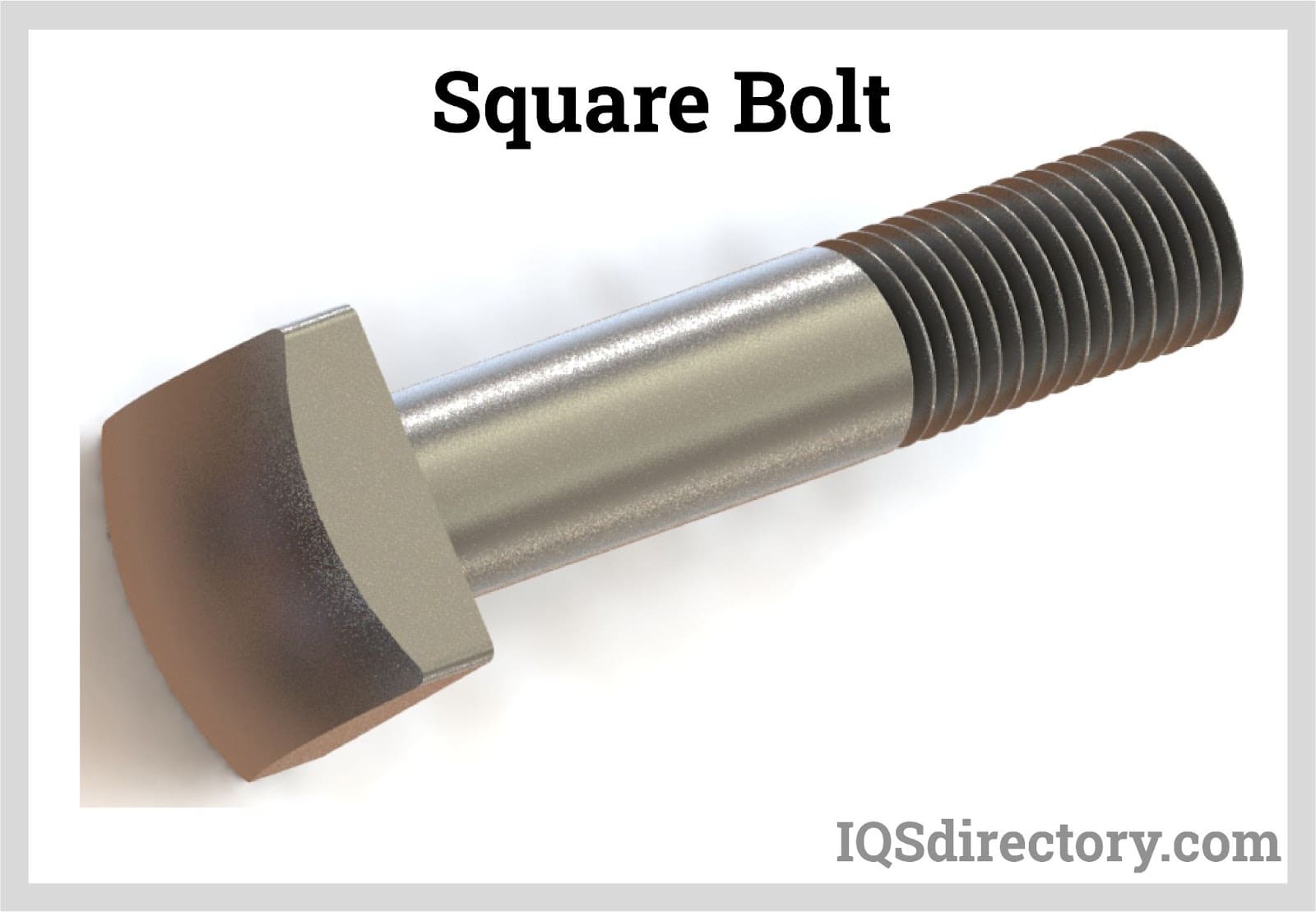 Square bolts are machine bolts that feature a square bolt head that offers a large bearing area for positive gripping. The square head design also provides a distinctive appearance for restoration projects, timber construction, and older mechanical assemblies.
Types of Bolts
Bolts are available in a wide variety of sizes, shapes, grades, and materials, each suited for different purposes. Selecting among these options usually depends on load, substrate, installation access, corrosion exposure, and service requirements.
When people search for the best bolt for a project, they are usually comparing application, substrate, load, environment, and installation method. A bolt that performs well in wood framing may not suit concrete anchoring, vibration-prone equipment, chemical exposure, or outdoor structural service, so matching the fastener type to the job is part of choosing wisely.
Oven Head Bolt
Also known as a stove head bolt, oval binding head bolt, or truss head bolt, this design is intended for use with large diameter clearance holes in sheet metal. They are often chosen where a broad bearing surface and a neat finished appearance are useful.
Square Head Bolt
Named for its square-shaped head, square head bolts were once the industry standard. Today, they are primarily used for aesthetic purposes, especially for creating a rustic look on buildings. Their head shape can also provide better wrench engagement in some field conditions.
Anchor Bolt
Commonly used in building and construction, anchor bolts are typically embedded in concrete. They are widely used for anchoring columns and supports to foundations or securing traffic signal poles. They are a common choice when permanent equipment or structural members must be secured to masonry or concrete.
U-Bolt
Shaped like the letter "U", these bent bolts feature threads at both ends. They can be round, square, or semi-round, and are often used to attach suspended items to a surface. U-bolts are widely used in construction and the automotive industry. They are frequently used for pipe support, suspension, and clamping round members.
Eye Bolt
With threads on one end and a circular eye on the other, eye bolts are used to guide a cable, rope, or chain for lifting purposes. They are commonly found in aircraft construction. Selection should account for load direction, lifting practice, and the rating of the eye itself.
J Bolt
Named for their "J" shape, these bolts are half of a U-bolt. They are typically used as cast-in-place anchor bolts and are often made from steel or titanium. Their shape helps anchor the fastener into poured concrete for support and hold-down applications.
Stud Bolt
Stud bolts are round metal bars that are threaded at either end or throughout the entire length. They are often used for fastening or anchoring. They are often used in flanged connections, maintenance work, and assemblies requiring nuts on both ends.
Expansion Bolt
Comprising a taper-headed bolt, lead sleeve, metal cone, and a nut, expansion bolts are used to secure seating in theatres, auditoriums, stadiums, and classrooms. As the bolt is driven into a surface, its attachments expand, securing the bolt in place. This makes them useful where a mechanical anchor is needed in an existing base material.
Lag Bolt
Heavy wood screws with a hexagonal or square head, lag bolts are typically driven into wooden beams or posts using a wrench. They are common in wood construction and other heavy-duty fastening jobs involving timber.
Hex Bolt
Characterized by a six-sided head, hex bolts are commonly used fasteners. They feature a threaded shank and a washer, with varieties such as heavy hex bolts and hex cap screws. A hex nut is used to fasten these bolts. They remain a go-to choice for general industrial fastening because they are easy to source and easy to tighten with standard tools.
Shoulder Bolt
Used as pivot mounting shafts, shoulder bolts are not threaded all the way to the head. The threading stops short, leaving a smooth shaft that is wider than the threaded part. These bolts are generally made from stainless steel and can be square or round. The smooth shoulder supports rotation, spacing, or guided motion in mechanical assemblies.
Carriage Bolt
With a rounded head and a square collar, carriage bolts are designed to prevent twisting during installation. They are primarily used for joining wood. They are often used in wood construction, decking, and furniture-style assemblies.
Elevator Bolt
These bolts feature a flat head with a square collar that keeps the bolt in place as it is tightened. They are most commonly used in conveyor systems. Their low-profile head helps reduce snagging in systems that move material.
Flange Bolt
Flange bolts have an integral washer that helps distribute bearing weight and prevents material distortion during installation. This built-in bearing surface can reduce the need for a separate washer in some assemblies.
Metric Bolt
Metric bolts use the metric system for their measurements and are widely used internationally. They are often specified for international equipment, imported machinery, and projects requiring metric compatibility.
Machine Bolt
Industrial bolts with square or hexagonal heads, machine bolts usually range in diameter from ¼ inch to 3 inches. They are selected for assemblies where a nut-secured connection is preferred over a screw-driven thread.
Thru Bolt
Thru bolts pass completely through a material layer and are secured with a nut on the opposite side. Known for their strength and reliability, they are ideal for heavy-duty applications and can handle large loads. Thru bolts are commonly used in rolling shutters, security grills, sun awnings, and garage doors. Their full-through clamping arrangement is valued when strong retention and easy inspection are priorities.
Across these categories, buyers often narrow their choices by diameter, length, thread pitch, material grade, and finish. Coarse threads are often selected for general-purpose fastening and quicker assembly, while fine threads may be preferred when adjustment, vibration resistance, or a tighter clamping relationship is desired.
Installation of a Bolt
To install industrial bolts, you'll need a nut and a tool such as a screwdriver, high-pressure drill, or Allen wrench. The nut, which attaches to the end of the bolt shank, holds components in place along the bolt axis. Use the tool to apply angular force while holding the bolt or securing its placement. Alternatively, apply force to the bolt head while holding the nut steady. As you tighten the bolt, the internal threads of the nut mesh with the external threads of the bolt. During this process, the bolt may stretch slightly, and the components will deform slightly to ensure a secure fit.
Proper installation matters because joint performance depends on more than simply turning the nut. Clean threads, compatible washers, correct hole sizing, and controlled tightening help develop consistent preload, reduce the chance of loosening, and support longer service life in machinery, structural frames, and repair work.
Bolt Standards and Specifications
Industrial bolts are used in a wide range of demanding applications, leading various industries and organizations to establish standard requirements for their design and performance. For example, the military and aerospace industries have specific standards that call for bolts to have special anti-corrosive coatings and materials. To ensure compliance with these standards, manufacturers subject bolts to thorough testing. It is wise to verify that the bolts you purchase meet the required industry standards.
In the U.S., most bolts are measured according to the American Measuring System, while Europe and Asia use the Metric System. To ensure compatibility with products from other countries, it's advisable to choose metric bolts. This is especially important as metric bolts have become increasingly popular in the U.S. for this reason.
Common standards for bolts include those set by ASTM and ISO. ASTM classifies steel bolts into different grades, which indicate the levels of proof and tensile strength. ISO standards, on the other hand, cover a wide range of factors, including dimensions and tolerances. It is always recommended to choose bolts that are certified by ASTM or ISO to ensure quality and reliability.
For purchasing teams and engineers, specifications are more than catalog details. Standards, grades, dimensions, coatings, and inspection requirements help confirm that a bolt can handle the intended load, fit the mating hardware, and perform reliably in the actual service environment, whether that involves outdoor exposure, washdown, heat, or repeated disassembly.
Things to Consider When Purchasing Bolts
For top-quality bolt products, we suggest partnering with an experienced industrial bolt professional. To help you, we’ve provided a list of trusted suppliers at the top of this page. Take the time to explore their websites and, when ready, contact a few that seem like the best fit for your needs. During your discussions, ensure they can meet your budget, timeline, and specific requirements. As always, excellent customer service is helpful. Compare the manufacturers you connect with, and choose the one that aligns best with your goals!
A productive purchasing conversation usually covers bolt type, quantity, dimensions, thread form, finish, material, lead time, certification needs, and the environment where the fastener will be used. That information helps suppliers recommend industrial bolts that align with performance goals rather than offering a one-size-fits-all replacement.
Proper Care for Bolts
The primary threat to bolts is rust and corrosion. To extend their lifespan, consider applying anti-corrosion coatings before installation. Additionally, try to keep bolts out of the elements and limit their exposure to moisture whenever possible. Material choice, plating, and storage conditions all play a role in how well a fastener resists environmental wear.
To clean bolts, you can sand them down (followed by lubrication to restore function), apply hydrogen peroxide (then remove and scour the fasteners), repaint, or use a rust cleaner. If you opt for rust cleaner, ensure it's approved by the manufacturer. Always confirm that the cleaning method will not damage the base material, coating, or dimensional fit.
If all else fails, it’s best to replace the bolts. It’s wiser to invest a bit more upfront than risk system failure or injury from an unexpected malfunction.
Preventive maintenance also helps reduce premature fastener failure. Regular inspection for rust, damaged threads, worn coatings, elongation, or loosening can identify a problem before it affects the full assembly. In applications exposed to weather, chemicals, or vibration, a planned inspection schedule is often a smart practice.
Industrial Bolt Accessories
Industrial bolt accessories include items like thread pitch gauges, nuts, installation tools (such as drills and allen wrenches), and clamping kits. Be sure to consult your supplier to identify the accessories that best meet your needs. Choosing the right accessories can improve installation speed, torque control, and long-term joint performance.
Accessories can influence bolt performance just as much as the fastener itself. Washers, lock nuts, thread lubricants, anti-seize products, torque tools, and thread gauges all support better installation accuracy, improved serviceability, and a more dependable bolted joint.
Bolt Terms
-
Angle Controlled Tightening
A method of tightening where the fastener is initially tightened to a pre-selected (snug) torque. The nut is then given an additional measured rotation to further tighten it, often beyond its yield point, ensuring the precise preload is achieved.
Anti-Friction (AF) Coating
Dry lubricants consisting of small solid lubricant particles, such as graphite or PTFE, designed to reduce friction.
Anti-Seize Compound
A compound applied to the threads of fasteners to prevent issues like galling, improve corrosion resistance, or seal the threads to prevent water penetration.
Bearing Stress
The surface pressure applied to a joint face as a result of the clamping force exerted by a fastener.
Black
Refers to the wider tolerances used in the manufacturing of nuts and bolts, not the color of the surface finish.
Clamping Force
The compressive force exerted by a fastener on a joint, ensuring that the components are tightly held together.
Class of Fit
A measure of the fit between mating external and internal threads. The three main classes of fit for metric screw threads are fine, medium, and coarse.
Creep
The permanent deformation of a fastener, such as a bolt, caused by sustained stress and heat over time.
Cut Threading
A method of forming threads on a fastener by cutting and removing excess metal from the surface.
Eccentricity
The measure of difference in the centers of the surface of a bolt at different points, resulting in a non-central alignment.
Fatigue Strength
The ability of a fastener, like a bolt, to resist fracture when subjected to repeated variations in stress.
Grip
The total thickness of all materials that a bolt is designed to fasten together.
Head
The top portion of a bolt, typically the largest diameter part, that allows for the application of tools to tighten or loosen the bolt.
Joint
The materials or components that are connected together by the fastener (bolt).
Nut
A metal piece with a hole in the center, designed to fit over the threaded end of a bolt. Nuts are often hexagonal in shape.
Pull-Out
The amount of force required to pull a fastener out of the base material.
Shank
The part of a headed fastener that lies between the head and the point, typically the longest section.
Tensile Strength
The ability of a fastener to withstand longitudinal load or elongation without failure, either of the fastener itself or the joint.
Thread
A raised helical pattern on the shank of a bolt, measured by pitch, which is the distance between one peak of the thread and the next.
Ultimate Torque
The maximum force at which a threaded fastener, nut, or insert begins to fail, such as by stripping threads.