Alloys
Alloys are formed by combining two or more metals, or a metal and a non-metal, resulting in a material with distinct and improved properties compared to the individual components. The process of creating alloys dates back to the Bronze Age when early humans discovered that mixing copper with metals like tin, lead, or zinc created a stronger and more durable material. Today, alloys are at the center of modern manufacturing because they allow engineers, buyers, and product designers to select a metal material with a more precise balance of strength, hardness, machinability, conductivity, heat resistance, wear resistance, and corrosion protection. Whether a project involves structural framing, medical tools, automotive parts, electronics, food processing equipment, or aerospace assemblies, alloy selection often determines long-term performance, fabrication efficiency, and product lifespan. Many buyers begin their research by asking what alloy will hold up best in demanding service environments, which alloy offers the right strength-to-weight ratio, or how alloy composition affects cost, durability, and manufacturability. Those questions make alloys a high-value topic for industrial sourcing, materials engineering, and production planning.
Alloys FAQs
What is an alloy and how is it formed?
An alloy is a material made by combining two or more metals, or a metal with a non-metal, to improve strength, durability, hardness, conductivity, heat resistance, or corrosion resistance compared to pure metals. Alloys are commonly formed through melting and controlled solidification, but they can also be produced through powder metallurgy or solid-state diffusion methods when tighter property control is needed.
What are the main methods used to create alloys?
Alloys can be created through melting, powder metallurgy, or solid-state reactions. Melting is most common, where metals are heated and combined into a uniform mixture. Powder metallurgy is useful for near-net-shape production and specialty compositions, while solid-state techniques can support controlled diffusion, tighter tolerances, and advanced material performance in high-specification applications.
Why is metal purity important in alloy production?
Metal purity helps ensure consistent alloy performance from batch to batch. Impurities can weaken strength, reduce ductility, interfere with heat treatment, lower conductivity, or increase corrosion, so manufacturers use advanced purification, testing, and quality control methods to produce reliable alloys for industrial, commercial, and technical applications.
What are some common types of alloys and their uses?
Common alloys include steel for construction and machinery, brass for decorative and plumbing components, bronze for bearings, sculptures, and marine-related parts, stainless steel for sanitary and corrosion-resistant equipment, and aluminum alloys for automotive, aerospace, and lightweight fabricated products.
What advantages do alloys offer over pure metals?
Alloys provide tailored properties such as increased strength, better flexibility, improved wear performance, lighter weight, higher heat resistance, and stronger corrosion resistance. Because they can be engineered for specific service conditions, alloys are widely used when pure metals do not offer enough durability, consistency, or application-specific performance.
What are the main limitations of using alloys?
Some alloys are costly to produce and may require energy-intensive melting, casting, or heat-treating processes. Others can be brittle, harder to machine, more difficult to weld, or less ductile than expected in certain operating conditions, so material selection should always match the application, load requirements, and service environment.
Which industries rely most on alloy materials?
Alloys are widely used in aerospace, automotive, construction, electronics, energy, marine, medical, industrial processing, food equipment, and consumer goods manufacturing. These industries depend on alloy materials for their combination of strength, reliability, corrosion resistance, formability, and long-term performance in demanding environments.
How can I find a reliable alloy manufacturer?
Compare alloy manufacturers by reviewing their material capabilities, production methods, quality systems, fabrication services, and application experience. Buyers often request quotes, compare available grades and lead times, and evaluate whether a supplier can meet tolerance, finishing, and volume requirements for a specific project or long-term production program.
Creating Alloys
There are various methods for creating alloys, such as melting, powder metallurgy, and solid-state reactions. The most common method is melting, where two or more metals are heated to high temperatures and combined to form a uniform mixture. Powder metallurgy involves mixing metal powders, compacting them under high pressure, and then heating them to create a solid alloy. Solid-state reactions occur when metals are heated in a vacuum or inert gas, promoting diffusion and bonding between the atoms. Each route influences grain structure, density, hardness, dimensional stability, and final performance, which is why engineers often compare production methods before choosing an alloy for a demanding application. Manufacturers may also use casting, forging, extrusion, rolling, heat treatment, and precision machining to refine the finished alloy into a usable component or semi-finished product. For buyers researching alloy manufacturing, common search questions include how alloys are made, which process delivers the best consistency, and which method supports the required tolerances, finish, and mechanical properties.
The purity of the constituent metals is highly important in the alloy-making process. Impurities can significantly alter the alloy's properties, including its strength, ductility, hardness, weldability, conductivity, and resistance to corrosion. To ensure high-quality alloys, manufacturers employ advanced techniques to maintain the purity of the metals involved, including controlled melting environments, chemical analysis, and strict quality assurance procedures. This matters for both prototype work and full-scale production, because even minor composition changes can affect downstream forming, machining, surface finishing, and long-term field performance. When comparing alloy grades, it is also helpful to evaluate certification requirements, repeatability, and whether the supplier can maintain consistent chemistry across multiple production runs.
Popular Alloys
There are numerous alloys used across various industries, with some of the most common ones being the materials buyers, engineers, and fabricators encounter when sourcing metal stock, comparing grades, or selecting a metal for corrosion resistance, strength, weight savings, or appearance. The best alloy for one application may be the wrong choice for another, which is why understanding how popular alloy families perform in real-world service conditions can improve purchasing decisions and reduce costly material mismatches.
Steel
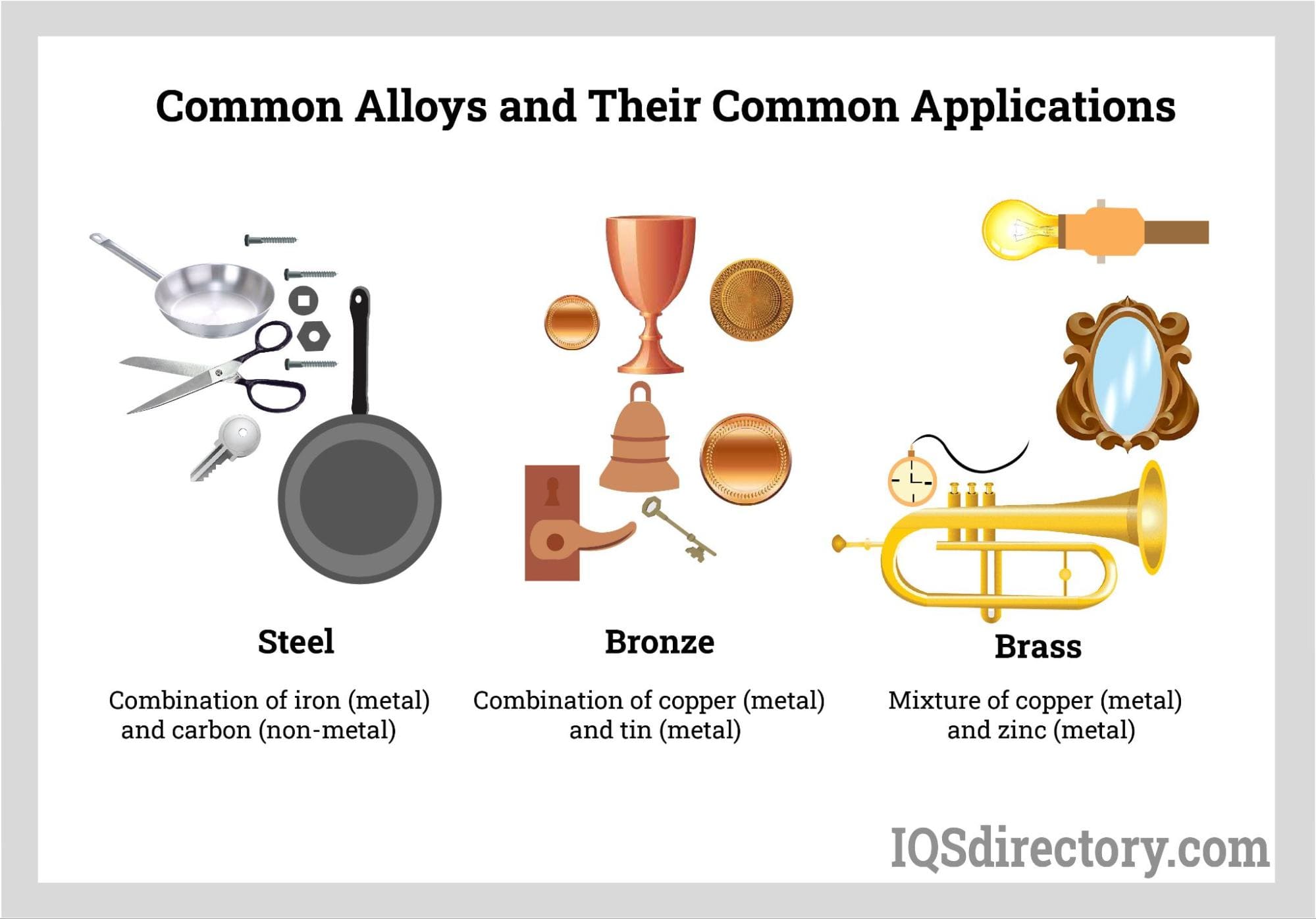
Made from iron and carbon, with small amounts of other elements like manganese, silicon, and chromium, steel is known for its high strength, durability, and corrosion resistance. Steel alloys are among the most widely specified engineering materials because they can be tailored for structural support, heavy equipment, tooling, fasteners, piping, pressure applications, and fabricated industrial components. Carbon steel, alloy steel, and specialty grades give buyers a broad range of options when they need a balance of affordability, toughness, machinability, and load-bearing performance.
Brass
A mixture of copper and zinc, brass is malleable, ductile, and corrosion-resistant. It's commonly found in plumbing fixtures, musical instruments, and decorative items. Brass alloys are also valued for their machinability, attractive finish, and ability to perform well in fittings, valves, connectors, and precision turned parts. For buyers comparing copper alloys, brass often stands out when appearance, moderate strength, conductivity, and ease of fabrication all matter.
Bronze
An alloy of copper and tin, bronze is hard, strong, and resistant to corrosion. It's often used in statues, coins, and other ornamental items. In industrial settings, bronze alloys are also selected for bearings, bushings, wear plates, marine hardware, and applications where low friction and dependable service life are priorities. Bronze remains a practical option when users need a copper-based alloy with better wear resistance and strength than pure copper can deliver.
Stainless Steel
Composed of iron, chromium, and nickel, stainless steel is highly resistant to corrosion and staining. It's used in kitchen appliances, medical equipment, and other applications requiring high hygiene standards. Stainless steel alloys are also common in architectural systems, food processing lines, pharmaceutical equipment, chemical handling, marine hardware, and fabricated enclosures because they offer a dependable mix of cleanability, strength, heat resistance, and long-term appearance retention.
Aluminum Alloys
Combinations of aluminum with metals like copper, magnesium, and zinc, aluminum alloys are lightweight, strong, and resistant to corrosion, making them ideal for use in aerospace and automotive industries. They are also widely used in transportation, framing systems, housings, heat exchangers, and consumer products where lighter weight can improve fuel economy, simplify handling, or lower shipping costs. For many applications, aluminum alloys are evaluated when buyers ask which metal can deliver both structural performance and easier weight management.
Limitations of Alloys
While alloys provide many advantages, they also come with some limitations and drawbacks. For example, alloy production can be costly and energy-consuming, contributing to a significant carbon footprint. Additionally, certain alloys may lack ductility, making them brittle and susceptible to cracking when subjected to stress. Some alloy grades also present tradeoffs in weldability, machinability, thermal expansion, or availability, especially when applications call for tight tolerances or specialty chemistry. That is why alloy selection should account for the full operating environment, not just initial material price. Buyers often compare service temperature, exposure to chemicals or moisture, expected mechanical load, maintenance needs, and fabrication requirements before choosing an alloy for production.
Benefits of Alloys
Despite their drawbacks, alloys offer considerable advantages across a variety of applications. For example, alloys can be tailored to exhibit specific properties, such as enhanced strength, ductility, corrosion resistance, thermal stability, conductivity, and wear performance, based on their intended purpose. This customization makes alloys ideal for a broad spectrum of uses, ranging from construction to healthcare, heavy industry, electronics, transportation, and consumer products. Furthermore, alloys are known for their resistance to wear and corrosion, helping them remain durable and reliable even in demanding environments with heat, moisture, abrasion, pressure, or repeated mechanical stress. From a sourcing perspective, alloys also support smarter material matching: buyers can compare metal grades based on performance targets, fabrication needs, lifespan expectations, and budget goals rather than settling for a one-size-fits-all material. That flexibility is one reason alloys remain such a widely searched category in industrial procurement and engineering design.
Applications of Alloys
Alloys can be tailored to meet specific needs by adjusting the composition of their constituent metals, making them highly versatile materials across various industries. Some examples of industries that rely on alloys include sectors where durability, corrosion resistance, weight reduction, heat tolerance, hygiene, conductivity, and repeatable performance directly affect product quality and service life. For businesses evaluating metal materials, this is often where search intent becomes more specific: what alloy is best for aerospace, what alloy resists corrosion in medical equipment, or which metal alloy performs well in construction and automotive applications.
Aerospace Industry
Alloys are highly valuable in the aerospace industry because of their excellent strength-to-weight ratio and corrosion resistance. Titanium alloys, nickel alloys, and aluminum alloys are commonly used in the production of aircraft and spacecraft, where every component must balance performance, weight, heat tolerance, and long-term reliability. In this sector, alloy selection can affect fuel efficiency, structural integrity, and maintenance cycles, which makes advanced alloy materials a major focus during design and procurement.
Automotive Industry
In the automotive industry, alloys are used to manufacture parts that are strong, lightweight, and resistant to corrosion. Common alloys in this sector include aluminum alloys, steel alloys, and magnesium alloys. These materials are found in frames, engine components, body panels, wheels, fasteners, exhaust systems, and safety assemblies because they help support durability, efficiency, and manufacturability at production scale. Automotive buyers often compare alloys based on crash performance, weight savings, repairability, and cost efficiency.
Construction Industry
The construction industry utilizes alloys to create building materials that offer strength, durability, and resistance to corrosion. Steel alloys, aluminum alloys, and copper alloys are often used for these applications. Structural systems, architectural elements, roofing, framing, fasteners, supports, and specialty hardware all benefit from alloy materials that can handle outdoor exposure, high loads, and long service cycles. In many projects, the right alloy improves both performance and lifecycle value by reducing maintenance and replacement frequency.
Electronics Industry
In electronics, alloys are employed to produce components with desirable electrical properties. For example, copper-nickel alloys are used in resistance wires for heating elements, while aluminum alloys serve as electrical conductors. Additional alloy systems are used in connectors, terminals, housings, heat sinks, shielding components, and specialty assemblies where conductivity, thermal transfer, and dimensional stability are all relevant. For electronics manufacturers, alloy consistency can support better signal performance, thermal management, and product durability.
Medical Industry
Alloys are highly valuable in the medical industry for manufacturing surgical instruments, implants, and other medical devices. Titanium alloys, stainless steel alloys, and cobalt-chromium alloys are preferred due to their biocompatibility, strength, and resistance to corrosion. These materials are selected for tools, orthopedic implants, dental devices, hospital equipment, and precision components that must perform reliably in sterile, demanding, and highly regulated environments. When buyers evaluate medical alloys, they often focus on cleanliness, corrosion resistance, surface finish, and dependable long-term performance.

Jewelry Industry
In the jewelry industry, alloys are frequently used to make precious metals more durable and affordable. For instance, 14-karat gold is an alloy that combines pure gold with metals like copper, silver, or nickel. Alloying can improve hardness, color variation, polish retention, and day-to-day wear performance, making it easier to create rings, chains, watches, and decorative pieces that hold up better than pure soft metals alone. This balance of appearance and durability keeps alloys relevant in both fine jewelry and commercial accessories.
Food Industry
Alloys are also used in the food industry to create cooking equipment that is resistant to corrosion and oxidation. Stainless steel alloys are commonly found in pots, pans, and other kitchen utensils, as well as in processing lines, storage systems, sanitary fittings, conveyors, tanks, and preparation surfaces. In food applications, alloy performance is often evaluated through cleanability, resistance to staining, product safety, and the ability to withstand repeated washdowns and temperature changes without degrading.
Choosing the Right Alloy Manufacturer
To achieve the best results when purchasing alloys from an alloy manufacturer, it is helpful to compare multiple companies using our directory of alloy manufacturers. Each manufacturer has a detailed business profile page showcasing their areas of expertise and capabilities, along with a contact form for easy communication to request more information or a quote. Use our proprietary website previewer to quickly explore each company’s specializations. Once you've reviewed the profiles, you can contact multiple alloy manufacturers at once by filling out our simple RFQ form. As you compare suppliers, consider the alloy grades they offer, their production capacity, secondary services, fabrication support, quality systems, lead times, and experience with your application or industry. Buyers frequently search for terms like best alloy manufacturer, custom alloy supplier, alloy fabrication services, corrosion-resistant alloy provider, and alloy material sourcing because selecting the right partner can improve pricing, shorten turnaround, and support more consistent production outcomes. A strong alloy manufacturer should be able to answer practical questions about material options, processing methods, tolerances, performance tradeoffs, and which alloy is most appropriate for your project goals.